Functional Centering
Michael Strube & Udo Hahn
Freiburg University( ~ [ } Computational Linguistics Lab Europaplatz 1, D-79085 Freiburg, Germany {strube, hahn}@coling, uni-freiburg, de
Abstract
Based on empirical evidence from a free word order language (German) we propose a fundamental revision of the principles guid- ing the ordering of discourse entities in the forward-looking centers within the center- ing model. We claim that grammatical role criteria should be replaced by indicators of the functional information structure of the utterances, i.e., the distinction between context-bound and unbound discourse ele- ments. This claim is backed up by an empir- ical evaluation of functional centering.
1 Introduction
The centering model has evolved as a methodology for the description and explanation of the local coherence of discourse (Grosz et al., 1983; 1995), with focus on pronominal and nominal anaphora. Though several cross-linguistic studies have been carded out (cf. the enumeration in Grosz et al. (1995)), an almost canon- ical scheme for the ordering on the forward-looking centers has emerged, one that reflects well-known reg- ularities of fixed word order languages such as En- glish. With the exception of Walker et al. (1990; 1994) for Japanese, Turan (1995) for Turkish, Ram- bow (1993) for German and Cote (1996) for English, only grammatical roles are considered and the (par- tial) ordering in Table 11 is taken for granted.
I subject > dir-object > indir-object I > complement(s) > adjunct(s)
Table 1: Grammatical Role Based Ranking on the C!
~Table 1 contains the most explicit ordering of grammat- ical roles we are aware of and has been taken from Bren- nan et al. (1987). Often, the distinction between comple- ments and adjuncts is collapsed into the category "others" (c.f., e.g., Grosz et al. (1995)).
Our work on the resolution of anaphora (Strube & Hahn, 1995; Hahn & Strube, 1996) and textual el- lipsis (Hahn et al., 1996), however, is based on Ger- man, a free word order language, in which grammat- ical role information is far less predictive for the or- ganization of centers. Rather, for establishing proper referential relations, the functional information struc- ture of the utterances becomes crucial (different per- spectives on functional analysis are brought forward in Dane~ (1974b) and Dahl (1974)). We share the no- tion of functional information structure as developed by Dane~ (1974a). He distinguishes between two cru- cial dichotomies, viz. given information vs. new infor- mation (constituting the information structure of ut- terances) on the one hand, and theme vs. rheme on the other (constituting the thematic structure of utter- ances; cf. Halliday & Hasan (1976, pp.325-6)). Dane~ refers to a definition given by Halliday (1967) to avoid the confusion likely to arise in the use of these terms: "[...] while given means what you were talking about (or what I was talking about before), theme means what I am talking about (now) [...]" Halliday (1967, p.212). Dane~ concludes that the distinction between given information and theme is justified, while the dis- tinction between new information and rheme is not. Thus, we arrive at a trichotomy between given infor- mation, theme and rheme (the latter being equivalent to new information). We here subscribe to these con- siderations, too, and will return in Section 3 to these notions in order to rephrase them more explicitly by using the terminology of the centering model.
In this paper, we intend to make two contributions to the centering approach. The first one, the intro- duction of functional notions of information structure in the centering model, is methodological in nature. The second one concerns an empirical issue in that we demonstrate how a functional model of centering can successfully be applied to the analysis of several forms of anaphoric text phenomena.
At the methodological level, we develop arguments that (at least for free word order languages) grammat- ical role indicators should be replaced by functional
role patterns to more adequately account for the or- dering of discourse entities in center lists. In Section 3 we elaborate on the particular information structure criteria underlying a function-based center ordering. We also make a second, even more general method- ological claim for which we have gathered some pre- liminary, though still not conclusive evidence. Based on a re-evaluation of empirical arguments discussed in the literature on centering, we stipulate that ex- changing grammatical by functional criteria is also a reasonable strategy for fixed word order languages. Grammatical role constraints can indeed be rephrased by functional ones, which is simply due to the fact that grammatical roles and the information structure patterns, as we define them, coincide in these kinds of languages. Hence, the proposal we make seems more general than the ones currently under discus- sion in that, given a functional framework, fixed and free word order languages can be accounted for by the same ordering principles. As a consequence, we argue against Walker et al.'s (1994, p.227) stipulation, which assumes that the C I ranking is the only parameter of the centering theory which is language-dependent. In- stead, we claim that f u n c t i o n a l centering constraints for the C ! ranking are possibly universal.
The second major contribution of this paper is re- lated to the unified treatment of specific text phe- nomena. It consists of an equally balanced treatment of intersentential (pro)nominal anaphora and textual ellipsis (also called functional or partial anaphora). The latter phenomenon (cf. the examples given in the next section), in particular, is usually only sketchily dealt with in the centering literature, e.g., by assert- ing that the entity in question "is realized but not di- rectly realized" (Grosz et al., 1995, p.217). Further- more, the distinction between those two kinds of re- alization is generally delegated to the underlying se- mantic theory. We will develop arguments how to lo- cate elliptical discourse entities and resolve textual el- lipsis properly at the center level. The ordering con- straints we supply account for all of the above men- tioned types of anaphora in a precise way, includ- ing (pro)nominal anaphora (Strube & Hahn, 1995; Hahn & Strube, 1996). This claim will be validated by a substantial body of empirical data (cf. Section 4).
2 Types of Anaphora Considered
Text phenomena, e.g., textual forms of ellipsis and anaphora, are a challenging issue for the design of parsers for text understanding systems, since imper- fect recognition facilities either result in referentially incoherent or invalid text knowledge representations. At the conceptual level, textual ellipsis relates a quasi- anaphoric expression to its extrasentential antecedent by conceptual attributes (or roles) associated with that
antecedent (see, e.g., the relation between "Akkus" ( a c c u m u l a t o r ) and " 3 1 6 L T " , a particular notebook, in (lb) and (la)). Thus, it complements the phenomenon of nominal anaphora, where an anaphoric expression is related to its antecedent in terms of conceptual gen- eralization (as, e.g., "Rechner" ( c o m p u t e r ) in (lc) refers to " 3 1 6 L T ' in (la) mediated by the textual ellip- sis in (lb)). The resolution of text-level nominal (and pronominal) anaphora contributes to the construction of referentially valid text knowledge bases, while the resolution of textual ellipsis yields referentially coher- ent text knowledge bases.
(1) a. Ein Reserve-Batteriepaek versorgt den 316LT c a . 2 Minuten mit Strom.
(A reserve battery pack - supplies - the 316LT -
for approximately 2 minutes - with power.)
b. Der Status des Akkus wird dem Anwender ange- zeigt.
(The status of the accumulator - is - to the user - indicated.)
c. Ca. 30 Minuten vor der Entleerung beginnt der
Rechner 5 Sekunden zu beepen.
(Approximately 30 minutes - before the discharge - starts - the computer - for 5 seconds - to beep.)
d. 5 Minuten bevor er sich ausschaltet, f'angt die Low-Battery-LED an zu blinken.
(5 minutes - before - it - itself- turns o f f - begins - the low-battery-LED - to flash.)
In the case of textual ellipsis, the missing concep- tual link between two discourse elements occurring in adjacent utterances must be inferred i n order to estab- lish the local coherence of the discourse (for an early statement of that idea, cf. Clark (1975)). In the sur- face form of utterance (lb) the information is missing that "Akkus'" ( a c c u m u l a t o r ) links up with " 3 1 6 L T " .
This relation can only be made explicit if conceptual knowledge about the domain, viz. the relation p a r t - o f
between the concepts ACCUMULATOR and 316LT, is available (see Hahn et al. (1996) for a more detailed treatment of text ellipsis resolution).
3 Principles of Functional Centering
The main difference between Grosz et al.'s work and our proposal concerns the criteria for ranking the forward-looking centers. While Grosz et al. assume that grammatical roles are the major determinant for the ranking on the C'y, we claim that for languages with relatively free word order (such as German), it is the functional information structure (IS) of the ut- terance in terms of the context-boundedness or un- boundedness of discourse elements. The centering data structures and the notion of context-boundedness can be used to redefine Dane~' (1974a) trichotomy be- tween given information, theme and new information (rheme). The Cb(U,), the most highly ranked element of C . t ( U n - i ) realized in [In, corresponds to the el- ement which represents the given information. The theme of U, is represented by the preferred center C'p(U,), the most highly ranked element of C! (Un). The theme/rheme hierarchy of [In is represented by CI(U,~ ) which - in our approach - is partly deter- mined by the C! ( U n - i ) : the rhematic elements of Un are the ones not contained in C! ( U , _ i ) (unbound dis- course dements); they express the new information in Un. The ones contained in C l ( U , _ i ) and Cy(U,) (bound discourse elements) are thematic, with the theme/rheme hierarchy corresponding to the ranking in the Cls. The distinction between context-bound and unbound elements is important for the ranking on the C I, since bound elements are generally ranked higher than any other non-anaphoric elements (cf. also Haji~ov~i et al. (1992)).
An alternative definition of theme and rheme in the context of the centering approach is proposed by Ram- bow (1993). In his approach the theme corresponds to the
Cb
and the theme/rheme hierarchy can be derived from those elements of C! ( U , - i ) that are realized in [In. Rambow does not distinguish, however, between the information structure and the thematic structure of utterances, which leads to problems when a change of the criteria for recognizing the thematic structure is envisaged, Our approach is flexible enough to acco- modate other conceptions of theme/rheme as defined, e.g., by Haji6ov~i et al. (1995), since this change af- fects only the thematic but not the information struc- ture of utterances.bound element(s)
>~sb~..
unbound element(s)anaphora >X Sbo,,a
(possessive pronoun xor elliptical antecedent) >,Sbo,,a (elliptical expression xor head of anaphoric expression)
nom head, >pr,c nom head2 >p~,o ... > ~ , nom headn
Table 2: Functional Ranking Constraints on the C!
The rules holding for the ranking on the C' I , derived from a German language corpus, are summarized in Table 2. They are organized into three layers 2. At the top level, >,sb,,~ denotes the basic relation for the overall ranking of information structure (IS) patterns. Accordingly, any context-bound expression in the ut- terance U,_ i is given the highest preference as a po- tential antecedent of an anaphoric or elliptical expres- sion in [In while any unbound expression is ranked next to context-bound expressions.
The second relation depicted in Table 2, >iSbou~u, denotes preference relations dealing exclusively with multiple occurrences of (resolved) anaphora, i.e., bound elements, in the preceding utterance. >'Sbo,,d distinguishes among different forms of context-bound elements (viz., anaphora, possessive pronouns and tex- tual ellipses) and their associated preference order. The final element of >,Sbou~u is either the elliptical expression or the head of an anaphoric expression which is used as a possessive determiner, a Saxon gen- itive, a prepositional or a genitival attribute (cf. the ellipsis in (2c): "die Ladezeit" (the charge time) vs. "seine Ladezeit" (its charge time) or "die Ladezeit des Akkus" (the accumulator's charge time)).
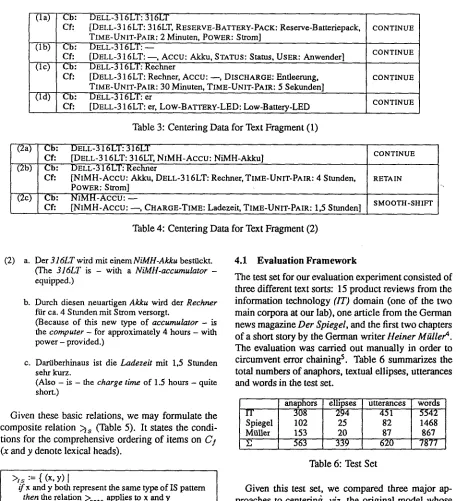
For illustration purposes, consider text fragment (1) and the corresponding Oh~C! data in Table 33: In (ld) the pronoun "er" (it) might be resolved to "Akku" (accumulator) or "Rechner" (computer), since both fulfill the agreement condition for pronoun resolu- tion. Now, "der Rechner" (computer) figures as a nominal anaphor, already resolved to DELL-3 16LT, while "Akku" (accumulator) is only the antecedent of the elliptical expression "der Entleerung" (dis- charge). Therefore, the preferred antecedent of "er" (it) is determined as Rechner (computer).
The bottom level of Table 2 specifies >~rco which covers the preference order for multiple occurrences of the same type of any information structure pattern, e.g., the occurrence of two anaphora or two unbound elements (all heads in an utterance are ordered by linear precedence relative to their text position). In sentence (2b), two nominal anaphors occur, "Akku" (accumulator) and "Rechner" (computer). The tex- tual ellipsis "Ladezeit" (charge time) in (2c) has to be resolved to the most preferred d e m e n t of the C' I of (2b), viz. the entity denoted by "Akku" (accumula- tor) (cf. Table 4). Note that "Rechner" (computer) is the subject of the sentence, though it is not the pre- ferred antecedent, since "Akku" (accumulator) pre- cedes "Rechner" (computer) and is anaphoric as well.
2Disregarding coordinations, the ordering we propose in- duces a strict ordering on the entities in a center list.
3Minuten (minutes) is excluded from the C! for reasons concerning the processing of complex sentences (cf. Strube (1996)).
(la) Cb: DELL-3 16LT: 316LT
Cf." [DELL-316LT: 316LT, RESERVE-BATTERY-PAcK: Reserve-Batteriepack, TIME-UNIT-PAIR: 2 Minuten, POWER: Strom]
(lb) Cb: D E L L - 3 1 6 L T : -
Cf: [DELL-316LT:--, A c c u : Akku, STATUS: Status, USER: Anwender] (lc) Cb: DELL-3 16LT: Rechner
Cf: [DELL-316LT: Rechner, A c c u : - - , DISCHARGE: Enfleerung, TIME-UNIT-PAIR: 30 Minuten, TIME-UNIT-PAIR: 5 Sekunden] (ld) Cb: DELL-3 16LT: er
Cf: [DELL-316LT: er, LoW-BATTERY-LED: Low-Battery-LED
Table 3: Centering Data for Text Fragment (1)
CONTINUE
CONTINUE
CONTINUE
CONTINUE
(2a) Cb: DELL-3 16LT: 316LT
Cf: [DELL-316LT: 316LT, N I M H - A c c u : NiMH-Akku] (2b) Ch: DELL-3 16LT: Reehner
Cf: [NIMH-Accu: Akku, DELL-316LT: Rechner, TIME-UNIT-PAIR: 4 Stunden, POWER: Sffom]
(2c) . Cb: N I M H - A c c u : -
Cf: [NIMH-Accu: - - , CHARGE-TIME: Ladezeit, TIME-UNIT-PAIR: 1,5 Stunden]
CONTINUE
RETAIN
SMOOTH-SHIFT
Table 4: Centering Data for Text Fragment (2)
(2) D e r 3 1 6 L T w ~ d m i t e i n e m N i M H - A k k u bestllckt. (I'he 316LT is - with a NiMH-accumulator - equipped.)
b. Durch diesen neuartigen Akku wird der Rechner ffir ca. 4 Stunden mit Strom versorgt.
(Because of this new type of accumulator - is the computer - for approximately 4 hours - with power - provided.)
c. Dartiberhinaus ist die Ladezeit mit 1,5 Stunden sehr kurz.
(Also - is - the charge time of 1.5 hours - quite short.)
Given these basic relations, we may formulate the composite relation :>,s (Table 5). It states the condi- tions for the comprehensive ordering o f items on C ! (x and y denote lexical heads).
>,s := { (x,y) I
~fx and y both represent the same type of IS pattern then the relation >~,,c applies to x and y
e l s e / f x and y both represent different forms of bound elements
then the relation >rSbo,,a applies to x and y else the relation >rsb°,= applies to x and y }
Table 5: Information Structure Relation
4 E v a l u a t i o n
In this section, we first describe the empirical and methodological framework in which our evaluation experiments were embedded, and then turn to a dis- cussion o f evaluation results and the conclusions we draw from the data.
4.1 Evaluation F r a m e w o r k
The test set for our evaluation experiment consisted of three different text sorts: 15 product reviews from the information technology (IT) domain (one o f the two main corpora at our lab), one article from the German news magazine D e r Spiegel, and the first two chapters o f a short story by the German writer H e i n e r Miiller 4. The evaluation was carried out manually in order to circumvent error chaining 5. Table 6 summarizes the total numbers o f anaphors, textual ellipses, utterances and words in the test set.
ag. apho~ ellipses utterances w o r d s
IT 308 294 451 5542
Spiegel 102 25 82 1468 MfiUer 153 20 87 867
563 339 620 7877
Table 6: Test Set
Given this test set, we compared three major ap- proaches to centering, viz. the original model whose ordering principles are based on grammatical role in- dicators only (the so-called c a n o n i c a l model) as char- acterized by Table 1, an "intermediate" model which can be considered a n a i v e approach to free word order languages, and, o f course, the f u n c t i o n a l model based on information structure constraints as stated in Table 2. For reasons discussed below, augmented versions of the naive and the canonical approaches will also be considered. They are characterized by the additional
4Liebesgeschichte. In Heiner Mflller. Geschichten aus der Produktion 2. Berlin: Rotbuch Verlag, pp. 57-63.
SA performance evaluation of the current anaphora and ellipsis resolution capacities of our system is reported in Hahn et al. (1996).
[image:4.612.72.536.52.553.2] [image:4.612.82.519.63.326.2]constraint that elliptical antecedents are ranked higher than elliptical expressions (short: "ante > express").
For the evaluation of a centering algorithm on nat- urally occurring text it is necessary to specify how to deal with complex sentences. In particular, methods for the interaction between intra- and intersentential anaphora resolution have to be defined, since the cen- tering model is concerned only with the latter case (see Suri & McCoy (1994)). We use an approach as de- scribed by Strube (1996) for the evaluation.
Since most of the anaphors in these texts are nom- inal anaphors, the resolution of which is much more restricted than that of pronominal anaphors, the rate of success for the whole anaphora resolution process is not significant enough for a proper evaluation of the functional constraints. The reason for this lies in the fact that nominal anaphors are far more constrained by conceptual criteria than pronominal anaphors. So the chance to properly resolve a nominal anaphor, even at lower ranked positions in the center lists, is greater than for pronominal anaphors. While we shift our evaluation criteria away from simple anaphora resolu- tion success data to structural conditions based on the proper ordering of center lists (in particular, we focus on the most highly ranked item of the forward-looking centers) these criteria compensate for the high propor- tion of nominal anaphora that occur in our test sets. The types of centering transitions we make use of (cf. Table 7) are taken from Walker et al. (1994).
~(~)=
~(~)
~ ( ~ ) #
~(~)
cb(u.) = c~(u._~)
OR Cb(U,,-I) undef.
CONTINUE
R E T A I N R O U G H - S H I F T
Cb(U.) #
C~(U~_~)
S M O O T H - S H I F T
Table 7: Transition Types
4.2 Evaluation Results
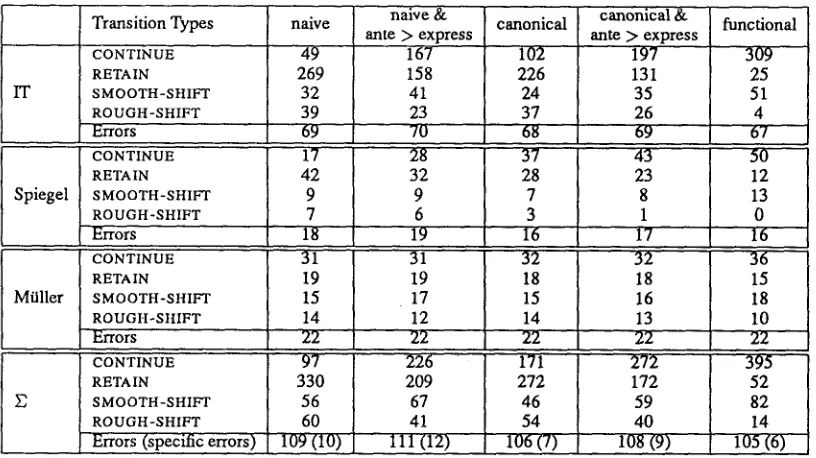
In Table 8 we give the numbers of centering transi- tions between the utterances in the three test sets. The first column contains those which are generated by the naive approach (such a proposal was made by Gordon et al. (1993) as well as by Rambow (1993) who, nev- ertheless, restricts it to the German middlefield only). We simply ranked the elements of C! according to their text position. While it is usually assumed that the elliptical expression ranks above its antecedent (Grosz et al., 1995, p.217), we assume the contrary. The sec- ond column contains the results of this modification with respect to the naive approach. In the third column of Table 8 we give the numbers of transitions which are generated by the canonical constraints as stated by Grosz et al. (1995, p.214, 217). The fourth column supplies the results of the same modification as was
used for the naive approach, viz. elliptical antecedents are ranked higher than elliptical expressions. The fifth column shows the results which are generated by the functional constraints from Table 2.
First, we examine the error data for anaphora res- olution for the five cases. All approaches have 99 errors in common. These are due to underspecifica- tions at different levels, e.g., the failure to account for prepositional anaphors (16), plural anaphors (8), anaphors which refer to a member of a set (14), sen- tence anaphors (21), and anaphors which refer to the global focus (12). Only 6 errors of the functional ap- proach are directly caused by an inappropriate order- ing of the C I , while the naive approach leads to 10 errors and the canonical to 7. When the antecedent of an elliptical expression is ranked above the elliptical expression itself the error rate of these two augmented approaches increases to 12 and 9, respectively.
We now turn to the distribution of transition types for the different approaches. The centering model as- sumes a preference order among these transitions, e.g., CONTINUE ranks above RETAIN and RETAIN ranks
above SHIFT. This preference order reflects the pre-
sumed inference load put on the hearer or speaker to coherently decode or encode a discourse. Since the functional approach generates a larger amount of CONTINUE transitions, we interpret this as a first rough indication that this approach provides for more efficient processing than its competitors.
But this reasoning is not entirely conclusive. Count- ing single occurrences of transition types, in general, does not reveal the entire validity of the center lists. Instead, considering adjacent transition pairs gives a more reliable picture, since depending on the text sort considered (e.g., technical vs. news magazine vs. lit- erary texts) certain sequences of transition types may be entirely plausible, though they include transitions which, when viewed in isolation, seem to imply con- siderable inferencing load (cf. Table 8). For instance, a CONTINUE transition which follows a CONTINUE transition is a sequence which requires the lowest pro- cessing costs. But a CONTINUE transition which fol- lows a RETAIN transition implies higher processing costs than a SMOOTH-SHIFT transition following a RETAIN transition. This is due to the fact that a RE- TAIN transition ideally predicts a SMOOTH-SHIFT in the following utterance. In this case the SMOOTH- SHIFT is the "least effort" transition, because only the first element of the C! of the preceding utterance has to be checked to perform the SMOOTH-SHIFT transi-
tion, while in the case of CONTINUE at least one more
check has to be performed. Hence, we claim that no one particular centering transition is preferred over an- other. Instead, we postulate that some centering tran- sition pairs are preferred over others. Following this
IT
Transition Types naive naive & ante > express
CONTINUE 49 167
RETAIN 269 158
SMOOTH-SHIFT 32 41
ROUGH-SHIFT 39 23
Errors ' 69 70
canonical
102 226 24 37 68
canonic~ &
functional an~ > express
197 309
131 25
35 51
26 4
69 67
Spiegel
Miiller
CONTINUE 17
RETAIN 42
SMOOTH-SHIFT 9 ROUGH-SHIFT 7
Errors 18
CONTINUE 31
RETAIN 19
SMOOTH-SHIFT 15 ROUGH-SItlFT 14
Errors 22
CONTINUE 97
RETAIN 330
SMOOTH-SHIFT 56 ROUGH-SHIFT 60 Errors (specific errors) 109 (10)
28 32 9 6 19 31 19 17 12 22
37 28 7 3 16 3 2 18 15 14 22
43 50
23 12
8 13
1 0
17 f6
32 36
18 15
16 18
13 10
22 22
272 395
172 52
59 82
40 14
108 (9) 105 (6) 2 2 6 171
209 272
67 46
41 54
[image:6.612.88.496.59.288.2]111 (12) 106 (7)
Table 8: Numbers of Centering Transitions
line of argumentation, we here propose to classify all occurrences of centering transition pairs with respect to the costs they imply. The cost-based evaluation of different C! orderings refers to evaluation criteria which form an intrinsic part of the centering model 6.
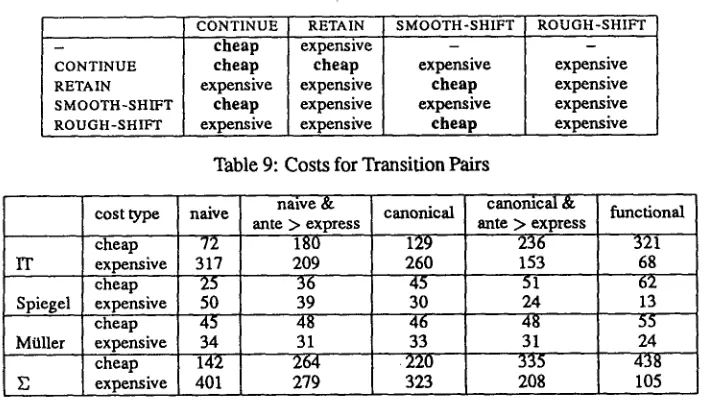
Transition pairs hold for two immediately succes- sive utterances. We distinguish between two types of transition pairs, cheap ones and expensive ones. We call a transition pair cheap if the backward-looking center of the current utterance is correctly predicted by the preferred center of the immediately preced- ing utterance, i.e., Cb(Ui) = Gp(Ui_l),i = 2 . . . n . Transition pairs are called expensive if the backward- looking center of the current utterance is not
correctly
predicted by the preferred center of the immediately preceding utterance, i.e., Cb(Ui) # Gp(Ui_l),i = 2 . . . n. Table 9 contains a detailed synopsis of cheap and expensive transition pairs. In particular, chains of the RETAIN transition in passages where the Cb does not change (passages with constant theme) show that the canonical ordering constraints for the forward- looking centers are not appropriate,The numbers of centering transition pairs generated by the different approaches are shown in Table 10, In general, the functional approach shows the best re-
6As a consequence of this postulate, we have to rede- fine Rule 2 of the Centering Constraints (Grosz et al., 1995, p.215) appropriately, which gives an informal characteriza- tion of a preference for sequences of CONTINUE over se- quences of RETAIN arid, similarly, sequences of RETAIN over sequences of SHIFT. Our specification for the case of text interpretation says that cheap transitions are preferred over expensive ones, with cheap and expensive transitions as defined in Table 9.
Suits, while the naive and the canonical approaches work reasonably well for the literary text, but exhibit a poor performance for the texts from the IT domain and the news magazine. The results for the latter ap- proaches become only slightly more positive with the modification of ranking the antecedent of a textual el- lipsis above the elliptical expression, but they do not compare to the results of the functional approach.
We were also interested in finding out whether the functional ordering we propose possibly "includes" the grammatical role based criteria discussed so far. We, therefore, re-evaluated the examples already an- notated with Gb/C! data available in the literature (for the English language, we considered all exam- pies from Grosz et al. (1995) and Brennan et al. (1987); for Japanese we took the data from Walker et al. (1994)). Surprisingly enough, all examples of Grosz et al. (1995) passed the test successfully. Only with respect to the troublesome Alfa Romeo driving scenario (cf. Brennan et al. (1987, p.157)) our con- straints fail to properly rank the elements of the third sentence C! of that example. 7 Note also that these results were achieved without having recourse to ex- tra constraints, e.g., the shared property constraint to account for anaphora parallelism (Kameyama, 1986).
We applied our constraints to Japanese examples in the same way. Again we abandoned all extra con- straints set up in these studies, e.g., the Zero Topic As- signment (ZTA) rule and the special role of empathy
7In essence, the very specific problem addressed by that example seems to be that Friedman has not been previously introduced in the local discourse segment and is only acces- sible via the global focus.
CONTINUE
- cheap
CONTINUE cheap
RETAIN expensive
SMOOTH-SHIFT cheap
ROUGH-SHIFT expensive
RETAIN expensive
cheap
expensive expensive expensive
SMOOTH-SHIFT
expensNe
cheap
expens~e
cheap
ROUGH-SHIFT
i expensive expensive expensive expensive
Table 9: Costs for Transition Pairs
naive & cost type naive
ante > express
cheap 72 180
1T expensive 317 209
Cheap 25 36
Spiegel expensive 50 39
cheap 45 48
MOiler expensive 34 31
cheap 142 264
expensive 401 279
c~onical
129 260 45 30 46" 33 ,220
323
functional ante > express
236 153 51 24 48 31 335 208
321 68 62 13 55 24 438 105
Table 10: Cost Values for Centering Transition Pair Types
verbs (Walker et al., 1994). However, the results our constraints generate are the same as those generated by Walker et al. including these model extensions. Only a single problematic case remains,
viz.
example (30) of Walker et al. (1994, p.214) causes the same problems they described (discourse-initial utterance, semantic or world knowledge should be available). Even for the crucial examples (32)-(36) of Walker et al. (1994, p.216-221) our constraints generate the same C l s as Walker et al.' s constraints with ZTA.To summarize the results of our empirical evalua- tion, we first claim that our proposal based on func- tional criteria leads to substantially better and - - with respect to the inference load placed on the text under- stander, whether human or machine - - more plausi- ble results for languages with free word order than the structural constraints given by Grosz et al. (1995) and those underlying a naive approach. We base these ob- servations on an evaluation approach which considers transition pairs in terms of the inference load specific pairs imply. Second, we have gathered some evidence, still far from being conclusive, that the functional con- straints on centering seem to incorporate the struc- tural constraints for English and the modified struc- tural constraints for Japanese. Hence, we hypothesize that functional constraints on centering might consti- tute a general mechanism for treating free an___dd fixed word order languages by the same descriptive mecha- nism. This claim, however, has to be further substan- tiated by additional cross-linguistic empirical studies.
5 C o m p a r i s o n w i t h R e l a t e d A p p r o a c h e s
The centering model (Grosz et al., 1983; 1995) is con- cerned with the interactions between the local coher- ence of discourse and the choices of referring expres- sions. Crucial for the centering model is the way
the forward-looking centers are organized. Despite several cross-linguistic studies a kind of "standard" has emerged based on the study of English (cf. Ta- ble 1 in Section 1). Only few of these cross-linguistic studies have led to changes in the basic order of dis- course entities, the work of Walker et al. (1990; 1994) being the most far reaching exception. They consider the role of expressive means in Japanese to indicate topic status and the speaker's perspective, thus introducing
functional
notions, viz. ToPIc and EMPATHY, into the discussion. German, the object language we deal with, is also a free word order lan- guage like Japanese (possibly even more constrained). Our basic revision of the ordering scheme completely abandons grammatical role information and replaces it with entirely functional notions reflecting the informa- tion structure of the utterances in the discourse. Inter- estingly enough, several extra assumptions introduced to account, e.g., for anaphora parallelism (e.g., the shared property constraint formulated by Kameyama (1986)) can be eliminated without affecting the cor- rectness of anaphora resolutions. Rambow (1993) has presented a theme/rheme distinction within the cen- tering model to which we fully subscribe. His pro- posal concerning the centering analysis of German (al- ready referred to as the "naive" approach; cf. Section 4) is limited, however, to the German middlefield and, hence, incomplete.A common topic of criticism relating to focusing approaches to anaphora resolution has been the diver- sity of data structures they require, which are likely to hide the underlying linguistic regularities. Focus- ing algorithms prefer the discourse element already in focus for anaphora resolution, thus considering context-boundedness, too. But the items of the fo- cus lists are either ordered by thematic roles (Sidner,
[image:7.612.148.503.56.256.2]1983) or grammatical roles (Suri & McCoy, 1994; Dahl & Ball, 1990)). Dahl & Ball (1990) improve the focusing mechanism by simplifying its data struc- tures and, thus, their proposal is more closely related to the centering model than any other focusing mecha- nism. But their approach still relies upon grammatical information for the ordering of the centering list, while we use only the functional information structure as the guiding principle.
6 C o n c l u s i o n
In this paper, we provided an account for ordering the forward-looking centers which is entirely based on functional notions, grounded on the information struc- ture of utterances in a discourse. We motivated our proposal by the constraints which hold for a free word order language such as German and derived our results from data-intensive empirical studies of (real-world) expository texts. We have gathered preliminary evi- dence that the functional ordering of discourse enti- ties in the centers seems to coincide with the gram- matical roles of fixed word order languages. We also augmented the ordering criteria of the forward-looking center such that it accounts not only for (pro)nominal but also for functional anaphora (textual ellipsis), an issue that, so far, has only been sketchily dealt with in the centering framework. The extensions we pro- pose have been validated by the empirical analysis of real-world expository texts of considerable length. We thus follow methodological principles of corpus-based studies that have been successfully exercised in the work of Passonneau (1993). Still open are proper de- scriptions of deictic expressions, proper names (cf. the Alfa Romeo driving scenario), and plural or generic definite noun phrases. An anaphora resolution module and an ellipsis handler based on this functional center- ing model has been implemented as part of a compre- hensive text parser for German.
Acknowledgments. We would like to thank our colleagues in the 8£ZY r group for fruitful discussions and Jon A1- cantara (Cambridge, UK) for re-reading the final version via Interact. This work has been funded by LGFG Baden- Wiirttemberg (M. S trube).
R e f e r e n c e s
Brennan, S. E., M. W. Friedman & C. J. Pollard (1987). A centering approach to pronouns. In Proc. of ACL-87, pp. 155-162.
Clark, H. H. (1975). Bridging. In Proc. of TINLAP-1, pp. 169-174.
Cote, S. (1996). Ranking forward-looking centers. In E. Prince, A. Joshi & M. Walker (Eds.), Centering in Discourse. Oxford: Oxford University Press (to ap- pear).
Dahl, D. A. & C. N. Ball (1990). Reference resolution in PUNDIT. In P. Saint-Dizier & S. Szpakowicz (Eds.),
Logic and Logic Grammars for Language Processing, pp.. 168-184. Chichester, U.K.: Ellis Horwood. Dahl, O. (Ed.) (1974). Topic and Comment, Contextual
Boundness, and Focus. Hamburg: Buske.
Dane~, E (1974a). Functional sentence perspective and the organization of the text. In F. Dane~ (Ed.), Pa- person Functional Sentence Perspective, pp. 106-128. Prague: Academia.
Dane~, F. (Ed.) (1974b). Paperson FunctionalSentencePer- spective. Prague: Academia.
Gordon, P. C., B. J. Grosz & L. A. Gilliom (1993). Pro- nouns, names, and the centering of attention in dis- course. Cognitive Science, 17:311-347.
Grosz, B. J., A. K. Joshi & S. Weinstein (1983). Providing a unified account of definite noun phrases in discourse. In Proc. of ACL-83, pp. 4430.
Grosz, B. J., A. K. Joshi & S. Weinstein (1995). Center- .ing: A framework for modeling the local coherence of
discourse. Computational Linguistics, 21 (2):203-225. Hahn, U. & M. Strube (1996). Incremental centering and
center ambiguity. In Proc. of the 1 8 th Annual Confer- ence of the Cognitive Science Society. La Jolla, CA. Hahn, U., M. Strube & K. Markert (1996). Bridging textual
ellipses. In Proc. of COLING-96.
Hajieowi, E., V. Kubofi & P. Kubofi (1992). Stock of shared knowledge: A tool for solving pronominal anaphora: InProc. ofCOL1NG-92, Vol. 1, pp. 127-133. Haji~ov~, E., H. Skoumalov~ & P. Sgall (1995). An auto-
marie procedure for topic-focus identification. Com- putational Linguistics, 21(1):81-94.
Halliday, M. A. K. (1967). Notes on transitivity and theme in English, Part 2. Journal of Linguistics, 3:199-244. Halliday, M. A. K, & R. Hasan (1976). Cohesion in English.
London: Longman.
Kameyama, M. (1986). A property-sharing constraint in centering. In Proc. of ACL-86, pp. 200-206.
Passormeau, R. J. (1993). Getting and keeping the center of attention. In M. Bates & R. Weisehedel (Eds.), Chal- lenges in Natural Language Processing, pp. 179-227. Cambridge, UK: Cambridge University Press. Rambow, O. (1993), Pragmatic aspects of scrambling and
topicalization in German. In IRCS Workshop on Cen- tering in Discourse. Univ. of Pennsylvania, 1993. Sidner, C. L. (1983). Focusing in the comprehension of deft-
nite anaphora. In M. Brady & R. Berwick (Eds.), Com- putational Models of Discourse, pp. 267-330. Cam- bridge, MA: MIT Press.
Strube, M. (1996). Processing complex sentences in the cen- tering framework. In this volume.
Strube, M. & U. Hahn (1995). ParseTalk about sentence- and text-level anaphora. In Proc. of EACL-95, pp. 237- 244.
Suri, L. Z. & K. F. McCoy (1994). RAFT/RAPR and center° ing: A comparison and discussion of problems related to processing complex sentences. Computational Lin- guistics, 20(2):301-317.
Turan, U. (1995). Null vs. Overt Subjects in Turkish: A Cen- tering Approach. (Ph.D. thesis). University of Penn- sylvania.
Walker, M. A., M. Iida & S. Cote (1990). Centering in Japanese discourse. In Proc. of COLING.90, Ap- pendix, 6pp.
Walker, M. A., M. Iida & S. Cote (1994). Japanesediscourse and the process of centering. Computational Linguis- tics, 20(2): 193-233.