WSD as a Distributed Constraint Optimization Problem
Siva Reddy IIIT Hyderabad
India
Abhilash Inumella IIIT Hyderabad
India
Abstract
This work models Word Sense Disam-biguation (WSD) problem as a Dis-tributed Constraint Optimization Problem (DCOP). To model WSD as a DCOP, we view information from various knowl-edge sources as constraints. DCOP al-gorithms have the remarkable property to jointly maximize over a wide range of util-ity functions associated with these con-straints. We show how utility functions can be designed for various knowledge sources. For the purpose of evaluation, we modelled all words WSD as a simple DCOP problem. The results are competi-tive with state-of-art knowledge based sys-tems.
1 Introduction
Words in a language may carry more than one sense. The correct sense of a word can be iden-tified based on the context in which it occurs. In the sentence, He took all his money from the bank, bank refers to a financial institution sense instead of other possibilities like the edge of river sense. Given a word and its possible senses, as defined by a dictionary, the problem of Word Sense Dis-ambiguation (WSD) can be defined as the task of assigning the most appropriate sense to the word within a given context.
WSD is one of the oldest problems in com-putational linguistics which dates back to early 1950’s. A range of knowledge sources have been found to be useful for WSD. (Agirre and Steven-son, 2006; Agirre and Mart´ınez, 2001; McRoy, 1992; Hirst, 1987) highlight the importance of various knowledge sources like part of speech, morphology, collocations, lexical knowledge base (sense taxonomy, gloss), sub-categorization, se-mantic word associations, selectional preferences,
semantic roles, domain, topical word associations, frequency of senses, collocations, domain knowl-edge. etc. Methods for WSD exploit information from one or more of these knowledge sources.
Supervised approaches like (Yarowsky and Flo-rian, 2002; Lee and Ng, 2002; Mart´ınez et al., 2002; Stevenson and Wilks, 2001) used collec-tive information from various knowledge sources to perform disambiguation. Information from var-ious knowledge sources is encoded in the form of a feature vector and models were built by training on sense-tagged corpora. These approaches pose WSD as a classification problem. They crucially rely on hand-tagged sense corpora which is hard to obtain. Systems that do not need hand-tagging have also been proposed. Agirre and Martinez (Agirre and Mart´ınez, 2001) evaluated the contri-bution of each knowledge source separately. How-ever, this does not combine information from more than one knowledge source.
In any case, little effort has been made in for-malizing the way in which information from var-ious knowledge sources can be collectively used within a single framework: a framework that al-lows interaction of evidence from various knowl-edge sources to arrive at a global optimal solution. Here we present a way for modelling informa-tion from various knowledge sources in a multi agent setting called distributed constraint opti-mization problem (DCOP). In DCOP, agents have constraints on their values and each constraint has a utility associated with it. The agents communi-cate with each other and choose values such that a global optimum solution (maximum utility) is at-tained. We aim to solve WSD by modelling it as a DCOP.
To the best of our knowledge, ours is the first attempt to model WSD as a DCOP. In DCOP framework, information from various knowledge sources can be used combinedly to perform WSD. In section 2, we give a brief introduction of
DCOP. Section 3 describes modelling WSD as a DCOP. Utility functions for various knowledge sources are described in section 4. In section 5, we conduct a simple experiment by modelling all-words WSD problem as a DCOP and perform dis-ambiguation on Senseval-2 (Cotton et al., 2001) and Senseval-3 (Mihalcea and Edmonds, 2004) data-set of all-words task. Next follow the sec-tions on related work, discussion, future work and conclusion.
2 Distributed Constraint Optimization Problem (DCOP)
A DCOP (Modi, 2003; Modi et al., 2004) consists of n variables V = x1, x2, ...xn each assigned to an agent, where the values of the variables are taken from finite, discrete domainsD1, D2, ..., Dn respectively. Only the agent has knowledge and control over values assigned to variables associ-ated to it. The goal for the agents is to choose values for variables such that a given global objec-tive function is maximized. The objecobjec-tive function is described as the summation over a set of utility functions.
DCOP can be formalized as a tuple (A, V, D, C, F) where
• A ={a1, a2, . . . an}is a set ofnagents,
• V = {x1, x2, . . . xn} is a set of n variables, each one associated to an agent,
• D = {D1, D2, . . . Dn} is a set of finite and discrete domains each one associated to the corresponding variable,
• C ={fk:Di×Dj×. . . Dm→ ℜ}is a set of constraints described by various utility func-tions fk. The utility function fk is defined over a subset of variables V. The domain offkrepresent the constraintsCfk andfk(c) represents the utility associated with the con-straintc, wherec∈Cfk.
• F =X
k
zk·fkis the objective function to be
maximized wherezkis the weight of the cor-responding utility functionfk
An agent is allowed to communicate only with its neighbours. Agents communicate with each other to agree upon a solution which maximizes the objective function.
3 WSD as a DCOP
Given a sequence of words W={w1, w2, . . . wn} with corresponding admissible senses Dwi =
{s1
wi, s2wi. . .}, we model WSD as DCOP as fol-lows.
3.1 Agents
Each word wi is treated as an agent. The agent (word) has knowledge and control of its values (senses).
3.2 Variables
Sense of a word varies and it is the one to be deter-mined. We define the sense of a word as its vari-able. Each agentwiis associated with the variable swi. The value assigned to this variable indicates the sense assigned by the algorithm.
3.3 Domains
Senses of a word are finite in number. The set of sensesDwi, is the domain of the variableswi.
3.4 Constraints
A constraint specifies a particular configuration of the agents involved in its definition and has a util-ity associated with it. For e.g. Ifcij is a constraint defined on agents wi andwj, then cij refers to a particular instantiation ofwiandwj, saywi =spwi andwj =sqwj.
A utility functionfk:Cfk → ℜdenote a set of constraintsCfk ={Dwi×Dwj. . . Dwm}, defined on the agents wi, wj. . . wm and also the utilities associated with the constraints. We model infor-mation from each knowledge source as a utility function. In section 4, we describe in detail about this modelling.
3.5 Objective function
As already stated, various knowledge sources are identified to be useful for WSD. It is desirable to use information from these sources collectively, to perform disambiguation. DCOP provides such framework where an objective function is defined over all the knowledge sources (fk) as below
F =X
k
zk·fk
can be weighted. (Note: It is desirable to nor-malize utility functions of different knowledge sources in order to compare them.)
Every agent (word) choose its value (sense) in a such a way that the objective function (global solu-tion) is maximized. This way an agent is assigned a best value which is the target sense in our case.
4 Modelling information from various knowledge sources
In this section, we discuss the modelling of infor-mation from various knowledge sources.
4.1 Part-of-speech (POS)
Consider the word play. It has 47 senses out of which only 17 senses correspond to noun category. Based on the POS information of a word wi, its domainDwi is restricted accordingly.
4.2 Morphology
Noun orange has at least two senses, one corre-sponding to a color and other to a fruit. But plu-ral form of this word oranges can only be used in the fruit sense. Depending upon the morphologi-cal information of a wordwi, its domainDwi can be restricted.
4.3 Domain information
In the sports domain, cricket likely refers to a game than an insect. Such information can be cap-tured using a unary utility function defined for ev-ery word. If the sense distributions of a word wi are known, a function f : Dwi → ℜ is defined which return higher utility for the senses favoured by the domain than to the other senses.
4.4 Sense Relatedness
Sense relatedness between senses of two words wi,wj is captured by a functionf :Dwi×Dwj →
ℜ where f returns sense relatedness (utility) be-tween senses based on sense taxonomy and gloss overlaps.
4.5 Discourse
Discourse constraints can be modelled using a n-ary function. For instance, to the extent one sense per discourse (Gale et al., 1992) holds true, higher utility can be returned to the solutions which favour same sense to all the occurrences of a word in a given discourse. This information can be modeled as follows: Ifwi, wj, . . . wm are
the occurrences of a same word, a function f : Di×Dj×. . . Dm → ℜis defined which returns higher utility whenswi = swj =. . . swm and for the rest of the combinations it returns lower utility.
4.6 Collocations
Collocations of a word are known to provide strong evidence for identifying correct sense of the word. For example: if in a given context bank co-occur with money, it is likely that bank refers to financial institution sense rather than the edge of a river sense. The word cancer has at least two senses, one corresponding to the astrological sign and the other a disease. But its derived form can-cerous can only be used in disease sense. When the words cancer and cancerous co-occur in a dis-course, it is likely that the word cancer refers to disease sense.
Most supervised systems work through colloca-tions to identify correct sense of a word. If a word wico-occurs with its collocate v, collocational in-formation fromvcan be modeled by using the fol-lowing function
coll infrm vwi :Dwi → ℜ
where coll infrm vwi returns high utility to collocationally preferred senses of wi than other senses.
Collocations can also be modeled by assigning more than one variable to the agents or by adding a dummy agent which gives collocational informa-tion but in view of simplicity we do not go into those details.
Topical word associations, semantic word asso-ciations, selectional preferences can also be mod-eled similar to collocations. Complex information involving more than two entities can be modelled by using n-ary utility functions.
5 Experiment: DCOP based All Words WSD
Our method performs disambiguation on sen-tence by sensen-tence basis. A utility function based on semantic relatedness is defined for every pair of words falling in a particular window size. Re-stricting utility functions to a window size reduces the number of constraints. An objective function is defined as sum of these restricted utility functions over the entire sentence and thus allowing infor-mation flow across all the words. Hence, a DCOP algorithm which aims to maximize this objective function leads to a globally optimal solution.
In our experiments, we used the best similarity measure settings of (Sinha and Mihalcea, 2007) which is a sum of normalized similarity mea-sures jcn, lch and lesk. We used used Distributed Pseudotree Optimization Procedure (DPOP) algo-rithm (Petcu and Faltings, 2005), which solves DCOP using linear number of messages among agents. The implementation provided with the open source toolkit FRODO1(L´eaut´e et al., 2009) is used.
5.1 Data
To compare our results, we ran our experiments on SENSEVAL-2 and SENSEVAL -3 English all-words data sets.
5.2 Results
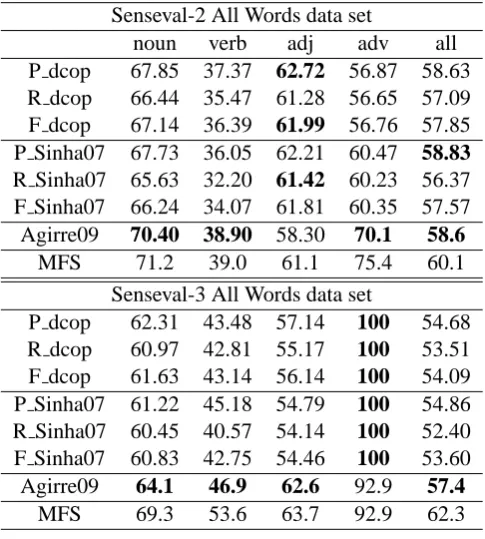
Table 1 shows results of our experiments. All these results are carried out using a window size of four. Ideally, precision and recall values are ex-pected to be equal in our setting. But in certain cases, the tool we used, FRODO, failed to find a solution with the available memory resources.
Results show that our system performs con-sistently better than (Sinha and Mihalcea, 2007) which uses exactly same knowledge sources as used by us (with an exception of adverbs in Senseval-2). This shows that DCOP algorithm perform better than page-rank algorithm used in their graph based setting. Thus, for knowledge-based WSD, DCOP framework is a potential al-ternative to graph based models.
Table 1 also shows the system (Agirre and Soroa, 2009), which obtained best results for knowledge based WSD. A direct comparison between this and our system is not quantita-tive since they used additional knowledge such as extended WordNet relations (Mihalcea and
1http://liawww.epfl.ch/frodo/
Moldovan, 2001) and sense disambiguated gloss present in WordNet3.0.
Senseval-2 All Words data set
noun verb adj adv all
P dcop 67.85 37.37 62.72 56.87 58.63
R dcop 66.44 35.47 61.28 56.65 57.09
F dcop 67.14 36.39 61.99 56.76 57.85
P Sinha07 67.73 36.05 62.21 60.47 58.83
R Sinha07 65.63 32.20 61.42 60.23 56.37 F Sinha07 66.24 34.07 61.81 60.35 57.57
Agirre09 70.40 38.90 58.30 70.1 58.6
MFS 71.2 39.0 61.1 75.4 60.1
Senseval-3 All Words data set
P dcop 62.31 43.48 57.14 100 54.68
R dcop 60.97 42.81 55.17 100 53.51
F dcop 61.63 43.14 56.14 100 54.09
P Sinha07 61.22 45.18 54.79 100 54.86
R Sinha07 60.45 40.57 54.14 100 52.40
F Sinha07 60.83 42.75 54.46 100 53.60
Agirre09 64.1 46.9 62.6 92.9 57.4
MFS 69.3 53.6 63.7 92.9 62.3
Table 1: Evaluation results on Senseval-2 and Senseval-3 data-set of all words task.
5.3 Performance analysis
We conducted our experiment on a computer with two 2.94 GHz process and 2 GB memory. Our algorithm just took 5 minutes 31 seconds on Senseval-2 data set, and 5 minutes 19 seconds on Senseval-3 data set. This is a singable reduction compared to execution time of page rank algo-rithms employed in both Sinha07 and Agirre09. In Agirre09, it falls in the range 30 to 180 minutes on much powerful system with 16 GB memory hav-ing four 2.66 GHz processors. On our system, time taken by the page rank algorithm in (Sinha and Mihalcea, 2007) is 11 minutes when executed on Senseval-2 data set.
Since DCOP algorithms are truly distributed in nature the execution times can be further reduced by running them parallely on multiple processors.
6 Related work
Earlier approaches to WSD which encoded infor-mation from variety of knowledge sources can be classified as follows:
[image:4.595.307.550.101.371.2]Lee and Ng, 2002; Mart´ınez et al., 2002; Stevenson and Wilks, 2001) rely on the sense tagged data. These are mainly discrimina-tive or aggregadiscrimina-tive models which essentially pose WSD a classification problem. Dis-criminative models aim to identify the most informative feature and aggregative models make their decisions by combining all fea-tures. They disambiguate word by word and do not collectively disambiguate whole con-text and thereby do not capture all the rela-tionships (e.g sense relatedness) among all the words. Further, they lack the ability to directly represent constraints like one sense per discourse.
• Graph based approaches: These approaches crucially rely on lexical knowledge base. Graph-based WSD approaches (Agirre and Soroa, 2009; Sinha and Mihalcea, 2007) per-form disambiguation over a graph composed of senses (nodes) and relations between pairs of senses (edges). The edge weights encode information from a lexical knowledge base but lack an efficient way of modelling in-formation from other knowledge sources like collocational information, selectional prefer-ences, domain information, discourse. Also, the edges represent binary utility functions defined over two entities which lacks the abil-ity to encode ternary, and in general, any N-ary utility functions.
7 Discussion
This framework provides a convenient way of integrating information from various knowledge sources by defining their utility functions. Infor-mation from different knowledge sources can be weighed based on the setting at hand. For exam-ple, in a domain specific WSD setting, sense dis-tributions play a crucial role. The utility function corresponding to the sense distributions can be weighed higher in order to take advantage of do-main information. Also, different combination of weights can be tried out for a given setting. Thus for a given WSD setting, this framework allows us to find 1) the impact of each knowledge source in-dividually 2) the best combination of knowledge sources.
Limitations of DCOP algorithms: Solving DCOPs is NP-hard. A variety of search algorithms have therefore been developed to solve DCOPs
(Mailler and Lesser, 2004; Modi et al., 2004; Petcu and Faltings, 2005) . As the number of constraints or words increase, the search space in-creases thereby increasing the time and memory bounds to solve them. Also DCOP algorithms ex-hibit a trade-off between memory used and num-ber of messages communicated between agents. DPOP (Petcu and Faltings, 2005) use linear num-ber of messages but requires exponential memory whereas ADOPT (Modi et al., 2004) exhibits lin-ear memory complexity but exchange exponential number of messages. So it is crucial to choose a suitable algorithm based on the problem at hand.
8 Future Work
In our experiment, we only used relatedness based utility functions derived from WordNet. Effect of other knowledge sources remains to be evaluated individually and in combination. The best possible combination of weights of knowledge sources is yet to be engineered. Which DCOP algorithm per-forms better WSD and when has to be explored.
9 Conclusion
We initiated a new line of investigation into WSD by modelling it in a distributed constraint opti-mization framework. We showed that this frame-work is powerful enough to encode information from various knowledge sources. Our experimen-tal results show that a simple DCOP based model encoding just word similarity constraints performs comparably with the state-of-the-art knowledge based WSD systems.
Acknowledgement
We would like to thank Prof. Rajeev Sangal and Asrar Ahmed for their support in coming up with this work.
References
Eneko Agirre and David Mart´ınez. 2001. Knowledge sources for word sense disambiguation. In Text,
Speech and Dialogue, 4th International Conference, TSD 2001, Zelezna Ruda, Czech Republic, Septem-ber 11-13, 2001, Lecture Notes in Computer
Sci-ence, pages 1–10. Springer.
Eneko Agirre and Aitor Soroa. 2009. Personaliz-ing pagerank for word sense disambiguation. In
EACL ’09: Proceedings of the 12th Conference of the European Chapter of the Association for Compu-tational Linguistics, pages 33–41, Morristown, NJ,
Eneko Agirre and Mark Stevenson. 2006. Knowledge sources for wsd. In Word Sense Disambiguation:
Algorithms and Applications, volume 33 of Text, Speech and Language Technology, pages 217–252.
Springer, Dordrecht, The Netherlands.
Scott Cotton, Phil Edmonds, Adam Kilgarriff, and Martha Palmer. 2001. Senseval-2. http://www.
sle.sharp.co.uk/senseval2.
Christiane Fellbaum, editor. 1998. WordNet An
Elec-tronic Lexical Database. The MIT Press,
Cam-bridge, MA ; London, May.
William A. Gale, Kenneth W. Church, and David Yarowsky. 1992. One sense per discourse. In HLT
’91: Proceedings of the workshop on Speech and Natural Language, pages 233–237, Morristown, NJ,
USA. Association for Computational Linguistics.
Graeme Hirst. 1987. Semantic interpretation and the resolution of ambiguity. Cambridge University
Press, New York, NY, USA.
Thomas L´eaut´e, Brammert Ottens, and Radoslaw Szy-manek. 2009. FRODO 2.0: An open-source framework for distributed constraint optimization. In Proceedings of the IJCAI’09 Distributed
Con-straint Reasoning Workshop (DCR’09), pages 160–
164, Pasadena, California, USA, July 13. http:
//liawww.epfl.ch/frodo/.
Yoong Keok Lee and Hwee Tou Ng. 2002. An em-pirical evaluation of knowledge sources and learn-ing algorithms for word sense disambiguation. In
EMNLP ’02: Proceedings of the ACL-02 conference on Empirical methods in natural language process-ing, pages 41–48, Morristown, NJ, USA.
Associa-tion for ComputaAssocia-tional Linguistics.
Roger Mailler and Victor Lesser. 2004. Solving distributed constraint optimization problems using cooperative mediation. In AAMAS ’04:
Proceed-ings of the Third International Joint Conference on Autonomous Agents and Multiagent Systems, pages
438–445, Washington, DC, USA. IEEE Computer Society.
David Mart´ınez, Eneko Agirre, and Llu´ıs M`arquez. 2002. Syntactic features for high precision word sense disambiguation. In COLING.
Susan W. McRoy. 1992. Using multiple knowledge sources for word sense discrimination.
COMPUTA-TIONAL LINGUISTICS, 18:1–30.
Rada Mihalcea and Phil Edmonds, editors. 2004.
Proceedings Senseval-3 3rd International Workshop on Evaluating Word Sense Disambiguation Systems.
ACL, Barcelona, Spain.
Rada Mihalcea and Dan I. Moldovan. 2001. ex-tended wordnet: progress report. In in Proceedings
of NAACL Workshop on WordNet and Other Lexical Resources, pages 95–100.
Pragnesh Jay Modi, Wei-Min Shen, Milind Tambe, and Makoto Yokoo. 2004. Adopt: Asynchronous dis-tributed constraint optimization with quality guaran-tees. Artificial Intelligence, 161:149–180.
Pragnesh Jay Modi. 2003. Distributed constraint opti-mization for multiagent systems. PhD Thesis.
Adrian Petcu and Boi Faltings. 2005. A scalable method for multiagent constraint optimization. In
IJCAI’05: Proceedings of the 19th international joint conference on Artificial intelligence, pages
266–271, San Francisco, CA, USA. Morgan Kauf-mann Publishers Inc.
Ravi Sinha and Rada Mihalcea. 2007. Unsupervised graph-basedword sense disambiguation using mea-sures of word semantic similarity. In ICSC ’07:
Pro-ceedings of the International Conference on Seman-tic Computing, pages 363–369, Washington, DC,
USA. IEEE Computer Society.
Mark Stevenson and Yorick Wilks. 2001. The inter-action of knowledge sources in word sense disam-biguation. Comput. Linguist., 27(3):321–349.