Collaborative Decoding: Partial Hypothesis Re-ranking
Using Translation Consensus between Decoders
Mu Li
1, Nan Duan
2, Dongdong Zhang
1, Chi-Ho Li
1, Ming Zhou
11
Microsoft Research Asia
2Tianjin University
Beijing, China Tianjin, China
{muli,v-naduan,dozhang,chl,mingzhou}@microsoft.com
Abstract
This paper presents collaborative decoding (co-decoding), a new method to improve ma-chine translation accuracy by leveraging trans-lation consensus between multiple machine translation decoders. Different from system combination and MBR decoding, which post-process the n-best lists or word lattice of ma-chine translation decoders, in our method mul-tiple machine translation decoders collaborate by exchanging partial translation results. Us-ing an iterative decodUs-ing approach, n-gram agreement statistics between translations of multiple decoders are employed to re-rank both full and partial hypothesis explored in decoding. Experimental results on data sets for NIST Chinese-to-English machine translation task show that the co-decoding method can bring significant improvements to all baseline decoders, and the outputs from co-decoding can be used to further improve the result of system combination.
1
Introduction
Recent research has shown substantial improve-ments can be achieved by utilizing consensus statistics obtained from outputs of multiple ma-chine translation systems. Translation consensus can be measured either at sentence level or at word level. For example, Minimum Bayes Risk (MBR) (Kumar and Byrne, 2004) decoding over
n-best list tries to find a hypothesis with lowest expected loss with respect to all the other transla-tions, which can be viewed as sentence-level consensus-based decoding. Word based methods proposed range from straightforward consensus voting (Bangalore et al., 2001; Matusov et al., 2006) to more complicated word-based system combination model (Rosti et al., 2007; Sim et al., 2007). Typically, the resulting systems take out-puts of individual machine translation systems as
input, and build a new confusion network for second-pass decoding.
There have been many efforts dedicated to ad-vance the state-of-the-art performance by com-bining multiple systems’ outputs. Most of the work focused on seeking better word alignment for consensus-based confusion network decoding (Matusov et al., 2006) or word-level system combination (He et al., 2008; Ayan et al., 2008). In addition to better alignment, Rosti et al. (2008) introduced an incremental strategy for confusion network construction; and Hildebrand and Vogel (2008) proposed a hypotheses re-ranking model for multiple systems’ outputs with more features including word translation proba-bility and n-gram agreement statistics.
A common property of all the work mentioned above is that the combination models work on the basis of n-best translation lists (full hypo-theses) of existing machine translation systems. However, the n-best list only presents a very small portion of the entire search space of a Sta-tistical Machine Translation (SMT) model while a majority of the space, within which there are many potentially good translations, is pruned away in decoding. In fact, due to the limitations of present-day computational resources, a consi-derable number of promising possibilities have to be abandoned at the early stage of the decoding process. It is therefore expected that exploring additional possibilities beyond n-best hypotheses lists for full sentences could bring improvements to consensus-based decoding.
In this paper, we present collaborative decod-ing (or co-decoding), a new SMT decoding scheme to leverage consensus information be-tween multiple machine translation systems. In this scheme, instead of using a post-processing step, multiple machine translation decoders col-laborate during the decoding process, and trans-lation consensus statistics are taken into account to improve ranking not only for full translations, but also for partial hypotheses. In this way, we
expect to reduce search errors caused by partial hypotheses pruning, maximize the contribution of translation consensus, and result in better final translations.
We will discuss the general co-decoding mod-el, requirements for decoders that enable colla-borative decoding and describe the updated mod-el structures. We will present experimental re-sults on the data sets of NIST Chinese-to-English machine translation task, and demonstrate that co-decoding can bring significant improvements to baseline systems. We also conduct extensive investigations when different settings of co-decoding are applied, and make comparisons with related methods such as word-level system combination of hypothesis selection from mul-tiple n-best lists.
The rest of the paper is structured as follows. Section 2 gives a formal description of the co-decoding model, the strategy to apply consensus information and hypotheses ranking in decoding. In Section 3, we make detailed comparison be-tween co-decoding and related work such as sys-tem combination and hypotheses selection out of multiple systems. Experimental results and dis-cussions are presented in Section 4. Section 5 concludes the paper.
2
Collaborative Decoding
2.1 Overview
Collaborative decoding does not present a full SMT model as other SMT decoders do such as Pharaoh (Koehn, 2004) or Hiero (Chiang, 2005). Instead, it provides a framework that accommo-dates and coordinates multiple MT decoders. Conceptually, collaborative decoding incorpo-rates the following four constituents:
1. Co-decoding model. A co-decoding model consists of a set of member models, which are a set of augmented baseline models. We call decoders based on member models
member decoders, and those based on base-line models baseline decoders. In our work, any Maximum A Posteriori (MAP) SMT model with log-linear formulation (Och, 2002) can be a qualified candidate for a baseline model. The requirement for a log-linear model aims to provide a natural way to integrate the new co-decoding features.
2. Co-decoding features. Member models are built by adding additional translation consen-sus -based co-decoding features to baseline models. A baseline model can be viewed as a
special case of member model with all co-decoding feature values set to 0. Accordingly, a baseline decoder can be viewed as a special setting of a member decoder.
3. Decoder coordinating. In co-decoding, each member decoder cannot proceed solely based on its own agenda. To share consensus statis-tics with others, the decoding must be per-formed in a coordinated way.
4. Model training. Since we use multiple inter-related decoders and introduce more features in member models, we also need to address the parameter estimation issue in the frame-work of co-decoding.
In the following sub-sections we first establish a general model for co-decoding, and then present details of feature design and decoder implemen-tation, as well as parameter estimation in the co-decoding framework. We leave the investigation of using specific member models to the experi-ment section.
2.2 Generic Collaborative Decoding Model
For a given source sentence f, a member model in co-decoding finds the best translation 𝑒∗ among the set of possible candidate translations ℋ(𝑓) based on a scoring function 𝐹:
𝑒∗= argmax
𝑒∈ℋ(𝑓)𝐹(𝑒) (1) In the following, we will use 𝑑𝑘 to denote the 𝑘𝑡ℎ member decoder, and also use the notation
ℋ𝑘(𝑓) for the translation hypothesis space of f
determined by 𝑑𝑘. The 𝑚𝑡ℎ member model can
be written as:
𝐹𝑚 𝑒 = Φ𝑚(𝑓, 𝑒) + Ψ𝑘(𝑒, ℋ𝑘(𝑓))
𝑘,𝑘≠𝑚 (2)
where Φ𝑚(𝑓, 𝑒) is the score function of the 𝑚𝑡ℎ
baseline model, and each Ψ𝑘(𝑒, ℋ𝑘(𝑓)) is a par-tial consensus score function with respect to 𝑑𝑘
and is defined over e and ℋ𝑘 𝑓 :
Ψ𝑘 𝑒, ℋ𝑘 𝑓 = 𝜆𝑘,𝑙 ℎ𝑘,𝑙(𝑒, ℋ𝑘 𝑓 )
𝑙 (3)
where each ℎ𝑘,𝑙(𝑒, ℋ𝑘 𝑓 ) is a feature function based on a consensus measure between e and ℋ𝑘 𝑓 , and 𝜆𝑘,𝑙 is the corresponding feature weight. Feature index l ranges over all consen-sus-based features in Equation 3.
2.3 Decoder Coordination
describe the multiple decoder coordination issue in co-decoding. Note that in Equation 2, though the baseline score function Φ𝑚 𝑓, 𝑒 can be computed inside each decoder, the case of Ψ𝑘(𝑒, ℋ𝑘(𝑓)) is more complicated. Because usually it is not feasible to enumerate the entire hypothesis space for machine translation, we ap-proximate ℋ𝑘 𝑓 with n-best hypotheses by
convention. Then there is a circular dependency between co-decoding features and ℋ𝑘(𝑓): on
one hand, searching for n-best approximation of ℋ𝑘(𝑓) requires using Equation 2 to select top-ranked hypotheses; while on the other hand, Eq-uation 2 cannot be computed until every ℋ𝑘(𝑓) is available.
We address this issue by employing a boot-strapping method, in which the key idea is that we can use baseline models’ n-best hypotheses as seeds, and iteratively refine member models’
n-best hypotheses with co-decoding. Similar to a typical phrase-based decoder (Koehn, 2004), we associate each hypothesis with a coverage vector
c to track translated source words in it. We will use ℋ𝑘(𝑐, 𝑓) for the set of hypotheses associated
with c, and we also denote with ℋ𝑘(𝑓) = ℋ𝑐 𝑘(𝑐, 𝑓) the set of all hypotheses generated
by member decoder 𝑑𝑘 in decoding. The
co-decoding process can be described as follows:
1. For each member decoder𝑑𝑘, perform de-coding with a baseline model, and memorize all translation hypotheses generated during decoding in ℋ𝑘(𝑓);
2. Re-group translation hypotheses in ℋ𝑘(𝑓)
into a set of buckets ℋ𝑘 𝑐, 𝑓 by the cover-age vector c associated with each hypothesis;
3. Use member decoders to re-decode source sentence 𝑓 with member models. For mem-ber decoder𝑑𝑘, consensus-based features of
any hypotheses associated with coverage vector c are computed based on current set-ting of ℋ𝑠 𝑐, 𝑓 for all s but k. New
hypo-theses generated by 𝑑𝑘 in re-decoding are
cached in ℋ𝑘′(𝑓);
4. Update all ℋ𝑘(𝑓) with ℋ𝑘′(𝑓);
5. Iterate from step 2 to step 4 until a preset iteration limit is reached.
In the iterative decoding procedure described above, hypotheses of different decoders can be mutually improved. For example, given two de-coders 𝑑1 and 𝑑2 with hypotheses sets ℋ1 and
ℋ2, improvements on ℋ1 enable 𝑑2 to improve
ℋ2, and in turn ℋ1 benefits from improved ℋ2, and so forth.
Step 2 is used to facilitate the computation of feature functions ℎ𝑘,𝑙(𝑒, ℋ𝑘 ∙ ), which require both e and every hypothesis in ℋ𝑘 ∙ should be
translations of the same set of source words. This step seems to be redundant for CKY-style MT decoders (Liu et al., 2006; Xiong et al., 2006; Chiang, 2005) since the grouping is immediately available from decoders because all hypotheses spanning the same range of source sentence have been stacked together in the same chart cell. But to be a general framework, this step is necessary for some state-of-the-art phrase-based decoders (Koehn, 2007; Och and Ney, 2004) because in these decoders, hypotheses with different cover-age vectors can co-exist in the same bin, or hypo-theses associated with the same coverage vector might appear in different bins.
Note that a member model does not enlarge the theoretical search space of its baseline model, the only change is hypothesis scoring. By re-running a complete decoding process, member model can be applied to re-score all hypotheses explored by a decoder. Therefore step 3 can be viewed as full-scale hypothesis re-ranking be-cause the re-ranking scope is beyond the limited
n-best hypotheses currently cached in ℋ𝑘.
In the implementation of member decoders, there are two major modifications compared to their baseline decoders. One is the support for co-decoding features, including computation of feature values and the use of augmented co-decoding score function (Equation 2) for hypo-thesis ranking and pruning. The other is hypothe-sis grouping based on coverage vector and a me-chanism to effectively access grouped hypothes-es in step 2 and step 3.
2.4 Co-decoding Features
We now present the consensus-based feature functions ℎ𝑘,𝑙(𝑒, ℋ𝑘 𝑓 ) introduced in Equation 3. In this work all the consensus-based features have the following formulation:
ℎ𝑘,𝑙 𝑒, ℋ𝑘 𝑓 = 𝑃 𝑒′ 𝑑𝑘 𝐺𝑙(𝑒, 𝑒′) 𝑒′∈ℋ𝑘 𝑓
(4)
where e is a translation of f by decoder 𝑑𝑚(𝑚 ≠
𝑘), 𝑒′ is a translation in ℋ
𝑘 𝑓 and 𝑃 𝑒′ 𝑑𝑘 is
the posterior probability of translation 𝑒′
Referring to the log-linear model formulation, the translation posterior 𝑃 𝑒′ 𝑑𝑘 can be
com-puted as:
𝑃 𝑒′ 𝑑𝑘 = exp 𝛼𝐹𝑘 𝑒′
exp 𝛼𝐹𝑘 𝑒′′ 𝑒′′ ∈ℋ𝑘 𝑓
(5)
where 𝐹𝑘(∙) is the score function given in Equa-tion 2, and 𝛼 is a scaling factor following the work of Tromble et al. (2008)
To compute the consensus measures, we fur-ther decompose each 𝐺𝑙 𝑒, 𝑒′ into n-gram matching statistics between e and 𝑒′. Here we do
not discriminate among different lexical n-grams and are only concerned with statistics aggrega-tion of all n-grams of the same order. For each n -gram of order n, we introduce a pair of comple-mentary consensus measure functions 𝐺𝑛+ 𝑒, 𝑒′
and 𝐺𝑛− 𝑒, 𝑒′ described as follows:
𝐺𝑛+ 𝑒, 𝑒′ is the n-gram agreement measure
function which counts the number of occurrences in 𝑒′of n-grams in e. So the corresponding
fea-ture value will be the expected number of occur-rences in ℋ𝑘 𝑓 of all n-grams in e:
𝐺𝑛+ 𝑒, 𝑒′ = 𝜏(𝑒𝑖𝑖+𝑛−1, 𝑒′) 𝑒 −𝑛+1
𝑖=1
where 𝜏(∙,∙) is a binary indicator function – 𝜏 𝑒𝑖𝑖+𝑛−1, 𝑒′ is 1 if the n-gram 𝑒
𝑖𝑖+𝑛−1 occurs in
𝑒′ and 0 otherwise.
𝐺𝑛− 𝑒, 𝑒′ is the n-gram disagreement
meas-ure function which is complementary to 𝐺𝑛+ 𝑒, 𝑒′ :
𝐺𝑛− 𝑒, 𝑒′ = 1 − 𝜏 𝑒𝑖𝑖+𝑛−1, 𝑒′ 𝑒 −𝑛+1
𝑖=1
This feature is designed because 𝐺𝑛+ 𝑒, 𝑒′
does not penalize long translation with low pre-cision. Obviously we have the following:
𝐺𝑛+ 𝑒, 𝑒′ + 𝐺𝑛− 𝑒, 𝑒′ = 𝑒 − 𝑛 + 1
So if the weights of agreement and disagree-ment features are equal, the disagreedisagree-ment-based features will be equivalent to the translation length features. Using disagreement measures instead of translation length there could be two potential advantages: 1) a length feature has been included in the baseline model and we do not need to add one; 2) we can scale disagreement features independently and gain more modeling flexibility.
Similar to a language model score, n-gram consensus -based feature values cannot be summed up from smaller hypotheses. Instead, it must be re-computed when building each new hypothesis.
2.5 Model Training
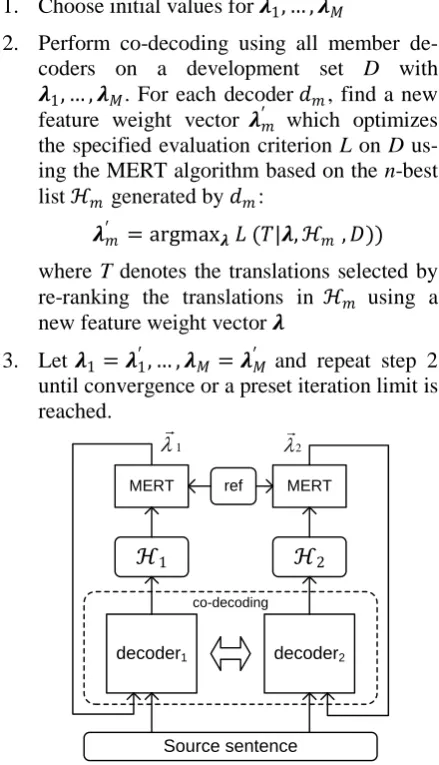
We adapt the Minimum Error Rate Training (MERT) (Och, 2003) algorithm to estimate pa-rameters for each member model in co-decoding. Let 𝝀𝑚 be the feature weight vector for member
decoder 𝑑𝑚, the training procedure proceeds as follows:
1. Choose initial values for 𝝀1, … , 𝝀𝑀
2. Perform co-decoding using all member de-coders on a development set D with 𝝀1, … , 𝝀𝑀. For each decoder 𝑑𝑚, find a new
feature weight vector 𝝀𝑚′ which optimizes the specified evaluation criterion L on D us-ing the MERT algorithm based on the n-best list ℋ𝑚 generated by 𝑑𝑚:
𝝀𝑚′ = argmax𝝀 𝐿 (𝑇|𝝀, ℋ𝑚 , 𝐷))
where T denotes the translations selected by re-ranking the translations in ℋ𝑚 using a new feature weight vector 𝝀
3. Let 𝝀1= 𝝀1′, … , 𝝀𝑀 = 𝝀𝑀′ and repeat step 2
[image:4.595.305.525.247.630.2]until convergence or a preset iteration limit is reached.
Figure 1. Model training for co-decoding
In step 2, there is no global criterion to optim-ize the co-decoding parameters across member models. Instead, parameters of different member models are tuned to maximize the evaluation cri-teria on each member decoder’s own n-best out-put. Figure 1 illustrates the training process of co-decoding with 2 member decoders.
Source sentence decoder1 decoder2
ℋ1
MERT
ℋ2
MERT
co-decoding
ref 1
2
2.6 Output Selection
Since there is more than one model in co-decoding, we cannot rely on member model’s score function to choose one best translation from multiple decoders’ outputs because the model scores are not directly comparable. We will examine the following two system combina-tion -based solucombina-tions to this task:
Word-level system combination (Rosti et al., 2007) of member decoders’ n-best outputs
Hypothesis selection from combined n-best lists as proposed in Hildebrand and Vogel (2008)
3
Experiments
In this section we present experiments to eva-luate the co-decoding method. We first describe the data sets and baseline systems.
3.1 Data and Metric
We conduct our experiments on the test data from the NIST 2005 and NIST 2008 Chinese-to-English machine translation tasks. The NIST 2003 test data is used for development data to estimate model parameters. Statistics of the data sets are shown in Table 1. In our experiments all the models are optimized with case-insensitive NIST version of BLEU score and we report re-sults using this metric in percentage numbers.
Data set # Sentences # Words NIST 2003 (dev) 919 23,782 NIST 2005 (test) 1,082 29,258 NIST 2008 (test) 1,357 31,592
Table 1: Data set statistics
We use the parallel data available for the NIST 2008 constrained track of Chinese-to-English machine translation task as bilingual training data, which contains 5.1M sentence pairs, 128M Chinese words and 147M English words after pre-processing. GIZA++ is used to perform word alignment in both directions with default settings, and the intersect-diag-grow me-thod is used to generate symmetric word align-ment refinealign-ment.
The language model used for all models (in-clude decoding models and system combination models described in Section 2.6) is a 5-gram model trained with the English part of bilingual data and xinhua portion of LDC English Giga-word corpus version 3.
3.2 Member Decoders
We use three baseline decoders in the experi-ments. The first one (SYS1) is re-implementation of Hiero, a hierarchical phrase-based decoder. Phrasal rules are extracted from all bilingual sen-tence pairs, while rules with variables are ex-tracted only from selected data sets including LDC2003E14, LDC2003E07, LDC2005T06 and LDC2005T10, which contain around 350,000 sentence pairs, 8.8M Chinese words and 10.3M English words. The second one (SYS2) is a BTG decoder with lexicalized reordering model based on maximum entropy principle as proposed by Xiong et al. (2006). We use all the bilingual data to extract phrases up to length 3. The third one (SYS3) is a string-to-dependency tree –based decoder as proposed by Shen et al. (2008). For rule extraction we use the same setting as in SYS1. We parsed the language model training data with Berkeley parser, and then trained a de-pendency language model based on the parsing output. All baseline decoders are extended with
n-gram consensus –based co-decoding features to construct member decoders. By default, the beam size of 20 is used for all decoders in the experiments. We run two iterations of decoding for each member decoder, and hold the value of 𝛼 in Equation 5 as a constant 0.05, which is tuned on the test data of NIST 2004 Chinese-to-English machine translation task.
3.3 Translation Results
We first present the overall results of co-decoding on both test sets using the settings as we described. For member decoders, up to 4-gram agreement and disagreement features are used. We also implemented the word-level sys-tem combination (Rosti et al., 2007) and the hy-pothesis selection method (Hildebrand and Vogel, 2008). 20-best translations from all decoders are used in the experiments for these two combina-tion methods. Parameters for both system com-bination and hypothesis selection are also tuned on NIST 2003 test data. The results are shown in Table 2.
NIST 2005 NIST 2008 SYS1 38.66/40.08 27.67/29.19 SYS2 38.04/39.93 27.25/29.14 SYS3 39.50/40.32 28.75/29.68 Word-level Comb 40.45/40.85 29.52/30.35 Hypo Selection 40.09/40.50 29.02/29.71
In the Table 2, the results of a member decod-er and its corresponding baseline decoddecod-er are grouped together with the later one for the mem-ber decoders. On both test sets, every memmem-ber decoder performs significantly better than its baseline decoder (using the method proposed in Koehn (2004) for statistical significance test).
We apply system combination methods to the
n-best outputs of both baseline decoders and member decoders. We notice that we can achieve even better performance by applying system combination methods to member decoders’ n -best outputs. However, the improvement margins are smaller than those of baseline decoders on both test sets. This could be the result of less di-versified outputs from co-decoding than those from baseline decoders. In particular, the results for hypothesis selection are only slightly better than the best system in co-decoding.
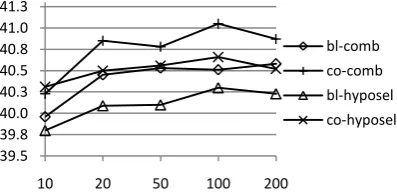
[image:6.595.79.278.476.572.2]We also evaluate the performance of system combination using different n-best sizes, and the results on NIST 2005 data set are shown in Fig-ure 2, where bl- and co- legends denote combina-tion results of baseline decoding and co-decoding respectively. From the results we can see that combination based on co-decoding’s outputs per-forms consistently better than that based on base-line decoders’ outputs for all n-best sizes we ex-perimented with. However, we did not observe any significant improvements for both combina-tion schemes when n-best size is larger than 20.
Figure 2. Performance of system combination with different sizes of n-best lists
One interesting observation in Table 2 is that the performance gap between baseline decoders is narrowed through co-decoding. For example, the 1.5 points gap between SYS2 and SYS3 on NIST 2008 data set is narrowed to 0.5. Actually we find that the TER score between two member decoders’ outputs are significantly reduced (as shown in Table 3), which indicates that the out-puts become more similar due to the use of con-sensus information. For example, the TER score between SYS2 and SYS3 of the NIST 2008 out-puts are reduced from 0.4238 to 0.2665.
NIST 2005 NIST 2008 SYS1 vs. SYS2 0.3190/0.2274 0.4016/0.2686 SYS1 vs. SYS3 0.3252/0.1840 0.4176/0.2469 SYS2 vs. SYS3 0.3498/0.2171 0.4238/0.2665
Table 3: TER scores between co-decoding translation outputs
In the rest of this section we run a series of experiments to investigate the impacts of differ-ent factors in co-decoding. All the results are reported on NIST 2005 test set.
We start with investigating the performance gain due to partial hypothesis re-ranking. Be-cause Equation 3 is a general model that can be applied to both partial hypothesis and n-best (full hypothesis) re-scoring, we compare the results of both cases. Figure 3 shows the BLEU score curves with up to 1000 candidates used for re-ranking. In Figure 3, the suffix p denotes results for partial hypothesis re-ranking, and f for n-best ranking only. For partial hypothesis ranking, obtaining more top-ranked results re-quires increasing the beam size, which is not af-fordable for large numbers in experiments. We work around this issue by approximating beam sizes larger than 20 by only enlarging the beam size for the span covering the entire source sen-tence. From Figure 3 we can see that all decoders can gain improvements before the size of candi-date set reaches 100. When the size is larger than 50, co-decoding performs consistently and sig-nificantly better than the re-ranking results on any baseline decoder’s n-best outputs.
Figure 3. Partial hypothesis vs. n-best re-ranking results on NIST 2005 test data
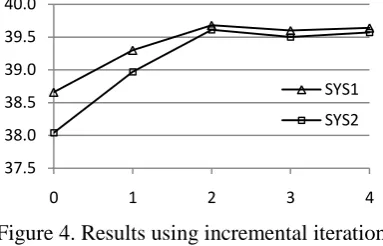
Figure 4 shows the BLEU scores of a two-system co-decoding as a function of re-decoding iterations. From the results we can see that the results for both decoders converge after two ite-rations.
In Figure 4, iteration 0 denotes decoding with baseline model. The setting of iteration 1 can be viewed as the case of partial co-decoding, in
39.5 39.8 40.0 40.3 40.5 40.8 41.0 41.3
10 20 50 100 200
bl-comb co-comb bl-hyposel co-hyposel
38.0 38.5 39.0 39.5 40.0 40.5 41.0 41.5
10 20 50 100 200 500 1000
[image:6.595.316.520.510.615.2]which one decoder uses member model and the other keeps using baseline model. The results show that member models help each other: al-though improvements can be made using a single member model, best BLEU scores can only be achieved when both member models are used as shown by the results of iteration 2. The results also help justify the independent parameter esti-mation of member decoders described in Section 2.5, since optimizing the performance of one de-coder will eventually bring performance im-provements to all member decoders.
Figure 4. Results using incremental iterations in co-decoding
Next we examine the impacts of different con-sensus-based features in co-decoding. Table 4 shows the comparison results of a two-system co-decoding using different settings of n-gram agreement and disagreement features. It is clear-ly shown that both n-gram agreement and disa-greement types of features are helpful, and using them together is the best choice.
SYS1 SYS2 Baseline 38.66 38.04 +agreement –disagreement 39.36 39.02 –agreement +disagreement 39.12 38.67 +agreement +disagreement 39.68 39.61
Table 4: Co-decoding with/without n-gram agreement and disagreement features
In Table 5 we show in another dimension the impact of consensus-based features by restricting the maximum order of n-grams used to compute agreement statistics.
[image:7.595.82.274.232.355.2]SYS1 SYS2 1 38.75 38.27 2 39.21 39.10 3 39.48 39.25 4 39.68 39.61 5 39.52 39.36 6 39.58 39.47
Table 5: Co-decoding with varied n-gram agree-ment and disagreeagree-ment features
From the results we do not observe BLEU im-provement for 𝑛 > 4. One reason could be that the data sparsity for high-order n-grams leads to over fitting on development data.
We also empirically investigated the impact of scaling factor 𝛼 in Equation 5. It is observed in Figure 5 that the optimal value is between 0.01 ~ 0.1 on both development and test data.
Figure 5. Impact of scaling factor 𝛼
4
Discussion
Word-level system combination (system combi-nation hereafter) (Rosti et al., 2007; He et al., 2008) has been proven to be an effective way to improve machine translation quality by using outputs from multiple systems. Our method is different from system combination in several ways. System combination uses unigram consen-sus only and a standalone decoding model irrele-vant to single decoders. Our method uses agree-ment information of n-grams, and consensus fea-tures are integrated into decoding models. By constructing a confusion network, system com-bination is able to generate new translations dif-ferent from any one in the input n-best lists, while our method does not extend the search spaces of baseline decoding models. Member decoders only change the scoring and ranking of the candidates in the search spaces. Results in Table 2 show that these two approaches can be used together to obtain further improvements.
The work on multi-system hypothesis selec-tion of Hildebrand and Vogel (2008) bears more resemblance to our method in that both make use of n-gram agreement statistics. They also empiri-cally show that n-gram agreement is the most important factor for improvement apart from language models.
Lattice MBR decoding (Tromble et al., 2008) also uses n-gram agreement statistics. Their work focuses on exploring larger evidence space by using a translation lattice instead of the n-best list. They also show the connection between expected
n-gram change and corpus Log-BLEU loss. 37.5
38.0 38.5 39.0 39.5 40.0
0 1 2 3 4
SYS1 SYS2
38.0 38.5 39.0 39.5 40.0
0 0.01 0.03 0.05 0.1 0.2 0.5 1
Dev SYS1
Dev SYS2
Test SYS1
[image:7.595.134.227.640.735.2]5
Conclusion
Improving machine translation with multiple sys-tems has been a focus in recent SMT research. In this paper, we present a framework of collabora-tive decoding, in which multiple MT decoders are coordinated to search for better translations by re-ranking partial hypotheses using aug-mented log-linear models with translation con-sensus -based features. An iterative approach is proposed to re-rank all hypotheses explored in decoding. Experimental results show that with collaborative decoding every member decoder performs significantly better than its baseline decoder. In the future, we will extend our method to use lattice or hypergraph to compute consen-sus statistics instead of n-best lists.
References
Necip Fazil Ayan, Jing Zheng, and Wen Wang. 2008. Improving alignments for better confusion net-works for combining machine translation systems. In Proc. Coling, pages 33-40.
Srinivas Bangalore, German Bordel and Giuseppe Riccardi. 2001. Computing consensus translation from multiple machine translation systems. In
Proc. ASRU, pages 351-354.
David Chiang. 2005. A hierarchical phrase-based model for statistical machine translation. In Proc. ACL, pages 263-270.
Xiaodong He, Mei Yang, Jianfeng Gao, Patrick Nguyen, and Robert Moore. 2008. Indirect-hmm-based hypothesis for combining outputs from ma-chine translation systems. In Proc. EMNLP, pages 98-107.
Almut Silja Hildebrand and Stephan Vogel. 2008. Combination of machine translation systems via hypothesis selection from combined n-best lists. In
8th AMTA conference, pages 254-261.
Philipp Koehn, 2004. Statistical significance tests for machine translation evaluation. In Proc. EMNLP. Philipp Koehn, 2004. Pharaoh: a beam search decoder
for phrase-based statistical machine translation model. In Proc. 6th AMTA Conference, pages 115-124.
Philipp Koehn, Hieu Hoang, Alexandra Brich, Chris Callison-Burch, Marcello Federico, Nicola Bertol-di, Brooke Cowan, Wade Shen, Christine Moran, Richard Zens, Chris Dyer, Ondrej Bojar, Alexandra Constantin, Evan Herbst. 2007. Moses: open source toolkit for statistical machine translation. In
Proc. ACL, demonstration session.
Shankar Kumar and William Byrne 2004. Minimum Bayes-Risk Decoding for Statistical Machine Translation. In HLT-NAACL, pages 169-176. Yang Liu, Qun Liu, Shouxun Lin. 2006.
Tree-to-string alignment template for statistical machine translation. In Proc. ACL-Coling, pages 609-616. Evgeny Matusov, Nicola Ueffi ng, and Hermann Ney.
2006. Computing consensus translation from mul-tiple machine translation systems using enchanced hypotheses alignment. In Proc. EACL, pages 33-40.
Franz Och and Hermann Ney. 2002. Discriminative training and maximum entropy models for statis-tical machine translation. In Proc. ACL, pages 295-302.
Franz Och. 2003. Minimum error rate training in sta-tistical machine translation. In Proc. ACL, pages 160-167.
Franz Och and Hermann Ney. 2004. The alignment template approach to statistical machine transla-tion. Computational Linguistics, 30(4), pages 417-449
Antti-Veikko Rosti, Necip Fazil Ayan, Bing Xiang, Spyros Matsoukas, Richard Schwartz, and Bonnie Dorr. 2007. Combining outputs from multiple ma-chine translation systems. In HLT-NAACL, pages 228-235
Antti-Veikko Rosti, Bing Zhang, Spyros Matsoukas, and Richard Schwartz. 2008. Incremental hypothe-sis alignment for building confusion networks with application to machine translation system combina-tion. In Proc. Of the Third ACL Workshop on Sta-tistical Machine Translation, pages 183-186. K.C. Sim, W. Byrne, M. Gales, H. Sahbi, and P.
Woodland. 2007. Consensus network decoding for statistical machine translation system combination. In ICASSP.
Libin Shen, Jinxi Xu, and Ralph Weischedel. 2008. A new string-to-dependency machine translation al-gorithm with a target dependency language model. In Proc. HLT-ACL, pages 577-585.
Roy W. Tromble, Shankar Kumar, Franz Och, and Wolfgang Macherey. 2008. Lattice minimum bayes-risk decoding for statistical machine transla-tion. In Proc. EMNLP, pages 620-629.