Fast Consensus Decoding over Translation Forests
John DeNero David Chiang and Kevin Knight Computer Science Division Information Sciences Institute University of California, Berkeley University of Southern California
[email protected] {chiang, knight}@isi.edu
Abstract
The minimum Bayes risk (MBR) decoding ob-jective improves BLEU scores for machine trans-lation output relative to the standard Viterbi ob-jective of maximizing model score. However, MBR targeting BLEU is prohibitively slow to op-timize overk-best lists for largek. In this pa-per, we introduce and analyze an alternative to MBR that is equally effective at improving per-formance, yet is asymptotically faster — running 80 times faster than MBR in experiments with 1000-best lists. Furthermore, our fast decoding procedure can select output sentences based on distributions over entire forests of translations, in addition tok-best lists. We evaluate our proce-dure on translation forests from two large-scale, state-of-the-art hierarchical machine translation systems. Our forest-based decoding objective consistently outperformsk-best list MBR, giving improvements of up to 1.0 BLEU.
1 Introduction
In statistical machine translation, output transla-tions are evaluated by their similarity to human reference translations, where similarity is most of-ten measured by BLEU (Papineni et al., 2002). A decoding objective specifies how to derive final translations from a system’s underlying statistical model. The Bayes optimal decoding objective is to minimize risk based on the similarity measure used for evaluation. The corresponding minimum Bayes risk (MBR) procedure maximizes the ex-pected similarity score of a system’s translations relative to the model’s distribution over possible translations (Kumar and Byrne, 2004). Unfortu-nately, with a non-linear similarity measure like BLEU, we must resort to approximating the ex-pected loss using ak-best list, which accounts for only a tiny fraction of a model’s full posterior dis-tribution. In this paper, we introduce a variant of the MBR decoding procedure that applies effi-ciently to translation forests. Instead of maximiz-ing expected similarity, we express similarity in terms of features of sentences, and choose transla-tions that are similar to expected feature values.
Our exposition begins with algorithms over k -best lists. A na¨ıve algorithm for finding MBR translations computes the similarity between every pair ofksentences, entailingO(k2)comparisons. We show that if the similarity measure is linear in features of a sentence, then computing expected similarity for allksentences requires onlyk sim-ilarity evaluations. Specific instances of this gen-eral algorithm have recently been proposed for two linear similarity measures (Tromble et al., 2008; Zhang and Gildea, 2008).
However, the sentence similarity measures we want to optimize in MT are notlinear functions, and so this fast algorithm for MBR does not ap-ply. For this reason, we propose a new objective that retains the benefits of MBR, but can be op-timized efficiently, even for non-linear similarity measures. In experiments using BLEU over 1000-best lists, we found that our objective provided benefits very similar to MBR, only much faster.
This same decoding objective can also be com-puted efficiently from forest-based expectations. Translation forests compactly encode distributions over much larger sets of derivations and arise nat-urally in chart-based decoding for a wide variety of hierarchical translation systems (Chiang, 2007; Galley et al., 2006; Mi et al., 2008; Venugopal et al., 2007). The resulting forest-based decoding procedure compares favorably in both complexity and performance to the recently proposed lattice-based MBR (Tromble et al., 2008).
The contributions of this paper include a linear-time algorithm for MBR using linear similarities, a linear-time alternative to MBR using non-linear similarity measures, and a forest-based extension to this procedure for similarities based onn-gram counts. In experiments, we show that our fast pro-cedure is on average 80 times faster than MBR using 1000-best lists. We also show that using forests outperforms usingk-best lists consistently across language pairs. Finally, in the first pub-lished multi-system experiments on consensus
coding for translation, we demonstrate that bene-fits can differ substantially across systems. In all, we show improvements of up to 1.0 BLEU from consensus approaches for state-of-the-art large-scale hierarchical translation systems.
2 Consensus Decoding Algorithms
Letebe a candidate translation for a sentence f, whereemay stand for a sentence or its derivation as appropriate. Modern statistical machine trans-lation systems take as input somefand score each derivation e according to a linear model of fea-tures:P
iλi·θi(f, e). The standard Viterbi decod-ing objective is to finde∗ =arg maxeλ·θ(f, e).
For MBR decoding, we instead leverage a sim-ilarity measureS(e;e0)to choose a translation us-ing the model’s probability distribution P(e|f), which has support over a set of possible transla-tionsE. The Viterbi derivatione∗ is the mode of this distribution. MBR is meant to choose a trans-lation that will be similar, on expectation, to any possible reference translation. To this end, MBR chooses e˜that maximizes expected similarity to the sentences inEunder P(e|f):1
˜
e = arg maxeEP(e0|f)S(e;e0) = arg maxe X
e0∈E
P(e0|f)·S(e;e0)
MBR can also be interpreted as a consensus de-coding procedure: it chooses a translation similar to other high-posterior translations. Minimizing risk has been shown to improve performance for MT (Kumar and Byrne, 2004), as well as other language processing tasks (Goodman, 1996; Goel and Byrne, 2000; Kumar and Byrne, 2002; Titov and Henderson, 2006; Smith and Smith, 2007).
The distribution P(e|f) can be induced from a translation system’s features and weights by expo-nentiating with basebto form a log-linear model:
P(e|f) = b λ·θ(f,e) P
e0∈Ebλ·θ(f,e 0)
We follow Ehling et al. (2007) in choosingbusing a held-out tuning set. For algorithms in this sec-tion, we assume that E is ak-best list andb has been chosen already, so P(e|f)is fully specified.
1
Typically, MBR is defined as arg mine∈EE[L(e;e 0
)]for some loss functionL, for example1−BLEU(e;e0). These definitions are equivalent.
2.1 Minimum Bayes Risk over Sentence Pairs
Given any similarity measure S and a k-best list E, the minimum Bayes risk translation can be found by computing the similarity between all pairs of sentences inE, as in Algorithm 1.
Algorithm 1MBR over Sentence Pairs
1: A← −∞
2: fore∈Edo
3: Ae ←0 4: fore0 ∈E do
5: Ae←Ae+P(e0|f)·S(e;e0) 6: ifAe > AthenA,˜e←Ae, e 7: return˜e
We can sometimes exit the innerforloop early, whenever Ae can never become larger than A (Ehling et al., 2007). Even with this shortcut, the running time of Algorithm 1 isO(k2·n), where nis the maximum sentence length, assuming that S(e;e0)can be computed inO(n)time.
2.2 Minimum Bayes Risk over Features
We now consider the case whenS(e;e0) is a lin-ear function of sentence features. LetS(e;e0) be a function of the form P
jωj(e)·φj(e0), where φj(e0)are real-valued features ofe0, andωj(e)are sentence-specific weights on those features. Then, the MBR objective can be re-written as
arg maxe∈E EP(e0|f)S(e;e0)
=arg maxe X e0∈E
P(e0|f)·X j
ωj(e)·φj(e0)
=arg maxe X j
ωj(e)
" X
e0∈E
P(e0|f)·φj(e0)
#
=arg maxe X j
ωj(e)·EP(e0|f)φj(e0). (1)
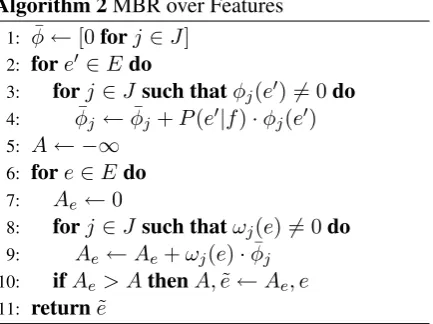
Algorithm 2MBR over Features 1: φ¯←[0forj ∈J]
2: fore0 ∈Edo
3: forj∈J such thatφj(e0)6= 0do 4: φ¯j ←φ¯j+P(e0|f)·φj(e0)
5: A← −∞
6: fore∈Edo
7: Ae ←0
8: forj∈J such thatωj(e)6= 0do 9: Ae←Ae+ωj(e)·φ¯j
10: ifAe> AthenA,e˜←Ae, e 11: return˜e
An example of a linear similarity measure is bag-of-words precision, which can be written as:
U(e;e0) =X t∈T1
δ(e, t) |e| ·δ(e
0, t)
where T1 is the set of unigrams in the language, and δ(e, t) is an indicator function that equals 1 ift appears ineand 0 otherwise. Figure 1 com-pares Algorithms 1 and 2 using U(e;e0). Other linear functions have been explored for MBR, in-cluding Taylor approximations to the logarithm of BLEU (Tromble et al., 2008) and counts of match-ing constituents (Zhang and Gildea, 2008), which are discussed further in Section 3.3.
2.3 Fast Consensus Decoding using Non-Linear Similarity Measures
Most similarity measures of interest for machine translation are not linear, and so Algorithm 2 does not apply. Computing MBR even with simple non-linear measures such as BLEU, NIST or bag-of-words F1 seems to requireO(k2) computation time. However, these measures are all functions of features ofe0. That is, they can be expressed as S(e;φ(e0))for a feature mappingφ:E→Rn.
For example, we can express BLEU(e;e0) =
exp "
„ 1−|e
0
| |e| «
−
+1 4
4 X
n=1 ln
P
t∈Tnmin(c(e, t), c(e
0 , t)) P
t∈Tnc(e, t)
#
In this expression, BLEU(e;e0)referencese0only via itsn-gram count featuresc(e0, t).2
2
The length penalty“1−||ee0||”
−is also a function of n-gram counts:|e0|=P
t∈T1c(e 0
, t). The negative part oper-ator(·)−is equivalent tomin(·,0).
Choose a distribution P over a set of translations E
MBR over Sentence Pairs
Compute pairwise similarity Compute expectations
Max expected similarity Max feature similarity 3/3 1/4 2/5
1/3 4/4 0/5 2/3 0/4 5/5
MBR over Features
E[δ(efficient)] = 0.6
E[δ(forest)] = 0.7
E[δ(decoding)] = 0.7
E[δ(for)] = 0.3
E[δ(rusty)] = 0.3
E[δ(coating)] = 0.3
E[δ(a)] = 0.4
E[δ(fish)] = 0.4
E[δ(ain’t)] = 0.4 c1 c2 c3
r1
r2
r3
1
2
3
2
3
I ... telescope
Yo vi al hombre con el telescopio I ... saw the ... man with ... telescope
the ... telescope 0.4
“saw the” “man with”
0.6 “saw the”
1.0 “man with”
E[r(man with)] = 0.4 + 0.6·1.0
50.0 50.2 50.4 50.6 50.8
511,660 513,245 514,830
Total model score for 1000 translations
Corpus BLEU
0 22.5 45.0 67.5 90.0
Hiero SBMT
70.2 84.6
56.6 61.4
51.1 50.5
Viterbi n-gram precision
Forest n-gram precision at Viterbi recall Forest n-gram precision for Er(t) ! 1
Forest samples (b!2) Forest samples (b!5) Viterbi translations
U(e2;e1) =
|efficient| |efficient for rusty coating|
EU(e1;e!) = 0.3(1+13)+0.4·23
= 0.667
EU(e2;e!) = 0.375 EU(e3;e!) = 0.520
U(e1;Eφ) =
0.6+0.7+0.7 3 = 0.667 U(e2;Eφ) = 0.375
U(e3;Eφ) = 0.520
P(e1|f) = 0.3 ; e1= efficient forest decoding
P(e2|f) = 0.3 ; e2= efficient for rusty coating
[image:3.595.75.292.67.229.2]P(e3|f) = 0.4 ; e3= A fish ain’t forest decoding
Figure 1: For the linear similarity measureU(e;e0), which computes unigram precision, the MBR translation can be found by iterating either over sentence pairs (Algorithm 1) or over features (Algorithm 2). These two algorithms take the same input (step 1), but diverge in their consensus computa-tions (steps 2 & 3). However, they produce identical results forUand any other linear similarity measure.
Following the structure of Equation 1, we can choose a translationebased on the feature expec-tations ofe0. In particular, we can choose
˜
e=arg maxe∈ES(e;EP(e0|f)φ(e0)). (2)
Algorithm 3Fast Consensus Decoding 1: φ¯←[0forj ∈J]
2: fore0 ∈Edo
3: forj∈J such thatφj(e0)6= 0do 4: φ¯j ←φ¯j+P(e0|f)·φj(e0)
5: A← −∞
6: fore∈Edo
7: Ae ←S(e; ¯φ)
8: ifAe> AthenA,e˜←Ae, e 9: return˜e
As described, Algorithm 3 can use any sim-ilarity measure that is defined in terms of real-valued features of e0. There are some nuances of this procedure, however. First, the precise form of S(e;φ(e0)) will affect the output, but S(e;E[φ(e0)]) is often an input point for which a sentence similarity measureS was not originally defined. For example, our definition of BLEU above will have integer valued φ(e0) for any real sentencee0, butE[φ(e0)]will not be integer valued. As a result, we are extending the domain of BLEU beyond its original intent. One could imagine dif-ferent feature-based expressions that also produce BLEU scores for real sentences, but produce dif-ferent values for fractional features. Some care must be taken to defineS(e;φ(e0))to extend nat-urally from integer-valued to real-valued features. Second, while any similarity measure can in principle be expressed as S(e;φ(e0)) for a suffi-ciently rich feature space, fast consensus decoding will not apply effectively to all functions. For stance, we cannot naturally use functions that in-clude alignments or matchings between eande0, such as METEOR (Agarwal and Lavie, 2007) and TER (Snover et al., 2006). Though these functions can in principle be expressed in terms of features ofe0(for instance with indicator features for whole sentences), fast consensus decoding will only be effective if different sentences share many fea-tures, so that the feature expectations effectively capture trends in the underlying distribution.
3 Computing Feature Expectations
We now turn our focus to efficiently comput-ing feature expectations, in service of our fast consensus decoding procedure. Computing fea-ture expectations from k-best lists is trivial, but k-best lists capture very little of the underlying model’s posterior distribution. In place of k-best
Choose a distribution P over a set of translations E
MBR over Sentence Pairs
Compute pairwise similarity Compute expectations
Max expected similarity Max feature similarity 3/3 1/4 2/5
1/3 4/4 0/5 2/3 0/4 5/5
MBR over Features
E[δ(efficient)] = 0.6 E[δ(forest)] = 0.7 E[δ(decoding)] = 0.7 E[δ(for)] = 0.3 E[δ(rusty)] = 0.3 E[δ(coating)] = 0.3 E[δ(a)] = 0.4 E[δ(fish)] = 0.4 E[δ(ain’t)] = 0.4
c1 c2 c3
r1
r2
r3 1
2
3
2
3
50.0 50.2 50.4 50.6 50.8
511,660 513,245 514,830 Total model score for 1000 translations
Corpus BLEU
0 20 40 60 80
Hiero SBMT 56.6 61.4
51.1 50.5
N-grams from baseline translation N-grams with high expected count
Forest samples (b!2) Forest samples (b!5) Viterbi translations U(e2;e1) =
|efficient| |efficient for rusty coating|
EU(e1;e!) = 0.3(1+
1 3)+0.4·
2 3 = 0.667
EU(e2;e!) = 0.375 EU(e3;e!) = 0.520
U(e1;Eφ) =0
.6+0.7+0.7 3 = 0.667 U(e2;Eφ) = 0.375
U(e3;Eφ) = 0.520
P(e1|f) = 0.3 ; e1= efficient forest decoding
P(e2|f) = 0.3 ; e2= efficient for rusty coating
P(e3|f) = 0.4 ; e3= A fish ain’t forest decoding
I ... telescope
Yo vi al hombre con el telescopio I ... saw the ... man with ... telescope
the ... telescope 0.4
“saw the” “man with”
0.6 “saw the”
1.0 “man with”
E[c(e,“man with”)] = ! h
P(h|f)·c(h,“man with”)
[image:4.595.309.523.60.246.2]= 0.4·1 + (0.6·1.0)·1
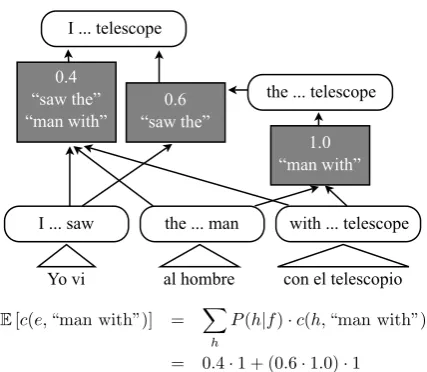
Figure 2: This translation forest for a Spanish sentence en-codes two English parse trees. Hyper-edges (boxes) are an-notated with normalized transition probabilities, as well as the bigrams produced by each rule application. The expected count of the bigram “man with” is the sum of posterior prob-abilities of the two hyper-edges that produce it. In this exam-ple, we normalized inside scores at all nodes to 1 for clarity.
lists, compact encodings of translation distribu-tions have proven effective for MBR (Zhang and Gildea, 2008; Tromble et al., 2008). In this sec-tion, we consider BLEU in particular, for which the relevant featuresφ(e)aren-gram counts up to lengthn = 4. We show how to compute expec-tations of these counts efficiently from translation forests.
3.1 Translation Forests
Translation forests compactly encode an exponen-tial number of output translations for an input sentence, along with their model scores. Forests arise naturally in chart-based decoding procedures for many hierarchical translation systems (Chiang, 2007). Exploiting forests has proven a fruitful av-enue of research in both parsing (Huang, 2008) and machine translation (Mi et al., 2008).
Formally, translation forests are weighted acyclic hyper-graphs. The nodes are states in the decoding process that include the span(i, j)of the sentence to be translated, the grammar symbol s over that span, and the left and right context words of the translation relevant for computingn-gram language model scores.3 Each hyper-edgeh rep-resents the application of a synchronous rulerthat combines nodes corresponding to non-terminals in
rinto a node spanning the union of the child spans and perhaps some additional portion of the input sentence covered directly byr’s lexical items. The weight of h is the incremental score contributed to all translations containing the rule application, including translation model features onrand lan-guage model features that depend on both r and the English contexts of the child nodes. Figure 2 depicts a forest.
Eachn-gram that appears in a translationeis as-sociated with somehin its derivation: theh corre-sponding to the rule that produces then-gram. Un-igrams are produced by lexical rules, while higher-ordern-grams can be produced either directly by lexical rules, or by combining constituents. The n-gram language model score of e similarly de-composes over thehinethat producen-grams. 3.2 Computing Expected N-Gram Counts
We can compute expected n-gram counts effi-ciently from a translation forest by appealing to the linearity of expectations. Letφ(e)be a vector ofn-gram counts for a sentencee. Then,φ(e)is the sum of hyper-edge-specificn-gram count vec-tors φ(h) for all h in e. Therefore, E[φ(e)] =
P
h∈eE[φ(h)].
To compute n-gram expectations for a hyper-edge, we first compute the posterior probability of eachh, conditioned on the input sentencef:
P(h|f) = X e:h∈e
bλ·θ(f,e)
! X
e
bλ·θ(f,e)
!−1
,
whereeiterates over translations in the forest. We compute the numerator using the inside-outside al-gorithm, while the denominator is the inside score of the root node. Note that many possible deriva-tions offare pruned from the forest during decod-ing, and so this posterior is approximate.
The expectedn-gram count vector for a hyper-edge is E[φ(h)] = P(h|f)·φ(h). Hence, after computingP(h|f)for everyh, we need only sum P(h|f)·φ(h) for allhto computeE[φ(e)]. This entire procedure is a linear-time computation in the number of hyper-edges in the forest.
To complete forest-based fast consensus de-coding, we then extract a k-best list of unique translations from the forest (Huang et al., 2006) and continue Algorithm 3 from line 5, which chooses the˜efrom thek-best list that maximizes BLEU(e;E[φ(e0)]).
3.3 Comparison to Related Work
Zhang and Gildea (2008) embed a consensus de-coding procedure into a larger multi-pass dede-coding framework. They focus on inversion transduction grammars, but their ideas apply to richer models as well. They propose an MBR decoding objective of maximizing the expected number of matching constituent counts relative to the model’s distri-bution. The corresponding constituent-matching similarity measure can be expressed as a linear function of features ofe0, which are indicators of constituents. Expectations of constituent indicator features are the same as posterior constituent prob-abilities, which can be computed from a transla-tion forest using the inside-outside algorithm. This forest-based MBR approach improved translation output relative to Viterbi translations.
Tromble et al. (2008) describe a similar ap-proach using MBR with a linear similarity mea-sure. They derive a first-order Taylor approxima-tion to the logarithm of a slightly modified defini-tion of corpus BLEU4, which is linear inn-gram indicator featuresδ(e0, t)ofe0. These features are weighted by n-gram countsc(e, t) and constants θthat are estimated from held-out data. The lin-ear similarity measure takes the following form, whereTnis the set ofn-grams:
G(e;e0) =θ0|e|+ 4 X
n=1 X
t∈Tn
θt·c(e, t)·δ(e0, t).
Using G, Tromble et al. (2008) extend MBR to word lattices, which improves performance over k-best list MBR.
Our approach differs from Tromble et al. (2008) primarily in that we propose decoding with an al-ternative to MBR using BLEU, while they propose decoding with MBR using a linear alternative to BLEU. The specifics of our approaches also differ in important ways.
First, word lattices are a subclass of forests that have only one source node for each edge (i.e., a graph, rather than a hyper-graph). While forests are more general, the techniques for computing posterior edge probabilities in lattices and forests are similar. One practical difference is that the forests needed for fast consensus decoding are
generated already by the decoder of a syntactic translation system.
Second, rather than use BLEU as a sentence-level similarity measure directly, Tromble et al. (2008) approximate corpus BLEU withGabove. The parametersθof the approximation must be es-timated on a held-out data set, while our approach requires no such estimation step.
Third, our approach is also simpler computa-tionally. The features required to computeGare indicatorsδ(e0, t); the features relevant to us are countsc(e0, t). Tromble et al. (2008) compute ex-pected feature values by intersecting the transla-tion lattice with a lattices for eachn-gramt. By contrast, expectations of c(e0, t) can all be com-puted with a single pass over the forest. This con-trast implies a complexity difference. LetHbe the number of hyper-edges in the forest or lattice, and T the number ofn-grams that can potentially ap-pear in a translation. Computing indicator expec-tations seems to requireO(H·T)time because of automata intersections. Computing count expec-tations requires O(H) time, because only a con-stant number ofn-grams can be produced by each hyper-edge.
Our approaches also differ in the space of trans-lations from whiche˜is chosen. A linear similar-ity measure likeGallows for efficient search over the lattice or forest, whereas fast consensus decod-ing restricts this search to ak-best list. However, Tromble et al. (2008) showed that most of the im-provement from lattice-based consensus decoding comes from lattice-based expectations, not search: searching over lattices instead of k-best lists did not change results for two language pairs, and im-proved a third language pair by 0.3 BLEU. Thus, we do not consider our use ofk-best lists to be a substantial liability of our approach.
Fast consensus decoding is also similar in char-acter to the concurrently developed variational de-coding approach of Li et al. (2009). Using BLEU, both approaches choose outputs that match ex-pectedn-gram counts from forests, though differ in the details. It is possible to define a similar-ity measure under which the two approaches are equivalent.5
5For example, decoding under a variational approxima-tion to the model’s posterior that decomposes over bigram probabilities is equivalent to fast consensus decoding with the similarity measureB(e;e0) = Q
t∈T2 h c(e0,t)
c(e0,h(t)) ic(e,t)
, whereh(t)is the unigram prefix of bigramt.
4 Experimental Results
We evaluate these consensus decoding techniques on two different full-scale state-of-the-art hierar-chical machine translation systems. Both systems were trained for 2008 GALE evaluations, in which they outperformed a phrase-based system trained on identical data.
4.1 Hiero: a Hierarchical MT Pipeline
Hiero is a hierarchical system that expresses its translation model as a synchronous context-free grammar (Chiang, 2007). No explicit syntactic in-formation appears in the core model. A phrase discovery procedure over word-aligned sentence pairs provides rule frequency counts, which are normalized to estimate features on rules.
The grammar rules of Hiero all share a single non-terminal symbol X, and have at most two non-terminals and six total items (non-terminals and lexical items), for example:
myX2’sX1 →X1 de miX2
We extracted the grammar from training data using standard parameters. Rules were allowed to span at most 15 words in the training data.
The log-linear model weights were trained us-ing MIRA, a margin-based optimization proce-dure that accommodates many features (Crammer and Singer, 2003; Chiang et al., 2008). In addition to standard rule frequency features, we included the distortion and syntactic features described in Chiang et al. (2008).
4.2 SBMT: a Syntax-Based MT Pipeline
SBMT is a string-to-tree translation system with rich target-side syntactic information encoded in the translation model. The synchronous grammar rules are extracted from word aligned sentence pairs where the target sentence is annotated with a syntactic parse (Galley et al., 2004). Rules map source-side strings to target-side parse tree frag-ments, and non-terminal symbols correspond to target-side grammatical categories:
Arabic-English
Objective Hiero SBMT
Min. Bayes Risk (Alg 1) 2h 47m 12h 42m Fast Consensus (Alg 3) 5m 49s 5m 22s
Speed Ratio 29 142
Chinese-English
Objective Hiero SBMT
Min. Bayes Risk (Alg 1) 10h 24m 3h 52m Fast Consensus (Alg 3) 4m 52s 6m 32s
[image:7.595.306.524.60.231.2]Speed Ratio 128 36
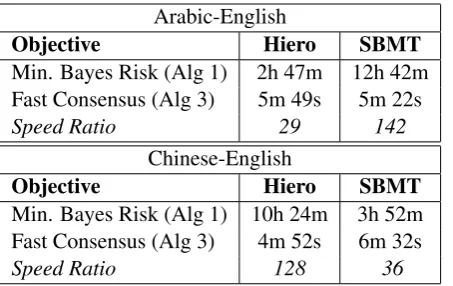
Table 1: Fast consensus decoding is orders of magnitude faster than MBR when using BLEU as a similarity measure. Times only include reranking, notk-best list extraction.
4.3 Data Conditions
We evaluated on both Chinese-English and Arabic-English translation tasks. Both Arabic-English systems were trained on 220 million words of word-aligned parallel text. For the Chinese-English experiments, we used 260 mil-lion words of word-aligned parallel text; the hi-erarchical system used all of this data, and the syntax-based system used a 65-million word sub-set. All four systems used two language models: one trained from the combined English sides of both parallel texts, and another, larger, language model trained on 2 billion words of English text (1 billion for Chinese-English SBMT).
All systems were tuned on held-out data (1994 sentences for Arabic-English, 2010 sentences for Chinese-English) and tested on another dataset (2118 sentences for Arabic-English, 1994 sen-tences for Chinese-English). These datasets were drawn from the NIST 2004 and 2005 evaluation data, plus some additional data from the GALE program. There was no overlap at the segment or document level between the tuning and test sets.
We tuned b, the base of the log-linear model, to optimize consensus decoding performance. In-terestingly, we found that tuning b on the same dataset used for tuningλwas as effective as tuning bon an additional held-out dataset.
4.4 Results overK-Best Lists
Taking expectations over 1000-best lists6 and us-ing BLEU7 as a similarity measure, both MBR
6We ensured thatk-best lists contained no duplicates. 7To prevent zero similarity scores, we also used a standard smoothed version of BLEU that added 1 to the numerator and denominator of alln-gram precisions. Performance results
Arabic-English
Expectations Similarity Hiero SBMT
Baseline - 52.0 53.9
104-best BLEU 52.2 53.9
Forest BLEU 53.0 54.0
Forest LinearG 52.3 54.0
Chinese-English
Expectations Similarity Hiero SBMT
Baseline - 37.8 40.6
104-best BLEU 38.0 40.7
Forest BLEU 38.2 40.8
Forest LinearG 38.1 40.8
Table 2: Translation performance improves when computing expected sentences from translation forests rather than104 -best lists, which in turn improve over Viterbi translations. We also contrasted forest-based consensus decoding with BLEU and its linear approximation,G. Both similarity measures are effective, but BLEU outperformsG.
and our variant provided consistent small gains of 0.0–0.2 BLEU. Algorithms 1 and 3 gave the same small BLEU improvements in each data condition up to three significant figures.
The two algorithms differed greatly in speed, as shown in Table 1. For Algorithm 1, we ter-minated the computation of E[BLEU(e;e0)] for each e whenever e could not become the maxi-mal hypothesis. MBR speed depended on how often this shortcut applied, which varied by lan-guage and system. Despite this optimization, our new Algorithm 3 was an average of 80 times faster across systems and language pairs.
4.5 Results for Forest-Based Decoding
Table 2 contrasts Algorithm 3 over104-best lists and forests. Computing E[φ(e0)] from a transla-tion forest rather than a104-best list improved Hi-ero by an additional 0.8 BLEU (1.0 over the base-line). Forest-based expectations always outper-formed k-best lists, but curiously the magnitude of benefit was not consistent across systems. We believe the difference is in part due to more ag-gressive forest pruning within the SBMT decoder. For forest-based decoding, we compared two similarity measures: BLEU and its linear Taylor approximationGfrom section 3.3.8 Table 2 shows were identical to standard BLEU.
[image:7.595.75.302.62.205.2]Choose a distribution P over a set of translations E
MBR over Sentence Pairs
Compute pairwise similarity Compute expectations
Max expected similarity Max feature similarity
3/3 1/4 2/5
1/3 4/4 0/5
2/3 0/4 5/5
MBR over Features
E[δ(efficient)] = 0.6
E[δ(forest)] = 0.7
E[δ(decoding)] = 0.7
E[δ(for)] = 0.3
E[δ(rusty)] = 0.3
E[δ(coating)] = 0.3
E[δ(a)] = 0.4
E[δ(fish)] = 0.4
E[δ(ain’t)] = 0.4 c1 c2 c3
r1
r2
r3
1
2
3
2
3
50.0 50.2 50.4 50.6 50.8
511,660 513,245 514,830
Total model score for 1000 translations
Corpus BLEU
0 20 40 60 80
Hiero SBMT
56.6 61.4
51.1 50.5
N-grams from baseline translations N-grams with high expected count
Forest samples (b!2)
Forest samples (b!5)
Viterbi translations
U(e2;e1) = |efficient|
|efficient for rusty coating|
EU(e1;e!) = 0.3(1+ 1 3)+0.4·
2 3 = 0.667
EU(e2;e!) = 0.375
EU(e3;e!) = 0.520
U(e1;Eφ) = 0.6+0.7+0.7 3 = 0.667 U(e2;Eφ) = 0.375
U(e3;Eφ) = 0.520
P(e1|f) = 0.3 ; e1= efficient forest decoding
P(e2|f) = 0.3 ; e2= efficient for rusty coating
P(e3|f) = 0.4 ; e3= A fish ain’t forest decoding
I ... telescope
Yo vi al hombre con el telescopio
I ... saw the ... man with ... telescope
the ... telescope 0.4
“saw the” “man with”
0.6 “saw the”
1.0 “man with”
E[c(e,“man with”)] = !
h
P(h|f)·c(h,“man with”)
= 0.4·1 + (0.6·1.0)·1
[image:8.595.75.286.60.202.2]N-gram Precision
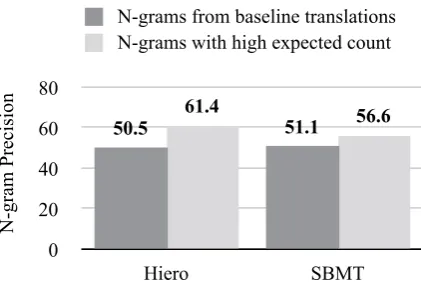
Figure 3:N-grams with high expected count are more likely to appear in the reference translation that n-grams in the translation model’s Viterbi translation,e∗. Above, we com-pare the precision, relative to reference translations, of sets of n-grams chosen in two ways. The left bar is the precision of then-grams ine∗. The right bar is the precision ofn-grams withE[c(e, t)]> ρ. To justify this comparison, we choseρ so that both methods of choosingn-grams gave the same n-gram recall: the fraction ofn-grams in reference translations that also appeared ine∗or hadE[c(e, t)]> ρ.
that both similarities were effective, but BLEU outperformed its linear approximation.
4.6 Analysis
Forest-based consensus decoding leverages infor-mation about the correct translation from the en-tire forest. In particular, consensus decoding with BLEU chooses translations using n-gram count expectations E[c(e, t)]. Improvements in translation quality should therefore be directly at-tributable to information in these expected counts. We endeavored to test the hypothesis that ex-pectedn-gram counts under the forest distribution carry more predictive information than the base-line Viterbi derivatione∗, which is the mode of the distribution. To this end, we first tested the pre-dictive accuracy of the n-grams proposed bye∗: the fraction of then-grams in e∗ that appear in a reference translation. We compared this n-gram precision to a similar measure of predictive accu-racy for expected n-gram counts: the fraction of the n-grams t with E[c(e, t)] ≥ ρ that appear in a reference. To make these two precisions com-parable, we chose ρ such that the recall of ref-erence n-grams was equal. Figure 3 shows that computingn-gram expectations—which sum over translations—improves the model’s ability to pre-dict which n-grams will appear in the reference. min(1,E[c(e0, t)]). Assuming ann-gram appears at most once per sentence, these expressions are equivalent, and this assumption holds for mostn-grams.
Reference translation:
Mubarak said that he received a telephone call from Sharon in which he said he was “ready (to resume ne-gotiations) but the Palestinians are hesitant.”
Baseline translation:
Mubarak said he had received a telephone call from Sharon told him he was ready to resume talks with the Palestinians.
Fast forest-based consensus translation:
Mubarak said that he had received a telephone call from Sharon told him that he “was ready to resume the nego-tiations) ,but the Palestinians are hesitant.”
Figure 4: Three translations of an example Arabic sentence: its human-generated reference, the translation with the high-est model score under Hiero (Viterbi), and the translation chosen by forest-based consensus decoding. The consensus translation reconstructs content lost in the Viterbi translation.
We attribute gains from fast consensus decoding to this increased predictive accuracy.
Examining the translations chosen by fast con-sensus decoding, we found that gains in BLEU of-ten arose from improved lexical choice. However, in our hierarchical systems, consensus decoding did occasionally trigger large reordering. We also found examples where the translation quality im-proved by recovering content that was missing from the baseline translation, as in Figure 4.
5 Conclusion
We have demonstrated substantial speed increases ink-best consensus decoding through a new pro-cedure inspired by MBR under linear similarity measures. To further improve this approach, we computed expected n-gram counts from transla-tion forests instead ofk-best lists. Fast consensus decoding using forest-basedn-gram expectations and BLEU as a similarity measure yielded con-sistent improvements over MBR withk-best lists, yet required only simple computations that scale linearly with the size of the translation forest.
The space of similarity measures is large and relatively unexplored, and the feature expectations that can be computed from forests extend beyond n-gram counts. Therefore, future work may show additional benefits from fast consensus decoding.
Acknowledgements
References
Abhaya Agarwal and Alon Lavie. 2007. METEOR: An automatic metric for MT evaluation with high levels of correlation with human judgments. In Pro-ceedings of the Workshop on Statistical Machine Translation for the Association of Computational Linguistics.
David Chiang, Yuval Marton, and Philip Resnik. 2008. Online large-margin training of syntactic and struc-tural translation features. InProceedings of the Con-ference on Empirical Methods in Natural Language Processing.
David Chiang. 2007. Hierarchical phrase-based trans-lation. Computational Linguistics.
Koby Crammer and Yoram Singer. 2003. Ultracon-servative online algorithms for multiclass problems.
Journal of Machine Learning Research, 3:951–991.
Steve DeNeefe, Kevin Knight, Wei Wang, and Daniel Marcu. 2007. What can syntax-based MT learn from phrase-based MT? InProceedings of the Con-ference on Empirical Methods in Natural Language Processing and CoNLL.
Nicola Ehling, Richard Zens, and Hermann Ney. 2007. Minimum Bayes risk decoding for BLEU. In Pro-ceedings of the Association for Computational Lin-guistics: Short Paper Track.
Michel Galley, Mark Hopkins, Kevin Knight, and Daniel Marcu. 2004. What’s in a translation rule? InProceedings of HLT: the North American Chapter of the Association for Computational Linguistics.
Michel Galley, Jonathan Graehl, Kevin Knight, Daniel Marcu, Steve DeNeefe, Wei Wang, and Ignacio Thayer. 2006. Scalable inference and training of context-rich syntactic translation models. In Pro-ceedings of the Association for Computational Lin-guistics.
Vaibhava Goel and William Byrne. 2000. Minimum Bayes-risk automatic speech recognition. In Com-puter, Speech and Language.
Joshua Goodman. 1996. Parsing algorithms and met-rics. InProceedings of the Association for Compu-tational Linguistics.
Liang Huang, Kevin Knight, and Aravind Joshi. 2006. Statistical syntax-directed translation with extended domain of locality. InProceedings of the Associa-tion for Machine TranslaAssocia-tion in the Americas.
Liang Huang. 2008. Forest reranking: Discriminative parsing with non-local features. In Proceedings of the Association for Computational Linguistics.
Shankar Kumar and William Byrne. 2002. Minimum Bayes-risk word alignments of bilingual texts. In
Proceedings of the Conference on Empirical Meth-ods in Natural Language Processing.
Shankar Kumar and William Byrne. 2004. Minimum Bayes-risk decoding for statistical machine transla-tion. InProceedings of the North American Chapter of the Association for Computational Linguistics.
Zhifei Li, Jason Eisner, and Sanjeev Khudanpur. 2009. Variational decoding for statistical machine transla-tion. InProceedings of the Association for Compu-tational Linguistics and IJCNLP.
Daniel Marcu, Wei Wang, Abdessamad Echihabi, and Kevin Knight. 2006. SPMT: Statistical machine translation with syntactified target language phrases. In Proceedings of the Conference on Empirical Methods in Natural Language Processing.
Haitao Mi, Liang Huang, and Qun Liu. 2008. Forest-based translation. InProceedings of the Association for Computational Linguistics.
Franz Josef Och. 2003. Minimum error rate training in statistical machine translation. InProceedings of the Association for Computational Linguistics.
Kishore Papineni, Salim Roukos, Todd Ward, and Wei-Jing Zhu. 2002. BLEU: A method for automatic evaluation of machine translation. In Proceedings of the Association for Computational Linguistics.
David Smith and Noah Smith. 2007. Probabilistic models of nonprojective dependency trees. In Pro-ceedings of the Conference on Empirical Methods in Natural Language Processing and CoNLL.
Matthew Snover, Bonnie Dorr, Richard Schwartz, Lin-nea Micciulla, and John Makhoul. 2006. A study of translation edit rate with targeted human annotation. InProceedings of Association for Machine Transla-tion in the Americas.
Ivan Titov and James Henderson. 2006. Loss mini-mization in parse reranking. InProceedings of the Conference on Empirical Methods in Natural Lan-guage Processing.
Roy Tromble, Shankar Kumar, Franz Josef Och, and Wolfgang Macherey. 2008. Lattice minimum Bayes-risk decoding for statistical machine transla-tion. InProceedings of the Conference on Empirical Methods in Natural Language Processing.
Ashish Venugopal, Andreas Zollmann, and Stephan Vogel. 2007. An efficient two-pass approach to synchronous-CFG driven statistical MT. In Pro-ceedings of HLT: the North American Association for Computational Linguistics Conference.