F A C T O R I N G R E C U R S I O N AND DEPENDENCIES: A N A S P E C T OF TREE A D J O I N I N G G R A M M A R S (TAG) A N D A C O M P A R I S O N OF SOME F O R M A L P R O P E R T I E S OF TAGS, GPSGS, PLGS, AND L P G S *
Aravind K. Joshi
D e p a r t m e n t of Computer and I n f o r m a t i o n Science R. 268 M o o r e School
U n i v e r s i t y of P e n n s y l v a n i a Philadelphia, PA 19104
I . I W r R O D U C T I O N
D u r i n g t h e l a s t few y e a r s t h e r e i s v i g o r o u s a c t i v i t y In c o n s t r u c t i n g highly c o n s t r a i n e d grammatical systems by e l i m i n a t i n g the transformational component either totally or partially. There is increasing r e c o g n i t i o n of t h e f a c t t h a t t h e e n t i r e r a n g e o f d e p e n d e n c i e s t h a t t r a n s f o r m a t i o n a l g r a m m a r s i n t h e i r v a r i o u s i n c a r n a t i o n s h a v e t r i e d t o a c c o u n t f o r c a n be s a t i s f a c t o r i l y captured by classes of rules that are n o n - t r a n s f o r m a t i o n a l and at the same Clme highly constrlaned in terms of the classes of g r a m m a r s a n d l a n g u a g e s t h a t t h e y de f i n e .
Two t y p e s o f d e p e n d e n c i e s a r e e s p e c i a l l y important: s u b c a t e g o r l z a t l o n and filler-gap d e p e n d e n c i e s . M o r e o v e r , t h e s e d e p e n d e n c i e s can be u n b o u n d e d . One o f t h e m o t i v a t i o n s f o r transformations was co account for u n b o u n d e d dependencies. The so-called
n o n - t r a n s f o r m a t i o n a l grammars account for the unbounded dependencies in different ways. In a cree-adJoinlng grammar (TAG), which has been introduced earlier in (Joshi,1982),
unhoundedness is achieved by factoring the dependencies and recursion in a novel and, we belleve, in a linguistically interesting manner. All dependencies are defined on a finite set of basic structures (trees) which are bounded. Unhoundedness is then a corollary of a p a r t i c u l a r c o m p o s i t i o n o p e r a t i o n called ad~olnlng. There are thus no unbounded dependencies in a sense.
In this paper, we will ~irsC briefly describe TAG's, w h i c h have the f o l l o w i n g
I m p o r t a n t properties: (l) we can represent the usual transformational relations more or less directly in TAG's, (2) the power of TAG's is o n l y slightly more than that of context-free grammars (CFG's) in what appears to be Just the right way, and (3) TAG's are powerful enough to c h a r a c t e r i z e d e p e n d e n c i e s ( e . g . ,
subcategorlzatlon, as in verb subcategorlzatlon, and filler-gap dependencies, as in the case of moved constltutents in w h - q u e s t l o n s ) which might *GPSG: Generalized phrase structure grammar, PLG: Phrase linking grammar, and LFG: L e x l c a l functional grannnar.
This w o r k is partially supported by the NSF Grant M C S 81-07290.
b e a t u n b o u n d e d d i s t a n c e and n e s t e d or c r o s s e d . We will then compare some of the formal
p r o p e r t i e s of TAG's, GPSG*s,PLG's, and LFG*s, in particular, c o n c e r n i n g (I) the types of
languages, r e f l e c t i n g different patterns of d e p e n d e n c i e s that can or cannot be g e n e r a t e d by t h e d i f f e r e n t t y p e s of g r a m m a r s , ( 2 ) t h e d e g r e e of free word o r d e r i n g permitted by different grammars, and (3) parsing c o m p l e x i t y of the d i f f e r e n t gra--,-rs.
2.TREE A D J O I N I N G GRAMMAR(TAG)
A t r e e a d j o i n i n g g r a m m a r ( T A G ) , G = ( I , A ) c o n s i s t s o f two f i n i t e s e t s o f e l e m e n t a r y t r e e s . The trees in I will be called the initial trees and the trees in A, the a u x i l i a r y trees. A tree
{~ is an initial tree if the root node of is labeled S and the frontier nodes are all terminal symbols (the interior nodes are all non-termlnals). A tree ~ is an a u x i l i a r y tree if the root node of ~ is labeled by a
non-terminal, say, X, and the frontler nodes are all terminals except one w h i c h is also labeled X, the same label as that of the root. The node labeled by X on the frontier will be called the foot node of ~ . The internal nodes are non-terminals.
~t. ~ermfmJ$
, , h A l ~As d e f i n e d a b o v e , t h e i n i t i a l t r e e s a n d t h e a u x i l i a r y t r e e s a r e n o t c o n s t r a i n e d i n a n y m a n n e r o t h e r t h a n a s i n d i c a t e d a b o v e . The i d e a , h o w e v e r , i s t h a t b o t h t h e i n i t i a l a n d t h e a u x i l i a r y trees will be minimal i n some sense. An initial tree will c o r r e s p o n d to a minimal sententlal tree (i.e., for example, without recurslng on any non-terminal) and an a u x i l i a r y tree, with the root node and the foot node labeled X, will correspond to a minimal structure that must be brought into the d e r i v a t i o n , i f o n e r e c u r s e s on X.
We will now define a composition operation called adjoining (or adJunction) which composes a n a u x i l i a ~ t r e e ~ w i t h a t r e e ~ • ~ t
t r e e w i t h a n o d e l a b e l e d X a n d l e t ~ ~ a n a u x i l i a r y t r e e ~ t h t h e r o o t l a b e l e d X a l s o . ~ t e C h a t ~ ~ s t ~ v e , b y d e f i n i t i o n , a n o d e (and o n l y o n e ) l a b e l e d X on the frontier. ~ J o l n l n g can now ~ defined as follows. If Is a d j o i n i n g t o ~ a t the node n then the resulting tree ~ is as s h o ~ in Fig.l.
s
e
/
FiG,
:L.
The tree t dominated by X in ~ is e x c i s e d , ~ i s i n s e r t e d a t t h e n o d e n i n
a n d t h e t r e e t i s a t t a c h e d t o t h e f o o t n o d e
( l a b e l e d X ) of ~ , i . e . , ~ i s i n s e r t e d o r ' a d j o i n e d ' t o the node n i n ~ pushing t downwards. Note that adjoining is not a s u b s t i t u t i o n o p e r a t i o n i n t h e u s u a l s e n s e . Example 2.1: Let G - (I,A) be a TAG where
m +
b
~
r
/ ~
/
xb
o-
b
t+i--
,
(Z)
+++: db
T x(~
S
o,,
b
<:x,, T
b
T h e r o o t n o d e a n d t h e f o o t n o d e o f e a c h a u x i l i a r y t r e e i s c i r c l e d f o r c o n v e n i e n c e . L e t u s t o o k a t s o m e d e r i v a t i o n s i n G.
~ wlll be adjoined t o ~/o a t the indicated node i n ~ . The resulting tree Is then ~
b ~ - r o
$
( ~ . T . b
b
We c a n continue t h e derivation by
ad~olnlng, say /@@, at S as indicated i n g £ . The resulting tree ~fX is then
. sL"
•
P 4
F • ~
"[ 4 ' ' z ' "
@-
b
Note that ~ o is an initial tree# a sententiat tree. The derived trees y i and MR
a r e a l s o sentential trees,
We will now define
T(G): The set of all trees derived in G starting from the initial Crees in I. This set will be called the tree setof G.
LCG): The set of all terminal strings of the trees i n TCG). This set will be called the strln~ language(or language) of G.
The relationship between TAG's CFG's and the corresponding string languages can be summarized as follows (Joehl, Levy, and Takahashl, 1975).
Theorem 2.1: For every CFG, G', there is an equivalent TAG, G, both weakly and strongly.
Theorem 2.2: For e v e r y TAG, G, one of the following statements holds:
(a)there is a cfg, G', that is both weakly and s t r o n g l y e q u i v a l e n t t o G,
( b ) t h e r e is a c f g , G ' , t h a t i s w e a k l y e q u i v a l e n t t o G but not s t r o n g l y e q u i v a l e n t t o G, Or
Parts (a) and (c) appear in (Joshl, Levy, and Takahashl, 1975). Part (b) is implicit in that paper, but it is important to state It explicitly as we have done here. For the TAG, G, in Example 2.1, it can be shown that there is a CFG, G', such that G" Is both weakly and strongly equivalent to O. Examples 2.2 and 2.3 below illustrate parts (b) and (c) respectively. Example 2.2: Let G - (I,A) be a TAG w h e r e
I:
A
e
S
o-'I"
$
-r
~ z " I Ii", i~
"T"
Some derivations in G.
t
e.¥~
:- ' / I
/ O, "1" ~,,
/ , i O. "I"
| " b
$
!e
i O. "3".,, .t
! e.
/ndi'u~ili aide ~i ¢a~i
3
. . . .
$
Clearly, L(G)=L= { a'~e be/ n ~/ 0}, which Is a cfl. Thus there must exist a CFG, G', w h i c h t s a t l e a s t weakly equivalent t o G. It can be shown however that there Is no CFG, G', which Is strongly ,equivalent to G,l.e., T(G)=T(G'). This follows from the fact that T(G), the tree set of G, i s
" n o n - r e c o g n t z a b ] e ' , i . e . , t h e r e i s no finite s t a t e b o t t o m t o t o p a u t o m a t o n t h a t can r e c o g n i z e p r e c i s e l y T ( G ) . Thus a TAG may g e n e r a t e a c f l , yet assign structural descriptions to the strings that cannot be assigned by any CFG.
Example 2.3: Let C - (I,A) be a TAG where
" [ : o<d = S
I
e
A ;
" ,
d 3
O- "1-" / 1 ~
1 1 ~
b "I"
cI t c a n be s h o w n t h a t L ( C ) - L1 = { w e c n / n ~ 0 } , w i s a s t r i n g o f a ' s a n d b ' s s u c h t h a t ( 1 ) t h e n u m b e r o f a ' s = t h e n u m b e r o f b ' s a n d ( 2 ) f o r a n y i n i t i a l s u b s t r l n g o f w, t h e n u m b e r of a's ~ t h e number of b ' s . }
Ll c a n be c h a r a c t e r i z e d a s f o l l o w s . We s t a r t w i t h t h e l a n g u a g e L = ( ( b a ) " e c ~ / n ~ 0 } . L! i s t h e n o b t a i n e d by t a k i n g s t r i n g s i n L a n d m o v i n g ( d t s l o c s t t n g ) s o m e a ' s t o t h e l e f t . It can be shown that L! is a strictly
c o n t e x t - s e n s i t l v e language (csl), thus there can be no C F G that is weakly equivalent to G.
TAG's have more power than CFG's, however, the extra power is quite limited. The language Ll has equal number of a's ,b's had c's; however, the a's and b ' s are mixed in a certain way. The Language L2 ={a~b~e cn/ n O} is similar to Li, except that all a's come before all b's. TAG's are not powerful to generate L2. The so-called copy inguage L3 ~ {w e w /w 6 { a , b } P } also cannot be generated by a TAG.
The fact that TAG's cannot generate L2 and L3 is important, because it shows that TAG's are only slightly more powerful than CFG's. The way TAG's acquire this power is linguistically significant. With some m o d i f i c a t i o n s of TAG's or rather the operation of adjoinlnR, which Is linguistically motivated, it is possible to generate L2 and L3, but only in some special ways. (This m o d i f i c a t i o n consists of allowing
for the possibility for checking ieft-riRht tree c o n t e x t ( I n terms of a proner analysis) as well as top-bottom tree context (in terms of
domination) around the node at which adiunctlon is made. Thls is the notion of local
constraints in (Joshi and Levy,1981)). Thus L2 and L3 in some ways characterize the limiting cases of c o n t e x t - s e n s i t l v l t y that can be achieved by TAG's and TAG's with local c o n s t r a i n t s .
In (JoshI,Levy, and Takahashi,1975) it is also shown that
3. We will now c o n s i d e r TAG's w i t h links. The e l e m e n t a r y trees (initial and auxlliar-~ "-=- trees) a r e t h e a p p r o p r i a t e d o m a i n s f o r
c h a r a c t e r i z i n g c e r t a i n d e p e n d e n c i e s . The d o m a i n o f t h e d e p e n d e n c y i s de f i n e d by t h e e l e m e n t a r y t r e e itself. However, the d e p e n d e n c y c a n be c h a r a e C e r l z e d e x p l i c i t l y by i n t r o d u c i n g a s p e c i a l r e l a t i o n s h i p between c e r t a i n s p e c L f l e d p a i r s o f nodes o f an e l e m e n t a r y t r e e . T h i s r e l a t i o n s h i p is pictorially e x h i b i t e d by an arc (a dotted line) from one node to the oti,er. For e x a m p l e , in t h e t r e e b e l o w , t h e nodes l a b e l e d B and q a r e l i n k e d ,
A
~ -
c
I-,
,,l'-
c
~ :
F
G
' I ~ / ~
" ~ ~ . - - ~ ~=.
We will require the following c o n d i t i o n s to hold for a llnk In an e l e m e n t a r y tree. If a node n[ is tlnked to a node n2 then (1) n2 c - c o m m a n d s n l and ( 2 ) nl d o m i n a t e s a null s t r i n g ( o r a t e m i . a l symbol i n t h e n o n - l i n g u i s t i c f o r m a l grammar e x a m p l e s ) .
The notion of a link introduced here is closely related to that o f Peters and Rltchie (1982).
A TAG with links is a T A G w h e r e some of the e l e m e n t a r y trees ~ y have links as defined above. Henceforth, we may often refer to a T A G w i t h links as just a TAG. Links are defined on
t h e e l e m e n t a r y t r e e s . However, t h e i m p o r t a n t idea is that the c o m p o s i t i o n o p e r a t i o n of a d j o i n i n g will preserve the links. Links defined on the elementary trees may become stretched as the d e r i v a t i o n proceeds.
[n a TAG the d e p e n d e n c i e s are defined on the e l e m e n t a r y t r e e s ( w h i c h are bounded) and t h e s e d e p e n d e n c i e s a r e t h e n p r e s e r v e d by t h e a d ~ o l n l n g ( r e c u r s l v e ) operation. This is how rectlrsion and d e p e n d e n c i e s are factored in a TAG. This is in contrast t o t r a n s f o r m a t i o n a l grammars (TC) where recursion is defined i n the base and the transformations e s s e n t i a l l y carry out the checking of the dependencies. The PiG's and LFG's share this a s p e c t ' o f TG,i.e.,
tee.talon builds up a set of structures, some of w h i c h are filtered out by transfotn~atlons in a TG, by the c o n s t r a i n t s on l i n k i n g i n a PiG, and by the constraints i n t r o d u c e d via functional structures in LFG. In a G P S G on the other hand, recurslon and the checking of the d e p e n d e n c i e s go hand in hand in a sense. In a TAG,
d e p e n d e n c i e s are defined initially on bounded structures and recurslon simply preserves chem.
In the A P P E N D I X we have given some e x a m p l e s to show how certain s e n t e n c e s could be deirved in a TAG.
Example 2.4: Let G = (I,A) be a T A G with links where
I
e,
IX
i'-,b
I S /
/ I
o.."
S
l--r:
Some d e r i v a t i o n s i n G:
!
e.
.'I
t "" . , , i - , . B .• OL_'- "%= • f " i
/ t
',.L.',.
5
%,,/ = o,. o,. e. b b
• s O-'; I" ~,
'
i.'"l.- Io
o'
1
e., w - - o, e b
i..,....,.I
Y ~ "
S
/i
/O.", .%
/ i , \ ' .,
-.:,_."I=. . . .
"" - .L":-'~
S
c,,*" I
' "l"s
-'-.1.~ b
5
I e .
%J : ct~s~e-4
~ ¢ a n d e s each have one l i n k . ~%and ~63 show how the l i n k i n g i s p r e s e r v e d i n
a d j o i n i n g . In ~ one o f the l i n k s i s s t r e t c h e d . I t should be c l e a r now, how, i n g e n e r a l , the l i n k s w i l l be p r e s e r v e d d u r i n g the d e r i v a t i o n . We note i n t h i s example t h a t i n ~¢ the dependencies between the a ' s and the b ' s as r e f l e c t e d t n the t e r m i n a l s t r i n g a r e p r o p e r l y n e s t e d , w h i l e i n ~ two o f them a r e p r o p e r l y nested, and the third one is cross-serlal and it i s crossed w i t h r e s p e c t Co the nested ones. The two e l e m e n t a r y t r e e s / ~ and Ps have o n l y one l i n k each. The n e s t t n g s and c r o s s i n g s i n ~ and ~3 are the r e s u l t o f a d j o i n i n g . There are two points Co note here: (I) TAG's with links c a n c h a r a c t e r i z e c e r t a i n c r o s s - s e r i a l
d e p e n d e n c i e s a s w e l l a s , o f c o u r s e , n e s t e d d e p e n d e n c i e s . ( 2 ) The c r o s s - s e r i a l d e p e n d e n c i e s a s w e l l a s t h e n e s t e d d e p e n d e n c i e s a r i s e a s a
r e s u l t o f a d j o i n i n g . B u t t h i s i s n o t t h e o n l y way t h e y c a n a r i s e . I t i s p o s s i b l e t o h a v e two
l i n k s i n a n e l e m e n t a r y t r e e w h i c h r e p r e s e n t c r o s s e d o r n e s t e d d e p e n d e n c i e s , w h i c h w i l l t h e n be p r e s e r v e d d u r i n g t h e d e r i v a t i o n .
I t i s c l e a r f r o m E x a m p l e 2 . 4 t h a t t h e string language of TAG with links is not affected by the links. Thus if G is a TAG w i t h links. Then L(G)-L(G') where G" is a TAG w h i c h i s o b t a i n e d f r o m G by r e m o v i n g a l l t h e l i n k s i n t h e e l e m e n t a r y t r e e s o f G. The l i n k s do n o t a f f e c t t h e weak g e n e r a t i v e c a p a c i t y . H o w e v e r , t h e y make c e r t a i n a s p e c t s o f t h e s t r u c t u r a l description e x p l i c i t , which i s i m p l i c i t i n the TAG without the l i n k s .
TAG's (or TAL's) also have the following t h r e e i m p o r ~ a n t p r o p e r t i e s :
( l ) L i m i t e d c r o s s - s e r i a l d e p e n d e n c i e s : Although TAG's p e r m i t c r o s s - s e r i a l d e p e n d e n c i e s , t h e s e a r e r e s t r i c t e d . The r e s t r i c t i o n i s t h a t i f t h e r e a r e two s e t s o f c r o s s i n g d e p e n d e n c i e s , then they must be e i t h e r d i s j o i n t or one o f them must be p r o p e r l y nested i n s i d e the o t h e r .
Hence, languages such as the double copy language, L4 - {w e w e w / w ~ { a , b } ~ } or L5 = {anb " @ d n e ~ / n ~ [} cannot be generated by TAG's. For d e t a i l s , see (Joshi,1983).
(2)Constant. ~rowth property: In a TAG,G,at each s t e p o f the d e r i v a t i o n , we h a v e a
sententlal tree with the terminal string which is a string in L(G). As we adjoin an auxiliary t r e e , we augment the l e n g t h o f the t e r m i n a l s t r i n g by the l e n g t h o f the t e r m i n a l s t r i n g o f
( n o t c o u n t i n g the s i n g l e n o n - t e r m i n a l symbol in the frontier of ~ ).Thus for any string, w, of L(G), we have
where wgls the terminal string of some initial tree and wg,l ~ i ~ m, the terminal string of the [-th auxiliary tree, assuming t h e r e are m a u x i l i a r y trees. Thus w is a linear c o m b i n a t i o n of the length of the terminal string o~ some Inltial tree and the lengths of the terminal strings of the a u x i l i a r y trees. Th~ constant growth property severely restricts the class of languages generated by TAG's.
H e n c e , l a n g u a g e s such as L6 = { a ~" / n ~ l} or L8 ~{a n% /n ~ [} cannot be generated by TAG's.
( 3 ) P o l y n o m i a l p a r s t n ~ : T A L ' s can be parsed i n time O ( n ~ ) ( J o s h i and Yokomori, 1983). Whether o r not an O ( n 5 ) a l g o r i t h m e x i s t s f o r TAL's is not known a t present.
3. A C O M P A R I S I O N OF G P S G ' s , T A G ' s , P F G ' s , a n d LFG's WITH RESPECT TO SOME OF T H E I R FORMAL PROPERTIES
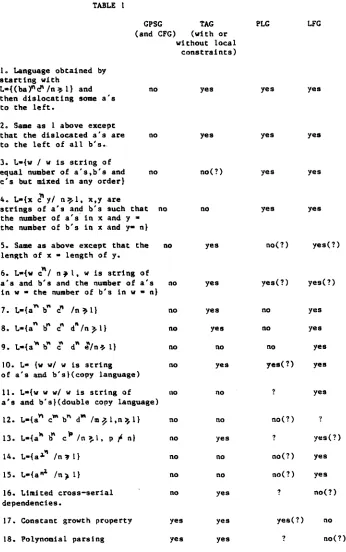
TABLE I lists (i) a set of languages reflecting different patterns of dependencies Chat can or cannot be g e n e r a t e d by the d i f f e r e n t types of grammars, and (li) the three properties Just mentioned ahove.
As regards the degree of free word order permitted by each grammar, the languages
1,2,3,4,5, and 6 In TABLE I give some idea of the degree of freedom. The language in 3 in TABLE I is the extreme case where the a's, b's,and c's can he any order, as long as the number of a's =the number of b's=the number of c ' S . GPSG~and TAG's cannot g e n e r a t e t h i s language (although f o r TAG's a proof is not in hand yet), LFG's can generate this language.
In a TAG f o r each e l e m e n t a r y t r e e , we can add mare e l e m e n t a r y t r e e s , s y s t e m a t i c a l l y g e n e r a t e d from the g i v e n t r e e t o p r o v i d e a d d i t i o n a l freedom o f word o r d e r ( t n a somewhat s i m l l a r fashion as in (Pullum,1982)). Since the adjoining operation in a TAG gives some
additional power to a TAG beyond chat of a CFG, t h i s d e v i c e o f augmenting the set o f e l e m e n t a r y t r e e s should g i v e more freedom, f o r example, by a l l o w i n g some l i m i t e d s c r a m b l i n g o f an item o u t s i d e o f the c o n s t i t u e n t i t belongs co. Even then a TAG does not seem co be c a p a b l e o f g e n e r a t l n g the language in 3 in TABLE I. Thus
there is extra freedom but it is quite limited.
l w l . ,
i'~.l~" al.lw~i+ %~w~l+ ---.a,.lw.l
TABLE I
GPSG TAG
(and CFG) (with o r without local
c o n s t r a i n t s )
PLC LFG
no yes y e s yes
to Language o b c a l n e d by s t a r t i n g w i t h
L = { ( b a ) n ~ n / n ~ 1} a n d t h e n d i s l o c a t i n g s o m e a ' s t o t h e l e f t .
2o Same a s I a b o v e e x c e p t t h a t t h e d i s l o c a t e d a ' s a r e t o t h e l e f t o f a l l b ' s . . 3. L={w / w is string of
equal number of a's,b's and no c ' s b u t m i x e d i n a n y o r d e r }
4 ° L = { x ~ y / n ~ l , x , y a r e s t r i n g s o f a ' s a n d b * s s u c h t h a t t h e n u m b e r o f a ' s i n x a n d y = the number of b's in x a n d y- n} 5. Same a s a b o v e except t h a t t h e l e n g t h of x = l e n g t h o f y . 6. L={w ~ / n ~ t , w is string o f a ' s and b ' s and t h e number o f a ' s in w = t h e number of b ' s i n w - n} 7 . L = { a ~ b " c" I n ~ l )
8. L f { a n b ~ c n d " / n ~ t } 9. L = { a ~ b ~ ~ d" ~ e / n 7 1}
IO. L= {w w/ w i s s t r i n g of a's and b ' s } ( c o p y language)
11. L=(w w wl w is string o f a ' s and b's}(double copy language)
12. L=ia ~ c TM b ~ d m /m ~ l,n ~ 1} 13. L={a ~ ~ c W /n ~1, p ~ n)
14.
L-{a ~
In~
It
1 5 . L - { a nz / n ~ 1} 1 6 . L i m i t e d c r o s s - s e r i a l d e p e n d e n c i e s .
1 7 . C o n s t a n t growth property 1 8 . P o l y n o m i a l p a r s i n g
no y e s y e s y e s
y e s
no(?)
no no y e s
no y e s n o ( ? )
no y e s y e s ( ? )
no y e s no
no y e s no
no no no
no y e s y e s ( ? )
no no ?
no no no ( ? )
no y e s ?
n o no no ( ? )
no no n o ( ? )
no y e s ?
y e s y e s y e s ( ? )
y e s y e s ?
y e s
y e s
y e s ( ? )
y e s ( ? )
y e s y e s y e s y e s
y e s
? y e s < ? ) y e s y e s n o ( ? )
no n o ( ? )
N o t a t i o n : ? : a n s w e r u n k n o w n t o t h e a u t h o r , y e s ( ? ) : c o n j e c t u r e d y e s n o ( ? ) : c o n j e c t u r e d n o .
[image:6.612.68.414.61.613.2]REFERENCES
[ [ ] Gazdar,G.,"Phrase structure grammars" in The Nature of Syntactic Representations(eds. P. Jacobson and G.K. Pullum),D. Reidel, Dordrecht, (to appear).
[2] Joshi, A.K. and Levy, L.S.,"Phrase structure trees bear more fruit than you would have thought", AJCL, 1982.
[3] Joshl, A.K., Levy, L.S., and Takahashi, M.,"Tree adjunct grammars", Journal of the Computer and System Sciences,1975.
[4] J o s h t , A.K.,"How much
c o n t e x t - s e n s i t i v i t y Is r e q u i r e d t o p r o v i d e a d e q u a t e structural descrlpclons ?", in Natural language processing: Psycholln~ulstic, - -Theoretical, and Computational Perseptives, (edso Dowry, O., Karttunen, L., and Zwicky, A.), Cambridge University Press, (to appear).
[5] Joshl, A.K. and Yokomorl, T.,"Parsln8 of tree adjoining grammars", Tech. Rep. Department of Computer and Information Science, University of Pennsylvanla,1983.
[6] Joshl, A.K. and Kroch, T., "Linguistic slgniflcance of TAG's" (tentative title), for thcoml n g .
[7] K a p l a n R. and B r e s n a n J.W., "Lexlcal
f u n c t i o n a l g r a m m a r - s formal system f o r g r a m m a t i c a l r e p r e s e n t a t i o n " , i n The M e n t a l
Representation of Grammatical Relatlons~ed.
B r e s n a n , J.), MIT P r e s s , 1983.
[8] P e t e r s , S. and R i t c h t e , R.W., " P h r a s e l i n k i n g g r a m m a r s " , T e c h . Rep. U n i v e r s i t y o f
Texas at Austin, Department of Linguistics, 1982.
[ 9 ] Pullum, G.K.,"Free word order and
p h r a s e structure rules", in P r o c e e d i n g of NELS
[_~2(eds. P u s t e . | o v s k y , J . and Sells, P . ) , A m h e r s t , MA, 1982.
APPENDIX
We will give here some examples to show how certain sentences could be derived in a TAG. For further details about thls TAG and its linguistic relevance, see (Joshi,1983 and Joshl and Kroch, forthcoming). Only the releva- ~ trees of the TAG, G-(I,A) are shown below. The following points are worth noting: (1)In a TAG the derivation starts with an initial tree. The appropriate lexlcal insertions are made for the Inltlal tree and the corresponding constraints as specified by the lexicon can be checked
( e . g . , a g r e e m e n t and s u b c a c e g o r i z a c i o n ) . Then a s t h e d e r i v a t i o n p r o c e e d s , a s e a c h a u x i l i a r y t r e e i s b r o u g h t i n t o t h e d e r i v a t i o n , t h e a p p r o p r i a t e l e x i c a l i t e m s a r e i n s e r t e d and t h e
constraints checked. Thus in a TAG, lexical insertion goes hand in hand with the derivation. (2) Each one of the two finite sets, I and A can be q u i t e l a r g e , b u t t h e s e s e t s need n o t be expllcltely listed. The crees in [ roughly correspond to all the "minimal' sentences corresponding to different subcategorlzation frames together with the "transforms" of these sentences. We could , of course, provide rules for obtaining the trees in I from a given subset of I. These rules achieve the effect of
conventional transformational rules, however, these rules can be formulated not as the usual transformational rules but directly as tree rewriting rules, since both the domains and the co-domains of the rules are finite.
Introduction of links can ~,~ considered as a part of this rewriting. In any case, these rules will be abbreviatory in the sense Chat they will generate only finite sets of trees. Their adoption will be only a matter of convenience and does not affect the TAG in any essential ~ n n e r . The set of auxiliary trees is also finite. Again these trees could themselves be "derived" from the corresponding trees i n I by i n t r o d u c i n g a p p r o p r i a t e tree rewrltlng rules. Again these rules will be abbrevlacory only as discussed above. It is in this sense that the trees in I and A capture the usual
transformational relations more or less directly.
Some d e r i v a t i o n s :
( l ) T h e g i r l who met 8ill i s a s e n i o r . We s t a r t w i t h t h e i n l t t a l t r e e ~ w i t h t h e a p p r o p r i a t e t e x l c a l i n s e r t i o n s .
S ~--z..--
~/P V P
~ r e~ v ~ P
I
I
;~ / ~
-'tk e. ~;~ I
o.. N
I
Se..n ,'~ •
Adjoining 8 t (with the a p p r o p r i a t e lexical insertions) t o ~ at the indicated node in ~ , ve o b t a i n ~ I .
/ " \
Z.~ ',
/ \
e V NP ) kip v~' % ~
i ~ i 1 / \ , ,
INt"
I I i V Ivp'.
l t l l l ) I I ! 4i--Z._
l l k l mee I,'il ~ i~llii..-'
• "rl,,t ~i~i i i k , I mlit I ; l l {i 0, i l ~ i l r
(2)John p e r s u a d e d Bill to invite H a r y .
N 9 ,~p
| / . ~ , tim "To vl °
V x P
I I
inv;te I
A d ~ o t n i n ~ / ~ ro ~".1 a t the tndit'~ated node i n ~.lr, ~ o h t a i n Y i "
~JP
'4p
I
/ \ ~
#
t,i ;,,'11
~ii,~'ll ~ e l l i t i e i L l l ' l l
t I / t ~ _ ]
/ I , " / ~ _
'~ ~'o~'" I ~ . ;
II \
% / "' t I -'Iril ,~i ~i
) f r o
. . . . " V ~ P I I
~,
i ~ l ' t t i
(3)Nho did John persuade Bill to invite ?
~ l ~ o { I i -.. 3
4 4 \ . S "/''x'''~
v I / \
~, ~ a To V ?
V ,'SAP "~, I ". I
• "% i'l'lll'fl ~"
A d ~ o i n t n g ~ J t o ~C% a t t h e i n d i c a t e d node i n IC~L, we o b t a i n y ~ . .
®
3 o NP ~ ? / ~ ~
I v N P
ra
'
t
""
~'a k,, ld
p~v.fu.,ll ;
r~¢tl
.S
" " , / { ~ - A P
/,ili~ lle' .,i?
, ,
a
/ ~ - - ~ ' ~ - -
:
I- ~ ~ V ~ P
, '
~ peY~.,~. [ ', m o v , ' h @
"- . . GIll ) , I ", I
Note the l i n k I n ~ i s ' p r e s e r v e d ' i n ~ , i t i s " s t r e t c h e d ' r e s u l t i n 8 i n t h e s o - c a l l e d unbounded dependency.
(&)John tried to p l e a s e Mary.
i ",._-
NP v p
l
/ ~ - ~ o 1-o ,,/P'V N P
On the other hand
( 5 ) j o h n seems t o l i k e M a r y . c o u l d be
derived as follows. We will start with ~ # ~ .
/
~. S z"-z --~" ~ P V?
-r~ v f / \
: T ~ , 4 UP
[ i
I
A d J ° i n i n 8 J 7 ~o ~ a t the i n d i c a t e d node i n Y~ we o b t a i n ~ l "
~'r =
,
~4
I
t
/
t Hr" v P '
l I / ' ~ '
\
-t.i~'~
j~i'~
f~ " ~
• ~ . . •
-to V P
~ e
i \V
NP
A d J o i n i n ~ ~ M t o Y~. a t t h e i n d i c a t e d n o d e i n ~'*t , we o b t a i n ~*~.
I
S
I
o
/ ~ . . !
m V Y P
I
"
i i
! / ~
wP
I
r~A~
J a Q m ~ - t o l ( k a /,4 o P.~