S T R U C T U R A L
M A T C H I N G
O F P A R A L L E L
T E X T S
Y u j i M a t s u l n o t o
G r a d u a t e S c h o o l o f I n f o r m a t i o n S c i e n c e A d v a n c e d I n s t i t u t e o f S c i e n c e a n d T e c h n o l o g y , N a r a
T a k a y a n a a - c h o , I k o m a - s h i , Na.ra 630-01 J a p a n [email protected] ist-na ra.ac.jp
H i r o y u k i I s h i m o t o T a k e h i t o U t s u r o D e p a r t m e n t o f E l e c t r i c a l E n g i n e e r i n g
K y o t o U n i v e r s i t y S a k y o - k u , K y o t o 606 J a p a n
{ i s h i m o t o , u t s u r o } @ p i n e . k u e e . k y o t o - u . a c . j p
A b s t r a c t
This paper describes a method for finding struc- rural matching between parallel sentences of two languages, (such as Japanese and English). Par- allel sentences are analyzed based on unification grammars, and structural matching is performed by making use of a similarity measure of word pairs in the two languages. Syntactic ambiguities are re- solved simultaneously in the matching process. The results serve as a. useful source for extracting lin- guistic a.nd lexical knowledge.
I N T R O D U C T I O N
Bilingual (or parallel) texts are useful resources for acquisition of linguistic knowledge as well as for ap- plications such as machine translation. Intensive research has been done for aligning bilingual texts at the sentence level using statistical teclmiques by measuring sentence lengths in words or in charac- ters (Brown 91), (Gale 91a). Those works are quite successful in that far more than 90% of sentences in bilingual corpora, are a.ligned correctly.
Although such parallel texts are shown to be use- ful in real applications such as machine translation (Brown 90) and word sense disambiguatioll (Daga.n 91), structured bilingual sentences are undoubtedly more informative and important for filture natural language researches. Structured bilingual or multi- lingual corpora, serve a.s richer sources for extract- ing linguistic knowledge (Kaji 92), (Klavans 90),
(Sadler 91), (Utsuro 92).
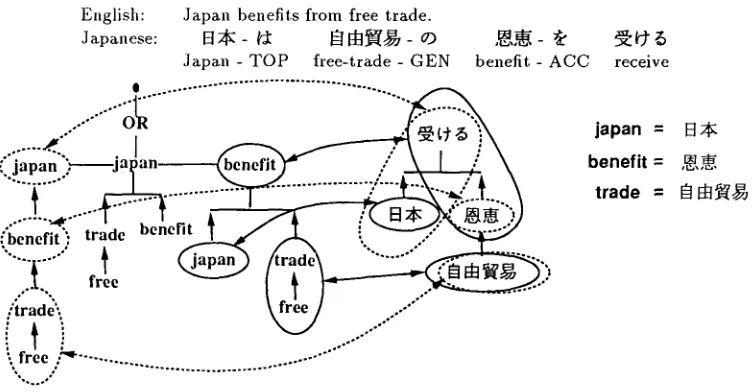
Phrase level or word level alignment has also been done by several researchers. The Textual Knowledge Bank Project (Sadler 91) is building lnonolingual and multilingual text bases structured by linking the elements with grammatical (depen- dency), referential, and bilingual relations. (Karl 92) reports a method to obtain phrase level corre- spondence of parallel texts by coupling phrases of two languages obtained in CKY parsing processes. This paper presents another method to obtain structural matching of bilingual texts. Sentences in both languages are parsed to produce (disjunctive) feature structures, from which dependency struc- tures are extracted. Ambiguities are represented as disjunction. Then, the two structures are matched to establish a one-to-one correspondence between their substructures. The result of the match is ob- tained as a set of pairs of minimal corresponding substructures of the dependency structures. Exam- ples of the results are shown in Figures 1, 2 and 3. A dependency structure is represented as a tree, in which ambiguity is specified by a disjunctive node (OR. node). Circles in the figure show substruc- tures and bidirectional arrows show corresponding substructures.
links between words in two sentences, equating two whole subtrees headed by the words. We prefer the Ininimal s u b s t r u c t u r e correspondence and the relationship between substructures. Such a mini- mal s u b s t r u c t u r e stands for the minimal meaning- ful c o m p o n e n t in the sentence, which we believe is very useful for our target application of extracting lexical knowledge fi'om bilingual corpora.
S P E C I F I C A T I O N
O F
S T R U C T U R A L
M A T C H I N G
P R O B L E M
Although the structural m a t c h i n g m e t h o d shown in this p a p e r is language independent, we deal with parallel texts of J a p a n e s e a.nd English. We assume t h a t a.lignment at the sentence level is already pre- processed m a n u a l l y or by other methods such as those in (Brown 91), (Gale 91a). T h r o u g h o u t this paper, we assume to m a t c h simple sentences. 1
D E F I N I T I O N S O F D A T A S T R U C T U R E S
A pair of Ja.panese and English sentences are parsed independently into ( d i s j u u c t i v e ) f e a t u r e structures. For our present purpose, a p a r t of a feature struc- ture is taken out as a dependency s t r u c t u r e consist- ing of the content words 2 t h a t a p p e a r in the original sentence. Ambiguity is represented by disjunctive feature structures ( K a s p e r 87). Since any relation other than modifier-modifyee dependencies is not considered here, p a t h equivalence is not taken into consideration. Both of va.lue disjunction and gen- eral disjunction are allowed.
We are currently using LFG-like g r a m m a r s for both J a p a n e s e and English, where the value of the 'pred' label in an f-structure is the content word t h a t is the head of the corresponding c-structure.
We s t a r t with the definitions of simplified dis- junctive feature structures, and then disjunctive dependency structures, t h a t are extracted from the disjunctive feature structures obtained by the pars- ing process.
D e f i n i t i o n 1 Simple feature structures (FS) (L is the sel of feature labels, and A is the set of atomic values) are defined recursively:
1 M a t c h i n g of c o m p o u n d s e n t e n c e s are done by c u t t i n g t h e m u p i n t o simple s e n t e n c e f r a g m e n t s .
2In the p r e s e n t s y s t e m , llOUllS, l)FOtK~utls, verbs, adjec- tives, mad a d v e r b s are regarded as content, words.
N I L
a where a E A 1 : 4 where l E L, 4 E F S
¢
A~b
where 4 , ¢ E FSC V g, where ¢ , ¢ E FS
To define (Disjunctive) Depen.dency Structures as a special case of an FS, we first require the fol- lowing definitions.
D e f i n i t i o n 2 Top label set of an F S ¢, written as tl(¢), is defined:
1. If O = l : if1, then t l ( 4 ) = { l } ,
2. I f 4 = 4 1 A 4 " . o r 4 = 4 1 V 4 2 , then t l ( 4 ) =
t l ( 4 1 ) U
?~l(42).
D e f i n i t i o n 3 A relation 'sibling' between feature labels in 4 is defined:
1. I f 4 -= l : 41, then l and labels in 41 are not sibling, and sibling relation holding in 41 also holds in 4.
2. /Jr4 -- 4 1 A 42, then labels in tl(41) and labels in tl(4_,) are sibling.
3. I f ¢ -- 41 V 42, then labels in 41 and labels in 42 are not sibling.
Note t h a t the sibling relation is not an equiva- lence relation. We refer to a set of feature labels in ¢ t h a t are m u t u a l l y sibling as a sibling label set of 4. Now, we are ready to define a dependency s t r u c t u r e (DS).
D e f i n i t i o n 4 A dependency s t r u c t u r e ~b is an FS lhaI satisfies the following condition:
Condition: Every sibling label set of ¢ includes ex- actly one 'pred' label.
T h e idea behind those are t h a t the value of a 'pred' label is a content word a p p e a r i n g in the orig- inal sentence, and t h a t a sibling label set defines the dependency relation between content words. A m o n g the labels in a sibling label set, the values of the labels other than 'pred' are dependent on (i.e., modify) the value of the 'pred' label. A DS can be drawn as a tree s t r u c t u r e where the nodes are either a content word or disjunction o p e r a t o r and the edges represent the dependency relation. D e f i n i t i o n 5 A substructure of an F S 4 is defined (sub(4) stands for the sel of all substructures of
4,):
1. N I L and 4 itself are substruclures of 4.
2. I f 4 = a (a E A), then a is a s'ubstructare o f
English: She has long hair.
Japanese: ~ - 0 - ~ - ~: J ~
she - GEN hair - T O P long
s h e
l o n g
h a i r = ~
F i g u r e 1: E x a m p l e o f s t r u c t u r a l m a t c h i n g , No.1
English: This child is starving for parental love.
Japanese: U_. 69 --~- ~ ~ - 09 ~ - W-_
this child - T O P p a r e n t - GEN love - D A T
pa,ental ~
~
¢
be-starving
t h i s =
c h i l d =
l o v e =
~.69
F i g u r e 2: E x a m p l e o f s t r u c t u r a l m a t c h i n g , No.2
English: Japan benefits from free trade.
Japa,,ese: ~ * ~ ~ 0~ ,~,,,N- *
Japan - T O P free-trade - GEN benefit - A C C
[image:3.612.186.440.77.220.2] [image:3.612.133.491.271.435.2] [image:3.612.122.498.482.678.2]o°°°°°o.°..O~° oo'" ... ...°°....
... .,e.." . I
(, j a p a n . ) l a a n
:~benefit ) c '~ t ~ f A ~,. ~ / ~ ; 2 : ~
i ~
...
" f r e e : . . .
%.°..,°
receive
j a p a n = El
b e n e f i t = , ~ , ~
t r a d e = I~ 1 ~
3. I f ¢ ---- l : ¢1, t h e n sub(t1) are s u b s t r u c t u r e s of
¢.
It" ]f ¢ ---- (~1 A (/)2, then for a~y (q C s u b ( e l ) a n d
for any ¢2 e sub(C2), ¢1A¢~ is a subslruclure o f t .
5. I f ¢ = ¢1 V ¢2, then for for any '/r/)l ~ sub(~) 1 )
and for any ¢2 E sub(C2), ¢1 v ¢ 2 is a sub-
slr~ucture of ¢.
T h e DS derived fi'om an FS is the m a x i m u l n sub- s t r u c t u r e of the FS t h a t satisfies the condition in Definition 4. T h e DS is uniquely determined fi'oln an FS.
D e f i n i t i o n 6 A disjunction-free maximal sub- structure of an F S ¢ is called a complete FS of
¢.
An FS does not usually have a unique complete FS. This concept is i m p o r t a n t since the selection of a complete FS corresponds to alnbiguity resolution. Naturally, a lnaximal disjunction-free s u b s t r u c t u r e of a DS ¢ is again a DS and is called a complete DS of ¢.
D e f i n i t i o n 7 A semi-complete DS of a DS ¢ is a substruclure of a complete DS o f ¢ thai satisfies the condition in Definilion ~.
Note t h a t a s u b s t r u c t u r e of a DS is not neces- sarily a DS. T h i s is why the definition requires the condition in Definition 4.
A complete DS ~/., can be decomposed into a set of non-overlapping selni-complete DSs. Such a de- composition defines the units of structural lnatch- ing and plays the key role in our problem.
D e f i n i t i o n 8 A set of semi-complete DS of a DS ¢, D = { ¢ 1 , " ' ¢ n } , is called a decomposition of ¢, iff every ¢i in the set contains at least one oc- currence of 'pred' feature label, and every content word at the 'pred' feature label appeariT~g in '¢ is contained in exactly one ~i.
D e f i n i t i o n 9 Th.e reduced DS of a DS (, with re- spect to a decomposition D = { ¢ 1 , " - 4 ' , ~ } is con- stracted as follows:
I. ¢i is transformed to a DS, "pred : St', where Si is the set of all coT~le~l words appeari~J 9 i7~ ¢i. Th.is DS is referred to as r e d ( i t ) .
2. If there is a direcl dependency relatiol~ between two conient words wl and w~ that are in ¢i and t j (i 7~ j ) , lh.en lhe dependency relation is allotted between ¢i and l/,j.
Although this definition should be described pre- cisely, we leave it with this more intuitive descrip- tion. E x a m p l e s of dependency structures and re- duced dependency structures are found in Figures 1, 2 and 3, where the decompositions are indicated by circles.
It is not difficult to show t h a t the reduced DS satisfies the condition of Definition 4.
S T R U C T U R A L M A T C H I N G O F B I L I N - G U A L D E P E N D E N C Y S T R U C T U R E S
Structural m a t c h i n g p r o b l e m of bilingual sentences is now defined formally.
Parsing parallel English and J a p a n e s e sentences results in feature structures, f r o m which depen- dency structures are derived by removing unrelated features.
Assmne t h a t ~.'E and 'OJ are dependency struc- tures of English and J a p a n e s e sentences. T h e struc- tural m a t c h i n g is to find the most plausible o n e - t o -
o n e mapping between a decomposition of a com-
plete DS of CE and a decomposition of a complete DS of C j , provided t h a t the reduced DS of CE and the reduced DS of Cj w.r.t, the decompositions are isomorphic over the dependency relation. T h e isomorphism imposes a. n a t u r a l one-to-one corre- spondence on the dependency relations between the reduced DSs.
Generally, the m a p p i n g need not always be one- to-one, i.e., all elements in a decomposition need not m a p into another decomposition. W h e n the m a p p i n g is not one-to-one, we assume t h a t d u m m y nodes are inserted in the dependency structures so t h a t the m a p p i n g naturally extends to be one-to- o n e .
When the decompositions of parallel sentences have such an isomorphic one-to-one mapping, we assume t h a t there are s y s t e m a t i c m e t h o d s to com- pute similarity between corresponding elements in the decompositions and to c o m p u t e similarity be- tween the corresponding dependency relations 3.
We write the function defining the former sim- ilarity as f , and t h a t of the latter as g. T h e n , f is a flmction over semi-complete DSs derived fi'om English and J a p a n e s e parallel sentences into a real number, and 9 is a function over feature label sets
of English and J a p a n e s e into a real number. D e f i n i t i o n 10 Given dependency structures, DS1 and DS,,, of two languages, tile structural match- ing p r o b l e m is to find an isomorphic oT~e-to-one mapping m be*ween decompositions of DSa aT~d DS2 that maximizes the sum of the vahtes of simi- larity functions, f and g.
That is, the problem is to find the fltnctioT~ m that maximizes
~-~m(f( d, re(d)) + ~ t g(l, ,n.(/)))
where d varies over semi-complete DS of DS1 and l varies over feature labels in D,-q. 1.
T h e similarity functions can be defined in vari- ous ways. "vVe assume some similarity measure be- tween J a p a n e s e and English words. For instance, we assume t h a t the similarity function f satisfies the following principles:
1. f is a simple function defined by the similar- ity measure between content words of two la.n- guages.
2. Fine-grained decompositions get larger simi- larity measure than coarse-grained decompo- sitions.
3. D u m m y nodes should give solne negative vahte to f .
T h e first principle is to simplify the complexity of the structural matching a.lgorithm. T h e second is to obtain detailed structural m a t c h i n g between parallel sentences and to avoid trivial results, e.g., the whole DSs are matched. T h e third is to avoid the introduction of dunnny nodes when it, is possi- ble.
T h e fimction g should be defined according to the language pair. Although feature labels repre- sent g r a m m a t i c a l relation between content words or phrases and m a y provide useful information for measuring similarity, we do not use tile informa- tion at, our current stage. T h e reason is that we found it difficult to have a clear view on the re- lationship between feature labels of English and J a p a n e s e and on the meaning of feature labels be- tween semi-complete dependency structures.
S T R U C T U R A L
M A T C H I N G
A L G O R I T H M
Tile structural matching of two dependency struc- tures are combinatorially diflicult problem. V~re
apply the 1)ranch-and-bound m e t h o d to solve tile problem.
Tile b r a n c h - a n d - b o u n d algorithm is a top-down depth-first b a c k t r a c k i n g algorithm for search prob- lems. It looks for tile answers with the B E S T score. Ill each new step, it e s t i m a t e s tile m a x i m u m value of the expected scores along the current p a t h and compares it, with the currently known best score. T h e m a x i n m m expected score is usually calculated by a. simplified p r o b l e m t h a t guarantees to give a value not less than the best score a t t a i n a b l e along the current path. If the maximuna expectation is less t h a n the currently known best score, it means t h a t there is no chance to find b e t t e r answers by pursuing the path. T h e n , it gives up tile current path and hacktracks to try remaining paths.
We regard a dependency s t r u c t u r e as a tree structure t h a t inchtdes disjunction ( O R nodes), and call a content word and a dependency rela- tion as a node and an edge, respectively. Then a semi-complete dependency structure corresponds to a connected s u b g r a p h in the tree.
T h e m a t c h i n g of two dependency trees starts from the top nodes and the m a t c h i n g process goes along edges of the trees. During the m a t c h i n g pro- cess, three types of nondeterminisln arise:
1. Selection of t o p - m o s t subgraphs in b o t h of the trees (i.e., selection of a semi-complete DS) 2. Selection of edges ill b o t h of tile trees to decide
the correspondence of dependency relations 3. Selection of one of the disjuncts a.t an ' O R '
node
While tile matching is done top-down, the exact score of the m a t c h e d s u b g r a p h s is calculated us- ing the similarity function f . 4 W h e n the matching process proceeds to the selection of the second type, it selects an edge in each of the dependency trees. T h e m a x i m u m expected score of m a t c h i n g the sub- trees under the selected edges are calculated from the sets of content words in the subtrees. Tile cal- culation m e t h o d of the m a x i m u m expected score is defined ill solne relation with the similarity func- tion f .
Suppose h is the function t h a t gives the maxi- m u m expected score of two subgraphs. Also, sup- pose B and P be the currently known best score
and the total score of the already matched sub- graphs, respectively. If s and t are the subgraphs under the selected edges and s' and t' are the whole relnailfing subgraphs, the m a t c h i n g under s and t will be undertaken fi, rther only when the following inequation holds:
P + h(s,t) + h(s',t') > B
Any selection of edges t h a t does not satisfy this inequality cannot provide b e t t e r matching than the currently k n o w n best ones.
All of the three types of n o n d e t e r m i n i s m are sim- ply treated as the n o n d e t e r m i n i s m in the algorithm. T h e syntactic ambiguities in the dependency structures are resolved sponta.lmously when the m a t c h i n g with the best score is obtained.
E X P E R I M E N T S
We have tested the structural m a t c h i n g algorithm with 82 pairs of sample sentences r a n d o m l y selected froln a Japanese-English dictionary.
We used a machine readable Japanese-English dictionary (Shimizu 79) and R o g e t ' s thesaurus
(Ro-
get 11)
to measure the silnilarity of pairs of content words, which are used to define the fimctiou f . S i m i l a r i t y o f w o r d p a i r sGiven a pair of J a p a n e s e and English sentences, we take two m e t h o d s to lneasure the similarity be- tween J a p a n e s e and English content words a p p e a r - ing in the sentences.
For each J a p a n e s e content word wj apl)earing in the J a p a n e s e sentence, we can find a set of translat- able English words fl'om the Japanese-Ellglish die- tionary. When the J a p a n e s e word is a. polysemous word, we select an English word fi'om each polyse- mous entry. Let CE] be the set of such translat- able English words of w j . Suppose CE is the set of contents words in the English sentence. T h e trans- latable pairs of w j, Tp(u u), is de.fined as follows:
Tp(wj) = {(wj,'wE) ['we E CE., n C.'L,} We use Roget's thesaurus to measure similarity of other word pairs. Roget's t.hesaurtls is regarded as a tree s t r u c t u r e where words are a.llocated at the leaves of the tree: For each J a p a n e s e content word 'wj a p p e a r i n g in tim J a p a n e s e sentence, we can de- fine the set of translatable English words of wa, C E j . From each English word in the set., the mini- m u m distance to each of the English content words
appearing in the English sentence is measured. 5 This m i n i m u m distance defines the similarity be- tween pairs of J a p a n e s e and English words.
We decided to use this similarity only for esti- m a t i n g dissimilarity between J a p a n e s e and English word pairs. We set a p r e d e t e r m i n e d threshold dis- tance. If the minimal distance exceeds the thresh- old, the exceeded distance is counted as the nega- tive similarity.
T h e similarity of two words Wl and w2 a p p e a r - ing in the given pair of sentences, sim((wl, w~)), is defined as follows:
) =
6 (wl, w2) E Tp(wl) or ('w2, 'wx) E Tp(w2)
-I~ (,w~, w.) ~t Tp(w~)
and (w2,
w~) ft Tp(w.,)
and the distance between wl and w., exceeds the threshold by k.
0 otherwise
S i m i l a r i t y o f s e m i - c o m p l e t e
DSs
T h e similarity between corresponding semi- complete DSs is defined based on the similarity be- tween the content words. Suppose t h a t s and t are semi-colnplete DSs to be m a t c h e d , and t h a t Vs and Vt are the sets of content words in s and t. Let A be the less larger set of l~ and Vt and B be the other (I A I<l B I). For each injection p from A into B, the set of word pairs D derived from p can be defined as follows.
Now, we define the similarity fimction f over J a p a a e s e and English semi-colnplete DSs to give the naa.xinmm value to the following expression for all possible injections:
(
= max/ × O.951vd+IVd -~
J
T h e s u m m a t i o n gives the maximuna s u m of the similarity of the content words in s and t. 0.95 is the penalty when the semi-complete DSs with more than one content words are used in the matching.
Figures 1, 2 and 3 shows the results of the struc- tural m a t c h i n g algorithm, in which the t r a n s l a t a b l e pairs obtained fi'om the Japanese-English dictio- nary are shown by the equations.
Table 1: Results of experiment, s Parsing J al)anese and English sent.enccs N u m b e r of sentences 82
Parse failure 23
Parsable 59
Correct parsability
Correctpa.rse ] 53 ] 8 9 . 8 % ( 5 3 / 5 9 )
Incorrect parse 6 10.2% (6/59)
T h e m a t c h with tile best score includes Correct m a t c h i n g 47 89% (47/53) no correct naatching 6 11% (6/53) Single correct m a t c h i n g 34 64% (34/53)
R e s u l t s o f t h e e x p e r i m e n t s
We used 82 pairs of J a p a n e s e and English sen- tences a p p e a r i n g in a Japanese-English dictionary. T h e results were checked and examined in detail by hand. Some of the sentences are not parsable be- cause of the limited coverage of our current gram- mars. Although 59 pairs of them are parsable, 6 out of them do not include correct parse results.
T h e structural matchi,lg algorithm with the set- ting described above is applied to the 53 pairs. T h e cases where the correct, matchilig is not included in the best rated answers are 6 out of them. T h e remaining 47 pairs include the correct matching, of which 31 pairs result in the correct matching uniquely. Tal)le 1 sumnaarizes tile results.
E V A L U A T I O N
A N D D I S C U S S I O N
Although the n u m b e r of sentences used in tile ex- p e r i m e n t s is small, the result, shows that a b o u t two third of the pairs give the unique matching, in which every syntactic ambiguity is resolved.
T h e cases where no correct matching was ob- tained needs be examined. Some sentences contain an idiomatic expression t h a t has coml)letely differ- ent syntactic structures fl'om the sentence struc- ture of the other. Such an expression will 110 way be matched correctly except that the whole struc- tures are matched intact. Other cases are caused by complex sentences t h a t include an embedded sen- tence. When the verbs at the roots of the depen- dency trees are irrelevant, extraordinary matchings are produced. We intend not to use our method to m a t c h complex or compound sentences as a whole. ~,¥e will rather use our method to find structural
matching between simple sentences or verb phrases of two languages.
Tile m a t c h i n g problmn of complex sentences are regarded as a different p r o b l e m though the simi- lar technique is usable. We think t h a t the scores of m a t c h e d phrases will help to identify tile cor- responding phrases when we m a t c h complex sen- tences.
Taking the sources of other errors into consider- ation, possible i m p r o v e m e n t s are:
1. E n h a n c e m e n t of English and J a p a n e s e gram- mars for wider coverage and lower error rate. 2. Introduction of more precise similarity mea-
s u r e m e n t of content words.
3. Utilization of g r a m m a t i c a l information: • Feature labels, for estimating m a t c h i n g
plausibility of dependency relations • P a r t of speech, for measuring matching
plausibility of content words
• O t h e r g r a m m a t i c a l information: mood, voice, etc.
The first two iml)rovements are undoubtedly im- p o r t a n t . As for the similarity m e a s u r e m e n t of con- tent words, completely different approaches such as statistical m e t h o d s m a y be useful to get good translatable pairs (Brown 90), (Gale 91).
Various g r a m m a t i c a l information is kept in the feature descriptions produced in the parsing pro- cess. However, we should be very p r u d e n t in using it. Since English and J a p a n e s e are g r a m m a t i c a l l y quite different, some g r a m m a t i c a l rela.tion m a y not be preserved between them. In Figure 3, solid ar- rows and circles show the correct matching. While 'benefit' m a t c h e s with the s t r u c t u r e consisting of ' ,~,,~ ' and ' ~_.~ ~ ', their d e p e n d e n t words ' t r a d e ' and ' H ~ : ~ ' modify t h e m as a verb modifier and as a noun modifier, the g r a m m a t i c a l relation of which are quite different.
[image:7.612.68.282.68.230.2]sentence, taking part-of-speech into consideration may jeopardize the correct matching, either. The fact that the verb and noun usages of 'benefit' bear common concept implies that more precise similar- ity measurement will solve this particular probleln. Since the interpretations of the sample English sen- tences are in different mood, imperative and declar- ative, the mood of a. sentence is also usefnl to re- move irrelevant interpretations.
C O N C L U S I O N S
The structural matchillg problem of parallel texts is formally defined and our current implementation and experilnents are introduced. Although the re- search is at the preliminary stage and has a. very simple setting, the experiments have shown a. nuln- ber of interesting results. T h e method is easily enhanced by ilnproving the gramnm.rs and by in- corporating more accurate similarity measurement. Number of other researches of building tra.nsla- tion dictionaries and of deterlnining similarity re- lationship between words are useful to improve our method.
To e x t r a c t useful information fl'om bilingual cor- pora, structural matching is inevitable for language pairs like English and Japanese that have quite dif- ferent linguistic structure. Incidentally, we have found that this dissimilarity plays an i m p o r t a n t role in resolving syntactic ambiguities since the sources of anlbiguities in English and Japanese sen- tences are in many cases do not coincide (Utsuro 92). We are currently working on extracting verbal case frames of Japanese fi'om the results of struc- tural matching of a aal)anese-l~nglish corpus (Ut- suro
93).
T h e salne teclmique is naturally a.pplica- ble to acquire verbal case fi'ames of English as well. Another application we are envisaging is to extract translation pattern from the results of structural matching.We plan to work on possible improvements dis- cussed in the preceding section, and will make large scale experiments using translated newspal~er arti- cles, based on the phrase matching stra.t.egy.
A C K N O W L E D G M E N T S
This work is partly supported by the (-;rants from Ministry of Education, "Knowledge Science" (#03245103).
R E F E R E N C E S
Brown, P.F., et al., A Statistical Approach to Ma- chine Translation, Computalional Linguistics, Vo1.16, No.2, pp.79-85, 1990.
Brown, P.F., Lai, J.C. and Mercer, R.L., Align- ing Sentences ill Parallel Corpora, ACL-91, pp.169-176, 1991.
Dagan, I., Itai, A. and Schwall, U., T w o Lan- guages are More Iuformative than
One,
ACL- 91, pp.130-137, 1991a.Gale. W.A. and Church, K.W., A Program for Aligning Sentences in Bilingual Corpora, ACL-91, pp.177-184, 1991b.
Gale. W.A. and Church, K.W., Identifying Word Correspondences in Parallel Texts, '91 DARPA Speech and Natural Language Work- shop, pp.152-157, 1991.
Kaji, H., Kida, Y., and Morimoto, Y., Learning Translation Templates froln Bilingual Text,
COLING-92, pp.672-678, 1992.
Kasper, R., A Unification Method for Disjunc- tive Feature Descriptions, ACL-87, pp.235- 242, 1987.
Klavans, J. and T z o u k e r m a n n , E., T h e BICORD System: Combining Lexical Information from Bilingual Corpora. and Machine Readable Dic- tionaries, COLING-90, pp.174-179, 1990. Miller, G.A., et al., Five Papers on WordNet, Cog-
nilive Science Laboratory, Princeton Univer- sity, CSL Report 43, July 1990.
Roget, S.R., Roget's Thesaurus, Crowell Co., 1911.
Sadler, V., T h e T e x t u a l Knowledge Bank: De- sign, Construction, Applications, Proc. h~ler- national Workshop on Fundamental Research for the Future Generation of Natural Language Processing (FGNLP), pp.17-32, Kyoto, Japan, 1991.
Shimizu, M., et al. (ed.), Japanese-English Dictio- nary, Kodansha, 1979.
Utsuro, T., Matsumoto, Y., and Nagao, M., Lexi- cal Knowledge Acquisition from Bilingual Cor- pora., COLING-92, pp.581-587, 1992.