University of Warwick institutional repository: http://go.warwick.ac.uk/wrap
This paper is made available online in accordance with
publisher policies. Please scroll down to view the document
itself. Please refer to the repository record for this item and our
policy information available from the repository home page for
further information.
To see the final version of this paper please visit the publisher’s website.
Access to the published version may require a subscription.
Author(s): C Connaughton and J Harris
Article Title: Scaling properties of one-dimensional cluster–cluster
aggregation with Lévy diffusion
Year of publication: 2010
Link to published article:
Colm Connaughton∗ and Jamie Harris† Mathematics Institute and Centre for Complexity Science, University of Warwick, Gibbet Hill Road, Coventry CV4 7AL, UK
(Dated: May 11, 2010)
We present a study of the scaling properties of cluster-cluster aggregation with a source of monomers in the stationary state when the spatial transport of particles occurs by L´evy flights. We show that the transition from mean-field statistics to fluctuation-dominated statistics which, for the more commonly considered case of diffusive transport, occurs as the spatial dimension of the system is tuned through two from above, can be mimicked even in one dimension by vary-ing the characteristic exponent, β, of the the L´evy jump length distribution. We also show that the two-point mass correlation function, responsible for the flux of mass in the stationary state, is strongly universal: its scaling exponent is given by the mean field value independent of the spatial dimension and independent of the value of β. Finally we study numerically the two point spatial correlation function which characterises the structure of the depletion zone around heavy particles in the diffusion limited regime. We find that this correlation function vanishes with a non-trivial fractional power of the separation between particles as this separation goes to zero. We provide a scaling argument for the value of this exponent which is in reasonable agreement with the numerical measurements.
Citation: C Connaughton and J Harris J. Stat. Mech. (2010) P05003 doi: 10.1088/1742-5468/2010/05/P05003
PACS numbers: 05.70.Ln, 05.40.Fb, 68.43.Jk, 47.27.Gs
I. INTRODUCTION TO CLUSTER-CLUSTER
AGGREGATION (CCA)
Cluster-cluster aggregation (CCA) refers to the statis-tical dynamics of a large collection of particles (or clus-ters) which move around under the action of some trans-port process and which, in addition, have a probability to coalesce irreversibly when they collide. The transport is usually stochastic, diffusion being a commonly stud-ied case, and coalescence of clusters conserves mass. In general, both the rate of coalescence and the transport coefficient are functions of cluster mass. Such dynamics are relevant to many physical phenomena. Commonly cited applications include the study of aerosols [1], the development of structure in the expanding universe [2], clustering of algae [3] and cloud droplet coalescence [4]. From a theoretical perspective, CCA can be modelled us-ing relatively simple interactus-ing particle systems and can thus provide a testing ground for statistical mechanics theories of complex systems. The theoretical objective is to understand the statistical properties of the mass distribution of the clusters.
CCA is an intrinsically non-equilibrium process. Ag-gregation is irreversible so there is no possibility for the statistical dynamics to have detailed balance. In some circumstances it may be appropriate to consider frag-mentation of clusters in addition to aggregation. In such cases, detailed balance may be achievable. We do not
∗Electronic address: [email protected] †Electronic address: [email protected]
consider such situations here however. Two different sce-narios may be studied which we refer to as the decay and forced cases. In the decay case, the more common of the two, the system is initially populated with a large num-ber of small particles (monomers) which are considered to be the fundamental unit for the aggregation process and whose mass can accordingly be taken to be one. The size distribution subsequently spreads in the space of cluster masses as larger clusters are generated by the aggrega-tion of smaller ones. This time evoluaggrega-tion proceeds for all time (we do not consider models exhibiting a gelation transition here) often in a self-similar fashion. In the forced case, the system initially has no clusters but we continually deposit monomers into the system at a con-stant rate from an external source. The size distribution again spreads in the mass space but, due to the constant replenishment of the monomers by the external source, eventually reaches a stationary state at any given cluster size. In this stationary state, the depletion of clusters of a given size by aggregation events is exactly balanced by the formation of such clusters by the aggregation of smaller ones. This results in a constant flux of mass in the mass space. An analogy may be drawn with the flux of energy through scales in the Kolmogorov cascade of hydrodynamic turbulence [5]. We shall be concerned pri-marily with the stationary forced case.
The most basic statistical measure is the average mass density,N(m, t), giving the average density of clusters of massmat time t. At the mean-field level, N(m, t) sat-isfies the Smoluchowski equation [6]. For many applica-tions, the collision kernel in the Smoluchowski equation, which reflects the mass dependence of the underlying mi-croscopic coalescence rates, is a homogeneous function
whose degree we shall denote byζ. For a broad class of such kernels, the Smoluchowski equation has self-similar solutions which describe scaling behaviour of N(m, t) in both m and t. In particular, N(m, t) has power law asymptotics forN(m, t) as a function of mass. In the de-cay case, we often findN(m, t)∼m−(ζ+1). In the forced case, the stationary state is given byN(m)∼m−(ζ+3)/2
[5, 7]. The reviews by by Aldous [8] and Leyvraz [9] provide comprehensive discussions of the Smoluchowski equation and its scaling solutions.
One of the most interesting aspects of CCA is that this mean field description can fail under certain conditions. This results in a transition to a fluctuation dominated regime with completely different scaling properties for the large m asymptotics. The fundamental assumption underpinning mean field theory is the absence of spa-tial correlations. In particular, the joint distribution of clusters having masses m1 and m2 at a given point, x, which is linked to the probability of collision, factorises as the product of the one-point distributions of clusters with masses m1 andm2. Likewise for higher order joint
distributions. This works well in the so-called reaction limited regime when the density of clusters is sufficiently high that each aggregating cluster has a large number of potential partners to with which to aggregate. In the most commonly considered case, in which the trans-port process is simple diffusion, this assumption turns out to be inconsistent for large masses if the spatial di-mension is less than or equal to two. The reason is that in two dimensions and below random walks are recur-rent so that clusters which encounter each other once are highly probable to do so infinitely many times and hence to aggregate. Heavy clusters thereby generate an effective depletion zone around themselves. The dynam-ics thus becomes diffusion limited and dominated by dif-fusive fluctuations making the system much more diffi-cult to analyse. The only case for which a systematic study of the diffusion limited regime has been done is the case of constant kernel in which the aggregation rate is independent of mass (ζ = 0). For the forced case in
d <2, the diffusion limited stationary mass density can be shown to scale as N(m) ∼ m−(2d+2)/(d+2) which is
shallower than the corresponding mean-field prediction,
N(m)∼m−3/2. Note that the diffusion limited scaling exponent coincides with the reaction limited one when
d = 2 which reflects the fact that d = 2 is the criti-cal dimension for this model. In addition to having a different value for the scaling exponent ofN(m), the sta-tistical properties of the diffusion limited regime are also structurally different: higher order correlation functions exhibit multi-scaling in the sense that they do not scale as powers of the corresponding single-point densities as they do in the mean field regime.
In this article we focus in detail on this transition from mean field to fluctuation dominated regime in CCA. The fact that the parameter controlling the transition is the physical dimension of the model is inconvenient for both numerical exploration and physical applicability. We
re-mark that the important ingredient for the application of mean field theory is not the physical dimension per se but rather whether or not the transport mechanism has the ability to break spatial correlations between par-ticles. We show that by replacing diffusive transport with L´evy flights it is possible to continuously tune be-tween fluctuation-dominated behaviour and mean-field behaviour even in one dimension. The tuning param-eter is the characteristic exponent of the L´evy distribu-tion underlying the jump size distribudistribu-tion for particle hops. The physical intuition is that correlations between particles are broken even in low dimensions if there are sufficiently many long range hops to effectively mix the clusters. We also explore the special role played in the forced case by the second order mass correlation function whose scaling exponent is strongly universal as a result of the so-called Constant Flux Relation (CFR) [10]. Its scaling exponent is, perhaps surprisingly, independent of both the spatial transport mechanism and the physical dimension and is always given by its mean field value.
The outline of the article is as follows. We begin by defining the stochastic model used in studying CCA, as well as a brief overview of the statistical field theory used in deriving the Lee-Cardy equation for this model (Sec-tion 2). Then, we summarise the scaling properties of the multi-particle correlation functions or arbitrary order as applied to both reaction-limited and diffusion-limited regimes (Section 3). Using the Constant Flux Relation (CFR) we then derive the scaling invariance of the flux-carrying correlation function, demonstrating that this re-sult is independent of the dimension of the system and of the mechanism of spatial transport (Section 4). Imple-menting L´evy flights for the one-dimensional model, we then characterise the suggested form of the mass density as a function of the L´evy exponent, which we validate against numerical simulation together with taking direct measurements for the integrated forms of the mass cor-relation functions (Section 5). Here we verify the scaling independence of the flux-carrying correlation function as we alter the spatial transport mechanism. We finish the paper by determining a predicted form for the structure of the depletion zones as a function of the L´evy expo-nent (Section 6), which we validate numerically before providing a conclusion.
II. THE LEE-CARDY EQUATION AND
STOCHASTIC SMOLUCHOWSKI EQUATION
clusters of a single basic monomer unit. The state of the system at time t is characterised by the set of occupa-tion numbers,Nxm t, specifying the number of particles
of each massmat each point,xof the lattice. The occu-pation numbers evolve in time according to the following microscopic dynamical transitions which occur in contin-uous time with exponentially distributed waiting times:
• Diffusion: A particle at any site may hop to an adjacent site. These hops occur at rateDe, taken to
be independent of particle mass.
• Injection of monomers: A new monomer may ap-pear at any site onL. The injection of monomers takes place at rateJe.
• Aggregation: Two particles having masses m1 and m2 which are at the same lattice point,x, may
ag-gregate to create a single new particle having mass
m1+m2. This occurs at rate λNe xm1t(Nxm2t−
δm1m2) where λe is the reaction rate, taken to be
independent of mass, and theNxm tfactors encode
the pairwise nature of the aggregation process (the Kronecker symbol,δm1m2, ensures that the rate is
correct when two particles of the same mass aggre-gate).
The “rates” in these rules refer to the corresponding wait-ing times. These rules define a Markov chain which can be easily simulated using the Gillespie algorithm [13]. All numerical results presented in this paper have been ob-tained in this fashion.
This model has a Master Equation whose solution can be used to compute averages with respect to the micro-scopic dynamics. Such averages, which we shall denote by h.iL, are equivalent to averages with respect to the effective action of an associated statistical field theory. This effective action is obtained from the dynamical rules by the well known Doi-Peliti construction. For details of the procedure for this specific model see [14]. For many microscopic models describing interacting parti-cle systems, averages with respect to this effective action are further equivalent to averages with respect to solu-tions of a stochastic rate equation [15, 16] known as the Lee-Cardy equation. The Lee-Cardy equation specific to our CCA model, first derived in [17], takes the form of a stochastic Smoluchowski equation. In the continuous limit it takes the form:
∂tφxt m = D∆φxt m+
J
m0δ(m−m0)
+ λ
Z m
0
φxm0tφxm−m0tdm0
− 2λ φxm t
Z ∞
0
φxm0tdm0
+ i√λ φxm tξxt (1)
where ξxt is Gaussian white noise and ∆ is the d
-dimensional Laplacian. D,λand J are respectively the diffusion constant, reaction rate and mass injection rate obtained from an appropriate rescaling of the correspond-ing microscopic rates with the lattice spaccorrespond-ing in the con-tinuous limit [14]. We shall denote averages with respect to the solutions of Eq. (1) byh.iξ.
One of the most striking aspects of the Lee-Cardy equation is that the noise term is imaginary indicating that the fieldφxm tcannot be literally interpreted as the
density of particles, Nxm t, however tempting such an
identification may seem. Imaginary noise encodes the fact that the particles in the system are anti-correlated [15, 18]. Physically, this anti-correlation comes about since the process of aggregation tends, on average, to produce a depletion zone around each particle. We shall discuss these depletion zones in detail in Sec. VI.
Careful study of the construction leading to Eq. (1) leads to the conclusion [14] that single point moments
ofφxm t correspond tofactorial momentsof the physical
density,Nxm t:
hφnxm tiξ =
1
n!hNxm t(Nxm t−1). . .(Nxm t−n+ 1)iL. (2) Multi-point moments translate directly. For example,
hφxm1tφxm2tiξ =hNxm1tNxm2tiL ifm16=m2. (3)
These relations allow us to translate correlation functions of Eq. (1) which are most suitable for theoretical analy-sis into corresponding correlation functions in the origi-nal lattice model which are most suitable for numerical measurements. In relation to the interpretation of the field φxm t alluded to above, Eq. (2) tells us that φxm t
is equal to the density,Nxm t, on average but differs in
distribution.
If the occupation numbers are large, we can, to leading order, ignore the distinction between moments and facto-rial moments on the right hand side of Eq. (2). Further-more, if we could neglect correlations between particles, higher order correlation functions could be factorised into products of densities:
hNxm1tNxm2tiL≈ hNxm1tiLhNxm2tiL. (4)
This is the essence of the mean field approximation for CCA. If the density exhibits scaling with some physical quantity such as the mass or the source strength, it fol-lows from the mean field approximation that the higher order correlation functions exhibit simple scaling. That is to say that if the density has a scaling exponent, γ1,
then the corresponding scaling exponent of an order n
correlation function isγn=n γ1.
dimen-sions the large time, large mass behaviour is always dif-fusion limited resulting in anticorrelations between par-ticles which are sufficiently strong to invalidate the mean field approximation. Low dimensions in this case means
d <2 with the cased= 2 being marginal. One expects to observe a violation of mean field theory accompanied by the onset of multiscaling as one varies the dimension of the latticeL. This is indeed true with strong
multiscal-ing observed in both the decaymultiscal-ing [17] and forced [14, 19] cases ind= 1 which mellows to logarithmic corrections to the mean-field scaling ind= 2. Triggering this transition from mean-field to non-mean-field behaviour by varying the spatial dimension is not very easy in practice. In Sec. V of this article we show that introducing long-range diffusion can break the anti-correlations between particles resulting in behaviour which is very reminiscent of mean-field behaviour even in one dimension. Before this however we will review the scaling properties of CCA with regular diffusion.
III. SCALING PROPERTIES OF CCA WITH A
SOURCE OF MONOMERS: REACTION LIMITED AND DIFFUSION LIMITED REGIMES
A constant injection of monomers into the system al-lows for the creation of a non-equilibrium stationary state, which is characterised by a constant flux of mass from smaller to larger masses under aggregation. How-ever, since there is no upper mass limit defined on the system, the creation of arbitrarily large clusters can go on indefinitely. In this sense, the stationary state is only defined for some inertial range of masses. Any station-ary solution to the Stochastic Smoluchowski Equation describing the mass density must therefore be of Kol-mogorov type [5]. That is, these solutions exhibit scaling evocative of the Kolmogorov spectrum found in forced hydrodynamic turbulence, with a cascade defined by a constant flux of mass from smaller to larger clusters me-diated by the aggregation of particles. From this point on, we shall assume statistical homogeneity and drop the
xindex.
The mass density has dimension [Nm] = L−dM−1.
The dimensions of the physical parameters appearing in Eq. (1) are as follows [D] = L2T−1, [λ] = LdT−1 and
[J] = M L−dT−1. In order to describe a cascade, the stationary density should depend on the mass flux, J. There are two natural ways to construct an expression with the correct dimension using only one additional pa-rameter in addition to the flux:
Nm ∝
r J λm
−3
2, (5)
Nm ∝
J
D d+2d
m−2dd+2+2. (6)
The first corresponds to the reaction-limited regime in which diffusion plays no role. The second corresponds
to the diffusion-limited regime in which the reaction rate plays no role since reactions are effectively instantaneous compared to the time required for particles to find each other by diffusion.
If we average Eq. (1) in the statistically homogeneous case and make the mean field approximation, Eq. (4), then we obtain the standard Smoluchowski coagulation equation:
∂tNm(t) = λ
Z ∞
0
dm1dm2Nm1Nm2δ(m−m1−m2)
− λ
Z ∞
0
dm1dm2NmNm1δ(m2−m−m1)
− λ
Z ∞
0
dm1dm2NmNm2δ(m1−m2−m)
+ (J/m0)δ(m−m0). (7)
The exact stationary solution of this equation is [5, 7]
Nm=
r J
2πλm
−3
2, (8)
confirming that the reaction-limited scaling, Eq. (5), cor-responds to the mean field scaling. In one dimension, exact calculations [12, 20] showed that for the case of instantaneous reactions,λ→ ∞,
Nm∼Γ(1/3)−1
4J
9D 13
m−43, (9)
form1, which agrees with the diffusion-limited scal-ing, Eq. (6), with d = 1. Furthermore the dynamical scaling properties of the time-relaxation to these steady states in both the mean-field and one-dimensional cases were computed exactly in [21]. It was subsequently shown in [22] that the diffusion-limited scaling, Eq. (6), is actually exact for alld <2. The fact that the exponents in Eqs. (5) and (6) become equal whend= 2 reflects that the critical dimension for this system is 2.
The presence of multiscaling in d <2 can be detected by measuring the higher order mass correlation functions:
cn(m1, . . . , mn, t) =hφxm1t. . . φxmntiξ. (10)
The case n = 1 is just the mass density as discussed above. In the statistically homogeneous case, these corre-lation functions do not depend on the spatial point,x, at which they are measured. For aggregation with source,
cn(m1, . . . , mn, t) becomes independent of t as t → ∞
and is a homogeneous function of mass for large masses:
cn(h m1, . . . , h mn)∼hγncn(m1, . . . , mn). (11)
In [19], the exponentsγn were calculated perturbatively
in= 2−dusing dynamical renormalisation group:
γn=
2d+ 2
d+ 2
n+n(n−1) 2 (d+ 2)+O(
and found to agree remarkably well with Monte Carlo simulations ind= 1 despite the fact that, formally,= 1 in this case. The epsilon expansion written in this way, withdappearing explicitly, demonstrates that the effect of fluctuations is to correct thesimple scalingγn=n γ1
(recall thatγ1is given exactly byγ1=2dd+2+2 [22]), thereby demonstrating the presence of multi-scaling in the model. Full details are given in [14]. Direct measurement of the exponents γn from numerics is quite difficult for n > 1
due to the strong fluctuations in the diffusion-limited regime. In practice, for n > 1, better statistics are ob-tained by measuring the integrated correlation functions,
Cn(m) =
Z ∞
m
dm1. . .
Z ∞
m
dmn−1cn(m, m1. . . , mn−1).
(13)
Cn(m) can be expressed in terms of site occupation
num-bers using Eqs. (2) and (3) and scales with exponent
γn −n+ 1. Notice from Eq. (12) that γ2 = 3,
inde-pendent of the spatial dimension, to first order in the
-expansion. Furthermore, this is exactly the exponent one would expect from mean-field theory even though Eq. (12) specifically describes the non-mean-field regime. In fact,γ2 is exactly given by its mean-field value in all dimensions regardless of whether mean-field theory ap-plies or not. This is a specific case of a general property of many non-equilibrium stationary states which carry a flux of some conserved quantity: strong universality of the flux-carrying correlation function [10]. The fact that conservation laws determine the scaling of the flux-carry correlation function exactly is well know in turbulence as Kolmogorov’s 45-Law (see [23] for a review and wide-ranging discussions). We now study this important fea-ture in more detail.
IV. CONSTANT FLUX RELATION
We have already remarked that in the forced case, CCA reaches a quasi-stationary state characterised by a con-stant flux of mass from small to large masses. The Con-stant Flux Relation (CFR) [10] expresses the fact that this constant flux of mass exactly determines the scaling of the flux-carrying correlation function in the stationary state, a common feature of most driven non-equilibrium systems which reach stationary states dominated by a constant flux of a conserved quantity.
The Lee-Cardy equation, Eq. (1), is equivalent to the underlying effective field theory, a fact which sometimes calls into question the usefulness of the Lee-Cardy for-malism. The derivation of the CFR, however, is enor-mously easier using the Lee-Cardy equation than it would be otherwise. At stationarity, and assuming spatial ho-mogeneity, Eq. (1) can be written
0 = λ
Z m
0
hφ(m0)φ(m−m0)iξdm0
− 2λ
Z ∞
0
hφ(m)φ(m0)iξdm0, (14)
10-9 10-8 10-7 10-6 10-5 10-4 10-3 10-2 10-1 100 101
10-1 100 101 102 103 104 C2
(m)
m Random hopping
`=1.6 Levy diffusion Regular diffusion
10-3
10-2
10-1
100
100 101 102 103 104
C1 (m) m (A) 10-8 10-6 10-4 10-2
100 101 102
C3
(m)
[image:6.612.341.537.51.240.2]m (B)
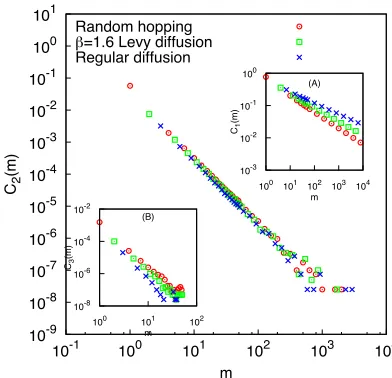
FIG. 1: Scaling universality of the second order integrated mass correlation function,C2(m) as given by Eq. (13), with mass,m, as shown for three different transport mechanisms. In comparison, scaling for the first and third order integrated mass correlation functions are shown in insets (A) and (B) respectively.
where we have taken averages with respect to the noise term ξ and let m > m0. Let us assume that for large masses, the correlation functionhφ(m1)φ(m2)iξtakes the
form
C(m1, m2) = (m1m2)−xψ
m1 m2
, (15)
where we have introduced the dimensionless scaling func-tion ψ. By the symmetry of C, ψ has the property
ψ(x) = ψ(x−1). This defines our flux-carrying corre-lation function. Re-writing Eq. (14) in the symmetric form
0 = λ
Z ∞
0
Z ∞
0
C(m1, m2)δ(m−m1−m2)dm1dm2
− λ
Z ∞
0
Z ∞
0
C(m, m1)δ(m2−m−m1)dm1dm2
− λ
Z ∞
0
Z ∞
0
C(m, m2)δ(m1−m2−m)dm1dm2,
(16)
and applying the Zakharov transformations [24]
(m1, m2) −→
mm1 m2 ,
m2 m2
,
(m1, m2) −→
m2 m1,
mm2 m1
(17)
to the second and third integrals of Eq. (16) respectively, results in an expression in which each delta-function has the same argument. This gives the condition
0 =
Z ∞
0
Z ∞
0
(m1m2)−xψ
m
1 m2
(my−my2−my1)
which can only be satisfied fory:= 2x−2 = 1, or equiv-alently, x = 32. Therefore, the flux-carrying correlation function must be of the form
C(m1, m2)∼(m1m2)−32ψ
m1
m2
(19)
for sufficiently large masses, which is a homogeneous function of degree -3. We have implicitly assumed that the corresponding integrals in Eq. (16) converge for this exponent. This can be demonstrated explicitly for the constant kernel case but, for general kernels must be ver-ified numerically [25]. An immediate corollary of this result applies to the specific case m1 = m2: using the factorial moments relationship in Eq. (2) we have that
1
2hNm(Nm−1)iL∼m
−3. (20)
Namely, that the stationary average density of pairs must scale with exponent -3 for sufficiently largem.
In the mean field regime, higher order correlation func-tions factorise into products of densities as expressed in Eq. (4). It immediately follows from Eq. (8) thatγ2= 3
in mean field theory. Thus the scaling exponent, γ2, is given by its mean field value in all dimensions. We note also that the dependence on the transport process dis-appears on averaging Eq. (1) so that the exponentγ2 is strongly universal, as suggested by figure (1). In the next section we consider CCA with L´evy flights. The choice of the characteristic exponent, β, of the L´evy flights strongly affects the scaling of general correlation func-tions in the model. We shall see, however, that the value ofγ2is insensitive to the choice ofβ.
V. ONE-DIMENSIONAL CCA WITH L ´EVY
DIFFUSION
CCA with L´evy diffusion is of some interest in certain surface growth phenomena [27, 28] but our interest stems from the theoretical point of view that it allows us to mimic the transition to mean-field behaviour even in one dimension. From now on we focus entirely on the one dimensional case.
We modify the model introduced earlier by allowing particles to make long range jumps. The waiting times between particle hops remain exponentially distributed with a fixed rate. Rather than simply hopping to nearest neighbours, however, the length of each jump is inde-pendently sampled from a probability distribution with a heavy tail. In our numerical experiments, we took this distribution to be a symmetric L´evy distribution with scale factor 1 and scaling exponent β ∈ (0,2]. Jump lengths were rounded to the nearest integer to remain consistent with our lattice formulation. Such hops are referred to as L´evy flights [29] and should not be con-fused with the (often more physically realistic) case of L´evy walks in which the waiting time distribution and
1 1.2 1.4 1.6 1.8 2
0 0.5 1 1.5 2
Density scaling exponent,
a1
`
[image:7.612.340.539.49.237.2]Levy Dimensional analysis
FIG. 2: Comparison of the numerically measured exponent
γ1 against the prediction derived from dimensional analysis, Eq. (23), as plotted against the L´evy characteristic,β. Data was taken from stationary simulations on a lattice of size 105. The error bars on the exponents represent two standard devia-tions as estimated by bootstrapping a least squares estimator with the data measuring the integrated density, C1(m), as defined by Eq. (13), over 4 decades ofm.
0 1 2 3 4 5 6
0 0.5 1 1.5 2
Scaling exponents,
an
` a1MF=3/2
a1DL=4/3 a2MF= a2DL= 3 a3MF=9/2 a3DL=5
a1
a2
a3
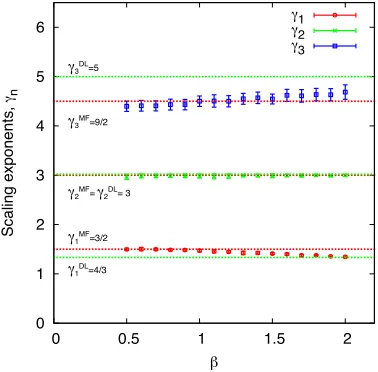
FIG. 3: Scaling exponents for the first three mass correlation functions as functions of L´evy characteristic β. The expo-nentsγ2 andγ3 were estimated using a maximum likelihood estimator [26] for a power law distribution of pairs and triplets entering Eq. (13). Theoretically predicted values for both the mean field and diffusion limited cases are included for each exponent. Error bars correspond to two standard deviations calculated by bootstrapping the estimator.
[image:7.612.346.535.356.542.2]exponentβ satisfies a fractional diffusion equation:
∂P ∂t =Dβ
∂βP
∂xβ (21)
where the generalised (or anomalous) diffusion coeffi-cient, Dβ, has dimension LβT−1 and the fractional
derivative is defined through its Fourier space represen-tation. See [29] for details. For β = 2 the L´evy dis-tribution reduces to the Gaussian disdis-tribution and we recover the case of regular diffusion. In this case, the mean square displacement of a particle grows linearly in timehx2(t)i=Dtproviding a natural way to define the
diffusion length,lD=
√
D t. Forβ <2,hx2(t)iis infinite
for any finite time and we require a different approach to defining the anomalous diffusion length. One reason-able way to do this uses the fact that Eq. (21) has a self-similar solution describing the evolution ofP(x, t) in which the self-similar variable is z = (D|x|
βt)1/β [29]. It
therefore makes sense, as one might expect from dimen-sional considerations, to define the anomalous diffusion length aslβ = (Dβt)1/β despite the fact that the mean
square displacement is divergent.
One may repeat the dimensional argument outlined in Sec. III in the diffusion-limited regime taking the anoma-lous diffusion coefficient,Dβ, instead ofD and arrive for
d= 1 at
Nm∝
J
Dβ
1+1β
m−2+1+ββ. (22)
For β = 2 we recover the known diffusion limited scal-ing, Eq. (9). For β = 1, the scaling becomes that of the mean-field answer, Eq. (8), with Dβ replacing the
reaction rate, λ. This suggests that at β = 1, the L´evy flights have become sufficiently long range to break all lo-cal anti-correlations between particles. Ifβ is decreased below 1, we do not expect that the scaling properties would change any further since particles are now effec-tively independent. Thus we have the following dimen-sional prediction for the scaling of the mass density in the presence of L´evy flights:
γ1=
3
2 β <1 2+β
1+β 1≤β≤2
(23)
Fig. 2 compares the results of numerical measurements of γ1 with the predictions of Eq. (23) and indicates fair agreement. If we are correct in interpreting Eq. (23) as describing the breaking of correlations by the long-range hops then it should follow that multiscaling described by Eq. (12) should also be lost as β is tuned from 2 to 1 and simple scaling should be restored for the higher or-der correlation functions. This is illustrated in Fig. 3 which shows the measured scaling exponents of the first three higher order correlation functions as a function of
β. We see that within error, simple scaling is restored in one dimension as β → 1. This is not because we force the system to become reaction-limited by increasing the
0 0.2 0.4 0.6 0.8 1 1.2 1.4
0 10 20 30 40 50
Density auto-correlation,
l2
(x,0,m)
| x | m=1 m=10 m=100 m=1000
0 2 4 6 8 10
0 5 10 15 20
l2
(x,0,m)
| x | Data rescaled by m1/3
[image:8.612.339.538.51.236.2]Linear
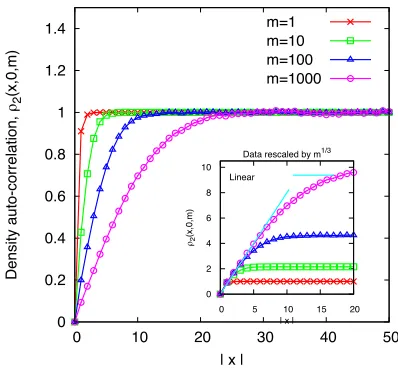
FIG. 4: The structure of the depletion zone as given by Eq. (27) in the case of regular diffusion. These plots have been normalised against the single-point densities corresponding to each choice of mass,m. The inset shows plausible evidence in support of the predicted form given by Eq. (27) after an appropriate rescaling of the data bym1/3.
number of particles per site (the average number of parti-cle per site in all simulations shown here was about 0.8 so we remain in the low density regime). Rather the trans-port process breaks correlations between particles allow-ing the mean field behaviour to become observable again. It was pointed out to us that a somewhat similar transi-tion in the scaling exponents of CCA as a additransi-tional scal-ing parameter is varied was demonstrated within mean field theory in [7]. There, an additional scaling parame-ter was introduced by the inclusion of exogeneous growth of clusters on top of the basic model dynamics.
As an aside, we remark that the dimensional argument leading to Eq. (23) suggests γ1 = 2dd++ββ when d is left arbitrary. Settingγ1 = 32 might lead one to conjecture that the critical dimension for CCA with L´evy diffusion is
dc =β. While intriguing, this suggestion of a fractional
critical dimension lacks the exact expression forγ1which allowed a convincing argument to be made fordc= 2 in
the case of regular diffusion (β= 2) [22].
VI. STRUCTURE OF THE DEPLETION ZONE
The breaking of anti-correlations between particles by L´evy flights should also be seen in the structure of the depletion zones surrounding particles. We now turn our attention to characterising this effect in one dimension. To detect the presence of depletion zones around particles in CCA we need to calculate the multipoint correlation functions between densities at different spatial points:
A closely related 2-point correlation function was calcu-lated exactly in one dimension for the case of infinite reaction rate in [22] and demonstrated clearly the ten-dency for clusters to anti-correlate in the diffusion-limited regime. It is natural to normalise such correlation func-tions with the mass density so that the ratio goes to 1 when particles are uncorrelated. To avoid excessively clumsy notation, we suppress the mass dependence of the spatial correlations for the time being.
If we forget about the mass dependence of the particles for the moment we are left with the coagulation process
A+A→A. One can study how the analogous correlation functions in this system behave. For the A+A → A
system without source it was predicted in [30] and later proven rigorously in [31] that in one dimension:
ρn(x1, . . .xn, t)∼
1
√
D t n
Y
1≤i<j≤n
|xi−xj|
√
D t , (25)
where ∼ denotes the short-distance asymptotic be-haviour. The first term on the right hand side is simply thenth power of the density. The second term accounts for correlations, producing multiscaling of the time-decay exponents for the A+A → A problem in d = 1. The fact that ρn(x1, . . .xn, t) vanishes as any two points are
brought together reflects the fact that particles are anti-correlated.
Since the mechanism for the generation of anticorrela-tions in the stationary CCA model is the same as for the
A+A→A, one can use Eq. (25) to guess the correspond-ing formula for the CCA model in the stationary state [32]. In Eq. (25) the diffusion length for decaying coagula-tion appears aslD =
√
D t. The corresponding diffusion length for particles of massminstationaryCCA is, from dimensional considerations,
lD=
D m
J 13
. (26)
Upon substitution into Eq. (25) we arrive at the following suggestion for the asymptotic behaviour, now in mass, of the multi-point correlation functions in stationary CCA:
ρn(x1, . . .xn, m)∼
J
D n3
m−43n Y
1≤i<j≤n
|xi−xj|
(D mJ )1/3.
(27) In the absence of a complete calculation, the plausibility of this argument should be assessed by comparison with numerics. This is done for n= 2 in Fig. 4. Eq. (27) im-plies that after rescaling withm1/3,ρ2(x1,x2, m)/ρ1(m)2
for different values of m should collapse onto the same curve which vanishes linearly as the separation,|x1−x2|,
tends to 0. Fig. 4 clearly shows that the depletion zone is larger for the heavier particles. The inset provides plausible evidence in support of the expected scaling.
We may now ask what happens in the case of L´evy flights. Fig. VI shows that as β is varied from 2 to 1,
0 x 100
1 x 10⁻³
2 x 10⁻³
3 x 10⁻³
4 x 10⁻³
5 x 10⁻³
0 20 40 60 80 100
Density auto-correlation
x Regular Diffusion
`=2.0 Levy diffusion
`=1.6 Levy diffusion
`=1.0 Levy diffusion
[image:9.612.337.540.51.224.2]Random hopping
FIG. 5: The depletion zone as shown for different transport mechanisms without normalisation against the single-point densities, for a fixed choice of mass,m= 1000. As the L´evy characteristic,βis varied from 2 down to 1, the anticorrelation void disappears, with the limiting cases of random lattice hops and regular diffusion also being shown.
the depletion zone disappears. For comparison, the cor-responding correlation functions for the limiting cases of completely local hops and completely random hops are shown. The results for L´evy flights lie somewhere in be-tween. Interestingly, the correlation between particles does not seem to vanish linearly with separation in the L´evy case. See, for example, the main panel of Fig. VI.
In the case of stationary CCA with L´evy flights, the anomalous diffusion length for particles of massmin one dimension is, dimensionally,
lDβ =
D
βm
J 1+1β
. (28)
The fact that the correlation between particles vanishes linearly in the case of regular diffusion follows from the calculations performed in [30] and is connected to the fact that the spatial transport mechanism is diffusion. Dimensionally, any power of|xi−xj|/lD in Eq. (25) or
Eq. (27) would be consistent so there is no reason to expect that this power should remain unity in the L´evy case when the transport mechanism is changed:
ρn(x1, . . .xn, m) ∼
J
D 1+nβ
m−2+1+ββn
× Y
1≤i<j≤n
"
|xi−xj|
(Dβm
J )
1/(1+β) #α
.
(29)
0 0.2 0.4 0.6 0.8 1 1.2 1.4
0 20 40 60 80 10
l2
(x,0,m)
| x |
M=10 M=100 M=1000
0 1 2 3 4
0 1 2 3 4 5 6 7
m
(
`
-1)/(
`
+1)
l2
(x,0,m)
| x |(`-1) Data rescaled according to Eq.(30)
[image:10.612.78.277.50.239.2]Linear
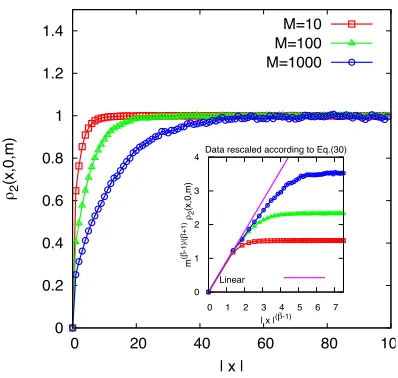
FIG. 6: Shape of the depletion zone as given by the predic-tion Eq. (30) for the L´evy characteristic β = 3/2. Each plot corresponds to a different choice of mass,m, and have been normalised against the corresponding single-point densi-ties. The inset provides plausible evidence for this prediction through the data collapse suggested by Eq. (30).
supported for the case of L´evy flights by the numerical measurements presented in Fig. 3. If one accepts that this scaling remains true when the single point correla-tion funccorrela-tion is split onto two nearby points, then one would expect that the power of J in Eq. (29) is unity for n = 2 (or equally, the power of m should be −3) which then requires that the exponentαshould be equal to β −1. This is consistent with Eq. (27) when β = 2 and consistent with the disappearance of the depletion zone when β = 1. For 1< β ≤2 we therefore propose the following shape for the depletion zone as measured by the two-point function:
ρ2(x1,x2, m)∼
J
D 1+2β
m−4+21+ββ |x1−x2|
β−1
(Dβm
J )(β−1)/(1+β)
.
(30) This prediction is tested against the numerical measure-ments forβ = 3/2 in Fig. VI. The inset shows the mea-sured values ofρ2(x1,x2, m)/ρ1(m)2for several different values of m rescaled by m(β−1)/(1+β) plotted as a func-tion of |x1−x2|
β−1
. According to Eq. (30), the data should collapse to a single curve vanishing linearly for small separations. The collapsed curve seems to rule out the possibility of linear scaling as one might expect by eye from the main panel of Fig. VI and makes the suggested scaling, Eq. (30), seem plausible. Further investigations, preferably supported by analytic calculations, will be re-quired in order to draw a definitive conclusion. In partic-ular, it is important to properly characterise the “inter-nal” mass structure of correlation functions like Eq. (27) for different masses, particularly for n= 2. It might be expected that the denominators of the |xi−xj| terms
have mass dependences of the form (mimj)1/6f(mi/mj)
wheref(x) is a homogeneous function of degree 0 which has been ignored in our scaling arguments. The legiti-macy or otherwise of this neglect is likely to be somehow related to the question of the locality of the mass cascade (see [25] for some discussion). This is a tricky issue in general and will require further work.
VII. CONCLUSIONS
To summarise, we have studied in detail, the scal-ing properties of one dimensional stationary CCA with L´evy flights. We have demonstrated that the transition from mean field statistics to fluctuation dominated statis-tics usually observed as the physical dimension is tuned through two from above, can be mimicked in one dimen-sion by varying the characteristic exponent, β, of the jump size distribution of the L´evy flights. This is physi-cally reasonable since the introduction of long range hops provides a mechanism to weaken correlations between particles in the system and may erase them entirely if they are sufficiently frequent. Our predicted values for the scaling exponent of the mass density as a function of
β based on dimensional arguments agreed well with nu-merical simulations of the underlying stochastic particle system.
We also provided a direct demonstration of the strong universality of the scaling exponent of the mass-flux-carrying correlation function in the stationary state. It is independent of both the physical dimension and the value ofβ as expected from theoretical considerations.
Finally we performed detailed investigations of the spa-tial structure of the depletion zones surrounding heavy particles in stationary CCA with both regular diffusion and L´evy flights. Our results indicate that in the case of regular diffusion, the exact results of [30] describing the multiscaling of correlation functions in the decaying
A+A→Amodel, have direct analogues for stationary CCA. In the case of L´evy flights, our numerical studies suggest that the two-point correlation function measur-ing the anti-correlation between particles in the system vanishes with a non-trivial fractional power of the sepa-ration between the particles as this sepasepa-ration decreases to zero. Using our knowledge of the exact scaling for the flux-carrying correlation function we put forward a scaling argument that this power should beβ−1. This scaling is consistent with numerical observations but fur-ther efforts will be required to make it definitive.
It is not immediately evident how to extend the meth-ods employed in [14, 30] to account for L´evy flights since the fractional Laplacian entering the propagator of effec-tive field theory seems difficult to obtain from the opera-tor representation of the master equation. A direct calcu-lation from the master equation seems equally daunting. Nevertheless we expect that some progress in this direc-tion could and should be made. This will greatly clarify the scaling arguments presented in this article.
model in order to make it more physically realistic. One would be to introduce mass-dependent diffusion, for ex-ample, and allowing the diffusion rate to decrease as a power of the mass, D(m) ∼ m−a, as one would expect
for real particles. Another would be to replace the L´evy flights with L´evy walks to account for the fact that phys-ical particles cannot instantaneously make long range jumps. We know that neither of these modifications would affect the scaling exponent, γ2 of the two-point
function which is fixed by the CFR alone. The value of
γ1and indeed γn forn >2 are, however, expected to be
sensitive to such modifications and would considerably complicate the picture.
Another natural extension would be to ask similar questions about the structure of anticorrelations in the so-called charge model with L´evy diffusion. The charge model [21, 33] is a closely related model in which masses (or charges) can take positive and negative values. When the rates of injection of positive and negative charges are equal, the flux J is zero on average so that the scal-ing arguments presented here fail. Instead of an exact conservation law for charge one instead has a statisti-cal conservation law for charge squared. This was used to derive the CFR (γ2= 4) for the charge model in [10]. Repeating the dimensional arguments leading to Eq. (22) in arbitrary dimension takingJ to be the average flux of
m2 givesγ1=3dd++ββ as a first guess for the charge model
scaling. In d = 1 one has γ1 = 3+1+ββ which gives the
diffusion limited result γ1 = 5/3 when β = 2 and the mean-field answerγ1= 2 whenβ= 1, both of which are known from [33]. If this dimensional prediction were sub-stantiated by an additional analytic or numerical study it could be used to generalise the remaining arguments.
Acknowledgements
CC thanks R. Rajesh and O. Zaboronski for many il-luminating discussions and acknowledges funding from RCUK. JH acknowledges funding from EPSRC.
Copyright
Scaling properties of one-dimensional cluster-cluster ag-gregation with L´evy diffusion.
Journal of Statistical Mechanics: Theory and Experi-ment cCopyright (2010) IOP Publishing Ltd.
This is an author-created, un-copyedited version of an article accepted for publication in Journal of Statistical Mechanics: Theory and Experiment. IOP Publishing Ltd is not responsible for any errors or omissions in this version of the manuscript or any version derived from it. The definitive publisher authenticated version is available online at doi: 10.1088/1742-5468/2010/05/.
[1] S.K. Friedlander.Smoke, Dust, and Haze: Fundamentals of Aerosol Dynamics. Oxford University Press, Oxford, 2nd ed. edition, 2000.
[2] J. Silk and S. D. White. The development of structure in the expanding universe. Astrophys. J., 223:L59–L62, 1978.
[3] A.S. Ackleh. Parameter estimation in a structured al-gal coagulation-fragmentation model. Nonlin. Analysis, 28(5):837 – 854, 1997.
[4] W.S. Scott. Analytic studies of cloud droplet coalescence i. J. Atmos. Sci., 25(54):54–65, 1968.
[5] C. Connaughton, R. Rajesh, and O. Zaboronski. Sta-tionary Kolmogorov solutions of the Smoluchowski ag-gregation equation with a source term. Phys. Rev. E, 69:061114, 2004.
[6] M. V. Smoluchowski. Drei Vortrage uber Diffu-sion, Brownsche Bewegung und Koagulation von Kol-loidteilchen. Phys. Z., 17:557-85, 1916.
[7] S. Cueille and C. Sire. Droplet nucleation and Smolu-chowski’s equation with growth and injection of particles. Phys. Rev. E, 57(1):881–900, 1998.
[8] D. J. Aldous. Deterministic and Stochastic Models for Coalescence (Aggregation and Coagulation): A Review of the Mean-Field Theory for Probabilists. Bernoulli, 5(1):3–48, February 1999.
[9] F. Leyvraz. Scaling theory and exactly solved models in the kinetics of irreversible aggregation. Phys. Reports, 383(2):95–212, August 2003.
[10] C. Connaughton, R. Rajesh, and O. Zaboronski.
Con-stant Flux Relation for driven dissipative systems.Phys. Rev. Lett., 98:080601, 2007.
[11] K. Kang and S. Redner. Fluctuation-dominated ki-netics in diffusion-controlled reactions. Phys. Rev. A, 32(1):435–447, Jul 1985.
[12] H. Takayasu, I. Nishikawa, and H. Tasaki. Power-law mass distribution of aggregation systems with injection. Phys. Rev. A, 37(8):3110–3117, 1988.
[13] D. T. J. Gillespie. Exact stochastic simulation of coupled chemical reactions. J. Phys. Chem., 81:2340–2361, 1977. [14] C. Connaughton, R. Rajesh, and O. Zaboronski. Cluster-cluster aggregation as an analogue of a turbulent cas-cade : Kolmogorov phenomenology, scaling laws and the breakdown of self-similarity. Physica D, 222:97–115, 2006.
[15] B.P. Lee. Renormalization group calculation for the reac-tion ka to oe. J. Phys. A: Math. Gen., 27(8):2633–2652, 1994.
[16] J. Cardy. Field theory and nonequilibrium statis-tical mechanics. Lectures given at Troisi`eme cy-cle de la Physique en Suisse Romande, 1998-1999, semestre d’´et´e, 1998. Available online at: http://www-thphys.physics.ox.ac.uk/users/JohnCardy/home.html. [17] O. V. Zaboronski. Stochastic aggregation of diffusive
par-ticles revisited. Phys. Lett. A, 281(2-3):119 – 125, 2001. [18] M.J. Howard and U.C. Tauber. ‘real’ versus ‘imaginary’
noise in diffusion-limited reactions. J. Phys. A: Math. Gen., 30(22):7721–7731, 1997.
Break-down of Kolmogorov scaling in models of cluster aggre-gation. Phys. Rev. Lett., 94:194503, 2005.
[20] G. Huber. Scheidegger’s rivers, takayasu’s aggregates and continued fractions. Physica A, 170:463–470, 1991. [21] S.N. Majumdar and C. Sire. Exact Dynamics of a Class
of Aggregation Models. Phys. Rev. Lett., 71(22):3729– 3732, 1993.
[22] R. Rajesh and S. N. Majumdar. Exact calculation of the spatiotemporal correlations in the takayasu model and in the q model of force fluctuations in bead packs. Phys. Rev. E, 62(3):3186–3196, Sep 2000.
[23] U. Frisch. Turbulence: the legacy of A. N. Kolmogorov. Cambridge University Press, Cambridge, 1995.
[24] V.E. Zakharov, V.S. Lvov, and G. Falkovich.Kolmogorov Spectra of Turbulence. Springer-Verlag, Berlin, 1992. [25] C. Connaughton, R. Rajesh, and O. Zaboronski.
Con-stant Flux Relation for diffusion limited cluster–cluster aggregation. Phys. Rev. E, 78(041403), October 2008. [26] A. Clauset, C.R. Shalizi, and M.E.J. Newman. Power-law
distributions in empirical data. SIAM Rev., 51(4):661– 703, 2009.
[27] J. G. Amar, F. Family, and D.C. Hughes. Submonolayer epitaxial growth with long-range (l´evy) diffusion. Phys.
Rev. E, 58(6):7130–7136, 1998.
[28] M. S. Levine, A. A. Golovin, and V. A. Volpert. Step-flow growth of a crystal surface by l´evy flights.Europhys. Lett., 82(2):28007, 2008.
[29] R. Metzler and J. Klafter. The random walk’s guide to anomalous diffusion: a fractional dynamics approach. Phys. Rep., 339:1–77, 2000.
[30] R. M. Munasinghe, R. Rajesh, and O. V. Zaboronski. Multiscaling of correlation functions in single species reaction-diffusion systems. Phys. Rev. E, 73(5):051103, 2006.
[31] R. M. Munasinghe, R. Rajesh, R. Tribe, and O. V. Zaboronski. Multi-Scaling of the n-Point Density Func-tion for Coalescing Brownian MoFunc-tions. Comm. Math. Phys., 268:717–725, December 2006.
[32] C. Connaughton, R. Rajesh, and O. Zaboronski. Kinetics of Cluster–Cluster Aggregation. In K. Sattler, editor, Handbook of Nanophysics, chapter 16, pages 1–40. Taylor and Francis, 2010 (to appear).