warwick.ac.uk/lib-publications
Original citation:
O'Regan, David D., Hine, Nicholas, Payne, Mike C. and Mostofi, Arash A.. (2010) Projector
self-consistent DFT plus U using nonorthogonal generalized Wannier functions. Physical
Review B (Condensed Matter and Materials Physics), 82 (8). 081102(R).
Permanent WRAP URL:
http://wrap.warwick.ac.uk/78088
Copyright and reuse:
The Warwick Research Archive Portal (WRAP) makes this work by researchers of the
University of Warwick available open access under the following conditions. Copyright ©
and all moral rights to the version of the paper presented here belong to the individual
author(s) and/or other copyright owners. To the extent reasonable and practicable the
material made available in WRAP has been checked for eligibility before being made
available.
Copies of full items can be used for personal research or study, educational, or not-for-profit
purposes without prior permission or charge. Provided that the authors, title and full
bibliographic details are credited, a hyperlink and/or URL is given for the original metadata
page and the content is not changed in any way.
Publisher statement:
© 2010 American Physical Society
http://dx.doi.org/10.1103/PhysRevB.82.081102
A note on versions:
The version presented here may differ from the published version or, version of record, if
you wish to cite this item you are advised to consult the publisher’s version. Please see the
‘permanent WRAP URL’ above for details on accessing the published version and note that
access may require a subscription.
David D. O’Regan,1,∗ Nicholas D. M. Hine,1, 2 Mike C. Payne,1 and Arash A. Mostofi2 1
Cavendish Laboratory, University of Cambridge, J. J. Thomson Avenue, Cambridge CB3 0HE, United Kingdom
2
The Thomas Young Centre, Imperial College London, London SW7 2AZ, United Kingdom
(Dated: June 10, 2012)
We present a formulation of the density-functional theory + Hubbard model (DFT+U) method
that is self-consistent over the choice of Hubbard projectors used to define the correlated subspaces. In order to overcome the arbitrariness in this choice, we propose the use of non-orthogonal
gener-alized Wannier functions (NGWFs) as projectors for the DFT+U correction. We iteratively refine
these NGWF projectors and, hence, the DFT+U functional, such that the correlated subspaces
are fully self-consistent with the DFT+U ground-state. We discuss the convergence characteristics
of this algorithm and compare ground-state properties thus computed with those calculated using hydrogenic projectors. Our approach is implemented within, but not restricted to, a linear-scaling
DFT framework, opening the path to DFT+U calculations on systems of unprecedented size.
Published asPhys. Rev. B 82, 081102(R) (2010).
PACS numbers: 71.15.Mb, 31.15.E-, 71.15.Ap (Accepted for Physical Review B Rapid Communications)
The physics of localized electrons bound to transition metal or Lanthanoid ions is important for understand-ing and harnessunderstand-ing the behaviour of complex systems such as molecular magnets1inorganic catalysts2and the
organometallic molecules that facilitate some of the most critical chemical reactions in biochemistry3.
Despite its success at predicting ground-state proper-ties of materials, Kohn-Sham density-functional theory (DFT)4fails to describe the physics of such
“correlated-electron” systems when local or semi-local exchange-correlation (XC) functionals are used, often predicting results that are not only quantitatively but qualitatively inconsistent with experiment5. The origin of this
ap-parent failure has been understood since the work of Perdew et al.6 and is related to the unphysical
curva-ture of the energy functional with respect to electronic occupation number7,8inherent to such functionals unless a self-interaction correction is employed9.
DFT + Hubbard U (DFT+U)10 is a simple,
compu-tationally inexpensive method for improving the descrip-tion of on-site Coulomb interacdescrip-tions provided by conven-tional XC funcconven-tionals and, hence, for extending the range of applicability of DFT to strongly-correlated materials. The principle of DFT+U is to divide the system into a delocalized, free electron-like part, the “bath”, which is well-described by conventional XC functionals, and a set of “correlated sites” which is not. The XC functional for electrons associated with these sites is then explicitly augmented with screened Coulomb interactions, the form of which are inspired by the Hubbard-model11, together with a double-counting term to correct for the component already included within the XC functional.
The correlated sites are defined by a set of 3d
and/or 4f atomic-like orbitals, or “Hubbard projec-tors”, that are chosen a priori. Projector functions that are commonly used include hydrogenic wavefunctions7,
maximally-localized Wannier functions12, and
LMTO-type orbitals5,10. This arbitrariness constitutes an unsat-isfactory, adjustable parameter in the DFT+U method.
In this article, we present an approach in which the am-biguity in the choice of Hubbard projectors is removed, and in which they are determined self-consistently with respect to the DFT+U ground-state. We first outline the theoretical framework of our approach, and present results of calculations on ligated iron porphyrin. We ex-amine the adequacy of hydrogenic orbitals as Hubbard projectors and, in particular, the sensitivity of the results to the form of these orbitals. We show that optimized non-orthogonal generalized Wannier functions (NGWFs) provide an unambiguous and natural choice for Hub-bard projectors and we introduce a technique for self-consistently delineating the subspaces in which correla-tion effects play an important role.
Our implementation is within the framework of linear-scaling DFT, however, the same self-consistent projec-tor methodology may be applied to any DFT approach that solves for localized Wannier-like functions (either directly, or indirectly in a post-processing step using an interface to a code such as Wannier9013).
Fur-thermore, our approach may be readily combined with recently-proposed methods to calculate U parameters from first-principles7,14, facilitating entirely
parameter-free and self-consistent DFT+U calculations.
The Hubbard energy correction term in DFT+U can be interpreted as a functional that penalizes the unphys-ical non-integer occupancy of the spatially localizedd−
orf−orbitals, those that are most prone to the spurious self-interaction present in standard DFT XC functionals.
We use a rotationally-invariant correction term,
EU = ∑
Iσ
U(I)(σ)
2
[ ∑
m
nmm−∑ mm′
nmm′nmm′ ](I)(σ)
, (1)
2
between electrons of spin σ, localized on the correlated siteI. Eq. (1) is, in effect, a penalty functional for devi-ation from idempotency of the projection of the single-particle density-matrix onto each correlated subspace.
The occupancy matrix in the case of a set ofM non-orthogonal Hubbard projectors |φ(mI)⟩, m ∈ {1, . . . , M}, localized on siteI, is given by
n(mI)(σ)m′ =∑ ik
fi(kσ)⟨ψi(kσ)|Pˆm(I)m′|ψi(kσ)⟩, (2)
whereψi(kσ)is a Kohn-Sham eigenstate for spin channelσ
with band index i, crystal momentum kand occupancy
fi(kσ), and ˆPm(I)m′ = |φm(I)⟩⟨φ(I)m ′
| is the Hubbard pro-jection operator. The contravariant dual vectors|φ(I)m⟩
are related to the covariant projectors through the site-centered overlap matrix Omm(I)′ = ⟨φ
(I)
m|φ
(I)
m′⟩ which is
a metric on the correlated subspace C(I): |φ(I)m⟩ =
|φ(mI)′⟩O(I)m ′m
;O(I)m′m′′O(I)
m′′m=δm ′ m.
Our definition of the occupancy matrix differs to that of Refs. 15 and has the following desirable properties: the expressions are tensorially correct; the energy and resulting potential are rotationally invariant; the result-ing potential is Hermitian and localized to the correlated site; and the trace of the occupancy matrix gives the occupancy of the correlated site16. The contravariant
metricO(I)mm′ is calculated only as an inverse of the co-variant overlap matrixO(mmI)′, therefore, the duals of the
Hubbard projectors are also localized to the site. As a re-sult, and in contrast with previously proposed approaches to DFT+U models using non-orthogonal projectors, the DFT+U potential constructed from the tensorially con-sistent energy for a given correlated site remains mani-festly local to that site. We note that for the special case of an orthogonal set of projectors on each site, the pro-jection operator is self-adjoint and the above expressions reduce to the DFT+U correction of Ref. 7.
Any set of localized functions may, in principle, be used as Hubbard projectors with which to define the oc-cupancy matrix. Solutions of appropriate orbital sym-metry of the hydrogenic Schr¨odinger equation, such as atomic-like or linear muffin-tin orbitals, are a common choice5,10,14. These are generally characterized by an
ef-fective chargeZthat determines their spatial diffuseness. For a given value of U, results of DFT+U calculations with different values chosen for Z will not necessarily yield the same ground-state properties14,17.
Notwith-standing, hydrogenic orbitals may be inappropriate in cases in which the orbitals of the correlated manifold dif-fer significantly from atomic wavefunctions.
In order to obtain accurate occupancies, a set of projec-tors is required which adequately accounts for electronic hybridization and which, if possible, is defined unambigu-ously for the system under study. Wannier functions, in particular maximally-localized Wannier functions (ML-WFs)18, form just such an accurate minimal basis. They have been used with good effect to augment DFT with lo-calized many-body interactions19, and there is numerical
evidence to suggest that MLWFs constitute the projector set which maximizes theU parameter12.
We work with the single-particle density-matrix, which is expressed in separable form20 ρ(r,r′) = ∑
αβϕα(r)K αβϕ
β(r′) in terms of a localized basis of NG-WFs21 {ϕ
α(r)}, related to the Kohn-Sham eigenstates by a linear transformation ψ(nσ)(r) =
∑
αϕα(r)M
(σ)α n . The density kernel Kαβ = ⟨ϕα|ρˆ|ϕβ⟩ is the representa-tion of the single-particle density operator ˆρin terms of the contravariant duals {ϕα(r)} of the NGWFs, which satisfy⟨ϕα|ϕβ⟩=δβα. The NGWFs are in turn expanded in terms of a systematic basis of Fourier-Lagrange, or psinc22, functions. The size of this basis is determined
by an energy cutoff, akin to a plane-wave kinetic energy cutoff, with respect to which calculations are converged. The DFT energy functional is iteratively minimized with respect to both the density kernel and the NGWF ex-pansion coefficients. The minimization scheme in the ONETEP linear-scaling code is detailed in Refs. 23.
These NGWFs, therefore, are a readily accessible set of localized orbitals which are calculated with linear-scaling computational cost. Similarly to MLWFs, NGWF cen-tres may be used to calculate polarizabilities16. Thus, in this framework, it is natural to use a localised subset of Wannier functions obtained at the end of a ground-state calculation, with appropriate orbital character, as Hubbard projectors for defining the DFT+U occupancy matrix. NGWFs are adapted to their chemical environ-ment, reflecting the balance between the competing ten-dencies of electron itinerancy and localization in strongly correlated systems and, as a result, provide an accurate representation of the occupancy of the correlated site.
We propose a projector self-consistent scheme whereby the Hubbard projectors are determined self-consistently by iteratively solving for the Kohn-Sham ground-state using the Hubbard projectors defined by NGWFs from the DFT+U ground-state energy calculation of the pre-vious iteration. In this way, the Hubbard projectors con-verge to those that are optimally adapted for their own DFT+U ground-state density. This scheme, as we go on to show, rapidly and monotonically converges to an un-ambiguously defined DFT+U ground-state which, for a givenU parameter, is of lowest energy. In other words, the DFT+U energy functional is additionally minimized with respect to the set of localized NGWF projectors that are, at convergence, self-consistent with the DFT+U cal-culation from which they are determined.
We applied our method to iron porphyrin (FeP). Met-alloporphyrin systems, such as FeP, play an important role in biochemistry. The ability of metalloporphyrins to bind simple molecules is of interest, particularly in the case of FeP which can have a greater affinity for CO and NO than O2, resulting in hindrance of respiration.
We performed fully converged energy minimization on FeP, and its complex with carbon monoxide, using the ONETEP code23. We used spin-polarized DFT+U
ki-1.60 1.65 1.70 1.75 1.80 1.85 1.90 1.95 2.00 2.05
7 8 9 10 11 12
P ro je ct ed m agne ti c m om ent ( µB )
Hydrogenic projector effective charge U = 2eV hydrogenic
U = 2eV NGWF U = 4eV hydrogenic U = 4eV NGWF U = 6eV hydrogenic U = 6eV NGWF -0.8 -0.6 -0.4 -0.2 0.0 0.2 0.4 0.6 0.8 Bi ndi ng E ne rgy (e V )
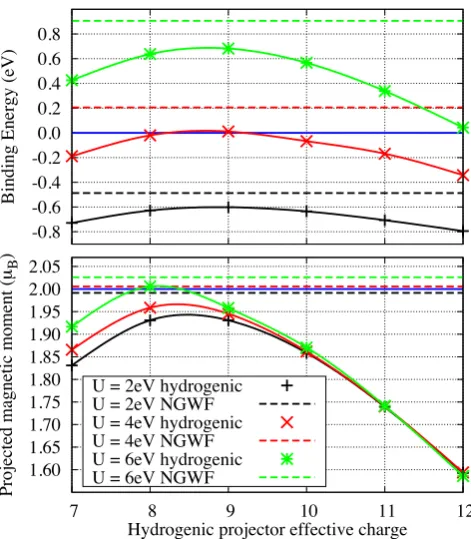
FIG. 1. (Color online) The interaction energy, positive for an unbound ligand, of the CO and FeP moieties (top panel) and the magnetic dipole moment projected onto the correlated manifold of triplet-state FeP (bottom panel). Both are
plot-ted at variousU as a function of the effective chargeZ used
to define the hydrogenic projectors (solid lines), while dashed lines show those quantities calculated with self-consistent NGWF Hubbard projectors. Blue lines indicate the binding threshold (top) and the ideal projected moment (bottom).
netic energy cutoff of 1000 eV was used with a cubic sim-ulation cell of side-length 37 ˚A. The NGWFs were spa-tially restricted to atom-centered spheres of radius 5.3 ˚A and no density kernel truncation was applied. Since the principal focus of this study was the dependence of com-puted DFT+U ground-state properties on variations in the Hubbard projectors for a given U value, optimized PBE (U = 0 eV) structures were used.
Shown in Fig. 1, is the interaction energy between FeP and CO as an illustration that the binding affinity be-tween moieties in DFT+U can be strongly influenced by the localization of the Hubbard projectors. As can be seen, binding affinity is by no means uniquely defined when hydrogenic projectors are used, although this may be partly compensated by a projector-dependent first-principles7,14 U parameter. At U = 6 eV it varies from approximately 0.04 eV to 0.69 eV over the range ofZ con-sidered; atU = 4 eV the result is even qualitatively am-biguous as a function ofZ. Using self-consistent NGWF projectors (dashed lines) generally results in energetically less favourable ligand binding, demonstrating that, for a given value of U, NGWF projectors more effectively counteract the spurious tendency of GGA functionals to
10-10 10-9 10-8 10-7 10-6 10-5 10-4 10-3 10-2 10-1 100
0 1 2 3 4 5 6 7 8
( E - E
SCF
) (eV)
Wannier function projector self-consistency iteration U = 2 eV
U = 4 eV U = 6 eV U = 8 eV
FIG. 2. (Color online) The difference in total energyE and
the total energy at projector self-consistencyESCFas a
func-tion of the projector self-consistency iterafunc-tion. The procedure
is initialized (iteration 0) with a set of hydrogenic 3d
projec-tors to construct the correlated subspace, using the
Clementi-Raimondi27effective charge ofZ= 11.17 for iron 3dorbitals.
over-bind ligands to FeP26. Also shown in Fig. 1, the
pro-jected magnetic dipole moment of FeP in its ground-state varies strongly with the value ofZ chosen for hydrogenic projectors (solid line), with only a narrow range ofZ at
U = 6 eV giving values that are close to the expected 2.0µB for optimal projectors. Moreover, a pathological
inconsistency with experiment emerges in thatU values of sufficient magnitude to achieve the requisite moment (for someZ) bring us into the unphysical regime where FeP+CO binding is disfavoured. Conversely, the use of self-consistent NGWF projectors (dashed) results in a projected magnetic moment which lies within the physi-cally reasonable range and is rather insensitive toU.
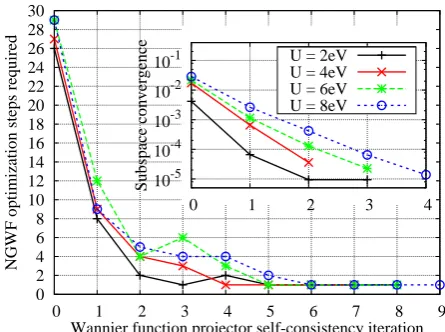
Fig. 2 demonstrates the stable convergence of the Hub-bard projector self-consistency scheme for FeP+CO at different values ofU. Each data point represents an in-dividual variational total-energy minimization, wherein the Hubbard projectors are re-constructed from the op-timized ground-state NGWFs from the previous itera-tion. The energy decreases rapidly as the projectors are refined, converging within a small number of iterations. This confirms our understanding that the Wannier are optimally adapted for the hybridized character of the electronic orbitals, while minimizing the energy. In this way, more spatially diffuse self-interaction corrections are introduced than with purely atomic orbitals, in a compli-mentary manner to such methods as DFT+U+V28which allow more general interaction terms between sites.
[image:4.595.59.295.52.322.2] [image:4.595.324.549.53.218.2]4 0 2 4 6 8 10 12 14 16 18 20 22 24 26 28 30
0 1 2 3 4 5 6 7 8 9
NGWF optimization steps required
Wannier function projector self-consistency iteration
10-5
10-4
10-3
10-2
10-1
0 1 2 3 4
Subspace convergence
U = 2eV U = 4eV U = 6eV U = 8eV
FIG. 3. (Color online) The number of NGWF optimization steps needed to converge the total energy for each projec-tor self-consistency iteration for FeP+CO. Shown inset is the convergence of the correlated subspace, as quantified by its
3d-orbital character.
In order to achieve meaningful insight into the U -dependence of bond formation, it is necessary to allow
for Hubbard projector update consistent with variations in the molecular geometry. We stress that ionic force expressions are not complicated by the inclusion of self-consistent Hubbard projectors, with no additional terms appearing over those in conventional DFT+U.
In conclusion, we have proposed and demonstrated a method within DFT+U for obtaining Hubbard projec-tors that are uniquely-defined, optimally adapted to their chemical environment, and consistent with the DFT+U
ground-state density. Our implementation may be in-corporated into any method that either solves directly for localized Wannier-like states, or which computes such states in a post-processing fashion. If combined self-consistently with approaches for calculatingU from first-principles7,14, this work opens up the possibility of
parameter-free DFT+U calculations on large systems.
ACKNOWLEDGMENTS
This research was supported by EPSRC, RCUK and the National University of Ireland. Calculations were performed on the Cambridge HPCS Darwin computer under EPSRC grant EP/F032773/1.
1
J. S. Miller and A. J. Epstein, Angew. Chem. Int. Ed.
Engl.,33, 385 (1994).
2 B. C. H. Steele and A. Heinzel, Nature,414, 345 (2001).
3 R. H. Holm, P. Kennepohl, and E. I. Solomon, Chem.
Rev.,96, 2239 (1996).
4 P. Hohenberg and W. Kohn, Phys. Rev.,136, B864 (1964);
W. Kohn and L. J. Sham,ibid.,140, A1133 (1965).
5
K. Terakura, T. Oguchi, A. R. Williams, and J. K¨ubler,
Phys. Rev. B,30, 4734 (1984); S. L. Dudarev, G. A.
Bot-ton, S. Y. Savrasov, C. J. Humphreys, and A. P. SutBot-ton,
ibid.,57, 1505 (1998).
6
J. P. Perdew, R. G. Parr, M. Levy, and J. L. Balduz, Phys.
Rev. Lett.,49, 1691 (1982).
7
M. Cococcioni and S. de Gironcoli, Phys. Rev. B, 71,
035105 (2005); H. J. Kulik, M. Cococcioni, D. A. Scherlis,
and N. Marzari, Phys. Rev. Lett.,97, 103001 (2006).
8
A. J. Cohen, P. Mori-Sanchez, and W. Yang, Science,321,
792 (2008).
9 A. Svane and O. Gunnarsson, Phys. Rev. Lett.,65, 1148
(1990). 10
V. I. Anisimov, J. Zaanen, and O. K. Andersen, Phys.
Rev. B, 44, 943 (1991); V. I. Anisimov, I. V. Solovyev,
M. A. Korotin, M. T. Czy˙zyk, and G. A. Sawatzky,ibid.,
48, 16929 (1993).
11
J. Hubbard, Proc. R. Soc. London Ser. A,276, 238 (1963);
277, 237 (1964); 281, 401 (1964).
12
T. Miyake and F. Aryasetiawan, Phys. Rev. B,77, 085122
(2008).
13 A. A. Mostofi, J. R. Yates, Y.-S. Lee, I. Souza, D.
Vander-bilt, N. Marzari, Comp. Phys. Comm.,178, 685 (2008).
14
W. E. Pickett, S. C. Erwin, and E. C. Ethridge, Phys.
Rev. B,58, 1201 (1998).
15 M. J. Han, T. Ozaki, and J. Yu, Phys. Rev. B,73, 045110
(2006); K. K. H. Eschrig and I. Chaplygin, Journal of Solid
State Chemistry,176, 482 (2003).
16 Further details to appear in a forthcoming paper.
17 S. Fabris, S. de Gironcoli, S. Baroni, G. Vicario, and
G. Balducci, Phys. Rev. B,72, 237102 (2005).
18 N. Marzari and D. Vanderbilt, Phys. Rev. B, 56, 12847
(1997). 19
F. Lechermann, A. Georges, A. Poteryaev, S. Biermann, M. Posternak, A. Yamasaki, and O. K. Andersen, Phys.
Rev. B,74, 125120 (2006).
20
R. McWeeny, Rev. Mod. Phys.,32, 335 (1960).
21
C.-K. Skylaris, A. A. Mostofi, P. D. Haynes, O. Di´eguez,
and M. C. Payne, Phys. Rev. B,66, 035119 (2002).
22
A. A. Mostofi, P. D. Haynes, C.-K. Skylaris and M. C.
Payne, J. Chem. Phys., 119, 8842 (2003); D. Baye and
P.-H. Heenen, J. Phys. A: Math. Gen.,19, 2041 (1986).
23
C.-K. Skylaris, P. D. Haynes, A. A. Mostofi and M. C.
Payne, J. Chem. Phys.,122, 084119 (2005); P. D. Haynes,
C.-K. Skylaris, A. A. Mostofi, and M. C. Payne, Chem.
Phys. Lett.,422, 345 (2006).
24
J. P. Perdew, K. Burke, and M. Ernzerhof, Phys. Rev.
Lett.,77, 3865 (1996).
25 A. M. Rappe, K. M. Rabe, E. Kaxiras, and J. D.
Joannopoulos, Phys. Rev. B, 41, 1227 (1990); RRKJ
Pseudopotentials were generated using the Opium code,
http://opium.sourceforge.net, using the GGA in-put parameters available therein, albeit with a scalar-relativistic correction for all species and, for iron, a non-linear core correction of Fuchs-Scheffler characteristic ra-dius 1.3a.u. and core-rara-dius of 2.0a.u.
26
D. A. Scherlis, M. Cococcioni, P. Sit, N. Marzari, J. Phys.
[image:5.595.64.287.51.217.2]27
E. Clementi and D. L. Raimondi, J. Chem. Phys.,38, 2686
(1963).
28
V. L. Campo Jr and M. Cococcioni, Journal of Physics: