Author: K.M. Hofman (s1877240)
Supervisors: Dr. Ir. E. Hofman / Dr. A.G. Sigurðardóttir
Master Thesis Business Administration
Track: Entrepreneurship, Innovation and Strategy
October 30
th, 2018
i | P a g e
Preface
This research is executed as final project of the master Business Administration at the University of Twente. It has been written in order to fulfill the graduation requirements. I have worked on this research
for the past several months, with this document as result.
I would like to thank a few people, because I would not have been able to conduct this research without their cooperation. First, I would like to thank my supervisor Dr. Ir. Erwin Hofman, who gave me the
opportunity to write my Master Thesis in his research domain. Also, I would like to thank him for his support during the whole process. Second, I would like to thank my supervisor Dr. Aldis Sigurðardóttir for her feedback during the last few weeks of my Master Thesis. Third, I would like to thank Ir. Remco
Siebelink, PDEng, for his feedback, excellent guidance and support that he provided during the entire
research process. Fourth, I would like to thank my cousins, roommate and sister for their time, effort, feedback and interesting insights. Last, but not least, I would like my whole family for their unconditional support during my studies the last few years.
Enschede, 30th of October, 2018
ii | P a g e
Abstract
Purpose – The goal of this research is to create an overview of the differences and similarities of the methods SWOT-analysis and scenario planning, from a theoretical as well as practical perspective,
hereby is the focus on the techniques and outcomes. This research is of interest, because there is little information available in the literature on the comparison between the methods, while the methods are
most commonly used in practice. The main research question is: “What are the differences and
similarities between the SWOT-analysis and scenario planning regarding their techniques and outcomes?”
Methodology – This research has used a qualitative approach. A theoretical framework is written in
order to research the existing literature on the SWOT-analysis and scenario planning. An interview
protocol is built on the existing literature. Nine interviews are conducted in this research. They have answered questions about their procedure regarding the two methods (from a practical perspective).
Findings – The results show three differences (focus, purpose and ‘unexpected opportunities’) and three similarities (features, strategic option development and shared understanding) from a theoretical point
of view and two differences (focus and purpose) and three similarities (subjectivity, teamwork and real option approach) from a practical point of view.
Conclusion/Discussion – Despite the fact that the methods share four similarities, there are three
important differences, namely the focus of the methods (1), purpose of the methods (2), and the opportunity to take advantage of unexpected opportunities (3). From here, three managerial implications
are formulated, whereby the managers are encouraged to choose the right method in terms of techniques and outcomes. Limitations and recommendations for future research are stated.
iii | P a g e
Table of contents
1. Introduction ... 1
1.1 Research goal and research questions ... 2
1.2 Research outline ... 3
2. Methodology ... 4
2.1 Desk research ... 4
2.2 Interviews ... 4
3. Theoretical findings ... 6
3.1 Method 1: SWOT-analysis ... 6
3.1.1 Definition SWOT-analysis ... 6
3.1.2 Technique SWOT-analysis ... 9
3.1.3 Outcomes SWOT-analysis ... 11
3.2 Method 2: Scenario planning... 12
3.2.1 Definition scenario (planning) ... 12
3.2.2 Technique scenario planning ... 15
3.2.3 Outcomes scenario planning ... 18
3.3 Comparison SWOT-analysis and scenario planning ... 19
3.3.1 Comparison techniques ... 19
3.3.2 Comparison outcomes ... 20
3.3.3 Overview comparisons ... 21
4. Practical findings ... 22
4.1 Sample ... 22
4.2 Findings SWOT-analysis ... 22
4.2.1 Technique SWOT-analysis ... 23
4.2.2 Outcomes SWOT-analysis ... 24
4.3 Findings scenario planning ... 25
4.3.1 Technique scenario planning ... 25
iv | P a g e
4.4 Comparison SWOT-analysis and scenario planning ... 28
4.4.1 Comparison techniques ... 28
4.4.2 Comparison outcomes ... 28
4.4.3 Overview comparisons ... 29
5. Discussion and conclusion ... 30
5.1 Discussion ... 30
5.1.1 Managerial implications ... 32
5.1.2 Theoretical contributions ... 33
5.1.3 Limitations ... 33
5.1.4 Recommendations for future research ... 34
5.2 Conclusion ... 35
References ... 37
Appendix I Interview protocol SWOT-team ... 42
v | P a g e
List of figures and tables
Figures
Figure 1 Research model ... 3
Figure 2 Visualization theoretical chapter ... 6
Figure 3 Visualization SWOT-analysis (own creation) ... 8
Figure 4 Difference inductive and deductive scenarios ... 15
Tables
Table 1 Data collection methods (* derived from Bryman & Bell, 2011) ... 4Table 2 Steps SWOT-analysis ... 10
Table 3 Steps scenario planning ... 17
Table 4 Overview differences and similarities theoretical ... 21
Table 5 Overview interviews ... 22
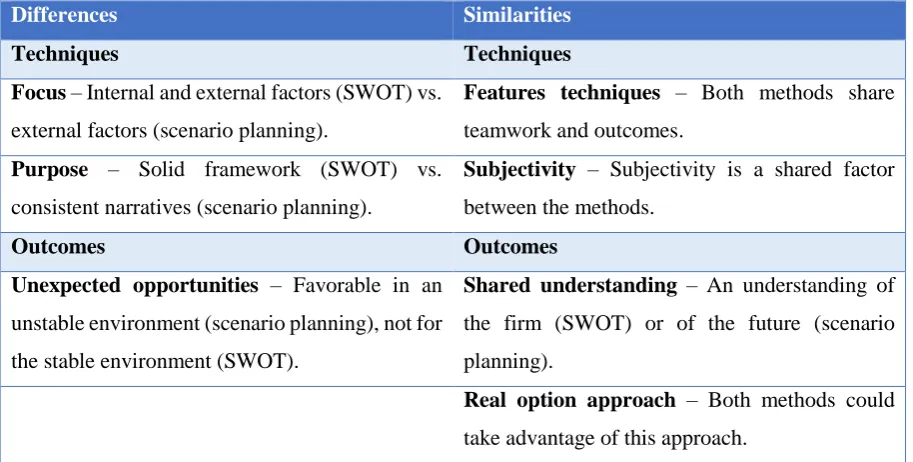
Table 6 Overview differences and similarities practical ... 29
vi | P a g e
List of abbreviations
BA Business Administration
CE Chemical Engineering
CEM Civil Engineering Management
IEM Industrial Engineering and Management
STM&I Strategic Technology Management and Innovation
SWOT Strengths, Weaknesses, Opportunities and Threats
List of definitions
Outcome the way a thing turns out; a consequence (Oxford Dictionary, 2018).
Scenario ‘A scenario is a description about possible future worlds that highlight key strategic decision points in the present and direct attention towards how underlying causal structures might evolve.’ (e.g. MacKay & Tambeau, 2013)
Scenario planning ‘Scenario planning is a systematic method for thinking creatively about possible complex and uncertain external futures, by understanding the past and the future
in the present.’ (e.g. Peterson, Cumming, & Carpenter, 2003)
SWOT-analysis ‘SWOT-analysis is a method for formulating a strategy and long-term planning,
by analyzing historical data on the external environment (opportunities and threats) and internal qualities (strengths and weaknesses).’ (e.g. Hay & Castilla,
2006)
1 | P a g e
1. Introduction
Nowadays, managers/decision-makers (from now on: managers) have to deal with strategic questions about the interests of their firm. Limited time, complex issues, and existing and potential competitors
contribute to the complexity of these strategic questions (Bodin, Chermack, & Coons, 2016). Every firm will be at least once confronted with a variety of internal and/or external forces, be it stimulants or
limitations (Van Wijngaarden, Scholten, & Van Wijk, 2012). These forces positively or negatively disturb a firm’s objectives (Houben, Lenie, & Vanhoof, 1999). To overcome this confrontation, firms
should formulate a strategic plan, from which it can distract concrete actions to turn possible limitations into stimulants, and build further on existing stimulants (Van Wijngaarden et al., 2012).
This strategic plan is often referred to as strategy. A strategy is “an integrated overarching
concept of how the business will achieve its objectives” (Hambrick & Fredrickson, 2005, p.51). A
strategy provides a plan for interacting with the environment to achieve organizational goals (Daft, Murphy, & Willmott, 2014). Thus, a strategic plan is the articulation and elaboration of a strategy or
vision (Mintzberg, 1994), and should be formulated in order to survive and grow (Burt & Van der Heijden, 2003; Van der Heijden, 1996).
Regarding the process of the formulation of a strategic plan, firms need to consider three stages.
The three stages are strategy analysis and formulation (gathering information)(1), strategic choice (exploring alternatives)(2), and strategy implementation (understanding the future implications of
present decisions)(3) (Bodin et al., 2016; Houben et al., 1999; Jarzabkowski & Giulietti, 2007). Scholars recommend to keep moving through the stages and go over and over them again, because a strategy is a
never ending concept (Bowman & Hurry, 1993; Daft et al., 2014).
The importance of a strategic plan is described in a nutshell. It can be said that every firm should
(re-)consider the three stages in order to survive and grow. Scholars have identified numerous techniques and methods to do this. Research has shown that the SWOT-analysis (SWOT: strengths, weaknesses,
opportunities and threats) (32%) and scenario planning (14%) are the most frequently used methods for formulating a (new) strategic plan (Clark, 1997; Jarzabkowski & Giulietti, 2007).
The methods SWOT-analysis and scenario planning share differences and similarities. For example, a similarity is that both methods are qualitative in nature (Al-Araki, 2013; Popper, 2008).
Conversely, the organizational environment, the environment in which firms operate, is a difference between the methods. The SWOT-analysis benefits of a stable environment (Bonn & Rundle-Thiele, 2007; Dent, 1999), whilst scenario planning is profitable in an unstable environment (Amer, Daim, &
2 | P a g e
Despite the fact that both methods are extensively described in the literature and commonly used, surprisingly little is written about the differences and similarities between the two most frequently
used methods. Also, there is not much known about the practical side of the methods, the procedures and experiences of the practitioners with the methods. Since there is little written about the differences
and similarities, it is of interest to conduct a research with as aim to create an overview of the differences and similarities between the two methods from two perspectives, theoretical and practical. The scope is
narrowed to the techniques and outcomes of both methods. With the overview, the contribution is two-fold. First, the overview is filling the gap in the literature on the differences and similarities between the
two methods. Second, managers could take advantage with this overview to choose the right method in terms of strategy development. It could be that one methods is in favor of the other method under certain
circumstances.
1.1 Research goal and research questions
The purpose of this research is to gain more insights into the techniques and outcomes of the
SWOT-analysis and scenario planning, and ultimately providing an overview. Therefore, the following main research question is formulated: “What are the differences and similarities between the SWOT-analysis
and scenario planning regarding their techniques and outcomes?”
Four sub-questions are formulated in order to respond to the main research question: two from a theoretical point of view and two from a practical point of view. On the one hand, the questions from a
theoretical point of view are descriptive. It provides information on the differences and similarities between the two methods and it contributes to the main research question by an extensive description of
the available literature on the techniques and outcomes of both methods.
1. What are the differences between the SWOT-analysis and scenario planning regarding their techniques and outcomes? (theoretical)
2. What are the similarities between the SWOT-analysis and scenario planning regarding their techniques and outcomes? (theoretical)
On the other hand, the questions from a practical point of view are rather explorative, as there is not much known about the differences and similarities between the two methods in the literature. The
questions contribute to the main research question by giving the differences and similarities regarding the techniques and outcomes, based on interviews. The interviews are conducted after both methods are
applied by the subjects. Overall aiming at a better understanding.
3 | P a g e
4. How do subjects evaluate the similarities between the SWOT-analysis and scenario planning in context of the techniques and outcomes? (practical)
1.2 Research outline
This research proceeds as follows. The second chapter describes the methodology of this research. The
third chapter provides the theoretical framework on the definitions, techniques and outcomes of both methods. The fourth chapter describes the results of the interviews, and elaborates on the procedure of
the respondents with the SWOT-analysis and scenario planning. The fifth chapter combines the results from previous chapters to create a complete overview of the differences and similarities. The sixth and
last chapter provides the discussion of this research. Here, the conclusion, theoretical contribution and managerial implications are given, as well as the limitations and recommendations for future research.
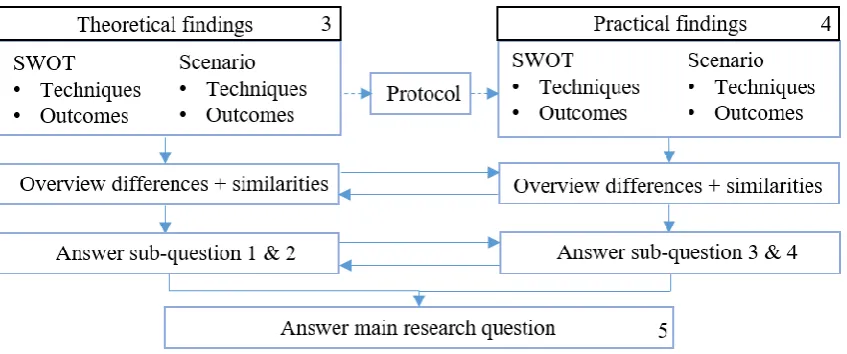
[image:11.595.72.496.356.533.2]Figure 1 shows the model of this research. The black boxes in the figure mirror the chapters of this research, even as the numbers in the boxes. Important to notice is that chapter two is the methodology of this research, which is not included in the figure.
4 | P a g e
2. Methodology
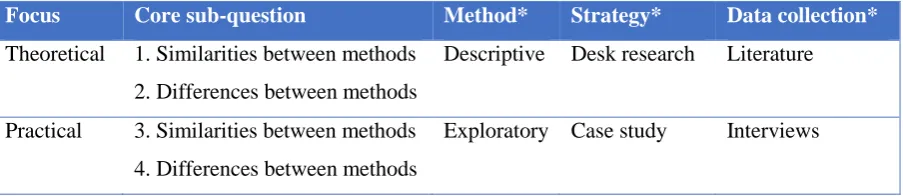
[image:12.595.74.526.184.282.2]This chapter defines the methodology of this research. Table 1 shows the first four sub-questions, sorted by focus, with the corresponding method, strategy and data collection.
Table 1 Data collection methods (* derived from Bryman & Bell, 2011)
2.1 Desk research
Desk research is the strategy that is applied to answer the first and second sub-question. The purpose of
this strategy is to write a theoretical chapter in order to get more insights in the existing theories of the SWOT-analysis and scenario planning. To ensure high quality literature, the databases of Google Scholar, Scopus and Web of Science have been used for finding articles and books. Also, journals as ‘Technological Forecasting and Social Change’ and ‘Journal of Management’ are used to gain more
insights into the specific topics. Search words as ‘SWOT-analysis’ and ‘scenario planning’ have been
used to assure articles within the scope of this research. The term SWOT-analysis is also written down as ‘strengths, weaknesses, opportunities, threats’. Scenario planning is also replaced by the terms ‘scenarios’, and ‘scenario analysis’. Furthermore, the so-called snowball-effect is applied in order to
reach for more relevant articles. The literature is criticized by the researcher in order to verify the quality
of the articles/books. As the methods are discussed for years, literature from the eighties is also included.
2.2 Interviews
Data collection
The third and fourth sub-question are rather explorative, because there is not much known about the
practical side of the two methods. An explorative study creates a better understanding and more feasibility to the topic (Babbie, 2007). This research has tried to aim for a better understanding of the methods by asking subjects about their procedure, while applying the methods SWOT-analysis and
scenario planning. A qualitative research is chosen, because it rather emphasizes words than quantifications in the collection and data analysis (Bryman & Bell, 2011). Therefore, semi-structured
interviews are designated as the collection method. In general, semi-structured interviews make use of an overall form of an interview protocol, with topics and general questions (Bryman & Bell, 2011). This
type of interview gives the researcher the flexibility to go into more detail if deemed necessary or interesting, but also to deviate from the interview protocol to some extent (Baarda, 2009).
Focus Core sub-question Method* Strategy* Data collection*
Theoretical 1. Similarities between methods
2. Differences between methods
Descriptive Desk research Literature
Practical 3. Similarities between methods 4. Differences between methods
5 | P a g e
The interview protocol was mainly formulated based on the theoretical chapter. The protocol had three general topics. The first topic was the background of the interviewees, combined with their experiences
on the application. The second topic was the method or were the methods that the subjects had worked with. The third topic were the outcomes of the method(s), as applied by the subjects.
A pre-test has been conducted to see whether questions should be changed or deleted from the protocol. A pre-test should never be skipped, because it provides valuable insights and feedback on the
chosen method (Babbie, 2007). The pre-test of this research showed that small adjustments had to be made in order to develop the best working protocol. Appendices I and II show the final interview
protocols, which have served as guidelines during the interviews. To have all information given during the interviews, the interviewees have been asked if they agreed on recording.
Sampling frame and method
The sample frame for the interviews consisted of 68 students of the master course Strategic Technology Management and Innovation (STM&I) of the University of Twente. The students were part of an experiment, focused on the practical side of the SWOT-analysis and scenario planning. The interviewees
have answered questions about the experiment, based on their procedure with one or two methods. A probability sample was taken, to ensure that every student had the same chance to be invited for an
interview. Per group of four students, one student is asked to join the interviews. In total, nine students were part of the interviews.
Data analysis
Qualitative data analysis is the process whereby the qualitative data moves to some form of explanation, understanding or interpretation of the people (who we investigate) (Taylor & Gibbs, 2018). In order to
analyze the results from the interviews, coding is used. Coding “entails reviewing transcripts and/or
field notes and giving labels (names) to component parts that seem to be of potential theoretical significance” (Bryman & Bell, 2011, p.578). With this process, the data is grouped together in order to
look for relationships in the end. First, a transcript of every interview was made, all interviewees agreed on recording the interviews. So, the transcription is made by writing down the information as ongoing
story, which means that only the information of the interviewees is taken into consideration and not the questions and sayings of the researcher. Second, axial codes were selected. Axial coding can be seen as
the process for grouping together the data. It creates categories by looking at codes which belong together and how they can be arranged (Bryman & Bell, 2011; Verhoeven, 2014). The categories are
similar to the questions from the interview protocols. Third, the method of selective coding is used. This step has included structuring the data, which means that all fragments of all interviewees with the same
6 | P a g e
3. Theoretical findings
This chapter provides the results from desk research. The methods SWOT-analysis and scenario planning are described regarding their definition, techniques and outcomes. Figure 2 provides a
[image:14.595.73.529.185.271.2]visualization on how this chapter is divided into three different paragraphs.
Figure 2 Visualization theoretical chapter
3.1 Method 1: SWOT-analysis
This paragraph elaborates on the definition, techniques and outcomes of the SWOT-analysis.
3.1.1 Definition SWOT-analysis
The SWOT-analysis has become an important method in the field of strategic analysis. It is one of the most frequently used qualitative methods in strategic analysis (Al-Araki, 2013; Jarzabkowski &
Giulietti, 2007). The SWOT-analysis is an useful method “for addressing the complex strategic
situations by reducing the quantity of information to improve decision-making” (Helms & Nixon, 2010,
p.216). The history of this method goes back to the sixties (Dyson, 2004; Ghazinoory, Esmail Zadeh, & Memariani, 2007). The Harvard Business School and other American business schools were the pioneers
in this field, especially Keith Andrews has been of great influence (Hill & Westbrook, 1997).
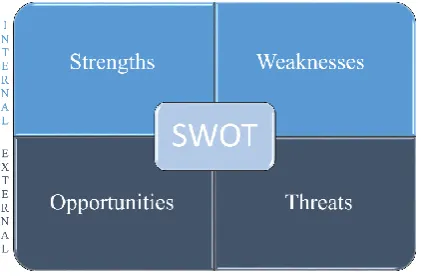
The SWOT-analysis deals with the internal strengths and weaknesses, and external opportunities and threats. Agreement is found on the working of the analysis. The
SWOT-analysis is concerned with the SWOT-analysis of the strengths and weaknesses of a firm and the opportunities
and threats in a stable external environment (Bonn & Rundle-Thiele, 2007; Dent, 1999; Dyson, 2004; Hay & Castilla, 2006; Hill & Westbrook, 1997; Houben et al., 1999; Panagiotou, 2003). The recognition of these factors results in a simple framework (Dyson, Bryant, Morecroft, & O’Brien, 2007), or often
referred to as two-by-two matrix (Chermack & Kasshanna, 2007) (see figure 3).
The distinction of the internal qualities and external environment should be clear. On the one
hand, the internal valuation is based on a broad variety of aspects of the firm, for example, personnel, facilities, products and services, and location (Dyson, 2004). Another distinction could be image,
7 | P a g e
On the other hand, the external valuation scans the political, economic, social, technological and competitive environment, in order to identify possible opportunities and threats (Dyson, 2004). Helms
and Nixon (2010) expand these scans to also include, for example, customers, trends in the market, and economic, political and regulatory issues.
The SWOT-analysis works best in a stable environment. A stable environment is characterized by slow decision-making and a comprehensive decision-making process (Bonn & Rundle-Thiele, 2007),
because managers in this environment have time to achieve well-defined goals in the most effective and efficient way (Peterson, Cumming, & Carpenter, 2003). The information for this process is available,
which means that there is less pressure on the collection of the data, plus the data is reliable (Khatri & Ng, 2000).
With the SWOT-analysis, the contribution of the managers is two-fold. On the one hand, managers are capable of bringing forth a good strategy. Here, the SWOT-analysis can be seen as
underlying tool that tries to formalize the strategy making process (Helms & Nixon, 2010; Hill & Westbrook, 1997; Houben et al., 1999; Pickton & Wright, 1998). Additionally, to connect internal and external factors, new strategies can be developed (Dyson, 2004). The main benefit of the combination
of the internal and external factors is that managers are able to formulate appropriate objectives for their firms (Zarkos, Morgan, & Kouropalatis, 2007). On the other hand, managers are able to create a
long-range or strategic planning in order to enhance the planning process (Helms & Nixon, 2010; Houben et al. 1999; Panagiotou, 2003). So, the SWOT-analysis can be seen as an essential starting point for any
strategic planning process (Helms & Nixon, 2010; Houben et al, 1999).
Information is key to perform the SWOT-analysis. According to Houben et al. (1999), firms
should focus on historical data. This data is available within the firms, as a result, it does not require much time to track down this information (Khatri & Ng, 2000). The data provides insights on the strategy
that is previously implemented, as well as the successes the firm has achieved in the past. Here, it is important that firms focus on the reasons behind the successes. However, firms should be aware that
there is no guarantee for new successes (Makridakis & Gaba, 1998). The information should be extended with a description of the current situation. Firms must go beyond the extrapolation of the past, because
“the model that best fits historical data is not necessarily the most accurate one” (Makridakis & Gaba,
1998, p.7). So, in addition to historical data, new data is also required.
The SWOT-analysis offers five practical advantages. First, the analysis is relatively simple and
practical in use (Pickton & Wright, 1998). Second, the analysis allows managers to evaluate risks with only little qualitative information (Paja, Maté, Woo, & Mylopoulos, 2016) and allows managers to focus
only on the key issues, which affect business development and growth (Pickton & Wright, 1998). Third, the SWOT-analysis is a helpful technique to see if and why the firm’s strategy is working (Chermack &
Kasshanna, 2007). Fourth, the SWOT-analysis creates a list which includes which strength should be used, which weakness should be eliminated, which opportunity should be exploited and which threat
8 | P a g e
Fifth advantage of the SWOT-analysis is improved team spirit. Teamwork is relatively important while creating the analysis. Hill and Westbrook (1997) mention that the outcomes of the
SWOT-analysis should be gained from a meeting or meetings with managers. This meeting may be facilitated by a consultant. Or, as Dyson et al. (2007) suggest, preferably within a structured group process. Also,
teamwork is important, because it promotes the creative thinking and expands the vision of managers (Balamuralikrishna & Dugger, 1995; Chermack & Kasshanna, 2007; Panagiotou, 2003).
Conversely, the SWOT-analysis itself also has two weaknesses. Firstly, Helms and Nixon (2010) argue that the biggest weakness is that the analysis faces the internal and external factors, but it
gives poor results and should therefore not be used in isolation. The SWOT-analysis should be extended with, for example McKinsey’s 7-structure or Porters 5-forces (Chermack & Kasshana, 2007; Helms &
Nixon, 2010), or with the real option approach (Zarkos et al., 2007).
Secondly, the distinction of the four quadrants of the SWOT-analysis is imprecise. Grant (in
Van Wijngaarden et al., 2012) argues that strengths, weaknesses, opportunities and threats, in general, are impossible to typify, because all aspects of the SWOT-analysis are classically based on a manager’s point of view. Also, Holweg and Van Donk (in Helms & Nixon, 2010) argue that the criteria to designate
a factor to one of the four quadrants is not clarified. A factor can be identified as strength, but someone else can argue this as a weakness, or vice versa. As a consequence, the SWOT-analysis becomes
relatively subjective. Therefore, Grant (in Van Wijngaarden et al., 2012) supports a confrontation of only external and internal factors, without making the further distinction.
To summarize, the SWOT-analysis is a widely known method for analyzing internal qualities and external environment, which is mostly based on historical data. The analysis is often chosen because
of its simplicity. Managers are able to formulate a strategy and create a strategic planning with this method. The definition of the SWOT-analysis for this research is as follows:
‘SWOT-analysis is a method for formulating a strategy and long-term planning,
[image:16.595.195.406.593.731.2]by analyzing historical data on the external environment (opportunities and threats) and internal qualities (strengths and weaknesses).’
9 | P a g e
3.1.2 Technique SWOT-analysis
This paragraph starts with the description of the existing techniques of the SWOT-analysis, followed by a suggestion for a generic technique.
Existing techniques
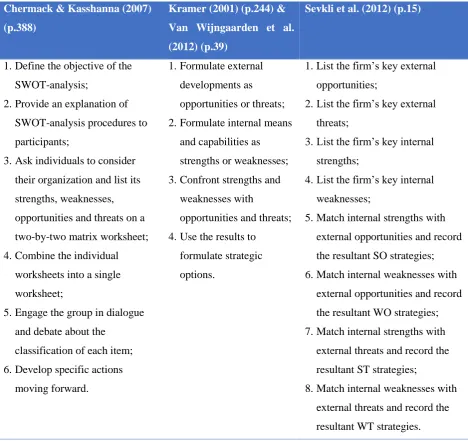
Table 2 shows three different techniques of the SWOT-analysis. This paragraph gives a comparison of the techniques on the process as well as the features. To start with this latter aspect. The number of steps
differs ranging from four to eight (Chermack & Kasshanna, 2007; Kramer, 2001; Sevkli et al., 2012; Van Wijngaarden et al., 2012). Nevertheless, it can be said that the steps of Kramer (2001), Van
Wijngaarden et al. (2012), and Sevkli et al. (2012) are similar. Though, Sevkli et al. (2012) consider the strengths, weaknesses, opportunities and threats as single items, whereas Kramer (2001) and Van
Wijngaarden et al. (2012) group the items together.
To continue with the process of the techniques. There are three major differences. First, before
the analysis of the internal and external factors, Chermack and Kasshanna (2007) argue that the scope of the exercise should be defined, followed by an explanation to all participants. The other two techniques do not include these two steps. Also, the technique of Chermack and Kasshanna (2007) is
the only one which describes the group process. The other two techniques do not mention this. Earlier in this research, teamwork is already explained as important, because it promotes creative thinking, and
it expands the vision of the managers.
Second, there is more evidence that the process of the SWOT-analysis is not uniform. Sevkli et
al. (2012) argue that the match of, for example, internal strengths with external opportunities results in a ‘SO strategy’. The technique suggests four confrontations. The techniques of Kramer (2001) and Van
Wijngaarden et al. (2012) also confront the factors with each other, but this does not automatically create a strategy. The creation of a strategy is the last step of their techniques. Chermack and Kasshanna (2007)
do not explicitly mention the confrontation of the items, but only discuss the dialogue as confrontation. Third, another factor of discordance is the end-state of the techniques. Sevkli et al. (2012) argue
that their four strategies give enough insights on how to proceed. Alternatively, Chermack and Kasshanna (2007), Kramer (2001) and Van Wijngaarden et al. (2012) argue that the results of the SWOT-analysis should be used in order to formulate strategic/specific options. In their opinion, the
confrontation of the factors is not sufficient for strategy development.
To summarize, the three techniques show several steps and activities, but there is not one
technique that is the best. It is recommended to use a combination of the three techniques in order to create the best SWOT-framework. The following section gives the generic SWOT-technique, which
10 | P a g e
Table 2 Steps SWOT-analysis
Generic SWOT-technique
1. Define the objective of the SWOT-analysis;
2. Provide an explanation of the SWOT-analysis procedures to participants; 3. Formulate external developments (opportunities and threats) as a team;
4. Formulate internal factors (strengths and weaknesses) as a team; 5. Create a 2*2 framework with the factors of step 3 and 4;
6. Confront the factors with each other as a team;
7. Use the results of step 6 to develop specific actions moving forward.
Chermack & Kasshanna (2007)
(p.388)
Kramer (2001) (p.244) &
Van Wijngaarden et al. (2012) (p.39)
Sevkli et al. (2012) (p.15)
1.Define the objective of the
SWOT-analysis;
2.Provide an explanation of
SWOT-analysis procedures to participants;
3.Ask individuals to consider
their organization and list its
strengths, weaknesses, opportunities and threats on a two-by-two matrix worksheet;
4.Combine the individual worksheets into a single
worksheet;
5.Engage the group in dialogue
and debate about the classification of each item;
6.Develop specific actions moving forward.
1.Formulate external
developments as opportunities or threats;
2.Formulate internal means and capabilities as strengths or weaknesses;
3.Confront strengths and
weaknesses with
opportunities and threats; 4.Use the results to
formulate strategic options.
1.List the firm’s key external
opportunities;
2.List the firm’s key external
threats;
3.List the firm’s key internal strengths;
4.List the firm’s key internal
weaknesses;
5.Match internal strengths with external opportunities and record
the resultant SO strategies; 6.Match internal weaknesses with
external opportunities and record the resultant WO strategies;
7.Match internal strengths with external threats and record the
resultant ST strategies;
8.Match internal weaknesses with
11 | P a g e
The above mentioned technique is a proposal for the generic SWOT-technique. This technique is a combination of the techniques identified by scholars as Chermack and Kasshanna (2007), Kramer
(2001), Sevkli et al. (2012), and Van Wijngaarden et al. (2012). The managers, who are working with the methods, should make a start with defining the objectives and the scope of the SWOT-analysis (step
1). The result of this step is at the same time the announcement to the participants of the SWOT-workshop (step 2). It also includes the data for follow-up meetings and the deviation of the participants
into different groups. This should be done beforehand, because the follow-up steps should be done in teams. The teams need to come up with first the external factors, the opportunities and threats (step 3),
followed by the internal factors, strengths and weaknesses (step 4). The amount of items per factor should be equal to five, because this amount is manageable (Kramer, 2001). Eventually, the factors
should be grouped together in a SWOT-framework (step 5). This is a visualization of individual items. There will be twenty items as maximum. The twenty factors should be confronted with each other. This
could be done with the symbols plus and minus. For example, if the two factors are positively influencing each other, it should get a plus or plus-plus. It is important to have a debate on this with all members of the team from the organizational point of view (step 6). In the end, team members are able to analyze
all the factors based on the symbols. Firms should work with their plus-plus and plus and should take care of the minus and especially the minus-minus. However, negative results are by definition not
failures, and positive items do not directly facilitate a better organizational performance (Kramer, 2001). The results of this analysis guide the managers to develop specific actions towards the future (step 7).
3.1.3 Outcomes SWOT-analysis
The outcomes contribute to the achievement of two intended goals of the SWOT-analysis. First, the
long-term goal is to have a solid framework for strategic purposes, be it planning or formation (Ghazinoory et al., 2007; Houben et al., 1999). When the SWOT-analysis is applied in an effective way,
the outcome of the analysis is a solid framework (Balamuralikrishna & Dugger, 1995; Hill & Westbrook, 1997; Houben et al., 1999), with which managers are able to “build on the strengths, eliminate the
weaknesses, exploit the opportunities or counter the threats” (Dyson, 2004, p.632). Moreover, the
framework creates an understanding of external factors coupled with internal factors (Kahraman, Demirel, & Demirel, 2007; Kurttila, Pesonen, Kangas, & Kajanus, 2000), or in other words: “the
investigation of the internal environment will accordingly result in an overview of all weaknesses and strengths of the company, while the investigation of the external environment will result in an overview of all opportunities and threats” (Houben et al., 1999, p.126).
However, it can be argued that the framework is not sufficient. Although, it provides a checklist
of internal and external factors, including which strength should be used, which weakness should be eliminated, which opportunity should be exploited and which treat should be defended (Barney, 1995;
12 | P a g e
Therefore, it is suggested to combine the outcomes of the SWOT-analysis with the real option approach (Chermack & Kasshanna, 2007; Dyson et al., 2007; Lu, 2010; Van Wijngaarden et al., 2012).
Eventually, the contribution of the real option approach is two-fold. On the one hand, real options produce more flexible strategic plans, whereby firms are capable of utilizing its strengths and by
confronting its weaknesses (Zarkos et al., 2007). On the other hand, the development of real options lead to the identification of a feasible strategy (Franco, Meadows, & Armstrong, 2013).
Second, the goal of the SWOT-analysis is to create a better understanding of the firm and its factors affecting the performance. The SWOT-analysis is part of the dynamics of the management
process (Balamuralikrishna & Dugger, 1995; Pickton & Wright, 1998). As a result, the creation of the framework facilitates opportunities for management development. Also, the aim of the SWOT-analysis
is to create a better understanding among stakeholders. The understanding of both, firm and stakeholders, eventually leads to a better performance of the firm (Van Wijngaarden et al., 2012).
To summarize, the outcomes of the SWOT-analysis contribute to the achievement of two goals. First, the solid framework (the outcomes of the confrontation of internal and external factors) for strategic planning/formation, which eventually leads to the real option approach, in order to formulate
actions towards the future. Second, the better understanding of the firm and its factors, but also the shared understanding among managers will lead to a higher performance.
3.2 Method 2: Scenario planning
This paragraph elaborates on the definition, techniques and outcomes of scenario planning.
3.2.1 Definition scenario (planning)
This sub-paragraph starts with a description of a scenario before diving into the theory of scenario planning.
Definition scenario
The current situation of doing business is concerned with high uncertainty due to changes in the field of, for example, technology, legislation, environment et cetera. For managers, it is best to be aware of
these developments, in order to anticipate and act promptly when necessary (Masini & Vasquez, 2000). For this, information is key as it will lead to understanding. Development of scenarios can be useful in
order to get a better understanding of this context (Van der Heijden, 2000). Van der Heijden (1996) defines scenarios as “a set of reasonably plausible, but structurally different futures” (p.29). Furthermore, Burt, Wright, Bradfield, Cairns, and Van der Heijden (2006) argue that a scenario is not a
predication, or a description of good and bad futures, but rather “a description of a future end state in a
13 | P a g e
In addition, MacKay and Tambeau (2013) argue that scenarios are “alternative views about possible
future worlds that highlight key strategic decision points in the present and direct attention towards how underlying causal structures might evolve” (p.674). Likewise, Wilson (2000) describes a scenario as “a
management tool to improve the quality of executive decision making” and “a learning tool to explore
general areas of risks and opportunities” (p.24). Thus, a scenario is often referred to as a description of
possible alternative futures, with as aim to improve the quality of decision making.
However, the emphasis of scenarios should not be on the development of the scenarios. Scholars agree that scenario planning affects the strategic decision making process (Postma & Liebl, 2005;
Wilson, 2000), because it provides managers more understandable, feasible and internally consistent scenarios (Postma & Liebl, 2005). However, this effect has thus far not been included in any definition.
Therefore, the following definition is formulated for this research.
‘A scenario is a description about possible future worlds that highlight key strategic decision points in
the present and direct attention towards how underlying causal structures might evolve.’
Definition Scenario Planning
Scenario planning is a commonly used method in strategic formation. The origin of scenario planning
goes back to the seventies, where Royal Dutch/Shell was a pioneer in this field (Schoemaker, 1995; Van der Heijden, 1996). Even back then, the urge of strategic planning was recognized. Scenario planning is
a process that combines the descriptions of plausible futures with the practical means of adapting to these possible futures today (Docherty & McKiernan, 2008). In addition, the contribution of this process
is to enable firms to think about complexity and uncertainty in external and unstable context.
The unstable environment is important for scenario planning. Scenario planning is ultimately
suitable for the dynamic and complex environment (Amer et al., 2013; MacKay & Tambeau, 2013). The unstable environment is characterized by fast decision-making and a simplified decision-making process
(Bonn & Rundle-Thiele, 2007). The information that is needed in this context is to some extent unreliable and limited in quantity. Therefore, managers should make use of intuition, which is key in developing an understanding of the situation (Khatri & Ng, 2000).
So, the importance of the complex and uncertain future is clarified. Peterson et al. (2003) also argue this phenomenon, but include creativity in their definition. Scenario planning is “a systematic
method for thinking creatively about possible complex and uncertain futures” (Peterson et al., 2003,
p.359). Also, Bodwell and Chermack (2010) argue that scenario planning has to deal with creativity.
Their definition of scenario planning is as follows: “scenario planning involves intuition, creativity, the
ability to wonder about the environment and its possibilities, as well as a deep understanding of industry
trends, competitor actions and global forces that drive economic, social, and political systems” (p.198). Apparently, creativity is an important factor for scenario planning.
14 | P a g e
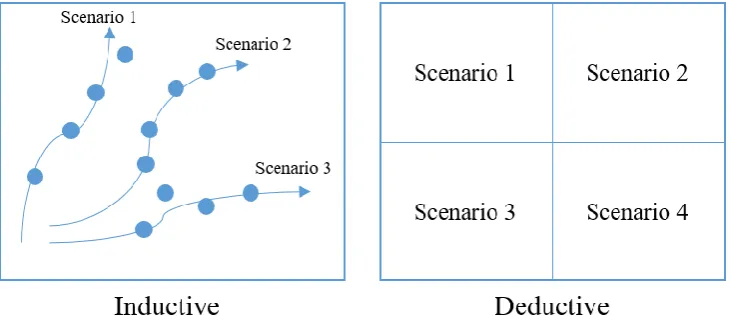
Furthermore, scenarios can be divided into four categories. Davis (2002) argues four ways in which scenarios can be build; inductive, deductive, incremental and normative. Although, in general,
scholars only discuss the inductive and deductive approach, because the other two are more for firms who are not familiar with strategic planning in general (Van der Heijden, 1996) (see figure 4). The
inductive approach does not have an overall framework, but the story lines grow from the step-by-step data (Van der Heijden, 1996). Contrarily, the deductive approach includes a framework. Here, the
information is inserted into four different quadrants, resulting in four different scenarios (Bowman, MacKay, Masrani, & McKiernan, 2013).
The contribution of scenario planning is two-fold. On the one hand, projects and decisions are more robust under a variety of alternative futures when working with scenario planning (O’Brien, 2004).
So, the robustness of the alternatives appear to increase by the development of an understanding of the uncertainties. Thus, managers are better at making decisions regarding the strategy formation (Postma
& Liebl, 2005). While, on the other hand, scenario planning provides a better thinking about the future by an enhanced understanding of the possible futures (Van der Heijden, 1996; Wright, Bradfield, & Cairns, 2013). Especially when managers have to deal with the medium and long-term future (Rickards,
Wiseman, Edwards, & Biggs, 2014).
Scenario planning has two advantages. Firstly, scenario planning gives firms the ability to learn
faster than the competitors (Burt & Van der Heijden, 2003). Royal Dutch/Shell is a good example. The firm was able to adapt quickly to changes in the external environment. With as result, the firm took advantage of its competitors (O’Brien, 2004; Peterson et al., 2003). Secondly, scenario planning offers
managers more than one possible scenario. In most cases, three to five alternatives will be developed (O’Brien, 2004; Richards et al., 2014; Schnaars, 1987). “A greater number tends to be confusing (and
unworkable), and less than two (one) is a point-estimate forecast” (Schnaars, 1987, p.112).
Scenario planning has two major weaknesses. First, the focus of scenario planning is imprecise. A majority of scholars argue for the focus on the external environment when creating scenarios
(Derbyshire & Wright, 2017; Dyson, 2004; Postma & Liebl, 2005; Schoemaker, 1995). However, Fink and Schlake (2000) argue for an internal as well as an external focus. Where firms are able to only influence the internal scenarios. Both focusses are useful, but the choice for the focus is depending on
the requirements of the firm. Nonetheless, scenarios are about the uncertain and unpredictable future (Peterson et al., 2003; Serrat, 2017), so, the scenarios are more associated with the external environment.
Second, there is a possibility that the created scenarios turn out as useless. If the scenarios lack logical consistency, the scenarios are nothing more than some speculations (Miller & Waller, 2003).
To summarize, scenario planning is a method which requires creativity and works with the unstable and uncertain external environment. With scenario planning, managers are able to make robust
15 | P a g e
‘Scenario planning is a systematic method for thinking creatively about possible complex and
uncertain external futures, by understanding the past and the future in the present.’
3.2.2 Technique scenario planning
This paragraph starts with the description of the existing techniques of scenario planning, followed by
a suggestion for a generic technique.
Existing techniques
Table 3 shows five different techniques of scenario planning. This paragraph gives the comparison
between the techniques on the process as well as the features. To start with this latter aspect. The number of steps differs ranging from eight to ten steps (Godet, 2000; Postma & Liebl, 2005; Schoemaker, 1995; Tapinos, 2012; Wright et al., 2013). However, the technique of Tapinos (2012) is divided into two parts.
The first six steps belong to scenario development and the last two steps to strategy development. Four similarities can be found in the development of multiple scenarios. First, there should
always be more than one scenario, commonly between three and five (O’Brien, 2004; Rickards et al., 2014; Schnaars, 1987). Second, all five techniques use deductive scenarios. For example, Schoemaker
(1995) calls them scenario themes, which is relatable to the deductive approach, while Wright et al. (2013) describe them as cluster outcomes. Third, Godet (2000) mentions the internal variables in step
three. Earlier in this research, it is agreed that scenario planning is based on external changes and opportunities (Derbyshire & Wright, 2017; Dyson, 2004; Postma & Liebl, 2005; Schoemaker, 1995).
So, this technique does not seem very useful. Fourth, the importance of teamwork is also a common factor. O’Brien (2004) discusses that a certain level of participation is recommended for the
development of the scenarios. Otherwise, personal life experiences can put constraints on the scenario
[image:23.595.116.482.117.278.2]process. Therefore, at least two persons should be involved in the process. Moreover, active participation in the scenario process enhances learning and application (Wright et al., 2013).
16 | P a g e
However, only the technique of Wright et al. (2013) mention explicitly teamwork. The other four techniques describe this group process in their research papers.
Five differences are found in the different steps of each technique. Overall, all techniques start with defining the scope. Second, the techniques continue with the determination of the key forces in the
external environment. Later on, only the techniques of Postma and Liebl (2005), Tapinos (2012) and Wright et al. (2013) discuss the rank of importance for these forces. It seems rather important, because
firms are normally only interested in the two/three most important ones, which will have the highest impact (Wright et al., 2013). Third, it seems that scenario planning continues with the development of
scenario themes. The techniques are all quite similar on this topic. Fourth, the scenarios will be checked for (internal) consistency in the techniques of Schoemaker (1995) and Tapinos (2012). Other techniques
do not mention this. Fifth, the techniques are infrequent when it comes to the end goal of the technique. The techniques of Godet (2000), Postma and Liebl (2005) and Tapinos (2012) explicitly mention
strategic options as outcome. Firms could write a plan of action, in combination with the options, based on the scenarios (Tapinos, 2012). Nevertheless, Schoemaker (1995) only mentions that firms should evolve toward the scenarios, but he does not provide a plan on how firms should work on that. Similarly,
the technique of Wright et al. (2013) stops after the development of the scenarios and does not elaborate on further activities.
To summarize, the five techniques show several steps and activities, but there is not one technique that is the best. It is recommended to use a combination of the five techniques in order to write
17 | P a g e
Table 3 Steps scenario planning
Schoemaker (1995)
(p.28-30)
Godet (2000)
(p.10)
Postma and Liebl (2005)
(p.164)
Tapinos (2012)
(p.340)
Wright, Bradfield and
Cairns (2013) (p.5)
1. Define the scope;
2. Identify the major
stakeholders;
3. Identify basic trends;
4. Identify key uncertainties;
5. Construct initial scenario
themes;
6. Check for consistency and
plausibility;
7. Develop learning
scenarios;
8. Identify research needs;
9. Develop quantitative
models;
10.Evolve toward decision
scenarios.
1. The problem formulated;
2. Diagnoses of firm;
3. Key variables
internal-external;
4. Dynamics of firm in
relation to its
environment;
5. Environment scenarios;
6. From identity to visions
and projects;
7. Evaluation of strategic
options;
8. From project to strategic
choices;
9. Plan of action and
implementation.
1. Identify focal issue or
decision;
2. Key forces in the local
environment;
3. Driving forces;
4. Rank by importance and
uncertainty;
5. Selecting the scenario
logics;
6. Fleshing out the scenarios;
7. Implications for strategy;
8. Selection of leading
indicators and signposts;
9. Feed the scenarios back to
those consulted;
10.Discuss the strategic
options;
11.Agree the implementation
plan;
12.Publicize the scenarios.
1. Define the scope of the
exercise;
2. Identify factors of
external uncertainty;
3. Reduce or cluster the
uncertainties;
4. Develop initial scenario
themes;
5. Check for internal
consistency;
6. Express scenarios in
narratives;
7. Assess the impact of
scenarios;
8. Develop and select
potential strategies.
1. Setting the agenda;
2. Determining the driving
forces;
3. Clustering the driving
forces;
4. Defining the cluster
outcomes;
5. Impact/uncertainty
matrix;
6. Framing the scenarios;
7. Scoping the scenarios;
18 | P a g e
Generic scenario planning technique
1. Define the scope of the exercise and providing the procedures to the participants;
2. Determine the driving forces in the external environment; 3. Rank the driving forces by importance and uncertainty;
4. Develop initial scenario themes (four);
5. Check for internal consistency and plausibility;
6. Express scenarios in narratives;
7. Use the results of step 6 to formulate actions towards the future.
The above mentioned technique is the proposal for the generic scenario planning technique. This
technique is a combination of techniques identified by scholars as Godet (2000), Postma and Liebl (2005), Schoemaker (1995), Tapinos (2012), and Wright et al. (2013). The managers should make a
start with defining the scope of the exercise (step 1). Scenario planning should be done in teams, as explained by O’Brien (2004), so step 1 should also include the deviation of the members. Also, it should
include the data for follow-up meetings. Each team should determine the driving forces in the external
environment (step 2). The driving forces should be ranked by importance and uncertainty (step 3). It is recommended to reduce the driving forces to a more manageable number of construct, like two or three
(Postma & Liebl, 2005). With this in mind, the initial scenario themes could be developed by the teams, and could function as handle for the four themes (step 4). Four, because of the agreement on the
deductive approach. The driving forces, in combination with the scenario themes, lead to the check for internal consistency and plausibility (step 5). This could be done by judging the driving forces on a
low/middle/high impact for each scenario. This results in a fingerprint, or table, with all four scenarios with corresponding impact. The narratives, arising from the driving forces, should be written after the
completion of this check (step 6). Each team member should write a narrative about their specific theme. Four members mirrors four scenarios. In the end, each team should have different scenarios, based on
the same driving forces (but with other impacts). The results should be used to formulate actions towards the future (step 7).
3.2.3 Outcomes scenario planning
The outcomes contribute to the achievement of three intended goals of scenario planning. First, scenario planning aims to improve the quality of the strategic conversation in firms (Burt & Van der Heijden,
2003; O’Brien & Meadows, 2013). According to Van der Heijden (1996), scenario planning is a method which is highly recommended in terms of having a strategic conversation. The method, which is
developed for the debate on the future, should facilitate a strategic conversation on what is happening now and may happen in the world around us (Masini & Vasquez, 2000). Also, to become aware of new
19 | P a g e
Also, Docherty and McKiernan (2008) state that the outcome of scenario planning is “its active
engagement of actors in its process and its power to enable them to think about complexity and
uncertainty in external contexts, and then how they might shape the external environment to contribute to their own strategic ends” (p.10). So, the active engagement of actors should eventually contribute to
the strategic conversation within firms.
Second, the goal of scenario planning is to cope with the uncertain environment. Scenario
planning aims to take advantage of unexpected opportunities (Chermack, 2011; O’Brien & Meadows, 2013; Schoemaker, 1995). Also, Peterson et al. (2003) state that a successful scenario should enhance
the ability of people to cope with and take advantage of future changes. The outcome of scenario planning benefits the firm on two levels: on the short term, the adaptability of the firm will increase, as
the business environment is more explicitly observed, and on the long term, a more robust organizational system can be developed, which can prevent firms from crashes (O’Brien, 2004; Van der Heijden, 1996).
Third, another goal of scenario planning is to make effective decisions. Scenario planning aims to make strategic choices (O’Brien & Meadows, 2013). However, scenario planning provides only a perspective on the future or shared understanding among managers, but it does not give directions on
how to act on this (Miller & Waller, 2003). It is up to managers on how to proceed towards the future. Therefore, managers should consider to create strategic options by using the real option approach.
Research has shown that ‘scenario planning’ and the ‘real option approach’ complement each other (Miller & Waller, 2003; Van Reedt Dortland, Voordijk, & Dewulf, 2014). The scenarios offer a structure
and guidance, real options commit to that by actual actions (Boisot & MacMillan, 2004; Ram & Montibeller, 2013).
To summarize, the outcomes of scenario planning contribute to the achievement of three goals. First, the strategic conversation within the firm, which eventually leads to a better understanding of the
future. Second, the adaptability on the short term could be increased, as well as the robustness of the organizational system on the long term. Third, the firm could actually act on the scenarios by using the
real option approach to create actual actions towards the future.
3.3 Comparison SWOT-analysis and scenario planning
This paragraph provides a comparison between the two methods from a theoretical point of view. It aims
for an understanding of the similarities and differences of the methods. It elaborates on the techniques and outcomes.
3.3.1 Comparison techniques
The comparison of the techniques is based on the features as well as the process. Before considering the
20 | P a g e
Both techniques should be applied in groups in order to enhance creative thinking (e.g. Balamuralikrishna & Dugger, 1995), and learning and application (Wright et al., 2013). Even though
the SWOT-analysis creates a list with internal strengths and weaknesses, and the external opportunities and threats, and scenario planning creates a description of how the external environment might turn out,
the outcomes are the same. Both techniques have the strategic option development as last step, this is not explicitly mentioned for scenario planning. Nevertheless, it is a similarity between the two
techniques. Conversely, when considering other features, it becomes clear that the SWOT-analysis focuses on both internal and external factors, whereas scenario planning only focus on the external
environment. Scenario planning does not take their internal organization into consideration, which is only done by the SWOT-analysis.
Moreover, the process of the techniques shows differences and similarities. Both techniques start with defining the scope and providing an explanation to the participants. The tasks after this are
different. For example, the SWOT-analysis considers four factors and creates a SWOT-framework, while scenario planning dives into the key uncertainties in the external environment in order to determine the impact and discuss how these uncertainties might turn out in the future. Eventually, to
write an internally consistent story based on that discussion. However, the end-state is similar. Both techniques formulate specific actions towards the future.
To summarize, the focus of the two methods is different (internal + external vs. external). Also, the purpose of the techniques is different. The SWOT-analysis creates a solid framework, while scenario
planning creates a narrative. However, there are four features which are similar: teamwork, scope, explanation to participants, and outcomes.
3.3.2 Comparison outcomes
This sub-paragraph starts with a short re-cap of the results. On the one hand, the SWOT-analysis
considers two outcomes. First, the SWOT-analysis tries to create a solid framework for strategic purposes (Ghazinoory et al., 2007; Houben et al., 1999), which should be complemented by the real
option approach. This combination provides more flexible strategic plans, and a flexible strategy (Franco et al., 2013; Zarkos et al., 2007). Second, the SWOT-analysis aims to create a better understanding of the firm and the factors which affect the performance (Pickton & Wright, 1998).
On the other hand, scenario planning reflects three outcomes. First, scenario planning aims to improve the quality of a strategic conversation in firms (Burt & Van der Heijden, 2003). Second, it
attempts to take advantage of unexpected opportunities (O’Brien & Meadows, 2013; Schoemaker, 1995). Third, scenario planning seeks for making strategic choices (O’Brien & Meadows, 2013). This
21 | P a g e
The methods share the outcome of the strategic option development. However, the input for the strategic option development is different, because the SWOT-analysis creates a framework with
strengths, weaknesses, opportunities and threats, whereas scenarios creates narratives about how the future might turn out. Also, the shared understanding is comparable. Although, the SWOT-analysis is
dealing with the organization, while scenario planning is focusing on the future. The difference between the methods is that scenario planning argues for a third outcome, namely ‘to take advantage of
unexpected opportunities’. This outcome is positively correlated with the unstable and complex environment (O’Brien & Meadows, 2013). Scenario planning deals with this environment. The
SWOT-analysis does not, which implies that this outcome is (less) applicable.
To summarize, the methods share two outcomes. The strategic option development (1) and the
better understanding (2). However, it should be noted that the input of the real options and the area of the understanding is different: organization vs. future. Scenario planning has another outcome, the
advantage of unexpected opportunities, which is less applicable to the SWOT-analysis. This is a difference between the two methods.
3.3.3 Overview comparisons
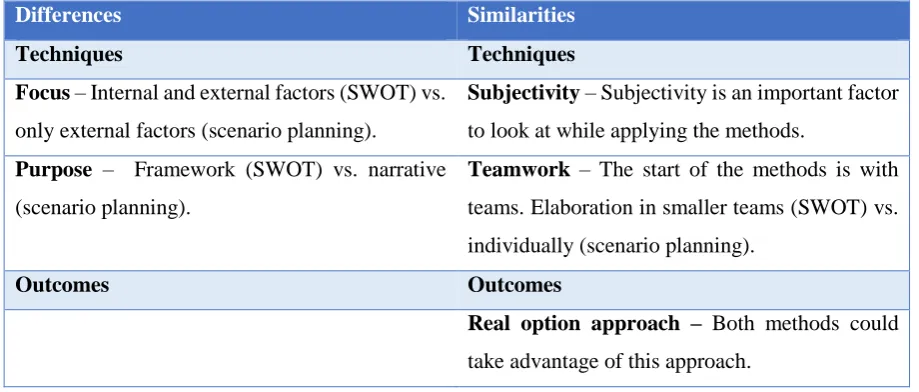
Table 4 shows the differences and similarities between the SWOT-analysis and scenario planning, explained by findings from the literature (desk research). Hereby, the first and second sub-question are
answered.
Table 4 Overview differences and similarities theoretical
Differences Similarities
Techniques Techniques
Focus – Internal and external factors (SWOT) vs.
only external factors (scenario planning).
Features – Four features are similar: teamwork,
scope, explanation to participants, and outcomes.
Purpose – Solid framework (SWOT) vs. consistent narrative (scenario planning).
Outcomes Outcomes
Unexpected opportunities – Favorable in an unstable environment (scenario planning), not for
the stable environment (SWOT).
Strategic option development – Both methods could take advantage of this.
Shared understanding – Understanding of the organization (SWOT) and understanding of the
22 | P a g e
4. Practical findings
This chapter shows the results of the interviews. The interviews are explorative in nature, which means that the results from the interviews are used to explore the differences and similarities between the two
methods from a practical point of view. This chapter starts with a description of the actual sample and continues with the results of the interviews, sorted by SWOT-analysis and scenario planning.
4.1 Sample
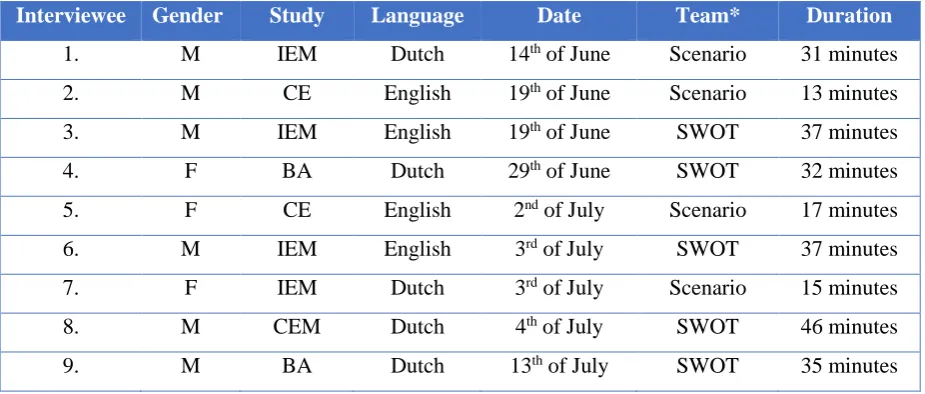
One student per group is asked to join the interviews. This has resulted in nine respondents. Table 5
shows an overview of the interviews that have been conducted. Information is provided on gender, study, language, date, team, and duration of the interview(ee). The contribution of the interviewees is processed
[image:30.595.71.534.333.530.2]anonymously. When applicable, the quotations of the interviewees are given.
Table 5 Overview interviews
Interviewee Gender Study Language Date Team* Duration
1. M IEM Dutch 14th of June Scenario 31 minutes
2. M CE English 19th of June Scenario 13 minutes
3. M IEM English 19th of June SWOT 37 minutes
4. F BA Dutch 29th of June SWOT 32 minutes
5. F CE English 2nd of July Scenario 17 minutes
6. M IEM English 3rd of July SWOT 37 minutes
7. F IEM Dutch 3rd of July Scenario 15 minutes
8. M CEM Dutch 4th of July SWOT 46 minutes
9. M BA Dutch 13th of July SWOT 35 minutes
* Before the experiment started, the students were divided into two teams. This was either the
SWOT-team or the scenario-SWOT-team. The students of each SWOT-team had to fulfill certain tasks regarding their specific method, for example: creating a SWOT-framework (SWOT-team) or writing narratives (scenario-team).
4.2 Findings SWOT-analysis
Interviewees have argued that the SWOT-analysis is developed to look with more details into a specific
company and its environment. The SWOT-analysis is about a fixed future, because it does not discuss different futures. The SWOT-analysis is ultimately suitable, when a company needs to re-organize their
internal structure or when the company wants to change/improve internally.
23 | P a g e
4.2.1 Technique SWOT-analysis
This sub-paragraph elaborates on the procedures of the SWOT-analysis, as applied by the interviewees during the experiment, in order to track down their experiences with the method.
The SWOT-analysis is performed as a team by analyzing the external factors of the environment, the
opportunities and threats first. Then, the analysis of the internal factors of the company is carried out. Overall, teams have done this by compiling a list with first the favorable and unfavorable items of the
external environment, followed by strong and weak factors of the company. After that, the items were divided into the four quadrants of the SWOT-analysis.
When looking at the internal factors, the teams have looked into the strengths and weaknesses of the company. These were sometimes difficult to find, as students had no experiences with the
company, nor do businesses normally provide their weaknesses on a platter. In that case, teams had to look for further information and look with more detail into the company. The website of the company
and the provided documents gave input for that.
‘We first made a list of opportunities and threats. We extended the list by the strengths and weaknesses.’ (student 8)
This challenge was expected. Therefore, students had to prepare themselves. A list of twelve driving forces was compiled by the company and students had to study the current status of these forces prior
to the experiment. The list was very useful for the analysis of the strengths and weaknesses, but also for the analysis of the external environment, and therefore very useful for the analysis of the opportunities
and threats. Most of the teams made use of this list while creating their SWOT-framework.
The SWOT-analysis consists of four quadrants. It can be argued that two of the four quadrants,
weaknesses and threats, are more attractive for the company to get familiar with than the other two, opportunities and strengths. The company should turn their weaknesses into strengths and should protect
themselves against possible threats.
‘We were only looking at the weaknesses and threats of the company.’ (student 6)
The interviewees indicated some difficulty with the placing of certain aspects in the quadrant.
Depending on the argumentation, someone could argue a factor as a strength, while someone else could argue the same factor as a weakness, or vice versa. Thus, the distinction between the four quadrants is
not clear. It is in most cases subjective.