http://wrap.warwick.ac.uk/
Original citation:
Birrell, Stewart A., Young, Mark S. and Jenkins, D. P. (2008) Improving driver behaviour
by design : a cognitive work analysis methodology. In: 2nd International Conference on
Applied Human factors and Ergonomics, Las Vegas, USA, 14-17 Jul 2008.
Permanent WRAP url:
http://wrap.warwick.ac.uk/53215
Copyright and reuse:
The Warwick Research Archive Portal (WRAP) makes this work of researchers of the
University of Warwick available open access under the following conditions. Copyright ©
and all moral rights to the version of the paper presented here belong to the individual
author(s) and/or other copyright owners. To the extent reasonable and practicable the
material made available in WRAP has been checked for eligibility before being made
available.
Copies of full items can be used for personal research or study, educational, or
not-for-profit purposes without prior permission or charge. Provided that the authors, title and
full bibliographic details are credited, a hyperlink and/or URL is given for the original
metadata page and the content is not changed in any way.
A note on versions:
The version presented in WRAP is the published version or, version of record, and may
be cited as it appears here.
Improving driver behaviour by design:
A Cognitive Work Analysis methodology
< digital picture>
< IF AVAILABLE> Birrell, Stewart
Ergonomics Research Group, School of Engineering and Design, Brunel University, Uxbridge, Middlesex, UB8 3PH, UK.
E-mail: [email protected]. Tel: +44 (0) 1895 267178
<digital picture>
< IF AVAILABLE> Young, Mark
Ergonomics Research Group, School of Engineering and Design, Brunel University, Uxbridge, Middlesex, UB8 3PH, UK.
E-mail: [email protected]. Tel: +44 (0) 1895 266527
< digital picture>
< IF AVAILABLE> Stanton, Neville
Ergonomics Research Group, School of Engineering and Design, Brunel University, Uxbridge, Middlesex, UB8 3PH, UK.
E-mail: [email protected]. Tel: +44 (0) 1895 265543
<digital picture>
< IF AVAILABLE> Jenkins, Daniel
Ergonomics Research Group, School of Engineering and Design, Brunel University, Uxbridge, Middlesex, UB8 3PH, UK.
E-mail: [email protected]. Tel: +44 (0) 1895 267108
ABSTRACT
Within the European Community both the environmental and safety costs of road transport are unacceptably high. ‘Foot-LITE’ is a UK project which aims to encourage drivers to adopt ‘greener’ and safer driving practices, with real-time and retrospective feedback being given both in-vehicle and off-line. This paper describes the early concept development of Foot-LITE, for which a Cognitive Work Analysis (CWA) was conducted. In this paper, we present the results of the first phase of CWA – the Work Domain Analysis, as well as some concept interface designs based on the WDA to illustrate its application. In summary, the CWA establishes a common framework for the project, and will ultimately contribute to the design of the in-vehicle interface.
Keywords
Eco-driving, road safety, human-machine interface, cognitive work analysis
INTRODUCTION
Foot-LITE
A UK project aims to develop a system for providing feedback and advice on driving style, in an effort to encourage drivers to adopt safer and greener driving behaviours. The ‘Foot-LITE’ project comprises a UK consortium of six commercial companies, four governmental / charity organisations, and three universities, funded jointly by the TSB, DfT and EPSRC. The system potentially comprises two aspects: an on-line (i.e., in-car) interface providing real time feedback and advice on driving style, coupled with an off-line (pre- and post-drive) data logging system which can help to inform transport choices. Whilst there already exist some in-car monitoring systems which can provide information on fuel consumption, none of these as yet give feedback to the driver in order for them to refine their behaviour to actually improve efficiency and safety. The Foot-LITE in-car interface might be envisaged to collect data not only on fuel consumption, but also on vehicle dynamics, evaluating the trade-offs between safe behaviours and overall environmental impact, and give the driver real-time feedback on how to optimise their driving style. The complementary off-line system would record journey data and wider behavioural patterns, providing information and advice on higher-level transport choices. For instance, it might be able to optimise journey choice based on safety, environmental impact, or even efficiency, advising the user on the appropriate transport mode – which may include public transport options. Longer-term advice on car maintenance and usage could also be included, such as keeping tyre pressures at their optimum in order to minimize fuel consumption.
One of the project’s concerns focuses on the ergonomics of the product – determining the driver behaviour parameters and designing an interface to optimise performance. There is already much research in ergonomics regarding driving safety, with considerable attention on advanced driver assistance systems (ADAS). Many authors have commented on the potential positive and negative effects of such devices on driver performance, and models of human interaction with technology are abundant. However, to date there has been relatively little ergonomics research dedicated to improving performance factors specifically related to environmental impact. In driving, there may be specific behaviours which are both safe and ‘green’; likewise, there may be occasions when these goals are in conflict. Enabling drivers to develop the skills for managing these conflicts is a challenge for ergonomics. In order to meet that challenge, we must first understand the nature of the task and capture the relevant behaviours which we need to address. Cognitive Work Analysis (CWA) offers a methodology for developing the concept of the Foot-LITE system, which can later be used to inform the design of the human-machine interface.
Cognitive Work Analysis
CWA is a structured framework for considering the development and analysis of complex socio-technical systems, which leads the analyst to consider the environment within which the task takes place, and the effects of constraints imposed on the system’s ability to perform its purpose. The conceived benefits of CWA are that the framework supports revolutionary rather than evolutionary design (Naikar & Lintern, 2002). Vicente (1999) states that CWA can be broken down into five phases, each of which models different constraints on the system; these phases are: Work Domain Analysis; Control Task Analysis; Strategies Analysis; Social Organisation and Cooperation Analysis; Worker Competencies Analysis. Within the Foot-LITE project all five phases of the CWA will be completed, but in this paper the focus is on the first phase - Work Domain Analysis (WDA).
largely used the WDA phase to identify variables and guide design for examples such as a lateral collision warning system (Jenkins et al, 2007), lane change manoeuvres (Stoner et al., 2003), the road transport system (Salmon et al, 2007) and adaptive cruise control (Seppelt and Lee, 2007). The principle claim of CWA is that it enables a ‘formative’ approach to design, rather than ‘normative’ (Jenkins et al, in press).
METHODOLOGY Work Domain Analysis
Work domain analysis (WDA) is the first and most commonly used phase of CWA; it is used to represent the domain in which the activity of a system is conducted. The key benefit of a WDA for the design process is that it offers a framework for the systematic organisation of information to assist design. The main output of a WDA is the Abstraction Hierarchy (AH), which enables the system to be considered at different levels which themselves are connected through relevant nodes via means-ends links. These levels are (adapted from Naikar et al, 2005):
Functional purpose – the highest level objectives of the system, or why the system
exists. These objectives do not change with time or as a result of different events, but remain fixed. The success of the system is defined by whether these functional purposes are achieved.
Values and priority measures – defines the criteria used to determine whether or not
the functional purposes are being achieved. This level outlines specific measures to determine what makes for the successful attainment of the overall aims of the system.
Purpose related functions – characterised by what functions the system is performing
in relation to the overall purpose. In simple terms this is how will the values and priority measures be achieved.
Object-related processes – what the physical objects in the system can do, or a further
detailed breakdown of functions.
Physical objects – the bottom level of the hierarchy lists all of the physical objects or
resources in the system, which can be either man-made or natural.
In order to collect data to populate the WDA, and to ensure a representative spread of views from within the Foot-LITE consortium, a series of three focus group sessions were run with all project partners attending. The present authors facilitated the focus groups, providing guidance on the process while allowing the WDA objects to be supplied by the attendees.
Foot-LITE Abstraction Hierarchy
The first objective of the analysis was to define the functional purposes of the system - the top level of the AH. Two such purposes were identified immediately as safe and eco-friendly road use; after much discussion a third was added to encapsulate road network efficiency. The latter purpose was deemed important as efficiency has a direct link to cost savings for the user, either by lower fuel consumption, maintenance or repair costs. An efficient road network is also inherently related to both a safer and greener road network, due to a reduction of road accidents and traffic jams. The functional purposes of the Foot-LITE system are thus:
Eco-friendly road transport use
Safe road transport use
After the functional purposes were established the group then set about defining the ‘Values and priority measures’. These are the criteria used to judge whether the system is achieving its purposes. Detailed discussions and off-line consolidation of the data generated the following measures:
Reduce carbon footprint; Reduce polluting emissions; Reduce local environmental impacts; Reduce risk, number and severity of road traffic accidents and incidents; Reduce inappropriate driver behaviour; Reinforce good driver behaviour; Satisfy personal mobility requirements; Increase predictability of journey times; Reduce cost of use; Increase availability of capacity.
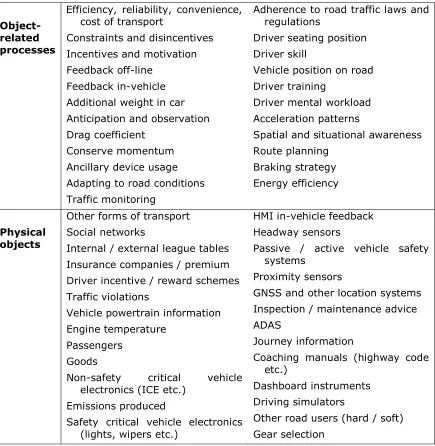
[image:5.612.90.525.291.737.2]Next, the focus group moved on to discuss and evaluate the items which should be included in the bottom two levels of the AH (the object-related processes and physical objects). As before, a first draft of the AH was constructed during the meeting, which was further populated and consolidated off-line by the authors (see table 1).
Table 1: Object-related processes and Physical objects included in the AH.
Object-related processes
Efficiency, reliability, convenience, cost of transport
Constraints and disincentives Incentives and motivation Feedback off-line
Feedback in-vehicle Additional weight in car Anticipation and observation Drag coefficient
Conserve momentum Ancillary device usage Adapting to road conditions Traffic monitoring
Adherence to road traffic laws and regulations
Driver seating position Driver skill
Vehicle position on road Driver training
Driver mental workload Acceleration patterns
Spatial and situational awareness Route planning
Braking strategy Energy efficiency
Physical objects
Other forms of transport Social networks
Internal / external league tables Insurance companies / premium Driver incentive / reward schemes Traffic violations
Vehicle powertrain information Engine temperature
Passengers Goods
Non-safety critical vehicle electronics (ICE etc.)
Emissions produced
Safety critical vehicle electronics (lights, wipers etc.)
HMI in-vehicle feedback Headway sensors
Passive / active vehicle safety systems
Proximity sensors
GNSS and other location systems Inspection / maintenance advice ADAS
Journey information
Coaching manuals (highway code etc.)
Dashboard instruments Driving simulators
Tyre pressure sensors
Training organisations (IAM,DVLA) Ambient temperature
Weight sensor Road topography Speed alerts
Driver coaching aid After journey review Vehicle telematics Fuel consumption
Throttle position
Hands-on wheel sensor Eye tracker
External driving conditions Road markings and signs In-vehicle noise sensor Start-up drill
Traffic information Use of HVAC
After treatment equipment
During the CWA focus group meetings only the top and bottom levels of the Foot-LITE AH were discussed. The middle layer of the hierarchy is considered to be the most challenging to complete. The purpose-related functions define how the Foot-LITE system will actually achieve its aims of improving eco-friendly, safe, and efficient road transport usage. By reviewing these aims it was established that the most likely way that Foot-LITE will achieve them is by informing and influencing user transport choices and driving behaviour. Therefore the purpose-related functions, which were completed offline by CWA experts, were subsequently defined as follows:
Influencing transport choices; Awareness of impact of transport choice; Improve communication between vehicle and driver; Reduce vehicle energy losses; Improve driver information provision; Improve driving styles and technique; Improve route management; Awareness of cost of transport choice
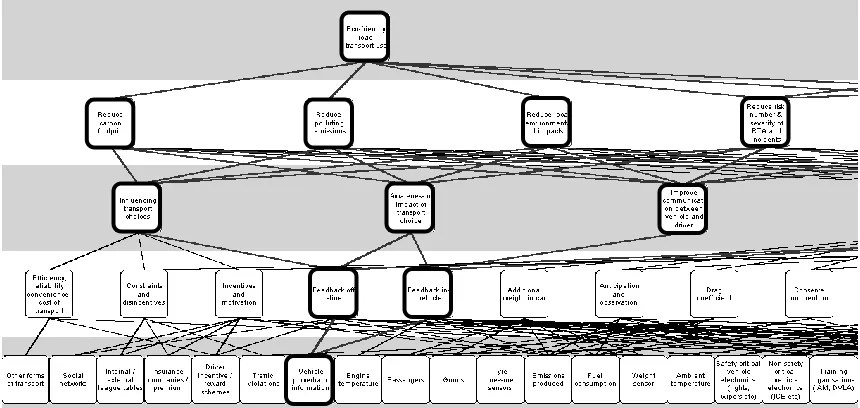
[image:6.612.86.527.54.220.2]Figure 1 shows an abridged section of the completed Foot-LITE AH, with the means-ends links added. By way of illustration, means-means-ends links relating to ‘Vehicle powertrain information’ have been highlighted. Following through the example in figure 1 shows that vehicle powertrain information is linked to the level above via in-vehicle and off-line feedback. In turn, feedback is then linked to numerous other functions and measures, and ultimately affects all three functional purposes (safety, eco-friendliness and efficiency).
[image:6.612.91.521.512.716.2]Audit trail
The explanation of the WDA process here has been simplified considerably; during the focus group meetings many iterations were discussed and whilst much detail was gained, many ideas also fell by the wayside. The final AH is considered to be an optimised representation based on group consensus. Further documentation for all of the ideas generated during the meetings, as well as reasons for their inclusion or exclusion, were minuted and archived for the project’s audit trail.
WDA FINDINGS
The WDA is the most recognised and widely used phase of the CWA process. The principal benefits are that it offers a structured means-end analysis to organise information at the early development stages of a project. Other benefits are that the analysis has determined a universal language for the consortium, and acted as a very effective springboard for numerous discussions about the project concept. The AH is a useful tool to define what aspects were considered inside and outside scope for Foot-LITE, without placing unnecessary constraints on the system. Subsequently, the analysis further defined the anticipated benefits of the system, and started to outline methods of how this may be achieved. As well as highlighting what we want to measure, the AH will also set criteria to judge the relative success of the system. The tangible benefit of conducting the WDA is that the physical objects and purpose-related functions established can be used as direct input for user requirements identification.
Summarising the findings from the Foot-LITE AH shows us that the process has identified many sensors that would be beneficial to assist the driver in positively changing their driving behaviour, such as hands on wheel sensors, eye trackers, and weight sensors. These are in addition to potentially pre-installed devices such as proximity and headway sensors, tyre pressure sensors and ambient temperature. A clear thought reiterated throughout the CWA process was the need to measure fuel consumption and emissions. If these data cannot be obtained from the vehicle powertrain then they must be measured or inferred using other means. In order to assess driving style, variables such as acceleration, braking, gear selection and steering also need to be measured. Again, whether these are actual or inferred data is for future consideration. For more detailed analysis of driving style and more specific and useful feedback the focus groups stated that some functionality with GNSS is essential. Feedback such as speed alerts, traffic violation information and geo-fencing will assist the user to drive in a safer manner. The Foot-LITE system may wish to draw on other sources of information such as route planning and traffic information. These sources may inform the driver and assist in better transport and route choices. Finally, off-line information in the form of after journey reviews will be extremely beneficial – for instance in informing the user of their cost of use or carbon footprint. The off-line feedback is envisaged to be the principal method of inducing longer term behavioural changes. Across all these solutions, though, the need for an efficient interface design in order to facilitate behaviour change is paramount – particularly in the vehicle, where we want to optimise performance while avoiding any detrimental effects of distraction.
CWA & DESIGN
relation to other information. Furthermore, determining how components of information can best be represented will help operators to rapidly perceive meaning from the information display. Finally, the process should review how a worker can navigate through the information space and how they can integrate pieces of information that need to be associated. Lintern et al (2004) relate the considerations presented above to the phases of CWA. They state that the ‘WDA identifies essential functions and thereby the specifications for information that must be displayed to represent those functions. By showing how different functions need to be associated, this analysis also provides specifications for access, navigation and linking between items of information’.
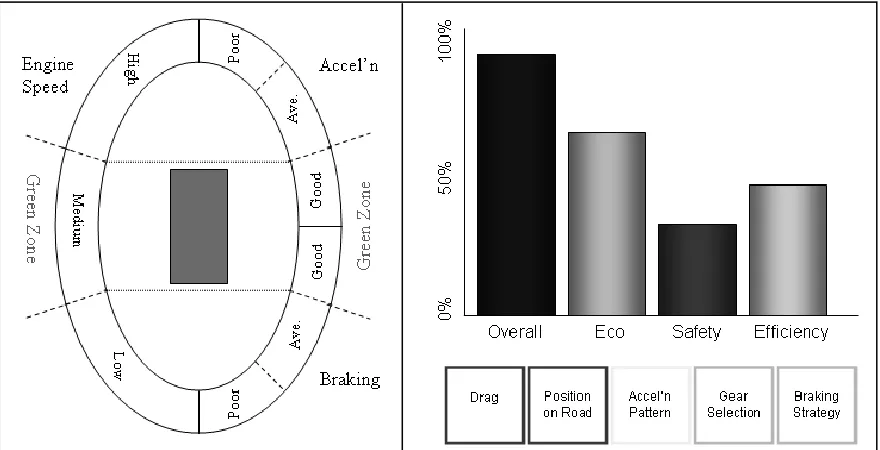
[image:8.612.86.526.430.655.2]Even if the design cannot be directly drawn from CWA as suggested above, the process itself works to inform the design procedure, as constraints of the system have been identified and a structured framework has given background to the issue or system which is being designed for. By way of illustration, two early concept interface designs are presented below, which use principles derived from the CWA process. The interface on the left is based around ecological interface design (EID) principles, whereas the one on the right draws heavily from the CWA process presented previously in this paper. The histograms, on the CWA design, show how the driver is performing in relation to the three functional purposes of Eco, Safe and Efficient driving with a combined, or overall Foot-LITE compliance, rating. This clearly shows which aspects of your driving are performing better than the others. The boxes underneath the bars represent which specific aspects of the driver’s behaviour are performing poorly (first two boxes), satisfactorily (middle) and well (last two). A skillful, or informed driver, can alter their driving to correct the areas at which they are performing poorly. These attributes are taken directly from the object-related processes outlined in the AH. The EID interface focuses on the outcomes from the structured CWA discussions that conserving momentum, accelerating and braking smoothly, planning ahead and gear selection were the most important factors for ‘smart’ driving.
Figure 2: Interface design ideas resulting from CWA.
CONCLUSIONS
for an in-car interface to help inform and support the driver. A clear trail form the WDA to the EID has been demonstrated. Future research projects will compare the EID approach with other approaches to interface design.
In conclusion, the CWA methodology has proved its worth in both process and outcome terms. For the project process, it provided a common language for ergonomists and engineers in the consortium to agree on the functional specification of the system and the constraints upon it. In terms of the outcome, the WDA in particular has been used as a platform to derive some interface design concepts for taking the system forward. The next phase of the project will test these designs in simulated and actual driving scenarios, in order to determine which has the most positive effects on driver behaviour and performance.
ACKNOWLEDGMENTS
Foot-LITE is sponsored by the TSB, the DfT and the EPSRC under the Future Intelligent Transport Systems initiative. The Foot-LITE consortium is comprised of: MIRA, TRW, Auto-Txt, Hampshire County Council, the Institute of Advanced Motorists, Nissan, Ricardo, Sussex Police, TfL, Zettlex, the University of Southampton, the University of Newcastle, and Brunel University.
REFERENCES
EEA, 2007, Transport and environment: On the way to a new common transport policy. European Environment AgencyReport (pp. 1-38).
EC, 2001, European transport policy for 2010: Time to decide. Luxembourg, European Commission(pp. 1-126).
Jenkins, D. P.; Stanton, N. A.; Walker, G. H.; Young, M. S., 2007, A new approach to designing lateral collision warning systems, International Journal of Vehicle Design, 45, 379-396.
Jenkins, D. P.; Stanton, N. A.; Salmon, P. M.; Walker, G. H., in press, Cognitive Work Analysis: Coping with Complexity. Ashgate, Aldershot, UK.
Lintern, G.; Cone, S.; Schenaker, M.; Ehlert, J.; Hughes, T., 2004, Asymmetric Adversary Analysis for Intelligent Preparation of the Battlespace (A3-IPB). United States Air Force Research Department Report.
Naikar, N.; Lintern, G., 2002, A review of "Cognitive Work Analysis: Towards safe, productive, and healthy computer-based work" by Kim J. Vicente, The International Journal of Aviation Psychology, 12(4), 391-400.
Naikar, N.; Hopcroft, R.; Moylan, A., 2005, Work Domain Analysis: Theoretical Concepts and Methodology. DSTO Technical Report, DSTO-TR-1665.
Salmon, P. M.; Stanton, N. A.; Regan, M.; Lenne, M.; Young, K., 2007, Work domain analysis and road transport: Implications for vehicle design, International Journal of Vehicle Design, 45(3), 426-448.
Seppelt, B. D.; Lee, J. D., 2007, Making adaptive cruise control (ACC) limits visible, International Journal of Human-Computer Studies, 65, 192-205.
Stoner, H. A.; Wiese, E. E.; Lee, J. D., 2003, Applying ecological interface design to the driving domain: The results of an abstraction hierarchy analysis. Proceedings of the Human Factors and Ergonomics Society 47th Annual Meeting, Santa Monica, CA, 444-448.