
University of Warwick institutional repository: http://go.warwick.ac.uk/wrap
A Thesis Submitted for the Degree of PhD at the University of Warwick
http://go.warwick.ac.uk/wrap/3640
This thesis is made available online and is protected by original copyright. Please scroll down to view the document itself.
Parallelisation for Data-Intensive
Applications over
Peer-to-Peer Networks
by
Xinuo Chen
Thesis
Submitted to the University of Warwick
In partial fulfilment of the requirements for the degree of
Doctor of Philosophy
Department of Computer Science
Contents
List of Tables ... i
List of Figures ... ii
Declarations ... vii
Glossary of Terms ... x
Abstract ... 1
Chapter 1 Introduction ... 3
1.1 Thesis Contributions ... 9
Chapter 2 Background ... 11
2.1 BLAST ... 11
2.2 Peer-to-Peer Network ... 13
2.2.1 Peer-to-Peer File Sharing ... 13
2.2.2 DHT ... 16
2.2.3 Peer-to-Peer Computation ... 15
Chapter 3 Analysing BitTorrent’s Seeding Strategies ... 19
3.1 Introduction ... 19
3.3 Understanding BitTorrent ... 22
3.3.1 BitTorrent Mechanism ... 22
3.3.2 Seeding Strategy ... 23
3.3.3 Additional Related Work on the Analysis of BitTorrent ... 25
3.4 Modelling Seeding Strategies ... 27
3.4.1 Metrics, Assumptions and Scenarios ... 28
3.4.2 The Model ... 29
3.5 Simulation Methodology ... 32
3.5.1 Simulator Details ... 32
3.5.2 Metrics ... 34
3.5.3 Setup of Experiments ... 34
3.5.4 Roadmap of Experiments ... 36
3.6 Results: the Homogenous Setting ... 36
3.6.1 Impact of Freeriders ... 37
3.6.2 Impact of Exploiters ... 40
3.7 Results: the Heterogeneous Setting ... 42
3.7.1 Impact of Freeriders ... 42
3.7.2 Impact of Exploiters ... 47
3.8 Conclusions and Discussion ... 51
Chapter 4 Distributed Arbitrary Segment Tree ... 53
4.1 Introduction ... 53
4.2 DHT and DAST ... 54
4.3 Other Rang Query Support ... 56
4.3.2 Distributed Segment Tree (DST) ... 58
4.4 Design of DAST ... 59
4.4.1 Arbitrary Segment Tree ... 59
4.4.2 DAST operations ... 63
4.4.3 The Value of M ... 64
4.4.4 Accuracy of Result for a range query ... 64
4.4.5 Load Balancing ... 66
4.4.6 Tree Maintenance and Fault Tolerance ... 67
4.5 Evaluation ... 68
4.5.1 Implementation ... 68
4.5.2 Setup ... 69
4.5.3 Structural Properties of DAST ... 70
4.5.4 Range query operations in DAST, DST and PHT ... 75
4.5.5 Comparison of the latencies for insertions and range queries in DAST, DST and PHT ... 77
4.6 Conclusions ... 78
Chapter 5 ppBLAST: A BLAST service over Peer-to-Peer networks ... 80
5.1. Introduction ... 80
5.2 Additional Related Work ... 81
5.2.1 Parallelising BLAST ... 81
5.2.2 SETI@home and Folding@home ... 82
5.2.3 Recent distributed data intensive computing techniques ... 83
5.3 Design of ppBLAST ... 83
5.3.1 Characteristics of BLAST ... 83
5.3.3 DAST-DHT ... 86
5.3.4 Peers and the worker component ... 88
5.3.5 Service Broker ... 89
5.3.6 Segment Distributor ... 91
5.4 Performance Evaluation ... 92
5.4.1 Experimental Roadmap and Setup ... 93
5.4.2 Results from the feasibility experiments ... 96
5.4.3 Results from the simulation experiments ... 99
5.5 Conclusions ... 102
Chapter 6 Conclusions and Future Work ... 103
6.1 Conclusions ... 103
6.1.1 Analysing BitTorrent Seeding Strategies ... 104
6.1.2 Distributed Arbitrary Segment Tree on DHT ... 105
6.1.3 A Parallelisation of BLAST over Peer-to-Peer network ... 106
6.2 Future Work ... 106
BitTorrent Seeding Strategies ... 106
DAST ... 107
ppBLAST ... 107
i
List of Tables
Table 1-1 BLAST programs and their functions ... 3
Table 3-1: Bandwidth distribution of leechers (derived from actual distribution of the Gnutella network [2, 3]) ... 35
Table 4-1: The experimental results for N = 4 and N = 5 ... 76
Table 4-2: The experimental results for AoR ... 77
Table 4-3: The comparison of AoR between PHT and DAST ... 78
Table 4-4: The experimental results for the average latencies of insert and range query in DAST, DST and PHT ... 79
Table 5-1. The hardware specifications for the five PCs ... 92
ii
List of Figures
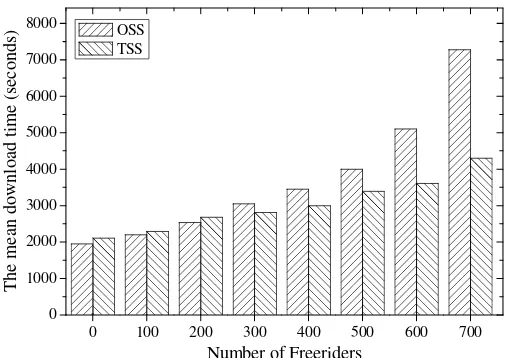
Figure 3-1. Results for homogenous setting with freerider: the mean download completion time comparison ... 37
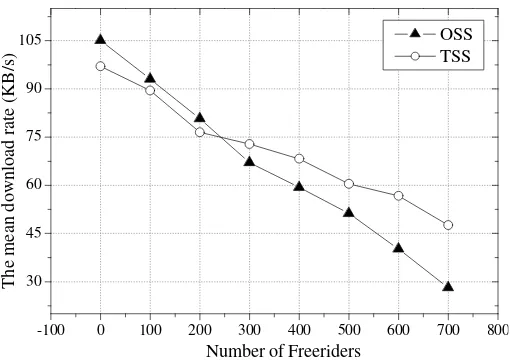
Figure 3-2. Results for homogenous setting with freerider: the download rate comparison ... 38
Figure 3-3. Results for homogenous setting with freerider: the IRD
comparison ... 39
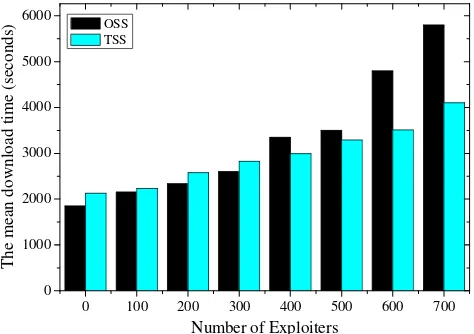
Figure 3-4. Results for homogenous setting with exploiters: the mean download time comparison ... 39
Figure 3-5. Results for homogenous setting with exploiters: the download rate comparison ... 41
Figure 3-6. Results for homogenous setting with exploiters: the IRD
comparison ... 41
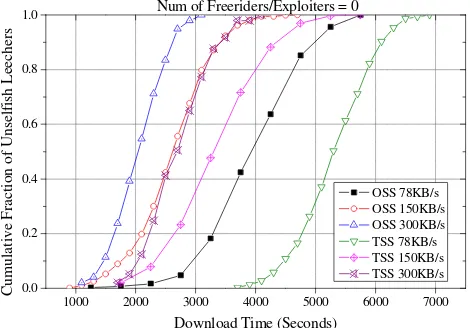
Figure 3-7. The cumulative distribution of the download times, when the number of freeriders or exploiters equal to zero, for all unselfish leechers ... 43
Figure 3-8. The cumulative distribution of the download times, when the number of freeriders or exploiters equal to zero, for each class of unselfish leechers ... 43
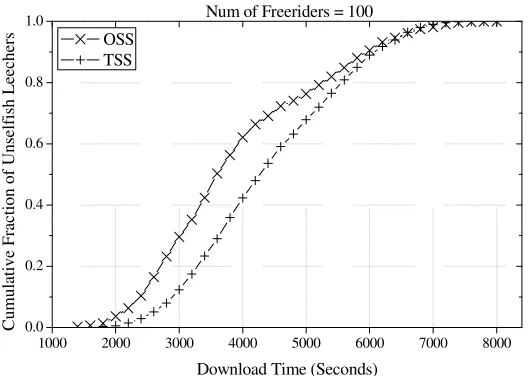
iii Figure 3-10. The cumulative distribution of the download times for all unselfish leechers when freeriders exist (300 freeriders) ... 44
Figure 3-11. The cumulative distribution of the download times for all unselfish leechers when freeriders exist (700 freeriders) ... 45
Figure 3-12. The cumulative distribution of the download times for each class of unselfish leechers when freeriders exist (100 freeriders) ... 45
Figure 3-13. The cumulative distribution of the download times for each class of unselfish leechers when freeriders exist (300 freeriders) ... 46
Figure 3-14. The cumulative distribution of the download times for each class of unselfish leechers when freeriders exist (700 freeriders) ... 46
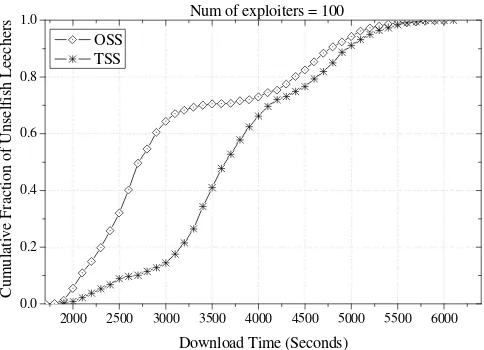
Figure 3-15. The cumulative distribution of the download times for all unselfish leechers when exploiters exist (100 exploiters) ... 48
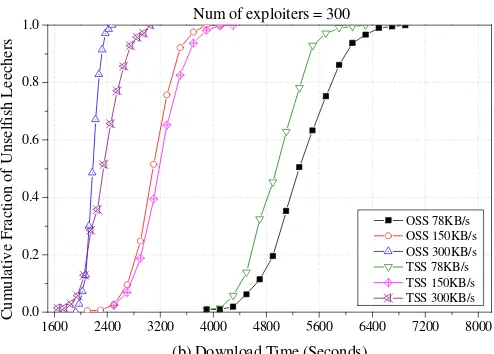
Figure 3-16. The cumulative distribution of the download times for all unselfish leechers when exploiters exist (300 exploiters) ... 48
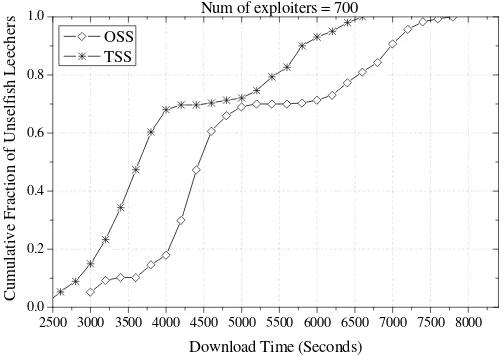
Figure 3-17. The cumulative distribution of the download times for all unselfish leechers when exploiters exist (700 exploiters) ... 49
Figure 3-18. The cumulative distribution of the download times for each class of unselfish leechers when exploiters exist (100 exploiters) ... 49
Figure 3-19. The cumulative distribution of the download times for each class of unselfish leechers when exploiters exist (300 exploiters) ... 50
iv Figure 4-1. An example AST with the segment tree range [0, 16] and M = 4. We choose the segment tree range such hat each node can have an arbitrary number of children and the segments are uniformly split in each level while maintaining appropriate span length. An exemplar query for range [6, 13] is also illustrated here. The query union can be {[6, 6], [7, 8], [9, 9], [10, 11], [12, 13]} with AoR 100% or be {[5, 9], [10, 14]} with AoR 71.4%. ... 59
Figure 4-2. Plots of DHT operations for different values of M (Maximum number of children): the plot of the average number of DHT insertions for one DAST insert request; ... 70
Figure 4-3. Plots of DHT operations for different values of M (Maximum number of children): the plot of the average number of DHT retrievals for one DAST range query request ... 71
Figure 4-4. Plots of DHT operations for different values of N (the level number that DAST starts to insert data items): the plot of the average number of DHT insertions for one DAST insert request ... 72
Figure 4-5. Plots of DHT operations for different values of N (the level number that DAST starts to insert data items): the plot of the average number of DHT retrievals for one DAST range query request ... 73
Figure 4-6. Plot of the average number of DHT retrievals for one DAST range query request with different values of AoR (the accuracy of result). ... 74
Figure 4-7. Comparison of DAST (with different AoR) against DST and PHT on average number of DHT retrievals for one range query. ... 75
Figure 4-8. Comparison of DAST (with different AoR) against DST and PHT on query latency. ... 75
v Figure 5-2. An example AST with the entire range [0, 8] ... 85
Figure 5-3. the BLAST searching time comparison of local search and ppBLAST search ... 95
Figure 5-4. Speedup of ppBLAST comparing to the local searches on PC1, PC3, PC5 ... 96
Figure 5-5. The work loads of each PC (the percentage of the total number of tasks in a BLAST job) ... 98
Figure 5-6. Speedup of ppBLAST when every peer has at least 60% of the complete segment set ... 99
Figure 5-7. Speedup of ppBLAST when every peer has full segment set ... 100
vi
Acknowledgements
I would like to express my most sincere thanks to my supervisor, Professor Stephen Jarvis, for offering me a great environment, unlimited support and perti-nent suggestions. Without his continual guidance, this work would not have been possible.
I would also like to thank Dr. Guang Tan. He is one of my best friends and one of the kindest persons I ever met in my life. He gives me many valuable advices on my research and much help even in my personal life. Without the vivid discus-sions we had on the research, the process of finishing this work would have been much less fun. Another important PhD mate who I cannot forget is Dr. Wen Jun James Xue. He encouraged me a lot in my studies.
This PhD study is the best time in my life. Thanks to the members and associates of the High Performance Systems Group at University of Warwick both past and present, including Dr. Ligang He, Dr. Daniel Spooner, Lei Zhao, Paul Isitt, Brian Foley, and Gihan Mudalige.
Thanks to my parents. To them, I am always a little boy. They give me their unlimited love to support me in all the years. No matter how busy they were, they always prepared the best food for me to take the cooking burden off my shoulder so that I have more dedicated time on this work.
vii
Declarations
This thesis is presented in accordance with the University of Warwick regulations for the degree of Doctor of Philosophy. It has been written by myself and has not been submitted in any previous applications for any degrees. This work described in the thesis has been undertaken by myself except where otherwise stated.
During this period of research, I have contributed to the following publications:
X Chen, SA Jarvis, Shuangyan Liu, “ppBLAST: A Computational Service over Peer-to-Peer network for BLAST”, International Conference on Advances in P2P Systems (AP2PS 2009), Sliema, Malta, October 11-16, 2009. [4]
X Chen, SA Jarvis, “Analysing BitTorrent's Seeding Strategies”, 7th IEEE/IFIP International Conference on Embedded and Ubiquitous Computing (EUC-09), Vancouver, Canada, August 29-31, 2009. BEST Paper Award. [5]
X Chen, SA Jarvis, “Design and Implementation of Efficient Range Query over DHT Services”, International Conference on Signal Processing and Communica-tion Systems (ICSPCS 2007), Australia, Gold Coast, 17-19 December 2007. [6]
X Chen, SA Jarvis, “Distributed Arbitrary Segment Tree: Efficient Range Query Over Public DHT Services”, 12th IEEE International Workshop on Computer Aided Modelling and Design of Communication Links and Networks (CAMAD 07), held as part of the 18th IEEE International Symposium on Personal, Indoor and Mobile Radio Communications (PIMRC 2007), Athens, Greece, September, 2007. [7]
viii X Chen, SA Jarvis, G Tan, L He, DP Spooner, GR Nudd, “An implementation of BLAST over peer-to-peer and its performance validation through simulation”, 8th International Conference on Computer Modelling and Simulation, Oxford, UK, 6-8 April 2005. [9]
G Tan, SA Jarvis, X Chen, DP Spooner, GR Nudd, “Performance Analysis and Improvement of Overlay Construction for Peer-to-Peer Live Media Streaming”,
Simulation: Transactions of the Society for Modeling and Simulation, 82:93-106, Feb 2006. [10]
G Tan, SA Jarvis, X Chen, DP Spooner, GR Nudd, “Performance Analysis and Improvement of Overlay Construction for Peer-to-Peer Live Media Streaming”, 13th IEEE Symposium on Modeling, Analysis, and Simulation of Computer and Telecommunication Systems (MASCOTS), Sept. 2005. [11]
G Tan, SA Jarvis, L He, X Chen, DP Spooner, GR Nudd, “Modelling Web trans-fer Performance over Asymmetric Networks”, 1st International Workshop on Per-formance Modelling in Wired, Wireless, Mobile Networking and Computing (PMWMNC-2005), 11th IEEE International Conference on Parallel and Distrib-uted Systems (ICPADS'05), Fukuoka Institute of Technology, Japan, 20-22 July 2005. [12]
L He, SA Jarvis, DP Spooner, X Chen, GR Nudd, “Dynamic Scheduling of Paral-lel Jobs with QoS Demands in Multiclusters and Grids”, 5th IEEE/ACM Interna-tional Workshop on Grid Computing (Grid2004), Pittsburgh, USA, Nov 8, 2004. [13]
L He, SA Jarvis, DP Spooner, X Chen, GR Nudd, “Hybrid Performance-based Workload Management for Multiclusters and Grids”, IEE Proc.-Softw., 151(5):224-231, October 2004. [14]
ix and Grids”, 3rd International Conference on Grid and Cooperative Computing (GCC 2004), Wuhan, China, October 2004. [15]
L He, SA Jarvis, D Bacigalupo, DP Spooner, X Chen, GR Nudd, “Queueing Net-work-based Optimisation Techniques for Workload Allocation in Clusters of Computers”, IEEE International Conference on Services Computing (SCC 2004), Shanghai, China, September 15-18, 2004. IEEE Computer Society Press. [16]
x
Glossary of Terms
BLAST
A Bioinformatics tool set which is used to compare two DNA sequences.
Peer-to-Peer networks
The application level of overlays where computers over the Internet con-nect to each other to share resources such as files, storage, computing power, and so on.
BitTorrent
The most popular and effective Peer-to-Peer file sharing protocol which splits large files into pieces and distributes them among peers.
Seed
The peer that have a complete set of file pieces in BitTorrent networks. They upload to others without the need of downloading.
Leecher
The peer that downloads file pieces in the BitTorrent networks.
Selfish leecher
xi
Freerider
A type of selfish leecher who downloads many file pieces without sharing any with others.
Exploiter
A type of selfish leecher who shares file pieces while downloading, but leaves the network immediately after finishing.
Seeding strategy
The strategy which guides seeds to upload file pieces to leechers.
Tit-For-Tat
One of the key mechanisms in BitTorrent protocol. It forces leechers to upload.
BitTorrent Choking Algorithm
The file chunks are exchanged between peers. Every peer employs the Choking Algorithm to decide whom it will upload to.
Choking Slot
When a peer uses the choking algorithm to decide whom to upload, the choking slot is actually the number of other peers this peer will upload to.
SHA-1
xii
Tracker
A server that stores the locations of all peers (in the BitTorrent overlay) and provides every peer with the locations of others.
Homogeneous and Heterogeneous network environments
In homogeneous network environment, every peer is assumed to have the same network bandwidth. For heterogeneous network environment, the network bandwidths of peers are different.
DHT
Distributed Hashtable. A Peer-to-Peer overlay that provides lookup and storage functions.
Traditional Segment Tree
A traditional segment tree is a binary tree and the value of every parent is split and assigned to its two children.
Bootstrap Peer
1
Abstract
In Data Intensive Computing, properties of the data that are the input for an application decide running performance in most cases. Those properties in-clude the size of the data, the relationships inside data, and so forth. There is a class of data intensive applications (BLAST, SETI@home, Folding@Home and so on so forth) whose performances solely depend on the amount of input data. Another important characteristic of those applications is that the input data can be split into units and these units are not related to each other during the runs of the applications. This characteristic helps this class of data intensive applications to be parallelised in the way where the input data is split into units and application runs on different computer nodes for certain portion of the units. SETI@home and Folding@Home have been successfully parallelised over peer-to-peer networks. However, they suffer from the problems of single point of failure and poor scal-ability. In order to solve these problems, we choose BLAST as our example data intensive applications and parallelise BLAST over a fully distributed peer-to-peer network.
BLAST is a popular bioinformatics toolset which can be used to compare two DNA sequences. The major usage of BLAST is searching a query of se-quences inside a database for their similarities so as to identify whether they are new. When comparing single pair of sequences, BLAST is efficient. However, due to growing size of the databases, executing BLAST jobs locally produces prohibitively poor performance. Thus, methods for parallelising BLAST are sought.
ex-2 pensive, prohibitively so when the growth of the sequence database are taken into account. It involves high cost and complication when increasing the number of nodes to adapt to the growth of BLAST databases. Hence a Peer-to-Peer-based BLAST service is required.
This thesis demonstrates our parallelisation of BLAST over Peer-to-Peer networks (termed ppBLAST), which utilises the free storage and computing re-sources in the Peer-to-Peer networks to complete BLAST jobs in parallel. In order to achieve the goal, we build three layers in ppBLAST each of which is responsi-ble for particular functions. The bottom layer is a DHT infrastructure with the support of range queries. It provides efficient range-based lookup service and storage for BLAST tasks. The middle layer is the BitTorrent-based database tribution. The upper layer is the core of ppBLAST which schedules and dis-patches task to peers. For each layer, we conduct comprehensive research and the achievements are presented in this thesis.
3
Chapter 1
Introduction
1.1 Overview of BLAST
The Basic Local Alignment Search Tool (BLAST) is a tool set which is used throughout Bioinformatics to compare two nucleotide or protein sequences. Normally, all sequences that have already been identified are categorised and packed into databases, while newly discovered sequences can be encapsulated into queries. BLAST compares each sequence in a query with each sequence in a database. For each sequence in the query, the statistical similarity that is derived from all comparisons is calculated in order to decide whether it is novel or not. If novel sequences are indicated by the results, they will be added into the existing databases and, therefore, the size of the existing databases will grow.
The current most popular version of BLAST is NCBI-BLAST, which is implemented by the National Centre for Biotechnology Information (NCBI) [18]. NCBI-BLAST consists of five programs: blastn, blastp, blastx, tblastn and tblastx
Table 1-1 BLAST programs and their functions
BLAST program Function
blastn Compare nucleotide with nucleotide
blastp Compare protein with protein
blastx Compare translated nucleotide with protein
tblastn Compare translated protein with nucleotide
4 (their functions are summarised in Table 1-1). Each program can be executed through the command line. The parameters for the commands of the five pro-grams are similar; the two major parameters express the query and an associated database, both of which contain a number of sequences. More details about NCBI-BLAST and NCBI-BLAST are presented in Chapter 2. In this chapter, for simplicity, we only use the term BLAST and the terminology for a command line execution of a BLAST comparison is expressed as a “blast query database”.
BLAST provides high efficiency algorithms to compare two sequences; however, for the daily tasks of discovering new nucleotide or protein sequences, the usage of BLAST is restricted by the exponential growth in the databases [19]. As described above, every officially identified novel sequence will be added to the existing databases, e.g., GenBank [20]. In order to identify one newly discov-ered sequence, each of the existing sequences in the databases has to be compared with it using BLAST. Hence, along with the growth of the databases, more se-quences will join the comparison queue for one query sequence, and the search time of a single BLAST job also increases exponentially. To illustrate the current performance of a typical BLAST job, we present an example. The current size of the nucleotide sequence database (nt database from GenBank in FASTA format) is 7.29GB. For a query of sequences, whose size is 1MB, if we compare it with the nt database using BLAST on a PC with 2GB memory and an Intel Core2 Duo 2.4GHz CPU, it will take approximately 8 hours and 34 minutes. This is the cur-rent status, and clearly the performance will deteriorate yet further as the data-bases associated with BLAST continue to grow.
In order to reduce this performance impact, a number of advances (re-search and / or industry oriented) have emerged to parallelise BLAST1. While some of these propose special hardware to directly accelerate BLAST compari-sons [21, 22], most focus on software level parallelisation, which splits a job into a number of tasks and distributes them among nodes in a cluster [23-25].
1
5 BLAST has the following characteristics that make it possible to split a BLAST job into tasks at a software level. First, one unit of comparison in BLAST is between two single sequences. Although BLAST accepts a query or database that contains more than one sequence, the actual operation that BLAST conducts is to compare each pair of sequences (one sequence from the query and the other from the database) until all comparison units are finished. For example, if a query has three sequences and a database has five sequences, a blast query on the data-base will execute 15 comparisons one by one. Moreover, all comparisons are in-dependent to each other, which means that one comparison operation will not af-fect another. Thus, if one splits the database into several parts, each of which con-tains a number of sequences, a query and one portion of the database can be then combined to create a task. When those portions of the database are distributed among nodes in a cluster, a BLAST job can then be completed in parallel by all nodes.
The feasibility of splitting BLAST jobs and utilising clusters to improve BLAST performance has been proven by [9, 19, 23, 25-29]. However, the cluster-based parallelising approaches also face problems of scalability and resource limi-tations. While the sizes of the existing databases grow exponentially [20], more nodes have to be continuously added into a cluster to match the growth in speed required in order to satisfy the demand for BLAST performance. This has already been shown to involve tremendous cost and an increased complexity in the main-tenance and administration of these supporting clusters. Another burden on the scalability of cluster-based BLAST is the number of BLAST job requests from the users. If the number of job requests increases, more nodes are needed in a cluster to satisfy the requests of the users. For example, Darling et al. [24] claims that their cluster-based approach of parallelising BLAST can obtain near linear speedup for one BLAST job. Nevertheless, if an increasing number of BLAST jobs are submitted to the cluster simultaneously, which is commonly the case, the performance will unlikely reach the optimal degree.
6 job requests, we investigate another type of available and usable resources – Peer-to-Peer networks. The Peer-Peer-to-Peer technology has become popular since the suc-cess of Napster [30] in 1999. Traditional approaches to sharing music files were based on the server / client Internet model. If a user wants to share his own music files, he has to upload the files onto the server. The server was responsible for hosting the music files and all clients downloaded from the server. This approach suffers from the scalability problem: if a large number of clients try to download music files simultaneously, the server has to either put limits on the number of connections or stop the service directly. In either case, the result is that the clients cannot obtain satisfactory service. Napster solved the problem by maintaining an index server which did not host any files. If a client has a file to share with others, it connects to the server and informs it which file it wants to share and what is the IP:Port it provides. The server will then index this information. When another ent wants to download the file, the server will tells it who has the file and the cli-ent will try to connect to the file owner’s computer and download from it directly. In other words, downloading and uploading files will occur between clients, not between clients and servers. This solves the scalability problem for the server.
After the birth of Napster, many Peer-to-Peer applications emerged cover-ing areas such as file-sharcover-ing [2, 31], storage [32-34], online video streamcover-ing [35], information routing [36], processing power sharing [37-39] and so forth. Their achievements have shown the availability and scalability of Peer-to-Peer re-sources. The projects on SETI@Home claim that over millions of peers have con-tributed their resources since the projects started [40]. Their successes demon-strate the richness of the Peer-to-Peer resources and peers are willing to share not only their storage space but also the CPU processing power. Therefore, inspired by the model of SETI@Home, we have targeted Peer-to-Peer networks as the new computing resource provider for BLAST and have carried out extensive research on utilising scalable Peer-to-Peer networks in parallelising BLAST.
7
• Network Bandwidth
In a cluster environment, the network links between nodes nor-mally have high bandwidths. In a cluster, there is a master node that as-signs tasks to worker nodes and hosts the database fragments. If a worker node needs a fraction of a database at a certain point in time to finish a task, it can download it from the master node directly (and immediately) without considering the performance impact that will be brought about from the transfer delay [24]. This is the so-called “on demand”.
In a Peer-to-Peer network overlay, however, this is hard to achieve. Most peers are normal home PCs which are connected to the Internet through home broadband. Their download and upload bandwidths are much more limited compared to cluster interlinks. If we adapt the “on de-mand” design to the database distributions in a Peer-to-Peer network, the time spent on the comparatively low transfers will decrease the overall performance significantly.
Therefore a more efficient file distribution approach needs to be investigated and employed for Peer-to-Peer BLAST in order to save the time cost in distributing databases among peers.
• Self-organising (has advantage)
Cluster-based BLAST parallelisation is in a centrally controlled paradigm. The master node hosts database fragments and is responsible for organising all worker nodes to cooperate with each other to finish a BLAST job. This makes the master node the central point of failure. With-out a properly functioning master node, the BLAST service cannot oper-ate.
8 In addition, the self-organising mechanism will also remove the central control from Peer-to-Peer BLAST and further increase the scalability of the system.
• Storage
Since there will be no master element in Peer-to-Peer BLAST, one remaining question is where the queries or results should be stored after users submit their BLAST jobs. As users will not wait for all worker peers to obtain the queries or return results, queries or results need to be tempo-rarily stored in the overlay for worker nodes or users to retrieve them later.
• Self-scheduling
9
1.2 Thesis Contributions
Through solving the above problems, we design a Peer-to-Peer BLAST service, ppBLAST, where volunteer peers (which also can be BLAST users) con-struct an overlay, receive BLAST job requests from users, and return the results. In this thesis, we demonstrate the achievements of this research on BLAST paral-lelisation over a Peer-to-Peer network. The three specific contributions of this the-sis are as follows.
The first contribution is the analysis of BitTorrent seeding strategies. In order to boost the database distributions over the Peer-to-Peer network, we em-ploy the efficient Peer-to-Peer BitTorrent file sharing protocol. Although the effi-ciency of BitTorrent is one of its key advantages, the seeding strategy of the pro-tocol has been largely overlooked. In order to obtain the optimum performance from BitTorrent to aid the database distributions for ppBLAST, we carry out comprehensive analysis dedicated to BitTorrent seeding strategies. This contribu-tion is presented in Chapter 3.
The second contribution is in the design and implementation of efficient range queries over Distributed Hash Table (DHT) services. The DHT is based on a Peer-to-Peer overlay to provide a lookup service similar to a hash table. {key,
value} pairs can be inserted into DHT and the value be retrieved through the key. DHT can be used as a light-weight information storage and retrieval system. In addition, DHTs are purely distributed and self-organised. These characteristics of
10 can be retrieved through one query operation. This contribution is presented in Chapter 4.
The final contribution is the ppBLAST service and its performance meas-urements. A BitTorrent-like file distribution with correct seeding strategy is em-ployed in ppBLAST to boost the database distribution process. A DHT infrastruc-ture with support for range queries is also added as a fundamental layer of ppBLAST to provide a self-organising ability, peer seeking and locating function-alities, as well as the storage of queries and results. We then design ppBLAST framework and self-scheduling algorithms using the two research contributions above.
11
Chapter 2
Background
In this chapter, we present the necessary background research for this the-sis. Since this thesis covers three research areas – BLAST (data intensive compu-tation), Peer-to-Peer file distribution and DHT - we split the background chapter into these three areas. It should be noted that each of the following chapters con-tains its own related work, and therefore we do not repeat this in this chapter.
In Section 2.1, we detail BLAST and its characteristics related to this the-sis. In Section 2.2, we introduce Peer-to-Peer overlays, Peer-to-Peer file sharing, DHTs and Peer-to-Peer-based computation. The documentation that is more topic-related is addressed at the beginning of the associated chapters.
2.1 BLAST
BLAST, the Basic Local Alignment Search Tool [41, 42] is mainly em-ployed by bioinformatics area to compare two amino-acid sequences from differ-ent proteins or the nucleotides of DNA. The results are then used to find the simi-larity between the two sequences. For example, if a gene from an ape is obtained, one can compare it with each identified human genome to see whether humans carry a similar gene; alternatively it can be compared with all identified ape ge-nomes to find out if the gene is new.
iden-12 tified nucleotide and protein sequences. Every identified sequence is added to the library. Bioinformatics scientists, who are BLAST users, will compare newly ob-tained sequences against the ones in certain databases in the library through BLAST. Although these five programs of NCBI-BLAST are used to compare dif-ferent types of sequences, their basic usages are similar. They accept a query and a database as the input, and produce the result to show the similarities between the query and database. Both query and database can have one or more sequences. If either of them has more than one sequence, each sequence will be compared against the target. For example, if a query has three sequences, each of them will be extracted and compared with the target database. If the target database has five sequences, then each possible pair of sequences (one from the query and the other from the database) will be compared. All five programs are executed through a command line in the form of “blast –p program_name –i query_name –d data-base_name –o out_result” with a number of other parameters. For simplicity, an execution of the BLAST program is termed a “blast query database”.
Although some characteristics of BLAST have been introduced in Chapter 1, more detail is required in the content of this work. BLAST is both data- and computation-intensive. The time overhead that is spent on a BLAST job has two parts. One is the disk operation time which is spent on reading the sequences from the hard disk to memory and writing text-based results from memory into the disk. The other overhead is the computational comparisons for sequences. Simply com-paring two single sequences using BLAST is very effective; however, once the number and the sizes of sequences (from either query or database) in a job are large, the execution time will become tremendous, as shown by the example in Chapter 1. However, the independent characteristics of BLAST provide a means for parallelisation.
13 the sequence pairs, compare them separately and finally combine all results. Therefore, in order to parallelise a BLAST job, we can split the database into fragments and distribute them among nodes (in cluster-based parallelisation, the term “node” refers to cluster node; in our Peer-to-Peer approach, it refers to peer over the Internet). Each node will therefore have a number of fragments and can compare the query against its own database portions. In this way, a BLAST job can be executed in parallel and the overall performance and efficiency are im-proved. Another advantage of this parallelisation approach is that the core of BLAST does not need to be modified and the parallelisation is focused on BLAST jobs but not on the core of BLAST programs.
2.2 Peer-to-Peer Network
As introduced in Chapter 1, the popularity of Peer-to-Peer networks in both research and industry arises largely from the success of Napster [2, 30]. The term Peer-to-Peer overlay indicates that a number of nodes are interconnected through a particular distributed architecture, which is laid on top of the physical network links. In the overlay, peers share resources with each other and during the sharing, peers are both servers and clients; this is different from the traditional network sharing model where nodes are normally clients and obtain services only from servers.
2.2.1 Peer-to-Peer File Sharing
14 shared by all downloaders. In the worst case, the server may stop working if the number of simultaneous downloaders reaches a threshold because the capacity of the server is exceeded. Peer-to-Peer file sharing applications solve the problem by allowing peers to connect to each other without considerable central server activ-ity. Peer can browse shared files of other peers or upload to / download from oth-ers. The bandwidths of the links between peers are then utilised more efficiently. In addition, the capacity of the whole system increases when more peers join the network, because the newly joined peers can supply more files / file chunks and contribute their bandwidths.
In June 1999, Napster emerged and started the popularity of Peer-to-Peer file sharing overlays. Gnutella [1], eDonkey2000 [43] and Freenet [44] were re-leased in 2000. Gnutella [1], employs a search driven file sharing mechanism. Peers do not browse for files; instead, they query their neighbours for the files that they want to retrieve. If their neighbours do not have the files, queries will be sent to the next level of neighbours to further explore the existence of the requested files. The whole overlay is unstructured, i.e., there are no particular algorithms to decide who peers should be connected to and peers randomly make connections to others through bootstrap nodes. eDonkey2000 [43] also follows this unstructured
design. However, it has a central indexing server to record which files peers share in the overlay and where they are located (IP:Port information of peers). This de-sign is similar to Napster, which is called a Hybrid Unstructured architecture. Freenet [44] has put much effort on the anonymity of peers. Peers in Freenet do not browse or query for files and they simply choose whether to receive files from others. Sharing a file normally starts from one peer, and that peer will send files to neighbours. If the neighbours choose to receive them, they will start the next round of sending after finishing their retrieval. Every peer knows only its neighbours who send the file, but not the information on which peer initialises the sharing.
15 wish to download this file will open the torrent file, retrieving the meta-information in it and starting the BitTorrent client. The client application will fol-low the records that reside in the torrent file and connect to the tracker server. The tracker server is the only centralised element in the BitTorrent overlay; however, its function is limited to only recording the IP:Port of peers who are currently download the file in the overlay. The key factor that leads to the BitTorrent suc-cess is the Tit-For-Tat mechanism (TFT). The TFT algorithm forces peers to up-load to others whose upup-loading rates are the highest. The reason for this design is that if one is willing to upload, it then can download faster from others. Peers use TFT to decide which peer to upload chunks to and which to download from. Bit-Torrent is suitable for the sharing of large files and has been demonstrated to ex-hibit very high efficiency [3, 7, 8, 31, 45-56]. This is one of the reasons that we select BitTorrent as our database distribution layer.
2.2.2 Peer-to-Peer Computation
The most representative applications in Peer-to-Peer computation area are SETI@Home [37, 38, 40] and Folding@Home [39]. Although the initiatives of these two projects are different, the internal Peer-to-Peer architectures are similar. Thus, we describe only SETI@Home in this section.
16 iteratively locates any available peers and assigns them with tasks. There are no communications between peers and the whole running process of SETI@Home is driven purely by the server.
SETI@Home is enormously successful. Since SETI@Home was launched on 17th May, 1999, it has had over 5.2 million participants worldwide. On 26th September, 2001, it has performed a total of 1021 floating point operations, which is the largest computation in history. On the 14th September, 2009, SETI@Home had 278, 832 active peers concurrently in the overlay and 2.4 million peers having been in the system. The computing capacity of the SETI@Home Peer-to-Peer overlay is over 684 TeraFLOPS. This provides the inspiration for the initiative of utilising Peer-to-Peer networks to parallelise BLAST. ppBLAST does however adopt a different Peer-to-Peer architecture for BLAST-style computation jobs.
2.3 DHT
A Distributed Hash Table (DHT) is a Peer-to-Peer system that provides a lookup service similar to a traditional hash table. A key and a value are combined as a {key, value} pair and stored in participating peers through a DHT construc-tion algorithm. Peers can submit a key to the overlay and retrieve its value. This functionality seems simple but provides many other services to Peer-to-Peer ap-plications. For example, using the DHT it is possible to store the location informa-tion (IP:Port) of peers, so centralised indexing servers are no longer necessary [57]; DHTs can also act as online Peer-to-Peer storage systems, where disk stor-age of peers can be easily utilised.
17 IP address is known to every peer and is used as the entrance to the overlay), it will be assigned an id which is generated by hashing its IP:Port information. The peer will then query the bootstrap node for a list of peers whose ids are closest to its own. Once the list is obtained, it will connect to those peers and add them into its neighbour list.
When a {key, value} pair is to be stored into the DHT, the key will be hashed in the same hashing space as the peer id. The remaining question for the storage of the {key, value} pair is which peers should physically store it. The peer that accepts the request of storage will not physically store them. For example, if peer A asks peer B to store {key, value} pair, peer B does not necessarily need to store the pair on its own hard drive. Instead, it will query its neighbours for the peers whose ids are closer to the pair’s key hash than itself. Neighbours will con-tinue to query the next level of neighbours for closer ids. If a peer cannot find any other neighbours whose ids are closer, it becomes the final peer that will then eventually store the pair physically in its hard drive. The DHT value retrieval process is similar to the storing, thus we do not repeat it here.
DHTs have the following characteristics:
• Decentralisation. There are no coordinating or indexing servers in DHT overlays and DHTs are purely decentralised [58]. All peers collectively form a DHT system without any central coordination. This removes the possible single point of failure (single place where can causes the failure of the whole system) from the system and thus obtains better robustness.
18 over all peers, i.e., every peer stores similar numbers of pairs [36]. There-fore, with the participation of more peers, the load on existing peers will be more relaxed as the new peers will share portions of pairs and balance them with the existing peers.
19
Chapter 3
Analysing BitTorrent’s Seeding Strategies
The analysis in this chapter is key to identifying how database distribu-tions over Peer-to-Peer networks can be conducted; this in turn is crucial for em-ploying BitTorrent in the implementation of ppBLAST.
Various terminology is introduced (e.g., freerider, exploiter, selfish leecher, etc.). A summary of this terminology can be found in the thesis glossary.
3.1 Introduction
20 on these results we discuss the choice of seeding strategy and speculate as to how more effective BitTorrent-based file distribution applications can be built.
3.2 Seeding Strategies and Performance
In a traditional client/server file distribution paradigm, a server takes responsibil-ity for transmitting data to all clients. This service model is limited in scalabilresponsibil-ity, especially when the files are large. As a successful Peer-to-Peer file-sharing sys-tem, BitTorrent [31] solves this problem by dividing a large file into many small sized blocks and encouraging clients to exchange blocks during their downloading processes. This mechanism reduces load on the server and improves the system service capacity.
Like many other peer-to-peer systems, BitTorrent faces the challenge of
freeriders [1, 49], which are peers who never upload blocks to others. A peer can act as a freerider by setting the upload rate to a very low value or even zero. For-tunately, BitTorrent can effectively penalise those freeriders using its Tit-For-Tat (TFT) policy, which determines how peers with incomplete files (called leechers) exchange blocks. With the TFT policy, all leechers exchange blocks only with those who upload to them at a higher rate, thus freeriders cannot obtain blocks because they never upload. While most previous research [31, 45, 49, 54] focuses on the behaviour of leechers, the role of the seeds (peers with complete files), in the process of preventing freeriders has been largely overlooked.
leech-21 ers. Thus the OSS strategy may benefit freeriders rather than necessarily fostering contribution. In order to solve this problem caused by freeriders, a new seeding strategy, called the Time-based Seeding Strategy (TSS), was proposed in [50]. By employing this strategy, seeds serve each leecher in turn and for the same amount of time so that no single leecher (including freeriders) can dominate the resources of seeds. However, the negative side of TSS is that the speed of producing fresh seeds in the overlay is slowed down and eventually the overall performance may be impacted. Due to the lack of a comprehensive analysis of TSS in [50], it is not clear whether TSS is better than OSS in preventing freeriders and as such this re-mains an open research question.
Furthermore, an issue largely ignored is that the newly generated seeds can choose not to act as expected – they may stay for only a short time [48, 53] or simply quit the system once they have obtained the whole file. In this chapter, we term these types of peers exploiters, i.e., they serve others while downloading, but quit the overlay immediately after its completion. So far little attention has been paid to the influence of exploiters; therefore it is unclear how OSS and TSS are resilient to their behaviour.
22 The remainder of this chapter is organised as follows. Section 3.3 presents an overview of BitTorrent and documents related work; Section 3.4 analyses the different seeding strategies using a mathematical model; Section 3.5 describe our simulation methodology; Section 3.6 and 3.7 discuss the simulation results; finally Section 3.8 summaries the chapter.
3.3 Understanding BitTorrent
BitTorrent employs a series of sophisticated mechanisms to encourage peers to upload data to each other, and thus achieves scalable and highly efficient content distributions. In this section, we first give an overview of BitTorrent. Sev-eral key factors behind the success of the BitTorrent protocol, such as the choking algorithm and the local-rarest-first mechanism, are already described in previous research [3, 31, 50, 54, 61]. We thus present only the two popular seeding strate-gies, OSS and TSS, in detail. Throughout this chapter, we use terminology first introduced in [50]; much of this terminology is summarised in the Glossary of Terms at the front of the thesis.
3.3.1 BitTorrent Mechanism
23 decide who to download data from or who to upload data to, by executing the
choking algorithm. When a peer starts to download data from others, leechers de-cide which file piece to retrieve by following the guidance of the local-rarest-first algorithm (LRF). Once a leecher finishes downloading, it either rejoins the over-lay to be a seed or leaves immediately so becoming an exploiter.
3.3.2 Seeding Strategy
The initial seed and the regular seeds that come from the leechers all have a complete set of file pieces and thus do not need any data from others. Note that the choking algorithm uses the uploading rates of leechers to decide whom to up-load to, thus it is not applicable for seeds because seeds cannot calculate other leechers’ uploading rates. In order to effectively contribute to the distribution overlay optimally, seeds employ seeding strategies. There are currently two de-ployed seeding strategies: the original seeding strategy (OSS) and the time-based
seeding strategy (TSS). These are described in the following text and further ana-lysed in Section 3.4.
Algorithm 3-1: OSS, invoked by seeds every 10 seconds
remove unchoked leecher from the interested_leecher_list
forevery leecher in the interested_leecher_listdo
calculate the rate (download_rate) at which the leecher downloads from
this_local_seed
end for
sort interested_leecher_list in descending order based on the leecher’s
download_rate
for݅ ← 1to 3 do
24 OSS (see algorithm 3-1) has been employed since BitTorrent was invented [31]. In the BitTorrent distribution process, there are seeds that always stay in the overlay for a limited time period [54, 61]. Thus, OSS aims to force seeds to con-tribute to the overlay as much as possible before they leave. In following OSS, seeds upload data to leechers whose downloading rates are highest. In other words, seeds aim to upload data as quickly as possible. There are three aspirations behind this process: 1. Seeds can deliver a maximum number of pieces to leechers; 2. Leechers that download from seeds can become new seeds quickly; 3. New seeds can continue to serve the remaining leechers.
Algorithm 3-2: TSS, invoked by seeds every 10 seconds global variable: ݐ
sort the interested_leecher_list based on the leecher’s last unchoke time, with the most recently unchoked leecher last
ifݐ = 0then
for݅ ← 1to 3 do
unchoke interested_leecher_list(݅)
end for
intݎ ← random integer between 4 and n (n is the number of interested leechers)
unchoke interested_leecher_list(ݎ) ݐ ← ݐ + 1
else ifݐ = 2
for݅ ← 1to 4 do
unchoke interested_leecher_list(݅)
end for
ݐ ← 0
25 TSS (see algorithm 3-2) was introduced in the official BitTorrent client 4.0.0 [50]. In following TSS, seeds upload data to leechers uniformly. In other words, seeds serve each of their neighbour leechers in turn based on the time stamp of the last service, regardless of the leechers’ download rates. A seed can perform s parallel uploads. After a seed has been uploading data to a leecher for sixty seconds (typically), it chokes the leecher and selects another leecher to serve. In this manner, all leechers that are connected to a seed will be served for a simi-lar time period. The purpose of this strategy is: 1. To prevent any single leecher from monopolising seeds; 2. To reduce the amount of duplicate data a seed needs to upload before it contributes a full set of file pieces to the overlay.
3.3.3 Additional Related Work on the Analysis of BitTorrent
There has been a good deal of research on analysing the BitTorrent mechanism. The methodologies that this work employs can be categorised into three groups: creating mathematical models, carrying out simulations and analys-ing BitTorrent traffic.
Qiu et al. [54] construct a fluid model for BitTorrent in order to address several issues: peer evolution, scalability, file sharing efficiency, local availability and incentives to prevent freeriders. Their work indicates that the mean download completion time of leechers does not relate to the peer arrival rate. The utilisation of the uploading/downloading bandwidth of each peer is fairly high. However, the success of the distribution of a file is related to the number of freeriders in the overlay. If the number of freeriders is increasing, the numbers of seeds will expo-nentially decrease and the distribution terminates.
26 Tian et al. [56] create a simple mathematical model to study the perform-ance of BitTorrent file sharing, with particular interest on the completeness of the downloading process. They find that the current choking algorithm improves the distribution efficiency but cannot help to maintain the file availability and may not prevent the system from termination (the rest of the leechers cannot finish downloading) because of the lack of certain pieces in the overlay.
Fan et al. [46] investigate how BitTorrent achieves incentives and pre-vents freeriders. Felber et al. [63] conduct a simulation to investigate how BitTor-rent-like protocols handle flash-crowds. By the means of simulation, they find several tradeoffs inside each algorithm that BitTorrent uses and that the system performance depends on many factors.
Bharambe et al. [3] use an event-driven simulator to comprehensively evaluate the performance impact from the core algorithms (TFT choking algo-rithm, local-rare-first algorithm and so forth) that BitTorrent employs. They find that the distribution rates are not optimal although they were reported to be high [48]. The choking algorithm is very effective and unfairness, which is defined in terms of serving rates, has been prevented to a satisfactory degree. However, if the fairness is defined in terms of the data served by nodes, the choking algorithm does not perform well. The local-rarest-first algorithm outperforms alternative piece selection strategies but does not effectively solve the last piece problem when leechers wait for the downloading of the last piece. The last finding from their work is that the initial seed is very important and it should distribute a full set of pieces into the overlay as quickly as possible.
upload-27 ing. However, one fact that is also discovered is that major data contributions are from a relatively small number of peers.
Pouwelse el al. [53] present a measurement study on BitTorrent. The ma-jor contribution of their work is the analysis of the flashcrowd effect, i.e., the phe-nomenon of the sudden popularity of a new file distribution. They indicate that the peer arrival process is not following the Poisson distribution and this gives guid-ance to the future BitTorrent-related simulation research work.
Guo et al. [47] focus on the fact that peers always download though multi-ple torrents simultaneously. With this fact, the research in which single torrent distribution is assumed is not accurate any more because the downloading / up-loading bandwidths of peers are shared among multiple BitTorrent distribution swarms. Guo et al. also find that the arrival / departure rate is exponential and that service availability becomes poor quickly when the distribution is close to the end. Finally, they propose a system design for multi-torrent cooperation.
Our work on BitTorrent differs from the previous work discussed above in the following respects. First, we identify a special kind of selfish leecher: termed exploiters. We show that the behaviour of the exploiters impacts on the system performance although the harm done is not as severe as that caused by freeriders. Second, we analyse two seeding strategies (OSS and TSS) in detail and focus on their resistance to the selfish leechers, which none of the previous research work has conducted. Finally, our experiments show that choosing a seeding strategy to adapt to the scale of the selfish leechers in the overlay is very important. We thus propose in our future work that a mechanism is in need to detect the scale of the selfish leechers so that the seeding strategy can be loaded or changed dynamically.
3.4 Modelling Seeding Strategies
applica-28 tions. In this section, we present a mathematical analysis to investigate the impact that freeriders or exploiters have on the mean download completion time of unsel-fish leechers if OSS is employed.
3.4.1 Metrics, Assumptions and Scenarios
Leechers join a BitTorrent network in order to obtain a complete shared file from the overlay. They have one major concern - the time that they need to spend to complete the download. Since uploading data is the driving force of a BitTorrent system, unselfish leechers are important to the overlay and the quality of service that they get from the distribution should be kept at a certain level; oth-erwise, the fairness in the system is violated. Thus, we choose the mean download completion time of unselfish leechers, denoted by ݐ௨, in the system as the metric of our mathematical analysis. Using this metric, we can investigate how freeriders and exploiters affect the fairness and the benefits that unselfish leechers obtain if BitTorrent employs OSS.
Another concern that leechers have is whether a complete set of blocks of the file can be finally obtained. [54] suggests that the probability of a leecher find-ing a desired block among its neighbours is very close to one, therefore, for sim-plicity of analysis, the first assumption that we make is that at any point in time, the network owns the complete set of blocks of a file.
The environment in which a file is distributed is assumed to be homogene-ous. This is the second assumption that we make. Initially, there are ܰ leechers and one initial seed. All peers have identical uplink bandwidths of ݑ, but varying downlink bandwidths of ݀. The size of the file being distributed is ܣ.
Two other assumptions are made:
29 downlink bandwidth of each leecher will not restrict the downloading process.
• Peers have the same uplink bandwidths u, and the mean utilisation of peers’ uplink bandwidths is 100% [3] in this homogeneous environment. We will consider the heterogeneous setting where the uplink bandwidths are not equal in our simulation study.
Three scenarios are considered in the model. All leechers in the first sce-nario are unselfish leechers. In the second scesce-nario, a number ܨ of leechers are freeriders and the remainder of the leechers are unselfish. In the final scenario, only unselfish leechers and a number ܧ of exploiters are present in the network. The different ݐ௨ for the three scenarios are calculated to show whether OSS can guarantee fairness in the system.
3.4.2 The Model
In all three scenarios, unselfish leechers act as seeds for a mean time ܶ௦ after finishing downloading, regardless of whether they are being served by seeds.
ܶ௦ is assumed to be a constant value, which is long enough to let new seeds
con-tribute sufficient blocks to the network [3, 61]. Let ܶ௦ denote the staying time of the initial seed. Freeriders and exploiters have higher downlink bandwidths than unselfish leechers. The mean download time of exploiters is denoted by ܶா.
In the first scenario, all the unselfish leechers keep uploading to others be-fore they become seeds. The amount of data that they upload is ݑܰݐ௨ (ݐ௨ is the period of time that unselfish leecher uploads for). After that they become seeds; they stay for a mean period of time ܶ௦, hence, the amount of data they send out to the system is ݑܰܶ௦. The initial seed contributes to the network with the amount of data ݑܶ௦, where ܶ௦ is long enough to ensure that at least one copy of the entire file blocks are distributed into the network.
30 file. Therefore, an amount ܰܣ of data has been uploaded by all peers. Thus, we have ܰܣ = ݑܰݐ௨+ ݑܰܶ௦+ ݑܶ௦ and ݐ௨ is given by
ݐ௨ = ܰܣ − ݑܰܶܰݑ௦− ݑܶ௦ =ܣݑ − ܶ௦ −ܶܰ௦ (1)
When the ܨ freeriders with the highest download rates join the system, the seeds pass on all of their contributions to the freeriders (following the OSS policy) before they, or the freeriders, leave the network. Because the freeriders do not up-load blocks at all, all data are distributed through only the unselfish leechers and the seeds; that is, ܰܣ = ሺܰ − ܨሻݑݐ௨ᇱ + ሺܰ − ܨሻݑܶ௦+ ݑܶ௦.
In the second case, ݐ௨ᇱ is given by
ݐ௨ᇱ =ܰܣ − ሺܰ − ܨሻݑܶሺܰ − ܨሻݑ௦− ݑܶ௦
=ܰ − ܨ ∙ܰ ܣݑ − ܶ௦−ܰ − ܨܶ௦
(2)
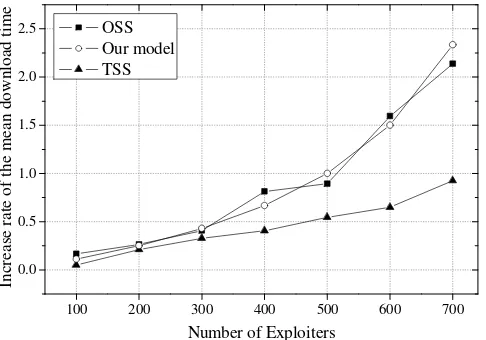
To show the performance degradation caused by the freeriders, the in-crease rate (ܫܴܦ) of mean download completion time of unselfish leechers is
ܫܴܦ =ݐ௨ᇱݐ−ݐ௨
௨ =
ܨ ܰ − ܨ ∙
ܣ
ݑ −ܶܰ௦
ܣ
ݑ −ܶܰ − ܶ௦ ௦
>ܰ − ܨܨ (3)
31 the network for a sufficiently long period of time, the mean download completion time of unselfish leechers will not be increased.
If an alternative strategy, TSS (see algorithm 2), is applied, the freeriders will not be the only consumers of the initial seed. The seed tries to equalise its contributions to every leecher in the system. The unselfish leechers have equal chance to obtain new blocks from the initial seeds and the blank transfer period no longer exists. The mean download completion time of the unselfish leechers is thus reduced. This result will be further demonstrated in the simulation experi-ments.
In the final scenario, the ܧ exploiters keep exchanging blocks with the leechers while they receive data from the seeds. However, the exploiters will leave the network as soon as they finish downloading; that is, they do not stay as seeds for a period of time ܶ௦ . Therefore, ܰܣ = ሺܰ − ܧሻݑݐ௨ᇱᇱ + ܧݑݐா+
ሺܰ − ܧሻݑܶ௦+ ݑܶ௦ and ݐ௨ᇱᇱ is given by
ݐ௨ᇱᇱ = ܰܣ − ܧݑݐா− ሺܰ − ܧሻݑܶ௦− ݑܶ௦
ሺܰ − ܧሻݑ
= ܰ − ܧ ∙ܰ ܣݑ −ܰ − ܧ ∙ ݐܧ − ܶ௦−ܰ − ܧܶ௦
(4)
where ݐா is the mean download time of the ܧ exploiters.
To show the performance degradation, ܫܴܦᇱ is calculated
ܫܴܦᇱ =ݐ௨ᇱᇱ−ݐ௨
ݐ௨ =
ܧ ܰ − ܧ ∙
ܣ
ݑ −ܶܰ − ݐ௦ ா
ܣ
ݑ −ܶܰ − ܶ௦ ௦
=ܰ − ܧ ∙ ሺ1 −ܧ ܣ ݐா − ܶ௦
ݑ −ܶܰ − ܶ௦ ௦
ሻ
(5)
32
ܫܴܦ′= ܧ
ܰ − ܧ ∙ ቌ1 −ܣ ݐா
ݑ −ܶܰ − ܶ௦ ௦
+ܣ ܶ௦
ݑ −ܶܰ − ܶ௦ ௦
ቍ
> ܰ − ܧ ∙ܧ ܣ ܶ௦
ݑ −ܶܰ − ܶ௦ ௦
(6)
The negative impact that the exploiters bring to the system is less than that of the freeriders. When ݐா increases, ܫܴܦᇱ drops. The reason for this is that if the exploiters have to stay as leechers in the network for a longer period of time, they serve more blocks to the unselfish leechers and the download rates of the unsel-fish leechers therefore increase. OSS does not try to force exploiters to stay as leechers for a longer period of time; on the contrary, it helps the exploiters finish downloading in a faster manner if exploiters have higher download rates.
3.5 Simulation Methodology
In this section we conduct simulations to: 1) Verify our mathematical model, which is presented in Section 3.4; 2) Analyse seeding strategies in both homogeneous and heterogeneous network environments; 3) Further explore the performance impact of seeding strategies using more comprehensive metrics.
3.5.1 Simulator Details
33 becomes able to serve others, the first choking round occurs and a preset choking event for the peer is generated. When the event finishes, it will generate or sched-ule the next choking round which will occur 10 seconds later. Note that the 10 seconds is the timestamp inside the simulation. All events, including both the pre-set and the newly generated events, are pushed into a priority queue, which is sorted by event time. The events in the event queue are polled one by one and executed.
Each peer in the simulator is associated with a downlink and an uplink bandwidth, which resemble asymmetric network access as widely observed today. Based on these bandwidth settings, the simulator calculates the block transfer de-lay in the following way. When peer A is going to send a block to peer B, the simulator retrieves A’s upload bandwidth and B’s download bandwidth. The bandwidth with the least value is selected and the time delay is calculated through dividing the block size by the selected bandwidth value. The simulator then schedules a block-received event with the time delay for peer B. When the event is executed, peer B receives the block and its file block set is updated.
Since the time delay computation for each block transmission is expensive, we make a number of simplifications that have negligible impact on the perform-ance aspects we are considering. For example, we ignore the interaction of Bit-Torrent control packets, which are normally very small compared with the data block size. Following Akella et al. [64], network bottlenecks are assumed to mainly occur in the edges of networks.
34
3.5.2 Metrics
In term of fairness, we focus on the benefits that the unselfish leechers can obtain in the BitTorrent distribution process. Hence the metrics we select for the simulations are all for unselfish leechers.
Mean download completion time of unselfish leechers: In the mathe-matical model, we use the mean download completion time of unselfish leechers as the metric to compare seeding strategies where freeriders or exploiters exist. Since the purpose of BitTorrent is to distribute a file among a number of peers, the mean download completion time indicates the efficiency of the distribution. Using this metric we can investigate the overall system performance. In the simulation experiments we continue to validate our model and extend the BitTorrent overlay environment from a homogenous to a heterogeneous setting. The download com-pletion time of every unselfish leecher is summed and a mean value calculated.
Download rate and bandwidth utilisation: In the experiments with ho-mogeneous settings, we use download rate and bandwidth utilisation of unselfish leechers as metrics to indicate performance differences between OSS-led and TSS-led BitTorrent overlays where selfish leechers exist.
Cumulative distribution of unselfish leechers’ download completion times: For the experiments with heterogeneous settings, we plot all cumulative distributions of the download times of all unselfish leechers. This metric will help us to understand how individual leechers perform.
![Figure 4-1. An example AST with the segment tree range [0, 16] and M =](https://thumb-us.123doks.com/thumbv2/123dok_us/9728018.473754/77.595.137.519.89.184/figure-example-ast-segment-tree-range-m.webp)
