Faculty of Behavioural, Management and Social sciences (BMS)
Master Thesis in the Study Programme MSC European Studies
October 2017
Authored by:
Benjamin Gössel
s0143472
Title:
Police work in the context of the EU's refugee-crisis:
A descriptive and explanatory cross-sectional comparative analysis of the police work
in and around the regular reception facility in Almelo (NL) and the arrival center in
Bramsche-Hesepe (GER)
Supervisor:
Dr. A.J.J. Meershoek
Co-reader:
Contents
Table of Figures ... 3
Abbreviations ... 4
Abstract ... 6
1. Introduction ... 7
2. Theoretical perspectives ... 14
3. Research questions ... 24
4. Methodology ... 25
4.1 Research purpose ...25
4.2 Research design ...25
4.3 Method of data collection ...26
4.4 Data analysis ...28
4.5 Sampling technique ...30
4.6 Ethical issues ...30
4.7 Limitations of the study ...31
5. The police force of Lower Saxony (GER) ... 33
5.1 Police department of Bramsche ...36
6. Netherlands Police ... 38
6.1 Basisteam 'B2 Twente Noord' ...42
7. Main differences and similarities between the two asylum accommodation facilities under study ... 44
7.1 Description of the arrival center in Bramsche-Hesepe ...44
7.2 Description of the regular reception facility (AZC) in Almelo ...52
7.3 Conclusion ...57
8. Main differences and similarities in the key problems that the police officers are confronted with in and around the respective asylum accommodation facility ... 59
8.1 Problems in and around the arrival center in Bramsche-Hesepe ...60
8.2 Problems in and around the regular reception facility (AZC) in Almelo ...67
8.3 Conclusion ...70
9.1 Policing of the arrival center in Bramsche-Hesepe ...74
9.2 Policing of the regular reception facility (AZC) Almelo ...78
9.3 Conclusion ...86
10. Factors that explain the differences between the modes of policing ... 90
10.1 Conclusion ... 103
11. Overall conclusion ... 104
References ... 107
Table of Figures
Figure 1: First time asylum applicants registered in the EU Member States ... 7
Figure 2: Schengen area and main migration routes to Europe ... 9
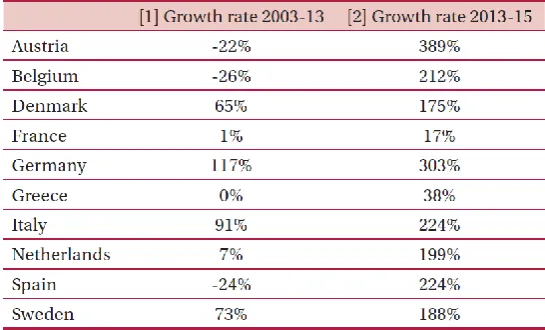
Figure 3: Growth rates of asylum requests in selected EU Member States ... 10
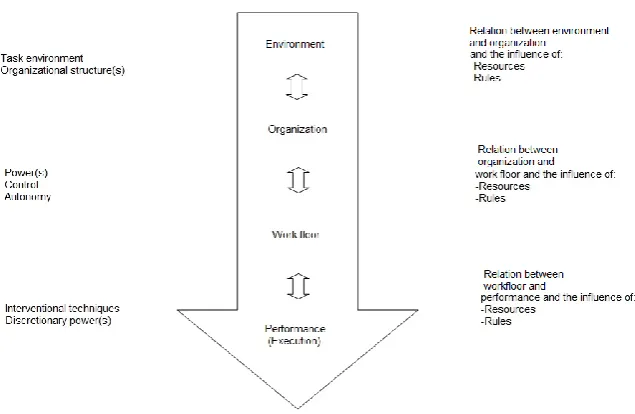
Figure 4: Theoretical model of policing ... 20
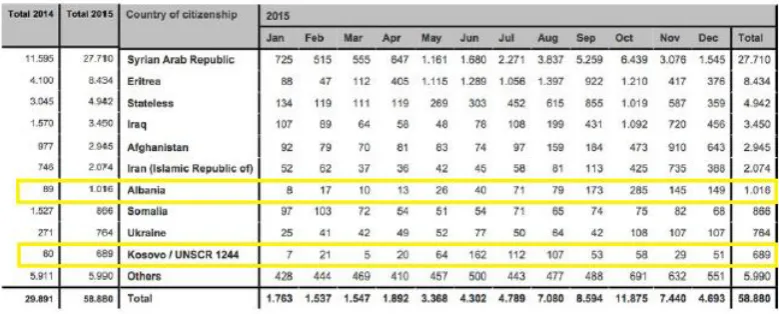
Figure 5: Asylum Statistics of the year 2015... 22
Figure 6: Overview interviewees Bramsche-Hesepe ... 27
Figure 7: Overview interviewees Almelo ... 27
Figure 8: Police Directorates of Lower Saxony ... 33
Figure 9: Organizational chart of the police force of Lower Saxony ... 35
Figure 10: Police department of Bramsche ... 37
Figure 11: Organizational chart of the Netherlands Police ... 40
Figure 12: A single national Dutch police with ten regional units ... 41
Figure 13: Regional police unit of East-Netherlands ... 43
Figure 14: Distribution of police personnel per basisteam ... 44
Figure 15: Overview of the arrival center in Bramsche-Hesepe ... 49
Figure 16: Occupancy figures Hesepe 08.05.2017 ... 51
Figure 17: Wanted poster police department of Bramsche ... 65
Abbreviations
AA Algemene asielprocedure (General asylum procedure)
ACS Aanmeldcentrum Schiphol (Application Center Schiphol)
AIDA Asylum Information Database
AsylG Asylgesetz (Asylum Act)
AufenthG Aufenthaltsgesetz (Residence Act)
AVIM Afdeling Vreemdelingenpolitie, Identificatie en Mensenhandel
(Aliens Police Department, Identification and People Trafficking)
AZC Asielzoekerscentrum (Asylum-seekers center)
BAMF Bundesamt für Migration und Flüchtlinge (Federal Office for
Migration and Refugees)
BKA Bundeskriminalamt (German Federal Criminal Police Office)
BOA Buitengewoon opsporingsambtenaar (Special investigation
officer)
BÜMA Bescheinigung über die Meldung als Asylsuchender)
(Confirmation of having reported as an asylum-seeker)
CBS Centraal Bureau voor de Statistiek (Central Agency for Statistics)
CEAS Common European Asylum System
COA Centraal Orgaan opvang asielzoekers (Central Agency for the
Reception of Asylum-Seekers)
COL Centraal Opvanglocatie (Central Reception Center)
DT&V Dienst Terugkeer en Vertrek (Repatriation and Departure
Service)
EASY Erstverteilung von Asylbewerbern (Initial distribution of
asylum-seekers)
ESD Einsatz- und Streifendienst (Operational and patrol service)
Et al. Et aliae
EU European Union
EuroCOP European Confederation of Police
EURODAC European Dactyloscopy
FRA European Union Agency for Fundamental Rights
I.e. Id est
IND Immigratie- en Naturalisatiedienst (Immigration and
GER Germany
KED Kriminal- und Ermittlungsdienst (Criminal and investigative
service)
KLPD Korps landelijke politiediensten (Dutch Police Services Agency)
KMar Koninklijke Marechaussee (The Royal Dutch Military
Constabulary)
KOB Kontaktbeamter (Liaison officer)
LAB NI Landesaufnahmebehörde Niedersachsen (Accommodation
Authority of the Federal State of Lower Saxony)
LKA Landeskriminalamt (State Office of Criminal Investigations)
NATO North Atlantic Treaty Organization
N.d. No date
NDR Norddeutscher Rundfunk (North German Broadcasting)
Nds. SOG Niedersächsisches Gesetz über die öffentliche Sicherheit und
Ordnung (Public Order and Security Act of Lower Saxony)
NOZ Neue Osnabrücker Zeitung (Local newspaper from the German
city of Osnabrück)
N.p. No pagination
NP Nederlandse Politie (Netherlands Police)
NL Netherlands
OJ Official Journal of the European Union
PIVA Programma Invoering Verbeterte Asielprocedure (Improved
Asylum Procedure)
POL Proces Opvanglocatie (Process Reception Center)
PK Polizeikommissariat (Police Station)
StPO Strafprozessordnung (German Code of Criminal Procedure)
Subs. Subsection
UNODC United Nations Office on Drugs and Crime
UAM Unaccompanied minors
VAP Verlengde Asielprocedure (Extended Asylum Procedure)
ZErmG Zentrale Ermittlungsgruppe (Central Investigation Unit)
ZKI Zentrale Kriminalinspektion (Central Criminal Investigation Unit)
ZPD Zentrale Polizeidirektion Niedersachsen (Central Police
Abstract
Over the last two years, the European Union (EU) has experienced a large-scale and
oftentimes uncontrolled influx of foreigners from non-EU countries applying for
asylum- a phenomenon that has in media outlets widely been referred to as the
refugee-crisis. This large-scale and oftentimes uncontrolled influx of genuine
asylum-seekers and irregular migrants has been associated with a number of problems and
increased workloads for the police in general, and those local police forces that are
responsible for the policing of asylum accommodation facilities, in particular.
But did the influx of asylum-seekers and irregular migrants really result in increased
workloads for local police forces that are responsible for policing asylum
accommodation facilities? And did local police forces in different Member States find
different solutions in order to cope with potentially increased workloads?
Hitherto, on a scientific level these are unanswered questions. It is the declared aim
of this study to fill in this gap to a certain extent.
This study essentially concentrates on the question, if the policing of the regular
reception facility (AZC) in Almelo (NL) currently differs from the policing of the arrival
center in Bramsche-Hesepe (GER), and if so, which factors provide an explanation
for the potentially observed differences in the modes of policing.
In order to detect differences in the modes in which the two asylum accommodation
facilities are policed, semi-structured face-to-face interviews (N=6) were conducted
with those police officers that are responsible for policing the two asylum
accommodation facilities.
Placed against the background that police scholars theoretically expect that
variations in the modes of policing are caused by environmental, organizational and
situational factors, this study comes to the conclusion that organizational factors are
least responsible for the observed differences between the modes in which the two
asylum accommodation facilities under study are policed. External environmental
factors, however, seem to provide explanations for the observed differences between
the mode of policing of the regular reception facility and the mode of policing of the
1. Introduction
Over the last two years, the European Union (EU) has experienced a large-scale and
oftentimes uncontrolled influx of foreigners from non-EU countries applying for
international protection- a phenomenon that has in media outlets widely been
referred to as the refugee-crisis. Data published by Eurostat (2016) indicate that in
the year 2015 alone, roughly 1.25 million1 third-country nationals have applied for asylum in the EU Member States, although not all of them were genuine
asylum-seekers entitled to international protection under international law (European
Parliament, 2016). In fact, in addition to genuine asylum-seekers, who have
predominantly fled from countries in conflict or crisis, such as Syria, Afghanistan and
Iraq (as can be seen from Figure 1) in order to save their lives or preserve their
freedom, the migratory flows of the last two years also included irregular migrants
who supposedly intended to enter the EU primarily for economic reasons and who
tried to legitimize their illegal status through also making applications for asylum
[image:8.595.124.472.414.598.2](European Commission, 2016; Aggarwal, La China & Vaculova, 2016).
Figure 1: First time asylum applicants registered in the EU Member States, 2014/2015 (Eurostat,
2016)
While, according to Directive 2011/95/EU of the European Parliament and of the
Council, international protection is granted to those third-country nationals who
qualify as refugees due to a well founded fear of prosecution for reasons of race,
religion, nationality, or membership of a particular social group or political opinion;
1
In addition, there is an unknown number of irregular or undocumented migrants who entered the EU
and subsidiary protection status is granted to those third-country nationals who would
face a real risk of suffering serious harm if returned to their respective country of
origin (OJ 2011 L 337/9, 20 December 2011), the EU Member States are, according
to Directive 2008/115/EC of the European Parliament and of the Council (OJ 2008 L
348/98, 24 December 2008), required to return irregular migrants to their country of
origin or other safe countries.
As, however, genuine asylum-seekers and irregular migrants often used the same
routes and means of transportation in their attempt to enter the EU (Metcalfe-Hough,
2015), and as a large number of irregular migrants arrived with false or no
identification documents (FRONTEX, 2016), responsible border authorities often
failed to properly distinguish between those people in need for international
protection and those moving in search of better economic opportunities, leading to
the high numbers of justified and unjustified asylum applications of the last two years.
The sheer number and the complexity of the inflow of asylum-seekers and other
migrants into the EU over the last two years have become highly sensitive political
issues, generating intense political and public debate and exacerbating pre-existing
weaknesses in a number of the EU's current institutional and legislative
arrangements (Metcalfe-Hough, 2015; Lehne, 2016). As indicated before, the
so-called refugee-crisis clearly exposed substantial shortcomings with regard to the
protection and control of the EU's external borders. Besides, and partly due to,
exposing these shortcomings, the massive influx of genuine asylum-seekers and
irregular migrants also threatened the very existence of the Schengen area
(Willermain, 2016). The Schengen Agreement, which took effect in 1985, abolished
internal border controls between countries in lieu of a single external border, enabling
the free movement of people, goods and services. It covers 22 EU Member States
and four non-EU Member States (European Commission, 2009). "The idea behind
softening borders in the Schengen area is that internal frontiers become soft, while
external ones are hard, effectively creating a larger zone of free movement, but one
with sharper edges...so entry to this area is strictly controlled" (Grabbe, 2000, p.
505). However, in the course of the refugee-crisis, several EU Member States "began
questioning the ability or willingness of other Member States to control the external
borders" (Jeffray, 2017, p. 8) and reinstated temporary border controls, thus calling
Figure 2: Schengen area and main migration routes to Europe (Jeffray, 2017, p.11)
Furthermore, the massive inflow of asylum-seekers and other migrants into the EU
demonstrated the unsustainability of the EU's current Common European Asylum
System (CEAS) and one of its core mechanisms, the Dublin III Regulation, in
particular (Fratzke, 2015). The Dublin III Regulation assigns the responsibility for
registering and processing the asylum applications of third-country nationals to the
first country of entry, in order to prevent asylum-seekers from filing applications in
several EU Member States simultaneously (OJ 2013 L 180/31, 29 June 2013).
Due to their geographical locations on the EU's southern periphery, Italy and Greece
have become the first countries of entry for the vast majority of third-country nationals
seeking asylum on the territory of the EU in 2015 (FRONTEX, 2016). Pursuant to the
Dublin III Regulation, Italy and Greece were actually responsible for registering and
(at least temporarily) accommodating all asylum-seekers entering their respective
territory. However, given the huge migratory pressures of the year 2015, the
authorities of the two fiscally constrained countries were no longer able to fulfill their
obligations and responsibilities and failed to prevent (unregistered) asylum-seekers
from continuing their journey to economically more vibrant and/or migration-friendly
destination countries such as Germany, Sweden, Spain, Belgium, the Netherlands
and Austria" (Willermain, 2016, p. 1).
In most, if not in all, of the main destination countries, initial feelings of empathy and
the widespread willingness to accept and help newcomers were soon accompanied
by worries about the negative consequences that the large-scale and (oftentimes)
uncontrolled arrival of genuine asylum-seekers and irregular migrants could have for
society, labor markets and welfare institutions. Due to the terror attacks in Paris,
Brussels and Berlin, as well as the incidents of sexual assaults and thefts during the
2016 New Year's Eve celebrations in Cologne (Germany), security concerns have
[image:11.595.161.434.302.467.2]also become a major issue in the policy discourse on asylum-seekers and migrants.
Figure 3: Growth rates (first-time requests) of asylum-seekers in selected EU Member States
(Bordignon & Moriconi, 2017, p. 4)
"The mechanisms established by states to protect people's rights, establish and
maintain order and guarantee stability and security are usually referred to collectively
as the security sector. An important actor in the security sector is the police, whose
functions, as a minimum, are the prevention and detection of crime, the maintenance
of public order and the provision of assistance to the public" (The United Nations
Office on Drugs and Crime, 2011, p. 5).
Due to the severity of public expenditure cuts on police pay and budgets throughout
the EU in the aftermath of the financial crisis and economic recession of 2008, the
capacity of national police forces to perform these security-related functions in a
satisfactory manner was, however, already seriously compromised in the recent past
With the help of a survey which was conducted among its members in the year 2014,
the European Confederation of Police (EuroCOP)2 for instance came to the conclusion, that even prior to the outbreak of the refugee-crisis, many police forces
across the EU were already considerably struggling with issues of understaffing,
increased workloads, as well as the lack of proper training and equipment (EuroCOP,
2015). The recent large-scale and (oftentimes) uncontrolled influx of third-country
nationals into the EU has certainly not contributed to an easing of the situation for the
European police forces.
Rather, it seems as if the refugee-crisis constitutes an additional burden that could
possibly stretch the police to their limits. Assumingly, this is increasingly the case for
police forces that are either located in close vicinity of the external border of a
specific EU Member State and/or for local police forces that are responsible for the
policing in and around asylum accommodation facilities. This expectation is for
instance corroborated by the fact that, since 2015, the number of attacks against
these facilities has sharply risen in a number of EU Member States (FRA, 2016). The
investigation and prosecution of these politically motivated crimes can be very time
intensive and keep the police busy.
Furthermore, while the absolute majority of asylum-seekers does not commit
prosecutable acts (and certainly are no terrorists), it cannot be denied that some of
them engage in criminal activities requiring police intervention. Although, according to
the president of the German Federal Criminal Office (Bundeskriminalamt, BKA),
Holger Münch, "the offenses committed most admittedly are merely minor bodily
harm, shoplifting and fare dodging, the police in some cases also identified links to
organized crime and/or gang structures similar to those found in the field of
organized crime" (2016, p. 2).
In the view of this development, EuroCOP issued the warning that "it is impossible to
believe that the new demands created by over one million new people entering
Europe in little over a year can properly be managed by police forces who were
already struggling to cope with falling numbers and existing demand" (2016, p. 2).
Instead, EuroCOP invoked, that it should be realized that "police officers have not
been trained to deal with the complex issues created by the refugee-crisis and that
2
"The European Confederation of Police (EuroCOP) is the umbrella organization for 35 police unions
and staff organizations in Europe. Based in Luxembourg, it represents the interests of over half a
some police forces are simply overwhelmed by the volume of people coming to their
jurisdictions" (2016, p. 1).
As a way out of this situation, EuroCOP calls for an increase in the number of police
officers throughout the EU as well as the development of specific police trainings for
dealing with asylum-seekers (2016). Especially the former approach, however,
neither comes cheaply, nor does it provide any near-term remedy, as new police
recruits usually have to serve multi-annual apprenticeship programs before attaining
full status in the police. Hence, for the time being, it seems as if the police have to
make do with existing staff and come up with different solutions to stem the additional
burdens that the refugee-crisis recently brought about.
As one potential reaction to the increased burden caused by the refugee crisis, the
State Agency for Police of the German Federal State of Lower Saxony for instance
ordered its police forces to reorganize their priorities, according to the Neue
Osnabrücker Zeitung (NOZ), citing an internal police paper. This reprioritization
refers to a "temporary deferment and reduction of measures in non-priority areas of
responsibility", and "an optimization in determining the intensity and scope of
non-priority areas of crime" (Neue Osnabrücker Zeitung, 2016, n.p.). As a result of the
reprioritization, "police officers are officially ordered to reduce their investigations into
minor crimes such as criminal damage, petty theft or fare evasion and to more
quickly close cases, if the chance of catching the offender is low" (Neue Osnabrücker
Zeitung, 2016, n.p.). The declared aim of this measure is to "free up more police
resources for other pressing tasks" (Neue Osnabrücker Zeitung, 2016, n.p.).
While acknowledging that the decision of the Federal State Agency for Police might
have been without any alternative, it remains highly questionable, however, whether
the adopted cuts in some areas of police work contribute to the population's
confidence in a fully functional police force.
All in all, a major problem for the police forces within the different EU Member States
was, and still is, that there was no real preparation time for them to adapt the police
service(s) to the new difficulties and challenges that came along with the
refugee-crisis. Comparable to the situation of other public authorities, the police was basically
taken by surprise when the refugee-crisis erupted in 2015 and had to generate rather
spontaneous solutions to the concerns and problems associated with this new
The main impetus for this study came from the police department
(Polizeikommissariat) of the German town of Bramsche, which is located in the
Federal State of Lower Saxony. The police department of Bramsche is inter alia
responsible for policing an arrival center that is located in Hesepe, a village that
comprises one district of the town of Bramsche. The police department's
administration was highly interested in finding out whether the policing of asylum
reception facilities in other main destination countries across the EU is carried out in
similar ways, or whether other police forces potentially found different or better
solutions to the new difficulties and challenges associated with the influx of
asylum-seekers to their jurisdictions.
As, according to their own account, the police in Bramsche are occupied with their
own policing matters to such an extent that they could not conduct such an ambitious
research project themselves, this task was delegated to the author of this report.
In the search for another police institution, to which the police work in and around the
arrival center in Bramsche-Hesepe can be compared to, police authorities in several
EU Member States that also became major destinations for asylum-seekers in the
past two years were contacted. In many cases, however, the requests have
remained unanswered or have been refused. In order to still be able to conduct the
study, the supervising professor of this research project, Dr. A.J.J. Meershoek,
established contact with the Dutch police director Rik de Boer to see whether he
could help to find a suitable object of comparison in the Netherlands.
After some inquiries, Rik de Boer indicated that the police unit (basisteam 'B2 Twente
Noord') of the Dutch city of Almelo, which is also responsible for the policing of an
asylum accommodation facility, expressed a great deal of interest in the envisaged
research project and agreed to participate in the study. Hence, the decision to
compare the ways in which the police department of Bramsche and the police unit of
Almelo are policing the asylum accommodation facilities in their respective
jurisdictions, has basically been driven by practical constraints and has been without
2. Theoretical perspectives
"There is no single definition of what policing is. But there is obviously a dominant
group of activities that is carried out by the police in most modern countries. These
activities have to do, generally speaking, with helping citizens in trouble, maintaining
public order and fighting crime. Those activities, however, can be carried out in many
different modes: criminal investigation, criminal prevention, reactive patrol, preventive
patrol, community oriented policing, et cetera (van de Vijver & Moor, 2012, p. 18).
In order to explain variations in the modes of policing (not only between different
countries or provinces, but also between individual police officers in the same
countries or provinces), prior research of other police scholars has identified three
mayor sets of potentially influential factors (Bernhard & Engel, 2001; White, 2002;
Chappell, MacDonald & Manz, 2006): environmental, organizational, and situational.
Variations in the mode of policing constitute the dependent variables-phenomena to
be explained- and environmental, organizational and situational factors are the
independent variables, which provide the explanation (Carrington & Schulenberg,
2003, p. 77).
"Situational variables affecting modes of policing refer to contextual factors specific to
each (individual) police-citizen encounter" (White, 2007, p. 407). These contextual
factors may involve characteristics of the suspects of a given crime, such as their
age, ethnicity, degree of intoxication or the seriousness of the offence (Durna, 2011;
Tasdoven, 2011). Furthermore, contextual factors may also involve characteristics of
the police officer(s), such as length of service, received training, education, age or
sex (White, 2007; Durna, 2011; Tasdoven, 2011). Other situational variables that
potentially influence the mode of policing may include characteristics of the specific
police-citizen encounter, such as presence of others- police officers or bystanders
and the incident location (White, 2007; Durna, 2011).
Although it has to be recognized that differences in the abovementioned situational
factors could certainly help to provide an explanation for potentially observed
variations in the modes of policing of the arrival center in Bramsche-Hesepe and the
regular reception facility in Almelo, an analysis of situational factors is purposely
excluded from this study. On the one hand, this is for instance due to limitations of
decision was felt because the collection of own data regarding the characteristics of
suspects would certainly go beyond the scope of this master thesis.
Organizational variables potentially affecting modes of policing refer to factors that
are within the realm of the police organization (White, 2007). "They can be seen as
the broader coordinating structures in place within which policing occurs" (Chriss,
2011, p.117). "Organizational variables which have been associated by researchers
with having an effect on modes of policing for instance include bureaucracy,
professionalism, department size, stability of assignment, and supervisor's span of
control" (Carrington & Schulenberg, 2003, p. 134). Slovak (1986) for instance came
to the conclusion that larger police departments result in coercive measures toward
the public they serve due to a lack of sufficient supervision.
When examining the impact of organizational context and structure on arrest rates in
child abuse incidents, Maguire (1994) figured out that smaller police departments
make more arrests than their larger counterparts.
"Wilson's (1968) pioneering case study of police organizational styles and officer
behavior suggested that individual police behavior and ideas about the police role are
a function of departmental goals, which occur within the broader political climate of a
community. Accordingly, police organizations are distinguishable from each other by
their level of bureaucratization and professionalism" (Chappell, MacDonald & Manz,
2006, pp. 288-289). Wilson (1968) suggested that police organizations could be
classified into three distinctive typologies: the legalistic style, the watchman style and
the service style. Each style guides the police officers in the execution of daily duties
(Wilson, 1968). According to Wilson's (1968) typology, police organizations exhibiting
the watchman style put their highest emphasis on the maintenance of order and
(serious) crime control. "This type of organization has a predisposition to avoid formal
involvement (i.e. issuance of citations or arrests), since their main function is to
control public disorder rather than to enforce the law" (Wilson, 1968, p. 148). Police
officers in watchman style organizations exercise a great deal of discretion and tend
to ignore many minor violations, such as traffic violations or misdemeanors involving
juveniles.
At the same time, police officers from police organizations operating under the
watchman style are to be tough in cases of serious crime or in situations where the
authority. Furthermore, watchman style police organizations "have flat bureaucratic
structures, low budgets, little specialization (police officers are perceived as
generalists) and few rules" (Chappell, MacDonald & Manz, 2006, p. 289).
In contrast, in police organizations operating under the legalistic style, "there is a high
emphasis on the strict enforcement of laws, resulting in a limited use of discretion by
police officers" (Carrington & Schulenberg, 2003, p. 134). "Police officers are
encouraged to handle commonplace situations as if they were matters of law
enforcement as opposed to order maintenance" (Scaramella, Cox & McCamey,
2011, p. 158). Formal action (i.e. issuance of citations or arrests) is a key component
of the legalistic style and accordingly a high proportion of juveniles are detained and
arrested, many tickets for traffic violations are issued and police officers act
vigorously against illicit enterprise (Wilson, 1968). "Police organizations that operate
under this style are highly complex bureaucratic agencies that rely on central
administrative authority and extensive rules and procedures" (Chappell, MacDonald
& Manz, 2006, p. 289). Moreover, they are characterized by a highly specialized
division of labor (i.e. specialized police units) and the presence of strict evaluation
processes.
The third policing style identified by Wilson is the service style. As the label suggests,
police organizations operating under the service style stress the service delivery
function of police (Liederbach & Travis, 2008). "Police officers are concerned with
public relations, problem solving, and deferral to community needs" (Chappell,
MacDonald & Manz, 2006, p. 290). Community resident's satisfaction is a major
organizational goal. "Accordingly, police officers take all requests for both law
enforcement and order maintenance seriously" (Zhao & Hassell, 2005, p. 414).
Serious crimes, such as robberies or burglaries take precedence over minor
infractions of the law, and "arrest are avoided when possible but there will be
frequent use of informal non-arrest sanctions" (Wilson, 1968, p. 201). "Service style
organizations are similar to legalistic departments in that they also have a high level
of professionalism. However, they have considerably fewer hierarchical levels and
less administrative control compared to legalistic organizations. They rely on a
According to Wilson (1968), the mode of policing of officers from a police
organization operating under the service style is coined by a high frequency of
contacts with the public and by the use of informal methods to interact with and aid
the public.
In contrast, the mode of policing of officers from a police organization that operates
under the watchman style is expected to be characterized by a low frequency of
contacts with the public and by the use of informal methods to interact with the
public.
Finally, the mode of policing of officers from police organizations exhibiting the
legalistic style is characterized by a high frequency of contact with the public and the
frequent use of formal measures to interact with the public.
While Wilson (1968) proposed that the organizational styles exhibited by local police
agencies do influence the individual performance and the behavior of police officers,
"it could be that police officer behaviors are partially the result of the specific
organizational model adopted by the police. Police officer behavior might reflect the
police culture existing in a particular police organization" (Cornelli, 2014, p. 56).
Therefore, not only different organizational styles, but also different policing models
(in terms of detailed operational procedures and rules for officers to follow) may
have a different influence on police officer behavior.
In their book 'Fixing Broken Windows: Restoring Order and Reducing Crime in Our
Communities' (1997), Kelling and Coles provide an in-depth history of the
development of two basic models of policing that have been dominant in western
societies throughout the last century: the reform-model and the
community-policing-model.
"From the 1940s until the 1960s the reform-model was at its peak" (Liedenbaum,
2011, p. 24). "Using the focus on criminal law as a basic source of police legitimacy,
police in the reform era moved to narrow their functioning to crime control and
criminal apprehension. Police agencies became law enforcement agencies. Their
goal was to control crime. Their principal means was the use of criminal law to
apprehend and deter offenders. Activities that drew the police into solving other kinds
of community problems and relied on other kinds of responses were identified as
'social work", and became the object of derision" (Kelling & Moore, 2005, p. 94). "In
provision of services to criminal apprehension through law enforcement. In terms of
tactics for carrying out these functions, intimate collaboration with citizens would be
replaced by more remote and reactive procedures, such as rapid responses to calls
for service and patrol by automobile, that would hold police back from interacting with
citizens" (Kelling & Coles, 1997, p. 77)."Moreover, police organizations emphasized
control over workers through bureaucratic means of control: supervision, limited span
of control, flow of instructions downward and information upward in the organization"
(Kelling & Moore, 2005, p. 95).
During the late 1960s and 1970s it was clear that the reform model of policing was in
crisis (Liedenbaum, 2011). On the one hand, the police were too disconnected from
many of the communities they served to retain the patina of legitimacy they derived
from the law (Kelling & Coles, 1997). On the other hand, "regardless of how police
effectiveness in dealing with crime was measured, police failed to substantially
improve their record. Despite large increases in the size of police departments and in
expenditures for new form of equipment, police failed to meet their own public
expectations about their capacity to control crime or prevent its increase" (Kelling &
Moore, 2005, p. 98).
Due to the criticism that the reform-model increasingly faced, policing has begun to
shift towards the community-policing-model in the 1990s (Liedenbaum, 2011). "Under
this model, the police should operate primarily preventive and proactive and should
be problem solving" (Liedenbaum, 2011, p. 24). "Everything that can help to make
neighborhoods safer is important. The police should be well integrated in their area.
Police officers should know the problems and the people, so that they are able to
deal with problems before they escalate. Repressive actions should only be used
when inevitable. The police should have vast discretionary powers, professional
autonomy and police-officers should be well educated" (van de Vijver & Moor, 2012,
p. 20).
However, "in many countries the community-policing-model has lost its luster under
the onslaught or organized local crime and transnational crime against which it
seems too soft and ineffective a model" (Marenin, 2007 p. 207). Therefore, recent
developments indicate a partial return to the reform-model of policing (Liedenbaum,
Coming back to the three mayor sets of variables that prior research of other police
scholars has identified as potentially having an impact on modes of policing, the third
mayor set of variables refers to environmental variables. "Environmental variables
pertain to factors outside the police organization and can be separated into two basic
categories: community characteristics that indirectly affect police behavior, such as
variations in community size, variations in local levels of crime and violence, and
direct external efforts to control police behavior, including the criminal justice systems
(i.e. principle of legality vs. principle of opportunity), police laws and regulations as
well as court rulings" (White, 2007, p. 406).
Regarding research on community characteristics, an empirical investigation
conducted by Fyfe (1981) for instance concluded that the police are more inclined to
behave harshly in communities with higher crime rates.
An important inspiration for this master thesis came from the research conducted by
Liedenbaum (2011). For her dissertation called 'Politiewerk: tussen taak en
uitvoering- Een vergelikend onderzoek naar de basispolitiezorg in Nederland en
Noordrijn-Westfalen', she conducted a cross-border comparative analysis about the
differences and similarities in the execution of the basic police work of the Dutch
police force and the police force of the German Federal State of North Rhine
Westphalia. The intended aim of her dissertation was to disclose potential differences
and similarities in the modes of policing of the two police forces and to contingently
explain them. Her decision to compare the basic police work of the Dutch police force
with the basic police work of the police force of the German Federal State of North
Rhine Westphalia was not a chance decision. Rather, she chose to compare those
two police forces because of almost identical community characteristics prevailing in
their respective jurisdictions.
As Liedenbaum (2011) showed, the Netherlands and North Rhine-Westphalia had
comparable population figures, almost the same gross domestic products and nearly
identical crime rates at the time when she conducted her study. In this way,
Liedenbaum could assume that community characteristics could not account for
potentially observed varieties between the modes of policing of the Dutch police force
and the police force of North Rhine-Westphalia. Therefore, she directed her research
at investigating whether differences in the institutional context in which both police
Figure 4: Theoretical model of policing (Liedenbaum, 2011, p. 46)
Through the study of the daily work of police officers, differences in policing are made
clear and presented against the background of the police systems in the Netherlands
and North-Rhine Westphalia. At the end, Liedenbaum concluded that "the mode of
policing of the Dutch police force features more elements of Wilson's watchman style
and Kelling and Coles' community-policing model, while the mode of policing of the
police force of North Rhine-Westphalia shows more parallels to Wilson's legalistic
style and Kelling and Coles' reform-model" (2011, p. 366).
At this intersection it should be noted that the findings of Liedenbaum regarding the
differences in the modes of policing of the Dutch police force and the police force of
the German Federal State of North Rhine-Westphalia must be treated with caution
for the purpose of this study. There is a variety of reasons for that:
Firstly, this is because Liedenbaum derived her findings from comparing the basic
police work of the Dutch police force and the police force of the German Federal
State of North Rhine-Westphalia. The focus of this study, however, is on investigating
differences and similarities in one specific niche of police work only, namely the
policing of asylum accommodation facilities (in Almelo (NL) and Bramsche-Hesepe
(GER)).
Secondly, this is due to the fact that Liedenbaum (2011) conducted her study prior to
the reorganization of the Dutch police force which came into effect on 1 January
2013 and which brought about some changes to the police management structure
Thirdly, Liedenbaum compared the Dutch police force with the police force of the
German Federal State of North Rhine-Westphalia. The focus of this study, however,
is upon the police work of a police department that belongs to the police force of the
German Federal State of Lower Saxony.
Even if Aden & Frevel (2017) state that "the nationwide criminal law and penal
procedure code (principle of legality) have an integrating effect on policing in
Germany", and that therefore "police and policing in the sixteen federal state are not
completely different" (p. 231), there are still a range of differences in several areas of
police organization and policing between the individual federal states (this issue will
be discussed in more detail in chapter 5). Therefore, it is sensible to not blindly apply
Liedenbaum's findings about the mode of policing of the police force of North
Rhine-Westphalia (in the realm of basic police work) to the mode of policing of police
officers from a department within the federal state of Lower Saxony.
Fourthly, and maybe most importantly, Liedenbaum's research was based on the
fundamental assumption, that if the community characteristics of the Netherlands and
North Rhine-Westphalia are (almost) identical, that the modes of policing of the
Dutch police force and the police force of North Rhine-Westphalia mainly differ
depending on both institutional environmental and organizational factors. In order to
explain the differences in the modes of policing of the two forces, her study
specifically analyzed how characteristics of the Dutch and North Rhine-Westphalian
police systems (macro-level) and internal conditions of the two police organizations
(meso-level) affect the modes of policing on the work floor (micro-level).
For the specific context of this study, however, the assumption that the environmental
variables in terms of the community characteristics are (almost) identical cannot be
made at all. Compared to about 890.0003 asylum-seekers and other migrants that entered Germany in the year 2015 (Federal Ministry of the Interior, 2016), only about
58.800 asylum-seekers and other migrants entered the Netherlands in the same
period (IND, n.d.). Based on the statement of the president of the German Federal
Criminal Office, Holger Münch (2016), that "the absolute majority of asylum-seekers
do admittedly not commit punishable acts", but that "the entire group of all
asylum-seekers, too, include individuals who engage in criminal activities" (p. 2), it might be
3
The federal state of Lower Saxony alone received about 102.000 asylum-seekers in 2015 (Neue
expected that, as the total number of asylum-seekers that entered Germany was
substantially higher than the total number of asylum-seekers that entered the
Netherlands, the proportion of individuals who engage in criminal activities might also
be higher in Germany than in the Netherlands, accordingly.
Considering that Struik, Sickler & Pruyt (2016) state that "simply because of the
growth of the population that the influx of asylum-seekers has created, the Dutch
police is confronted with additional pressures and workloads" (p. 2), then it might be
assumed that the considerably higher influx of asylum-seekers to Germany has
created even more pressure and higher workloads for the German police.
The extent to which these distinct differences in the environmental factors on the
national level also come to bear for the police department of Bramsche-Hesepe and
the basisteam 'B2 Twente Noord' and therewith potentially lead to differences in the
respective mode of policing is investigated in the course of this study.
In addition to the vast difference between the sheer numbers of asylum-seekers that
entered Germany and the Netherlands in the year 2015, there was also a significant
difference with regard to the countries of origin of the asylum-seekers that entered
both countries. According to the assessment of Thränhardt (2016), one third to a half
of all asylum-seekers (expressed in numbers: 297.000 to 445.000) that have arrived
in Germany in 2015 came from the Balkan states. As can be seen from Figure 5, of
the total number of asylum-seekers (58.800) that entered the Netherlands in 2015,
[image:23.595.102.492.549.706.2]only about 1.705 (roughly 2,9 percent) people came from the Balkan states.
Figure 5: Asylum Statistics of the year 2015 (IND, n.d.).
as safe countries of origin. Generally, applicants from safe countries of origin have
almost no chance of obtaining asylum in Germany (AIDA, 2016). Still,
asylum-seekers from the Balkan states, who are often referred to as irregular migrants, made
up one of the largest contingents of the applicants in Germany. How was that
possible? One potential explanation for this circumstance lies in the fact that, in order
to avoid being identified as irregular migrants, many people from the Balkan states
intentionally destroyed or withheld identity documents from the German Federal
Police (Bundespolizei) when they arrived at the German border (Diab, 2017). Hence,
the federal police often had no possibility to properly distinguish between those
people in actual need for international protection and those potentially moving in
search of better economic opportunities.
As will also be shown in more detail in chapter 7.1, entering German territory without
valid identity documents is punishable under Section 95 of the German Residence
Act (Aufenthaltsgesetz, AufenthG). Accordingly, police investigations are opened
against foreign nationals who are accused of having entered German territory without
a valid identity document.
As the number of irregular und undocumented migrants from the Balkan states that
arrived in Germany was considerably higher than in the Netherlands, it can also be
expected that the workload that the arrival of these irregular and undocumented
migrants created for the German police is way higher than for the Dutch police.
The extent to which these distinct differences in the environmental factors on the
national level also come to bear for the police department of Bramsche-Hesepe and
the basisteam 'B2 Twente Noord' and therewith potentially lead to differences in the
respective mode of policing is also investigated in the course of this study.
The study of Liedenbaum has impressively demonstrated that the modes of policing
of the Dutch police force and the police force of North Rhine-Westphalia level mainly
differ because of differences in their institutional environments and differences in
their organizational structures. To a certain extent, it can be expected that differences
between the modes of policing of the Dutch police force and the police force of Lower
Saxony can also be ascribed to differences in their institutional environments and
organizational structures. That the organizational structures of the Dutch police force
and the police force of Lower Saxony do indeed differ is shown in the chapters five
However, for the context of this study, it is assumed that besides differences in the
institutional environments and organizational structures, preeminently differences in
the external environments could be responsible for potentially observed differences
in the ways in which the policing of two asylum accommodation facilities is carried
out.
3. Research questions
After having provided a thorough introduction into the thesis' topic and having
revealed its relevance, this section of the report finally outlines the main research
question that the master thesis addresses:
Does the policing of the regular reception facility in Almelo (NL) currently differ from the policing of the arrival center in Bramsche-Hesepe (GER), and if so, which factors explain the differences?
In order to be able to give a clear and structured answer to this main research
question, it is divided into the following four sub-questions that are sequently
answered in the course of this master thesis report:
Sub-question 1: What differences and similarities exist between the two asylum accommodation facilities?
Sub-question 2: What are the main differences and similarities in terms of the key police problems that the police officers are confronted with in and around the asylum accommodation facilities in Almelo (NL) and Bramsche-Hesepe (GER)?
Sub-question 3: Do the police forces that are mainly responsible for policing the asylum accommodation facilities in Bramsche-Hesepe (GER) and Almelo (NL) differ in their respective modes of policing?
4. Methodology
4.1 Research purpose
"The classification of research purpose most often used in the research methods'
literature is the threefold one of exploratory, descriptive and explanatory" (Saunders,
Lewis & Thornhill, 2009, p.139)".
"Exploratory research seeks to investigate an area that has been underresearched.
Rather than testing hypotheses, this type of research starts to acquaint a researcher
with a topic, and helps him or her to gain insights into the respective subject area that
might be of potential use for further investigations" (Hesse-Biber & Leavy, 2011, p.
10).
The objective of descriptive research is to "portray an accurate profile of persons,
events or situations" (Robson, 2002, p. 59). "It is concerned with making complicated
things understandable. In social science, it often involves summarizing specific
factual information into empirical generalizations, or summarizing details of events,
characteristics, cases or processes" (Punch, 2006, pp. 34-35).
"Explanatory research seeks to explain social phenomena and the relationship
between different components of a topic" (Hesse-Biber & Leavy, 2011, p. 10). "It too
is concerned with making complicated things understandable, but on a different level.
It aims to find the reasons for things, showing why and how they are what they are"
(Punch,2006,p.34).
It should be noted that the abovementioned types of research are not mutually
exclusive. Depending on how the researcher sets up the research, it may be both
exploratory and descriptive or descriptive and explanatory (Slack & Parent, 2006).
The purpose of the present master thesis is twofold, namely descriptive and
explanatory. For the most part, the thesis is descriptive (sub-questions 1-3) and to a
lesser extent it is explanatory (sub-question 4).
4.2 Research design
For the study at hand, a cross-sectional research design was used. A cross-sectional
study involves observations of a sample, or cross section, of a population or
phenomenon that are made at one point in time" (Babbie, 2007, p. 102), during a
period of days, weeks or months. The period under consideration for this study
Cross-sectional studies are designed to look at how things are in the present, without
any sense of whether there is a history or trend at work. Most cross-sectional studies
actually are exploratory or descriptive in purpose, but there are also many
explanatory studies that use a cross-sectional design (Babbie, 2007; Saunders,
Lewis & Thornhill, 2009). "The terms cross-sectional design and cross-sectional
survey are often used interchangeably. Researchers typically use one-time
cross-sectional survey studies to collect data, but cross-cross-sectional data can also be
collected by interviews" (Lavrakas, 2008, p.171)
4.3 Method of data collection
Data collection methods can be classified into qualitative and quantitative methods. A
useful way to distinguish between the two methods is to think of qualitative methods
as providing data in the form of words, and quantitative methods as generating data
in the form of numbers and frequencies that can be transformed into useable
statistics (Denscombe, 2007).
"Quantitative data collection instruments are questionnaires, standardized measuring
instruments, ad hoc rating scales or observation schedules" (Punch, 2006, p. 52).
Qualitative data collection methods include observation, participant observation,
interviewing, focus groups and case studies (Denscombe, 2007).
The data collected for the present master thesis is primarily qualitative. Data sources
for answering the first sub-question were grey literature provided by the German
Federal Office for Migration and Refugees (Bundesamt für Migration und Flüchtlinge,
BAMF) and the Dutch Central Agency for the Reception of Asylum-Seekers (Centraal
Orgaan opvang asielzoekers, COA), the respective websites of the BAMF and the
COA, e-mail communications with employees of the BAMF and the COA as well as
newspaper articles of two relevant local newspapers, namely the German 'Neue
Osnabrücker Zeitung' and the Dutch 'Tubantia' (only newspaper articles that were
published by both newspapers between January 2015 and June 2017 were
considered). For the 'Tubantia' newspaper the following search terms were used:
'AZC Almelo', 'Incident(en) AZC Almelo, ' Politie inzet AZC Almelo', 'Politie AZC
Almelo' and 'Onrust AZC Almelo'. For the 'Neue Osnabrücker Zeitung' the author of
this report used the following search terms: 'Flüchtlingsunterkunft Bramsche',
Flüchtlingsunterkunft Hesepe', 'Polizei Flüchtlinge', 'Polizei Flüchtlingsunterkunft',
'Straftaten Flüchtlinge'.
For answering the second and the third sub-question, data was obtained from
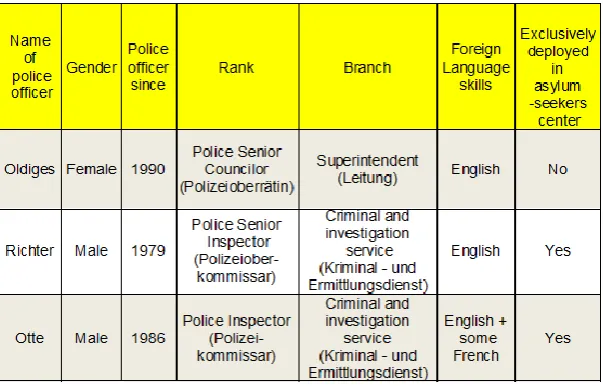
face-to-face semi-structured interviews (N=6; German police officers N=3, Dutch police
officers N=3) with police officers from the two police departments/units under
examination. In order to be able to gain an understanding of views from both an
operational and strategic point of view, the interviews were conducted with police
officers of different ranks and assigned tasks. A more detailed overview of the
[image:28.595.147.449.306.499.2]interviewed police officers can be found in the two graphics given below:
Figure 6: Overview interviewees Bramsche-Hesepe
[image:28.595.146.448.544.744.2]The interviews had a duration of 60-90 minutes and were recorded with interview
recording software on a personal computer ('Listen N Write'-software).
Semi-structured interviews were chosen as the method of data collection, because it was
perceived as important to be able to ask supplementary questions that add
significance and depth to the data. Semi-structured interviews provide the researcher
with the opportunity to probe answers, where he or she wants the respondents to
explain, or build on, their responses (Saunders, Lewis & Thornhill, 2009, p. 324).
All interviews were held in the office premises of the police officers' respective police
station. The interviews were conducted until clear and persistent themes were
identified and the author of this master thesis felt satisfied that the questions were
answered in depth and saturation was reached. The pre-determined set of questions
that was covered in all of interviews can be found in the appendix of this report.
The answer to the fourth sub-question does to a large extent depend on whether
actual differences in the ways in which the two asylum accommodation facilities
under examination are policed do exist. For the case that differences exist, it can, in
accordance with the theoretical perspectives that were presented earlier throughout
this report, be expected that differences in the organizational structures and in the
external environments of the two police units under study also lead to differences in
the ways in which they police the respective asylum accommodation facility.
In other words, the potentially disclosed differences between how the two asylum
accommodation facilities are policed, will partly be explained by detecting differences
in the respective external environmental conditions and organizational structures.
Furthermore, as the individual semi-structured interviews were held on several
consecutive days, the interview respondents were confronted with disclosed
differences and were asked to deliver an explanation thereof, if possible.
4.4 Data analysis
As has been indicated earlier in this report, (predominantly qualitative) data was
obtained with the help of semi-structured face-to-face interviews (N=6) with police
officers from the two police units under examination.
The semi-structured face-to-face interviews were recorded with interview recording
software on a personal computer ('Listen N Write'). The recorded audio files were
German police officers were held in German language, while the interviews with the
Dutch police officers were either held in English or Dutch language (according to the
respective language skills of the interview participants).4
For the analysis of the transcripts, the thematic analysis-approach was chosen.
According to Lapadat, (2010) "thematic analysis is not a research method in itself,
but rather an analytic approach and synthesizing strategy used as part of
meaning-making process of many research methods" (p. 926). Thematic analysis can be used
to manage and to make sense of large volumes of data in order to systematically
gain knowledge and empathy about a person, an interaction, a group, situation or
organization (Komori, n.d.). "The basic analytic strategy used in thematic analysis is
coding, a process of closely inspecting text to look for recurrent themes, topics, or
relationships, and marking similar passages with a code or label to categorize them,
that enables the researcher to build a complex descriptive or explanatory analysis of
the case or multiple cases" (Lapadat, p. 926). Thematic analysis is a highly inductive
strategy in which themes emerge from the data that is gathered and are not imposed
or predetermined by the researcher (Komori, n.d.).
The interview transcripts were printed, carefully read and notations (by hand) were
made in the margins. Based on these notations, the researcher created a coding
guide that went through several iterations (or coding rounds). Once the coding guide
was complete, the researcher divided the transcripts and coded them according to
the previously determined coding guide. From the codes, the researcher identified
predominant themes and patterns which emerged from the data. These predominant
themes and patterns then served as the basis to answer the second and the third
(and partly also the fourth) sub-question of the master thesis.
For answering the first sub-question, a document analysis was conducted. Document
analysis is a form of qualitative research in which data is examined and interpreted in
order to elicit meaning, gain understanding, and develop empirical knowledge
(Corbin & Strauss, 2008). Analyzing data stemming from documents incorporates
4
Five out of six police officers only agreed on participating in the research project if the interviews are
conducted in their native language, although they have previously stated to have command of the
coding the content into themes and patterns similar to how interview transcripts are
analyzed (Bowen, 2009).
The following written documents were subjected to the document analysis: grey
literature provided by the German Federal Office for Migration and Refugees (BAMF)
and the Dutch Central Agency for the Reception of Asylum-Seekers (COA), the
respective websites of the BAMF and the COA, e-mail communications with
employees of the BAMF and the COA as well as online newspaper articles of two
relevant local newspapers, namely the German 'Neue Osnabrücker Zeitung' and the
Dutch 'Tubantia' (to recall: only newspaper articles that were published by both
newspapers between January 2015 and June 2017 are considered).
As in the case of the interview transcripts, the aforementioned documents were
printed, carefully read and notations (by hand) were made in the margins. After that,
the notations were utilized to create a coding guide. Once the coding guide was
complete, the researcher divided the documents and coded them according to the
previously determined coding guide. From the codes, the researcher identified
predominant themes and patterns which emerged from the collected data.
4.5 Sampling technique
The sampling technique used for this study was purposive sampling. According to
Babbie (2007), purposive sampling is "a type of non-probability sampling in which the
units to be observed are selected on the basis of the researcher's judgment about
which ones will be the most useful or representative" (p. 184).
The interview participants were selected due to their particular knowledge and
experience about the policing of asylum accommodation facilities (within their
respective jurisdictions). Due to the fact that all of the participants are responsible for
the organization of the police work in/around the reception facilities under study
and/or perform their police service in/around these facilities, they all were designated
as being the most useful and representative informants for the purpose of this study.
4.6 Ethical issues
To ensure an ethically responsible research practice, employees and students from
the faculty of BMS can start research with human beings only after their intended
research proposal was transmitted on 6 April 2017 and approved by Dr. Henk van
der Kolk on 13 April 2017.
4.7 Limitations of the study
All studies have limitations. This one is no exception. Qualitative research in general,
and the use of semi-structured interviews as a qualitative research method in
particular, is often "criticized as being biased, small-scale, anecdotal and/or lacking
rigor; however when it is carried out properly it is unbiased, in depth, valid, reliable,
credible and rigorous. In qualitative research there needs to be a way of assessing
the extent to which claims are supported by convincing evidence. Although the terms
reliability and validity have been associated with quantitative research, increasingly
they are being seen as important concepts in qualitative research as well" (Anderson,
2010, p. 2).
For instance, the lack of standardization in semi-structured interviews may lead to
concerns about reliability. Reliability is a matter of whether a particular technique,
applied repeatedly to the same object, yields the same results each time (Babbie,
2007, p. 143). One response to the issue of reliability is that findings derived from
non-standardized research methods, such as semi-structures interviews "are not
necessarily intended to be repeatable since they reflect reality at the time they were
collected, in a situation which may be subject to change" (Saunders, Lewis &
Thornhill, 2009, p. 326). As the policing of asylum accommodation facilities is a
complex and dynamic process that might change over time (due to changes in the
ethnical composition of the center, the occupancy rate of the center, number and
quality of problems and crimes committed, etc.) it is conceivable that other
researchers yield different results when they replicate the study at a much later point
in time. If, however, other researchers repeat the study in the relatively near future,
the author of this report is convinced that they would find similar results.
In quantitative terms, "validity refers to whether a measurement instrument actually
measures what it is purported to measure" (Babbie, 2007, p. 153). Hammersly (1992)
provides a qualitative perspective: "an account is valid or true if it represents
accurately those features of the phenomenon that it intended to describe, explain or
theorize" (p. 69). The success and validity of describing and explaining a
phenomenon through the help of semi-structured interviews thus rests on the extent