Examining how outcome knowledge can impact assessments of interrogation quality
Tim Mansveld S1673173
University of Twente, Enschede
26-06-2018
Fist supervisor: dr. Renate Geurts, University of Twente
Department Psychology of Conflict, Risk, and Safety.
Second supervisor: dr. Simon Oleszkiewicz University of Twente
Abstract
This study has focused on the effect of already knowing the outcome of a police interrogation on evaluating the quality of this police interrogation. The hypothesis was that an interrogation is judged more positively when the interrogation results in a true confession than when it leads to a false confession. The study examines the effect of outcome information (e.g. receiving information that the suspect is guilty, receiving information that the suspect is innocent, or not receiving any information about guilt at all) on how people evaluate the quality of a police interrogation. An online study was conducted where participants got to view a video of a real-life interrogation. Afterwards, participants judged the general quality of the interrogation and the planning, preparation, explaining, engaging, accounting, questioning skills and the characteristics of the interrogator. As predicted, the participants who were informed that the suspect was innocent, thought that every aspect of the interrogation was worse than participants who were informed that the suspect was guilty did. In addition, the results showed that participants who were informed that the suspect was guilty attributed the outcome of the interrogation to the performance of the interrogator, the strength of the evidence and the intentions and personality of the suspect. Participants who were informed that the suspect was innocent attributed the outcome of the interrogation mainly to the performance of the interrogator. This shows that when an interrogation has a good outcome (true confession), people attribute this to all the aspects of the interrogation, and when an interrogation has a bad outcome (false confession), people attribute this to the performance of the interrogator. Ultimately, this study showed that the outcome bias has an influential role in evaluating police interrogations.
Examining how outcome knowledge can impact assessments of interrogation quality?
Imagine a marathon runner. During a year the marathon runner has two marathons. He finishes his first marathon in two and a half hours and ends on the ninth place. A few months later he has the second marathon, again he finishes in two and a half hours. Only this time he ends on the second place. It is easy to think that the marathon runner did better in the second marathon (because he finished on a higher position) than in the first one. However, the marathon runner ran both marathons in exactly the same time. Hence, the outcome can influence human decision making.
The example of the marathon runner illustrates that people can judge others based on the outcome of an event, this is called the outcome bias (Baron, & Hershey, 1988). According to Tversky and Kahneman the outcome bias is one of the many biases that people can possess (as cited in Hilbert, 2011). The outcome bias is a systematic error in which people judge a process or action based on the already known outcome of an event (Baron, & Hershey, 1988). The quality of behaviour is evaluated as good or bad, in line with the outcome (Gruppen, Margolin, Wisdom, & Grum, 1994). This results in judging the quality of an event as better when the outcome is better and judging the quality of an event as worse when the outcome is worse.
People often make use of emotional responses in decision making (Martino, Kumaran, Seymour, & Dolan, 2009). Especially when people do not have enough information to judge
because this can be very useful. But the outcome bias is solely using the outcome of something to make a decision, thereby neglecting other factual information, processes or behaviours (Baron & Hershley, 1988). The outcome bias should not be mistaken with the hindsight bias. The hindsight bias is a form of bias in which people have the feeling after an event that they knew all-along what was going to happen (Hawkins, & Hastie, 1990). The hindsight bias causes people who already know the outcome of a situation to overestimate the probability of that outcome to occur (Bornstein, & Emler, 2001). The outcome bias merely states that the knowledge of an outcome can influence the judgement of quality of actions, processes, or behaviours (Baron, & Hershey, 1988).
In current literature, many studies have focused on the hindsight bias. In a study from Fischhof (1975) it was found that when people are aware of the outcome of an event, they find this outcome more probable in hindsight, whereas people without the outcome knowledge found the outcome less probable. In addition, studies from Lassiter (2010) and Casper, Benedict, and Perry (1989) found that the hindsight bias is also present in judgements about testimonies. In these studies, they found that knowing the outcome of a testimony heightened the perceived probability of this outcome (e.g. being guilty or being innocent) to occur in hindsight.
Fewer studies have examined the influence of the outcome bias. These studies have shown that outcome bias is present in decision making. A study from Baron and Hershey (1988) shows that the outcome bias is present in conditions of uncertainty. In their study participants had to judge the quality of the decision, and the competence of the decision maker on decisions about medical matters and monetary gambles. In advance the participants received the outcome of the decision. It was found that a more favourable outcome led to a more positive evaluation of the quality of the decision maker and the decision, than a negative outcome. In addition, a study from Rosenzweig (2007) found that the success of companies is too often evaluated based on their outcomes. This means that if a company is making a lot of profit, people tend to see a company as an excellent company. However, this
present in legal judgements. This study found that participants judged behaviours as less ethical and punished behaviours harsher when the behaviours led to an undesirable outcome, even when the participants thought these behaviours were acceptable before knowing the outcome. This shows that outcome information can influence the judgements of people more than the process or behaviours that led to the outcome.
A situation where legal judgements are made, are police interrogations. Evaluating whether the interrogator did a good job should depend on the process of the interrogation and not on the outcome. However, if it is the case that people evaluate an interrogation as more successful when the suspect confessed, this might lead the interrogator to focus on getting a confession. However, if a confession is seen as a good outcome, and the confession is false, then the outcome of the
interrogation does not reflect the quality of the interrogator and the interrogation. Although it may be hard to believe that people confess to something that they did not do, research showed that 20 to 25% of prisoners in the United States between 1977 and 2003 that were exonerated by a DNA check had confessed during an interrogation (White, 2003). To examine whether knowing the outcome has an influence on evaluating a police interrogation, this study will focus on the effect of the outcome bias on evaluating the quality of a police interrogation.
Police interrogations
The main goal of an interrogation is to obtain knowledge about a crime from a person the police think, is related to the crime (Memon, Vrij, & Bull, 2003). These days a controversial technique called the Reid-technique is still used in most of the interrogations in the United States (Kassin, Drizin, Grisso, Gudjonsson, Leo, & Reclich, 2009). In this technique, interrogators deliberately give a false description of the situation, for example by pretending to be on the suspects’ side (Jacobs, &
Jackson, 2017). This technique involves nine steps to make the suspect confess the crime (Kassin, Drizin, Grisso, Gudjonsson, Leo, & Redlich, 2009). The problem with this technique is that it is so called ‘guilt-presumptive’ and coercive (Kassin, Drizin, & Grisso, Gudjonsson, Leo, & Redlich,
2015; Hartwig, Granhag, & Vrij 2005; Kassin, Drizin, Grisso, Gudjonsson, Leo, & Redlich, 2009). This interrogation method is called PEACE (Preparation and Planning, Engage and Explain, Account, Closure, and Evaluate) (Memon, Vrij, & Bull, 2003). This interrogation method was developed to overcome several bad points of commonly used interrogations. These aspects are a lack of preparation, a poor technique (mainly since the interrogation is performed in haste) , the assumption of guilt, coercive, persistent or repetitive questioning, failure to establish relevant facts and exertion of too much pressure (Clarke, & Milne, 2001).
Researchers suggest that these bad points can be overcome by being open minded through showing a positive attitude towards the suspect and show a genuine respect for the suspect (Baldwin, 1993; Gudjonsson, 2003; Holmberg & Christianson, 2002; Memon et al., 2003; Vrij, 2003;
Williamson, 1993, as cited in Hartwig, Granhag, & Vrij, 2005). In addition to that, there are other characteristics of a good interrogation. The interrogator should be well prepared, use open-ended questions, and no deceit or trickery in the form of creating fake evidence or exaggerating the
seriousness of the offence. (Hartwig, Granhag, & Vrij, 2005). In a study of Walsh and Bull (2015), it was found that a good interrogation should also gradually disclose evidence to the suspect, because then a more comprehensive account is obtained. In addition, when interrogators gradually disclose evidence, instead of disclosing all the information early in the interrogation process, the follow up questions are less focused on the evidence. The study of Walsh and Bull (2015) shows that when the follow up questions are less focused on the evidence, the investigator is prevented from making the suspect accept a guilt narrative. These aspects are taken into account in the PEACE-method. The PEACE interrogation method is focused on fact finding instead of being confession-driven. Research acknowledges that this method, is very effective (Kassin, Drizin, Grisso, Gudjonsson, Leo, & Redlich, 2009).
By using the PEACE method, false confessions are elicited less frequently, than in techniques that assume that the suspect is guilty (Kassin, Appleby, & Perillo, 2011).
information-gathering approach. Thus, as long as there is an outcome bias it may be difficult to avoid confession-driven interrogations.
This study
This study evaluates whether the outcome bias is present in evaluating the quality of an interrogation. It is studied whether people tend to evaluate the interrogations based on the outcome (true confession or false confession) instead of the behaviour of the interrogator. In this study participants will evaluate the quality of an interrogation in a real case. The interrogation that will be shown is a video fragment about a Canadian air force Colonel, called Russel Williams. Russel Williams is suspected of killing and assaulting multiple women. He was brought into interrogation since tire tracks that were found around the house of the latest victim matched his car. All the participants viewed the same interrogation, but prior to their evaluation they were informed about different outcomes of the interrogation. Specifically, three different conditions were developed. In the first condition people were informed that the suspect had confessed and was found guilty. In the second condition people were informed that the suspect confessed but was eventually found innocent. The third condition is a control condition, in which no information about guilt is given at all. It was expected that an interrogation would be judged more positively when the interrogation was believed to have resulted in a true confession than when it was believed to have led to a false confession.
In addition, there may be a difference in factors that participants attribute the success of the interrogation to. Therefore, it is explored whether participants attribute the success of the interrogation more to the strength of the evidence, the personality/intentions of the suspect, or the performance of the interrogator. In addition, it was examined whether there were differences in attribution between the different conditions (informed about guilt, informed about innocence). No predictions were formulated for the effect of attribution between the three factors and between these two conditions, but the
responses are examined for exploratory purposes.
Method
Design and Participants
guilt, informed about innocence, no information). The participants were randomly assigned to one of the three conditions through the software program Qualtrics.
Based on a power analysis (β = .2 d =.25), it was calculated that 159 participants were needed for the study. Eventually 92 students (57 women, 35 men) ranging in age from 18 to 64 (M = 24.5, SD = 9.28) participated in this study. Of these 92 respondents 70.7 % were Dutch, 22.8 % were German and 6.5% had a different nationality. In addition, of these 92 respondents 1.1% did not complete any formal education, 38.2% completed secondary education, 21.3% completed some college, but no degree, 32.6% got a bachelor’s degree, 2.2% got a master’s degree, and 4.5% got a professional
degree. Beforehand all participants agreed with an informed consent, the informed consent can be found in Appendix A. The participants were recruited by using an online platform called SONA, where students could receive course credits in exchange for participating in different studies. In addition, the study was shared with relatives and familiars. Inclusion criteria for participating in this study were that participants had to be at least 18 years old and were able to understand English language.
Participants were excluded when the control questions indicated that they did not sufficiently understand the task or made no serious effort in performing the study. Of the 92
participants, 3 did not fully understand what was said in the video. Therefore these 3 participants have been excluded from the data. Furthermore, it was checked whether participants took at least 14 minutes to complete the survey, because this would indicate that the participants did watch the video entirely and could therefore properly fill in the questionnaires. None of the remaining 89 participants were excluded based on this criterium. Of the 89 participants, 31 received no information about guilt at all (control), 22 were informed that the suspect was guilty, and 36 were informed that the suspect was innocent.
Materials
after watching the interrogation. The information that was given to the different conditions (informed about guilt, informed about innocence, no information) can be found in Appendix B.
Dependent variables. The dependent variable was the evaluation of the outcome bias, which is measured through questionnaires. The questionnaires made use of a Likert Scale (1 = strongly disagree, 7 = strongly agree), statements would be given, and participants could give an indication about the degree that they agreed with the statement.
The general questionnaire aims at getting a general overview of the opinion from the participants about the quality of the interrogation and the interrogator. The general questionnaire contained five questions, of which two were reversed, and had a Cronbach’s alpha of 0.94 An example of an item from the general questionnaire is the following: ‘This interrogation is an example of good police work’.
The questionnaire about P, E, A is a questionnaire about how people rated the quality of Planning and Preparation, Engaging and Explaining and Accounting from the interrogator. P, E, and A are all themes from the PEACE interview-model. Therefore, this questionnaire is based on research of Clarke and Milne (2001) about an evaluation of the PEACE questionnaire. The planning and
preparation part of the questionnaire contained three items with a Cronbach’s alpha of 0.83. An example of an item from Planning and Preparation is the following: ‘The interrogator was
knowledgeable about the case’. The engaging and explaining part of the questionnaire contained four items with a Cronbach’s alpha of 0.73. An example of an item from Engage and Explain is the
following: ‘The interviewer could explain the purpose of the interview professionally’. The accounting
part of the questionnaire contained four items, of which two were reversed, and had a Cronbach’s
alpha of 0.62. An example of an item from Account is the following: ‘The interrogator encouraged the suspect to give his own version of events’
Next, there was a specific questionnaire about characteristics and questioning skills. This questionnaire is partly based on the PEACE-interview model (Clarke, & Milne, 2001). The
the following: ‘The interrogator inappropriately interrupted the suspect’. The characteristics part of
the questionnaire also contained five items, of which two were reversed, and had a Cronbach’s alpha
of 0.78. An example of an item from the questionnaire about characteristics is the following: ‘The interrogator was open-minded’.
In addition, there was a questionnaire about attribution of the success of the interrogation. These questions were examined for exploratory purposes. An example of an item from the
questionnaire about attribution is the following ‘ I think the outcome of the interrogation will mainly be due to the strength of the evidence’.
Ultimately the questionnaire contained questions about demographic variables (age, gender, highest level of completed education).
The participants in all conditions, received the same questions. All the questions can be found in Appendix C.
Video. This study made use of an online software program called Qualtrics. Qualtrics is an
materials were altered to prevent participants from recognizing this case. During the survey the video was accessed through YouTube (Mansveld, 2018).
Procedure
The participants were provided with a link to the study. After they clicked on the link they had to sign an informed consent by marking a check box. Next, the participants would read an introduction story to the interrogation that they were going to watch. In addition, participants either read that the suspect in the interrogation was later found guilty (informed about guilt condition), that the suspect was later found innocent (informed about innocence condition), or no information about his guilt was provided (control condition). Next all participants watched the same modified video-fragment of the interrogation. The video fragment shows that Russel Walling (altered name) confesses to the crime of killing Jessica Leal (altered name). After watching the video, participants in the informed about guilt condition again received information about why the suspect was guilty, participants in the informed about innocence condition again received information why the suspect was innocent, and participants in the control condition again received no information about the suspect’s guilt. All then filled in the same types of questionnaires in which they rated the quality of the interrogation and interrogator. After filling in the questionnaires, all conditions would receive the same debriefing. Since the information about the real-life case of Russel Williams was manipulated in the informed about innocence condition, where information was provided that Russel Williams eventually was not guilty of murdering Jessica Lloyd, the debriefing explained the true nature of the case. Namely, that Russel Williams was in reality found guilty of murdering Jessica Lloyd. Eventually the participants received information about the purpose of this study.
Results
Hypothesis testing
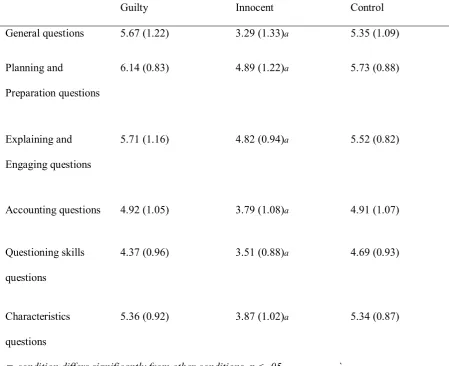
Table 1.
Means and standard deviations of questionnaire per condition.
Guilty Innocent Control
General questions 5.67 (1.22) 3.29 (1.33)a 5.35 (1.09)
Planning and
Preparation questions
6.14 (0.83) 4.89 (1.22)a 5.73 (0.88)
Explaining and Engaging questions
5.71 (1.16) 4.82 (0.94)a 5.52 (0.82)
Accounting questions 4.92 (1.05) 3.79 (1.08)a 4.91 (1.07)
Questioning skills questions
4.37 (0.96) 3.51 (0.88)a 4.69 (0.93)
Characteristics questions
5.36 (0.92) 3.87 (1.02)a 5.34 (0.87)
control condition and the informed about guilt condition show a positive evaluation of the
interrogation. No significant difference was found between the informed about guilt condition and the control condition (p > .999).
A one-way analysis of variance showed that there is a significant difference between the conditions (informed about guilt, informed about innocence, control) in average scores on the planning and preparation questions F(2,86) = 11.25, p < .001, ƞ² = 0.21. The post hoc Bonferroni test indicate that the average score on the planning and preparation questionnaire was significantly lower in the informed about innocence condition compared to the informed about guilt condition (p < .001) and the control condition (p = .002). In further support of the hypothesis, it was found that the participants in the informed about innocence condition thought that the interrogator was less prepared and was less capable of planning than the participants in both the informed about guilt and the control condition thought he was. No significant difference was found between the informed about guilt and control condition (p = .24).
account of the events from the suspect as the participants in both the informed about guilt and the control condition thought the interrogator did. In addition, it can be seen that the informed about innocence condition represents a negative evaluation of accounting, whereas the informed about guilt and control condition represent a positive evaluation of accounting. Again, no significant difference was found between the informed about guilt and control condition (p > .999).
For questioning skills, a one-way analysis of variance showed that there is a significant
difference between conditions F(2, 86) = 14.69, p < .001, ƞ² = .26. A post hoc Bonferroni test indicate that the average score on the questioning skills are significantly lower in the informed about innocence condition compared with both the informed about guilt condition (p = .001) and the control condition (p < .001). In further support of the hypothesis, it was found that the participants in the informed about innocence condition evaluated the questioning skills of the interrogator significantly more negative than participants in both the informed about guilt and the control condition. No significant difference was found between the informed about guilt condition and the control condition (p = .33).
For the characteristics of the interrogator, a one-way analysis of variance showed that there is a significant difference between conditions F(2, 86) = 26.43, p < .001, ƞ² = .38. A post hoc Bonferroni test indicate that the average score on the characteristics of the interrogator are significantly lower in the informed about innocence condition compared with both the informed about guilt condition (p < .001) and the control condition (p = < 001). In line with the hypothesis, this shows that the participants in the informed about innocence condition evaluated the characteristics, for example, the
self-confidence of the interrogator, significantly more negative than participants in both the informed about guilt and the control condition. In addition, it can be seen that the informed about innocence condition represents a negative evaluation of interrogator characteristics and the informed about guilt and control condition represent a positive evaluation of interrogator characteristics. No significant difference was found between the control condition and the informed about guilt condition (p > .999).
Exploratory analyses
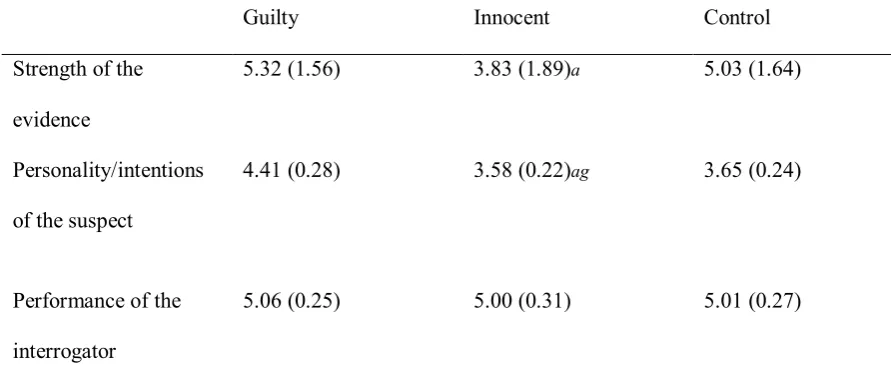
interrogator. Overall people attributed the outcome mostly to the performance of the interrogator (M= 5.03, SD= 1.44), secondly to the strength of the evidence (M= 4.59, SD= 1.84) and the least to the personality/intentions of the suspect (M= 3.79, SD= 1.34). The means and standard deviations of all conditions on the separate items can be found in table 2.
Table 2.
Means and standard deviations of attribution items per condition.
Guilty Innocent Control
Strength of the evidence
5.32 (1.56) 3.83 (1.89)a 5.03 (1.64)
Personality/intentions of the suspect
4.41 (0.28) 3.58 (0.22)ag 3.65 (0.24)
Performance of the interrogator
5.06 (0.25) 5.00 (0.31) 5.01 (0.27)
a = condition differs significantly from other conditions, p < .05
ag = condition differs significantly only from the guilty condition, p <.05
Between group comparisons were performed to examine whether there was a difference between the informed about innocence condition and the informed about guilt condition in attribution of the outcome of the interrogation to the strength of the evidence t(56) = 3.09, p < .003, ƞ² = 0.15. This shows that when participants are informed that the suspect falsely confessed, they attributed the outcome of the interrogation less to the strength of the evidence, than participants who were informed that the suspect was guilty.
An additional independent samples t-test was performed to examine whether there is a
participants who were informed that the suspect was guilty.
A last independent samples t-test was performed to examine whether there is a difference between the informed about innocence condition and the informed about guilt condition in attribution of the outcome of the interrogation to the performance of the interrogator t(56) = -0.13, p = .89. This shows that there is no difference in attributing the outcome to the performance of the interrogator between the participants who were informed that the suspect was guilty and the participants who were informed that the suspect was innocent.
Discussion
Major findings
This study was designed to examine how outcome knowledge impacts assessments of interrogation quality. It was expected and confirmed that the quality of the interrogation and the performance of the interrogator is judged more positively when the interrogation results in a true confession than when it leads to a false confession. In this study, the general questionnaire examined the overall quality of the interrogation and the interrogator. Results show that participants in the informed about guilt condition evaluated the overall quality of the interrogation and the interrogator as better than participants in the informed about innocence condition. Furthermore, participants thought that all the aspects of the interrogation and interrogator that were examined (preparation, planning, engaging, explaining, accounting, questioning skills, interrogator characteristics), were better when they were provided with information beforehand that the suspect was guilty (true confession) or when participants received no information at all, than when information was provided that the suspect was innocent. In addition, the difference between conditions on the general questionnaire, the accounting questionnaire, the questioning skills questionnaire, and the characteristics questionnaire was between positive (above 4) and negative evaluations (below 4).
Bazerman, 2010). In the current study these results are reflected in the fact that participants in the informed about innocence condition evaluated the questioning skills and the characteristics of the interrogator as worse than the other two conditions did. This could be seen as judging the ethical behaviours and characteristics of the interrogator as worse when information was provided that the suspect was innocent. Furthermore, findings suggest that there is an influence of outcome bias on the different parts of the PEACE model, even though the interrogation was a good example of how a PEACE-interrogation should go. This means that people who receive information that the suspect is wrongly accused, might pay less attention to focus on the process of the interrogation, and instead pay too much attention on the bad outcome. This is in line with research of Henriksen and Kaplan (2003) who observed that outcome knowledge is likely to distort our thinking on the quality of a process. In addition, there were no significant differences between not receiving any information about guilt at all and receiving information that the suspect is guilty (informed about guilt condition, control condition). One possible explanation is that participants in the control condition assumed that the suspect was guilty as the suspect confesses to the crime. This could explain that no differences were found between participants who received no information on guilt at all and participants who received information that the suspect was ultimately found guilty.
it leads to a false confession, because then participants mainly attribute the bad outcome to the performance of the interrogator.
Typically, there is a true link between a false confession and a bad interrogator or a bad interrogation. False confessions are often elicited by interrogator performance (Kassin, 2008). This is confirmed by a study from Bedau and Radelet (1987) who found that behavioural missteps of
interrogators are often the cause for false confessions. However, in this study the effect of the true link between a false confession and a bad interrogator was controlled for by confronting participants with the exact same interrogator behaviour. Therefore, the differences between conditions in this study are most likely the result of an outcome bias.
Limitations and Future research
The results of this study cannot test whether the effect of the outcome bias is the same when the suspect does not confess during the interrogation. It could be that the presence of outcome bias in evaluating an interrogation is stronger when the suspect falsely confessed. Therefore, it is possible that a different effect of outcome bias is found on evaluating the quality of a police interrogation when the suspect does not confess and appears not guilty (good outcome), and when the suspect does not confess and appears guilty (bad outcome). This issue is addressed in work in progress on outcome bias (Tukkers, 2018).
Next, the generalizability of this study might be limited. First, since the questionnaire was filled in online, it could not be checked whether the participants watched the video in its entirety. The only thing that could be checked was the amount of time that people spent on the survey. For further research it is therefore advised to set up a control mechanism on the video that is displayed online. This control mechanism can restrict people from skipping through parts of the video to make sure the video is watched in its entirety.
platforms to obtain a more mature population.
In addition, this study made use of an interrogation based on the PEACE-interrogation method. The interrogation was considered an outstanding interrogation (CBC news, 2014). However, when using an example of the REID interrogation method, a different effect of the outcome bias might be found. Based on the results of this study, it is predicted that using the REID method would still lead to a positive evaluation of the quality of the interrogation and interrogator in the condition where
participants are informed that the suspect is guilty. However, it is predicted that the evaluation of the quality of the interrogation and the interrogator will be more negative when no information about guilt is received at all, since it is likely that participants in the control condition base their evaluations more on the content of the interrogation. The study using the REID technique as example could use the same conditions and manipulations as this study used but change the video example to an example of a REIDD interrogation method. Using the REID interrogation technique as an example would be
interesting since this is still a commonly used interrogation technique in the United States. (Buckley,
2000).
Since no significant differences were found between the condition where people were informed about guilty and the condition that received no information about guilt at all, it is advised to alter the information that is provided to the control condition. In future research, information could be provided that the guilt is not established yet, in contrast to not providing any information about guilt at all. When this altered information is given, it could make participants in the control condition less prone to think that the suspect is guilty.
overview of the predictor variables of either a good or bad outcome and transfer these into a linear model or formula. In addition, this study found that switching from system 1 to system 2 could be done by taking an outsiders perspective. Gigerenzer, Hoffrage, and Kleinbölting found that taking an outsiders perspective reduce the overconfidence of decision makers considering their knowledge (as cited in Milkman, Chugh, & Bazerman, 2009). However, studies that apply these strategies to enhance decision making are currently lacking. Future research may therefore profit from creating conditions wherein participants have to switch between cognitive systems before evaluating an interrogation, to see whether the effect of the outcome bias can be diminished.
Conclusions
This study shows that the outcome bias is present in evaluating police interrogations.
References
Andrews, P.W., Haselton, M.G., & Nettle, D. (2005). The evolution of cognitive bias. In D.M. Buss (ED.), Handbook of evolutionary psychology (pp. 724-746). New York: Wiley
Baron, J., & Hershey, J.C. (1988). Outcome bias in decision evaluation. Journal of Personality and Social Psychology, 54, 569-579. doi: 10.1037/0022-3514.54.4.569
Bedau, H.A., & Radelet, M.L. (1987). Miscarriages of Justice in Potentially Capital Cases. Stanford Law Review, 40, 21-179. Retrieved from
https://deathpenalty.procon.org/sourcefiles/hugobedaumichaleredelet.pdf.
Bornstein, B.H., & Emler, A.C. (2001). Rationality in medical decision making: a review of the literature on doctors’ decision-making biases. Journal of Evaluation in Clinical Practice, 7,
97-107. doi: 10.1046/j.1365-2753.2001.00284.x
Buckley, J. (2000). The Reid technique of interviewing and interrogation. in T. Williamson (Ed.), Investigative interviewing: Rights, Research, regulation (pp, 190-206). Devon, Uk: Willan.
Casper, J.D., Benedict, K., & Perry, J.L. (1989). Juror Decision Making, Attitudes, and the Hindsight Bias. Law and Human Behavior, 13, 291-310. doi: 10.1007/BF01067031
CBC News. (2014, September 5). Russel Williams – The Confession – The fifth estate [Video File]. Retrieved from https://www.youtube.com/watch?v=lj7QRP37Wn0&t=1791s
Clarke, C., & Milne, R. (2001). National evaluation of the PEACE investigative interviewing course. Police Research Award Scheme. London: Home Office.
Deslauriers-Varin, N., Lussier, P., & St-Yves, M. (2011). Confessing their Crime: Factors Influencing the Offender’s Decision to Confess to the Police. Justice Quarterly, 28, 113-145. Retrieved from https://corpus.ulaval.ca/jspui/bitstream/20.500.11794/12160/1/Deslauriers-
Fisschof, B. (1975). Hindsight ≠ Foresight: The Effect of Outcome Knowledge on Judgment Under
Uncertainty. Journal of experimental psychology: Human perception and performance, 1, 288-299. doi: 10.1136/qhc.12.4.304
Gigerenzer, G., & Gaissmaier, W. (2011). Heuristic Decision Making. The annual review of psychology, 62, 451-482. doi: 10.1146/annurev-psych-120709-145346
Gilovich. T., Griffin, D., Kahneman, D. (2002). Heuristics and Biases. New York: Cambridge University Press.
Gino, F., Moore, D.A., & Bazerman, M.H. (2009). No harm, no foul: The outcome bias in ethical judgments (Working Paper No, 08-80, Harvard Business School).
Gino, F., Shu, L.L, & Bazerman, M.H. (2010). Nameless + Harmless = Blameless: When Seemingly Irrelevant Factors Influence Judgment of (Un)ethical Behavior. Organizational Behavior and Human Decision Processes, 111, 93-101. doi: 10.1016/j.obhdp.2009.11.001
Gruppen, L.D., Margolin, J., Wisdom, K., & Grum, C.M. (1994). Outcome bias and cognitive dissonance in evaluating treatment decisions. Academic medicine: journal of the Association of American Medical Colleges, 69. doi: 10.1097/00001888-199410000-00042
Gudjonsson, G.H., & Petursson, H. (1991). Custodial interrogation: Why do suspects confess and how does it relate to their crime, attitude and personality?. Personality and Individual Differences 12, 295-306. doi: 10.1016/0191-8869(91)90116-S
Hartwig, M., Granhag, P.A., & Vrij, A. (2005). Police Interrogation from a Social Psychology Perspective. Policing & Society, 15, 379-399. doi: 10.1080/10439460500309956
Hastie, R., & Hawkins, S.A. (1990). Hindsight: Biased judgments of past events after the outcomes are known. Psychological Bulletin, 107, 311-327. doi: 10.1037/0033-2909.107.3.311
https://www.semanticscholar.org/paper/Hindsight-bias%2C-outcome-knowledge-and- adaptive-Henriksen-Kaplan/0541452a25d7bc7feba66e53ed201365a5bc0f46.
Hilbert, M. (2011). Toward a Synthesis of Cognitive Biases: How Noisy Information Processing Can Bias Human Decision Making. Psychological Bulletin, 138, 211-237. doi:
10.1037/a0025940
Jacobs, J., & Jackson, J. (2017). The Routledge Handbook of Criminal Justice Ethics. New York: Routledge.
Kassin, S.M. (2008). False Confessions: Causes, Consequences, and Implications for Reform. Current Directions in Psychological Science, 17, 249-253.
doi:10.1177/2372732214548678
Kassin, S.M., Appleby, S.C., & Perillo, J.T. (2011). Interviewing suspects: Practice, science, and future directions. Legal and Criminological Psychology, 15, 39-55. doi:
10.1348/135532509X449361
Kassin, S.M., Drizin, S.A., Grisso, T., Gudjonsson, G.H., Leo, R.A., & Redlich, A.D. (2009). Police-Induced Confessions: Risk Factors and Recommendations. Law and human behavior, 34. doi: 10.1007/s10979-009-9188-6
Lassiter, G.D. (2010). Videotaped Interrogations and Confessions: What’s Obvious in Hindsight May
not Be in Foresight. Law and human behavior, 34. doi: 10.1007/s10979-009-9202-z.
Mansveld, T. (2018, April 30). Video interrogation (T) [Video File]. Retrieved from https://www.youtube.com/watch?v=HEHcbaToIRU
Martino, B.D., Kumaran, D., Seymour, B., & Dolan, R.J. (2009). Frames, Biases, and Rational Decision-Making in the Human Brain. Science, 313, 684-687. doi:
10.1126/science.1128356
Milkman, K.L., Chugh, D., & Bazerman, M.H. (2009). How Can Decision Making Be Improved?. Perspectives on Psychological Science, 4, 379-383. doi: 10.1111/j.1745-6924.2009. 01142.x
Rosenzweig, P. (2007). Misunderstanding the Nature of Company Performance: The Halo Effect and Other Business Delusions. California Management Review, 49. doi: 10.2307/41166403
Tukkers, B. (2018). Beïnvloedt Uitkomstinformatie de Kwaliteitsbeoordeling van een Politieverhoor? Het Effect van (on)schuld bij een Verhoor Zonder Bekentenis (unpublished bachelor thesis). University of Twente, Enschede.
Walsh, D., & Bull, R. (2015) 'Interviewing suspects: examining the association between skills, questioning, evidence disclosure, and interview outcomes'. Psychology, Crime & Law, 21, 661. doi: 10.1080/1068316X.2015.1028544
Appendix A. Informed consent
Thank you for taking part in this study.
This study examines how people evaluate suspect interrogations. You are going to watch a video clip that shows part of a real police interrogation with a person who is suspected of murder. Next, you will be asked to complete a questionnaire about the interrogation. There are no right or wrong answers to the questions, so please answer these questions truthfully. The study will take approximately 20 minutes to complete.
Appendix B. Manipulation texts
Information general
In January 2010, a young Canadian Woman, Jessica Leal, went missing. During the investigation, the police found distinctive tire tracks next to her house. Hence, the police set up a traffic control in search for matching tires. A few days later, a 46-year old man, Russel Walling, was stopped and it was found that the tires of his car matched the tracks that were found near Jessica’s house. Russel was taken in for interrogation. Although he denied the allegations at first, he eventually confessed to murdering Jessica.
Information before the video – guilty
The police found strong evidence pointing towards his guilt. Shortly after the interrogation, Jessica’s body was found. All evidence at the crime scene subscribed Russel’s involvement.
You will now see a video showing part of the police interrogation with Russel. The video takes 11 minutes. You can pause the video if you must, but it is of utmost importance to watch the entire videoclip. Please watch the video carefully. After watching the video, click ‘→’.
Information after the video – guilty
In accordance with Russel’s confession, the police found strong evidence pointing towards his guilt. Two days after the interrogation, Jessica’s body was found in a park nearby her house. It turned out she was raped and murdered. DNA traces on her body and at the crime scene matched with Russel’s DNA. Further tests revealed that the tire tracks and the footprints outside her house, indeed matched Russel’s car and boots. In addition, his finger prints were found at the backdoor of Jessica’s house and the police found Jessica’s underwear hidden in a drawer in Russel’s house.
Information before the video – Innocent (false confession)
Strikingly, Russel’s confession turned out to be false as Jessica appeared to be alive. A week after the interrogation, Jessica turned up at the police station explaining that she took off for a short while due to personal circumstances. She came back when she found out that the police were looking for her. You will now see a video showing part of the police interrogation with Russel. The video takes about 11 minutes. You can pause the video if you must, but it is of utmost importance to watch the entire videoclip. Please watch the video carefully. After watching the video, click ‘→’.
Information after the video – Innocent (false confession)
Appendix C Questionnaires General questionnaire
Strongly
disagree Disagree Somewhat disagree Neither agree nor disagree
Somewhat
agree agree Strongly agree
1) The interrogation
was of high quality. 1 2 3 4 5 6 7
2) The interrogator did a good job.
1 2 3 4 5 6 7
3) the interrogation
went bad. 1 2 3 4 5 6 7
4) this was a bad example of how an interrogation should be done.
1 2 3 4 5 6 7
5) This interrogation is an example of good police work.
Planning and preparation questionnaire
Strongly
disagree Disagree Somewhat disagree Neither agree nor disagree
Somewhat
agree agree Strongly agree
1) The interrogator was knowledgeable about the case.
1 2 3 4 5 6 7
2) The interrogator prepared well for the interview.
1 2 3 4 5 6 7
3) the interrogator knew what he was doing.
Engaging and explaining questionnaire
1 2 3 4 5 6 7
Strongly
disagree Disagree Somewhat disagree Neither agree nor disagree
Somewhat
agree agree Strongly agree
1) The interrogator could explain the purpose of the interview clearly.
1 2 3 4 5 6 7
2) The interviewer could explain the purpose of the interview professionally.
1 2 3 4 5 6 7
3) The interrogator was successful in bonding socially with the suspect.
1 2 3 4 5 6 7
4) The interviewer explained that the interview is an opportunity for the suspect to give his account.
Accounting questionnaire
Strongly
disagree Disagree Somewhat disagree Neither agree nor disagree
Somewhat
agree agree Strongly agree
1) The interrogator failed to explore new information.
1 2 3 4 5 6 7
2) The interrogator asked inappropriate questions.
1 2 3 4 5 6 7
3) the interrogator encouraged the
suspect to give his own version of events.
1 2 3 4 5 6 7
4) The interview followed a logical structure.
Questioning skills questionnaire
Strongly disagree
Disagree Somewhat disagree Neither agree nor disagree Somewhat agree
agree Strongly agree 1) The interrogator inappropriately interrupted the suspect.
1 2 3 4 5 6 7
2) The interrogator asked suggestive questions (questions that already imply what answer is expected, therefore influencing the suspect).
1 2 3 4 5 6 7
3) the interrogator made good use of open-ended questions.
1 2 3 4 5 6 7
4) The interviewer made good use of closed-ended questions.
1 2 3 4 5 6 7
5) The interrogator talked too much.
Interrogator characteristics questionnaire
Strongly disagree
Disagree Somewhat disagree Neither agree nor disagree Somewhat agree
agree Strongly agree 1) The interrogator showed self-confidence.
1 2 3 4 5 6 7
2) The interrogator was open-minded.
1 2 3 4 5 6 7
3) the interrogator was
inflexible.
1 2 3 4 5 6 7
4) The interrogator did not respond to new information.
1 2 3 4 5 6 7
5) The interrogator attentively listened to the suspect.
Attribution questionnaire
6) I think the outcome of the interrogation will mainly be due to the strength of the evidence.
1 2 3 4 5 6 7
7) I think the outcome of the interrogation will mainly be due to the performance of the interrogator
1 2 3 4 5 6 7
8). I think the outcome of the interrogation will mainly be due to the personality/intentions of the suspect.