SAFE DISCHARGE
RESEARCH QUESTION
“To what extent are health status factors during hospital stay predictors for safe discharge after esophagectomy in esophageal cancer patients?”
Student
Evita Bartels (s1590324)
First supervisor
Prof. Dr. S. Siesling
Second supervisor A. Lenferink
Supervisor ZGT
Dr. E.A. Kouwenhoven
UNIVERSITY OF TWENTE, ZGT ALMELO1
Table of contents
Abstract ... 1
Introduction ... 1
Patients and methods ... 2
Outcome measures ... 3
Statistical analysis ... 4
Results ... 4
Discussion ... 8
Conclusion ... 10
Appendix 1: References ... 11
Appendix 2: Codebook variables Access form ... 13
Algemeen ... 13
Standaard parameters ... 13
Dagelijkse parameters ... 14
Post-operatieve complicaties ... 14
Heropname... 17
Appendix 3: American Society of Anaesthesiologists’ (ASA) Physical Status Classification ... 18
1
Abstract
Background: The main curative treatment for patients with esophageal cancer is esophagectomy. Currently, the median perioperative hospital stay after esophagectomy is twelve days in the Netherlands. Fast track surgery (FTS) focusses on optimizing perioperative care, with the aim to enhance recovery, reduce morbidity and mortality rates, and decrease the length of hospital stay after major surgery. Implementing the FTS protocol should be done with high regard for safety, preferably based on factors predicting safe discharge.
Objective. Identifying predictors during hospital stay for safe discharge after esophagectomy in esophageal cancer patients.
Design. Quantitative retrospective.
Population. The study population contains esophageal cancer patients who underwent an esophagectomy in the Ziekenhuisgroep Twente (ZGT) Almelo from November 2013 to March 2017.
Method. Data is extracted from the Dutch Upper GI Cancer Audit (DUCA) database, databases composed for former research within the ZGT, and in the Electronic Patient Record (EPR) from 124 patients. To combine the data an Access form was developed. After data input, data was analyzed by SPSS Statistics 24. First, univariate analyses were performed, followed by a logistic regression.
Results. Logistic regression showed significant differences between groups based on body temperature on day three, heart rate on day thirteen and a lower blood pressure from day eleven to twelve.
Conclusion. Three health status factors have shown significant association with safe discharge. These are a lower body temperature on day three, a lower heart rate on day thirteen, and a drop in lower blood pressure from day eleven to day twelve.
Introduction
In the Netherlands, esophageal and cardia cancer are listed as the eighth most common cancer encountered among men, with a percentage of 3.7 (1). In 2016, the prevalence of esophageal cancer was 5234 in the Netherlands (2). The diagnosis esophageal cancer was given 2545 times, from which 72 percent were men (3). Being diagnosed with esophageal cancer leads to death within five years for 81 percent of the patients in the Netherlands (4).
Treatments of cancer can either have a curative or palliative focus. In sixty to seventy percent of the esophageal cancer cases, distant metastases are already present by the time symptoms and signs appear, which means palliative treatment is the only option left (5,6). There are three types of treatment possible at this stage: radiotherapy, endoprothesis placement and chemotherapy. All three options focus on
suppressing the tumor growth and alleviation of complaints.
2
cervical anastomosis (McKeown) (7). Esophagectomy is often executed in combination with chemoradiotherapy to increase the probability of success (5,6).
Currently, the median perioperative hospital stay after esophagectomy is twelve days in the Netherlands (8). Fast track surgery (FTS) focusses on optimizing perioperative care (9,10), with the aim to enhance recovery, reduce morbidity and mortality rates, and decrease the length of hospital stay after major surgery (11). Previously conducted research has shown that the average length of hospital stay can be reduced from twelve to eight days by implementing the fast track surgery protocol (12).
In order to support the safety of the fast track protocol, safe discharge criteria are important. Using these criteria aims to prevent complications caused by too early discharge. There is no information
available for discharge criteria after esophagectomy in the national guideline (13). It remains, therefore, unclear at which admission day and under which health circumstances the discharge after esophagectomy is safe and the most optimal. This research contributed to determining safe discharge criteria for the fast track protocol, by identifying which health status factors are predictors for safe discharge. When referring to “health status”, the following definition will be used: “Level of health of an individual person, a group, or a population as assessed by that individual or by objective measures” (14). These health status factors in this
research are among others patient’s body temperature, blood pressure, and mobility. Former research has showed that postoperative complications are associated with a high American Society of Anaesthesiology (ASA) rating, presence of comorbidity, old age (over 75 years old), black race, congestive heart failure, coronary artery disease, peripheral vascular disease, hypertension, insulin-dependent diabetes, smoking status, and steroid use (8,15). The ASA rate is a way to classify the physical status of the patient. An ASA rate of I is attributed to a normal healthy patient, while an ASA rate of VI is attributed to a declared brain-dead patient (16). The ASA rate per stage is outlined in Appendix 3.
The research question examined during this research is as follows: “To what extent are health
status factors during hospital stay predictors for safe discharge after esophagectomy in esophageal cancer patients?”
Patients and methods
The research was conducted at the surgery department in the ZGT Almelo. The ZGT is planning on implementing a fast track protocol for patients who underwent esophagectomy. The study population contains patients who underwent an esophagectomy in the ZGT Almelo from November 2013 to March 2017. Patients who died in hospital before discharge are excluded from the analyses.
3
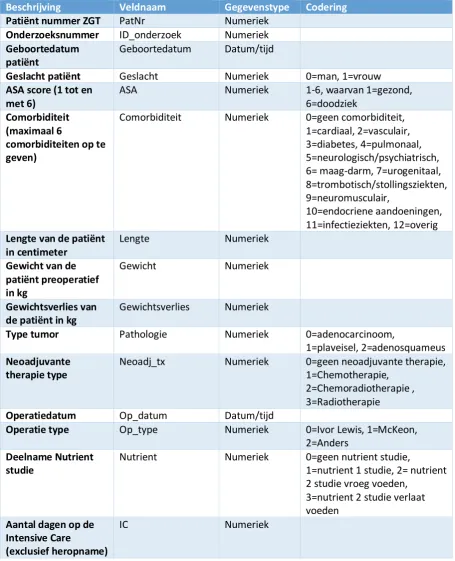
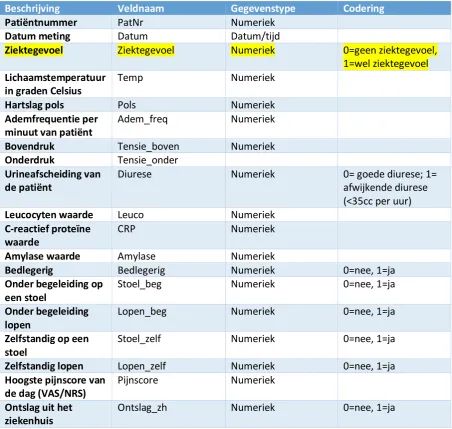
(day 0) to the day of discharge. In case a patient was in the hospital for more than fourteen days, daily parameters were documented until day fourteen. The discharge date was noted so that the total amount of days spent in the hospital could be calculated. Besides that, patients who were in the hospital for more than 14 days were not included in the analyses concerning the last day of hospital stay. An overview of all the variables and their documentation can be found in Appendix 2.
Outcome measures
Safe discharge was determined based on readmission or death within thirty days after discharge. Safe discharge covers patients without any readmission as well as patients who were readmitted with a Clavien-Dindo classification of I or II. Readmission classified with a Clavien-Clavien-Dindo of III or higher, including death of the patient, was determined as unsafe discharge.
The documented variables can be separated into baseline characteristics, daily parameters, and readmission data. Examples of baseline characteristics are gender, body mass index (BMI), age, operation date and ASA score. Daily parameters documented are among others body temperature, heart rate, and blood values such as leucocytes and C-reactive protein (CRP). The readmission data contains for example information about the date of readmission, its reason and the corresponding Clavien-Dindo score. A total overview of all variables and their documentation manners is shown in Appendix 2.
In addition to these variables, new variables were created. From all patients who were in the hospital for a maximum of fourteen days after surgery, the last day was identified and variables were analyzed. The same was done for the day before discharge, two days before discharge and three days before discharge. Besides that, new variables were created to be able to analyze the influence of daily variation. The rise or drop of all continuous variables was identified by creating a variable showing this variation. For example, the body temperature on day three was subtracted from the body temperature on day four and formed into a new variable. The same was done to identify the variation between the last day of hospital stay and the first day after surgery. For example, the heart rate on day one was subtracted from the heart rate on the last day of hospital stay. Last variables created concerned the variation between the day before discharge and the first day after surgery. For example, the upper blood pressure on day one was subtracted from the upper blood pressure on the day before discharge.
In order to answer the research question, several analyses are conducted. First, it was important to gain insight into the average length of hospital stay in the current situation. Second, gaining insight into the percentage of patients readmitted within thirty days after discharge was relevant to support the outcomes. It was also relevant to know the percentage of patients who died within thirty days after discharge. This information could be used to split the population into the safe and unsafe discharge groups. In addition, an overview of the reasons for these readmissions and deaths had to be made. Combining results from these analyses could lead to an overview of health status factors associated with safe discharge.
4
(17). The first nutrient study only contained patients who started oral intake directly following esophagectomy. However, the follow-up study, called Nutrient 2, contains patients within the early nutrition group as well as a group of patients following the conventional protocol.
The p-value used to determine significance is five percent. All variables which showed a two-tailed significance or two-sided asymptotic significance level of five percent or lower were considered as variant between the safe and unsafe discharge group.
Statistical analysis
The study population was divided into two groups, a group which was discharged safely and a group which was not. During the research, data collected from DUCA and the EPR was analyzed to identify which variables are associated with safe discharge. Data was analyzed using SPSS (Statistics 24), comparing two unpaired groups.
First, univariate tests were conducted to determine which variables are associated with safe discharge. Categorical variables were analyzed using the Chi-square test. These variables were gender, ASA score, comorbidity, surgery type, nutrient study participation, malaise, diuretic, mobility, and pain score. Continuous variables with a normal distribution were analyzed using the Student T-test. Normally distributed variables were age, BMI, body temperature, upper blood pressure, lower blood pressure and the leucocytes level. Not normal distributed continuous variables were analyzed using a Mann-Whitney U test. These variables were the length of hospital stay, weight loss, the number of days in intensive care, heart rate, respiratory rate, C-reactive protein (CRP) level and amylase level. In order to determine which variables needed to be included in the logistic regression, a significance level of five percent was used.
Second, a logistic regression (forward selection) was conducted on the variables with a significant difference within the univariate analyses, to determine the strength of association with safe discharge of these variables. During logistic regression, a significance level of five percent was used.
Results
5
[image:7.595.74.529.216.767.2]Within the Nutrient study, the early (21 patients (77.8%)) versus delayed (6 patients (22.2%)) nutrition analysis was made because the patients in the first Nutrient study followed the same nutrition protocol as part of the patients in the Nutrient 2 study (17). The other part of the patients in the Nutrient 2 study received nutrition following the conventional, delayed nutrition protocol. However, no significant differences (Pearson Chi-Square: 0.62) were found between the early and delayed nutrition groups. Within the early nutrition group, 19 patients (90.5%) were discharged safely. Within the delayed nutrition group, 5 patients were discharged safely (83.3%).
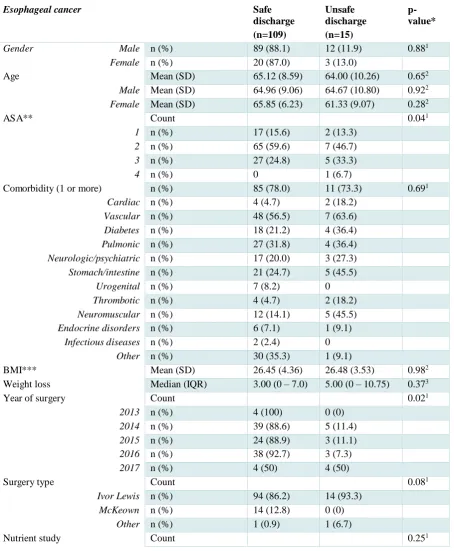
Table 1: Baseline characteristics
Esophageal cancer Safe
discharge (n=109)
Unsafe discharge (n=15)
p-value*
Gender Male n (%) 89 (88.1) 12 (11.9) 0.881
Female n (%) 20 (87.0) 3 (13.0)
Age Mean (SD) 65.12 (8.59) 64.00 (10.26) 0.652
Male Mean (SD) 64.96 (9.06) 64.67 (10.80) 0.922
Female Mean (SD) 65.85 (6.23) 61.33 (9.07) 0.282
ASA** Count 0.041
1 n (%) 17 (15.6) 2 (13.3)
2 n (%) 65 (59.6) 7 (46.7)
3 n (%) 27 (24.8) 5 (33.3)
4 n (%) 0 1 (6.7)
Comorbidity (1 or more) n (%) 85 (78.0) 11 (73.3) 0.691
Cardiac n (%) 4 (4.7) 2 (18.2)
Vascular n (%) 48 (56.5) 7 (63.6)
Diabetes n (%) 18 (21.2) 4 (36.4)
Pulmonic n (%) 27 (31.8) 4 (36.4)
Neurologic/psychiatric n (%) 17 (20.0) 3 (27.3)
Stomach/intestine n (%) 21 (24.7) 5 (45.5)
Urogenital n (%) 7 (8.2) 0
Thrombotic n (%) 4 (4.7) 2 (18.2)
Neuromuscular n (%) 12 (14.1) 5 (45.5)
Endocrine disorders n (%) 6 (7.1) 1 (9.1)
Infectious diseases n (%) 2 (2.4) 0
Other n (%) 30 (35.3) 1 (9.1)
BMI*** Mean (SD) 26.45 (4.36) 26.48 (3.53) 0.982
Weight loss Median (IQR) 3.00 (0 – 7.0) 5.00 (0 – 10.75) 0.373
Year of surgery Count 0.021
2013 n (%) 4 (100) 0 (0)
2014 n (%) 39 (88.6) 5 (11.4)
2015 n (%) 24 (88.9) 3 (11.1)
2016 n (%) 38 (92.7) 3 (7.3)
2017 n (%) 4 (50) 4 (50)
Surgery type Count 0.081
Ivor Lewis n (%) 94 (86.2) 14 (93.3)
McKeown n (%) 14 (12.8) 0 (0)
Other n (%) 1 (0.9) 1 (6.7)
6
1 – early nutrition n (%) 12 (11.0) 0
2 – early nutrition n (%) 7 (6.4) 2 (13.3)
2 – delayed nutrition n (%) 5 (4.6) 1 (6.7)
Days on intensive care Median (IQR) 1 (1 – 3) 1 (1 – 3) 0.413
Hospital stay (in days) Median (IQR) 11 (9 - 19) 11 (8 - 24) 0.913
Complication (1 or more) n (%) 67 (61.5) 14 (93.3) 0.021
Complication (1 or more) during primary hospital stay
n (%) 13 (24.5) 6 (85.7) 0.001
Readmission n (%) 11 (10.1) 15 (100) 0.001
Readmission due to complication****
n (%) 7 (70.0) 14 (93.3) 0.121
Grade I n 7 0
Grade II n 2 0
Grade III n 2 10
Grade IV n 0 4
Grade V n 0 1
Readmission day (after discharge) Median (IQR) 7 (4 – 65) 5 (2 – 15) 0.243
Readmission within 30 days n (%) 8 (7.3) 15 (100) 0.031
Mortality n (%) 24 (22.0) 2 (13.3) 0.351
30 days’ mortality (after discharge)
n (%) 0 1 (6.7)
* Performed analyses differed, depending on categorical/continuous variables and the distribution.
1 Chi-square test was performed, asymptotic significance (2-sided) of the Pearson Chi-Square is shown. 2 Student T-test was performed, significance (2-tailed) is shown.
3 Mann-Whitney U test was performed, asymptotic significance (2-sided) is shown.
** American Society of Anaesthesiologists score *** Body Mass Index
**** Readmission at any time, not limited to the thirty days after discharge
After analyzing the baseline characteristics of both groups, univariate analyses were performed to assess the influence of health status factors on the dependent variable safe discharge. All variables were tested on a relation between the variable and safe discharge. Categorical variables were tested by a Chi-square test, normally distributed continuous variables by a Student T -Test and not normally distributed continuous variables by a Mann-Whitney U test. In Table 2, only variables which showed a significant difference between the safe and unsafe discharge group are noted. From those variables, either a mean and standard deviation, a median and an interquartile range (IQR) or count and percentage are shown. In addition, the significance level is noted for all variables.
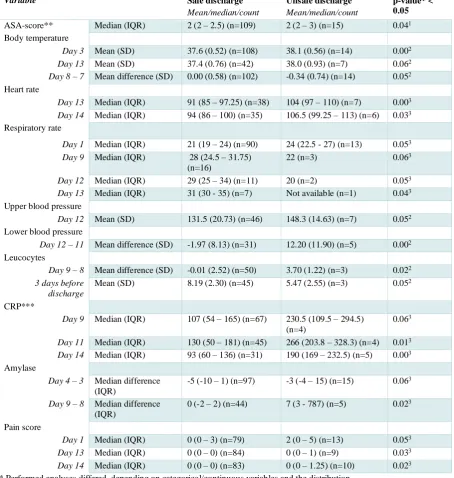
Besides that, all continuous variables were analyzed by differences per day. For example, the variation of body temperature from day one to day two. Significant differences or variables with a borderline significance that were found are shown in Table 2.
7
Table 2: Univariate analyses
Variable Safe discharge
Mean/median/count
Unsafe discharge
Mean/median/count
p-value* < 0.05
ASA-score** Median (IQR) 2 (2 – 2.5) (n=109) 2 (2 – 3) (n=15) 0.041
Body temperature
Day 3 Mean (SD) 37.6 (0.52) (n=108) 38.1 (0.56) (n=14) 0.002 Day 13 Mean (SD) 37.4 (0.76) (n=42) 38.0 (0.93) (n=7) 0.062 Day 8 – 7 Mean difference (SD) 0.00 (0.58) (n=102) -0.34 (0.74) (n=14) 0.052
Heart rate
Day 13 Median (IQR) 91 (85 – 97.25) (n=38) 104 (97 – 110) (n=7) 0.003 Day 14 Median (IQR) 94 (86 – 100) (n=35) 106.5 (99.25 – 113) (n=6) 0.033
Respiratory rate
Day 1 Median (IQR) 21 (19 – 24) (n=90) 24 (22.5 - 27) (n=13) 0.053 Day 9 Median (IQR) 28 (24.5 – 31.75)
(n=16)
22 (n=3) 0.063
Day 12 Median (IQR) 29 (25 – 34) (n=11) 20 (n=2) 0.053 Day 13 Median (IQR) 31 (30 - 35) (n=7) Not available (n=1) 0.043
Upper blood pressure
Day 12 Mean (SD) 131.5 (20.73) (n=46) 148.3 (14.63) (n=7) 0.052
Lower blood pressure
Day 12 – 11 Mean difference (SD) -1.97 (8.13) (n=31) 12.20 (11.90) (n=5) 0.002
Leucocytes
Day 9 – 8 Mean difference (SD) -0.01 (2.52) (n=50) 3.70 (1.22) (n=3) 0.022 3 days before
discharge
Mean (SD) 8.19 (2.30) (n=45) 5.47 (2.55) (n=3) 0.052
CRP***
Day 9 Median (IQR) 107 (54 – 165) (n=67) 230.5 (109.5 – 294.5) (n=4)
0.063
Day 11 Median (IQR) 130 (50 – 181) (n=45) 266 (203.8 – 328.3) (n=4) 0.013 Day 14 Median (IQR) 93 (60 – 136) (n=31) 190 (169 – 232.5) (n=5) 0.003
Amylase
Day 4 – 3 Median difference (IQR)
-5 (-10 – 1) (n=97) -3 (-4 – 15) (n=15) 0.063
Day 9 – 8 Median difference (IQR)
0 (-2 – 2) (n=44) 7 (3 - 787) (n=5) 0.023
Pain score
Day 1 Median (IQR) 0 (0 – 3) (n=79) 2 (0 – 5) (n=13) 0.053 Day 13 Median (IQR) 0 (0 – 0) (n=84) 0 (0 – 1) (n=9) 0.033 Day 14 Median (IQR) 0 (0 – 0) (n=83) 0 (0 – 1.25) (n=10) 0.023
* Performed analyses differed, depending on categorical/continuous variables and the distribution.
1 Chi-square test was performed, asymptotic significance (2-sided) of the Pearson Chi-Square is shown. 2 Student T-test was performed, significance (2-tailed) is shown.
3 Mann-Whitney U test was performed, asymptotic significance (2-sided) is shown.
** American Society of Anaesthesiologists score *** C-reactive protein
First, results of univariate analyses were scanned on striking results. It is important to point out that some populations are very small. Therefore, it is chosen to exclude variables wherein one of the groups contain less than five patients.
8
temperature and heart rate on day thirteen. A significant correlation of 0,332 was found between body temperature and heart rate. Since this correlation is small, it was decided that the variables were fit to analyze them within the same logistic regression model.
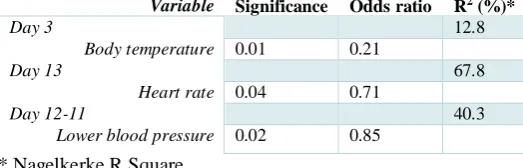
Third, logistic regression (forward selection) was conducted per day, containing the significant variables of that day. Table 3 shows the significance level, odds ratio (OR), and Nagelkerke R Square (R2).
The odds ratio is the exponential function of the regression coefficient associated with a one -unit increase in the exposure (18). The R2 shows the proportion of variance in the dependent variable associated with the
predictor (independent) variables (19). The higher the percentage, the stronger the prediction.
There were no significant variables found within the univariate analyses on day two, neither on day four to eleven. The logistic regression conducted for day one contained the variables respiratory rate and pain score. These variables did not show a significant influence on safe discharge. The only variable that showed a significant difference within the univariate analyses on day three was body temperature. The logistic regression model showed that the R2 of this variable is 12.8%. Similar to day three, the logistic
regression for day twelve contained one variable, upper blood pressure. The R2 of this variable is 67.8%.
Day thirteen showed three variables suitable for logistic regression: body temperature, heart rate, and pain score. The model with the highest R2 contained only heart rate, with a percentage of 40.3. The logistic
regression conducted for day fourteen contained heart rate, CRP level, and pain score. No significant influence was found for these variables.
[image:10.595.72.334.500.584.2]Furthermore, the daily variation showed significant differences in the univariate analyses from day seven to eight, and day eleven to twelve. The variation between day seven and eight showed a borderline significant p-value on body temperature. Lower blood pressure was identified as significant for the variation between day eleven and twelve. The R2 showed within this analysis was 40.3%.
Table 3: Logistic regression
Variable Significance Odds ratio R2 (%)*
Day 3 12.8
Body temperature 0.01 0.21
Day 13 67.8
Heart rate 0.04 0.71
Day 12-11 40.3
Lower blood pressure 0.02 0.85 * Nagelkerke R Square
According to the results shown in Table 3, predictors are found on day three, day thirteen and the variation from day eleven to twelve. Comparing these results to the outcomes in Table 2, it can be stated that a lower body temperature on day three is associated with safe discharge. In addition, a lower heart rate on day thirteen is associated with safe discharge. Last, analyses showed that a drop in lower blood pressure from day eleven to day twelve is associated with safe discharge.
Discussion
9
body temperature and heart rate applies that a lower value is associated with safe discharge. In case of lower blood pressure, a decrease is associated with safe discharge.
This research contained 124 esophageal cancer patients, all treated with esophagectomy within the ZGT Almelo. We assume that this group is representative of all the esophageal cancer patients treated with esophagectomy within the ZGT Almelo. However, its external validity is limited, because the gender distribution differs. Nationwide, 72 percent of the esophageal cancer patients are men, which is in contras t to the 81 percent of the database composed within this research (3). The mean age is approximately the same (20). Nevertheless, we expect that further research containing more patients will increase internal as well as external validity. In addition, it is expected that analyzing a larger group of patients will identify more predictors, with higher significance levels.
It is remarkable that the predicting factors differ per day; no variable is significant in more than one day according to the logistic regression. A possible explanation for this is the low number of patients. Strikingly, the median hospital stay was eleven days in both groups, which means the significant
differences showed within the analyses of day thirteen and day eleven to twelve contained only patients who were in the hospital longer than the median. The exact meaning of these results should be explored in further research. In addition, analyses supported the expectations concerning the influence of the ASA score. Earlier conducted research showed that a higher ASA score is associated with postoperative complications (8,15). Our research showed a similar influence of ASA score on safe discharge.
One interesting finding is that no significant differences were found between groups concerning the last day of hospital stay. Neither did the day before discharge or the day before that day show any significant differences. It could thus be suggested that all patients could have been discharged two days earlier. Another important finding was that the variation between day one and the last day also did not show significant differences between groups. Furthermore, the variation between day one and the day before discharge did not show any significant difference.
Another striking outcome is that the percentage of mortality is higher within the safe discharge group (22 vs. 13.3 percent). However, the cause of death is often not related to the esophagectomy, and the thirty days’ mortality is much lower (0 vs. 6.7 percent). Besides that, the average age of women is lower within the unsafe discharge group. These differences are not significant but should be paid attention to in further research.
10
perioperative outcomes for the Ivor-Lewis anastomosis, compared to the McKeown anastomosis (7). The p-value showed within this research is 0.079, which is borderline significant. However, it is unknown where this difference takes place exactly, and which operation type is safer.
There have been several limitations concerning the outcomes of the study. First, the study
population was relatively small. The unsafe discharge group contained fifteen patients, which induced that some analyses could not be conducted, and may have caused lower significance levels. Therefore, no reliable statements could be made, for example, about the influence of respiratory rate on day nine and CRP level on day eleven. The decision was made to exclude the variables with less than five patients in one of the groups, to protect validity and reliability. Nevertheless, these variables can be relevant for further research.
An important recommendation for further research is to increase the number of patients in the analyses. This may increase the number of variables with a significant difference, and therefore, may increase the fit for use of the results. When more variables are found, it is possible to imply those into an applicable prediction model. This model can be used to support the surgeon determining discharge.
Besides that, specifying the complications more on the type and occurring date might give a better insight into safe discharge. By doing this, a better overview can be made which shows the percentage of discharge with already recognized complications versus the unexpected complications. In addition,
analyses can be conducted in which a group without complications during hospital stay can be compared to a group with complications during hospital stay. By doing this, predictors for complications, in general, can be provided.
Conclusion
The research question examined during this study is: “To what extent are health status factors during
hospital stay predictors for safe discharge after esophagectomy in esophageal cancer patients?”
11
Appendix 1: References
1. Nederlandse Kankerregistratie [Internet]. [cited 2017 Mar 1]. Available from: http://www.cijfersoverkanker.nl/
2. Prevalentie | Slokdarm [Internet]. [cited 2017 Mar 1]. Available from: http://www.cijfersoverkanker.nl/selecties/dataset_3/img58a219ef552ea 3. Incidentie | Slokdarm [Internet]. [cited 2017 Mar 1]. Available from:
http://www.cijfersoverkanker.nl/selecties/dataset_2/img58a217aa07cc5 4. Overleving | Slokdarm [Internet]. [cited 2017 Mar 1]. Available from:
http://www.cijfersoverkanker.nl/selecties/dataset_2/img5898a6c90adbd
5. Patienten Informatie Map (PIM) - Slokdarmkanker [Internet]. Almelo; [cited 2017 Feb 27]. Available from: https://www.zgt.nl/media/folders/4906/pim-slokdarmkanker.pdf
6. Bruzzi J, Marom EM, Hofstetter WL, McAleer MF. Chapter 14 - Esophageal Cancer. In: Silverman PM, editor. Oncologic Imaging: A Multidisciplinary Approach [Internet]. Philadelphia: W.B. Saunders; 2012 [cited 2017 Feb 27]. p. 211–30. Available from:
http://www.sciencedirect.com/science/article/pii/B9781437722321000140
7. Zhai C, Liu Y, Li W, Xu T, Yang G, Lu H, et al. A comparison of short-term outcomes between Ivor-Lewis and McKeown minimally invasive esophagectomy. J Thorac Dis. 2015
Dec;7(12):2352–8.
8. DICA jaarrapportage 2013 [Internet]. [cited 2017 Mar 5]. Available from: https://www.dica.nl/jaarrapportage-2013/
9. Blom RLGM, Heijl M van, Bemelman WA, Hollmann MW, Klinkenbijl JHG, Busch ORC, et al. Initial Experiences of an Enhanced Recovery Protocol in Esophageal Surgery. World J Surg. 2013 Oct 1;37(10):2372–8.
10. Findlay JM, Gillies RS, Millo J, Sgromo B, Marshall REK, Maynard ND. Enhanced Recovery for Esophagectomy: A Systematic Review and Evidence-Based Guidelines. Ann Surg. 2014 Mar;259(3):413–31.
11. Chen L, Sun L, Lang Y, Wu J, Yao L, Ning J, et al. Fast-track surgery improves postoperative clinical recovery and cellular and humoral immunity after esophagectomy for esophageal cancer. BMC Cancer. 2016;16:449.
12. Shewale JB, Correa AM, Baker CM, Villafane-Ferriol N, Hofstetter WL, Jordan VS, et al. Impact of a Fast-Track Esophagectomy Protocol on Esophageal Cancer Patient Outcomes and Hospital Charges. Ann Surg. 2015 Jun;261(6):1114–23.
13. Oncoline | SPECIFIEKE PERIOPERATIEVE MAATREGELEN [Internet]. [cited 2017 Mar 14]. Available from: http://www.oncoline.nl/oesofaguscarcinoom
14. health status [Internet]. TheFreeDictionary.com. [cited 2017 Mar 4]. Available from: http://medical-dictionary.thefreedictionary.com/health+status
12 Thoracic Surgery Database risk adjustment model. J Thorac Cardiovasc Surg. 2009
Mar;137(3):587–96.
16. American Society of Anesthesiologists - ASA Physical Status Classification System [Internet]. [cited 2017 Mar 23]. Available from: http://www.asahq.org/resources/clinical-information/asa-physical-status-classification-system
17. Weijs TJ, Nieuwenhuijzen GAP, Ruurda JP, Kouwenhoven EA, Rosman C, Sosef M, et al. Study protocol for the nutritional route in oesophageal resection trial: a single-arm feasibility trial (NUTRIENT trial). BMJ Open. 2014 Jun 1;4(6):e004557.
18. Szumilas M. Explaining Odds Ratios. J Can Acad Child Adolesc Psychiatry. 2010 Aug;19(3):227–9. 19. IBM Knowledge Center [Internet]. [cited 2017 Jun 16]. Available from:
https://www.ibm.com/support/knowledgecenter/en/SSLVMB_23.0.0/spss/tutorials/plum_ger mcr_rsquare.html
20. Cijfers over Kanker I. Incidentie | Slokdarm | 5-jaars leeftijdsklassen [Internet]. [cited 2017 Jun 27]. Available from:
13
Appendix 2: Codebook variables Access form
Algemeen
• 0 = nee • 1 = ja [image:15.595.71.527.203.764.2]• 999 = onbekend
Standaard parameters
Table 3: Baseline characteristicsBeschrijving Veldnaam Gegevenstype Codering
Patiënt nummer ZGT PatNr Numeriek
Onderzoeksnummer ID_onderzoek Numeriek
Geboortedatum patiënt
Geboortedatum Datum/tijd
Geslacht patiënt Geslacht Numeriek 0=man, 1=vrouw
ASA score (1 tot en met 6)
ASA Numeriek 1-6, waarvan 1=gezond,
6=doodziek
Comorbiditeit (maximaal 6
comorbiditeiten op te geven)
Comorbiditeit Numeriek 0=geen comorbiditeit, 1=cardiaal, 2=vasculair, 3=diabetes, 4=pulmonaal, 5=neurologisch/psychiatrisch, 6= maag-darm, 7=urogenitaal, 8=trombotisch/stollingsziekten, 9=neuromusculair,
10=endocriene aandoeningen, 11=infectieziekten, 12=overig
Lengte van de patiënt in centimeter
Lengte Numeriek
Gewicht van de patiënt preoperatief in kg
Gewicht Numeriek
Gewichtsverlies van de patiënt in kg
Gewichtsverlies Numeriek
Type tumor Pathologie Numeriek 0=adenocarcinoom,
1=plaveisel, 2=adenosquameus
Neoadjuvante therapie type
Neoadj_tx Numeriek 0=geen neoadjuvante therapie,
1=Chemotherapie, 2=Chemoradiotherapie , 3=Radiotherapie
Operatiedatum Op_datum Datum/tijd
Operatie type Op_type Numeriek 0=Ivor Lewis, 1=McKeon, 2=Anders
Deelname Nutrient studie
Nutrient Numeriek 0=geen nutrient studie,
1=nutrient 1 studie, 2= nutrient 2 studie vroeg voeden,
3=nutrient 2 studie verlaat voeden
Aantal dagen op de Intensive Care
(exclusief heropname)
14
Datum van ontslag uit het ziekenhuis
Ontslag_zh Datum/tijd
[image:16.595.72.525.138.567.2]Dagelijkse parameters
Table 5: Daily variablesBeschrijving Veldnaam Gegevenstype Codering
Patiëntnummer PatNr Numeriek
Datum meting Datum Datum/tijd
Ziektegevoel Ziektegevoel Numeriek 0=geen ziektegevoel, 1=wel ziektegevoel
Lichaamstemperatuur in graden Celsius
Temp Numeriek
Hartslag pols Pols Numeriek
Ademfrequentie per minuut van patiënt
Adem_freq Numeriek
Bovendruk Tensie_boven Numeriek
Onderdruk Tensie_onder
Urineafscheiding van de patiënt
Diurese Numeriek 0= goede diurese; 1=
afwijkende diurese (<35cc per uur)
Leucocyten waarde Leuco Numeriek
C-reactief proteïne waarde
CRP Numeriek
Amylase waarde Amylase Numeriek
Bedlegerig Bedlegerig Numeriek 0=nee, 1=ja
Onder begeleiding op een stoel
Stoel_beg Numeriek 0=nee, 1=ja
Onder begeleiding lopen
Lopen_beg Numeriek 0=nee, 1=ja
Zelfstandig op een stoel
Stoel_zelf Numeriek 0=nee, 1=ja
Zelfstandig lopen Lopen_zelf Numeriek 0=nee, 1=ja
Hoogste pijnscore van de dag (VAS/NRS)
Pijnscore Numeriek
Ontslag uit het ziekenhuis
Ontslag_zh Numeriek 0=nee, 1=ja
Post-operatieve complicaties
Table 6: Post-operative complicationsBeschrijving Veldnaam Gegevenstype Codering
Aanwezigheid post-operatieve complicatie
Compl Numeriek 0=nee, 1=ja
[image:16.595.70.525.605.771.2]15 complicatie, 7=infectie, 8=wond/diafragma, 9=chyluslekkage, 10=anders Ernst complicatie adhv Clavien-Dindo
Compl_CD Numeriek
Datum van de complicatie
Compl_datum Datum/tijd
Is de patiënt overleden?
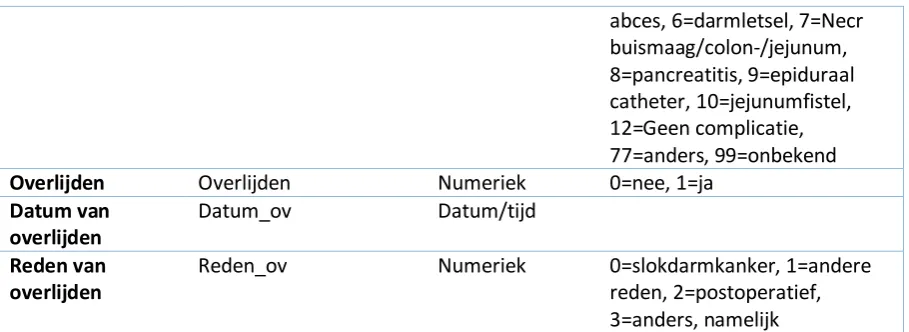
Overlijden Numeriek 0=nee, 1=ja
Datum van overlijden
Datum_ov Datum/tijd
Reden van overlijden
Reden_overlijden Numeriek 0=slokdarmkanker, 1=andere reden, 2=postoperatief, 3=anders, namelijk…
Reden van reinterventie
Reden_reinterventie 1=naadlekkage,
2=chyluslekkage, 3=nabloeding, 4=Fasciedehiscentie / platzbauch, 5=Intra-abominaal abces, 6=darmletsel, 7=Necrose buismaag/colon-/jejunuminterponaat, 8=pancreatitis, 9=Complicatie t.a.v. epiduraal catheter, 10=Complicatie t.a.v. jejunumfistel, 12=Geen complicatie aangetroffen, 77=anders, 99=onbekend Pulmonale complicatie
Compl_pulmonaal Numeriek 1=Pneumonie, 2=Pleura effusie waarvoor extra drainage, 3=Pneumothorax waarvoor behandeling, 4=Atelectase a.g.v. mucus plug waarvoor bronochscopie, 5=Respiratoir falen waarvoor re intubatie, 6=Acute aspiratie, 7=Acute Respiratory Distress Syndrome (ARDS), 8=Treacheo-bronchiaal letsel, 9=Persisterende luchtlekkage waarvoor thoraxdrain Cardiale complicatie
Compl_cardiaal Numeriek 0=Geen, 1= AF, 2=
16 AF+cardiale ischemie, 9= Astma cardiale
Gastrointestinale complicatie
Compl_gastrointestinaal Numeriek 0=geen GI complicatie,
1=lekkage, 2=necrose, 3=ileus, 4=obstructie, 5=jejunumfistel, 6=pyloromyotomie, 7=clostridium difficile, 8=bloeding, 9=vertraagde passage, 10=pancreatitis, 11=lever disfunctie, 12=darmletsel Indien naadlekkage, aard naadlekkage
Aard_naadlekkage Numeriek 0=geen naadlekkage,
1=radiologisch, 2=klinisch, 999=onbekend
Urologische complicatie
Compl_urologisch Numeriek 0=niet urologisch,
1=nierinsuffientie, 2=nierfalen, 3=urineweg infectie, 4=urine retentie
Trombo-embolische complicatie
Compl_trombo Numeriek 0=niet trombo-embolisch,
1=diep veneuze trombose, 2=long embolie, 3=CVA, 4=perifere tromboflebitis
Neurologische complicatie
Compl_neuro Numeriek 0=niet neurologisch, 1=nervus
recurrens, 2=andere
neurologische compl, 3=acuut delier, 4=delerium tremens
Infectueuze complicatie
Compl_infectie Numeriek 0=niet infectie,
1=wondinfectie, 2=centrale lijn inf, 3=intra-thoractaal/intra-abdominaal,
4=gegeneraliseerde sepsis, 5=andere infectie waarvoor antibiotica
Wond complicatie Compl_wond Numeriek 0=niet wond, 1=wonddehiscentie, 2=Fasciedehiscentie / platzbauch / hernia (acuut), 3=hernia diafragmatica (acuut)
Chylus complicatie
Compl_chylus Numeriek 0=niet chylus, 1=type I, 2=type II, 3=type III
Andere soort complicatie
Compl_anders Numeriek 0=niet anders, 1=overige
reoperaties, 2=MODS, 3=nabloeding, 4=epiduraal catheter, 5=anders
Reinterventie Reinterventie Numeriek 0=nee, 1=ja, 999=onbekend
Aard
reinterventie
Aard_reinterventie Numeriek 1=radiologisch,
2=endoscopisch, 3=re-operatie
Reden voor reinterventie
Reden_reinterventie Numeriek 1=naadlek, 2=chyluslek, 3=nabloeding,
4=Fasciedehiscenti
17 abces, 6=darmletsel, 7=Necr buismaag/colon-/jejunum, 8=pancreatitis, 9=epiduraal catheter, 10=jejunumfistel, 12=Geen complicatie, 77=anders, 99=onbekend
Overlijden Overlijden Numeriek 0=nee, 1=ja
Datum van overlijden
Datum_ov Datum/tijd
Reden van overlijden
Reden_ov Numeriek 0=slokdarmkanker, 1=andere
reden, 2=postoperatief, 3=anders, namelijk
[image:19.595.72.527.68.234.2]Heropname
Table 7: Readmission
Beschrijving Veldnaam Gegevenstyp e
Codering
Patiëntnummer ZGT
PatNr Numeriek
Heeft er een heropname plaatsgevonden ?
Heropname Numeriek 0=nee, 1=ja
Datum heropname
Heropname_datum Datum/tijd
Reden heropname
Heropname_reden Numeriek 0=geen complicatie,
1=pulmonale complicatie, 2=cardiale complicatie, 3=gastro-intestinale complicatie, 4=urologische complicatie, 5=trombo-embolische complicatie, 6=neurologische/psychiatrisch e complicatie, 7=infectie, 8=wond/diafragma,
9=chyluslekkage, 10=anders
Heropname gerelateerd aan oesofagectomie
Heropname_gerelateerd Numeriek 0=nee, 1=ja
Ernst van de complicatie bij heropname adhv Clavien-Dindo
Heropname_compl_CD Numeriek
Ontslagdatum bij heropname
Heropname_ontslag_datu m
18
Appendix 3: American Society of Anaesthesiologists’ (ASA) Physical
Status Classification
Table 8: American Society of Anaesthesiologists’ (ASA) Physical Status Classification (16)
ASA PS
Classification
Definition Examples
ASA I A normal healthy
patient
Healthy, non-smoking, no or minimal alcohol use
ASA II A patient with mild
systemic disease
Mild diseases only without substantive functional limitations.
Examples include (but not limited to): current smoker, social
alcohol drinker, pregnancy, obesity (30 < BMI < 40),
well-controlled DM/HTN, mild lung disease
ASA III A patient with
severe systemic
disease
Substantive functional limitations; One or more moderate to
severe diseases. Examples include (but not limited to): poorly
controlled DM or HTN, COPD, morbid obesity (BMI ≥40),
active hepatitis, alcohol dependence or abuse, implanted
pacemaker, moderate reduction of ejection fraction, ESRD
undergoing regularly scheduled dialysis, premature infant PCA
< 60 weeks, history (>3 months) of MI, CVA, TIA, or
CAD/stents.
ASA IV A patient with
severe systemic
disease that is a
constant threat to life
Examples include (but not limited to): recent ( < 3 months) MI,
CVA, TIA, or CAD/stents, ongoing cardiac ischemia or severe
valve dysfunction, severe reduction of ejection fraction, sepsis,
DIC, ARD or ESRD not undergoing regularly scheduled
dialysis
ASA V A moribund patient
who is not expected
to survive without
the operation
Examples include (but not limited to): ruptured
abdominal/thoracic aneurysm, massive trauma, intracranial
bleed with mass effect, ischemic bowel in the face of
significant cardiac pathology or multiple organ/system
dysfunction
ASA VI A declared
brain-dead patient whose
organs are being
removed for donor
purposes
19
Appendix 4: Additional graphs and tables
In order to give an overview of the daily variation of several parameters, additional graphs have been
made. Figure 1 shows the daily body measurements, such as body temperature, heart rate and
respiration rate. Figure 2 shows the upper and lower blood pressure. In Figure 3 the blood values
C-reactive protein and leucocytes level are shown. Figure 1, 2 and 3 are specified by a group with
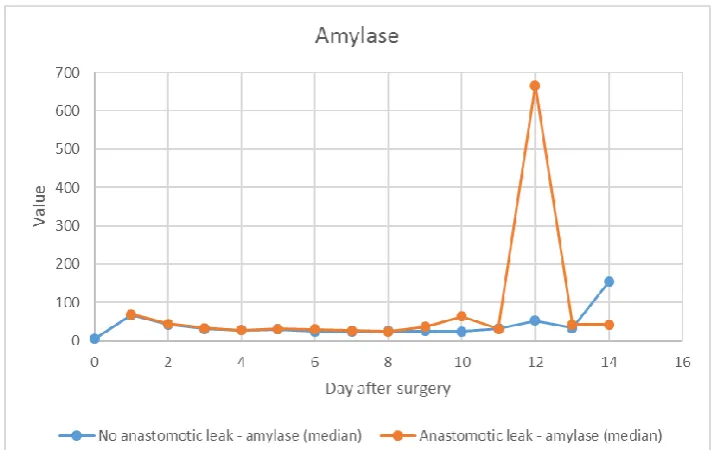
complications and a group without complications. Figure 4 gives an overview of the amylase levels
per day, specified by a group with anastomotic leakage and a group without. This distinction has been
[image:21.595.70.426.229.472.2]made, because the ZGT uses the amylase level to predict and detect anastomotic leakage.
Figure 1: Body measurements (body temperature, heart rate, respiration rate) specified by complication/no complication
[image:21.595.70.425.503.736.2]20
Figure 3: Blood values (leucocytes, C-reactive protein) specified by complication/no complication
Figure 4: Amylase level specified by anastomotic leak/no anastomotic leak
In addition, an overview of the Clavien-Dindo classifications assigned to the complications has been
made. Table 9 shows the complications per group, the assigned Clavien-Dindo classifications and the
[image:22.595.69.429.379.604.2]21 Table 9: Complications and their Clavien-Dindo classifications
*Patients with more than one complication are count for every complication they had. The number of diagnosed complications therefore differs from the number of patients.
Complications Safe
discharge*
Clavien-Dindo Unsafe
discharge
Clavien-Dindo
n* classification n (%) n* classification n (%)
Pulmonary complication 13 1 11 (84.6) 8 1 7 (87.5)
3 2 (15.4) 2 1 (12.5)
Cardiac complication 6 1 3 (50.0) 2 1 1 (50.0)
2 3 (50.0) 5 1 (50.0)
Gastrointestinal complication 5 1 1 (20.0) 13 3 10 (76.9)
2 2 (40.0) 4 3 (23.1)
3 2 (40.0)
Urologic complication 2 1 2 (100) 1 1 1 (100)
Thromboembolic
complication
1 2 1 (100)
Neurologic/psychiatric
complication
2 1 2 (100) 3 1 1 (33.3)
2 1 (33.3)
4 1 (33.3)
Infection 1 2 1 (100)
Wound/diaphragm 2 1 2 (100) 1 3 1 (100)