University of Warwick institutional repository: http://go.warwick.ac.uk/wrap
A Thesis Submitted for the Degree of PhD at the University of Warwick
http://go.warwick.ac.uk/wrap/67055
This thesis is made available online and is protected by original copyright. Please scroll down to view the document itself.
The formation of Black Sea Economic Cooperation
A case study of subregionalism
Panagiota Manoli
Submitted for the degree of Doctor of Philosophy
Department of Politics and International Studies
T ABLE OF CONTENTS List of Tables, Graphs, Appendices
Acknowledgements Page Declaration Abstract Abbrevia tions INTRODUCTION 1. The research agenda 2. A historical perspective
3. Why the Black Sea Economic Cooperation
4. Why the term subregionalism and other definitional clarifications 5. Introducing the analytical framework
6. Issues in research methodology 7. The structure of the dissertation
CHAPTER 1. THEORETICAL PERSPECTIVES
iii IV V vi 1 6 13 15
17
20 241. Introduction 27
2. Conceptualizing international (sub)regions 28
2.1 Defining regions 28
2.2 Defining subregions 32
2.3 Regions and subregions 36
3. A review of the theories of international relations and the regional phenomenon 41 3.1 Traditional theories of international relations and regionalism 41
3.2 The new regionalism approach 52
4. Conceptualizing Europe's subregionalism 54
5. The analytical framework 60
6. Conclusion 67
CHAPTER 2. UNFOLDING BLACK SEA ECONOMIC COOPERATION: ASSESSING NATIONAL PRREFERENCES
1. Introduction
2. BSEC in the literature 3. Leadership's choice
4. Assessing motivations of cooperation
4.1 Turkey's interests and geopolitical considerations 4.2 Russia's considerations vis-A-vis the Black Sea 4.3 Engaging Greece in the BSEC process
4.4 Ukraine: a 'buffer' state
4.5 Between Southeast Europe and the Black Sea: Albania, Bulgaria and
69
7277
81 81 9196
100Romania 102
4.6 Small state policy: Armenia, Azerbaijan, Georgia, Moldova 105
5. Conclusion 109
CHAPTER 3. AN INTERGOVERNMENTAL MODE OF COOPERATION: THE INSTITUTIONAL SETTING
1. Introduction
2. The institutional design 3. Multilevel governance
3.1 BSEC Related Bodies 3.2 Sectoral dialogue 3.3 The substate level
4. Comprehensive regionalism: ambitions and limitations 5. Policy-maki.ng and intergovernmentalism
7. Conclusion
CHAPTER 4. LIMITING INTEGRATION: ECONOMIC DIFFICULTIES AND TRANSNATIONAL DEMANDS
1. Introduction
2. EcononUcconditions
2.1
Economic fragmentation2.2 Economic difficulties
3.
Transnational exchange3.1
Trade barriers and trade regime(s) 3.2 Intra-BSEC trade integration3.3
Redirecting trade to the EU market 3.4 Investment driven integration 4. Organized transnational demands5. BSEC as a means of econonUc cooperation 5.1 A short lived FT A project
6. Conclusion
CHAPTER 5. SUBREGIONALISM WITHOUT LEADERSHIP AND UNDER SECURITY DILEMMA
1. Introduction
2. In search of leadership: ambitions, capabilities and constraints 2.1 The leadership role of Turkey
2.2 Russia: a regional playmaker
2.3 Gteece: a reluctant player
2.4
Ukraine: balancing of power policy 3. Transformation of security dilemma3.1 From polarization to pluralism
3.2 The triangle of rivalry and cooperation
3.3.
Security policy diversification3.4
Traditional and new elements of security dilemma 4. BSEC under security dilemma5. Conclusion
CHAPTER 6. THE IMPACT OF THE EUROPEAN UNION ON BSEC: INTERRELATIONS WITH THE EXTERNAL ANCHOR
1. Introduction
2. BSEC: stepping stone or alternative to the EU?
3. Regional treatment versus differentiation 3.1 Preference for bilateralism
3.2 A Platform for cooperation
4. A case of' regime maker-regime taker'
4.1 A 'soft' power
4.2
Setting the policy agenda4.3 Setting the institutional framework 4.4 Ambivalent influences
Tables Table 3.1 Table 3.2 Table 3.3 Table 3.4 Table 3.5 Table 4.1 Table 4.2 Table 4.3 Table 4.4 Table 4.5 Table 4.6 Table 4.7 Table 4.8 Table 4.9 Table 4.10 Table 4.11 Table 4.12 Table 4.13 Table 4.14 Table 4.15 Table 4.16 Table 4.17 Table 5.1 Table 5.2 Table 5.3 Table 6.1 Table 6.2
Figures
Figure 1.1 Figure 3.1 Figure 3.2 Figure 3.3 Figure 3.4 Figure 4.1 Figure 4.2 Figure 4.3LIST OF TABLES, FIGURES AND ApPENDICES
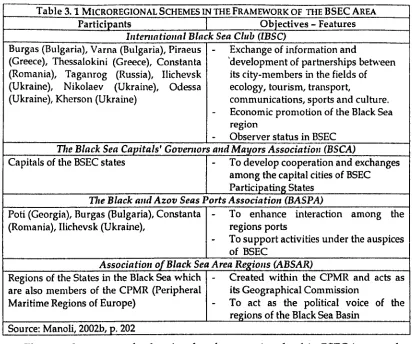
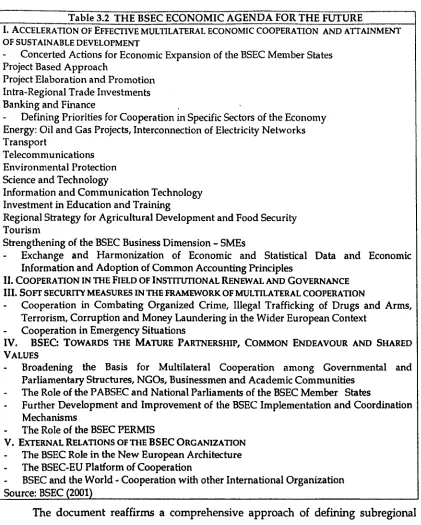
Microregional schemes in the framework of the BSEC area The BSEC Economic Agenda for the Future
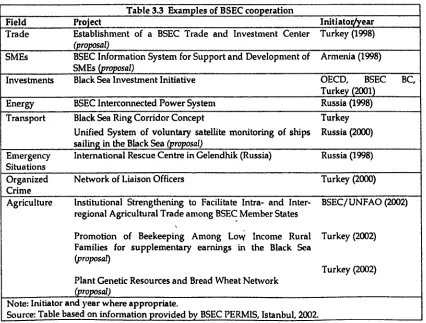
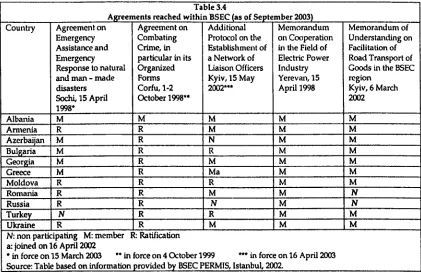
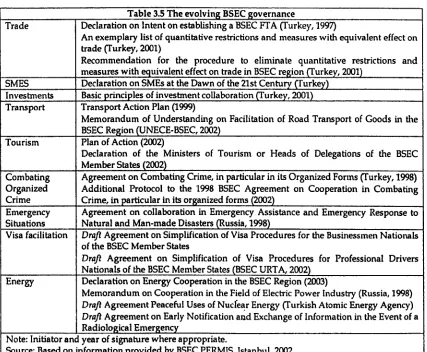
Examples of BSEC cooperation Agreements reached within BSEC The evolving BSEC governance
BSEC Countries in Transition: Indicators of Economic
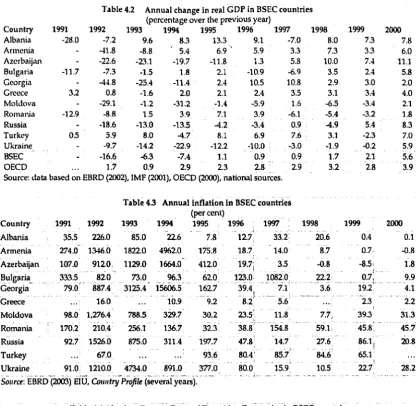
Performance, Liberalization, Democracy and Initial Conditions page 134 146 147 149 156 160 Annual change in real GOP in BSEC countries 164
Annual inflation in BSEC countries 164
Absolute Poverty Rates of Transition Economies in BSEC 164 countries, selected years
Free Trade Agreements among BSEC countries 166
Growth Rates of Intra-BSEC trade, 1991-2000 (percentage of 167 annual change)
Significance of individual countries in Intra-BSEC trade, 1992- 170 2000 (per cent)
Intra - BSEC trade by country, 1991-200 (millions of USO) 171 Share of BSEC trade in the total foreign trade of each BSEC 173 country
Evolution of EU - BSEC trade, 1992 - 2000 (millions of USD) 179 Growth rates of EU -BSEC trade, 1992-2000 (percentage of 179 annual change)
FDI Inflows in BSEC countries, selected year (millions of USO 182 and per cent)
FDI Inflows from EU countries, selected years 182 Turkish FDI in the BSEC region, by host country (2001) 186 FDI in Bulgaria by Foreign Investor Country, selected years 186 FDI in Romania by origin of Foreign Investor, selected years 186 Bilateral Investment Agreements among BSEC countries 187
Key economic indicators of BSEC countries 224
Defence expenditure and size of armed forces of the BSEC 244 countries
List of major conflicts around the Black Sea 258
Agreements between the EU and BSEC states 282
EU assistance to selected BSEC countries 1991-2000 (million 284 Euro)
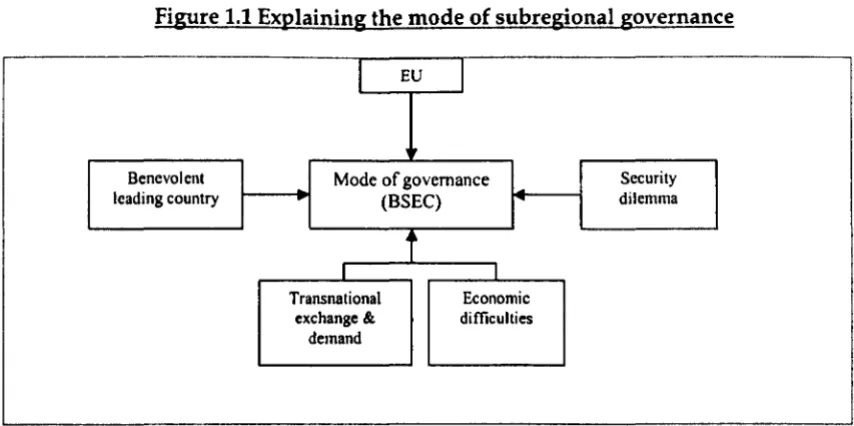
Explaining the mode of subregional governance 68
Black Sea Economic Cooperation 111
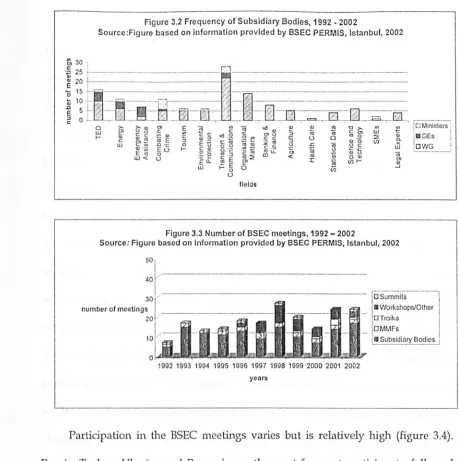
Frequency of Subsidiary Bodies, 1992-2002 120
Number of BSEC meetings, 1992-2002 120
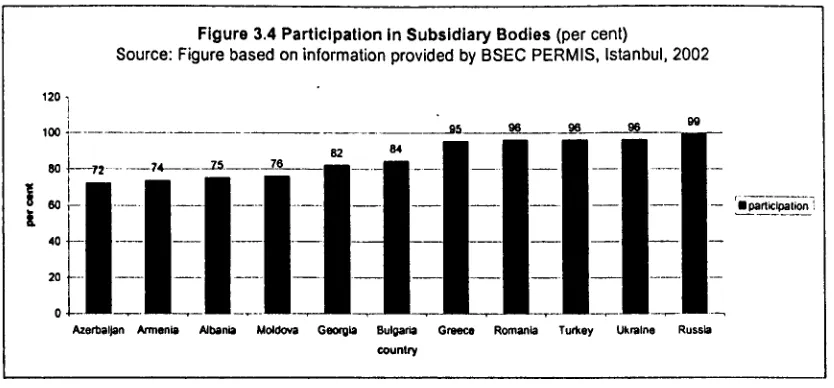
Participation in Subsidiary Bodies 122
Share of each country in intra-BSEC trade, 1994 - 2000 (per cent) 168 Share of BSEC trade in the total foreign trade of each BSEC 176 state, 1994 - 2000 (per cent)
1994 - 2000 (per cent)
Figure 4.4 Evolution of intra-BsEC & EU-BsEC trade, 1992-2000 (millions 180 of US D)
Figure 4.5 Growth rate of intra-BsEC & EU-BSEC trade, 1992-2000 (per 180 cent of annual change)
Appendices
Appendix 4.1 Direction of trade for each BSEC country, 1991 - 2000 208 Appendix 4.2 Share in BSEC - EU trade by country, 1991- 2000 219
ACKNOWLEDGMENTS
This dissertation is the result of several years of research and professional involvement with the Black Sea Economic Cooperation. Special thanks go to all those people that I interviewed for the dissertation at~d to those with whom I have had fruitful discussions and their names are not mentioned.
First, I would like to thank my supervisors. lowe great to Dr. Peter Ferdinand who steadily encouraged me throughout the years, supported and guided my research even during my long absences from the University of Warwick. Dr. Tim Sinclair assisted me greatly in finding my way especially at the early stages when dealing with the theoretical orientation of the dissertation.
My postgraduate studies at the University of Warwick were made possible due to the scholarship provided to me by the Alexandros Onassis Public Benefit Foundation. lowe great to the Foundation's financial assistance and support without which I would have not been able to proceed with pursuing a postgraduate degree.
I consider the Hellenic Foundation for European and Foreign Policy (ELIAMEP) based in Athens as my research home. Mentioning just a few names of the large community of ELIAMEP would not be enough. I have much been benefited by the kind advice and encouragement of Prof. Theodoros Couloumbis, Prof. Yannis VaIinakis and Prof. Thanos Veremis. I am mostly grateful to Dr. Dimitris Triantaphyllou whose opinion both as a friend and an expert has been precious. I would also wish to express my appreciation to Elisabeth Phoca and Dr. Thanos Dokos.
I would like to thank all my colleagues at the PABSEC Secretariat in Istanbul as well as the community of the Department of Politics and International Studies of the University of Warwick, in particular, Lindsay Bull, Eleni Tsingou and Andreas Gofas. I am thankful to Andreas Antoniadis, Evaggelos Areteos, Vasilis Maniatidis, Anna Psilaki, Pat Reynolds, Eugenia Strati, for their friendship and assistance at various stages of my research, and to Bilge Karcilioglu for his constant support.
DECLARATION
ABSTRACf
What are the determinants of the formation of the Black Sea Economic Cooperation (BSEC)? This is the question around which this dissertation evolves. Simple it might be as a question, preoccupation with it aims at disclosing the substance and nature of contemporary subregional cooperation which takes place at the borderlands of Europe.
This dissertation is above all a case study based on empirical research. The object of analysis is the Black Sea Economic Cooperation (BSEC), a cooperative structure tha t emerged in Europe in the early 1990s. Here we do not claim to undertake an area research rather we aim at examining an international political economy phenomenon.
The main conceptual element of this dissertation is that it brings forward the notion of subregionalism. To examine the formation of Black Sea subregionalism we embark on an eclectic theoretical approach and apply an analytical framework of five variables which come both from within the subregional level and outside of it: economic difficulties, transnational demands, leadership, security dilemma and the European Union.
ABSAR APEC BASPA BEAC BlackSeaFor BRASS BSCA BSEC BSECBC BSECURTA BSII BSTDB CARDS CBSS CEFTA CEI CEPS CIS CMEA DEIK EBRD EC ECO EFTA ELIAMEP EU FDI FTA FYROM GATT GDP GE GUUAM HCNM IBSC ICBSS INOGATE IPE ISS KNK NAFTA NATO NGOs NIS ABBREVIATIONS Association of Black Sea Area Regions Asia Pacific Economic Cooperation Black and Azov Seas Ports Association Barents Euro-Atlantic Council
Black Sea Naval Cooperation Task Group
Black Sea Region Association of Shipbuilders and Shiprepairers Association of Black Sea Capitals
Black Sea Economic Cooperation
Black Sea Economic Cooperation Business Council Union of Road Transport Associations of BSEC Black Sea Investment Initiative
Black Sea Trade and Development Bank
Community Assistance for Association, Democratization and Stabilization
Council of Baltic Sea States
Central European Free Trade Agreement Central European Initiative
Center for European Policy Studies Commonwealth of Independent States Council of Mutual Economic Assistance Foreign Economic Relations Board
European Bank for Reconstruction and Development European Commission
Economic Cooperation Organization European Free Trade Association
Hellenic Foundation for European and Foreign Policy European Union
Foreign Direct Investment Free Trade Agreement
Former Yugoslav Republic of Macedonia General Agreement on Trade and Tariffs Gross Domestic Product
Group of Experts
Georgia, Ukraine, Uzbekistan, Azerbaijan, Moldova High Commissioner for National Minorities
International Black Sea Club
International Center for Black Sea Studies Interstate Oil and Gas Transport to Europe International Political Economy
Institute for Security Studies
Confederation of Peoples of the Caucasus North American Free Trade Area
North Atlantic Treaty Organization Non Governmental Organizations . Newly Independent States
OECD OSCE PABSEC PERMIS PfP PHARE RIIA SAPARD SEC! SME TACIS TAD TRACECA UCPTE UN UNCTAD UNECE UNFAO WEU WG WIDER WNIS WTO
Organization for Economic Cooperation and Development Organization for Security and Cooperation in Europe
Parliamentary Assembly of the Black Sea Economic Cooperation Permanent International Secretariat
Partnership for Peace
Poland/Hungary: Assistance for Restructuring Economies Royal Institute of International Affairs
Special Accession Program for Agriculture and Rural Development Southeast European Cooperative Initiative
Small and Medium Sized Enterprises
Technical Assistance for the Commonwealth of Independent States Territoires Ammenagement Developpement
Transport Corridor Europe Caucasus Central Asia
Union for Power Production and Transport Coordination United Nations
United Nations Conference on Trade and Development United Nations Economic Commission for Europe United Nations Food and Agriculture Organization Western European Union
Working Group
World Institute for Development Economics Research Western Newly Independent States
World Trade Organization
INTRODUCTION
This dissertation is primarily an empirical study. The research object is the Black Sea Economic Cooperation (BSEC) whose foundations lie in the Istanbul Declaration of 25 June 1992 signed by the following eleven states: Albania, Armenia, Azerbaijan, Bulgaria, Georgia, Greece, Moldova, Romania, Russia, Turkey and Ukraine.
The purpose of this dissertation is twofold. First, to fill a gap in the empirical literature on contemporary regionalism by undertaking systematic research on a largely ignored subregional structure. Second, to contribute to the ongoing theoretical debate within the international relations discipline over the issue of regionalism by advancing the conceptualization of one type of regionalism: subregional cooperation.
Above all this dissertation examines the story of Black Sea subregionalism and in doing so, reveals what is significant here. The basic concern of the research is to disclose how the formation of BSEC has evolved since its conceptualization and what has been driving and conditioning the BSEC process.
1. The research agenda An introduction to BSEC
regional initiatives and international organizations and financial institutions" (preamble, para. 9). Economic cooperation is seen as "a contribution to the achievement of a higher degree of integration of the Founding Members into the world economy" (preamble, para. 10). Although an economic organization, BSEC's aims go far beyond purely economic goals to "turning the BSEC Region into one of peace, stability and prosperity" (preamble, para. 11). Furthermore, it does not represent a design and implementation of a set of preferential policies within the group of countries it includes, although it aims at the encouragement of the exchange of goods between them.
Hence, the philosophy upon which BSEC is built is based on the principle of 'stability and peace through prosperity'. Regional economic cooperation was thus perceived by the founding members as a stimulus for regional security and political stability and it was based on three motivations: cooperation rather than conflict; regionalism as a step to global integration and avoiding new division in Europe (Adams et al., 2002).
The principles and objectives to be promoted by the organization are specified as follows (BSEC, 1998a, article 3):
a) to act in a spirit of friendship and good neighbourliness and enhance mutual respect and confidence, dialogue and cooperation among the Member States;
b) to further develop and diversify bilateral and multilateral cooperation on the basis of the principles and rule of international law;
d) to develop economic collaboration in a manner not contravening the international obligations of the Member States including those deriving their membership to international organizations or institutions of an integrative or other nature and not preventing the promotion of their relations with third parties;
e) to take into account the specific economic conditions and interests of the Member States involved;
f) to further encourage the participation in the BSEC process of economic cooperation of other interested states, international economic and financial institutions as well as enterprises and companies.
In line with the above principles and objectives, BSEC's focus of activities is on the following fields: trade and economic development; banking and finance; communications; energy; transport; agriculture and agro-industry; health care and pharmaceuticals; environmental protection; tourism; science and technology; exchange of statistical data and economic information; collaboration between customs and other border authorities; human contacts; combating organized crime; illicit trafficking of drugs, weapons and radioactive materials, all acts of terrorism and illegal migration (BSEC, 1998a, article 4).
Conceived in 1990 as a flexible economic cooperation scheme originally among four Black Sea coastal states (Turkey, Romania, Bulgaria and the former Soviet Union), BSEC was soon transformed into an intergovernmental bureaucratic structure of eleven states stretching .beyond the Black Sea itself.! It covers an area of
1 Iran, FYROM, Serbia and Montenegro and Uzbekistan have put forward their applications
nearly 20 million sq. km expanding in two continents and has a market of 300 million people.2 Although it remains a primarily intergovernmental organization, it has
established a web of institutions at the parliamentary, local government, business, academic and financial level.
BSEC's regional identity has been contested. Starting with its membership it presents great asymmetry in terms of economic development, security concerns, political power, culture and religion, size and population and affiliation to international organizations. Historical developments have left each country at a different level of economic development. Geographical proximity, though contested, as in the case of Albania's membership, is a criterion for classing the countries as a group, but it is not a sufficient explanation for regional cooperation. Actual political and economic integration is difficult to trace throughout the BSEC-wide area. One might claim that there is a type of security community in terms of the interlink of security problems in the area but this is far from arguing that there is a common threat perception. Given the economic and political fragmentation of the BSEC space and the complex security problems among its members (almost all its members have bilateral security problems with some of them being technically in a state of war e.g. Armenia-Azerbaijan) as well as its cultural diversity, the existence of BSEC alone has been considered as a success. Notwithstanding the poor results of subregionalism in the area, it seems that all countries remain focused on subregional cooperation. The mode in which this cooperation has been evolving is a primarily intergovernmental one.
Tile driving question
The main concern of this dissertation is to explore the factors that shape BSEC's formation and evolution.
Conflict and cooperation are two dynamic~ that shape international relations around the Black Sea. It was disintegration (collapse of the Soviet Union, emergence of new state entities, economic and social fragmentation) rather than integration that in many aspects was dominant around the Black Sea area in the last decade. Institutionalized cooperative efforts to build a subregion have advanced in spite of the negative structural environment. In a decade of existence, BSEC's actual contribution to the economic integration or political coordination among its members may be regarded as poor, but BSEC has both enlarged and deepened particularly in the form of institutional development. From a historical perspective, at the time of its conceptualization, BSEC was devised as an informal economic process that would be business-led, requiring no extensive institutional structures. However, it developed exactly in the opposite direction, resulting in an intergovernmental structure, with a web of subregional bureaucratic institutions.
The main concern of this dissertation is to account for the reconfiguration of BSEC. This question is addressed in three sequenced parts. First, we aim to introduce BSEC and to provide an overview of the subregional process around the Black Sea. Second, we seek to establish the nature of BSEC and explain its mode of governance. Third, we place BSEC within the European integration process, revealing the interaction between the EU and BSEC. The main purpose is to cast light on the
factors influencing the reconfiguration of BSEC thus contributing to the conceptualization of the subregional phenomenon in Europe.
With this research, we try to fill in a gap in the existing literature on BSEC that either has focused on the founding factors of the initiative or has been of a normative nature. What has been lacking is a detailed and analytical exploration of the character of BSEC subregionalism and the dynamics of its evolution.
WlIat is new?
This dissertation has two elements that may be considered as carrying a sense of originality. Firstly, a systematic investigation to conceptualize the Black Sea Economic Cooperation process has not been previously carried out. We thus aim empirically to further the existing literature on regional cooperation with the insights derived from a structure not examined before. The existing literature deals with the issue of the origins of subregionalism but there is a gap in our understanding on the actual difference that subregional groups such as BSEC have brought about in international relations and in particular their interrelation with broader regional processes. Secondly, we embark upon an endeavour to test the analytical power of the term 'subregionalism' which has appeared relatively recently in the international relations literature.
2. A historical perspective
Starting from its geographical characterization, the Black Sea is an almost closed sea, which communicates with the Mediterranean only through the narrow Bosphorus Straits. It has access to the Central Asian Steppes (through the Caucasus and the Caspian Sea) and to Central Europe (through the Danube and other major European rivers). To question the existence of the Black Sea as a unity would be not a very difficult task. Textbooks of geography never present this region as a geographic unity but as a series of territories. Its territorial variety and cultural diversity has been coupled throughout time with political and often economic fragmentation that has reinforced the image of a divided land. Most approaches have placed the Black Sea on the margins of historically important regions such as Europe or the Mediterranean. Braudel (1976, p. 110) thus, has treated the Black Sea as a 'backyard' or an extension of the Mediterranean world:
The far off Black Sea, limit of Mediterranean shipping, was ringed round by wild lands, with a few exceptions, both uncivilized and de-civilized. Great mountains bordered it to the south and east, hostile mountains through which the roads made their difficult way from Persia, Armenia, Mesopotamia to the great center of Trebizond. To the north by contrast rolled the great Russian plains, a land of passage and nomadism, over which a jealous guard was still maintained by the Crimean Tatars in the sixteenth century. It was only in the following century that the Russian outlaws, the Cossacks, were to reach the shore of the sea and begin their piracy at the expense of the Turks. Already in the sixteenth century, the Muscovites were taking advantage of the winter to make' courreries' towards its shores.
A blooming trade took place across the Black Sea during the ancient Greek and Roman times, connecting its south and north, east and west coasts. In antiquity, fish and grain from the Black Sea were traded with manufactured goods from Greek and Italian cities. This composition of trade made the role of the Black Sea economy a peripheral one (Ozveren, 2001, p.73). In the Roman period, Sinope in the south of the Black Sea, benefiting from its central positioning, thus acting as a collecting point for products bound for export to the south and interior of Asia Minor or the Mediterranean. From the 4th century
B.c.
onwards the sea trade expanded. This was due to corn imports from the Crimea and southern Russian Steppes to Athens and Greek cities to support the ever expanding Roman army. The Euxeinos Pontus3became soon a Roman lake with garrisons placed along the north and east coasts to protect the corn trade of the north coast and the eastern trade.
Trade was not generated only around the coast of the Black Sea itself. Trade with Asia was central for the economy of the Black Sea cities. The northern trade route from the East to the Black Sea was a principal means of conveying the commodities of the East to Europe. Goods were brought from India to the Caspian Sea and from there to the Black Sea and via Sinope and the South Coast to Byzantium and Europe. In addition to the flourishing spice trade under the Roman Empire, the old silk-road from China ran along the north route and through to Tanais, the most north-eastern point of the Black Sea. Trade with the East was mainly in luxury items (silk, spices, perfumes, drugs, and ivory).
During the Byzantine rule, Black Sea production was directed to the capital city (Constantinople). When the Byzantine authority started fading, the area became
politically fragmented and open to outside economic penetration (Bratianu, 1969, p. 177). As Braudel argues (1976), in the sixteenth century the Black Sea was increasingly reduced to the status of an Ottoman lake, being turned into an economic unit cut off from the rest of the Mediterranean. The Black Sea as an economic unit was basically the result of the imposition of a certain division of labour by the Ottoman capital city. The regional market became subservient to the designed division of labour imposed from the centre with an eye to the 'provisioning principle' .
The regional political economy changed with the introduction of the Russian factor from the north. Braudel (1976, p. 191) stated that during the sixteenth century, the Russian presence in the region was limited, since Russian interest was focused on the Baltic and Caspian Seas as well as the economic expansion of Russian land:
The whole of southern Russian was a deserted land. Crossed only by the bands of Tartar nomads ... At the end of the eighteenth century Russian settlers were again to find an immense waste land, empty except for a few nomadic brigands raising their camels and horses.
In the late 19th and early 20th centuries (especially between 1870-1917) a water-born trade was flourishing. Merchants from Europe went into joint ventures with local businessmen and cooperated with the branches of locally established foreign firms in South Russia, sometimes even representing the interests of local entrepreneurs and merchants (Minoglou, 1997, pp. 70-77). Greek and Jewish networks dominated foreign trade on the south of Russia, and on the eve of World War I, the main livelihood of 40 million people living in the South was foreign trade.
Their activities were mainly focused on the export-import trade with western Europe. In 1912, sixty per cent of Russian exports went through the ports of the Black Sea and the Sea of Azov. They included mainly grain and petroleum products (the later being exported from the port of Batumi and Novorosiisk) while a few industrial exports (wood, glass, cotton, metals and rubber articles) were directed to the Balkans and Turkey. A trade, banking and shipping network was established by Greek businessmen who were attracted to the shores of the Black Sea by the special advantages granted to them such as free land and no obligation to pay taxes. At this time Odessa, located in the Northwest, became a credit market for the entire Black Sea region and the ports in the Sea of Azov such as Rostov, Taganrog and Mariupol also flourished. The multi-business networks were extended to several cities around the Black Sea, in central and western Europe, changing the local social fabric and opening up the local economy. The development of those regional networks was interrupted by World War I and later on by the Russian Revolution which halted entrepreneurship.
Historically, the balance between the north-south (Russia-Ottoman Empire) and later the east-west (Communist/Soviet-Capitalist) axes in the Black Sea has conditioned the regional political economy. The north-south axis has been considered as the backbone of the balance of power in the region, reflecting throughout time, i) the influence of the Byzantine and Ottoman authorities in the south, ii) the Russian and Soviet authority in the north, or iii) even earlier the Greek city-states dominant role in the eco~omic life of the region. The east-west divide that kept the Black Sea frozen for half of the 20th century introduced Significant barriers
A dominant perception has been that Black Sea unity can not be attributed to a common denominator of civilization. Far from constructing a unity, the Black Sea area and all eleven members of the BSEC group fall into the 'fault lines between civilizations' as reflected in the work of Huntington, i.e. 'The clash of civilizations' (Huntington, 1993, p. 33). Being on the northern border of the Islamic world, the area has been prone to conflicts following the end of the Cold War, divided between Orthodox (Russians, Armenians, Romanians, Georgians, Bulgarians, Greeks, majority of Ukrainians) and Muslim people (Azeri, Turks and Albanians). The two main poles, Russian (Orthodox) and Turkish (Muslim), have kept the land and its people divided. Russian fears about the security of its southern borders are thus not just an issue of state politics but also contain a cultural anthropological element. The Russian concerns are captured as follows:
Much of Russian history concerns the struggle between the Slavs and the Turkic people on their borders, which dates back to the foundation of the Russian state more than a thousand years ago. In the Slavs' millennium-long confrontation with their eastern neighbours lies the key to an understanding not only of Russian history, but Russian character. To understand Russian realities today one has to have a concept of the great Turkic ethnic group that has preoccupied Russians through the centuries (Roosevelt quoted in Huntington, 1993, p.33).
During the Soviet era, the Black Sea remained fragmented and economically paralysed, being divided into two political and economic blocks that allowed for no conununication. With the end of the Cold War, the Black Sea was given a chance to assume the status of a regional political economy. This is the first time in modem history that the Black Sea joins the international system, having a multilateral institutional framework and with the ambition to be dressed with a conunon political ability. As Ozveren has argued, the Black Sea deserves regional status as an entity, forecasting that the Black Sea of this century is likely to replicate the politically polycentric, economically market-integrated model of the nineteenth century (Ozveren, 2001, pp. 61-79).
Historically the social and economic unity of the Black Sea area is not evident.
It can be argued that the constitution of law and order within the Black Sea area has been a prerequisite for regional economic networks to flourish. Depending on the balance of power at the international level and the geopolitical situation each time, its unifying factors have been reinforced or undermined. What seems clear is that whenever economic life around the Black Sea flourished, it has done so in connection to increased economic interaction either (primarily) with the western markets or the eastern ones. Entrepreneurial spirit has not been absent from the region, but it was rather artificially interrupted through most of the 20th century, an interruption that
unifying factor in the area is reflected in the name of the new cooperative structure: Black Sea EC01101llic Cooperation.
3. Why the Black Sea Economic Cooperation?
A review of the literature indicates that the Black Sea area as a regional unit has almost been ignored in the field of international relations. The literature is rich in references to other neighbouring areas or sub-groupings such as Central Asia, Central Europe, the Balkans, the Caucasus or to large local players such as Turkey, Russia and Ukraine. The only reference to the Black Sea as a regional unity has been in terms of its ecosystem and the environmental issues or problems related to it. Neal Ascherson's (1996) book TIre Black Sea was an effort to bring to the front the richness of the political and cultural elements of the peoples of the region. For most of the twentieth century the political economy of this area was ignored. Politically divided between the 'East' and the 'West', the water body that today unites several peoples, was a zone of non-interaction and no conununication. A new regional political economy emerged with the collapse of the Soviet Union and the end of the Cold War. One of the early formations in the area was the BSEC process which established unified institutional capacity, in June 1992 thus marking the re-entrance of the Black Sea in to the political arena of international relations.
Kearns, 1999). TI1is thesis thus, tries to fill in a gap in the existing literature and to
shed light on new materials. Third, the Black Sea case can significantly contribute to
the conceptualization of subregional cooperation as it dissolves some of the myths,
e.g. 'the clash of civilisation' argument while reconfirming others, e.g. politics is the
main driving force of cooperation. The overall transformation of the political
economy of the Black Sea area through the emergence of new actors and the
structural and ideational changes make this case an interesting laboratory where the
power of traditional theories can be tested and tools of new analytical frameworks
can be applied.
Consequently, as a subregional entity, BSEC has a number of characteristics
that make it a unique case compared with all other subregional structures:
i. Although a subregion, it delineates a significant landmass stretching in
two continents (Europe and Asia) and includes a large population.
ii. It has a large (eleven states) and highly diversified (in terms of economic
development, size, culture, security concerns) membership.
iii. It has an advanced organizational structure and an international legal
personality .
iv. It is an indigenous structure that lacks any participation of a power
external to the subregion.
As we will see in Chapter 2, literature on BSEC is noticeably atheoretical with
few exceptions (Sezer, 1992b). Most of the writings focus on the individual member
states rather than approaching BSEC as a regional entity. BSEC has been hardly
related to the regional processes in Europe and the world, nor has it been examined
within the framework of the globalization-regionalization nexus. A large body of the
existing literature is of a normative nature and policy orientation, addressing the
calls for a more effective functioning of BSEC. Thus there is a paucity of research
4. Why the term subregionalism and other definitional clarifications
Regionalism and regional cooperation have been used interchangeably to refer to the same phenomenon. A broad definition of regionalism which fits the perspective of this dissertation is one of a "col/sao·lts poliCtJ of states to coordinate activities and arrangements in a greater region" (Wyatt-Walter, 1995, p. 77). Robert Keohane (1984, pp. 51-52) describes the process of cooperation as a process of 'policy coordination' where actors adjust their behaviour to the actual or anticipated preferences of others. Thus intergovernmental cooperation "takes place when the policies actually followed by one government are regarded by its partners as facilitating realization of their own objectives, as the result of a process of policy coordination" (Keohane, 1984, pp. 51-52).
Subregionalism fits these definitions as a type of regional cooperation but it is better conceptualized as a coordination of policies among states in a circumscribed space and vis-a-vis a larger regional political project. It can not be conceived as an independent process but it takes place within a larger regional context, aiming at the inclusion of its members in a broader integration process. Therefore, here the prefix 'sub' refers to the suggestion that the cooperation process is embedded in a broader regional political project. By using the term subregionalism we try to emphasize the fact that the BSEC process cannot be viewed without reference to the framework of an Organization for Security and Cooperation in Europe (OSCE)-wide region and the effects of the ongoing EU process. At the same time it is used to distinguish the case study from lower levels of micro regionalism promoted at a subnational level'. Chapter 1 of the dissertation examines the elements of the concept of
subregion(alism). In the conceptualization of the term subregionalism, emphasis should be put on the cooperation dimension rather than integration within the area it delineates. Thus, subregionalism has an extrovert character and it is a form of intra-regional cooperation process and governance rather than integration in its classic definition.s Subregionalism does not aim at higher levels of economic integration with the aim of achieving a union as described by classic integration theory. A broad, inclusive definition of subregionalism that stems from a study on subergionalism in post-Cold War Europe by the East West Institute6 is as follows:
Subregionalism can be defined as a process of regularized, significant political and economic interaction among a group of neighbouring states. This interaction takes place between national governments, local authorities, private business and civil society actors across a wide range of issues. It trends to be characterized by a low level of institutionalization and to be directed at the specific challenges negotiated by a particular group of - usually - neighbouring states.
The concept of a BSEC subregion is ambiguous and lacks a clear empirical reference. For reasons of clarity, let us refer here to the distinction between Black Sea coastal states and BSEC members. The BSEC subregion covers the territory of eleven countries (Albania, Armenia, Azerbaijan, Bulgaria, Georgia, Greece, Moldova Romania, Russia, Turkey, Ukraine) while the Black Sea area covers six coastal states (Bulgaria, Georgia, Romania, Russia Turkey, Ukraine). In this dissertation we do not
5 In its conventional use regional int~gration refers to a deeper process than regional
cooperation. Generally, the concept is broken down into economic integration (formation of a transnational economy, often referred to as negative integration), political integration (formation of a transnational political system, often referring to a minimum degree of transfer of sovereignty or functions to supranational organs), and social integration (formation of a transnational society). Regional cooperation may (or may not) form part of the process of regional integration.
6 See the three volumes produced by the EastWest project: Cottey, 1999; Dwan, 1999; Dwan &
follow the abovementioned strict definitional distinction, but we use both terms -Black Sea and BSEC subregion - interchangeably, for reasons of convenience.7 Scholars of international relations have generally referred to the geographical dimension of the Black Sea but have not regarded it as an international subsystem or purposive regional actor. When referring to the BSEC subregion itself, even the element of geography fades away. The BSEC area expands from the Caspian Sea (Azerbaijan) to the Adriatic (Albania), including countries that are considered to belong to Central Europe (Ukraine), the Balkans (Bulgaria, Romania), the Mediterranean (Turkey), the Caucasus (Armenia). The existing literature hardly focuses at the Black Sea level but rather refers to its sub-groupings such as the Caucasus (and partly Southeast Europe).
Here the term subregionalism is used to describe a formally constructed intergovernmental grouping which covers an area smaller than any of Europe's region-wide organizations. Subregionalism and subregional cooperation are used interchangeably as both terms place emphasis on the process of policy coordination between governments.
s.
Introducing the analytical frameworkThe scope of this dissertation is limited in several ways. First, it is limited by the research object. We do not undertake a comparative analysis but we focus on one specific process, the Black Sea Economic Cooperation. The aim is to conceptualize
7 The same approach has been applied by the organization itself and it is met in all BSEC
that scheme of subregional cooperation and to address a particular issue: BSEC's reconfigura tion.
The second limitation is related to the factors that the dissertation takes into consideration in examining the object" of analysis. The author's belief is that no single theoretical proposal can fully explain a complex phenomenon such as regional cooperation, particularly when this has a broad, 'comprehensive' agenda and it does not fit into the classic categories of security alliance or trade blocS formation. 'Region building' in international relations studies has been associated primarily with types of integration, governance and delineation of borders (not merely political but also economic, security and cultural borders). Rational and cognitive approaches provide a rich variety of theoretical maps and analytical tools for the study of regionalism. The value of each theory notwithstanding, given the complexity of contemporary 'new regionalism', we select a set of causal factors that we deem necessary in answering the question that this dissertation has placed at its centre. In this perspective, questions are raised regarding the role of states and their political elites as agents of integration on the one hand, and the impact of transnational demands and economic difficulties, on the other hand. Regional institutions, such as the EU, in fostering cooperation elsewhere, become the third factor.
Schools of thought conflict on a salient issue. What is the balance between domestic and systemic factors of regional integration? On the one hand, domestic factors play an important role in developing new regionalism: the will of
nation-8 A trade bloc is "an association of countries that reduces intra-regional barriers to trade in
states and mainly of leaders to rescue their sovereignty and recover their international bargaining power. The second cause is the private interest of export industries lobbying and networking on a regional basis. Thirdly, there is the internal functional spill-over as a consequence of successful - even if limited to relatively marginal sectors and branches - cooperation agreements. Finally, there is the desire of countries to cope gradually with global competition. On the other hand, many researchers focus on the impact of systemic causes which can make it easier to underline what is common among regional organizations. As R. O. Keohane points out, without an overview of common problems, constraints and challenges set by the international system, we would miss the analytical basis to better understand the weight of domestic factors and distinguish them from external causes (Gold thorpe,
1984).
The particular approach of this dissertation combines both these classical schools of thought. Apart from exploring the role of leadership from within the subregion, we put into the picture the structural, systemic changes that have shaped the context within which BSEC evolved. We place BSEC within a hemispheric regional (Europe-wide) level since subregional groupings in post-Cold War Europe are more about the new European order and less about the globalization -regionalization nexus. Neighbouring the most advanced political and economic regional structure, European subregional structures have been primarily, if not exclusively, looking towards the European Union. The focus here is the actual relationship between regionalism (European integration) and subregionalism (BSEC).
dissertation examines the factors behind BSEC's intergovernmental mode of cooperation whose nature and purpose is decisively shaped by the European integration process. We suggest that subregionalism's formation as an intergovernmental mode of cooperation has to be examined as the outcome of the interplay of four variables from the subregional level:9 transnational demands, economic difficulties, regional leadership and security concerns, and one variable from the regional level: the European Union. We have to clarify however that this dissertation places the member states and their political elites at the forefront of the analysis. The reasons for doing so are: i) BSEC's majority of members were newly established states, ii) the private sector has been either non-existent or too weak, and iii) the civil society fragmented.
6. Issues in research methodology
This research and its empirical oriented focus should be seen as an effort to enrich the debate over an ever evolving phenomenon: subregionalism in contemporary Europe. BSEC is a new case in international relations empirical research not theoretically conceptualized, empirically examined or policy evaluated. It has remained as a rather undefined political structure. The case study presented in this thesis is a detailed analysis of the evolution of regionalism in the Black Sea and as such it depends on the available historical materials, archived documents and recollections of those who were interviewed.
In terms of the literature reviewed, the diyersity and quantity of literature on regionalism and the relevant terms has been impressive. Selecting what part of
literature would be examined and therefore influence the theoretical stand and method of this research was not an easy task. This dissertation was not meant to provide an economic analysis of BSEC nor to focus on security aspects alone. A strictly historical approach to what forms a Black Sea region would be an interesting and unique endeavour but that would be beyond the scope of this research. To comprehend contemporary subregionalism we applied an 'inside-out' and 'outside-in' perspective accepting that both external and internal factors are necessary to be examined when conceptualizing a multidimensional phenomenon. A critical overview of the existing literature is therefore made which is informed with the empirical findings of the BSEC case. One dimension of this thesis develops at a conceptual level but the main emphasis is on the empirical part and the illustrations from field work in the Black Sea system.
were mainly obtained by official publications of international institutions found in academic libraries and national resources. Some newspaper articles were also used.
Interviews were conducted a~ several stages of the research (during the early writing as well as at the final stage) with BSEC officials, policy-makers and academics. Open and semi-structured interviewslO were mainly used due to the different background and position of each interviewer. Interviews yield rich resources of data on officials' experiences, opinions and expectations. To a certain degree opinions and conclusions presented in the dissertation stem from discussions with several people involved in the BSEC process whose names it is not always possible to include in the text. At an early stage of the research, a questionnaire was also formed and answered by the following persons: one BSEC bureaucrat, a member of the political elite from the region, a representative of the European Commission bureaucracy and a region expert. A list of the persons interviewed and consulted is provided.
The author's work at one of the institutions of the BSEC organization for several years has greatly contributed to a better understanding of the subregional process. Working at the Economic, Commercial, Technological and Environmental Affairs Committee of the Parliamentary Assembly of the BSEC, based in Istanbul, the author was permitted free access to documentation relevant to the research (published or restricted). Thus, a unique experience of how 'subregionalism' is translated into policy terms and everyday life was accumulated through daily engagement of the author in the PABSEC Secretariat and participation in BSEC
10 Open interviews are also called 'informal', 'unstandardized' or 'unstructured' interviews.
official meetings. This provided direct involvement in the negotiating processes and brought attention to pre-agreed, negotiated or even rejected documents. The author's researcher capacity was most of the time unknown to the officials. Nevertheless, employment at the PABSEC Secretariat did sometimes result in an overestimation of the ability of the regional institutions and the weight of the BSEC bureaucracy in the coopera tion processes.
Several problems occurred during the research. One difficulty was to obtain valid and comparable data for the economies of certain countries in the region as well as the lack of literature on their social development and on the changes in the overall political economy environment around the Black Sea. The significant diversity of the countries involved in the BSEC endeavour as well as the multidimensional character of the cooperation ensured heterogeneity of the information and literature used.
BSEC is engaged in a wide spectrum of fields including economic development, environment, transport, communications, trade, agriculture, tourism, 'soft' security issues, etc. Due to the lack of a previous detailed reference to BSEC's engagement in those areas of cooperation, it was deemed necessary to examine developments and progress achieved. We also place emphasis on the dynamics of economic integration and political! security considerations in the subregion. The reason for doing so is that BSEC, although used as a political instrument, has placed particular emphasis on the role of the market for its final success.
As far as the level of analysis is concerned, the dissertation proceeds on two levels. BSEC's identity is placed first within the context of the perceptions of the
participating states (subregional). Second, the EU factor is examined (regional level). This study shows how important politics remain and particularly how significant the influence of the EU has been on the effectiveness of subregion building. Although as the 'new regionalism' approach would stress, BSEC and the subregional groups of the same period are initiated from 'the inside'. However, the influence of external factors such as the EU should not be downplayed.
Learning how BSEC developed up to the present is helpful to configure what the essence of sub regionalism is and what its role is in contemporary European new architecture. However, regionalism is a phenomenon in constant evolution. Acknowledging that, the author recognizes the limitations of the conclusions of this research, limitations that are, the least, time and geography related.
7. The structure of the dissertation
This dissertation is solely a case study which attempts to reveal the factors that shape the type of subregional process evolving within BSEC. We do not claim to produce a causal model that fits all cases. What we aim to do is to comprehend BSEC, cast light on the nature of subregionalism that has been thriving in contemporary Europe and generate a set of causal factors.
to explain BSEC's reconfiguration are presented here. The second chapter refers to the existing literature on BSEC, its origins and the cooperation motivations. Unfolding the BSEC history we disclose the significance of leadership in initiating the process and the large diversity of motivations among the member states. The third chapter introduces BSEC as a structure and mode of governance and describes the institutionalized expression of subregionalism as an effort to create vested interests and to stimulate cooperation. The institutionalization of BSEC and the empirical evidence from its performance indicate that rather than being conceived as a tool of 'integration' among its member states, BSEC should be better understood as a mode of governance which still remains of a strictly intergovernmental nature (similar to many other subregional structures in post-Cold War Europe).
BSEe on the basis of its interaction with the European Union. Here we show how the EU itself has influenced BSEe. This chapter indicates the asymmetry between the EU's approach towards BSEC and the expectations of the latter's members. The empirical findings, theoretical proposals and future research directions are presented in the last concluding chapter.
We propose that the most adequate framework for understanding BSEC' s reconfiguration is a two level approach: the subregional one (Black Sea) which consists of four variables: transnational exchange and demands, economic difficulties, a leading country and security concerns, and the regional level (European) which brings in the variable of the EU. The second level of analysis i.e. the regional (European) on which brings in the variable of the EU, is of primary importance for understanding the character, evolution and limitations of BSEe.
CHAPTER 1. THEORETICAL PERSPECTIVES
1. Introduction
This chapter undertakes two tasks. First, we examine the central arguments of basic theories of international relations on conceptualizing regionalism and subregionalism and indicate the direction that we shall follow to analyze subregionalism. Second, we present the main elements of the analytical framework that we have chosen for this research.
We begin by identifying the basic characteristics of an international region and collating it with a new notion in international politics, that of subregion. The search for the attributes of region and subregion is not an end in itseU but it serves the purpose of clarity while it constitutes the first step towards understanding why (sub)regionalism is of interest in contemporary international relations. The need for a definition of subregion sterns from the lack in international relations literature of an adequate theoretical and empirical reference to the term. In the European context, subregion(alism) has been used as an alternative to regionalism to describe primarily schemes of intergovernmental cooperation such as the Barents Group, the Baltic Sea Cooperation Council and the Black Sea Economic Cooperation, which take place within a broader hemispheric or continent-wide regional context.
relevance to a broader regional process. Although a distinct phenomenon, subregionalism does not need a sui gelleris theory.
Since there is little consensus over definitions in the literature, theorizing should start by clarifying concepts. A distinction should be made between regionalism and regionalization as a starting pomt. Regionalism is usually associated with institution-building and it has been defined as 'a state- or states-led project designed to reorganize a particular regional space along defined economic and political lines' (Gamble & Payne, 1996, p. 2). Regionalization on the other hand, is associated with non-formal processes of economic integration and it mayor may not be directed by formal regionalism. Another term that we make use of later in the dissertation is transnationalism. Transnationalism is a process driven by private, non-state actors which leads to the opening up of national political economies to increased transactions with abroad.
2. Conceptualizing international (sub)regions 2.1 Defining regions
Definitions of region vary from ones emphasizing the geographical variant to ones completely ignoring geography and focusing only on political attitudes (such as voting attitudes in the United Nations). It goes without saying therefore that an international region does not mean ~he same thing to all analysts at all times. It could refer to a continent such as Europe, or to a broader geographically specified area such as the Asia - Pacific or a single territory covering parts of several states ('Euro-regions') or to a non-geographic area. It could be de fflcto or de jure depending on whether it is institutionalized or not. What are the main approaches to what constitutes a region in international relations and what criteria have been used by scholars to delineate regions?
Most scholars emphasize to different degrees geography, history, economy, culture and common interests as the underlying forces of region formation. The central hypothesis is the general idea that states and societies of a given geographic area share the same concerns (strategic, economic, ecological) and they are interdependent. Seen from this standpoint, an international region is viewed as Ita
limited number of states linked together by a geographical relationship and by a degree of mutual interdependence" (Nye, 1968, p. xii). The geographical connotation is particularly important in defining regional security systems, thus Buzan's definition has stressed the "relations among a set of states whose fate is that they have been locked into geographical proximity with each other" (Buzan, 1991, p. 188).
and regular interaction come closest to be the necessary and sufficient conditions for applying the concept of 'regional subsystem' (Thompson, 1973, pp. 93-94). In addition to that, internal and external recognition of the region as a distinctive area are equally important features (Tho~pson, 1973, p. 101), an element that adds to the ambiguity of the notion and it is not shared by all (Calley a, 1995, p. 51). In another work by Russett (1967) regions are classified as:
1. Regions of social and culhlTallromogeneihJ; that is, regions composed of states which are similar with respect to several kinds of internal attributes.
2. Regions of states which share similar political attitudes or external belw'viollr, as identified by the voting positions of national governments in the United Nations.
3. Regions of political interdependence, where the countries are joined together by a network of supranational or intergovernmental
political institutions.
4. Regions of economic interdependence, as identified by intra regional trade as a proportion of the nations' national income.
5. Regions of geographical proximihJ (stress on the original).
Louis
J.
Cantori and Steven L. Speigel, conceptualized region as 'subordinate' to a more' dominant' system of interaction at the global level, featuring competition between the 'world's great powers' (Cantori & Spiegel, 1970, p. 3). In this context, geographic proximity is only one feature of a region. Other more important variables include: the nature and level of sociopolitical cohesion or integration among would-be memwould-bers of a regional arrangement; the frequency of their communications (transportation, mass media and elite exchanges); the extent to which their national decision-making is adjusted to accommodate the interests of other regional actors (e.g. the transfer of power); and the sources and intensity of their cooperative or conflicting behaviour toward each other (Cantori & Spiegel, 1970, pp. 10-20).less natural physical barriers and ecological characteristics, ii) region as a social system with widening trans-local relations between human groups (e.g. a security complex), iii) region as transnatiollal cooperation which may be institutionalized or informal, iv) region as cil,if socien} with an orga~zational framework (formal or not) promoting social communications and convergence of values, and v) region as acting subject with a distinct identity, actor capability, legitimacy and structure of decision making. From a social constructivist perspective a region can be comprised of states with a shared sense of communal identity. The process whereby a society first comes to imagine itself is neither materially determined as Marxists used to claim, nor simply a matter of instrumental rationality, as utalitarians would have it (Ruggie, 1998, p. 184).
Forging these diverse criteria of geography, proximity, culture, economic interaction, etc. into a unified perspective has proved to be an almost impossible task.l Stubbs and Underhill (1994, pp. 331-332) trying to incorporate those criteria,
suggest that a region in a definable geographic area may develop - not necessarily equally - in three dimensions: i) the extent to which countries in that area have significant historical experiences in common and find themselves facing the same general problems (post-Cold War Eastern Europe), ii) the extent to which countries in that area develop socio-cultural, political and/or economic linkages that distinguish them from the rest of the global community (USA-Canada), and iii) the extent to which a group of countries develop organizations to manage crucial aspects of their collective affairs (European Union).
Most of the literature agrees on two factors underlying the persistence of regions (Russett, 1967, pp. 2-7). These are, a higher degree of mutual dependence
within an area than in relationships outside that area (this leads to the feeling of being part of a region - loyalty) or/and an ad hoc problem (e.g. Southeast Asia's principal claim for regional status was a result of the threat coming from Communist China). As Haas has put it, actors. who make integrative decisions do not always worry about the naturalness of their region (Haas, 1975, p. 8). Therefore, a way of overcoming difficulties that emerge from dealing with 'geographic proximity' or 'cultural homogeneity' is to see region as a policy-making space. A space whose emergence lies first, on the recognition of the existence of regional as opposed to state policy problems and second, on the existence of sufficiently strong policy networks/ communities that see the need to articulate policy responses to questions and problems in the context of a regional economic/corporate political space (Rosamond, 1996, p. 5). When both of the above conditions exist then it makes sense to think in terms of 'regional arrangements' in addition to existing national arrangements.
Finally, an important feature of regions is their 'global influencing characteristics' (Groom, 1994, p. 45). In this sense, the main international regions such as the EU, NAFTA and APEC reflect interrelationships in large parts of the world. This feature is in fact what makes regionalism substantially different to subregionalism.
2.2 Defining subregions
membership to the Western European states. Another term, which has been used instead of subregion is that of 'infraregion' implying 'low' or 'limited' cooperation among states engaged in a wider regional integration process. Clarifying and empirically informing the term subregion(alism) is thus a challenging task. How is a subregion defined and how does it differ, if it does, from a region?
Subregion has generally been defined as part of a region whether it involves more than one state or some transnational composition (border areas) (Buzan et al., 1998, pp. 18-19). It may neighbour or be a constituent part of a regional project such as the EU or NAFTA. Cooperation between two or three countries within the EU framework aiming at supporting their particular interests within the EU integration process has thus been described as subregional cooperation (Seabra, 1998). Such has been the case of the Benelux or the two Iberian countries.
language or commensurate levels of economic or political development (Tow, 1990, p.4).
The term subregion has been extensively used to delineate groupings of states in post-Cold War Europe having a geographic connotation such as Central European, the Baltic, South-East Europe, Western Balkans and so on. Some subregions have existed as entities without being institutionalized, e.g. the Balkans, while others were defined post factum as the result of institutionalization, e.g. BSEC. Although all the above subregional structures emerged simultaneously and their purpose has been the reconstruction of Europe, they have been divided into two types in terms of membership and motives (Bailes, 1997, p. 27; 1999, pp. 161-163). The first type consists of groups with large memberships which encompass a diverse range of states (e.g. BSEC, BEAC, CBSS and CEI). The second type consists of the Visegrad and Central European Free Trade Agreement (CEFTA) with small memberships and good chances of rapid integration in west European structures. Subregional groups of the first type do not have a joint integration strategy but they seem to have an instrumental role as they can relativize the loss felt by those who do not enter the EU/NATO at first attempt and mediate some of the tensions between existing membership of those groups, applicants and local powers opposed to enlargement. The small homogeneous groups were created as training grounds for integration and devices for maximizing their members' hopes of entry.
in fact little evidence to suggest that new identities are challenging old ones. Following that, it is concluded that those projects are in fact elite-driven. Fourth, as far as security is concerned, they are dealing only with 'soft' security issues (e.g. organised crime).
Subregional groups vary in terms of their institutionalization. Some groups such as EFT A have barely become institutionalized at all, while others such as BSEC have witnessed high institutionalization (Hook & Kearns, 1999, p. 251). It would be wrong however, to conclude that the level of institutionalization is a guide to how deep or how effective the resultant cooperation will actually be. It seems furthermore that wherever ambitious institutional structures have been set out, they often slide into disuse or become an additional source of potential tension between the states involved.
Regarding the regime types involved in subregional cooperation, we can argue that the process of democratization (in Eastern Europe and the former Soviet Union) has helped to create a climate facilitating cooperation. Nevertheless, there are cases in East Asia and Africa where subregional groups are underway or led by non democratic regimes, weakening the argument that democratic regimes are more likely to cooperate with one another than non-democratic.