Market involvement in value proposition
development by University spin-offs.
Author: Olaf Peters
University of Twente P.O. Box 217, 7500AE Enschede
The Netherlands
European universities are creating university spin-offs for approximately
the last forty years. Since there is no clear answer yet on how to
successfully run a university spin-off, the problem may lie in many causes.
The focus of this paper will be on the extent to which university spin-offs
consider their market while they are developing their value proposition.
Three interviews are conducted in order to find an answer to this
problem. Results show that commercial help from outside the spin-off is
needed to commercialize research ideas. While in the start-up phase focus
should be on the market and the way to the market should be found in an
early stage.
Supervisors: Dr. Kasia Zalewska-Kurek, Dr. Rainer Harms
Keywords
Commercial knowledge, market orientation, university spin-offs, value-in use, value proposition, valley of death.
Permission to make digital or hard copies of all or part of this work for personal or classroom use is granted without fee provided that copies are not made or distributed for profit or commercial advantage and that copies bear this notice and the full citation on the first page. To copy otherwise, or republish, to post on servers or to redistribute to lists, requires prior specific permission and/or a fee.
7th IBA Bachelor Thesis Conference, July 1st, 2016, Enschede, The Netherlands.
1.
INTRODUCTION
1.1.1
Situation and complication.
When it was recognized that entrepreneurship is a key instrument in technological innovation, some things changed in Europe, academic institutions for example felt before that transferring technology and commercialization were none of their business (Jean-Jacques Degroof, 2004). Nowadays however, it is expected that university spin-offs are dependant of government support, subsidies and need great effort in order to succeed (Paul Benneworth, 2005). Though, when these spin-offs receive loads of money and man power, there should be some guideline in how to succeed?
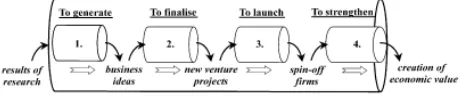
Several of universities‟ employees are researchers, which have access to the universities‟ resources. Sometimes leads the use of these resources to findings in a project which seems good enough to commercialize. The university will provide help to take the steps necessary to make commercialization happen. First of all, there will be research results which will lead to business ideas. Those ideas will be translated in new venture projects. These projects could be launched into an university spin-off firm. „University spin-offs are companies founded by university employees and refer to their founders as academic entrepreneurs‟ (Zhang, 2009, p. 255). Frédéric N. Ndonzuau et al. created a figure which visualizes these several phases, as seen in figure 1 (Frédéric Nlemvo Ndonzuau, 2002). On the basis of these phases, results of research could be transferred into the creation of economic value.
Figure 1: The global process of valorization by spin-off. Source: Frédéric Nlemvo Ndonzuau, 2002.
University spin-offs are already present in Europe for approximately forty years (Stankiewicz, 1994). In the beginning, universities were often indifferent to the spin-offs and sometimes even opposed to their development (Stankiewicz, 1994). Later on, universities and even politicians realized that university spin-offs could have a strategic goal. This could be through their ability to create and diffuse knowledge, to foster the region‟s capacity to innovate (Doutriaux, 1991).
In order to make it affordable for universities to create spin-offs, there need to be some way to make money out of them. To realize this commercialization, the spin-offs need to find their way to the market. Therefore some form of market orientation is necessary. Market orientation is valuable for a business, because it focuses on (1) continuously collecting information about needs of target-consumes and capabilities of competitors, and (2) using this information to continuously create superior customer value (Narver, 1995).
However, market orientation often seems to give businesses a hard time. Since products created by university spin-offs are often „new‟ and quite complex, it could be hard to find a way to the market or even a market at all. Studies show that there is a relationship between market orientation and new product performance (Albert Caruana, 1999). Therefore it is important to make sure that these two factors work well together. Although, this could be hard sometimes. The difficulty in transferring a complex technological product to the right market
and therefore commercializing it, could be seen as the „Valley of Death‟ (Markham, 2012). It is important to address this subject, because the process of market orientation could eventually make or break a business. The idea, product or service could be brilliant, but when no market could be found and commercialization is a difficult process, all the effort could end up wasted.
Therefore it could be interesting for university spin-offs to make the market part of the development of their value proposition. As Osterwalder states, a good value proposition consist of two parts; the value proposition and the customer segment (Osterwalder, 2014). These two parts are elements of Osterwalders‟ business model canvas. Customers segments define the different groups of people or organizations that an enterprise aims to reach and/or serve. Value propositions describe the bundle of products and services that create value for specific customer segments (Alexander Osterwalder, 2010). Hereby it is important to listen to the customers and further investigate what they need in order to get their jobs done, maximize their gains and cut their losses. A dialogue with customers could help support co-creation of value and even sustainable competitive advantage (David Ballantyne, 2006). As stated by Narver et al. it is also important to pay special attention to what customers actually do, as opposed to what they say they do (2004). The value proposition will be adapted to the actual needs of the market. Therefore it could be more efficient to involve the market in developing the value proposition. The goal of this paperl is to explore to which extent the market is co-creating in the development of the value proposition in university spin-offs. When the spin-off has a clear view of what they need to deliver to the market, more information will be available on how to deliver the promises made.
[image:2.595.57.288.378.426.2]Although, when wrong decisions are made in the market orientation process, a business could end up in the wrong market or targeting the wrong audience. If the market orientation process and value proposition creation could be eased, businesses could end up having a bigger and more fair chance in the already hard world of economics. This is why university spin-offs should be aware of the effect of co-creating value proposition with customers. Therefore is the central question in this research: to what extent do university spin-offs consider their market when developing their value proposition?
2.
THEORETICAL FRAMEWORK
The theoretical framework consists of the most important concepts/methods that are used in this paper. Each of the concepts/methods will be analyzed and described to give the reader an idea of what these concepts/methods mean. Since the paper consists of empirical research about university spin-offs, market involvement and development of the value proposition. Articles were read and investigation were conducted to find information about the selected topics.
The articles that are used were selected by the following criteria:
Relevance: is the subject of the article related to one of the research topics?
Rate: is the article well read, used it a significant amount of references or is it often published? So, is it a „trustworthy‟ article?
The criteria „relevance‟ was used, because this showed whether the topic of the article used was related to the research. The article needed to be related to the research somehow otherwise it couldn‟t be used as a source. The criteria „rate‟ was applicable, because it gave an indication whether the article was trustworthy or not. Indications that an article could be qualified as „good‟ quality are; if an article was well read, used a significant amount of references, or it was published several times.
The following procedures were used in findings articles:
Using (scientific) search engines like Google Scholar.
Checking references in papers which are already used or which seem relevant for this research.
Using relevant search terms, like; value proposition, university spin-offs and market involvement. Most of the articles that were used were found by using the first and latter method.
Unfortunately the articles used in this paper didn‟t represent everything that is produced about the consideration of the market while developing the value proposition by university spin-offs. Since there was limited time available for creating this paper, not all papers existing about this topic could be reviewed. Although, the diversification and the quality of the papers gave some clear indication about the situation of the topic.
2.1.1
Responsive and proactive market orientation.
Market orientation is „... the implementation of the marketing concept, hence a market-oriented organization is one whose actions are consistent with the marketing concept‟ (Ajay K. Kohli, 1990, p. 1). That market orientation is an important factor of business‟ success is confirmed by research of Narver and Slater: „We observe in our research that the businesses having the highest degree of market orientation are associated with the highest profitability (John C. Narver S. F., 1990, pp. 32-33)‟. It is also stated that market orientation is relevant in
every market environment, though Miles and Snow state that in some environments the use of market orientation is just uneconomic (Raymond E. Miles, 1978). Therefore it is not the case that the more money spent on market orientation, will definitely deliver a higher profit. At some point the incremental cost to increase the market orientation will exceed the incremental benefits which are gathered from this investment (John C. Narver S. F., 1990).
In the market orientation perspective of Narver and Slater (2004) two types of market orientation stand out; proactive market orientation and responsive market orientation. The responsive market orientation is the set of behaviors „in which a business attempts to discover, to understand, and to satisfy the expressed needs to customers‟ (2004, p. 335). This perspective targets customers‟ expressed needs: these are the needs of which they are aware. An example of an expressed need is „thirst‟, whereby the expressed solution is „water‟. The other perspective, proactive market orientation, is the set of behaviors „in which a business attempts to discover, to understand, and to satisfy the latent needs of customers‟ (2004, p. 335). This perspective targets customers‟ latent needs: these are the needs of which they are unaware of. „These needs are no less „real‟ than expressed needs, but they are not in the conscious of the customer. For example, at the outset of the development of computers, the need for the benefits of a personal computer was a latent need‟ (2004, p. 336). In order to see whether the clients‟ needs are addressed well, the delivered value has to be determined. Value-in use determines the value that clients experience by the use of a particular product or service.
2.1.2
Value in use
Grönroos states in his paper the value-in use dimensions with regard to business-to-business (B2B). These dimensions are described as followed: „The support of a supplier will always have some effect on the economic result of a customer‟s business. (…) What value a customer can create out of the support provided by a supplier can be divided into three dimensions:
Effects on the customer‟s growth- and revenue-generating capacity.
Effects on the customer‟s cost level.
Effects on perceptions.‟ (Grönroos, 2010, p. 242).
Beside the value-in use with regard to business-to-business, Grönroos states in his paper the value-in use dimensions with regard to business-to-consumer (B2C). Hereby the dimensions are described as followed: „Value for customers means that they, after having been assisted by the provision of resources or interactive processes, are or feel better off than before‟ (Grönroos, 2010, p. 242). It seems that it is important for businesses to know what customers‟ needs are and therefore how the business could be of assistance in fulfilling those needs. As stated above, those needs could be both latent or expressed. Therefore the business does sometimes need to dig some deeper into the need of customers to be actually able to fulfill those needs.
2.1.3
Value Proposition Canvas.
Osterwalder created in his latest book the value proposition canvas (Osterwalder, 2014), a spin-off from his original business model canvas. The value proposition canvas consists of two parts which are related with each other; value propositions and customer segments. Customers segments define the different groups of people or organizations that an enterprise aims to reach and/or serve. Value propositions describe the bundle of products and services that create value for specific customer segments (Alexander Osterwalder, 2010). Both parts consist of three segments.
The first part is customer segments from which the segments are; customer job(s), gains and pains. Hereby „customer job(s)‟ consists of functional jobs (for example eating healthy), emotional jobs (such as feelings) and social jobs (for example looking fit). Gains are the „things‟ that people expect, want or desire when they get a job done. Pains are the negative „things‟ which people experience when they are getting the job done. The second part of the value proposition canvas is value propositions, which consist of the following parts; products and services, gain creators and pain relievers. Products and services are the ones that offer people the most help to get their job done, to relieve the most pain and get their gains maximized. Gain creators are the ways in which the business intend to create outcomes and benefits which their customers expect, desire or surprise them. Pain relievers are the business intentions to get rid of or reduce „things‟ that customers dislike while (and so before or after) they try to complete their job. Since the research field is a different field than commercial field, university spin-offs could experience difficulties while creating their value proposition. Markham (2012) states in his article that this could happen because of a lack of commercial knowledge and experience, a so called „Valley of Death‟.
2.1.4
Valley of Death.
The gap between the market recognition or technological invention of an idea and the efforts to commercialize it are called the „Valley of Death‟. Loads of companies have the resources, structure and personnel which are needed for technology development. Similarly, companies have the resources for commercialization, like marketing, promotion, distribution etcetera. However, between those two sides of business, there is a gap in which the two sides are not combined well. This gap is the Valley of Death and shows a lack of structure, resources and expertise. Whenever these are not well balanced, Markham states, the business will have a hard time to transfer a product or service from the lab to the market.
3.
METHOD
The method section describes what kind research was conducted in this paper and how it will be conducted. Three methods were used and explained.
First, literature was used. The most essential research was described and explained in the introduction and theoretical framework. These topics gave an overview of the literature of this paper and were are guidelines in the creation phase of the interviews and interview questions.
Secondly, data was collected by interviewing three high ranked employees of university spin-offs. Every spin-off was connected to the medical industry. This industry was chosen because of the level of technology and complexity.
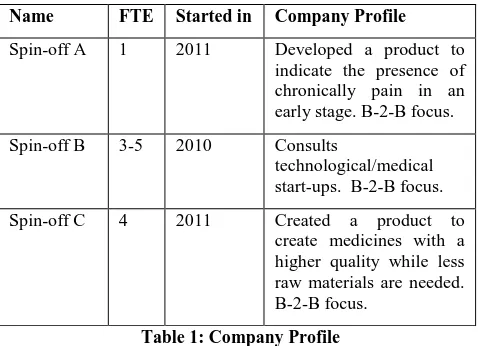
Name FTE Started in Company Profile
Spin-off A 1 2011 Developed a product to indicate the presence of chronically pain in an early stage. B-2-B focus. Spin-off B 3-5 2010 Consults
technological/medical start-ups. B-2-B focus. Spin-off C 4 2011 Created a product to
[image:4.595.305.544.70.243.2]create medicines with a higher quality while less raw materials are needed. B-2-B focus.
Table 1: Company Profile
While having the already gathered theoretical information in mind, interview questions were created. The goal was to formulate those questions in such a way that the interview was
semi-structured. The choice for semi-structured interviews was made, because the interviewer was in this way able to attract as much input from the interviewee as possible. Since there was information needed for this paper, which was specific and exclusive for the university spin-offs, input was needed from these spin-offs professionals. The employees knew the ins and outs of the spin-offs, therefore it was helpful for the research to attract as much information about the university spin-offs as possible. This was internal information, so this (specific) information was not available for outsiders. Due to the semi-structured interviews, it was possible to gather more internal information because of the influence of a more „open‟ interview. The sample for the interviews was as followed:
Three university spin-offs from the University of Twente.
Each university spin-off was started approximately five years ago.
Each university spin-off consisted of three to five employees.
Each university spin-off was present in a medical market. Medical products were there core business or consultancy for medical start-ups.
The sample was a purposive-sample.
information as possible was lost. The recordings were transferred into writing after the interviews, this was done by using open coding which led to identification of concepts, theories and dimensions. Information which couldn´t be identified by the open coding, and so where underdeveloped, were excluded from the research to be able to compare relevant information more efficient. Axial coding was used to compare information from specific categories. The coded data was used to distinguish specific information about theories as ´market orientation´, ´Valley of Death´, ´value-in use´ and ´value proposition´ and how they relate to the extent to which university spin-offs consider their market when developing their value proposition.
At third, content analysis and observation of secondary data will be used. These methods will help to clarify the situation with regard to market orientation of university spin-offs, as well as substantiate findings of the conducted interviews.
4.
RESULTS
Three Dutch university spin-offs were part of this research. From each of the spin-offs is one high-ranked employee interviewed in order to find information about to what extend these spin-offs consider their market while developing their value proposition. These sections describes first several outcomes from each interview and at second were those interviews combined to an overall result.
4.1.1
Spin-off A
The first university spin-off has currently three employees, from which one employee works full time, and was started in 2011 as the interviewee quote “after receiving demand from the market to transfer their ideas about indicating whether or not a patient will suffer chronically pain into a product”. Since the product
is developed for the medical field, especially clinics, is the university spin-off‟s focus business-to-business. The way to the market was rough, because of restrictions in the medical market. Therefore there was tried to find help from outside the firm, the spin-off felt that this was needed because this could help to “look with a more commercial view instead of a research/scientific view to the business”. This happened through conversations with external parties, like investors. The university spin-off was not really sure about the value that the product delivered, because the „real‟ value was not directly obtained by their client, but by the patient because their chronically pain was less intense. However, the clients benefit because they are able to deliver a more effective treatment and therefore are they better off then when the product was not used. Clients‟ needs are determined by conversations and feedback sessions with clients which use the university spin-off‟s product. The university spin-off tries to make the market part of their company, for example by sending out prototypes to test and by having conversations with business developers, because they “experienced that conversations lead have positive effects, not only for us, but for all parties involved ”. After some
time, the spin-off has evaluation conversations with the parties that used their prototype to find out what needs to be improved. This market focus is used from the start and they feel that the market should be the core of their everyday business. Hereby are the clients‟ latent needs central, because these are the needs that the clients are unaware of, but could be the most effective to solve their problems and therefore need the most attention. However, the focus should be on both the expressed and the latent needs. The university spin-off didn‟t know what they would do different when they had to start over, but said that they “try to focus on the market from the start and try to sell
products in an earlier stage”.
4.1.2
Spin-off B
The second university spin-off has currently five employees, from which three to four people work fulltime, and is started in 2010 by employees of the University of Twente when questions from commercial parties couldn‟t be answered within the university. Members of a specific department dug into these questions, tried to solve these and after a while they started an independent firm. The core business is to consult technological start-ups, so for the technological field, therefore is the focus business-to-business. After demand from the market started a department to help the technological start-ups and felt that there was need to start a business to be able to help more potential clients. At first they experienced difficulties in addressing the right clients, because of the gap between supply and demand. The university spin-off stated that ”help from a PR-company
was asked because they felt that there was a gap between the scientific field and the commercial field/market”, which they found difficult to overcome. Furthermore they felt that help from outside the firm was not vital, because the main focus should be on the product/service until proven otherwise because of disappointing sales quotes. However, the delivered value is not quite clear, because the communication with their clients stops after the university spin-off gives delivers its service. This makes it hard to find out what value the service delivers in terms of money, like boosted profit or reduced costs. The clients‟ needs are determined through conversations with their clients and experienced people in the „field‟ and through feedback. At the start of a project is also asked why their service is actually needed and is researched whether this is actually the case or that the problem is something different. However, the university spin-off states that “the market doesn’t
have a significant amount of influence in their everyday business, because their main focus is on their own capacities and qualities”. This involvement changed slightly because the spin-off started out of question from the market and the market focus helped to start the business at the start. But after a while a personal vision was created which focuses more on optimizing their service and this focus was followed till now. However, the spin-off tries to broader their view and ship their focus slightly more towards the market. The university spin-off aims on the expressed needs and as well as on the latent needs, because they try to look further than the specific questions which their clients have. The interviewee found it hard to say what they will do different whenever they had to start all over again.
4.1.3
Spin-off C
The third university spin-off has currently four employees, a team of advisers and was started in 2011 after experiencing in practice which problems were present in the medicine production, so from market demand. The product created for the medical field, especially for hospitals, to create medicines more efficient, therefore is the focus business-to-business. The university spin-off created a prototype and went to hospitals to ask whether they wanted to try the prototype. However, the hospitals where that enthusiastic that they immediately asked whether they could buy the product. Therefore was the prototype finished quickly to be able to commercialize it. One of the problems which was experienced was the time that the spin-off had to wait after they sold a product, because they needed the money to keep improving the product. The interviewee states that another problem was that they “felt the
and what the spin off‟s product can deliver to the client. The product can be used for research, but with a license is it also allowed to create medicines. These product can create higher quality medicines by the use of less raw materials, which saves the client money and makes them better off than when the product is not used. The clients‟ needs are determined by having conversations with them, finding out why they need the product and which problems could be solved by the usage. Through conversations with clients, by sending them prototypes to test and looking at competition tries the university spin-off to involve the market in their everyday business. The focus was at the market from the start, since the spin-off started from market demand and the focus is still the same. They feel that this is the best focus, because the clients are the main source of income. However, the interviewee states that the university spin-off feels “that the client should not be bothered with the whole process of product development. Clients’ input is needed at the start, but after that should the spin-off develop their own product, when it is(almost) done, then it should be send to clients for a usability test”. The spin-off feels that the focus at the start should be on both the expressed and the latent needs, but later more on the expressed needs. When asked what the university spin-off will do different when it had to start over again, it was stated that “probably move earlier to the market,
because this should be the main focus”.
4.1.4
Cross-cases analysis
The businesses that were analyzed in this research were all started by researchers as an university spin-off approximately five years ago after receiving questions from the market or after „feeling‟ that there was a need for the product/service in the market. Nowadays the spin-offs have three to five employees. There is a business-to-business focus and their main market is the medical market.
The spin-offs all needed help from outside the firm to transfer their ideas into something that could be commercialized, especially in the phase that they tried to bring the product/service to the market. Hereby an interviewee stated that: “Researchers spent a lot of their attention to new product
development and cooperating with other researchers, but less attention in taking products to the market. ... Companies make mistakes at this point, because they are research orientated, there is a big difference between the research/science field and the commercial field. Researchers are tent to over improve... ”.
The spin-offs find it hard to give a clear explanation of the value-in use that their product/service delivers, but state that it makes the client feel better off with than without their product/service: “Yes, this is the feedback that we receive from
the market”. Beside this clients could end up with higher profit/revenue or lower overall cost: “Clients get a higher
quality product and less raw materials are needed. They will earn more money and use less raw materials”. Conversations are held with (potential) clients to determine what their needs are. The spin-offs analyze the gathered data and try to find a way to realize their clients‟ needs. The conversation also indicates where the product/service is needed for and why the product/service could be helpful. An interviewee states: “We
will definitely name the positive aspects, but we won’t emphasize the negative aspects. However, when we feel that we can’t deliver goals, then will we share this honestly”.
The interviews show that a market focus is seen as important, especially in the start-up phase. Conversations with clients, analysis of competitors, potential markets and feedback are vital in this process. Spin-offs involve their clients in the process of creating their products/services, an interviewee states: “After
selling the product we ask questions about what we could change. The market is part of our product/service development. Client experiences are important for new product development”. An interviewee quotes that new products are send to clients to test, afterwards feedback is received which they try to implement this in their product to improve quality: “We send these new products to clients and they share their experiences with us”. The amount of market influence was quite stable over time. However, one spin-off states that there was only a market focus at the start, to create a product/service and find a way to the market. It is also stated that when the market is reached, the main focus should be on the product in order to make the product/service perfect.
The spin-offs feel that market focus is the best focus at the start:
“... good enough focus to help through the first years”. In the early phase of the business a market focus could be helpful to guide them successfully to the market, since this focus will help them to understand the needs in the market. Once the spin-offs are settled and clients know the spin-off and the quality that they deliver, then could the need to find new customers be less than in the earlier phase. Now it is more important to keep the customers close to business and stay on delivering good quality products/services. It is stated that “the client is the core, but we
shouldn’t tire them with the whole product development”. Keeping the clients‟ needs satisfied is essential, but the spin-offs should still want to be able to develop new products/services as well.
There is no clear view on whether the spin-offs should focus on the expressed or latent needs or both, because the interview shows that they all do something different. Spin-offs find it hard to say what they should do different when they had to start all over again. However, the decision to find the way to the market should probably be made in a earlier stage. It is stated earlier that researchers unfortunately tend to „over-improve‟ their prototype instead of finding out what the market thinks of the product.
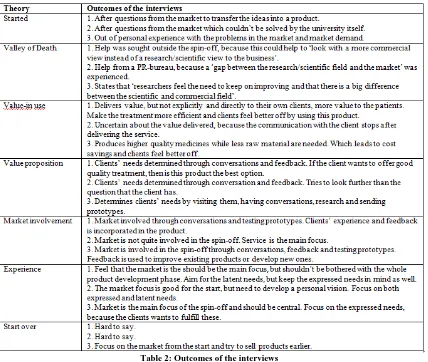
The most important results of the research are addressed in table 1 and are summed up below.
Help from outside the firm is needed to commercialize research ideas.
Uncertainty about the actual „value-in use‟ delivered by the product/service.
Conversations with the market and feedback are vital for spin-offs.
Once on the market, the focus could be switched more to the product.
Expressed needs are spin-offs‟ main focus.
5.
DISCUSSION AND CONCLUSION
5.1.1
Results and future research.
The interviews and the results give a indication of the situation in which the university spin-offs are at this moment. There is also retrospect to the history at the start of the spin-off and some feedback of their own experiences. Overall the results confirm some of the theories which are discussed at the start of this thesis.
First, the research confirms that there is in fact some kind of „Valley of Death‟. There is stated that researchers mainly focus on finding a way to solve problems in the most effective way and tend to keep on researching this. However, the problem could be solved already with the product/service which for them is only a prototype. Beside this, research states that researchers which start an university spin-off often have lack of commercial-experience. Research even shows that university spin-offs sometimes prefer to get commercial knowledge and commercial help, rather than investments or grants. Therefore it could be helpful to seek help from outside the spin-off in order to commercialize in a more successful way and to make it able to overcome the „Valley of Death‟.
Second, the university spin-offs focus on their clients‟
expressed needs. This could limit them, because the latent
needs are not addressed properly. Successful addressing the
latent needs could solve clients‟ problems in another way then which is expected, but this could probably deliver even better results. When the spin-offs are able to successfully fulfill these
latent needs, they could make their client more dependent and loyal.
Third, the research shows that the market is vital in the spin-offs every-day business. Though, it is difficult to address which role the market explicitly has in the spin-offs and if the co-creating by the market is done to its full extent. There is no clear guideline of how to pass the process of market orientation successfully. Several researches have been conducted and multiple papers have been written about this topic. Despite all this effort, university spin-offs tend to struggle with the market orientation phase. In future research the focus could be more explicit on role of the market and how they experience the collaboration. In this research the focus is on the spin-offs and their experiences. However, the experience of the market is not addressed. Whenever future research keeps the experiences from the side of the university spin-offs in mind, it could be able to create a clear view of the side of the market. When these two views can be combined, hopefully some clear answers could be given and eventually some advice.
[image:7.595.94.522.35.397.2]This research will try to make clear which struggles scientific or technological university spin-offs have with regard to market orientation while considering the value-in use of their complex products. This could give entrepreneurs more insight in the situation and help them to make a decision on which path to choose in the market orientation process. For the academic field this research could be an overlap between the already existing research and could also be a stepping stone for upcoming research. When futures research could give more of a guideline in how to succeed as a university spin-off. Then will the businesses which implemented the positive steps be able to have some competitive advantage with respect to businesses who did not implement those steps. When there are steps found which tend to have a negative effect, then those could be avoided in the future. Therefore could spin-offs or start-ups make their market orientation phase more successful, which will lead to more or stronger competition.
5.1.2
Limitations and future research.
The research has some limitations. First, the amount of university spin-offs interviewed is not quite high. The number of three spin-offs that were interviewed is not high enough to be able to generalize the findings. In order to do so, more research need to be done to see whether the results stay the same when a bigger sample is used. Although the research gives some indication of the current situation. It should be better when in future research more interviews will be conducted in order to give a clearer view of the situation.
Second, indications were given in the research that the spin-offs struggle to find their way to the market. Plenty of funding is received, but it seems that money isn‟t really the issue. However lack of commercial experience and commercial knowledge seems to be one of the problems, which confirms the theory described by Markham (2012). In this paper finding the way to the market was not the subject, however this subject could be addressed in future research. Therefore could new (eventually not even established) spin-offs get a clearer view of where to start and know what help they should get in order to successfully find their way to the market.
Third, the interviews are conducted with employees which are currently working at the university spin-off, so it could be possible that the answers are not totally trustworthy. In future research it could be helpful to also observe the spin-offs from a more objective/neutral point of view. This could be done by for example interviews with people that are somehow connected to the university spin-off, but do not actually work there. Therefore the subjects will be more free in speaking about the spin-off.
5.1.3
Conclusion
A combination of both interviews and literature research is used in empirical research about to extent university spin-offs consider their market while developing their value proposition. In order to find an answer, three interviews were conducted and thirteen articles were used. The combination of these methods made it able to give a broader view towards the situation than when only one method was used. The conducted research showed that university spin-offs know how important the market is for their everyday business and that they try to implement it in the most successful way. In order to do so, university spin-offs have conversations with their clients, conduct evaluation meetings, meet with advisors and try to notice what is currently going on in the market and trying to adapt to it. All these different elements are considered while university spin-offs are developing their value-proposition. Hereby does the spin-offs try to determine the market‟s create gains, relieve the pains and create the necessary products and services to make customer jobs as good as possible. While taking the research in mind, it can be said that the university spin-offs consider their market quite well while they are developing the value proposition. However, before the way to the market is found, the university spin-offs tend to „over-improve‟ their prototype as a result of the fact that the researchers which started the spin-off have some lack of commercial knowledge and experience. Therefore it can be said that at the start of the process the spin-off could be focused slightly more on the market instead of the product to find the way to the market in an earlier stadium. Therefore the answer to the research question can be stated as follows; the university spin-offs consider their market quite well while they are developing their value proposition, but that asking help in commercializing the product/service could make the process even better.
6.
REFERENCES
Ajay K. Kohli, B. J. (1990). Market Orientation: The Construct, Research Propositions, and Managerial Implications. Journal of Marketing , 1-18.
Albert Caruana, B. R. (1999). Market orientation and Performance in the Public Sector. Journal of Global Marketing
, 59-79.
Alexander Osterwalder, Y. P. (2010). Business Model Generation. John Wiley.
David Ballantyne, R. J. (2006). Creating value-in-use through marketing interaction: the exchange logic of relating, communicating and konwing. Marketing Theory, vol 6 , 335-348.
Doutriaux, J. (1991). University culture, spin-off strategy, and succes of academic entrepreneur at Canadian universities.
Proceedings of Frontiers of Entrepreneurship Research, Babson College Conference , 406-421.
Frédéric Nlemvo Ndonzuau, F. P. (2002). A stage model of academic spin-off creation. Technovation , 281-289.
Grönroos, C. (2010, 05 27). A service perspective on business relations: The value creation, interaction and marketing interface. Industrial Marketing Management , pp. 240-247. Jean-Jacques Degroof, E. B. (2004). Overcoming Weak Entrepreneurial Infrastructures for Academic Spin-Off Ventures. Journal of Technology Transfer , 327-352.
John C. Narver, S. F. (2004). Responsive and Proactive Market Orientation and New-Product Success. Journal of product innovation management , 334-347.
John C. Narver, S. F. (1990). The Effect of a Market Orientation on Business Profitability. Journal of Marketing , 20-35.
Juliet Corbin, A. S. (1998). Basics of Qualitative Research: Techniques and Procedures for developing grounded theory.
Sage.
Kay, J. (1995). Foundations of Corporate Success: How Business Strategies Add Value. Oxford University Press. Markham, S. K. (2012). Moving technologies from lab to market. Industrial Research Institute, Inc. , 31-42.
Narver, S. F. (1995). Market Orientation And Learning Organization. Journal of Marketing , 63-74.
Osterwalder, A. (2014). Value Proposition Design. Wiley. Paul Benneworth, D. C. (2005). University spin-off policies and economic development in less successsful regions: learning from two decades of policy practice. European planning studies
, 1-32.
Raymond E. Miles, C. C. (1978). Organizational Strategy, Structure, and Process. The Academy of Management Review , 546-562.
S.L. Vargo, R. L. (2004). Evolving to a new dominant logic of marketing. Journal of Marketing, vol 68 no. 1 , 1-17.
Stankiewicz, R. (1994). Spin-off companies from universities.
Science and Public Policy , 99-107.
7.
APPENDIX
7.1
Appendix 1: Interview questions
7.1.1
General Questions
The first couple of questions are here to get a bit of general information of you and the business you are connected to. This part consist of eight questions.
What is your name?
What is the name of your company?
How long does the company exist?
How did the company start?
What is the number of people that work for your company?
How would you describe your job in this company?
What is the main product/service that the company offers?
Is the focus Business or Business-to-Consumer?
7.1.2
Valley of Death
The following questions will be related to the phase in which the spin-off commercialized their idea. This part consists of four questions.
How was the product/service brought to the market?
When the original ideas were commercialized, where there any difficulties experienced?
o If yes, which difficulties were experienced? o If no, how were those overcome?
Was there help from „outside‟ the spin-off in the commercialization phase?
7.1.3
Value-in use
The next questions will be related to value-in use. This part consists of three to four questions.
How is the value that the product/service delivers determined ?
With regard to Business-to-Business;
o Would you say that customers make more revenue/profit when your product is used? o How do you determine whether customers
save money by using you product?
With regard to Business-to-Consumer;
o How do you know that customers will be better off when your product is used?
7.1.4
Value proposition
The upcoming questions will help to determine whether your business makes consumers part of developing the value proposition and how. This part consist of twelve questions.
How are the clients‟ needs determined?
Is there information gathered on what the product/service is actually needed for?
How do you make your target group aware of the positive or negative effect of you product/service?
Would you say that the market is involved in your company?
o If yes, how ?
How is the market involved in creating products/services?
Has the amount of market involvement changed over time?
o If yes, why did this change?
Did the company focus on the market since the start of the business?
7.1.5
Experience
The following part of the interview consists of some questions with regard to your experience with the focus used. This will help to check whether the path taken was the right one and what lessons could be learned by future spin-offs. This part consists of five questions.
Would you say that focusing on
customers/competitors is the best focus for your business?
o If yes, Why do you think that this is the right focus?
o If no, Why do you think that the focus should be different?
Do you think that the product would be even better when the customer was less involved in creating the product, so more time and effort could be dedicated to developing the product?
Would you say that the focus of the business should be on the needs of which customers are aware of or which they are unaware of? Why?
If you should start all over, would your focus still be on the market or more on the product?