Entailment Graphs for Relation
Extraction and Email Categorization
Dissertation
zur Erlangung des akademischen Grades eines
Doktors der Philosophie
der Philosophischen Fakultät
der Universität des Saarlandes
vorgelegt von
Kathrin Eichler
aus Kirchheimbolanden
Recognizing that the meaning of one text expression is semantically related to the meaning of another can be of help in many natural language processing applica-tions. One semantic relationship between two text expressions is captured by the
textual entailment paradigm, which is defined as a relation between exactly two
text expressions. Entailment relations holding among a set of more than two text expressions can be captured in the form of a hierarchical knowledge structure re-ferred to asentailment graphs. Despite the fact that several people have worked on building entailment graphs for different types of textual expressions, little research has been carried out regarding the applicability of such entailment graphs in NLP applications. This thesis fills this research gap by investigating how entailment graphs can be generated and used for addressing two specific NLP tasks: First, the task of validating automatically derived relation extraction patterns and, second, the task of automatically categorizing German customer emails. After laying a theoretical foundation, the research problem is approached in an empirical way, i.e., by drawing conclusions from analyzing, processing, and experimenting with specific task-related datasets. The experimental results show that both tasks can benefit from the integration of semantic knowledge, as expressed by entailment graphs.
Firstly, I would like to thank my supervisor, Günter Neumann, for the continuous support of my Ph.D study, especially for all the comments and questions that helped me improve my research and thesis.
I would also like to thank:
• Hans Uszkoreit for encouraging me to pursue a Ph.D and continuously sup-porting me throughout my years at DFKI,
• Feiyu Xu, Aleksandra Gabryszak, Sebastian Krause, Lili Kotlerman, Vivi Nastase, and Tae-Gil Noh for the fruitful and enjoyable collaboration and for providing code, data, and ideas,
• Stefania Racioppa, Evelyn Nowak, Gergana Popova, Vivien Macketanz, Oliver Marten, and Florian Petersen for their help with data annotation and evaluation,
• Hubert Truckenbrodt, Heike Paschotta, Philippe Thomas, and Jakob Wurster for providing valuable feedback on my writing,
• Josef van Genabith for taking his time to review my work, and • Leonhard Hennig for his invaluable help with preparing my defense.
Finally, a very special thanks to my family and friends for their love, support, and encouragement.
Für viele Anwendungen, die natürliche Sprache verarbeiten, spielt die Erkennung von semantischen Beziehungen zwischen Texten oder Textteilen eine große Rolle. Eine solche semantische Beziehung ist die textuelle Implikation (Englisch: textual entailment), die wie folgt definiert ist: Eine textuelle Einheit T impliziert eine Hypothese H (anders formuliert: H folgt aus T oder H kann aus T geschlossen werden), wenn ein Leser von T mit hoher Wahrscheinlichkeit annehmen würde, dass H wahr ist [Dagan and Glickman, 2004].
Die textuelle Implikation unterscheidet sich dadurch von der strikter definierten
logischen Implikation, dass sie auch Fälle abdeckt, in denen H zwar aus logischer
Sicht nicht zwangsläufig aus T folgt, in denen die Folgerungsbeziehung aber dem üblichen Sprachgebrauch entspricht. Folgendes Beispiel veranschaulicht die Bezie-hung der textuellen Implikation:
• T: ”Rebellisch, intelligent, knurrig – Christian Ströbele war nie bequem. Das bekam auch seine Partei, die Grünen, zu spüren. Jetzt verlässt er den Bundestag.”1
• H: ”Christian Ströbele war Bundestagsabgeordneter der Grünen.”
Text T impliziert im obigen Beispiel die Hypothese H, weil in T ausgedrückt wird, dass Ströbeles Partei die Grünen sind und er den Bundestag verlässt und ein Leser aus diesen beiden Informationen typischerweise ableiten würde, dass Ströbele für die Grünen Abgeordneter im Bundestag war.
Die Beziehung der textuellen Implikation (im Folgenden: Entailment) ist eine bi-näre Relation zwischen genau zwei Texteinheiten (z.B. Sätzen). Um Entailment-Beziehungen für mehr als zwei Texteinheiten zu modellieren, wurden sogenannte
Entailment-Graphen eingeführt [Berant et al., 2010], die Entailment-Beziehungen
in hierarchischer Form abbilden.
Das folgende Schaubild stellt einen Entailment-Graphen dar, der verschiedene Entailment-Beziehungen für den Ausdruck Bundestagsabgeordneter der Grünen
abbildet (die Pfeilrichtung gibt dabei die Richtung der Entailment-Beziehung an):
1Aus der Berliner Zeitung vom 27. Juni 2017
Entailment-Graphen wurden in der Vergangenheit von mehreren Forschungsgrup-pen eingesetzt, um Entailment-Beziehungen zwischen unterschiedlichen Arten von textuellen Einheiten zu modellieren, beispielsweise Prädikat-Argument-Struktu-ren [Berant et al., 2010, Levy et al., 2014], getypte Prädikate [Berant et al., 2012, 2011] oder Textfragmente [Kotlerman et al., 2015]. Der Einsatz von Entailment-Graphen in realen Anwendungen wurde bisher jedoch kaum erforscht. Die vor-liegende Arbeit hilft dabei diese Lücke zu schließen, indem sie untersucht, wie semantisches Wissen für zwei konkrete Anwendungen in Form von Entailment-Graphen modelliert und verwendet werden kann: Zum einen für die Validierung von automatisch generierten Mustern für die Relationsextraktion, zum anderen für die automatische Kategorisierung von deutschsprachigen Emails aus dem Kunden-support.
Ziel der Relationsextraktion ist es, aus Texten Informationen darüber zu gewin-nen, welche im Text genannten Entitäten (z.B. Personen) in einer bestimmten Beziehung (z.B. Ehe) zueinander stehen. So lässt sich beispielweise aus dem Satz
Ich war auf der Hochzeit von Maria und Peter eingeladendie Information ableiten,
dass die beiden mit Maria und Peter referierten Personen in einer Ehe-Beziehung zueinander stehen (oder standen).
Anwendungen, die solcherlei Relationen automatisch erkennen, nutzen häufig exis-tierendes Wissen, sogenannte Seed-Entitäten, die über die Zielrelation verbunden sind (z.B. Ehepaare), um damit aus Texten, in denen die Entitäten vorkommen, Extraktionsmuster abzuleiten. Diese Muster werden dann verwendet, um neue En-titäten zu erkennen, für die die Relation gilt. Aus dem BeispielsatzIch war auf der
Hochzeit von Maria und Peter eingeladen könnte mit Hilfe der Seed-Entitäten
Ma-ria und Peter beispielsweise das Extraktionsmuster [Hochzeit von Person1 und
Person2] abgeleitet werden, mit dem dann weitere Ehepaare gefunden werden könnten.
Dieses Verfahren ist jedoch fehleranfällig, da Seed-Entitäten, die zum Lernen von Extraktionsmustern verwendet werden, auch in anderen Satzzusammenhängen vorkommen können. So könnten die beiden mit Maria und Peter referenzierten Entitäten auch in einem Satz wieMaria spricht mit Peter gemeinsam auftauchen. Würde man aus diesem Satz das Muster [Person1 spricht mit Person2] extrahie-ren, so wäre dies vermutlich kein geeignetes Muster, um verheiratete Menschen zu erkennen. Die Filterung der automatisch generierten Muster ist daher ein wichtiger Schritt, um eine Teilmenge von Mustern zu erhalten, die korrekte Entitäten der Zielrelation mit hoher Genauigkeit extrahieren können. Filterstrategien können unterschiedlicher Natur sein. So können sie beispielsweise Informationen darüber nutzen, wie häufig ein Muster mit verschiedenen Seed-Entitäten vorkommt, oder externe Wissensdatenbanken, z.B. lexikalisch-semantische Netze, zu Hilfe nehmen, um zu beurteilen, ob ein Muster semantisch mit der Zielrelation verwandt ist. Die Erkennung von syntaktischen oder semantischen Überschneidungen in ver-schiedenen Mustern kann helfen, mit Hilfe von Cluster-Verfahren ähnliche Muster zu identifizieren. Oft wird hierbei jedoch außer Acht gelassen, dass Beziehungen zwischen Mustern nicht symmetrisch sein müssen. So könnte über ein Cluste-ring zwar beispielsweise herausgefunden werden, dass die Muster [Hochzeit von Person1 und Person2] (Muster 1) und [Scheidung von Person1 und Person2] (Muster 2) semantisch miteinander verwandt sind. Ein Clustering von Mustern kann aber nicht ausdrücken, dass sich zwar aus der mit Hilfe von Muster 2 ausge-drückten Beziehung (Scheidung) die mit Muster 1 ausgedrückte Beziehung (Hoch-zeit) ableiten lässt, sich aber umgekehrt aus einer Ehe-Beziehung keine Scheidungs-beziehung ableiten lässt.
Für die Filterung von Relationsmustern kann das Wissen über textuelle Inferen-zen zwischen den erkannten Mustern sehr hilfreich sein, weil es ermöglicht zu unterscheiden zwischen Mustern, aus denen sich die Zielrelation ableiten lässt, und solchen, für die das nicht möglich ist. So lassen sich beispielsweise sowohl mit Muster 1 als auch mit Muster 2 Entitäten extrahieren, die geheiratet haben, aber nur mit Muster 2 Entitäten, die sich haben scheiden lassen.
Diese Art von Inferenz-Beziehungen zwischen Extraktionsmustern lassen sich auf natürliche Weise mit den eingangs beschriebenen Entailment-Graphen abbilden. Um das Potential von Entailment-Graphen im Kontext der Relationsextraktion zu untersuchen, werden in der vorliegenden Arbeit zum einen Verfahren entwickelt, um Entailment-Graphen auf der Basis von Extraktionsmustern zu generieren; zum anderen wird experimentell gezeigt, dass die generierten Graphen sich eignen, um aus einer Menge von automatisch generierten Extraktionsmustern qualitativ hoch-wertige Muster zu selektieren.
Die zweite im Rahmen der Arbeit betrachtete Anwendung ist die der Emailkatego-risierung. Diese spielt beispielsweise im Kundensupport eine Rolle, wo eingehende Kundenanfragen automatisch existierenden Kategorien (z.B. Fehlerklassen) zuge-ordnet werden sollen, um so den Beantwortungsvorgang zu beschleunigen.
Für Anwendungen dieser Art werden die zugrundeliegenden Texte üblicherweise in eine vereinfachte Darstellung überführt, die dann für das Trainieren von Klas-sifikationsmodellen verwendet wird. Die am häufigsten verwendete Darstellung ist die sogenannte bag-of-words-Repräsentation, in der jeder Text als die Menge der in ihm enthaltenen Wörter dargestellt wird. Die zugrundeliegende Annahme ist hier, dass Texte, die ähnlich sind, dieselben Wörter enthalten.
Da die menschliche Sprache eine Vielzahl von Möglichkeiten bereithält, sich auf unterschiedliche Weise auszudrücken, gibt es jedoch Fälle, in denen die oben ge-nannte Darstellung zum Scheitern verurteilt ist. Das folgende Beispiel zweier Kun-denanfragen veranschaulicht dies:
• A: Wenn ich Daten im .mpg-Format öffne, stimmt die Tonspur nicht mit
dem Film überein.
• B: Bild und Ton einer Videodatei sind asynchron.
Obwohl beide Anfragen dasselbe Problem beschreiben, teilen sie kein einziges ge-meinsames Wort. Um die Ähnlichkeit der beiden Anfragen erkennen zu können, müssen daher Methoden angewendet werden, die über den Vergleich einzelner Wör-ter hinausgehen und die beiden Anfragen stattdessen auf der Bedeutungsebene miteinander vergleichen.
Existierende Ansätze verwenden hierfür häufig Wissen aus externen Ressourcen, das verwendet wird, um die bag-of-words-Darstellung semantisch anzureichern,
z.B. mit aus lexikalisch-semantischen Netzen extrahierten Synonymen oder Hy-pernymen. Auch auf großen Datenmengen erzeugte statistische Sprachmodelle, mit denen Bedeutungsähnlichkeiten von Wörtern aus der Ähnlichkeit ihrer Ver-teilung in sprachlichen Kontexten abgeleitet werden können, kommen hier zum Einsatz.
Die meisten dieser Ansätze operieren jedoch auf einer wortbasierten Textdarstel-lung, die größere semantische Einheiten wie Phrasen oder Sätze nicht berücksich-tigt. Das obige Beispiel zeigt jedoch, dass der Vergleich von größeren Einheiten durchaus relevant sein kann. Zwar kann die semantische Beziehung zwischen den Ausdrücken Ton und Tonspur auf lexikalischer Ebene erkannt werden (z.B. über die Zerlegung des Kompositums). Um zu erkennen, dass der Ausdruck Daten im
.mpg-Format eine Videodatei beschreibt oder dass der Ausdruck Tonspur stimmt
nicht mit dem Film übereinsynonym ist zuBild und Ton sind asynchronist jedoch
der Vergleich größerer Texteinheiten erforderlich.
Entailment-Graphen bieten eine natürliche Möglichkeit, um semantische Beziehun-gen zwischen Texteinheiten unterschiedlicher Art und Größe abzubilden. In dieser Arbeit wird daher ein Verfahren entwickelt, um aus in deutscher Sprache verfass-ten Kundenanfragen Entailment-Graphen zu erstellen, die Beziehungen zwischen in den Kundenanfragen enthaltenen Texteinheiten darstellen. Es wird außerdem gezeigt, dass das so generierte semantische Wissen verwendet werden kann, um die automatische Kategorisierung von Kunden-Emails zu verbessern.
Im Rahmen der vorliegenden Arbeit wird der Einsatz von Entailment-Graphen in realen Anwendungen, die natürliche Sprache verarbeiten, am Beispiel der bei-den oben genannten Anwendungen untersucht. Hierbei werbei-den die folgenbei-den For-schungsfragen adressiert:
1. Wie können Entailment-Graphen als Datenstruktur und die Methodik ihrer automatischen Generierung formalisiert werden?
2. Können mit Hilfe der entwickelten Methodik Entailment-Graphen für die Anwendung der Relationsextraktion generiert werden und dazu beitragen, Instanzen einer Zielrelation mit höherer Genauigkeit zu extrahieren?
3. Können mit Hilfe der entwickelten Methodik Entailment-Graphen für die Anwendung der Emailkategorisierung generiert werden und zur Verbesse-rung der automatischen KategorisieVerbesse-rung beitragen?
Forschungsfrage 1 beschäftigt sich mit den theoretischen Aspekten der Erstellung von Entailment-Graphen. Zur Beantwortung der Frage werden relevante Konzepte und Methodiken aus vorhergehenden Forschungsarbeiten analysiert, zentrale Kon-zepte definiert und der allgemeine Prozess der Erstellung von Entailment-Graphen formalisiert. Darauf aufbauend beschäftigen sich die beiden folgenden Forschungs-fragen mit der Anwendbarkeit von Entailment-Graphen für die beiden konkreten Aufgaben. Diese Forschungsfragen werden auf empirische Weise behandelt, indem existierende Daten analysiert und verarbeitet werden und als Grundlage für Ex-perimente dienen.
Um die Anwendbarkeit von Entailment-Graphen im Kontext der Relationsextrak-tion zu untersuchen, wird zunächst ein neuer Typ von Entailment-Graphen de-finiert, der automatisch gelernte komplexe Extraktionsmuster als Grundelemente (Graphknoten) verwendet und diese basierend auf erkannten Relationsbeziehun-gen (gerichtete Graphkanten) hierarchisch anordnet. Die zugrundelieRelationsbeziehun-gende An-nahme ist, dass eine solche Strukturierung der Muster dazu beitragen kann, die Muster zu filtern, die besonders zuverlässig Instanzen einer bestimmten Relation extrahieren. Um diese Annahme zu untersuchen, wird eine Methode entwickelt, um Extraktionsmustern auf der Grundlage von Entailment-Graphen zu filtern. Für die Evaluierung dieser Methode, wird zunächst ein Gold-Standard-Datensatz aufgebaut, der Entailment-Graphen für drei semantische Relationen enthält. Außerdem werden existierende Technologien aus dem Forschungsfeld Recognizing
Textual Entailment [Dagan and Glickman, 2004] (RTE) verwendet und angepasst,
um Muster-basierte Entailment-Graphen automatisch zu generieren. Hierfür wird unter anderem ein auf aus externen Wissensquellen extrahierten Alignments ba-sierendes RTE-System [Noh et al., 2015] eingesetzt und für die Verarbeitung von Extraktionsmustern angepasst. Das RTE-System wird auf einer Untermenge der handannotierten Muster aus dem Gold-Standard trainiert. Außerdem werden ver-schiedene Stragien für die Graph-Optimierung eingesetzt und evaluiert.
Um die vorgeschlagene Methode zur Entailment-Graph-basierten Filterung mit anderen Filterungsmethoden zu vergleichen, wird ein Evaluationsdatensatz aufge-baut, mit dem sich messen lässt, wie gut die mit der jeweiligen Methode selektierten Muster sich für die Relationsextraktion eignen. Die Experimente belegen den Nut-zen einer Entailment-Graph-basierten Filterung, inbesondere im Vergleich zu Me-thoden, die zwar die semantische Ähnlichkeit von Mustern ermitteln, hierbei aber nicht die asymmetrische Natur von semantischen Beziehungen berücksichtigen.
Ein weiterer Datensatz [Toutanova et al., 2015] wird verwendet, um zu ermitteln, wie generisch das trainierte RTE-Modell ist. Hier zeigen die Experimente, dass eine überschaubare Menge an handannotierten Mustern ausreicht, um ein Modell zu trainieren, das auch eingesetzt werden kann, um sinnvolle Entailment-Graphen für andere semantische Relationen zu erzeugen.
Um die Anwendbarkeit von Entailment-Graphen im Kontext der Klassifizierung von Emails zu untersuchen, wird zunächst ein Datensatz aus Emails aus dem Kun-densupport analysiert, um zu erkennen, in welcher Form textuelle Inferenz bei der Zuordnung von Emails zu Kategorien eine Rolle spielt. Hierfür werden Emailtexte mit den Beschreibungen der zugeordneten Kategorien verglichen, um zu ermitteln, welche Inferenzphänomene der Zuordnung zugrundeliegen. Die Verteilung der er-kannten Inferenzphänomene in den untersuchten Daten lässt darauf schließen, dass vor allem (domänenspezifische) lexikalische Semantik sowie die Erkennung von aus mehreren Wörtern bestehenden lexikalischen Einheiten eine Rolle spielen.
Aufbauend auf dieser Analyse werden Entailment-Graphen erzeugt, die semanti-sche Beziehungen zwisemanti-schen in Emailtexten und Kategoriebeschreibungen enthalte-nen Textausdrücken abbilden. Gold-Standard-Graphen werden direkt aus den Er-gebnissen der durchgeführten Analyse abgeleitet, für die automatische Erzeugung der Graphen werden RTE-Technologien eingesetzt. Außerdem wird eine Methode vorgestellt und evaluiert, die das in Form der Entailment-Graphen dargestellte semantische Wissen beim Trainieren eines Email-Klassifizierers verwendet. Insbe-sondere wird das abgebildete Wissen eingesetzt, um unterschiedliche Text-Reprä-sentationen für den Klassifizierer zu generieren, und experimentell ausgewertet, welche Auswirkung die Berücksichtigung einzelner Inferenztypen auf das Klassifi-kationsergebnis hat.
Die Ergebnisse dieser Evaluierung zeigen, dass das generierte Wissen zu einer er-höhten Performanz des Email-Klassifizierers beitragen kann, insbesondere in Sze-narien, in denen wenig Trainingsmaterial, z.B. in Form von manuell kategorisierten Emails, vorhanden ist. Die Verbesserungen in der Performanz lassen sich hier vor allem auf die Erkennung von Beziehungen zwischen lexikalischen Einheiten (ein-schließlich Mehrwort-Ausdrücken) zurückführen. Die Erkennung von Beziehungen zwischen komplexeren Texteinheiten trägt in den durchgeführten Experimenten nicht zu einer Performanz-Verbesserung bei.
Der erfolgreiche Einsatz von Entailment-Graphen im Rahmen der beiden in der Arbeit adressierten Anwendungen zeigt, dass Entailment-Graphen eine probate Möglichkeit bieten, das für eine bestimmte Aufgabe relevante, gegebenenfalls do-mänenspezifische, semantische Wissen abzubilden und zur automatisierten Be-wältigung der Aufgabe zu verwenden. Die Ergebnisse zeigen außerdem, dass vor-handene RTE-Technologien in der Lage sind, aussagekräftige Entailment-Graphen automatisch zu erzeugen. Vorhandene RTE-Systeme können allerdings bisher aus-schließlich Entailment-Beziehungen erkennen, die sich aufgrund von lexikalisch-semantischen Beziehungen oder syntaktischen Transformationen ableiten lassen. Um Entailment-Beziehungen für komplexere Fälle automatisch erkennen zu kön-nen, z.B. für Fälle, die die Berücksichtigung von verschiedenen Zeitformen und Modi oder domänenspezifischem Wissen erfordern, ist die Entwicklung fortge-schrittener Technologien beziehungsweise die Einbindung von Ressourcen, die das erforderliche Domänenwissen beinhalten, erforderlich.
Mit der Beantwortung der oben genannten Forschungsfragen leistet die vorliegende Arbeit folgenden Beitrag:
1. Sie schafft ein allgemeines Verständnis für die Fragestellungen, die sich im Zusammenhang mit der Erstellung von Entailment-Graphen ergeben. 2. Sie stellt zwei neue Arten von Entailment-Graphen vor sowie Methoden, das
dargestellte Wissen in reale Anwendungen einzubinden.
3. Sie zeigt mit Hilfe von Experimenten, dass Entailment-Graphen in zwei rea-len Anwendungen erfolgreich eingesetzt werden können.
4. Sie untersucht das Potential existierender Technologien zur Erkennung von Entailment-Beziehungen für die Generierung von Entailment-Graphen.
Folgende Publikationen sind aus der der vorliegenden Arbeit zugrundeliegenden Forschung entstanden:
• Eichler, K., Gabryszak, A., and Neumann, G. (2014). An analysis of tex-tual inference in German customer emails. InProceedings of the Third Joint
Conference on Lexical and Computational Semantics (*SEM), Dublin,
• Magnini, B., Zanoli, R., Dagan, I., Eichler, K., Neumann, G., Noh, T.-G., Padó, S., Stern, A., and Levy, O. (2014). The Excitement Open Platform for Textual Inferences. In Proceedings of the 52nd Annual Meeting of the
Association of Computational Linguistics, Baltimore, USA (Abschnitt 3.4.1)
• Noh, T.-G., Padó, S., Shwartz, V., Dagan, I., Nastase, V.,Eichler, K., Kot-lerman, L., and Adler, M. (2015). Multi-Level Alignments As An Extensible Representation Basis for Textual Entailment Algorithms. In Proceedings of
the 4th Joint Conference on Lexical and Computational Semantics, Denver,
USA (Abschnitte 4.4.2 und 5.4.2.2)
• Eichler, K., Xu, F., Uszkoreit, H., Hennig, L., and Krause, S. (2016). TEG-REP: A Corpus of Textual Entailment Graphs based on Relation Extraction Patterns. In Proceedings of the 10th International Conference on Language
Resources and Evaluation, Portorož, Slovenia (Abschnitt 4.3)
• Eichler, K., Xu, F., Uszkoreit, H., and Krause, S. (2017). Generating pattern-based entailment graphs for relation extraction. InProceedings of the
6th Joint Conference on Lexical and Computational Semantics, Vancouver,
Canada (Abschnitte 4.4 und 4.5)
• Eichler, K. and Gabryszak, A. (2017). Evaluating text representations for the categorization of German customer emails. In Theorie, Semantik und
Organisation von Wissen, Passau, Germany (Abschnitt 5.3)
Desweiteren werden folgende weitere Publikationen der Autorin der vorliegenden Arbeit zitiert:
• Eichler, K. (2005). Automatic classification of Swedish email messages. Bachelor thesis, Eberhard-Karls-Universität, Tübingen, Germany
• Eichler, K., Hemsen, H., and Neumann, G. (2008). Unsupervised relation extraction from web documents. In Proceedings of the 6th International
Conference on Language Resources and Evaluation, Paris, France
• Eichler, K.and Neumann, G. (2010). DFKI KeyWE: Ranking Keyphrases Extracted from Scientific Articles. In Proceedings of the 5th International
Abstract iii
Acknowledgements iv
Zusammenfassung vii
Contents xvii
List of Figures xxi
List of Tables xxiii
Abbreviations xxv 1 Introduction 1 1.1 Motivation . . . 1 1.1.1 Relation extraction . . . 3 1.1.2 Email categorization . . . 4 1.2 Contribution . . . 5 1.3 Justification . . . 8 1.4 Methodology . . . 9 1.5 Outline . . . 10 1.6 Delimitations . . . 10 2 Literature Review 13 2.1 Introduction . . . 13
2.2 Graph-structured semantic knowledge representations . . . 13
2.3 Recognizing textual entailment . . . 15
2.3.1 Definition of the task . . . 15
2.3.2 Approaches and technology . . . 17
2.3.3 Applications . . . 20
2.4 Entailment graphs . . . 21
2.5 Relation extraction . . . 23
2.6 Text categorization . . . 27 xvii
2.7 Conclusions . . . 29
3 Building Entailment Graphs 31 3.1 Introduction . . . 31
3.2 Entailment graphs . . . 32
3.3 Procedure . . . 36
3.3.1 Step 1: Identifying relevant expressions . . . 37
3.3.2 Step 2: Identifying modifiers . . . 37
3.3.3 Step 3: Building fragment graphs . . . 39
3.3.4 Step 4: Computing pair-wise entailment . . . 41
3.3.5 Step 5: Optimizing the graph . . . 42
3.4 Framework for building entailment graphs . . . 43
3.4.1 EXCITEMENT open platform . . . 44
3.4.2 Graph structures . . . 45
3.4.3 Architecture . . . 45
3.4.4 Module implementations . . . 47
3.4.4.1 Fragment annotators . . . 47
3.4.4.2 Modifier annotators . . . 49
3.4.4.3 Fragment graph generators . . . 49
3.4.4.4 Graph mergers . . . 50
3.4.4.5 Graph optimizers . . . 50
3.5 Summary and discussion . . . 51
4 Entailment Graphs for Relation Extraction 53 4.1 Motivation . . . 53
4.2 Approach . . . 56
4.3 Creating a gold-standard dataset of pattern-based entailment graphs 58 4.3.1 Related work . . . 58
4.3.2 Relation extraction patterns . . . 59
4.3.3 Annotation procedure . . . 61
4.3.3.1 General overview . . . 61
4.3.3.2 Identification of semantically equivalent patterns . 62 4.3.3.3 Annotation of unidirectional entailment . . . 65
4.3.3.4 Inference types . . . 65
4.3.4 Resulting corpus . . . 67
4.3.5 Summary and discussion . . . 68
4.4 Automatic generation of pattern-based entailment graphs . . . 71
4.4.1 Procedure . . . 71 4.4.2 RTE engine . . . 72 4.4.3 Graph optimization . . . 73 4.5 Evaluation . . . 75 4.5.1 Experimental setup . . . 75 4.5.1.1 TEG-REP . . . 75 4.5.1.2 FB15k-237 . . . 77
4.5.2 Results and discussion . . . 78
4.5.2.1 TEG-REP . . . 78
4.5.2.2 FB15k-237 . . . 82
4.6 Summary and discussion . . . 82
5 Entailment Graphs for Email Categorization 85 5.1 Introduction . . . 85 5.2 Data analysis . . . 86 5.2.1 Motivation . . . 86 5.2.2 Related work . . . 88 5.2.3 Dataset . . . 91 5.2.4 Types of representation . . . 92
5.2.5 Inference steps relating to lexical semantics . . . 93
5.2.6 Inference steps relating to compositional semantics . . . 94
5.2.7 Setup . . . 94
5.2.8 Possible effects on precision . . . 95
5.2.9 Distribution of inference steps . . . 96
5.2.10 Interannotator agreement . . . 97
5.2.11 Comparing text representations . . . 97
5.2.12 Summary and discussion . . . 98
5.3 Entailment-graph-based email categorization . . . 99
5.3.1 Formalization of the task . . . 100
5.3.2 Approach . . . 101
5.3.3 Task-specific definition of entailment graphs . . . 102
5.4 Constructing entailment graphs for email categorization . . . 103
5.4.1 Gold-standard entailment graphs . . . 103
5.4.2 Automatically constructed entailment graphs . . . 105
5.4.2.1 Procedure . . . 105
5.4.2.2 Entailment decision algorithms . . . 106
5.4.2.3 Experiments . . . 108
5.4.2.4 Results . . . 109
5.4.2.5 Analysis . . . 109
5.5 Evaluation on email categorization task . . . 109
5.5.1 Evaluation procedure . . . 110
5.5.2 Feature generation and application . . . 110
5.5.3 Evaluation of gold-standard entailment graphs . . . 111
5.5.3.1 Procedure . . . 111
5.5.3.2 Results and analysis . . . 112
5.5.3.3 Error analysis . . . 112
5.5.4 Evaluation of automatically constructed entailment graphs . 113 5.5.5 Results on test set . . . 115
5.6 Summary and discussion . . . 115
6.1 Summary and conclusions . . . 127
6.2 Future work . . . 129
6.2.1 Recognizing relevant expressions . . . 129
6.2.2 Other applications . . . 129
6.2.3 Deep learning . . . 130
6.2.4 Performance issues . . . 130
1.1 Entailment graph for propositional templates [Berant et al., 2010] . 2
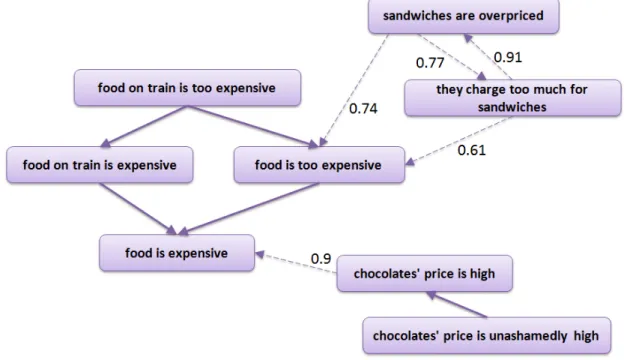
3.1 Example of a fragment graph [Kotlerman et al., 2015] . . . 40
3.2 Sample output of step 4 – A raw entailment graph . . . 42
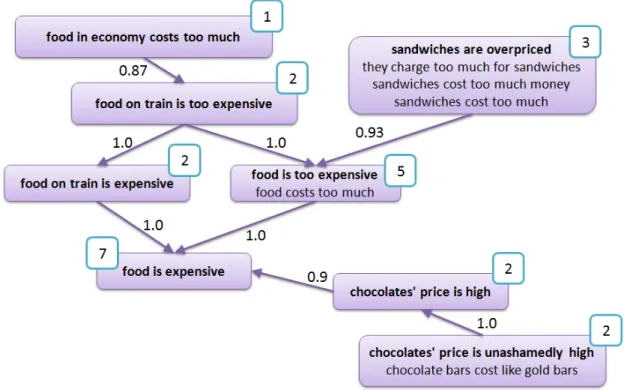
3.3 Sample output of step 5 – A collapsed entailment graph . . . 43
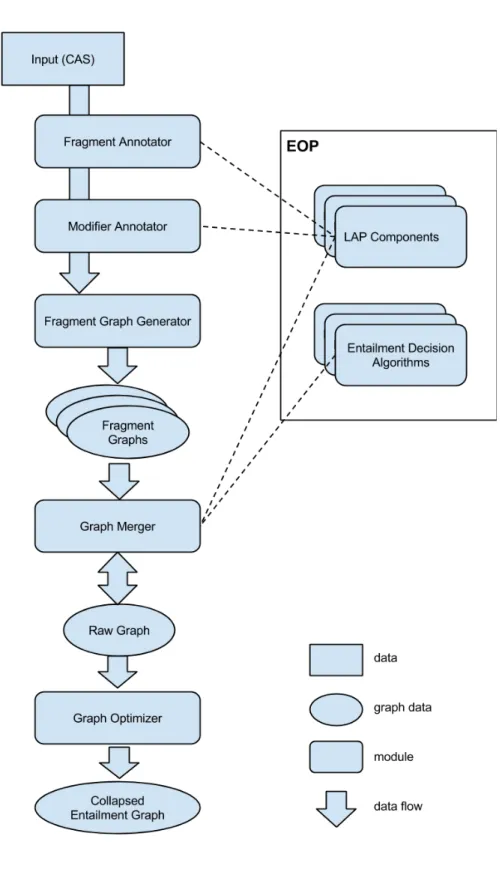
3.4 System architecture . . . 52
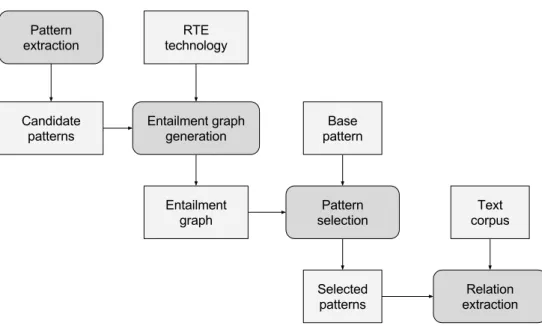
4.1 Procedure for relation extraction using pattern selection based on entailment graphs . . . 57
4.2 Subgraph showing entailment relations for the pattern ”Person1 <marry> Person2” . . . 57
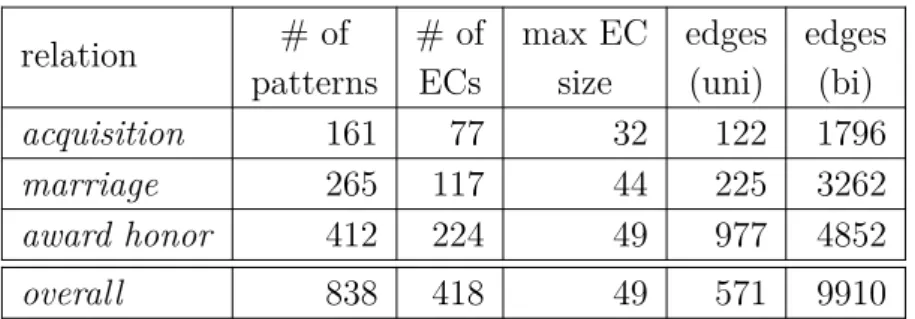
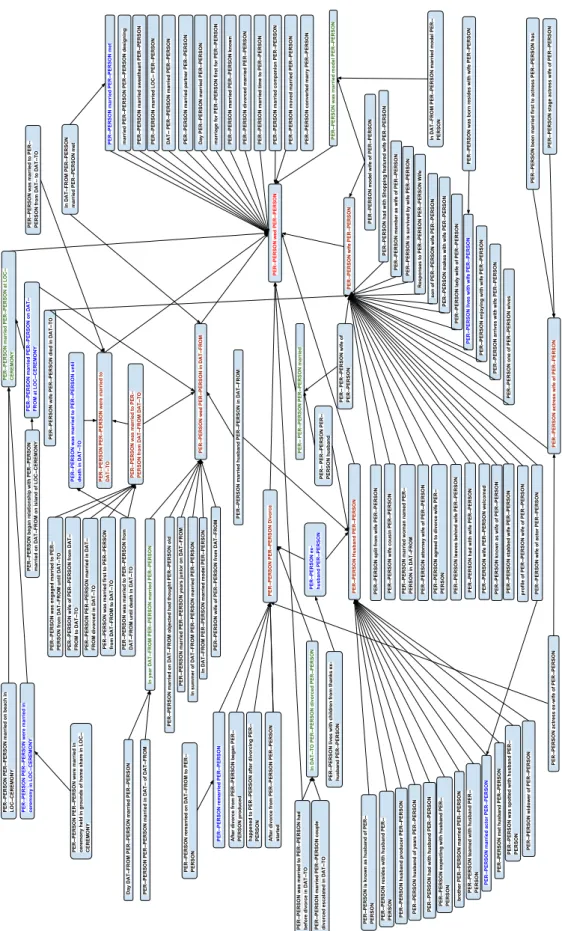
4.3 Entailment graph for marriagerelation . . . 69
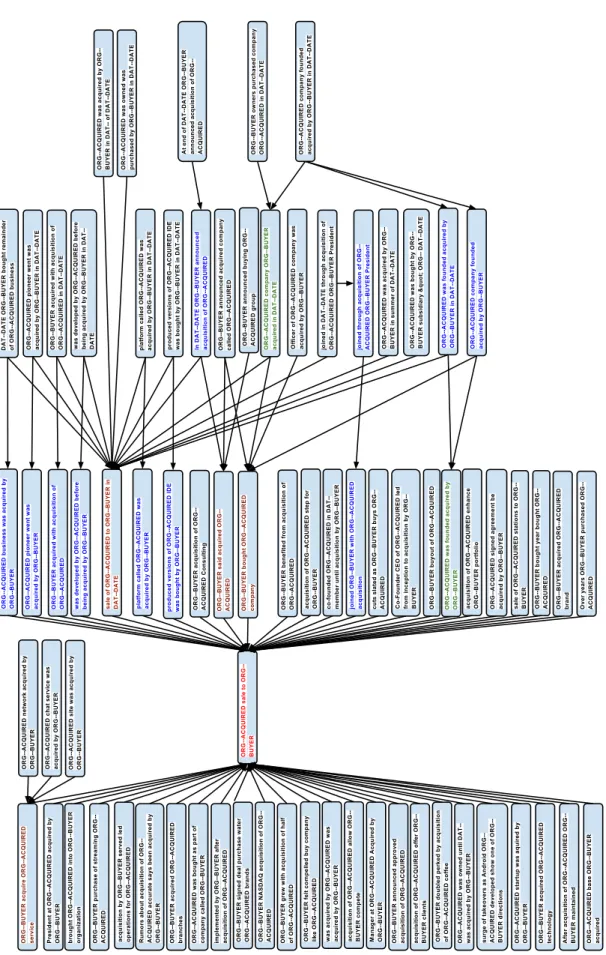
4.4 Entailment graph for acquisition relation . . . 70
4.5 Sample set of EDA decisions (YES: entailment, NO: no entailment) with associated confidence . . . 74
4.6 Sample outputs using greedy (left) and global (right) graph optimizer 74 5.1 Entailment graph showing a subset of relevant entailment relations for the two sample sentences. . . 103
5.2 Accuracy (y-axis) achieved with different EDAs, graph optimizers and optimizer thresholds (x-axis). . . 114
4.1 Semantic roles per relation . . . 60 4.2 Corpus statistics . . . 68 4.3 Distribution of entailment types . . . 68 4.4 Results for marriagerelation (TEG-REP corpus). . . 79 4.5 Results for acquisition relation (TEG-REP corpus). . . 79 4.6 Entailment graph based pattern selection (vs. baseline) for
rela-tions in FB15k-237 corpus. . . 81 5.1 Data example from the anonymized dataset. . . 92 5.2 Distribution of inference steps in the dataset. . . 117 5.3 Comparing different text representations . . . 118 5.4 Overview of mappings . . . 119 5.5 Results using MultiAlign . . . 120 5.6 Results using MaxEntClassificationEDA (original) . . . 120 5.7 Results using MaxEntClassificationEDA (adapted) . . . 120 5.8 Results using SEDA . . . 120 5.9 Mappings and configurations . . . 121 5.10 Results using single token paraphrase mappings . . . 121 5.11 Results using single and multi-token paraphrase mappings . . . 122 5.12 Results using single token entailment mappings . . . 122 5.13 Results using single and multi-token entailment mappings . . . . 122 5.14 Distribution of problem classes for wrongly assigned categories. . . 123 5.15 Results of entailment-graph-based email categorization on
develop-ment data using best SEDA model and different graph optimizers. . 124 5.16 Results of entailment-graph-based email categorization on
develop-ment data using best MaxEntClassificationEDA (adapted) model and different graph optimizers. . . 125 5.17 Results of entailment-graph-based email categorization on
develop-ment data using bestMultiAlignmodel and different graph optimizers.126 5.18 Results of entailment-graph-based email categorization on test data
(using best setting per method as optimized on the development set).126
BOW Bag Of Words
CAS CommonAnalysis System EDA Entailment DecisionAlgorithm EG Entailment Graph
EOP EXCITEMENT Open Platform IE Information Extraction
LAP Linguistic Analysis Pipeline NLP Natural Language Processing RE Relation Extraction
POS Part Of Speech
RTE Recognizing Textual Entailment STS Semantic Textual Similarity T/H Text/Hypothesis
Introduction
1.1
Motivation
Recognizing that the meaning of one text expression is semantically related to the meaning of another can be of help in many natural language processing applica-tions, such as question answering, information retrieval, information extraction, and document summarization. One semantic relationship between two text ex-pressions is captured by the textual entailment paradigm. According to the first PASCAL Recognising Textual Entailment (RTE) challenge, a textual expression T is defined to entail a hypothesis H if ”typically, a human reading T would in-fer that H is most likely true” [Dagan et al., 2006]. An example, taken from the dataset underlying this challenge, is the following:
• T: The two suspects belong to the 30th Street gang, which became embroiled
in one of the most notorious recent crimes in Mexico: a shootout at the Guadalajara airport in May, 1993, that killed Cardinal Juan Jesús Posadas Ocampo and six others.
• H: Cardinal Juan Jesús Posadas Ocampo died in 1993.
In the example above, T entails H because T states, among other things, that a person called Cardinal Juan Jesús Posadas Ocampo was killed in a shootout in May, 1993, and knowing this, a reader would typically infer that this person died in 1993, as stated by H.
Entailment relations can be unidirectional, as in the example above, or bidirec-tional, as in the following example:
• A: Cardinal Juan Jesús Posadas Ocampo and six others were killed at the
Guadalajara airport in May, 1993.
• B: In May 1993, Posadas Ocampo, along with six other people, was
assassi-nated at Guadalajara International Airport.
In this example, expression A entails expression B and vice versa. Bidirectional entailment holds if the two expressions are paraphrases of each other.
Textual entailment is defined as a relation between exactly two text expressions. For capturing the entailment relations holding among a set of more than two text expressions, Berant et al. [2010] introduced the notion ofentailment graphs, which represent entailment relations in a hierarchical way. A sample entailment graph from Berant et al. [2010] is depicted in Figure 1.1, which represents entailment relations holding between propositional templates. In this visualization,→denotes a unidirectional and ↔ a bidirectional entailment relation holding between the connected propositional templates.
Figure 1.1: Entailment graph for propositional templates [Berant et al., 2010] The given graph shows how the underlying templates are semantically related and allows for drawing inferences. For example, the graph states that the template
X-prevent-nausea entails the template X-related-to-nausea, from which we can
derive that any X that prevents nausea is also related to nausea. The graph also states that the two templates X-related-to-nausea and X-associated-with-nausea
bidirectionally entail each other, meaning that the two templates carry the same meaning.
Apart from propositional templates, entailment graphs have also been built for other types of text expressions, including typed predicates [Berant et al., 2012, 2011], open IE propositions [Levy et al., 2014], and text fragments extracted from customer interactions [Kotlerman et al., 2015].
Despite the fact that several people have worked on building entailment graphs for different types of textual expressions, little research has been carried out re-garding the applicability of such entailment graphs in natural language process-ing (NLP) applications. In this work, my goal is to investigate how entailment graphs, expressing knowledge about the semantic relationship holding between text expressions, can be used for two specific NLP tasks: First, the task of vali-dating automatically derived relation extraction patterns and, second, the task of automatically categorizing German customer emails. In the following, I introduce these two tasks and motivate the idea of addressing them using entailment graphs.
1.1.1
Relation extraction
The task of relation extraction is to recognize and extract relations between en-tities or concepts in texts. For example, from the sentence I went to Mary and
Peter’s wedding party, we may want to recognize the fact that the two entities
referred to byMary andPeter got married. A common way to approach this task is to derive extraction patterns using seed entities and use these extraction pat-terns for recognizing additional entities [Brin, 1998]. For example, using Mary and Peter as seed entities, from the sentence above, we could derive the extraction pat-tern [Person1 and Person2’s wedding]. However, automating this process can easily lead to wrong extraction patterns. For example, using the same seed enti-ties, we may also derive an extraction pattern like [Person1 talked to Person2] from a sentence like Mary talked to Peter. Thus, pattern filtering is a crucial step in order to identify high-quality extraction patterns. Filtering strategies can for example be based on frequency heuristics [Krause et al., 2012] or make use of external knowledge resources, such as semantic knowledge bases [Moro et al., 2013]. Assessing the quality of extraction patterns can also be based on identify-ing that extraction patterns are syntactically or semantically related. Work into this direction usually aims at clustering patterns or relation mentions based on similarity measures [Banko et al., 2007, Yates and Etzioni, 2009]. However, the fact that relationships holding among extraction patterns may not be bidirectional
has hardly been exploited so far. For example, identifying the patterns [Person1 married Person2] (pattern 1) and [Person1 divorced Person2] (pattern 2) as being semantically related can be helpful, but falls short of expressing that the relation expressed by pattern 2 entails the relation expressed by pattern 1, but not vice versa.
Being aware of these assymetric relationships between patterns can be of help in pattern selection, as it allows us to distinguish between patterns, from which the target relation can be inferred, and those for which this inference is not possible. For example, both patterns 1 and 2 can be used for extracting people that are or were married. However, only pattern 2 is a valid pattern for extracting couples whose marriage ended in a divorce.
With entailment graphs being a natural way of structuring textual expressions for drawing inferences, I suggest the generation and exploitation of entailment graphs for expressing inference relations holding among extraction patterns and evaluate the usability of these graphs in the context of relation extraction.
1.1.2
Email categorization
Assigning customer emails to matching categories can be approached as a text categorization task. The most commonly used text representation for this kind of tasks is the bag-of-words representation, which has been shown to work well in many applications. The underlying assumption made is that a text can be represented by the set of words contained in it, and that texts expressing similar meaning share the same words. However, as human language allows us to express the same idea in many different ways, for example by using synonyms or para-phrases, this representation can be too simple to capture the semantic relatedness of texts. This is illustrated by the following example, which is taken from a dataset of German customer emails:
• A: Wenn ich Daten im .mpg-Format öffne, stimmt die Tonspur nicht mit
dem Film überein. [When opening data in .mpg format, the audio track does
not match the film.]
• B: Bild und Ton einer Videodatei sind asynchron. [Image and sound of the
Sentences A and B represent two ways of expressing exactly the same customer problem, even though none of the words in B match words in A. In order to identify the semantic relationship between the two sentences, we need to go beyond the surface level of words, and, instead, compare the two texts at the meaning level. Numerous methods have been proposed and applied to address this issue. Ap-proaches range from enriching the bag-of-words representation semantically, for example by incorporating knowledge from external knowledge resources, such as lexical-semantic nets or ontologies, to statistical language models exploiting distri-butional similarities among words (e.g., latent semantic indexing) or topic models (e.g., latent Dirichlet allocation). Still, most of these approaches rely on a word level representation of the text. However, our example shows that matching the two sentences requires more than comparing the semantics of individual words. For example, even if we can derive the relatedness of lexical items such as Ton
[sound] and Tonspur [sound track], this information will not be enough to deter-mine that the expression Daten im .mpg-Format [data in .mpg format] refers to
a Videodatei [video file], and that the expression Tonspur stimmt nicht mit dem
Film überein [audio track does not match the film] is equivalent to Bild und Ton
sind asynchron [image and sound are asynchronous]. This requires the semantic
comparison of larger text units, such as phrases or sentences. Entailment graphs are a natural way of expressing semantic relations among text expressions of any kind and size. For addressing the task of automatically assigning categories to emails, I therefore suggest to generate entailment graphs expressing relationships holding among relevant text expressions, and make use of the generated knowledge when building the classifier.
1.2
Contribution
The general research problem addressed in this work is to investigate how entail-ment graphs can be generated and applied for solving NLP tasks. I approach this problem by evaluating the usefulness of entailment graphs in the context of two specific NLP applications, namely email categorization and relation extraction. The two tasks differ with respect to various dimensions (e.g., language and text type) and are therefore well-suited to demonstrate different issues relating to the construction and usage of entailment graphs, thus allowing for some generalization to other NLP tasks.
Addressing the research problem in an application-oriented way leads to the fol-lowing research questions, to which this thesis will provide answers:
1. How can we formalize the notion of entailment graphs and the general methodology for constructing them?
2. How can we design entailment graphs for the task of relation extraction and can we make use of the generated knowledge for improving extraction accuracy?
3. How can we design entailment graphs for the task of email categorization and can we make use of the generated knowledge for improving categorization performance?
While research question 1 deals with theoretical aspects of entailment graph cre-ation, questions 2 and 3 focus on the applicability of entailment graphs in the context of the two specific NLP tasks. By providing answers to these three ques-tions, this work:
• Provides a general understanding of the issues related to entailment graph generation,
• Proposes two new types of entailment graphs and methods of integrating entailment graph knowledge into NLP applications,
• Shows how entailment graphs can be successfully applied in the context of two NLP applications,
• Assesses the potential of existing RTE technology and resources to generate entailment graphs that can be integrated into real-world applications,
and thus makes a substantial contribution to the rather new field of entailment graph research.
The work underlying this thesis resulted in several publications. These are listed in the following, along with the sections of the thesis, in which the respective work is described.
• Eichler, K., Gabryszak, A., and Neumann, G. (2014). An analysis of tex-tual inference in German customer emails. InProceedings of the Third Joint
Conference on Lexical and Computational Semantics (*SEM), Dublin,
Ire-land (Section 5.2)
• Magnini, B., Zanoli, R., Dagan, I., Eichler, K., Neumann, G., Noh, T.-G., Padó, S., Stern, A., and Levy, O. (2014). The Excitement Open Platform for Textual Inferences. In Proceedings of the 52nd Annual Meeting of the
Association of Computational Linguistics, Baltimore, USA (Section 3.4.1)
• Noh, T.-G., Padó, S., Shwartz, V., Dagan, I., Nastase, V., Eichler, K., Kotlerman, L., and Adler, M. (2015). Multi-Level Alignments As An Exten-sible Representation Basis for Textual Entailment Algorithms. In
Proceed-ings of the 4th Joint Conference on Lexical and Computational Semantics,
Denver, USA (Sections 4.4.2 and 5.4.2.2)
• Eichler, K., Xu, F., Uszkoreit, H., Hennig, L., and Krause, S. (2016). TEG-REP: A Corpus of Textual Entailment Graphs based on Relation Extraction Patterns. In Proceedings of the 10th International Conference on Language
Resources and Evaluation, Portorož, Slovenia (Section 4.3)
• Eichler, K., Xu, F., Uszkoreit, H., and Krause, S. (2017). Generating pattern-based entailment graphs for relation extraction. InProceedings of the
6th Joint Conference on Lexical and Computational Semantics, Vancouver,
Canada (Sections 4.4 and 4.5)
• Eichler, K. and Gabryszak, A. (2017). Evaluating text representations for the categorization of German customer emails. In Theorie, Semantik und
Organisation von Wissen, Passau, Germany (Section 5.3)
Other related publications that I (co-)authored and that are referred to in this thesis are:
• Eichler, K. (2005). Automatic classification of Swedish email messages. Bachelor thesis, Eberhard-Karls-Universität, Tübingen, Germany
• Eichler, K., Hemsen, H., and Neumann, G. (2008). Unsupervised relation extraction from web documents. In Proceedings of the 6th International
• Eichler, K.and Neumann, G. (2010). DFKI KeyWE: Ranking Keyphrases Extracted from Scientific Articles. In Proceedings of the 5th International
Workshop on Semantic Evaluation, Los Angeles, USA
• Eichler, K., Meisdrock, M., and Schmeier, S. (2012). Search and Topic Detection in Customer Requests - Optimizing a Customer Support System.
KI - Künstliche Intelligenz, 26(4):419–422
1.3
Justification
In recent years, the creation of technologies and resources for a deeper understand-ing of text has become a major topic of research, one prominent example beunderstand-ing work in the field of textual inference. Textual inference technologies have been suc-cessfully used in various applications, including question answering, information extraction, summarization, and machine translation. Recently, entailment graphs were proposed as a data structure to capture semantic relationships holding among textual expressions. As such, entailment graphs have the potential to be a valu-able resource for textual inference. However, so far little research has been carried out on the usefulness of integrating entailment graphs into NLP tasks. Also, as the focus of most researchers is on English, little research has been carried out on German language data.
With the research described in this thesis, I aim at filling this gap by (1) de-veloping a generic, application- and language-independent procedure for building entailment graphs and (2) investigating how knowledge about the semantic rela-tionship between textual expressions, expressed in the form of entailment graphs, can be used for addressing two specific NLP tasks: First, the task of validating and selecting relation extraction patterns, and, second, the task of automatically categorizing German customer emails. I am not aware of any previous work related to approaching either of the two tasks using entailment graphs.
For investigating the usefulness of entailment graphs for solving NLP tasks, I chose these two tasks because they differ with respect to several aspects, including text type (relation patterns versus email texts), language (English versus German), domain-specificness (general versus highly domain-specific), as well as the specific usage of entailment graph information for the task. This allows me to identify and address various aspects relating to the generation and usage of entailment graphs
for different NLP tasks. While the focus in this work is clearly on these specific tasks, the findings described in this thesis are thus expected to be relevant to a range of other applications involving textual inferencing.
1.4
Methodology
After reviewing related literature, I address the research questions listed in Sec-tion 1.2 in the following way. Research quesSec-tion 1 is addressed by looking into theoretical aspects related to entailment graph generation. Generalizing and ex-tending notions and methodologies described in previous work in the field of entail-ment graphs, I provide relevant definitions and a formalized procedure for building entailment graphs, thus laying the grounds for the remainder of the work.
Having provided the theoretical foundation, I approach research questions 2 and 3 in an empirical way, i.e., by drawing conclusions from analyzing, processing, and experimenting with specific task-related datasets. Empirical techniques have been prominent in NLP since the 1990s [Cohen, 1995] and keep gaining importance, especially due to the ever-growing availability of language data as well as new technologies for processing them.
In order to investigate the usefulness of entailment graphs for the two tasks, I proceed in the following way: For each task, I first analyze an existing real-world dataset and design and create entailment graphs according to the outcome of the analysis, showing how the general procedure can be applied for building entailment graphs for the respective tasks. For either task, I then propose a methodology for using the knowledge represented by the entailment graphs for solving the respective task and evaluate the usefulness of this knowledge in an experimental way. I also evaluate the potential of state-of-the-art RTE systems, knowledge resources, and graph optimization algorithms to create entailment graphs for the two tasks automatically. This allows me to assess the usefulness of entailment graphs as such, but also the potential of existing RTE technology and resources to automatically generate entailment graphs that can be of help for solving NLP tasks.
1.5
Outline
The remainder of this thesis is structured as follows: Chapter 2 provides an overview of the field with related work on all relevant areas, including research related to semantic knowledge representations, textual entailment and entailment graphs, as well as previous semantic-based approaches to the tasks of email cate-gorization and relation extraction. Chapter 3 formalizes the notion of entailment graphs and the general procedure for building them. It also describes a framework developed for building entailment graphs automatically, using existing NLP and RTE technology, which forms an essential part of the experiments performed in the context of the two applications. In chapter 4, entailment graphs are designed and used in the context of relation extraction. After constructing a gold-standard entailment graph dataset for three semantic relations, I evaluate the potential of the constructed entailment knowledge as well as automatically generated graphs for improving the accuracy of extracting relation instances. Similarly, in chap-ter 5, entailment graphs are designed and used for categorizing German customer emails. Following an analysis of a dataset of German customer emails, I develop entailment graphs for the task of email categorization, propose a method of using the generated knowledge for the categorization task, and present experimental re-sults. Applying state-of-the-art RTE technology, I then build entailment graphs automatically and evaluate the resulting graphs on the task, showing the effects on categorization accuracy. Chapter 6 summarizes my contributions and presents directions for future work.
1.6
Delimitations
For addressing the above research questions, I made use of existing RTE technol-ogy, including several algorithms for deciding on entailment, two graph optimiza-tion strategies, and various linguistic knowledge resources. Within the scope of this thesis, no research was carried out regarding the development of new RTE technology. Rather, existing technology was applied and adapted to evaluate the applicability of entailment graphs for solving NLP tasks.
This was achieved by analyzing data and carrying out experiments in the context of two specific NLP tasks: relation extraction and email categorization. Due to
the vastness and diversity of NLP tasks, there may be aspects relevant in other NLP tasks that are not covered in this work. However, the two tasks were chosen to differ with respect to various dimensions, including language, type of input, and usage of entailment graph knowledge, thus ensuring that the results obtained allow for some generalization.
Literature Review
2.1
Introduction
This chapter presents an overview of the literature related to the research problem addressed in this thesis: the generation of entailment graphs and their applicability for solving natural language processing (NLP) tasks. In the first three sections, I will give an overview of work related to semantic knowledge representations, textual entailment and entailment graphs. In the remaining two sections, I will summarize previous work related to the two NLP tasks addressed in this work: text categorization and relation extraction, focussing on approaches that make use of semantic knowledge.
2.2
Graph-structured semantic knowledge
rep-resentations
The generation and usage of machine-readable representations of semantic knowl-edge has been a major theme of research in NLP for several decades. Research directions range from the manual and (semi-)automatic construction of semantic knowledge resources to the integration of these resources into a wide variety of NLP applications. A powerful means of representing knowledge is in the form of graph structures. A well-known example of a graph-structured resource is the se-mantic lexicon WordNet [Fellbaum, 1998, Miller, 1995], which represents relations between word meanings and has been heavily applied for a wide variety of tasks.
A common structuring principle for semantic lexicons is to define semantic classes, each expressing a distinct concept, and model the semantic relations holding be-tween semantic classes as a hierarchy of super and sub-concepts [Frank and Padó, 2012]. In WordNet, words are grouped into sets of cognitive synonyms callsed synsets, and synsets are interlinked by means of semantic relations. Some of these relations, such as the hyperonymy/hyponymy relation for nouns and specificity of manner for verbs, arrange the linked synsets in the form of a hierarchy. WordNet-like resources have been created for dozens of other languages, including many monolingual resources, such as GermaNet [Hamp and Feldweg, 1997] for German, but also resources linking WordNet resources across different languages [Pianta et al., 2002].
Unlike general language resources like WordNet, which aim at modelling a specific type of linguistic knowledge exhaustively for one or several languages, domain ontologies model relations among concepts relevant for a particular domain or ap-plication. They are particularly useful in domains with large amounts of domain-specific terminology, e.g., in biology [Bard and Rhee, 2004]. An important relation type in ontologies is the is-a relation, which creates a hierarchically structured taxonomy of concepts along the hyperonymy relation. Unlike linguistic knowledge resources, which are usually hand-crafted, domain ontologies are often created (semi-)automatically, for example using lexico-syntactic patterns [Hearst, 1992, Snow et al., 2004] or clustering [Cimiano and Völker, 2005]. In addition to pattern-based methods for extracting hypernym-hyponym relations, researchers have in-vestigated the usage of directional distributional similarity measures [Kotlerman et al., 2010] and word embeddings [Fu et al., 2014].
Even though lexical semantic resources and ontologies have shown useful in many applications, their expressivity is limited by the fact that their basic units are usually single, isolated words [Slodzian, 2001]. These resources usually do not cover semantic relationships holding between concepts expressed as linguistic units more complex than a single word.
Resources such as FrameNet [Baker et al., 1998] and VerbNet [Kipper-Schuler, 2005] go beyond lexical meaning and model predicate-argument structures, thus capturing the constitutive meaning relations holding between predicates and their arguments. FrameNet groups verbs, nouns, and adjectives into semantic classes (so-called frames), corresponding to abstract situations or events. The frames are linked according to a system of frame relations, which define relation hierarchies
(relating more general frames to more specific ones), but also semantic relations such as the succession of events and states. VerbNet is a verb lexicon of hierarchi-cally arranged verb classes where each verb class is described by thematic roles, selectional restrictions on the arguments, and frames. Though more expressive in terms of grammatical constraints, these hand-crafted resources are still centered around lexical items.
While hierarchical structures representing knowledge at the lexical level have been created and used massively, similar knowledge structures encoding relations be-tween larger text units have appeared only recently [Nastase et al., 2015]. One such structure are entailment graphs [Berant et al., 2010], which are based on the paradigm of textual entailment. They go beyond the lexical level, modelling relations holding between larger text units, such as predicate-argument structures or text fragments. The type of text expression, for which entailment relations are modelled, depends on the application, for which entailment graphs are built. Entailment graphs focus on a single relation type, textual entailment, which, un-like a simple is-a-hierarchy is able to express semantic relations holding between predicates and other complex text units. While hand-crafted entailment graphs have been created for evaluation purposes [Bentivogli and Magnini, 2014, Kotler-man et al., 2015], the ultimate goal is to create entailment graphs in an automatic way. The automatic generation of entailment graphs is commonly approached using entailment decision algorithms, (linguistic) knowledge resources, and graph optimization algorithms [Berant et al., 2010, 2011]. In the following, I will in-troduce the notion of textual entailment and present related work in the fields of recognizing textual entailment and building entailment graphs.
2.3
Recognizing textual entailment
2.3.1
Definition of the task
In semantics, the notion of entailment is defined as a relationship between two statements holding ”when the second is a logically necessary consequence of the first” [Brinton, 2000], i.e., a sentence A entails another sentence B if A is true in every possible state of affairs in which B is true. Viewed in a strict sense, entailment is a binary relation between declarative expressions, to which a truth
value can be assigned in a given context. However, entailment can also be extended to include relations between other types of textual expressions, such as words and phrases [Sánchez Valencia, 1996].
The NLP task of Recognizing Textual Entailment (RTE) was established in and evolved around the RTE challenges [Dagan et al., 2006] with the goal of deter-mining whether textual entailment holds for a given text/hypothesis pair. The notion oftextual entailment refers to an application-oriented notion of entailment: It considers a text T to entail a statement H (also called hypothesis) in cases in which H is highly plausible, given the truth of T, i.e., whenever ”a human reading T would typically infer that H is most likely true” [Dagan and Glickman, 2004]. This allows for cases, in which the truth of H may be considered slightly uncertain, at least hypothetically [Dagan et al., 2013], as in the following example, taken from the dataset of the RTE-2 challenge:
• T: About two weeks before the trial started, I was in Shapiro’s office in
Century City.
• H: Shapiro works in Century City.
Given the T/H pair above, we may think of a situation, in which Shapiro has an office in Century City, but does not actually work there. However, this situation would be highly unlikely. Rather, according to the typical expectations of a reader of T, one would say that the truth of H can be inferred from the truth of T. RTE relates to two other NLP tasks, namely Paraphrase Recognition and Seman-tic Textual Similarity. The term paraphrase is used when referring to textual expressions that convey the same meaning using different surface forms. Bhagat and Hovy [2013] distinguish between strict paraphrases, which must be exactly logically equivalent, and quasi-paraphrases, i.e., text expressions conveying
ap-proximately the same meaning. As most complex paraphrases, i.e., the ones with
alternations going beyond lexical synonymy and local syntactic changes, exhibit at least some degree of difference in content [Dolan and Brockett, 2005], the broader definition of paraphrase is the one that is commonly applied in NLP. Paraphrases may occur at several levels [Madnani and Dorr, 2010]: At the lexical level, para-phrases are usually referred to as synonyms, for example the verbs (to) buy and
(to) purchase. Phrasal paraphrases may be patterns with linked variables, for
complex transformations going beyond the substitution of individual words and phrases in the original sentence with their respective semantic equivalents, e.g.,
He needed to make a quick decision in that situation and The scenario required
him to make a split-second judgment.
Another related notion is text similarity, which can be measured with respect to different dimensions, including structure, style, and content [Bär et al., 2011]. The task of measuring the similarity of texts according to the content dimension is referred to as semantic textual similarity (STS), which ”measures the degree of semantic equivalence” [Agirre et al., 2012]. STS thus differs from paraphrase recognition in that its output is defined as being graded, rather than binary. Due to this vagueness, it is not directly applicable to inference tasks: As Dagan et al. [2013] illustrates, the sentence monkeys like bananas is semantically similar to
monkeys like mangoes, but neither can be inferred from the other.
The RTE task differs from both Paraphrase Recognition and STS in that it as-sumes the relation between two texts as beingdirectional, whereas both paraphrase recognition and STS measure a symmetric relation: If A is a paraphrase of B, then B is also a paraphrase of A. Similarly, the degree of similarity measured in STS for a pair of texts A and B does not consider any directional relationship between A and B. This symmetry does not hold in RTE: If a text A entails a text B, B can, but does not have to entail A. As both the paraphrase relation and the en-tailment relation are defined as binary relations, for which the the output is either TRUE or FALSE, the paraphrase relation can be viewed as bi-directional textual entailment.
2.3.2
Approaches and technology
Dagan et al. [2013] distinguishes five types of approaches to solving the RTE task: Edit distance-based approaches, approaches based on logical representa-tion and inference, transformarepresenta-tion-based approaches, alignment-based approaches, and paired-similarity approaches. Edit distance-based approaches, as applied by Mehdad et al. [2009] and Heilman and Smith [2010], define edit operations at the level of strings, tokens or syntactic dependency trees, as well as schemes reflect-ing the cost associated to each edit rule. This framework allows the computation of edit distance scores reflecting the amount of editing required to transform the text (T) into the hypothesis (H). The second type of approaches induce a logical
representation of T and H and combine this with a knowledge base representing background knowledge for determining entailment. Approaches along this line include the ones proposed by Bos and Markert [2005], Hodges et al. [2006] and Clark and Harrison [2009]. Transformation-based approaches [Bar-Haim et al., 2007, de Salvo Braz et al., 2005, Harmeling, 2009, MacCartney and Manning, 2009, Stern and Dagan, 2011] aim at making Text and Hypothesis identical using a set of transformation rules, which are constructed in a way that each transforma-tion yields a valid natural language sentence as their result. Alignment-based ap-proaches align portions of T (tokens, phrases, or more complex text constituents) to relating portions of H and were applied by Chambers et al. [2007], Chang et al. [2010], Hickl and Bensley [2007], Iftene and Dobrescu [2007], MacCartney et al. [2006], Madhumita [2016], Noh et al. [2015], Sammons et al. [2009]. Unlike the former approaches, paired-similarity approaches model similaritiesacrossdifferent T/H pairs, e.g., using kernel-based methods [Wang and Neumann, 2007, Zanzotto and Moschitti, 2006].
Irrespective of the chosen approach, most RTE systems underlyingly make use of the same two types of sources: First, knowledge derived by analyzing the text representing H and T using linguistic preprocessing tools, and second, knowledge derived from external knowledge resources, such as linguistic or semantic knowl-edge stored in (hand-crafted) resources, knowlknowl-edge derived using corpus-based methods, and transformation rules.
As linguistic analysis is an essential part of recognizing entailment, RTE sys-tems build upon preprocessing tools such as stemmers, part-of-speech taggers, and named-entity recognizers for creating additional lexical knowledge, and parsers for RTE systems operating at the syntactic level. External knowledge resources are crucial to recognize entailment in cases where text and hypothesis use different, but entailment-preserving surface forms (words or phrases). Linguistic knowledge resources such as CatVar [Habash and Dorr, 2003], NOMLEX [Meyers et al., 1998] and DErivBase [Zeller et al., 2013] can provide information about words belonging to the same derivational family. The most commonly used hand-crafted knowl-edge resources are lexical nets, such as WordNet Fellbaum [1998], which can help retrieve information about synonymy or hyperonymy relations. Other semantic knowledge resources capture information at higher grammatical levels, such as VerbNet [Kipper-Schuler, 2005], or FrameNet [Baker et al., 1998], the latter a resource applied by Burchardt [2008].
Apart from the above-mentioned hand-crafted knowledge resources, other resources can be (semi-)automatically derived based on statistics computed over large lan-guage corpora, e.g., Wikipedia. Corpus-based methods for knowledge acquisition are either based on distributional similarity or co-occurrence [Dagan et al., 2013]. Co-occurrence-based methods rely on the assumption that words that occur fre-quently together are topically related. They were introduced by Hearst [1992] who identified linguistic patterns connecting pairs of words that express a particular relation type, e.g., hyponymy. Distributional similarity methods follow the
dis-tributional hypothesis by Harris [1954], suggesting that words that tend to occur
in similar contexts have similar meanings. They assess the degree of similarity between two words by measuring the degree of similarity between their context representations. A widely used similarity measure for distributional similarity is the one by Lin [1998]. A collection of English paraphrase expressions automati-cally learned based on the distributional hypothesis is DIRT, created by Lin and Pantel [2001a].
Recently, with the rising availability of technological means to process large amounts of data, much attention has been put on data-driven methods. In particular, with the re-advent of neural networks in the context of ”deep learning”, the RTE task was addressed using neural models [Bowman et al., 2015, Rocktäschel et al., 2015]. Unlike previous approaches, they do not make use of processing pipelines or exter-nal resources, but require large high-quality datasets to achieve good performance on the RTE task. In the last two years, different neural network models were evaluated on the SNLI corpus [Bowman et al., 2015]. Earlier approaches were evaluated mostly on the datasets made available through the PASCAL RTE Chal-lenges [Dagan et al., 2006], on which a study by Bos and Markert [2005] found human agreement to be 95.25%. State-of-the-art systems are still far from this performance. The best result reported on the RTE-3 test dataset was an accuracy of 80% [Hickl and Bensley, 2007]. The best reported accuracy on the SNLI test corpus was 88.8% [Zhiguo Wang, 2017].
A number of RTE systems have become publicly available over the last years, in-cluding Nutcracker [Bos and Markert, 2005], EDITS [Kouylekov and Negri, 2010] and BIUTEE [Stern and Dagan, 2012]. Linguistic tools and knowledge resources commonly used by RTE systems were collected at the Textual Entailment Re-source Pool1 , a website created by the RTE Challenge organizers. In the context
of the EU project EXCITEMENT, an open platform providing RTE technology was developed and made available to the community. The platform called Excite-ment Open Platform [Magnini et al., 2014b] (EOP) provides a generic architecture and implementations for recognizing textual entailment in multiple languages, in-cluding English, German, Italian, and Bulgarian. The platform includes state-of-art algorithms following different approaches (tranformation-based, edit-distance-based, and classification-based), a large number of knowledge resources (lexical and syntactic), tools for creating new resources, as well as experimentation and testing facilities.
2.3.3 Applications
As drawing conclusions from natural language texts is highly relevant when pro-cessing natural language text automatically, RTE-based approaches have been in-vestigated in the context of various NLP applications, including question answer-ing, intelligent tutoranswer-ing, and machine translation. Harabagiu and Hickl [2006] use an RTE system to re-rank candidate answers in a Question Anwering sys-tem. Applying a rule-based approach to transform the input question into a short statement, they determine whether the transformed question (H) entails any of the candidate answers, and move entailing candidates to the top of the output list. Similarly, Celikyilmaz et al. [2009] compute entailment scores between feature rep-resentations of user questions and candidate sentences returned by a search engine to improve the ranking of the provided answers. In the QALL-ME system [Ferrán-dez et al., 2011], an RTE engine is used for mapping natural language questions against a structured database of prototypical question patterns. Entailment-based approaches have also been applied in the area of intelligent tutoring: Nielsen et al. [2009] and Sukkarieh and Stoyanchev [2009] measure the quality of student answers by checking whether they entail the concepts of the recorded reference answer. In machine translation, Mirkin et al. [2009] use entailment to address the task of translating unknown terms. Replacing unknown terms in the source sentence by hypernyms, they increased the coverage of unknown terms by 50% compared to allowing only synonyms as substitutes, losing only a few percent-age points in precision. RTE techniques have also been used in the context of evaluation. Padó et al. [2009] propose an entailment-based automated measure of translation quality. Entailment-based parser evaluation was introduced in the
SemEval-2010 Shared Task [Yuret et al., 2013]. The functionality of the EXCITE-MENT platform was applied to and evaluated in the context of two industrial use cases processing customer interactions [Noh et al., 2015]. Whereas previous experiments had been performed solely in research environments, this was the first time RTE systems were evaluated in a real-world context.
2.4
Entailment graphs
Entailment graphs are hierarchical representations of entailment decisions and can be viewed as a special type of knowledge graph. Knowledge graphs are ”graph-structured knowledge bases whic
![Figure 1.1: Entailment graph for propositional templates [Berant et al., 2010]](https://thumb-us.123doks.com/thumbv2/123dok_us/416223.2547693/28.893.229.614.694.885/figure-entailment-graph-for-propositional-templates-berant-et.webp)
![Figure 3.1: Example of a fragment graph [Kotlerman et al., 2015]](https://thumb-us.123doks.com/thumbv2/123dok_us/416223.2547693/66.893.112.730.777.1028/figure-example-fragment-graph-kotlerman-et-al.webp)