University of Warwick institutional repository:http://go.warwick.ac.uk/wrap A Thesis Submitted for the Degree of PhD at the University of Warwick
http://go.warwick.ac.uk/wrap/73391
This thesis is made available online and is protected by original copyright. Please scroll down to view the document itself.
Parametric Dynamic Survival
Models
by
Karla Hemming
A thesis submitted for the degree of Doctor of Philosophy
Department of Statistics
University of Warwick
Coventry
CV47AL
Contents
1 Introduction
2 Survival Analysis
2.1 Censoring and Truncation . . . . . 2.2 The Survival and Hazard Functions 2.3 The Likelihood . . .
2.4 The Bayesian Approach
2.5 Survival Models . . . . . 2.6 Non-proportional Hazards 2.7 Methods for Model Fitting . 2.8 Interval Censoring . . . .
2.9 Double Interval Censoring 2.10 Frailty . .
2.11 Summary
3 Dynamic Survival Models
3.1 The Dynamic Bayesian Model for Survival Data 3.2 Parametric Dynamic Survival Models . . . .
3.2.1 Conditional Survival Functions (1) 3.2.2 The Temporal Factorisation . . . . 3.2.3 Conditional Survival Functions (2) 3.2.4 Conditional Survival Functions (2B) 3.2.5 The Individual Factorisation.
3.2.6 MCMC Implementation
3.2.7 Convergence Diagnostics 3.3 Gastric Cancer Data Analysis
3.4 Summary . . . . . . .. 95
4 Flexible Dynamic Survival Models
4.1 Conditional Survival Functions (3) 4.2 Interval Censoring . . . . .
4.2.1 The Likelihood .. . 4.3 Double Interval Censoring . 4.3.1 The Initiating Event 4.3.2 The Terminating Event.
4.4 F r a i l t y . . .
4.4.1 The Normal Dynamic Frailty Model (NDFM) .. 4.4.2 Interval Censoring and Frailty ..
4.4.3 Individual Frailties . 4.5 Summary .
5 Model Fitting
5.1 Gibbs Sampling . . . . 5.1.1 The Full Conditionals
5.1.2 Metropolis-Hastings . 5.2 Imputation Methods . . . .
5.2.1 Interval Censoring .
5.2.2 Double Interval Censoring . . . . 5.3 Simulation Study
5.4 Summary . . . .
6 Data applications
6.1 Breast Cancer Data .
6.1.1 Analysis using the NDSM . . . .
ii
.
'..
97 99
.100
· 101 .102
.105 .106
· .110 · . 111
· .117 · .119 · .127
128
· 128 · 129
· . 135 · .. 136 · .. 138 · .. 140
· .. 142 · .. 150
151
6.2 Kidney Infection Data . . . . 6.3 AIDS Data . . . .
6.3.1 Analysis of Times of Infection
6.3.2 Analysis of Incubation Time .
7 Conclusions and Discussion
7.1 Summary . . . .
A Data Frames and Preliminary Analysis
A.l Gastric Cancer Data . .
A.2 Breast Cancer Data . A.3 Kidney Data. .
A.4 AIDS Data
..
A.5 Simulated DataB Simulation Code
iii
· 162 · 169
· 171 · 176
181
· 189
191
· 191
· 198 .205 .213
.225
List of Figures
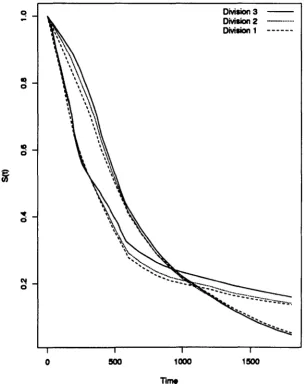
1 Gastric Cancer: Survival Function . 89
2 Gastric Cancer: Log-baseline Hazard 90
3 Gastric Cancer: Treatment Effect . . 91
4 Gastric Cancer: Proportional Hazards (NDSM) 92
5 Gastric Cancer: Survival using Individual Frailties . · 123
6 Gastric Cancer: Survival using Individual Frailties (2) . .124
7 Gastric Cancer (with Frailties): Esimated Log-Baseline Hazard 125 8 Gastric Cancer (with Frailties): Estimated Treatment Effect · 126
9 Right Censored Simulated Data: Group1 . . .144
10 Right Censored Simulated Data: Group2 . . .145
11 Interval Censored Simulated Data: Group1 . .146
12 Interval Censored Simulated Data: Group2 . .147
13 Double Interval Censored Simulated Data .148
14 Breast Cancer: Survival Function · 158
15 Breast Cancer: Treatment Effect · 159
16 Breast Cancer: Log-baseline Hazard . · 160
17 Breast Cancer: Proportional Hazards (NDSM) . · 161
18 Kidney Data: Survival Function . . · 166
19 Kidney Data: Log-baseline Hazard .167
20 Kidney Data: Covariate Effect . . . . · 168
21 AIDS Data Initiating Event: Covariate Effects · 172 22 AIDS Data Initiating Event: Survival Function · 173 23 AIDS Data Initiating Event: Log-baseline Hazard .174
24 AIDS Data Terminating Event: Survival Function . .178 25 AIDS Data Terminating Event: Covariate Effects
.
· 17926 AIDS Data Terminating Event: Log-baseline Hazard . . . 180
27 Gastric Cancer: Kaplan-Meier . . . 192
28 Gastric Cancer: Cox . . . 193
29 Gastric Cancer: Test of Proportionality. . 194
30 Gastric Cancer: Gibbs Sampling Output . 197
31 Breast Cancer: Thrnbull's Estimate . . 199
32 Breast Cancer: Cox . . . 200
33 Breast Cancer: Test of Proportionality . . . . 201
34 Breast Cancer: Gibbs Sampling Output. . . . 204
35 Kidney Data: Kaplan-Meier . . . 206
36 Kidney Data: Cox . . . . 207
37 Kidney Data: Test of Proportionality . . . 208
38 Kidney Data: Gibbs Sampling Output . . . . 212
39 AIDS (Initiating): Lightly Treated Thrnbull's Estimate. . 215
40 AIDS (Initiating): Test of Proportionality (1) . . . . 216
41
42
43
44
45
46
AIDS (Initiating): Test of Proportionality (2) . . . . 217
AIDS (Terminating): Lightly Treated Thrnbull's Estimate . 218
AIDS (Terminating): Heavily Treated Thrnbull's Estimate .. 219
AIDS (Terminating): Test of Proportionality (1) . . . . 220
AIDS (Terminating): Test of Proportionality (2) . . . 221
List of Tables
1 2 3 4 5 6 7 8 9 10 11 12 13 14 15 16 17 18 19Gastric Cancer: Time Axis Comparision
Gastric Cancer: Number of Iterations Comparision Gastric Cancer: Individual Frailties.
Gastric Cancer Data . . . .
Gastric Cancer: Numerical Output Gastric Cancer: Summary Output . Breast Cancer Data. . . .
Breast Cancer: Numerical Output .. Breast Cancer: Summary Output
Kidney Data. . . . Kidney Data: Numerical Output Kidney Data: Estimated Frailties
Kidney Data: Estimated Frailties (continued) AIDS Data: Lightly Treated Group . . . . AIDS Data: Heavily Treated Group . . . .
AIDS Data Initiating Event: Numerical Output
AIDS Data Terminating Event: Numerical Output AIDS Data Terminating Event: Imputation Output Simulated Data: Summary Output . . . .
93
94
· 122
· 191
· 195
· 196
Acknowledgements
I would like to thank my supervisor Ewart Shaw for all of his help
and guidance over the past 3 years, and the EPSRC for supporting
me financially. I wish to thank also my colleagues for their valuable
help. Finally thanks to Henry, my family and Pete.
Declaration
Summary
A non-proportional hazards model is developed. The model can
accommodate right censored, interval censored and double interval
censored data sets. There is also an extension of the model to include multiplicative gamma frailties.
The basic model is an extension of the dynamic Bayesian survival
model developed by Gamerman (1987), but with some alterations and
using a different method of model fitting. The model developed here,
the Normal Dynamic Survival Model, models both the log-baseline
hazard and covariate effects by a piecewise constant and correlated
process, based on some division of the time axis. Neighbouring
piece-wise constant parameters are related by a simple evolution equation:
normal with mean zero and unknown variance to be estimated.
The method of estimation is to use Markov chain Monte Carlo simu-lations: Gibbs sampling with a Metropolis-Hastings step. For double
interval censored data an iterative data augmentation procedure is
considered: exploiting the comparative ease at which interval
cen-sored observations may be modelled.
The model is applied within a range of well known, and illustrative
data sets, with convincing results. In addition the impact of censoring
General Notation
D Data including observations and priors.
i
=
1, ... ,rvr
Subscript for individuals.i
=
1, ... , ns Subscript for individuals in data set for S.K Number of observed covariates.
k = 1, ... , K Subscript for covariates.
ns
rvr
T
Number of individuals in the initiating study population.
Number of individuals in the study population.
Survival times.
T = X - S Survival time based on observing X and S.
t
Observed value of T.S
s
X
Survival or censoring time for individual i.
Survival time for the initiating event.
Observed value of S.
Calendar time of terminating event.
Time Axis Notation
(3j
Dj
Dynamic parameter for model.
Information observed up to time tj.
Gs = {so, sI, ... , SNs} Time axis division for initiating model.
GT =
{to,
tl, ... , tNT } Time axis division for survival model.Ij = (Sj-17 Sj] Interval on the initiating time axis.
Ij = (tj-t, tj] Interval on the time axis.
j
=
1, ... ,Nsj
=
1, ... ,NTNs
NT
Sj
tj
Subscript for interval points on the initiating time axis.
Subscript for interval points on the time axis.
Number of intervals on initiating time axis.
N umber of intervals on time axis.
Point on the initiating time axis.
1
Introduction
Cox's proportional hazards model permits the impact of covariates on
sur-vival to be estimated, and using the partial or marginal likelihood approaches
as in Cox (1972) and Kalbefieisch and Prentice (1980), estimates for the
model parameters have been shown to have the same asymptotic properties
as the maximum likelihood estimates (Tsiatis, 1981). Over the last three
decades the model has been heavily used: it has formed a large part of the
basis of statistical research in survival analysis, and has become probably the
most commonly used multivariate survival model in medical applications. Its
major drawback is the constraint of proportional hazards: an assumption
which is not always appropriate. The consequences of using such a model
when the assumption is not appropriate can be high, and for instance may
result in the conclusion of a single superior treatment, when infact this may
not be the case (Carter et al., 1983). Aware of the constraints of the
propor-tional hazards model, Gore et al. (1984) fitted several proportional hazards
models in consecutive intervals (being careful to ensure an adequate amount
of data within each of the intervals), thus avoiding an overall proportional
hazards assumption. The method is not ideal; will only work with large data
sets; and is very sensitive to the number and location of the intervals. Carter
et al. (1983) included treatment multiplied by time as a time dependent
can be extended to model other polynomial changes). Gamerman (1987)
used a piecewise constant baseline hazard and covariate effect, relating
inter-val estimates by a simple semi-parametric relationship. Parameter estimates
are sequentially updated as additional data are received, using conjugate and
linear Bayes approximations, finally sequencing backwards through the
in-tervals to obtain smoothed retrospective estimates. The piecewise constant
correlated process (often abbreviated to piecewise correlated process), is an
attractive way to model both the baseline hazard and covariate effects. Gray
(1992), amongst others, used cubic splines to model both the baseline hazard
and covariate effects over time. Apart from the quoted alternatives above,
there exist few other survival models which are not based on the proportional
hazards assumption.
For interval censoring, double interval censoring and frailty models
(non-independent observations), similar constraints exist in that the majority, if
not all, of the multivariate models are again based on Cox's proportional
hazards model. Piecewise correlated functions have been used to model the
baseline hazard for more complicated censoring types (Ghosh and Sinha,
1995), but the method has never been extended to modelling dynamic
co-variate effects. One of the main reasons for this has been the difficulty in
In this thesis a Markov chain will be constructed with a posterior
distri-bution which models the data by piecewise correlated functions for both the
baseline and covariate effects: thus avoiding the constraints of proportional
hazards, and at the same time overcoming the usual difficulty of estimating
model parameters. The model will be applied to standard right censored
data, and also to additional types of censoring such as interval censoring,
double interval censoring, and frailties. For right censored data the method
will be an alternative to that proposed by Gamerman (1987). For more
com-plicated data types, a non-proportional hazards model will thus have been
developed.
In Chapter 2, many of the standard survival analysis methods are introduced
(including both frequentist and Bayesian methods). A discussion is given as
to why proportional hazards may sometimes be an unreasonable
assump-tion to make, and some alternative methods are suggested. Recent advances
in model fitting techniques are explained, and the method of Markov chain
Monte Carlo (MCMC), including Gibbs sampling and Metropolis-Hastings,
are described. Additional types of censoring (interval censoring, double
inter-val censoring, and also non-independent observations), the problems which
In Chapter 3, Gamerman's model (Gamerman, 1987) is introduced, and the
method for estimating model parameters outlined. It is firstly noted how the
paramater which determines the amount of evolution from interval to interval
(the evolution variance) must be specified prior to model fitting. Secondly it
is observed that the method used by Gamerman to fit the model could not
be extended to accommodate interval, double interval censoring, or frailty
models. For these reasons, a parametric version of Gamerman's model is
introduced, called the Normal Dynamic Survival Model (NDSM). The model
has the same basic structure as in Gamerman (1987) but assumes that the
evolution of the parameters follows a normal distribution (it also models
the evolution variance as a hyper-parameter). It is a parametric model, but
only weakly so, and the model remains sufficiently flexible to accommodate a
wide range of both proportional and non-proportional hazard functions. The
model does however have one disadvantage, and that is no smooth estimates
of covariate effects and baseline hazard exist, although survival estimates are
smooth. To estimate model parameters, Gibbs sampling with a
Metropolis-Hastings step is used. It is noted how Gibbs sampling could not be used in
the semi-parametric model developed in Gamerman (1987), as without
mod-elling the evolution by some parametric distribution, the full conditionals
reparametrisation is introduced, and the likelihoods are based on a temporal
factorisation. The method is illustrated on a set of gastric cancer survival
times (Gamerman, 1987). The development of the NDSM, and data
appli-cations using this model are new developments.
In Chapter 4, likelihoods are developed under the same Normal Dynamic
Survival Model, for extended censoring types (including interval censoring,
double interval censoring, and frailties). For interval censoring, the likelihood
is fairly straightforward, and uses only a slight extension of the conditional
survival functions (developed in Chapter 3 and which were used within the
construction of the likelihood for the right censored model). For double
inter-val censoring, it is observed that the exact likelihood can not be derived, and
so an approximation is given in its place. For both interval censoring and
dou-ble interval censoring, it is not possidou-ble to create a temporal factorisation of
the likelihood and so a factorisation over each observation (individual
factori-sation) is derived as an alternative. For the right censored frailty model, the
likelihood is first given as a temporal factorisation, and secondly as a
factori-sation over the groups: so that the most efficient factorifactori-sations may be used
to compute different full conditionals. Likelihoods are similarly developed for
the interval censored frailty models (it is also described how the likelihood
a small discussion is given on the concept and use of individual frailties. All of
the work within Chapter 4 is new work, although some similarities may exist
between likelihoods of others, and where this is the case it will be made clear.
In Chapter 5, it is shown how Gibbs sampling can be used to estimate the
model parameters using the likelihoods developed in Chapter 4. For double
interval censoring it is explained how either the approximate likelihood could
be used in a full likelihood analysis using Gibbs sampling; or as an
alterna-tive, a method using imputation is outlined, where the data is augmented
to interval or right censored data as appropriate. Applying MCMC
tech-niques to survival data is by now a common feature. The techtech-niques within
this Chapter are not original, but applying them to the NDSM is. As with
the right censored model, a reparmeterisation is used: finding an effective
reparmeterisation is quite a common procedure, Gamerman (1998) also
sug-gested it within the context of a dynamic generalised linear model, although
work here was completely independent. Aslanidou
et
al. (1998) havecon-structed full conditionals for the frailty parameters in a similar model, and
those full conditionals do bare some similarity to those constructed here,
al-though their model is a proportional hazards model. To examine the impact
that the degree of censoring has on the model, data sets will be simulated
will then be compared to the relevant non-parametric technique.
In Chapter 6, the methods are applied to some real data applications:
in-cluding a set of breast cancer survival times, generating an interval censored
data set (Finkelstein, 1986); a group of haemophiliacs infected with HIV
and AIDS resulting in an incubation time which is double interval censored
(Kim et al., 1993); and some kidney infection times (McGilchrist and
Ais-bett, 1991) with non-independent observations. The data sets within this
Chapter arise frequently in papers within the particular field. Although to
knowledge they have never been analysed using a dynamic Bayesian survival
model.
In any analysis of data throughout this thesis, assumptions will be made
based on the dosage of the treatment, the nature of combination, and the
ordering of the treatment, to name but a few. It will also be assumed, unless
otherwise stated, random allocation of treatment, controlled clinical trials
and independent censoring (Chapter 2, section 2.1). So when interpreting
results from fitted models, caution must be exercised, not to come to medical
conclusions which are not appropriate to the nature of the data. Reference
will often be made to treatment effects, and treatment differences, but may
study).
Very general terms and concepts commonly used in Bayesian statistics and
survival analysis are not defined, although two very good reference for both
basic and in depth concepts and methods are Carlin and Lewis (1998) and
Collett (1994), with the latter being particularly relevant to survival analysis
and the former for methods involving Markov chain Monte Carlo simulations.
When terms are introduced for the first time, they will be highlighted by the
use of italics.
All of the standard calculations are carried out using S-PLUS (S-PLUS,
1999). More complicated models were programed in C, on a sun-sparc ultra
2
Survival Analysis
A brief and concise summary of survival analysis is given below. In the rest
of this Chapter, and those that follow, the topic will be introduced in greater
depth, where terms and phrases used in this initial brief summary will be
properly defined.
Survival analysis is the term used to describe the analysis of the time between
some defined time origin and a pre-defined failure event. There are several
reasons why survival analysis differs from standard statistical data analysis.
These include lack of symmetry (we often observe many short survival times
and few long observations), restriction to positive outcomes (survival times
can not be negative, which rules out using the normal distribution), and lack
of observing all end points (censoring). Probably the main reason why
sur-vival analysis is so distinct is because of the censoring. Reasons for censoring
include an individual withdrawing from the study early, still being alive at
the end of the study, being lost to follow up, or dying from another cause. In
such cases the survival time is known only to be greater than the time that
the individual was last known to be alive, called the right censoring time.
Even more complicated types of censoring arise when the failure is known
only to have occurred within some interval of time, often due to the
2.8}. Survival analysis is used in a complete range of applications, and the
term failure does not always have to be associated with death. It could for
instance denote the time from manufacture to breakdown of some
mechan-ical component, or the time from prison release to date of reconviction, in
the study of reconviction rates. In this thesis the term death is taken to
in-corporate both death in the usual sense, and failure of the more general kind.
Bayesian analysis of survival data consists of a survival model, with priors
and possibly hyper-priors for the parameters (Sweeting, 1987). Estimates for
model parameters are evaluated using both the data and the priors.
Compli-cations arise when the prior distributions are not conjugate to the
likelihood,
making the model intractable (section 2.4). Intractable models arise
ei-ther because a conjugate prior (Carlin and
Lewis,
1998) is not appropriate,or because the likelihood is too complicated to have an associated
conju-gate distribution. Until quite recently many Bayesian models were often
either unrealistically constrained to conjugate priors; likelihoods simplified;
approximation methods used; or otherwise were subject to difficult numerical
integration. However with the development of the Expectation Maximisation
(EM) algorithm; imputation methods; Markov chain Monte Carlo simulation
techniques (section 2.7); along with the general increase in computational
power; survival models have become much more realistic and at the same
time achievable.
Definition 2.1
The Survival Time
The 8unJival time, T, is defined to be the time between the initiating event
S, and the time of the terminating event X. So that
T=X-S.
In birth - death processes, the initiating event time is zero, and the
terminat-ing event time is the age at death. For the incubation period of the Acquired
Immune Deficiency Syndrome (AIDS), the initiating event time is the time
of infection with the Human Immunodeficiency Virus (HIV); and the
termi-nating event time is the time of progression from HIV to AIDS. In clinical
trials, the initiating event time is the time of randomisation to treatment;
and the terminating time will be the time of death, censoring, or remission
(dependent upon the study).
Definition 2.2
The Time Azi,
As the majority of sunJival models to be considered in detail within this
thesis are based on the evolution of the parameters over time, it is necessary
to create a division of the time
axis.
The division of the time axis will bedefined as:
and intervals within this division will be referred to by the notation I; =
(tj - b tj] for j = 1, .. " N, and tN should be greater than the last observation
time.
2.1
Censoring and Truncation
A fundamental feature of survival analysis is that the failure time may not
always be observed; in addition it is possible that only a subset of survival
times are observed due to the nature of sampling involved in the data
collec-tion methods. In survival analysis this is known as censoring and truncacollec-tion.
An observation is said to be right censored if it is observed only that the
survival time is greater than some observed time point, called the right
cen-soring time. In any analysis of survival data in this thesis, the assumption
will be made that the probability of an observation being censored, does not
depend on the survival time that would have been observed, had the
obser-vation not been censored (conditional on observed covariates), such types of
censoring will be refered to as independent censoring,
As right censoring is the most common type of censoring, it is usual to
define a right censoring indicator for each observation:
{
1 death,
6-D censored.
(1)
An observation may also be
left censored.
Left censoring occurs when itis known only that the survival time is smaller than the left censoring time
(when an individual contracts HIV, it is usually only known that the time of
infection is prior to the first positive test).
Left truncation
arises when an individual is included in the study only ifthe individual has a survival time which is greater than the so called left
truncation time.
Right truncated
data arise when the individual is includedin the observed data set only if the event of interest is experienced prior to
the chronological time of data ascertainment.
IntenJal censored data
arise when the survival time t is observed only tolie within some interval, commonly referred to as
(R, L],
but the precise timeof death is not known. The observed data therefore consists of
t E
(R, L].
Doubly censored data
arise when the time of the initiating event, S, is o~served to lie within an interval, so that 8 E (M, P]. It is possible that data are
censored on both the left and right, hence the term doubly censored.
Double
intenJal censored data
arise when both the initiating and terminating eventare observed up to an interval only.
It is usual within a survival analysis, in addition to observing survival times,
to also observe covariates. To make accurate inferences, it must be the case
that conditional on all of the observed covariates, all observations are ind~
pendent. Later within this thesis, non-independent observations will be
con-sidered, and the method of accounting for such dependences, called frailty
modelling will be investigated.
2.2 The Survival and Hazard Functions
T is the random variable representing the survival time of an individual.
The survival function, S(t), refers to the probability that an individual has
a survival time T which is greater than t:
S(t) = P(T
>
t).The corresponding probability density function for T is f(t), with the
distri-bution function of T given by:
F(t)
=
p(T~
t)=
lot
f(u)du.The hazard rate, h(t), or the instantaneous death rate, is the conditional
probability that an individual having survived to time t, will die at time
t
+
at.
More formally:h(t)
= limP(t
<
T
<
t
+
at
IT>
t).
t-+O
at
From the above definitions it is easy to verify the following relationships
between the survival function and the hazard rate:
h(t)
=~~!~.
The cumulative hazard
H(t)
=
fot
h(s)ds,is such that:
H(t) = -log(S(t».
Unless otherwise stated the continuous distributions will be used to model
the survival distribution S(t).
2.3 The Likelihood
The likelihood function will be defined throughout by L. The notation L(8Ix)
will be used to emphasise the likelihood as a function of the parameters and
data, but this will often be abbreviated to L(x) (where x denotes the data and
8 the parameters). Li will denote the likelihood contribution for an individual
i, and similarly Lj will denote the likelihood contribution from an interval Ij •
From an exact observation, the contribution to the likelihood will consist
of f(ti}, from a right censored observation the contribution will be S(ti}'
The likelihood accommodating exact and right censored data, may then be
written as:
R
L =
IT
S(ti}I-6, f(ti}~'i=1
Using relationships between the hazard and density function:
R
L =
IT
S(ti}h(ti}6,.=1
RI R2 (2)
=
IT
S(t.}IT
f(t.} . • =1 i=1Here nl is the number of right censored observations, ~ is the number of exact observations, and n = nl
+
n2.2.4 The Bayesian Approach
A Bayesian analysis uses both observed data and priors to make estimates
for model parameters in a given model (classical statistical methods use the
data only). The posterior may be obtained from the likelihood and priors by
using Bayes' Theorem (Carlin and Lewis, 199B):
L(9Ix}p(9)
p(9Ix) =
J
L(9Ix)p(9)d9'Up to a constant of proportionality this is:
p(9Ix) ex: L(9Ix)p(9).
Priors for the parameters may come from previous similar studies, or they
may be based on expert opinions. Where there is no such detailed
informa-tion then vague priors may be used. Sinha (1997) argues that priors should
be based on expert opinions or be based on stage zero studies, however it
is also acknowledged in that same paper that this may not always be possible.
Where the prior is conjugate to the likelihood, then the posterior will be
tractable. Essentially this means that for any observed data, the likelihood
is such that the posterior will belong to the same family as the prior.
Exam-pIes of practical Bayesian survival analysis are given in Raftery et al. (1996)
and Oellaportas and Smith (1993). A very simple example is given below,
which will form the basis of some calculations later in the thesis.
Definition 2.3
The Gamma Distribution
A random variable is said to have a gamma distribution:
8"-J G(a, -y),
when its probability density function takes the form:
with mean and variance:
Cl! a
E(8) = - and V(8) = 2'
-y -y
where r(-) is the Gamma function and is defined by r(x) = Jooo u%-le-udu.
Example 2.4 Constant Hazard - Gamma Prior
The survival is modelled using the constant and proportional hazards model:
h(t) = Ae".\,
using the notation (J = Ae".\. The chosen conjugate prior for (J is the gamma
distribution, with suitably chosen parameters:
(J '" G(a, 'Y).
The sUnJival function for a set of exact and right censored data, with hazard
(J is:
S(t) = exp( -
fot
h(u)du)=
exp( -fJt).The likelihood (using equation 2) is therefore:
n
L(T) =
IT
S(ti)h(ti)"i=l
n
=
exp( -(J ~ ti)(JE~_1 6 •• i=lUsing Bayes' Theorem, the updated distribution is obtained:
p((Jlx) ex L((Jlx)p((J)
which is proportional to a gamma density, 80 that:
91x f'V G(o:',
'Y'),
where
n n
0:'
=
0:+
E
6i and'Y'
=
E
ti+
'Y.i=l i=l
2.5 Survival Models
There exist many methods for modelling survival data. The methods may
be roughly broken down into three groups: non-parametric, semi-parametric,
and parametric. Each of these three groups may be sulKlivided into Bayesian
and classical type approaches.
Probably the most commonly used non-parametric model is the
Kaplan-Meier estimate (Kaplan and Kaplan-Meier, 1958). The Kaplan-Kaplan-Meier model is for a
single sample only, as it does not incorporate covariates. Strictly speaking
the Kaplan-Meier curve is not defined at the exact observation points, and
is also not defined after the last observation point (if the last observation is
a censored observation).
Proportional hazards is another common method for modelling survival data,
and may either be of a parametric or non-parametric form. The
parametric version was first introduced by Cox (Cox, 1972). For an
individ-ual with covariate vector z, the hazard is the product of the baseline hazard
Ao(t), multiplied by a function of the covariates:
h(t) = ,xo(t) exp(z,B).
The baseline hazard represents the hazard of an individual with all covariates
at the baseline, i.e. zero. The part of the hazard ~/J is known as the relative
hazard. Cox's proportional hazards model is a semi-parametric model and
without some parametric form assumed for the baseline hazard, maximum
likelihood estimates for the parameters can not be derived. Cox's approach
was to use a conditional likelihood, which depended only on the observed
death times. Kalbfleisch and Prentice (1980) claimed that the conditional
likelihood needed additional justification, and derived a marginal likelihood
(for the case of no ties the marginal and partiallikelihoods are equivalent).
In Cox (1975) the condition likelihood was renamed the partial likelihood
and Efron (1977) showed that inferences based on Cox's partiallike1ihood
are asymptotically equivalent to those based on all of the data.
One method for modelling the baseline hazard in a proportional hazards
model, was introduced by Breslow (1974), and is called the piecewise
con-stant baseline hazard model. In this model the baseline is modelled as a
series of constants spanning the time axis, so that for
t
El;:Ao(t)
=
A; for j=
1, ... , N,where the time axis is divided into N intervals. This form of baseline hazard
has been used in several applications in the statistical literature. The
piece-wise correlated baseline hazard, has the additional feature that the piecewise
baseline hazards are related across intervals. This relationship, which may
either be modelled parametrically or non-parametrically, is often referred to
as the evolution equation. Usually either the evolution of the baseline hazard
is modelled by a gamma distribution (Aslanidou, Dey and Sinha, 1995), or
the log of the evolution of the baseline is modelled, this time following a
nor-mal distribution (Ghosh and Sinha, 1995). Other commonly used processes
for modelling the baseline hazard are Levy processes (KalbHeisch, 1978),
al-though the independence assumption involved within this process has been
criticised (Arjas and Gasbarra, 1994).
Widely used parametric proportional hazards model include modelling the
baseline hazard using the Weibull (Aitkin and Clayton, 1980) or exponential
distribution. These are parametric analogues of Cox's proportional hazards
model. Although restricted by their parametric nature, these models do have
the added advantage of tractable maximum likelihood estimates.
There exist both graphical and non-graphical methods for testing the
va-lidity of the assumption of proportional hazards, a detailed account may be
found in Anderson et al. (1992). Further theoretical work on testing the
as-sumption of proportional hazards may be found in Grambsch and Themeau
(1994). Their method is based on using a weighted function of the
Schoen-feld residuals (SchoenSchoen-feld, 1982), estimating how the covariate effects may
change over time. They further develop a chi-squared test statistic with
pro-portional hazards being the null hypothesis. One of the main drawbacks of
this method is that no survival prediction is established based on the
alter-native estimate for the covariate effect. Within Splus a graphical estimate
of the covariate effect over time is produced along with confidence intervals,
and observed Schoenfeld residuals.
2.6 Non-proportional Hazards
Within a proportional hazards analysis, there is an assumption that the
effects of covariates are constant over time. Constant coefficients are essential
to the idea of proportional hazards. An extension of the proportional hazards
model is to make the relative hazard function a function of both the covariates
and time (denoted here by g(z,
t)):
h(t) = AO(t) exp(g(z, t)).
Various forms of the relative hazard function g(z,
t)
will be discussed, andthose of particular interest are those which result in non-proportionality.
In the treatment of some illnesses by surgery, the initial hazard may be
very high, much larger than under any other non-surgical treatment. Once
the patient has passed through this initial critical stage, the hazard may
decrease far below that of the non-surgical alternatives: and so treatments
will not have proportional hazards. Another example of non-proportional
hazards occurs in the analysis of breast cancer patients by stage. Here late
staged individuals have a comparatively high hazard during the first 10-20
months after diagnosis, but then in relation to early staged cases, the high
hazard drops considerably.
Gore et al. (1984) fitted a survival model to a data set of breast cancer
patients. They found that the effect of the treatment diminished over time,
contrary to the usual proportional hazards assumption. AB an alternative,
a stepwise proportional hazards model was fitted. That is, within several
different divisions of the time axis, separate, unrelated proportional hazards
models were used. The model identifies the need for dynamic covariate
ef-fects, but is limited to large data sets and a small number of intervals (so
as to ensure that there is sufficient data in each interval to provide accurate
estimates) .
Carter et al. (1983) fitted a survival model to a set of gastric cancer data,
and examined the possibility of covariates varying over time. In preference
to estimating the effects of the covariates independently, over different
divi-sions of the time axis, they instead included as an additional parameter: the
covariate as a function of time, and estimated its effect. The method models
a linear change in the covariate effect over time, and may be extended to
include other polynomial changes. Unfortunately linear order polynomials
are seldom appropriate for modelling.
Gamerman (1987) also considered an analysis of this same gastric cancer
data set, using a dynamic Bayesian survival model. The dynamic Bayesian
survival model, models both the log of the baseline hazard and the covariate
effects by a piecewise correlated process, using a non-parametric evolution
distribution. Using some conjugate assumptions, parameters are estimated
using a linear Bages approximation (section 3.1). The model developed in
Gamerman (1987) is considered in detail in the follOwing Chapter.
A further group of models which include non-proportionality are those where
the covariate effect is modeled by a spline function. Gray (1992) considered
modelling both the baseline hazard and covariate effects by cublic splines.
Although noted that for modelling the covaraite effects, due to instability
in the right tails of the distribution, piecewise constant splines were used
instead of cubic.
2.7 Methods for Model Fitting
So far most of the discussion has concentrated on models that may be solved
using maximum likelihood estimates, conjugate Bayesian methods, or some
other relatively standard and straightforward technique. However in the
following Chapters and the rest of this one, survival models will be introduced
that are increasingly flexible, not only in the types of hazards which they
incorporate, but also in the types of data that they can accommodate. In
order to estimate parameters for such models, the methods for model fitting
need to generally be more powerful: conjugacy and maximum likelihood
estimation are no longer adequate. Dellaportas and Smith (1993, page 443)
are also of this opinion:
" .. a major impediment of the routine Bayesian implementation
in this large class of models (referring to survival analysis) has
certainly been the difficulty of evaluating the integrals required."
An example of a conjugate / tractable analysis was given in section 2.4,
un-fortunately, most analysises are not this simple: likelihoods are often much
too complicated to have an associated conjugate distribution. Approximate
normality could be used, but there are many instances when this will not
be appropriate. Numerical integration (Reilly, 1976) is another possible
al-ternative, which although a useful approach, and one which has been used
within Bayesian survival analysis (Greive, 1987), can only really be
consid-ered in applications of up to around twenty dimensions. The
Expectation-Maximisation (EM) algorithm, Dempster, Laird and Rubin (1977), is an
iterative extension of the maximum likelihood technique, ideally suited for
missing data applications; but is a frequentist approach and does not
acco-mod ate prior distributions (although there do exist Bayesian variations on
this technique). Multiple imputation, again a technique for dealing with
missing data, iteratively replaces the missing data values with appropriately
simulated values. It is ideal for use when conditional on the missing data
the model is in some sense tractable (as is the EM algorithm). Data
aug-mentation (Tanner, 1996) has some similar properties to the EM algorithm:
it exploits properties of the likelihood (or posterior) for an agumented data
set.
Monte Carlo simulations are useful when trying to find the expected value
of some function 9 (x):
E[g(x)] =
L
g(x)f(x)dx.IT this integration cannot be solved analytically, then an approximation may
be obtained by repeatedly simulating from f(x), and estimating the
expec-tation, as the mean of the corresponding simulated g(x). Where direct
sim-ulations from f(x) are not possible (for example in high dimensions), then
simulations may be taken by observing a Markov chain which has f(x) as
its equilibrium distribution. This method is known as taking Markov chain
Monte Carlo (MeMC) simulations and is becoming ever increasingly
popu-lar, not only in Bayesian survival analysis but also more generally in Bayesian
statistics. This is because to construct a Markov chain which has the
distri-bution f(x) as its posterior, it is only necessary to know f(x) up to a constant
of proportionality: thus avoiding the difficult integration problem involved
in computing the constant of proportionality within a Bayesian analysis.
Definition 2.5 A Markov chain Monte Carlo Simulation
• Find a Markov chain with the target posterior as its unique equilibrium
distribution.
• Simulate from the Markov chain, until the chain is at the equilibrium,
and disregard all sampled values prior to this point.
• Take repeated samples from the equilibrium distribution to obtain many
Monte Carlo samples.
Clearly the difficulty consists of finding an appropriate Markov chain which
has the posterior as its equilibrium distribution. Several possible well
estab-lished algorithms, which do just this, are described below.
The Metropolis and Hastings samplers, Metropolis
et
al. (1953) andHast-ings (1970), iteratively propose possible parameter values, each of which are
in turn accepted or rejected. Roberts and Smith (1994) and Tierney (1994)
describe the conditions under which the sampling algorithms will converge to
the posterior. All of these sampling algorithms have the same basic structure
but variations exist in terms of the proposals and acceptance probabilities.
The algorithms were first introduced by Metropolis
et
al. (1953), butaf-ter some alaf-terations by Hastings (1970), they are often referred to as the
Metropolis-Hasting algorithms. As mentioned there exists various forms of
these samplers, and the one that has been used in this thesis is the Hastings
sampler. The reason why this sampler has been chosen is that the values that
are proposed are dependent on the chain's current position (the proposal is
a sensibly chosen distribution with mean at the current value and
appropri-ately chosen variance). So in some sense the proposal may be thought of as
dynamic with respect to the chain. The choice of the proposal distribution
is important, and proposals which are close to the posterior distribution will
result in gains in efficiency.
The Hastings Sampler
• Sample a value 9' from the proposal q(9'19) conditional on the current
value 9 .
• Accept the sampled value with probability 0:(9',9), where:
, . ( p(9'19)q(919'))
0:(9,9) = mm 1, p(919')q(9'19) ,
where p(.) represents the posterior; q(.) the proposal density function; 9
rep-resents the current value of the parameter; and 9' the proposed value.
Another Markov chain which will allow samples to be taken from the
pos-terior distribution is the Gibbs sampler. The Gibbs sampler, not without
reason, has become probably the most used form of MCMC in Bayesian
sur-vival analysis. Its popularity is based on its ease of handling multivariate
parameters. Suppose that the object of the analysis is to provide estimates
for N parameters:
Gibbs sampling repeatedly samples from the full conditionals:
replacing the current estimate 9i by the sampled value. Writing 9 = (911 ••• , 9N ),
the Gibbs sampler takes the following form:
Definition 2.6 The Gibbs Sampler
1. A starting value
00
=(Of., ... ,
~) is chosen for the complete multivariateparameter space.
2. 01 is sampled from its full conditional, conditional on the initial
esti-mates for all of the other parameters.
9.
00
is updated in place 1 with the sampled value for 01 to obtain(Of,
~.•• ,
f1k. ) .
./.. The process is repeated for each parameter, and many iterations are
carried out
Gemen and Gemen (1984) showed that, under weak conditions, repeated
samples as described above converge in distribution to the marginal
distri-bution of the parameters. Gelfand and Smith (1990) amongst others have
applied Gibbs sampling to general Bayesian statistics.
Gibbs sampling requires samples to be taken at each iteration from the
full conditional distribution. In practice the full conditionals will rarely
be well known distributions (which would allow sampling to be via
stan-dard techniques). Where the full conditional is not of standard from, then
some form of sampling technique must be used. Devroye (1986) provides
an excellent account of many of the current sampling techniques: examples
include sampling-resampling (Gelfand and Smith, 1990) and rejection
sam-pling. Most of these sampling techniques are very dependent upon the
distri-bution to be sampled from (the full conditional in this application). Because
Gibbs sampling involves generating samples from many different densities, a
method is needed that not only provides a sample from the correct
distribu-tion, but which is also efficient and generally applicable. Two of the most
frequently used methods in Gibbs sampling, which do just this are adaptive
rejection sampling, and a Metropolis-Hastings step.
Gilks and Wild (1992) proposed the method of adaptive rejection sampling
for cases where the full conditional is log-concave (Devroye, 1986), and an
ex-tension was given in Gilks et al. (1996) for cases where the full conditional is
almost log concave. The technique uses the fact that a log-concave
distribu-tion may be bounded above and below by piecewise constant hulls, allowing a
rejection sample to be easily implemented (without having to know the
loca-tion of the modes of the distribuloca-tion). Dellaportas and Smith (1993) applied
Gibbs sampling, with adaptive rejection sampling, to a Bayesian survival
problem. Although the method is time consuming to programme in
compar-ison to the Metropolis-Hastings step (below), it does have the advantage of
always providing a sample from the current full conditional.
A Metropolis-Hastings step could also be used to sample from the full
condi-tional, see Tierney (1991) and Gelman and Rubin (1993). A value is sampled
from the full conditional by sampling a possible value from a proposal and
accepting it with an acceptance / rejection criteria. Being easy to implement,
the method does not necessarily provide a sample from the full conditional
until the chain has reached equilibrium, although good choices of proposals
can improve this. Sargent (1998) considered such a technique in a survival
analysis application.
Mter implementing an MCMC simulation, checks should be made to
en-sure that the chain has reached the equilibrium distribution, and that only
those values sampled after reaching equilibrium are used in any subsequent
analysis (some chains may converge very slowly). Only in very limited
cir-cumstances do there exist exact checks on convergence. More generally a
range of convergence diagnostics are used. These convergence diagnostics
are an aid only and do not provide a definitive answer as to whether
con-vergence has occurred or not. Indeed many of the concon-vergence diagnostics
themselves rely on a range of assumptions and approximations. There
ex-ists a complete range of published and unpublished material on convergence
diagnostics, and an excellent review of the current methods is provided by
Cowles and Carlin (1996). These methods range from the theoretical to very
intuitive: for example Arjas and Gasbarra, (1994) are confident that their
model has converged when the resulting survival curves for a large data set
are similar to the Kaplan-Meier curves. In this thesis the convergence
diag-nostics provided by the package CODA (Best et al., 1993) are used to assess
convergence, and to determine the required length of the "burn in" .
Further methods which are related to MCMC include the MCEM algorithm
(Wei and Tanner, 1990) where the E step in the EM algorithm is replaced by
Monte Carlo simulations, and data augmentation (Tanner and Wong, 1987)
which is an iterative method for finding the posterior distribution (rather
than just the mode as the MCEM algorithm does), data augmentation may
be used in conjunction with Gibbs sampling (Tanner, 1996).
Now that some advanced methods of model fitting have been introduced,
it is possible to consider some of the current methods for dealing with more
complicated censoring types within a survival analysis.
2.8 Interval Censoring
Interval censored data, initially defined in section 2.1, arise when the survival
time is observed to lie within an interval of time, called the censoring
inter-val. When monitoring the occurrence of some disease which may be identified
only by a medical test, then the observed failure time will be known to lie
between the last negative examination and the first positive examination,
re-sulting in interval censored observations. An example of an interval censored
data set is given in example 2.7.
Grouped data are related to interval censored data: all that is known about
the survival time of an individual, is that their survival time lies within some
interval. However with grouped data, at every censoring or survival time, it
is possible to determine a risk set: it is known exactly how many patients are
at risk and how many have died since the last observation point. Risk sets
are known with grouped data as the censoring intervals do not overlap: this
enables the data to be ranked. Prentice and Gloecker (1978) give a detailed
account of an extension of Cox's proportional hazards model for grouped
data. Thrnbull (1976) extends the Kaplan-Meier estimate to accommodate
grouped data.
As interval censored data can not be ranked, the usual survival methods,
such as Cox's proportional hazards, or the Kaplain-Meier curve are not
im-mediately adaptable. Peto (1973) developed life table techniques for
in-terval censored data. Thrnbull (1976) constructed a Non-Parametric
Max-imum Likelihood Estimate (NPMLE), based on a "self consistency" alg<r
rithm. Frydman (1994) and Alioum and Commenges (1996) later extended
and amended Turnbull's method to be applicable for both interval censoring
and truncation. Pan and Chapell (1998) show that Turnbull's estimate can
underestimate survival at early times for left truncation (due to small risk
sets). Under a non decreasing hazards assumption, and using a gradient pr~
jection algorithm, they provide an alternative estimate which they claim has
a superior performance (in terms of both bias and variance).
Finkelstein (1986), extended Cox's proportional hazards model for both right
censoring and interval censoring, based on an extension of Turnbull's self
consistency algorithm. Unlike Cox's original model, in Finkelstein's
exten-sion, the baseline needs to be estimated. Satten (1996) has developed a
proportional hazards model which not only does not require the baseline
to be estimated, but has the additional feature that the model reduces to
the usual proportional hazards assumption as the length of the censoring
intervals shrink to zero (unlike Finkelstein's model). More recently,
Gog-gins
et
al. (1998) developed an EM algorithm (where the E step is replacedby MCMC simulations), again for the analysis of interval censored data
un-der the assumption of proportional hazards. Finkelstein and Wolfe (1985)
develop a semi-parametric regression survival model, using maximum
likeli-hood techniques.
Ghosh and Shin a (1995) have developed a semi-parametric model for interval
censored data, based on an piecewise correlated baseline hazard process (no
covariates were included): using a posterior likelihood approach they
advo-cate that the method may be used to check the assumption of proportional
hazards. Sinha (1997) modelled the baseline hazard by a discrete version of a
beta Levy process, and used Markov chain Monte Carlo simulations to
esti-mate the parameters. More generally Sinha and Dey (1996) give a review of
Bayesian survival analysis, and include interval censoring. Pan (2000) uses a
form of data augmentation to model interval censored survival data by Cox's
proportional hazards model.
There are alternative methods for dealing with interval censored data, such
as substituting interval midpoints as exact survival times, or by using some
other estimate of what the true survival time may have been. Using
mid-points or right end mid-points may give biased results, especially when the
censor-ing intervals are large. Estimates for the precision of the estimates will also
be overestimated, as the uncertainty associated with the substituted values
will not be accounted for. Using a Weibull based accelerated failure time
model, Odell
et
al. (1992) compared a midpoint analysis with that basedconclusions were that that the maximum likelihood method generally gave
a better fit, especially where hazards were not constant, censoring intervals
were long, and there was a large percentage of interval censored data.
With interval censored data, it may be less clear (compared with right
cen-sored data) whether the censoring mechanism is independent. If for example
the interval censoring mechanism is generated by patients visiting a doctor,
it may be possible that the onset of symptoms may make it more likely that
a patient will either keep an appointment or make an earlier one. Similarly
if a patient feels healthy they may be more inclined to miss an
appoint-ment. Extra care should be taken to be sure that the interval censored data
are censored in an independent way. Farrington and Gay (1999) offer an
approach for dealing with interval censored data where the censoring is
in-formative. But the approach does rely on detailed information of all visits
to the clinician, which will often be unavailable. As previously mentioned,
in this thesis the assumption of an uninformative censoring mechanism will
always be made.
Example 2.7
Breast Cancer and Cosmetic Outcome
Breast cancer patients monitored every .j. to 6 months for cosmetic
dete-rioration following the treatment of either chemotherapy or chemotherapy
were studied in Finkelstein and Wolfe (1985). Standard independence
as-sumptions of the censoring mechanism were assumed. Justification for these
assumptions were as follows:
"According to the medical investigator, the cosmetic deterioration
did not affect the patients' return to the clinic, and thus necessary
assumptions of independence of the censoring and failure
distri-butions are satisfied".
This data set may be found in table 7 (page 198), and will be examined in
more detail in Chapter 6.
2.9 Double Interval Censoring
Double interval censoring, explained within this thesis in section 2.1, occurs
when each of the initiating event and terminating event are observed only to
lie within some interval. In effect the data are interval censored on both the
left and right. For individual i the interval for the initiating event is denoted
by (Mi' ~l, and the censoring interval for the terminating event is (~,
Lil.
This is a generalisation of where the data are doubly censored: implying
that the data are censored on the left, usually interval censored; and censored
also on the right, but usually right censored.
data has become increasing interesting, is due to the study of HIV and AIDS.
Infection with HIV can only be ascertained by a screening test. If a series
of such screening tests were available, along with the corresponding negative
and positive outcomes, then the date of HIV infection could be identified
to lie within the interval of the most recent negative and first positive test
dates. The Center for Disease Control, has defined a set of AIDS defining
conditions (including wasting, dementia and Kaposi's sarcoma): so that an
individual moves from being HIV positive to having AIDS, when they have
one or more of these conditions. The surveillance definition has changed
over time, with more recent additions including invasive cervical cancer and
CD4+ counts below 200 units (CD4+ cells are depleted as the
mv
spreadsthrough the body). Some of the defining conditions are in some sense
subjec-tive (wasting), and others such as Kaposi's sarcoma are evaluated by medical
screening: progression to AIDS is much less clearly defined than time of HIV
infection, and the time of progression of AIDS varies from being tabulated as
exact, to interval censored. Where data are tabulated on the right as interval
censored, then that is how they will be analysed; similarly where they are
tabulated as exact or right censored then that is also how they will be
anal-ysed. A fuller discussion of the AIDS virus is given in Chapter 6, section 6.3.
data sets do not frequently arise within the analysis of the AIDS incubation
distribution. It is only in special circumstances that the time of
mv
infectioncan be determined to lie within some censoring interval as described above.
Usually it is observed only that the time of
mv
infection occurred beforethe patient tested positive for HIV (left censoring). This type of information
is not very informative for prediction of the AIDS incubation distribution.
There are generally two circumstances where such censoring occurs in AIDS
studies. The first is where partners of HIV infected individuals are monitored
over time by regular checks for HIV. The second type of data situation, which
is the type of application which will be used in this thesis, is illustrated via
an example below.
Example 2.8 Doubly Intert1al Censored. AIDS Data
An example of doubly intenJal censored data (Brookmeyer and Goedert,
1989), concerns the study of haemophiliacs receiving replacement blood
clot-ting factor at three different treatment centres during the 1980's. Blood
sam-ples were stored and subsequently tested for HIV infection, so that the date
of infection can be determined up to an intenJal of time. The subjects were
followed up and times at which they progressed to AIDS are also recorded.
This data set is intenJal censored on the left and exact or right censored on