1
Editorial: Special issue of the 25th annual IPSERA conference 2016
Purchasing & Supply Management: From efficiency to effectiveness in an integrated supply chain
Kai Foerstl a,*, Martin C. Schleper b and Michael Henke c
a German Graduate School of Management & Law (GGS), Chair of Supply Chain Management & Logistics, Bildungscampus 2, 74076 Heilbronn, Germany
b Nottingham University Business School, International Centre for Corporate Social Responsibility (ICCSR), Jubilee Campus, Wollaton Road, Nottingham, NG8 1BB, United Kingdom
c Fraunhofer Institute for Material Flow and Logistics, Joseph-von-Fraunhofer-Str. 2-4, 44227 Dortmund, Germany and TU Dortmund University, Chair for Enterprise Logistics
*Corresponding Author
E-Mail addresses: [email protected], [email protected],
Keywords: Purchasing and supply management, supply chain integration, performance, value creation eco-system, efficiency, effectiveness, digitalization, blockchain technology
Journal of Purchasing & Supply Management
2
1. Introduction
For over a quarter of a century now, the International Purchasing and Supply Education & Research Association (IPSERA) conference has been dedicated to the progression of multidisciplinary Purchasing and Supply Management (PSM) knowledge. The goal of the Journal of Purchasing and Supply Management coincides with this mission. In addition to the discussion of past, present and future research projects, the conference has a lasting tradition of aligning the scholarly evolution of the PSM field with timely and practically relevant challenges. Given its strong focus on applied, interdisciplinary research, the Fraunhofer Institute for Material Flow and Logistics (IML) and the TU Dortmund University of Technology provided the perfect venue for the 25th anniversary IPSERA conference. Now that PSM has become an established academic discipline mainly responsible for generating cost efficiencies, the 2016’s conference theme reached beyond this traditional imperative scope by discussing opportunities for PSM to contribute to overall supply chain effectiveness in the light of an increasing digitalization in Supply Chain Management (SCM). With more than 200 participants from 25 countries who presented and discussed their methodologies, research findings, practical experiences and management methods under the overarching theme “Purchasing & Supply Management: From efficiency to effectiveness in an integrated supply chain”, the conference was once again an international success.
As a response to rising competition and cost pressure in stagnating Western sales markets in the 1980s and 1990s, firms’ PSM functions increasingly relied on generating cost efficiencies to enhance their profitability (Carter & Narasimhan, 1996). This primarily cost-focused strategy has driven outsourcing processes and an emphasis on total cost of ownership in purchasing tasks (Ellram, 1995), which ultimately lead to the emergence of globally dispersed supply chains which we are seeing today (Trent & Monczka, 2003). As a result, disaggregated value creation across multiple entities along supply chains has catalyzed the acknowledgment of PSM as an important contributor to sustained competitive advantage (Foerstl et al., 2016; Tchokogué et al., 2017).
Although the seminal work of Peter Kraljic (1983) paved the way, PSM still struggles to be perceived as a strategic top- and bottom-line contributor to the organization. One explanation for this shortcoming might be PSM’s enduring focus on the direct buyer-supplier interface rather than the supply or value chain as a whole. Scholars must also acknowledge that PSM decisions are embedded in a wider network and that PSM is affected by the decisions of other up- and downstream supply network members. The notion that “organizations are not autonomous, but rather are constrained by a network of interdependencies with other organizations” (Pfeffer, 1987, p. 26-27) goes back to resource dependency theory (RDT). In the context of SCM, “to understand the behavior of an organization you must understand the context of that behavior—that is, the ecology [here the supply network] of the organization” (Pfeffer & Salancik, 1978, p. 1).
3 noting that “the supply chain is a network, consisting of nodes and links”, acknowledging that firm decision makers must consider their embeddedness in the overarching value-creation eco system or at least within a chained path within the network (Borgatti & Li, 2009).
The opportunities for PSM to contribute to supply chain and network integration and effectiveness are vast, particularly as internal functions become more permeable and external supply chain environments increase in complexity and dynamism (Eriksson, 2015). In these contexts, functions such as PSM, logistics, production and operations as well as marketing become more dependent on each other for effective supply chain decision-making (Mentzer et al., 2008). Of course, these functions have their own right to exist, but they also increasingly share overlap with functions of up- or downstream firms along the supply chain, which is why cross-functional collaboration becomes necessary to integrate and execute overarching supply chain strategies (Foerstl et al., 2013; Schoenherr & Swink, 2012). The value creation opportunities for PSM reach beyond mere efficiency (cost) improvements as the potential ways of contributing to the overall competitive position of the focal firm are manifold (Hartmann et al., 2012; Ramsay & Croom, 2008).
The purpose of this special issue is to illustrate how PSM decisions affect the supply chain as a whole and are in turn affected by it. Moreover, the special issue theme supports the decisions of practitioners and executives participating in the value creation eco-system (i.e., internal partners as well as (in)direct up- and downstream suppliers and customers) to decide on who to integrate with and the adequate level of supply chain integration intensity.
2. A Brief Overview of The 25th IPSERA Conference
Historically, the support of early career scholars (PhD students in particular) and professional development have received concentrated attention at IPSERA conferences. The 2016 doctoral workshop and the educators conference were held as a pre-conference one day ahead of the official opening. The main conference was opened on Monday by Professor Michael Henke on behalf of the local organizing committee and Professor Helen Walker, the IPSERA president.
The conference then moved into its traditional format of competitive, working and practitioner paper sessions. Further, three practitioner sessions provided opportunities to learn about and to discuss managerial practices and methods for the PSM and SCM profession. During the last day, participants were offered a company visit in Dortmund to the KHS GmbH and the Fraunhofer Labs for applied research. These visits provided excellent examples of the attainable mutual benefits from answering practically relevant research questions with rigorous scientific methods. The contributions presented throughout the conference illustrated the width of the PSM domain, reaching from its ability to contribute to the multi-dimensional nature of supply chain effectiveness, to its potential impact on the grand societal challenges of our generation such as social and environmental issues as well as urbanization and digitalization. Specific topics ranged from sustainable procurement and procurement innovations in a globalized world to novel financial models of PSM’s financial levers or the discussion of sector/industry-specific best practice examples.
4 during the breaks and particularly at the evening events. A visit to the Westphalia Stadium in Dortmund (Signal IDUNA Park) concluded the first day of the main conference. In the course of this night, Dr. Barbara Katharina Yilmaz (née Wichmann) from WHU – Otto Beisheim School of Management, Vallendar, was honoured with the first IPSERA Best Doctoral Dissertation Award 2015 for her thesis “Implementing environmental supply chain management initiatives: A social network perspective”.
The following evening on Tuesday marked the highlight of the 2016 conference honoring the quarter century anniversary of IPSERA with a wonderful gala dinner in the ballroom of Freischütz, Schwerte. During the dinner, the IPSERA Best Conference Paper, the IFPSM Best Paper with strong managerial implications, the NEVI Zorg Best Health Care Paper and the IPSERA Best Conference Reviewer were awarded. At the grand finale of the award ceremony, Professor Michiel Leenders was distinguished with the IPSERA Lifetime Achievement Award in appreciation for his extraordinary contributions to the advancement of PSM as an academic discipline.
3. PSM’s impact on supply chain effectiveness and integration – a framework for further research
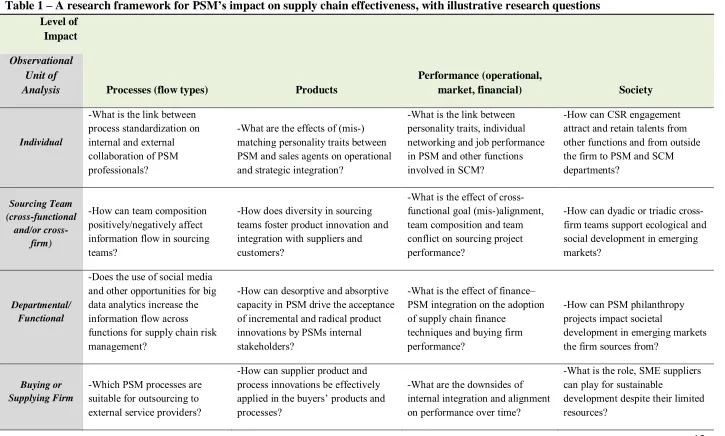
In order to contribute to the conceptualization of the relationship between PSM, supply chain integration and effectiveness, the following framework is suggested to guide future research (see Table 1). The framework incorporates the observational unit of analysis on the first axis. Potential research opportunities include the full spectrum from the individual level of the professional purchasing agent to the entire value creation network of firms. The second axis categorizes PSM’s level of impact on the value creation network. This impact can range from an adaptation of intra-firm process flows to a societal impact in certain sourcing locations.
With this framework, a map is provided to help locate this special issue’s articles based on their observational unit of analysis and their studied level of impact. To illuminate the vast research opportunities in the field of PSM and its impact on supply chain effectiveness through the various actors within value creation networks, the research framework is populated with illustrative research topics. This sample of topics is by no means intended to be considered mutually exclusive nor a cumulatively exhaustive list.
5 (see Table 1) and the explanatory unit of analysis of the applied theories (for an extended overview of grand theories applied in PSM please refer to Spina et al., 2016).
---
INSERT TABLE 1 ABOUT HERE---
With the challenge of addressing more complex research topics, the methodological bar is also rising. The prominent case study and survey research techniques that were predominantly used in JPSM publications may not always be able to support the generation of meaningful and practically relevant findings (Meehan et al., 2016). For inspiration on how to tackle these methodologically challenging research topics, refer to the recent special issue on the application of novel methods in PSM published in this journal (Knight et al., 2016). The selected papers in this conference special issue also pay specific attention to the elaboration of particular theories to their respective research context and the rigorous application of (novel) research methods to the PSM domain, such as content analysis (Dooley, 2016), secondary data analysis (Ellram and Tate, 2016) and experimental design (Eckerd, 2016).
4. Selected research topics from the research framework
The emerging topics presented in Table 1 are discussed in more depth. For instance, under the increasing pressure for supply chain transparency and supply chain sustainability, the purchase task visibility (product or service) to downstream customers becomes important when determining internal, external customer and supplier integration (Hofmann et al., 2015; Kirchoff et al., 2011). In this context, PSM also has to demonstrate how it can affect the firm’s top-line in contributing to sales growth and market share growth through its contribution to product quality and innovation (Paulraj et al., 2006; Spekman et al., 1999), but also its impact on green product characteristics and responsible production processes (Blome et al., 2017) or the inclusion of third parties such as local NGOs, auditors and other stakeholders (Gualandris et al., 2015).
Recent publications show that several firms are tapping into the need to harmonize product and financial flows among supply chain partners reaching beyond the traditional horizon of PSM. For such an integrated financial supply chain management cross-functional integration with finance/treasury internally and participating external suppliers is essential (Wuttke et al., 2013a). Such initiatives involve short-term working capital optimizations to leverage credit rating differentials between OEMs and their upstream suppliers (Hofmann & Kotzab, 2010) as well as long-term focused lending to suppliers to support their involvement in PSM innovation projects (Wuttke et al., 2013b) or the early stages of joint-product development projects (Wynstra et al., 2010).
6 property rights and agreements. With their ability to keep track of every transaction through a decentralized mechanism of ownership, blockchains offer transparency and accountability of information. Hence, they are likely to affect the sphere of sustainable supply chain management (Casey & Wong, 2017). For example, materials, components and even minerals could be traced back and verified. It could have potentially prevented recent sustainability scandals on conflict mineral or the horse meat scandal from 2013 (Hofmann et al., 2015).
Problems in integration and close collaboration in supply networks are often of organizations’ own making. For many purchasing managers, supplier integration comes at a price, which is dependence on and vulnerability to suppliers. For them, PSM is still often conceived to be a zero-sum game that results in supplier squeezing (Schleper et al., 2015). It is the power perspectives that require more scholarly attention. Recently, some studies have started to scrutinize these topics, such as the role of third party organizations in lowering power differences and social distance, thereby reducing overall transaction costs (e.g. Adobor & McMullen, 2014), the importance of power in defining the supply base structure (Ateş et al., 2015), power dynamics in dyads (Lacoste & Johnsen, 2015) or the factor of power imbalances for supply chain collaboration in general (Brito & Miguel, 2017) and in contexts of sustainability (Touboulic & Walker, 2015). It is particularly crucial to extend the view from a dyadic to a network perspective (Carnovale et al., 2017; Finne et al., 2015; Geldermann et al., 2008).
5. Selection of papers for this special issue
After the conference, the editorial team invited the twelve best papers to submit their work to this special issue. Following the regular JPSM reviewing procedures, four papers were accepted .1 Each one addresses a specific topic within the PSM domain focusing particularly on its contribution to supply chain integration and overall supply chain management effectiveness. Furthermore, two additional papers not presented at the 2016 conference (by Aitken & Paton, and Li & Huang) have been included in this special issue due to their topical fit2.
The first article in this issue, by Joanne Meehan, Laura Menzies and Michaelides Roula compares the growing topic of value-based procurement to saving-oriented aggregation based procurement in the public healthcare sector in the UK. The article illustrated how PSM can contribute to long-term innovation while still providing efficiency gains. Based on hermeneutic analysis the article points out how barriers of the transition can be overcome. The authors consider their findings with the resource-based view, thereby extending its consideration in public organizations.
With the growing importance of innovation sourcing, the second article by Matti Pihlajamaa, Riikka Kaipia, Julius Säilä, and Kari Tanskanen studies if and to what extent supplier innovations can substitute for internal R&D activities of the buying firm. Based on four open-innovation projects in the energy utility sector, the authors identify an alternative
1 The remaining eight papers either did not submit to this special issue, were redirected to the regular issue JPSM reviewing process or were rejected from publication at JPSM.
7 approach to the established complementary process of involving supplier in buyer-driven innovation projects. The authors elaborate the role of supplier management capabilities in tapping inbound open innovation projects by applying an absorptive capacity perspective.
The third article by Lydia Bals and Virpi Turkulainen addresses the question of how the PSM function itself can become more efficient and effective by outsourcing its non-strategic activities to external service providers. The authors point out how PSM organizations can be redesigned in order to enable such a transition. Using a longitudinal case study, the authors accompanied the organizational redesign of a multinational chemical and pharmaceutical firm. Their findings indicate that an activity-based design structure supports the outsourcing of operational processes and enables the establishment of effective interfaces between the remaining internal processes and the processes of outsourcing takers, namely the contracted service providers to the PSM function.
In the fourth article, with an interview-based survey, Päivi Jokela and Anne Söderman re-examine the link between fairness and commitment in buyer-supplier relationships. Their contribution challenges existing theory, and informs practice. Contrary to the conventional wisdom that fairness is an antecedent of commitment, they find that commitment can also lead to perceived fairness, thus establishing a bidirectional link.
The fifth article by Alan Aitken and Robert A. Paton confronts the notion of interdependent buyer-supplier relations. Its findings show that in important rebuys adversarial commercial approaches and operational collaborative approaches are applied simultaneously, thereby resembling the metaphor of a T-Shaped Buyer. This study applies innovative qualitative and longitudinal research methods combining web-based diaries and follow-up interviews providing a nuanced perspective on dominant patterns of buyer behaviour and illustrative graphical assessments
The sixth article by Yong-Hui Li and Jing-Wen Huang provides insights in the importance of relational bonding between internal and external partners in the green supply chain management context. Findings on the direct effects and the moderating effect of relation bonding on green innovation performance are provided based on a survey of 233 firms within the Taiwanese electronic, electrical, and information industries. Moreover, the authors show that three types of bonding initiatives (financial, social, and structural bonding) are effective in enhancing the ‘green supply chain management–performance link’.
As Guest Editors and conference organizers we would like to express our sincere gratitude to the Scientific Committee of the 25th IPSERA conference who greatly supported us in reviewing and selecting the best conference papers. Some of them also contributed to the refereeing process for this special issue. They were supported by the JPSM review board throughout multiple review rounds. We were impressed by the quality of reviews despite the immense time pressure reviewers faced to publish this special issue in time. Their thorough and critical feed-back while maintaining a constructive and developmental perspective towards all submissions was instrumental and invaluable to us as special issue editors. Last but certainly not least, we express our sincere thanks to Wendy Tate and Louise Knight, Co-Editors in Chief of JPSM, for their persistent support in this endeavour.
8 enhancements towards attaining effectiveness in integrated supply chain management. It provided great pleasure hosting the 25th annual IPSERA conference and it was an honour to edit this conference special issue. We hope studying these contributions invoke some of the IPSERA spirit in between conferences and wish you a lot of inspiration from this special issue.
Kai Foerstl,
9
References
Adobor, H., McMullen, S., 2014. Strategic purchasing and supplier partnerships—The role of a third party organization. Journal of Purchasing & Supply Management, 20 (4), 263–
272.
Ateş, M.A., Wynstra, F., van Raaij, E.M., 2015. An exploratory analysis of the relationship between purchase category strategies and supply base structure. Journal of Purchasing & Supply Management, 21 (3), 204-219.
Blome, C., Foerstl, K., Schleper, M.C., 2017. Antecedents of green supplier championing and greenwashing: An empirical study of leadership and ethical incentives. Journal of Cleaner Production, 152, 339-350.
Borgatti, S.P., Li., X., 2009. On social network analysis in a supply chain context. Journal of Supply Chain Management, 45 (2), 5-22.
Brito, R.P., Miguel, P.L.S., 2017. Power, governance, and value in collaboration: Differences between buyer and supplier perspectives. Journal of Supply Chain Management, 53 (2), 61–87.
Bruque-Cámara, S., Moyano-Fuentes, J., Maqueira-Marín, J.M., 2016. Supply chain
integration through community cloud: Effects on operational performance. Journal of Purchasing & Supply Management, 22 (2), 141–153.
Cardwell, D., 2017. Solar experiment lets neighbors trade energy among themselves. New York Times (13 March 2017). Available at: https://www.nytimes.com/2017/03/13/ business/energy-environment/brooklyn-solar-grid-energy-trading.html?_r=0. Accessed: 03 May 2017.
Carter, J.R., Narasimhan R., 1996. Is purchasing really strategic?, International Journal of Purchasing & Materials Management, 32 (1), 20-28.
Carter, C.R., Rogers, D.S., Choi, T.Y., 2015. Toward the theory of the supply chain. Journal of Supply Chain Management, 51 (2), 89-97.
Carnovale, S. Yeniyurt, S., Rogers, D.S., 2017. Network connectedness in vertical and horizontal manufacturing joint venture formations: A power perspective. Journal of Purchasing & Supply Management, 23 (2), 67–81.
Casey, M.J., Wong, P., 2017. Global supply chains are about to get better, thanks to blockchain. Harvard Business Review. [online] Available at:
https://hbr.org/2017/03/global-supply-chains-are-about-to-get-better-thanks-to-blockchain [Accessed 18 Mar. 2017]
Dooley, K.J., 2017. Using manifest content analysis in purchasing and supply management research. Journal of Purchasing and Supply Management 22 (4), 244-246
Eckerd, S. 2017. Experiments in purchasing and supply management research. Journal of Purchasing and Supply Management 22 (4), 258-261.
Ellram, L.M., 1995. Total cost of ownership: an analysis approach for purchasing.
10 Eriksson, P.E., 2015. Partnering in engineering projects: Four dimensions of supply chain
integration. Journal of Purchasing & Supply Management, 21 (1), 38-50. Ellram, L.M., Tate, W., 2017. The use of secondary data in purchasing and supply
management (P/SM) research. Journal of Purchasing and Supply Management 22 (4), 250-254.
Finne, M., Turunen, T., Eloranta, V., 2015. Striving for network power: The perspective of solution integrators and suppliers. Journal of Purchasing & Supply Management, 21 (1), 9-24.
Foerstl, K., Franke, H., & Zimmermann, F. 2016. Mediation effects in the 'Purchasing and Supply Management (PSM) Practice-Performance Link': Findings from a
Meta-Analytical Structural Equation Model. Journal of Purchasing and Supply Management, 22(6), 351-366.
Foerstl, K., Hartmann, E., Wynstra, F., Moser, R., 2013. Cross-functional integration and functional coordination in purchasing and supply management: Antecedents and effects on purchasing and firm performance. International Journal of Operations & Production Management, 33(6), 689-721.
Gelderman, C.J., Semeijn, J., De Zoete, R., 2008. The use of coercive influence strategies by dominant suppliers. Journal of Purchasing & Supply Management, 14 (4), 220–229. Gualandris, J; Klassen, R; Vachon, S; Kalchschmidt, M, 2015. Sustainable evaluation and
verification in supply chains: aligning and leveraging accountability to stakeholders. Journal of Operations Management, 38, 1-13.
Hartmann, E., Kerkfeld, D., Henke, M., 2012. Top and bottom line relevance of purchasing and supply management. Journal of Purchasing & Supply Management, 18 (1), 22-34. Hofmann, H., Schleper, M.C., Blome, C., 2015. Conflict minerals and supply chain due
diligence: An exploratory study of multi-tier supply chains, Journal of Business Ethics, forthcoming, doi:10.1007/s10551-015-2963-z.
Kirchoff, J.F., Koch, C., Nichols, B.S., 2011. Stakeholder perceptions of green marketing: the effect of demand and supply integration. International Journal of Physical Distribution & Logistics Management, 41 (7), 684-696.
Kim, Y., Choi, T.Y., Yan, T, Dooley, K., 2011. Structural investigation of supply networks: A social network analysis approach. Journal of Operations Management, 29 (3), 194-211.
Knight, L., Tate, W., Matopoulosa, A., Meehan, J., Salmi, A., 2016. Breaking the mold: Research process innovations in purchasing and supply management. Journal of Purchasing & Supply Management 22(4), 239–243
Kraljic, P., 1983. Purchasing must become supply management. Harvard Business Review, 61 (5), 109-117.
11 Meehan, J., Touboulic, A., Walker, H., 2016. Time to get real: The case for critical action
research in purchasing and supply management. Journal of Purchasing & Supply Management, 22 (4), 255-257.
Mentzer, J.T., Stank, T.P., Esper, T.L., 2008. Supply chain management and its relationship to logistics, marketing, production, and operations management. Journal of Business Logistics, 29 (1), 31-46.
Paulraj, A., Chen, I.J., Flynn, J., 2006. Levels of strategic purchasing: Impact on supply integration and performance. Journal of Purchasing & Supply Management, 12 (3), 107-122.
Pfeffer, J., Salancik, G.R., 1978. The external control of organizations, Harper & Row, Publishers Inc., New York.
Pfeffer, J., 1987. A resource dependence perspective on intercorporate relations. In Mizruchi, M. S., Schwartz, M. (Eds.), Intercorporate relations: The structural analysis of
business, Cambridge University Press, Cambridge.
Ramsay, J., Croom, S., 2008. The impact of evolutionary and development metaphors on purchasing and supply management: A critique. Journal of Purchasing & Supply Management, 14 (3), 192-204.
Schleper, M.C., Blome, C., Wuttke, D.A., 2017. The dark side of buyer power: Supplier exploitation and the role of ethical climates. Journal of Business Ethics, 140 (1), 97-114.
Schoenherr, T., Swink, M., 2012. Revisiting the arcs of integration: Cross-validations and extensions. Journal of Operations Management, 30 (1-2), 99-115.
Spekman, R.E., Kamauff, J.W., Spear, J., 1999. Towards more effective sourcing and supplier management. European Journal of Purchasing & Supply Management, 5 (2), 103-116. Spina, G., Caniato, F, Luzzini, D., Ronchi, S., 2016. Assessing the use of External Grand
Theories in Purchasing and Supply Management research. Journal of Purchasing & Supply Management, 22 (1), 18-30.
Tchokogué, A., Nollet, J., Robineau, J., 2017. Supply's strategic contribution: An empirical reality. Journal of Purchasing & Supply Management, 23 (2), 105-122.
Touboulic, A., Walker, H., 2015. Love me, love me not: A nuanced view on collaboration in sustainable supply chains. Journal of Purchasing & Supply Management, 21 (3), 178-191.
Trent, R.J., Monczka, R.M., 2003. Understanding integrated global sourcing. International Journal of Physical Distribution & Logistics Management, 33 (7), 607-629.
Wuttke, D.A., Blome, C., Foerstl, K., Henke, M., 2013a. Managing the innovation adoption of supply chain finance–empirical evidence from six European cases. Journal of Business Logistics, 34 (2), 148-166.
12 Wynstra, J.Y.F., Von Corswant, F., Wetzels, M., 2010. In chains? An empirical study of
13
Table 1 – A research framework for PSM’s impact on supply chain effectiveness, with illustrative research questions
Level of Impact
Processes (flow types) Products
Performance (operational,
market, financial) Society
Observational Unit of Analysis
Individual
-What is the link between process standardization on internal and external collaboration of PSM professionals?
-What are the effects of (mis-) matching personality traits between PSM and sales agents on operational and strategic integration?
-What is the link between personality traits, individual networking and job performance in PSM and other functions involved in SCM?
-How can CSR engagement attract and retain talents from other functions and from outside the firm to PSM and SCM departments?
Sourcing Team (cross-functional
and/or cross-firm)
-How can team composition positively/negatively affect information flow in sourcing teams?
-How does diversity in sourcing teams foster product innovation and integration with suppliers and customers?
-What is the effect of cross-functional goal (mis-)alignment, team composition and team conflict on sourcing project performance?
-How can dyadic or triadic cross-firm teams support ecological and social development in emerging markets?
Departmental/ Functional
-Does the use of social media and other opportunities for big data analytics increase the information flow across functions for supply chain risk management?
-How can desorptive and absorptive capacity in PSM drive the acceptance of incremental and radical product innovations by PSMs internal stakeholders?
-What is the effect of finance–
PSM integration on the adoption of supply chain finance
techniques and buying firm performance?
-How can PSM philanthropy projects impact societal
development in emerging markets the firm sources from?
Buying or Supplying Firm
-Which PSM processes are suitable for outsourcing to external service providers?
-How can supplier product and process innovations be effectively
applied in the buyers’ products and processes?
-What are the downsides of internal integration and alignment on performance over time?
-What is the role, SME suppliers can play for sustainable
14 Buyer-Supplier
Dyad
-How can blockchain technology improve process flows and transparency between buyers and suppliers?
-What is the effect of buyer-supplier integration on the treatment of product recalls and other product glitches?
-What is the connection between buyer/supplier exit options, supplier exploitation (squeezing) and buyer & supplier
performance?
-How can blockchains increase transactional transparency towards higher accountability of buyers and suppliers?
Triad /Multi-tier/ Network
-How can process
standardization along the supply chain beyond direct customers and first-tier suppliers be propagated and achieved?
-How can blockchain technology be used to generate transparency about the origin of components and raw materials used in the final product?
-How do power imbalances in the supply network change over time and what its drivers and effects on individual firm performance?