For Peer Review
Using the Plan-Do-Study-Act (PDSA) cycle to make change in general practice
Journal: InnovAiT
Manuscript ID INNOVAIT-2016-CA-153.R2 Manuscript Type: Non-Clinical Article
Manuscript Keywords: Management in Primary Care , Clinical Governance , Research and Academic Activity
For Peer Review
Using the Plan-Do-Study-Act (PDSA) cycle to make change in
general practice
As new members of the team, GP trainees can provide a fresh perspective on practice
systems. They are therefore ideally placed to enact change within practices. However, GP
trainees may feel ill-equipped to suggest and deliver change to their practices. This article
will explore the concept of change management using the Plan-Do-Study-Act (PDSA) cycle
and consider how to initiate change by providing a structure to guide the process.
The GP curriculum and change management
Contextual statement 2.02: Patient safety and quality of care states that as a GP you should:
• Understand principles of improvement methodology to facilitate change
• Show that, as a specialty trainee (GP) within the team environment of general practice, your experiences gained in previous settings can be shared with colleagues.
Recognise that the formal Patient Safety Agenda is relatively recent and may be
unfamiliar to well-established colleagues
• Illustrate how changes in behaviour and/or systems can influence patient safety
Contextual statement 2.03: The GP in the wider professional environment states that GPs
should be able to:
• Take into account the needs, feelings, values and expertise of others
• Understand the process of change and factors that influence it, and use resources for
obtaining support in developing and leading change
• Apply quality improvement methodologies
• Demonstrate the ability to improve the quality of healthcare delivered to your patients
by the practice
• Engage positively with change
• Successfully manage a simple quality improvement project
For Peer Review
The change process
Use of a structured approach to make a change can ensure better delivery of healthcare,
develop team work and leadership skills (RCGP, 2016a). Use of this structured approach can
address specific quality problems and positively influence organisational culture (Reed &
Card, 2016). Quality improvement activities form a mandatory component of the curriculum
for GP trainees. GPs are also then expected to continue undertaking quality improvement
activities as part of appraisal and revalidation (RCGP, 2016b).
Failure to manage change effectively can leave members of the practice feeling excluded,
confused and powerless (Strebel, 1996). As illustrated in Box 1, barriers to change can be
divided into individual, organisational and external factors (National Institute for Health and
Clinical Excellence (NICE), 2007).
(Insert Box 1 here)
PDSA cycle
Although there are multiple models offering frameworks for change, this article focuses on
the PDSA cycle. The PDSA cycle, also known as the Deming cycle, was adapted from the
works of Shewart in the 1920s. The four-stage cycle focuses on the continual improvement of
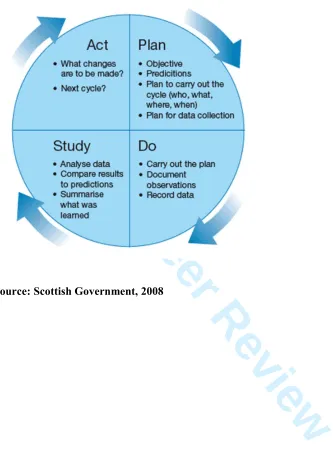
a product or process. In the ‘plan’ stage, a change aimed at improvement is identified. The
‘do’ stage sees this change tested and the ‘study’ stage examines the success of the change.
The ‘act’ stage identifies adaptations and next steps to inform a new cycle (Taylor et al,
2013). The PDSA cycle is widely used within the healthcare setting (Taylor et al, 2013) and
is recommended by the RCGP Quality Improvement in General Practice Guide (RCGP
For Peer Review
Quality Improvement in General Practice, 2000). Figure 1 illustrates each stage of a PDSA
cycle.
(Insert Figure 1 here)
The PDSA cycle can be considered an efficient way to collect data as it advocates collection
of just enough data to inform future PDSA cycles. The iterative nature of the PDSA cycle
helps to minimises resistance when change is implemented. This is achieved by small
intervention cycles that help increase confidence in the change by incremental modifications
and refinements (Leis & Shojania, 2016). Whilst the PDSA cycle is simple in concept, it can
be challenging to authentically execute (Reed & Card, 2016).
In the next section, the PDSA cycle will be explained with an example. The example
illustrates how a GP trainee may initiate change within a GP surgery by designing an
anticoagulation template for the GP computer clinical system. The aims of the change allow
for a standardised approach to anticoagulation initiation and drug monitoring standards.
Plan stage
The first step before making a change is to stop and describe what is currently going on
(RCGP Quality Improvement Guide, 2000). This helps justify the reasons for making a
change. There are a variety of tools that can help identify potential areas of change. A
strengths, weaknesses, opportunities and threats (SWOT) analysis is a strategic planning tool
that can be used to consider internal and external factors which currently affect the
organisation (Iles & Sutherland, 2001). GP trainees may therefore find this a useful way of
For Peer Review
identifying an area within the GP surgery that may benefit from a quality improvement
activity. Haberburg (2000) identifies that there is uncertainty over the origins of the SWOT
analysis, although it was thought to have been used by academics at the Harvard Business
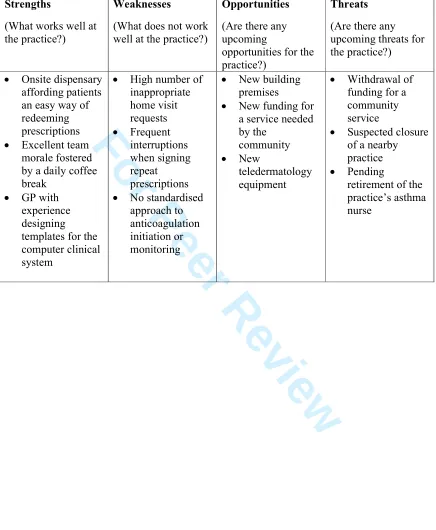
School during the 1960s. Box 2 details each domain of a SWOT analysis. A sample SWOT
analysis, seen in Table 1, can be completed individually or shared amongst the practice team
to gather an overview of the current position of the practice.
(Insert Box 2 here)
(Insert Table 1 here)
Results from the SWOT analysis can uncover an area to develop for a PDSA cycle. In this
example the practice does not have a standardised template for commencing patients on a
direct oral anticoagulant (DOAC). There may be inadequate record keeping on patients being
adequately counselled when initiated on a DOAC. Without adequate record keeping there is
no evidence that adequate information has been given to patients (for example on carrying an
anticoagulation alert card or advice on drug monitoring).
Other examples include: restructuring the repeat prescription signing process at the practice
(to provide protected time for script signing), creating a doctor led triage system for home
visit requests (to assess suitability and reduce unnecessary home visits) and designing an
intervention to recall asthma patients requesting frequent reliever therapy (to optimise asthma
management).
Once the area requiring change has been identified it is important to define what changes are
proposed. The pro forma in Table 2 can be a used as a means of structuring a PDSA cycle.
The pro forma has been completed using the example of implementation of an
anticoagulation template.
For Peer Review
(Insert Table 2 here)
It is important to define the intended outcomes of the PSDA cycle and this can be done by
making the outcomes SMART: specific, measurable, achievable, realistic and time-based
(Doran, 1981). Leis and Shojania (2016) advocate small goals that can be tested and then
modified as needed. Therefore, for the initial PDSA cycle the focus is on one DOAC with
plans to include other anticoagulants on the template in future cycles.
It is important that anyone involved or affected by the change has an opportunity for input to
the change process. Organisations or people that are affected by the changes in PDSA cycles
are known as stakeholders (Iles & Sutherland, 2001). Presenting a completed pro forma at a
practice meeting or in a tutorial with a clinical supervisor can help identify stakeholders.
A stakeholder analysis is a tool to assess the influence and resources that the stakeholders
bring and it has the value of increasing the chance of success with the project by influencing
the planning and execution of the project (Varvasovszky & Brugha, 2000). It is important to
identify the stakeholders in the change process such that barriers and challenges can be
overcome at an early stage. Possible stakeholders may include GPs, practice nurses, GP
trainees, medical students, allied healthcare professionals, administration, the patients and the
practice manager. As part of the analysis it may be necessary to organise meetings or
telephone calls with the stakeholders to understand their perceptions and perspective. For
example, meeting the community pharmacist may lead to learning on drug interactions with
the DOAC which will help inform the anticoagulation template. Early involvement of
stakeholders is encouraged to help ensure successful change (RCGP 2015). This can provide
clarity on the changes intended from an early stage and encourage stakeholder ‘buy in’.
For Peer Review
Proposed changes may be at risk of not being implemented if there is a lack of consensus on
the necessity for change amongst the stakeholders (Dixon-Woods, McNicol & Martin, 2012).
In the example in Table 2, it may be identified from discussions with the practice team that
another GP surgery within the Clinical Commissioning Group (CCG) has already
implemented use of an anticoagulation template. It may therefore be possible to share ideas
with the respective practice team to see if a similar template can be adopted. Further to the
stakeholder analysis the pro forma should be updated to reflect any modifications made.
Do stage
In the ‘do’ stage, the changes identified are implemented (Gillam & Siriwardena, 2013).
Changes from quality initiatives can have wide ranging consequences and include unintended
or unplanned consequences. These should be considered when measuring the effectiveness of
the change (Illes & Sutherland, 2001). In the example, a template could be designed with the
support of a GP from the team with experience of creating computer templates for the clinical
system. The initial template might provide a stepwise approach to standardise how GPs
initiate a specific DOAC and set up a recall for drug monitoring. The GPs could then be
informed about the new template and its use monitored over three months. A planned effect
might be greater compliance with drug monitoring and an unplanned effect might be
improved time efficiency within the consultation when using the template to assist record
keeping.
It is rare that efforts to drive improvement go smoothly (Leis & Shojania, 2016). For
example, the template might be difficult to locate leading to poor uptake by GPs at the
For Peer Review
practice. Reed and Card (2016) identify that key learning can occur when changes do not go
as planned. In this example difficulty locating the template might encourage a redesign of
access to the template so that the template appears automatically when typing a designated
read code.
Study stage
The ‘study’ stage identifies if the change implemented has made an improvement and
whether further change is required. A suitable means of assessing whether there has been an
improvement in quality of care should be utilised. For example, an audit could be performed
to identify whether adherence to anticoagulation blood test monitoring guidelines has
improved with introduction of the anticoagulation template. This might have patient safety
implications, for example by ensuring that patients are on the dose of DOAC appropriate to
their renal function.
The Institute for Healthcare Improvement (IHI) (2017) states that “while all changes do not
lead to improvement, all improvement requires change.” A reflection can be useful to
consider whether the changes introduced amount to an improvement (Gillam & Siriwardena,
2013). A reflective log entry in the Trainee ePortfolio may assist with development of critical
thinking, analysis of learning and the identification of areas for further development (RCGP
2017).
The RCGP Quality Improvement Guide (2000) encourages the results of the change to be
communicated with the stakeholders regardless of whether an improvement has been
achieved. This ongoing communication will keep the stakeholders up to date throughout the
For Peer Review
PDSA cycle and aligned with any plans for future cycles. For example, the anticoagulation
template could be cascaded to other practices at a local learning group to demonstrate the
learning from the process and any improvements achieved. However, it is important to note
that change initiatives may not translate across organisations, for example because of
different organisational cultures and engagement with the iterative process of PDSA cycles
(Walshe & Freeman, 2002).
Act stage
Leis and Shojania (2016) identify that improvements may not occur with the first PDSA
cycle. Therefore, the ‘act’ stage focuses on what should be planned for the next PDSA cycle.
This should incorporate any modifications that are deemed necessary from the ‘study’ stage
that may lead to an improvement (Gillam & Siriwardena, 2013).
The PDSA cycle demonstrated in Figure 1, should not be thought of as a process involving
just a single rotation of the cycle. Further rotations are required for continuous improvement
(Taylor et al, 2013). Dixon-Woods & Martin (2016) identify that organisations often fail to
stick to changes from quality improvement projects after initial implementation and that
replication can help assure success. In the example, the anticoagulation template might need
improvement with incorporation of other anticoagulants. Further engagement by the practice
team with the PDSA cycle could ensure ongoing improvements to the template and shared
ownership of successful change by the practice team.
For Peer Review
Conclusions
Engaging with a structured approach to change, such as the PDSA cycle can assist GP
trainees with delivering change. Although not every change is an improvement, significant
learning can occur through engaging with a quality improvement activity. An important
aspect of delivering change is to ensure involvement of stakeholders throughout the change
process. This increases their confidence in the process and will increase the likelihood of
success. The PDSA cycle should not be considered as singular event but as a continuous
process that aims to achieve incremental improvement. Undertaking quality improvement
activities using a PDSA cycle will benefit GP trainees in their future careers and develop
skills and experience in team working, leadership and change management.
Key points
• Practice teams can benefit from the insight that GP trainees bring from experience in
other general practice and secondary care placements
• The analysis of strengths, weaknesses, opportunities and threats can provide a useful
tool to identify possible areas for change
• Use of a pro forma may help GP trainees to structure a change management proposal
• Resistance to change from members of the primary care team and can be reduced by
involving them in the change process
• Skills in change management can be developed by GP trainees and will be valuable
throughout their careers
For Peer Review
References and further information
• Auerbach, A. D., Landefeld, C. S., & Shojania, K. G. (2007). The tension between
needing to improve care and knowing how to do it. New England Journal of Medicine,
357(6), 608-613. doi: 10.1056/NEJMsb070738
• De Silva D. (2015). What’s getting in the way? Barriers to improvement in the NHS.
Retrieved from
www.health.org.uk/publication/what%E2%80%99s-getting-way-barriers-improvement-nhs#
• Dixon-Woods, M., & Martin, G. (2016). Does quality improvement improve quality?
Future Hospital Journal. 3(3), 191-194. doi:10.7861/futurehosp.3-3-191
• Dixon-Woods, M., McNicol, S., Martin, G. (2012). Ten challenges in improving quality
in healthcare: Lessons from the Health Foundation’s programme evaluations and relevant
literature. BMJ Quality & Safety, 21, 876–884. doi: 10.1136/bmjqs-2011-000760
• Doran, G. (1981). There's a S.M.A.R.T. way to write management's goals and objectives.
Management Review, 70 (11): 35–36
• Gillam, S., & Siriwardena, A. (2013). Frameworks for improvement: Clinical audit, the
plan-do-study-act cycle and significant event audit. Quality in Primary Care, 21(2),
123-30.
• Haberberg, A. (2000). Swatting SWOT. Retrieved from
www2.wmin.ac.uk/haberba/SwatSWOT.htm
• IHI. (2017). Using Change Concepts for Improvement. Retrieved from:
www.ihi.org/resources/Pages/Changes/UsingChangeConceptsforImprovement.aspx
• Leis, J., & Shojania, K. (2016). A primer on PDSA: Executing plan–do–study–act cycles
in practice, not just in name. BMJ Quality & Safety, BMJ Quality & Safety, 16 December
2016. doi: 10.1136/bmjqs-2016-006245
For Peer Review
• NICE. (2007). How to change practice: Understand, identify and overcome barriers to
change. Retrieved from
www.nice.org.uk/media/default/about/what-we-do/into-
practice/support-for-service-improvement-and-audit/how-to-change-practice-barriers-to-change.pdf
• Iles, V., & Sutherland, K. (2001). Managing change in the NHS: Organisational change:
A review for health care managers, professionals and researchers. National Co-ordinating
Centre for NHS Service Delivery & Organisation R & D.
• Reed J., & Card A. (2016). The problem with Plan-Do-Study-Act cycles. BMJ Quality &
Safety, 25(3), 147-52. doi: 10.1136/bmjqs-2015-005076
• RCGP. Contextual statement 2.02: Patient safety and quality of care. Retrieved from
www.rcgp.org.uk/training-exams/gp-curriculum-overview/online-curriculum/working-in-systems-of-care/2-02-patient-safety-and-quality-of-care.aspx
• RCGP. Contextual statement 2.03: The GP in the wider professional environment.
Retrieved from
www.rcgp.org.uk/training-exams/gp-curriculum-overview/online-
curriculum/knowing-yourself-and-relating-to-others/2-03-the-gp-in-the-wider-professional-environment.aspx
• RCGP. (2015). Quality improvement for General Practice. London: RCGP. Retrieved
from
www.rcgp.org.uk/clinical-and-research/our-programmes/-/media/E96023402AFE4CF98C8634A7A1C63196.ashx
• RCGP. (2016a). Quality Improvement Project (QIP). Retrieved from
www.rcgp.org.uk/training-exams/mrcgp-workplace-based-assessment-wpba/qip-guidance.aspx
• RCGP. (2016b). RCGP Guide to supporting information for appraisal and revalidation.
London: RCGP. Retrieved from
www.rcgp.org.uk/learning/revalidation/new-revalidation-guidance-for-gps.aspx
For Peer Review
• RCGP. (2017). Learning Log for MRCGP Workplace Based Assessment. Retrieved from
www.rcgp.org.uk/training-exams/mrcgp-workplace-based-assessment-wpba/learning-log.aspx
• Scottish Government. (2008). The Scottish Government Health Delivery Directorate:
Improvement and Support Team: The Scottish Primary Care Collaborative. Retrieved
from www.gov.scot/Publications/2008/01/14161901/3
• Strebel, P. (2009). Why do employees resist change? Engineering Management Review,
IEEE, 37(3), 60-66. doi: 10.1109/EMR.2009.5235497
• Taylor, M., McNicholas, C., Nicolay, C., Darzi, A., Bell, D., & Reed, J. (2013).
Systematic review of the application of the plan–do–study–act method to improve quality
in healthcare. BMJ Quality & Safety, 23(4), 290-298. doi:10.1136/bmjqs-2013-001862
• Varvasovszky, Z., & Brugha, R. (2000). A stakeholder analysis. Health Policy and
Planning, 15(3), 338-345. doi:10.1093/heapol/15.3.338
• Walshe, K., & Freeman, T. (2002). Effectiveness of quality improvement: Learning from
evaluations. Quality & Safety In Health Care, 11(1), 85-87. doi: 10.1136/qhc.11.1.85
For Peer Review
Box 1. Barriers to change.• Individual factors- There may be a knowledge deficit on how to enact change or a
lack of motivation or time to engage with change (NICE, 2007). Individuals may
carry out change without reference to a structured process thus threatening
successful implementation of change (Reed & Card, 2016). Individuals may fail to
consider the requirements for sustainable improvement (Auerbach, Landefeld &
Shojania, 2007).
• Organisational factors- Lack of resources or personnel to deliver change (NICE,
2007). Practice culture resistant to change or engaging with the process of change
(Reed & Card, 2016). Perceived cost implications of engaging with change such as
loss of time for clinical commitments (Auerbach, Landefeld & Shojania, 2007).
• External factors- Conflicting priorities set by commissioning bodies and financial
disincentives for the desired change at practice level (De Silva, 2015).
For Peer Review
Box 2. SWOT analysis domains• Strengths- advantages, positive factors, successful activities, attributes and areas
where the practice team excels
• Weaknesses- disadvantages, negative factors, failures and areas where
improvement is needed and preferably possible
• Opportunities- areas that present the prospect of improvement and potential benefit
to the practice team by the implementation of change
• Threats- potential problems, areas that may have negative consequences in the
future, activities or areas that may need to be appropriately managed/ require
change
For Peer Review
Figure 1. PDSA cycle
Source: Scottish Government, 2008 2
For Peer Review
Table 1. SWOT analysisStrengths
(What works well at the practice?)
Weaknesses
(What does not work well at the practice?)
Opportunities
(Are there any upcoming
opportunities for the practice?)
Threats
(Are there any upcoming threats for the practice?)
• Onsite dispensary affording patients an easy way of redeeming prescriptions
• Excellent team morale fostered by a daily coffee break
• GP with experience designing templates for the computer clinical system
• High number of inappropriate home visit requests • Frequent interruptions when signing repeat prescriptions
• No standardised approach to anticoagulation initiation or monitoring
• New building premises
• New funding for a service needed by the
community
• New
teledermatology equipment
• Withdrawal of funding for a community service
• Suspected closure of a nearby practice
• Pending
For Peer Review
Table 2. Example pro forma to assist with change managementTitle: Developing an anticoagulation template for the GP medical record
Name: Date:
Stakeholders: GPs, practice nurses, administration, pharmacist, clinical commissioning group (CCG), anticoagulation clinic, patient participation group (PPG).
Area of change: Implement an anticoagulation template accessible from the GP medical record to help ensure all patients with a CHA2DS2VASc score of one or greater have been
adequately informed about anticoagulation, to help ensure the correct monitoring is being performed and that appropriate safety nets have been put in place for those on anticoagulation such as an anticoagulation alert card.
Why needed: No current standardised approach to practice initiated anticoagulation and varying levels of baseline tests for DOACs.
Proposed method of achieving change:
• Liaise with CCG/ anticoagulation clinic to ascertain if a template is currently available
• Meeting with PPG to assess suitability
• Meeting with community pharmacist to identify anticoagulation medication interactions that should be flagged on template
• Meeting with clinical system administrator on designing computer system templates
• Training event to inform GP/practice nurses of the template
Proposed Timeline:
• Complete stakeholder meeting- first two months of placement
• Template design and implementation– months three and four of placement
Action Plan: Meeting with clinical supervisor to discuss suitability of above changes.
Note: Example pro forma adapted from Quality improvement for General Practice (p 58), by RCGP, 2015, London: RCGP