NONLINEAR MAGNETIC RECONNECTION
A. M. Colin
A Thesis Submitted for the Degree of PhD
at the
University of St Andrews
1987
Full metadata for this item is available in
St Andrews Research Repository
at:
http://research-repository.st-andrews.ac.uk/
Please use this identifier to cite or link to this item:
http://hdl.handle.net/10023/14195
JSrOlsrmsrEAR MAGISTEXIO RECONNECT I ON
A. M. COEIN
Thesis submitted for the Degree of Doctor of Philosophy
of the University of St Andrews
I
Î
proQuest Number: 10167110
All rights reserved INFORMATION TO ALL USERS
The quality of this reproduction is dependent upon the quality of the copy submitted. In the unlikely event that the author did not send a com plete manuscript and there are missing pages, these will be noted. Also, if material had to be removed,
a note will indicate the deletion.
uest
proQuest 10167110
published by proQuest LLO (2017). Copyright of the Dissertation is held by the Author. All rights reserved.
This work is protected against unauthorized copying under Title 17, United States C ode Microform Edition © proQuest LLO.
proQuest LLO.
789 East Eisenhower parkway p.Q. Box 1346
ABSIEACI
In many astrophysical problems magnetic reconnection plays a major role. Despite this reconnection theory remains incompletely understood,
partly due to the strong non-linearity of the governing equations and
the resulting difficulties in demonstrating analytical solutions. This
thesis examines some fundamental aspects of reconnection theory; namely,
the dynamics of driven and spontaneously reconnecting systems.
We first consider the dynamics of a driven reconnecting system by
numerically modelling a configuration consisting of two oppositely
oriented flux systems with a variety of different boundary conditions and internal parameters. The results indicate that the rate of
reconnection is chiefly dependent on the magnetic Reynolds number, but
that the plasma flow is weakly dependent on this parameter, being more
affected by the curvature of incoming magnetic field. Scaling laws for the dimensions of the diffusion region are derived, and the existence of several reconnection regimes Is shown.
Using the same computer code we also simulate tearing modes in
Cartesian geometry under different boundary conditions. By imposing a
suitable perturbation a magnetic island is generated. The plasma flows
show marked differences for the different boundary conditions
implemented.
Lastly, we examine some aspects of the coalescence instability. The
usual flux function taken to represent a tearing mode island in the
linear growth phase is shown to be erroneous, and we derive a correct
expression. We show that under certain conditions there exists a
ACKKOVLEDOBKB m S
It is a great pleasure to be able to thank Professor Eric Priest for
his supervision of my research studentship over the last three years at
St Andrews, Dr Alan Sykes and the staff of the Theory Division at Culhara
Laboratory for help and guidance, Dr Alan Hood for his supervision of
Chapter 5, Dr Alastair Robertson for much discussion and advice on
numerical simulation, Culham Laboratory for a generous allocation of computer time, colleagues at St Andrews, and friends and family for
their unflagging support and encouragement,
DECLARATION
I, Andrew Mark Colin, declare that the following thesis is a record
of research work carried out by me, that the thesis is ray own
composition, and that it has not been submitted in any previous
application for a higher degree.
Signature of Candidat
Date
Ù
CERTIFICATE
I certify that Andrew Mark Colin has satisfied the conditions of the
Ordinance and Regulations and is thus qualified to submit the
accompanying application for the degree of Doctor of Philosophy.
Signature of Supervisor ....
mSlGRADUAÎE CAREER
I was admitted into the University of St Andrews as a research
student under Ordinance General No. 12 in October 1983 and as a
candidate for the degree of Ph.D. in October, 1984, to work on aspects
of Magnetic Reconnection under the supervision of Professor E.R. Priest.
CONTENTS Chapter 1 Introduction
1.1 Introduction to magnetic reconnection 1.2 Outline of thesis
1.3 The MHD equations
1.4 Analytical models of reconnection 1.5 Previous numerical work
Chapter 2 Numerical solution of the MHD equations 2.1 The MHD equations in conservative form 2.2 Computer simulation
2.3 The SHASTA algorithm
2.4 Solution of the diffusion equation 2.5 Spatial differencing
2.6 Temporal differencing
Chapter 3 Driven magnetic reconnection simulation 3.1 Introduction
3.2 Numerical implementation
3.2.1 Vector potential conversion routines 3.2.2 Compatability relations
3.2.3 Program development 3.3 A typical run
3.4 Effect of varying the magnetic Reynolds number 3.4.1 Size of the diffusion region
3.4.2 Alfven Mach numbers 3.4.3 Variation of shock angle 3.5 Variation of field line curvature
3.5.1 Size of the diffusion region 3.5.2 Alfven Mach numbers
3.5.3 Variation of shock angle 3.6 Variation of inflow speed
Chapter 4 Tearing mode simulation 4.1 Introduction
4.2 Numerical implementation of the symmetric tearing mode 4.3 Numerical implementation of the open-ended tearing problem 4.4 Experimental results
4.5 Conclusions
Chapter 5 Island coalescence 5.1 Introduction
5.2 Derivation of the energy integral 5.3 Minimisation of the energy integral
5.4 Perturbation expansion of the Euler-Lagrange equation 5.5 Magnetic field due to a tearing mode
5.6 Boundary conditions
5.7 Ideal stability of a current sheet 5.8 First order stability
5.9 Second order stability 5.10 Conclusions
Chapter 6 Conclusions and suggestions for further work
Appendix A Derivation of compatability relations for the two- dimensional ideal magnetohydrodynamical equations
Appendix B Listing of the computer code SHASTA
1. 1
-CHAPTER 1
INTRODUCTION
LJL iJitr.oduct l Qn to . magnet ic ,ra.aQQ.nec1ilQn,
Magnetic reconnection is a phenomenon of fundamental importance in
astrophysical and laboratory plasmas. A magnetic field occupying the
same spatial region as a perfectly conducting plasma or fluid is tied to
the fluid and convected along with the fluid motions, so the initial
topology is preserved in time. However, the introduction of even a small
amount of resistivity allows oppositely oriented magnetic field lines to
come together at current sheets (where a component of magnetic field changes sign) and break, or reconnect, into a different configuration.
Although the width of such current sheets may be very small compared with the scale length of the plasma, this localised effect alters the
global topology of the field. Magnetic reconnection may therefore act as
a decoupling mechanism; a topological constraint on the plasma is removed and new, lower energy states are accessible.
This has two major effects on the plasma. Firstly, new field topologies may be created, which allow transport of plasma ions and
impurities into previously inaccessible regions. Secondly, magnetic
energy within the magnetic field may be released and converted into kinetic and heat energy. Both phenomena are of considerable interest to
astrophysicists and laboratory plasma physicists.
1. 2
-(I) In a solar flare^ reconnection is believed to be the only mechanism
that can give rise to the observed release of very large amounts of
energy (up to 10'-^ J) over the observed short time-scales ( ^ lO'-^ s). In a two-ribbon flare, a magnetic arcade passes through a series of
magnetohydrostatic equilibria, until some critical shear in the field is
reached. The system then becomes unstable, begins to reconnect and
erupts outwards into the corona to produce loops and Hoc ribbons,
together with a wide range of electromagnetic radiation, an
interplanetary blast wave, relativistic and nonrelativistic nuclei, and
high-energy electrons.
(II) Magnetic reconnection is involved in the interaction of the Earth’s
magnetosphere and the solar wind. A current sheet is formed when the
interplanetary magnetic field meets the Earth’s magnetic field. The field lines then reconnect across the sheet, allowing protons and helium
ions from the solar wind to enter the dayside magnetosphere. Evidence
for reconnection has been provided by the ISEE spacecraft in the form of
both quasi-steady processes and flux transfer events (Bagenal, 1985).
Similar phenomena have been observed in the Jovian magnetosphere by the Voyager 1 and 2 spacecraft (Nishida, 1984)
(ill) Magnetic reconnection is an important cause of disruptions in tokamaks and activity in reverse field pinches. Temperatures of around
one hundred million degrees Kelvin are required for the successful
attainment of the Lawson criterion, which relates the number density and
confinement time for a plasma of deuterium nuclei to reach the conditions under which a fusion reaction may occur. To achieve such
conditions in the laboratory requires that the plasma be magnetically
1. 3
-vessel and strong axial magnetic field the torus may be made stable to ideal instabilities. However, there still remain the resistive
Instabilities (such as the tearing mode) which can degrade the
confinement properties of the plasma, enhance anomalous transport of
impurities, and even cause major disruptions that damage the containment vessel.
Despite the fundamental Importance of reconnection theory, it is
still incompletely understood. The subject has traditionally been
divided into the two schools of spoDtaneous and driven reconnection,
with each having its own (largely independent) literature.
Perhaps the best-known spontaneously reconnecting
magnetohydrodynamical phenomenon is the tearing mode instability, in
which the initially anti-parallel field lines about a current sheet 'tear' and reconnect to form a chain of magnetic islands. This process is highly time-dependent (Furth, Killeen and Rosenbluth, 1963). By
contrast, theories of driven reconnection have tended to concentrate on
steady-state solutions to the MHD equations, rather than on time- dependent phenomena. Thus results from the two schools have not been directly applicable, even though the same equations and physical
assumptions are usually used.
It has only been over the last decade, mostly through the medium of
large-scale computer simulation, that any further progress has been made
in the understanding of reconnection theory, and one of the most
striking results is how closely these two schools are now related. For
instance, consider the coalescence instability, in which an ideal
instability forces together two or more magnetic islands, possibly in a
1. 4
-mixture of ideal and resistive MHD effects. Although this instability
occurs spontaneously, the rate at which the islands coalesce will be determined by the maximum rate at which their field lines can reconnect
and is thus determined by the dynamics of driven reconnection. Indeed, we may regard any spontaneously reconnecting system as an ideal system
with the dynamics being locally controlled by driven systems, or a
driven system as a small cross-section of a spontaneously reconnecting
system. A more fruitful approach to use than^this rather arbitrary
division is to assume a set of equations that model the desired physical
system and to vary the boundary and initial conditions under which they
are solved. The bulk of the research presented below forms such a study.
Qu..t H a.a.„Q.f t h&s i s
The remainder of Chapter 1 reviews the current state of analytical
reconnection theory and describes the most important work published to date on numerical reconnection simulations. In Chapter 2 we describe the
fundamental algorithms employed in the computer code SHASTA, together
with their implementation, and give a brief account of recent research on the possiblities and limitations of numerical simulation. Chapter 3
shows how we adapted the code to simulate two-dimensional driven
reconnection, and found a series of steady states when the inflow field
line curvature, magnetic Reynolds number and Inflow speed were varied.
The results are compared with the recent study by Biskamp (1986) and
scaling laws for the reconnection rate and dimensions of the Internal region were deduced to be compared with analytical theory. Chapter 4 is
an account of how the same code was used to model tearing modes with two
1. 5
-the two cases and studied -the reconnection rate as functions of time.
Chapter 5 has an analytical study of the ideal coalescence instability
for a magnetic configuration generated by tearing mode instability, as the field profile due to Finn and Kaw (1977) used in all previous studies is shown to be unrealistic. Chapter 6 concludes with a summary
of the major results and some suggestions for further work.
I
4
y3
■4
JL-2 equations,
Throughout the next three chapters of this thesis we shall be
studying solutions to the full non-linear, compressible, resistive, two-
dimensional magnetohydrodynamical equations:
^
C p v ) . o
a t
"i
f
(1.3.1)
Induction
(1.3.2)
Mass
continuity
(1.3.3)
Momentum
(1.3. 4)
Energy
I
where
1. 6
-together with an Ohm's law
^ j - %
4
- Ÿ ^ %
" (1.3.6)
and Maxwell's equation
\ ) V H O (1.3.7)
These are supplemented by the equation of state for an ideal gas
(1.3. 8)
where the quantities £, z, p, p, X, t, E, T are non-dimensionalised as follows:
p ^ p 7 p°' - ' 7 " '
P = f Ô = i \ ) j -, ___
lo po) 1
V p X o y / p , ~ I Lo' G ' t
■ rv ( ■T' / / / I - II po T / p
where E', , p', p', X', X', t' ,E', T* are the dimensional magnetic
field, flow velocity, mass density, pressure, current density, spatial
coordinate, time, electric field and temperature, respectively. Eo‘ and
po' are the values of the magnetic field and plasma density in the
1. 7
region, and L.-.,' Is the size of the computational domain. V Is the ratio
of specific heats (= 5/3), R is the gas constant, is the free space
magnetic permeability and is the dimensionless magnetic resistivity.
t
is related to the dimensional magnetic resistivity V\^ , by
(1.3.8)
which is the inverse of the Lundquist number, more commonly referred to
as the magnetic Reynolds number. Ve adopt this usage throughout the rest
of the thesis.
The reader should note that the standard MHD approximations have
been made when combining the Euler fluid equations and Maxwell's
equations of electromagnetism to derive the magnetohydrodynamical equations:
3 D
(i) The displacement current is negligible compared to the
conduction current i.
(11) The plasma is electrically neutral, so that where p^ and Pg_ are the densities of neutral and charged ions within the plasma. For a fuller account of the approximations see, for instance,
Priest (1982, p 92). Note also that our form of Ohm's law is very simple
compared to the more generally used expression
E 4- V. ^ ^ <1.3.9)
(Chen, 1974, p 164) where e is the charge on the electron, n is the number density of charged particles and p^ is the electron pressure. In
1. 8
-1,
â
A.]qalyX.lgAl._..mo.dgls ■ of reconnect 1 on
In this section we give an overview of the most important analytical
MHD reconnection models. We follow the historical development of the subject by considering (in order) the Sweet-Parker, Petschek and Priest- Forbes models.
Sweet (1958) and Parker (1963) considered a two-dimensional, steady-
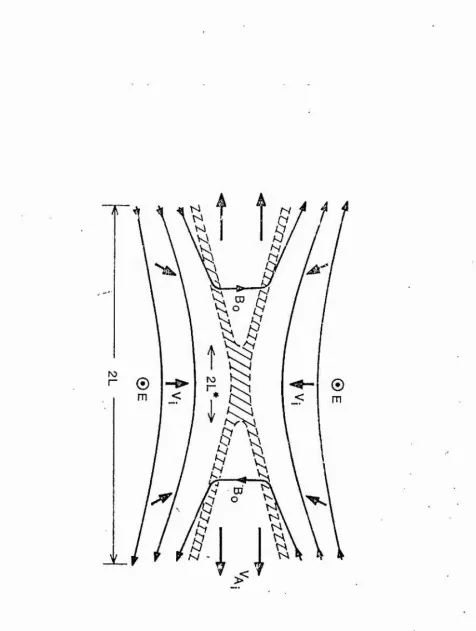
state system with antiparallel inflow magnetic fields on either side of a neutral line (Figure 1.1). They argue that in a steady state the speed
V* at which plasma carries magnetic field into a sheet of thickness
is just the speed at which the magnetic field diffuses through
the plasma:
/<
V ; ,
(1.4.1)where is the magnetic resistivity. For an incompressible medium the
current sheet accelerates the outgoing plasma to the Alfven speed
(1.4.2)
so we may use mass conservation to equate the inflow and outflow mass fluxes:
L v ; , t v , (1.4.3)
where L is the length of the sheet. This assumes that the current sheet
retains a width over the length of the sheet L, and that L is in fact
- 1. 9 ~
Eliminating between <1.4.1) and (1.4.3) gives the Alfven Mach number
(1.4,4)
from which we may derive the rate at which field lines can be carried
into the system. For a steady state this represents a measure of the
reconnection rate. Ve find
where the magnetic Reynolds number is
LoV-u
(1.4.5)
(1.4.6)
The difficulty with this model is that energy is released from the
magnetic field at rates which are far too slow to account for flare observations. Taking a magnetic Reynolds number of = 10® to 10 ^ a n Alfven speed of a: lOO km/s and a scale length of 10*m gives a
timescale for energy release of tens of days, which is clearly
inadequate when compared to the observed timescales of several tens of minutes. To give more accurate results a very much smaller length scale
must be taken, which is equivalent to making the inflow speed comparable
to the ambient Alfven speed.
The difficulty of reconection rates which are far too small was surmounted by Petschek (1964) in a classic paper based on an idea which
-- 1. -
10-may bifurcate into two pairs of slow magnetohydrodynamical shock waves
which propagate from a central current sheet. The essential difference
between this model and that of Sweet and Parker is that the central diffusion region may be very small, thus decreasing Em and allowing much
higher inflow speeds. The shock waves stand in the flow and (in the
compressible case) convert magnetic energy to the thermal and kinetic energy of two hot jets, which are accelerated from the diffusion region
to reach the local Alfven speed (Figure 1.2).
Soward and Priest (1977) have derived an expression for the
reconnection rate by finding incompressible, two-dimensional solutions
to the MHD equations which are asymptotic and hence valid at large distances from the diffusion region. For large Em they find a maximum
reconnection rate of
.
_
- i r" K-Ir- (1.4.7)
(where ULs, is the external Mach number) which in practice lies between
0.01 and 0.1 and is very much greater than the Sweet-Parker value. Sonnerup (1970) has proposed a model which, while not directly
physically applicable, nevertheless has features in common with several
numerical simulations. He proposes a model with four slow mode expansion
waves which are generated at corners in the inflow. The model predicts that for this configuration the Mach number in the inflow region may
takes values up to unity.
Vasyliunas (1975) has performed a detailed mathematical analysis of the Petschek and Sonnerup mechanisms. As well as putting the Petschek
ro
N
[image:23.612.68.544.46.677.2]1. 11
-streamlines for a Petschek solution converge on approaching the
diffusion region, an effect caused by a lessened pressure along a line
from the diffusion region outwards. Noting also that the magnetic field
decreases on approaching the current sheet, the solution is an example
of a fast mode expansion. For the Sonnerup solution the streamlines
diverge and the magnetic field increases on approaching the current sheet, thus forming a slow mode expansion.
Priest and Forbes <1986) have presented a new series of analytical solutions that include the Petschek solution and a Sonnerup-like
solution as special cases. They take a finite two-dimensional region
(Ix! <1, tyl < 1) and linearise about a uniform horizontal field in
the upper part of the region ( y 2 0) by setting
E = B. & +
+ . . .
(1.4.8)
1 = Viv 5L + 3b: + ... (1.4.9)
where Viy = V.., and where the lower half of the box consists of
field lines oppositely oriented from those in the upper half. The
boundary conditions for the solution in the upper half are:
Bix = 0 on y = 1
= 0 on the sides (Ixl = 1) Biy = f(x) on y = 0
where f(x) is a function that gives the appropriate normal magnetic
field generated by the slow mode shock waves. The solution is oc>
“L - c^s I d . 4 . i o >
- 1. 12
H e ’"
B;
A ^ - I K < _ (1.4.13)where B», Bi, M*», Mi are the external and internal magnetic fields, external and internal Mach numbers, respectively. Equation (4) of the
3 <1.4.11)
Ia '>o
where m = n + % and
L ( . B N
" ( L / U l t ^ ^ T n - 6 « 5 U C K t r l
The parameter b categorises the different types of solutions, b = 0
gives a Petschek solution; b = 1 gives a Sonnerup-type solution. When b < 0 we have a family of slow-mode compressions with strongly convergent
flows, while with b > 1 there exists a flux pile-up regime of slow-mode
expansions, with strongly divergent flow and an Increase in magnetic
field on approaching the current sheet. A hybrid regime exists when 0 < |
b < 1, for which there is a fast-mode expansion on the y-axls and a g
slow-mode expansion on the line 1x1 =1. Work is currently in progress
(Robertson and Priest, 1987) to provide a numerical counterpart to these
solutions. a
It is of interest to derive some estimates for the inner (at the Æ
-:W current sheet) and external (at the entrance to the inflow region)
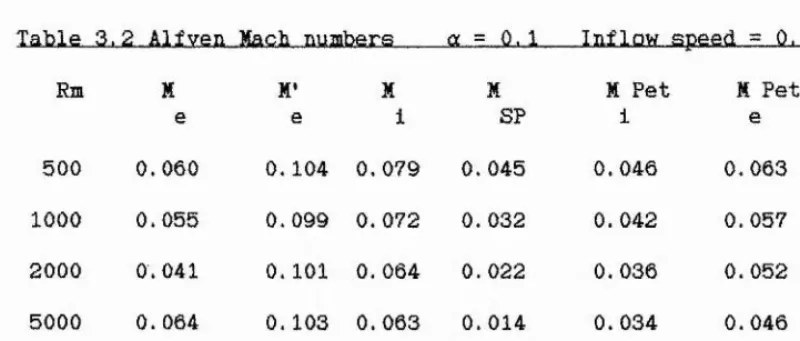
Alfven Mach numbers. For reference the results from the Sweet-Parker and
Petschek theories are grouped together in table 1.1. j
From equation (44) of Priest and Forbes (1986) we have I
- 1.
13-same paper relates the internal, external and normal magnetic field at
the neutral line:
= B e - I
)
<1.4.14)Since
i
-<1.4.15)
we may combine these results and substitute back into (1.4.13) to find the internal Mach number for the Petschek model in terms of the external
Mach number.
lable. ,1.1___ Internal.and, external Alfven Mach numbers
Sweet-Parker reconnection:
J
-M«» —
Mi
Petschek reconnection:
- 1. 14 - î
î'
These results will be required in Chapter 3 so that we may compare
results from the numerical work and the analytical theory.
Pxe.YloüS. nu.inericaL.,MO.r.k
This section presents a brief overview of previously published work
on numerical reconnection experiments that are similar to our work.
The first work on numerical reconnnection was performed by Fukao and
Tsuda (1973) who solved the incompressible time-dependent equations of
motion and induction over a rectangular region with boundary conditions imposed so as to give stagnation-point flow. Using a Friedrichs-Lax
scheme and an effective magnetic Reynolds number of 50-500, they
produced a non-zero component of magnetic field perpendicular to the
initial configuration, thus demonstrating that reconnection was
occurring. The experiment had the limitations of insufficient resolution
to resolve the diffusion region, and of not being run for long enough to allow a steady state to develop.
Ugai and Tsuda (1977) study a similar configuration, using a two-
step Lax-Vendroff scheme to solve the compressible MHD equations with an energy equation including ohmic heating; an artificial viscosity is
imposed to ensure stability of the numerical scheme. They take an
initial configuration of a one-dimensional current sheet and assume that Rm ( = 1000 in the external region) is diminished by a factor of 100
within a circle of given radius about the origin. This generates an x-
point in the magnetic field at the origin and produces Fetschek-type
flows, with a plasma jet directed along the x-axis. An integration over
the box shows that the magnetic energy in the box decreases over the
- 1.
15-reconnection mechanism is providing conversion into thermal and kinetic
energy. The same authors (Tsuda and Ugai 1977, Ugai and Tsuda 1979a,b)
have presented further runs of the same experiment, in which they show that holding the electric field vB constant on the inflow boundary gives
evolution to a steady state. The effect of increasing the plasma
resistivity is to shrink the diffusion region and to change the
reconnection rate, which is found to be in agreement with. Soward and Priest's 1977 result.
Ugai (1981 , 1982, 1983) continues this work by considering the effect of different boundary conditions. He finds that replacing the
free inflow boundary by a rigid wall over which there is no mass or
field flux only changes the reconnection rate slightly, but that replacing the exit boundary by the same type of wall inhibits fast
reconnection. Instead, an o-point forms where previously an x-point had been observed.
Hayashi and Sato (1978) solve a similar set of equations but obtain
driven reconnection by imposing the flow speed on their inflow boundary,
rather than letting it free float. They assume zero magnetic resistivity
(ideal MHD) everywhere except where the current density exceeds a critical value to model an anomalous diffusivity, With strongly curved incoming field lines and a free-floating exit boundary they state that a
steady state is reached after 15-20 Alfven transit times, although their
graphs of electric field at the x-point (a measure of the reconnection
rate) do not confirm this. A Petschek-type flow is found, together with an associated bifurcation of the initial current sheet into two standing
1. 16
-boundary replaced by a rigid wall) shows that an island forms within the box, and that an O-point rather than an X-point forms at the origin.
Biskamp (1935, 1986) presents some interesting solutions to the
incompressible equations at high resolution and magnetic Reynolds
number, for which he also has a driven inflow and free floating exit boundary. Despite the appearance of Petschek-type flows and an
associated current-sheet bifurcation, he interprets his results as being nearer a flux pile-up regime. The appearance of a reversed current
region at the downstream end of his diffusion region suggests that a reconection regime of the type considered by Syrovatsky (1971) is taking
place. Because of the importance of these simulations and their
relevance to the study presented in this thesis, a fuller discussion is postponed to Chapter 3 where the results from the two sets of
experiments are compared.
1.6 Reconnection regimes
Ve may summarise and extend Section 1.4 in a classification of six
distinct reconnection regimes for an electrically conducting plasma,
identified by inflow speed V«,, and proposed by Priest (1985):
(I) Very slow reconnection occurs when a system passes through a series of quasi-potential states. For this to occur, the inflow speed V» must
be less than the global diffusion speed , where V«. is the global
ambient length scale.
(II) Slow reconnection, or the Sweet-Parker regime (1958, 1963) occurs when
/VL ... . V.L
Vz.
- I
-
1.17-where Va. j is the Sweet-Parker reconnection rate and Rm is the
ambient magnetic Reynolds number. The diffusion region (or current
sheet) has length Le and the magnetic energy is converted equally into heat and kinetic energy.
(III) Petschek-Sonnerup reconnection develops when
- \ V<. <. V
where scales as 1/log(R^), a result first given by Petschek (1964).
He suggests that a current sheet may bifurcate into four slow mode MHD
shock waves propagating from a central region where the Sweet-Parker
regime is dominant. Since the dimensions of this central current sheet will be much less than the global length scale, the magnetic Reynolds
number governing the reconnection rate within the sheet will accordingly be lower and so the global reconnection rate will be much higher. In
fact, this internal Rm may become of order one and so account for very
rapid reconnection, which has made this model attractive to theorists.
(IV) Unsteady flux pile-up reconnection occurs when
< V.
so that a steady state cannot occur. This regime postulates the
existence of a maximum reconnection rate; magnetic field is brought into the system faster than it can be reconnected and so the flux accumulates
at the diffusion region, causing it to lengthen into a long current
-
1.18-save that the magnetic field strength will increase rather than decrease
on approaching the current sheet.
(V) Impulsive bursty reconnection may be induced after flux pile-up occurs. The central current sheet develops to such a length that it
becomes unstable to the tearing mode instability, leading to the
formation of chains of magnetic islands. These may be expelled from the box in the plasma jet at the end of the current sheet, or coalesce together to form larger islands. Sakai (1983) identifies signatures in
X-ray emission from coronal loops as a manifestation of this instability.
(VI) Turbulent reconnection may develop from the previous regime at
sufficiently high magnetic Reynolds number, with current filamentation
developing on progressivly lower length scales. However, the
difficulties of modelling such a process analytically or computationally
- 2. 1 -
CHAPTER 2
NUMERICAL SOLUTION OF THE MAGNETOHYDRODYNAMICAL EQUATIONS
2l1
The „M P. .équations.
Throughout the next three chapters of this thesis we shall be
studying solutions to the full non-linear, compressible, resistive, two-
dimensional magnetohydrodynamical equations given in Chapter 1 <1.3.1
-1.3.4). To produce a numerical solution we must expand these equations
out into components and cast them into the form of a generalised continuity equation:
where f is the transported quantity and S is a source terra. Ve have
<2.1.2)
<2.1.3)
2. 2
-b u a t b i
^
" h'^
%
3 £ t
3 x a t
(2.1.5)
(2 .1.6 )
(2. 1.7)
EMàSîà solves the MHD equations by splitting them into advective and
diffusive parts. This may be illustrated by examination of equation (2.1.1). Firstly, we solve the advective (hyperbolic) part of the equations, by setting the source term equal to zero;
^ + ^ ' ( P y ] - 0
o t (2. 1.8)
Secondly, we use the transported value f* determined from the first part as initial conditions for the diffusive (parabolic) part of the
equations. Ve set the divergence term equal to zero:
(2.1.9)
The rest of this chapter is a description of some of the numerical
methods used in our computer program that solves the above equations in
two-dimensional Cartesian geometry. The program (or code) is referred to
as SHASTA, after the particular flux-corrected transport algorithm used in the advective subroutines, For a fuller description the reader is
referred to the original papers by Boris and Book (1973, 1976), Weber's
2. 3
-"4
S
Computer simulation,
Traditionally, the three methodologies of astronomy and astrophysics
have been theory, experiment and observation. With the advent of widely f distributed, powerful computer facilities over the last decade a fourth
is now coming into widespread use; that of large-scale numerical
simulation.
Computing the behaviour of a physical system by specifying the governing laws and advancing them in time is a technique that lies
midway between the areas of the applied mathematician and the
experimentalist. In most cases the performance of a calculation on a
computer closely resembles the performance of a physical experiment, in
that the analyst runs an experiment without necessarily knowing what the
results will be. However, the results of a numerical experiment can be
much easier to compare with analytical work than with corresponding observations in the laboratory or above the atmosphere. In a
computational experiment the analyst has complete control over his nodel
universe. He may completely specify the initial configuration and
internal parameters; his experimental probes do not disturb the
experiment; he can study a purely two-dimensional configuration. He Is
also able to try what neither the theoretician nor the experimentalist
may, by testing the sensitivity of phenomena to independent theoretical
approximations (Arnett, 1985).
Most serious work in numerical simulation has come to require the power of supercomputers, such as those built by Cray Research, which
~ 2.
4-next decade a number of machines with non-Neumann architectures
(Pearson, Richardson and Toussaint, 1985) will be specially built to treat problems of comparable complexity and processing cost to those
examined in the subsequent chapters. These computers will be based on
large arrays of microprocessors configured in a two- or three-
dimensional matrix so that one processor is available for every
gridpoint at which the governing equations are to be solved. It may be
that such machines will eventually become more powerful for application to this class of problem than non-dedicated supercomputers, where
constraints such as the time taken for an electrical signal to cross the computer at the speed of light will put a limit on the ultimate speed of operation.
The program that produced the results presented in Chapters 3 and 4
was developed on the two DEC VAX 11/785 machines at St Andrews, and was
run both at St Andrews and on the UKAEA's PRIME at Culham Laboratory,
Oxfordshire, as a 'front-end' machine for the Harwell CRAY-1.
I hQ SHASTA...aiIg.Qr.i.thffl
In this section we give a brief account of SHASTA, one of a class of
flux-corrected transport (FCT) algorithms first presented by Boris
(1973). These schemes are designed to perform accurate transport of
discontinuities in fluid dynamical simulations, and hence the use of
such an algorithm will be particularly helpful when we come to simulate MHD shocks in the Petschek model.
Conceptually, such an algorithm consists of two stages: a transport
or convective stage, followed by an anti-diffusive or corrective stage.
2. 5
-of actual mass and energy densities, so steep gradients and inviscid
shocks are handled much more accurately than by a conventional second-
order scheme such as the Lax-Vendroff (Roache, 1976).
As an illustration of the method we here give a simple geometrical interpretation of FCT applied to the one-dimensional continuity equation
jÿ
0 ^ ^ ^ f ' (2.3.1) Vi
The method may easily be extended to multi-dimensional applications.
4
beginning of an iteration ( t = 0 ). Ve assume that the densities are known and that the velocities 1 V/J are known at t = (St/2, half a
timestep ahead. Ve require the densities ^ ^ ^ at the end of the
timestep when t = (St.
The method begins by considering a typical fluid-element trapezoid,
formed by connecting adjacent densities with straight line segments. The
density profile thus constructed is consistent with the definition of
the total mass
h
(2,3.2)On Figure 2.2(b) we have sketched short arrows, showing how these fluid
elements and their boundaries might convect in a Lagrangian sense. To
ensure positivity, Boris restricts his analysis to I v #t/#x I < %
where v = max (IVjl ) so that no fluid element boundary convects past a
Stage I ;
... transport
o
j-fl
Figure 2.1 Converted fluid trapezoid
y
p
A t
0+1
2 . 1 (c)
p
to ) b \\ , is
(2.3.5)
- 2. 6 - 4
g
cell boundary. In our full code we take a more restrictive condition %
that enables us to treat MHD waves; this Courant-Friedrichs-Lewy (or I CFL) condition is described below.
We follow the motion of the fluid element for one timestep in a 4 fN Lagrangian sense. The complete transport prescription, relating | )
P 0^ ' t t I ( Pi-H - P<) ) (2.3.3) I
+ ( 9 - ) p j
where for greater accuracy the j ^ derived from linear
interpolation back on the grid may be used (Figure 2.2(c)). These are given by
I
- C l - / i ] v i + ( c j / l )
,
LI
^ -12 I /z) (2.3.6)
C V •'< 0 )
where C
j
=|
V jS
t/ I .
For a uniform velocity field this reduces to the simpler form
P j - Pi - l(pj+'"pj''/ +
(2.3.7)~ 2. 7
-This formula is a simple two-sided differencing of the convection term,
plus a strong zero-order diffusion. Without this velocity-independent diffusion we just have the result found by using the two-step Lax-
Wendroff algorithm (Mitchell, 1969; Roache, 1976), with the usual
second-order dispersion and velocity-dependent diffusion.
The strong diffusion corresponds to acting on the initial density profile ^ pj ^ in the following way;
(2.3.8)
For the zero-velocity case the diffusion coefficient is strictly 0.125.
In the case of nonzero velocities 4 ^ is 0.125 plus small wave-number
and wave-number dependent terms. A von Neumann analysis of this equation
shows that the amplification factor is always less than unity for ^ < 0.5, so the transport scheme is always stable.
S-tage II: Anti diffusive transport
It is straightforward to remove the zero-order diffusion from stage I by applying an equal and opposite anti-diffusion. Since the previous
Ù i
readily be inverted by the use of standard algorithms. However, the equation represents an implicit tridiagonal system for ^ ^ ^ ^ it may
fastest and simplest way to remove this residual diffusion is by an explicit anti-diffusion equation
“ 2. 8 ”
This equation has the disadvantage of not conserving positivity.
Consider the example shown in Figure 2.2 . The antidiffusion imposed in
stage II, which is only intended to remove numerical errors introduced
in stage I, in fact brings in new numerical errors at the labelled grid points. New maxima and minima are formed where they are physically
unreasonable, and the new minimum is negative. We cure these features by invoking the principle of flux corrected transport.
Stage.. IlI.L_.Elux £orr.e£.tl-O.Q,
To remove the nonpositivity it is more direct to work with the mass
fluxes directly. We may rewrite the antidiffusion formula
T \ _ I
where the antidiffusive mass fluxes are defined as
<2.3.10)
(2.3.11)
This rewritten antidiffusion formula has two important properties: i) The antidiffusive fluxes and j! describe explicit
transfers of material.
ii) The equation is strictly conservative, no matter what values the
fluxes take, as every flux is added once and subtracted once somewhere else (except at the boundaries).
We are thus led to the principle of flux-corrected transport:
a#
P
t?; O
- 2. 9 ~
The antidlffusion stage should generate no new maxima or minima in the 4 '4
solution, nor should it accentuate already existing extrema. a
■ i
at any grid point beyond the density value at neighbouring points. This is the origin of the name 'flux-corrected transport' and is the crux of
12)
where
This scheme clearly maintains positivity. To make the limitation
quantitative without violating conservation, we correct the 4
antidiffusive mass fluxes. The are limited term by term so 4 that no antidiffusive-flux transfer of mass can push the density value 4
I
JÏ
the method. J'
The corrected fluxes ^ are given by the formula :%
*
% P j — P 3 (2.3.13) I
and the fluxes ^ are replaced in the original antidiffusion
equation. The quotation marks about the factor 0.125 indicate that a | ‘I more exact cancellation of factors can be achieved if even rough
approximations to the velocity and wavenumber dependent corrections are
included.
An application of this schema to sharp gradients gives rise to the
- 2.
10-that the Ranklne-Hugoniot relations (Jeffrey and Taniuti, 1964) are still satisfied.
of which the best known is the Alternating-Direction Implicit (ADI)
(Mitchell, 1969). The scheme we choose here is also implicit and has the
advantage, as do all this class of algorithms, of being unconditionally stable so that a timestep of any size may be taken without loss of
showing that ^ & j j may be found by solving the matrix equation
(ignoring the boundary conditions)
? I
I
2
^Solution of the diffusion. eq.uat.i,o.a.
I
There exist several ways to solve the two-dimensional diffusion
equation
J
numerical stability. Differencing the x-component of (2.4.1) gives
,
a-:;
n -;
A t '
This expression is first order in time and second order in space.
Rewriting (2.4.2),
2. 11
-o
o
... O 1
L
l u
Av
&K, <2.4.4)
This may be easily solved on noting that the matrix is tridiagonal. There exist several explicit, non-iterative algorithms to invert such
matrices; we choose that of Crout (Burden et ai, 1981).
For a numerical scheme of this type the boundary conditions must be imposed implicitly on the form of the matrix, unlike the advective part
of the code where they must be imposed explicitly. For instance,
consider the case of a zero first-order derivative boundary condition.
Denote the entry in the ith row and jth column by a(i,j); then the
matrix may be represented in the form [a(i,J)3. To impose a zero normal
A ft
derivative at the upper boundary, let % , ~ ^ ° * T^be matrix and vectors of magnetic field will then assume the form
^ 11 O » • • ! “ a , ' 1 h , \ — <^1.1 Ô • • • !■; o
1 °
O * - (ÎÎ 1
i
1
Bv, i = j Bs!i
I ^
(2.4.5)
2. 12
-as required.
ut*^!
* (2.5.1)
where nz is the number of points along the z-axis < = 60) and f is the fractional increase in spacing from one grid-point to the next ( =
0.10). The lowest grid spacing is thus Az - 0.012 and the highest is Az 0.133. Ve found from experiment that f could not exceed about 0.13 or
the code went unstable.
Ve are limited by the grid resolution as to the maximum magnetic
Reynolds number that may be taken. In the grid separation instability, a cascade of energy proceeds from long wavelengths to short ones due to
the nonlinearity of the MHD equations; the physics 'literally slips
i
where the vectors are the values of magnetic field on a column of the ^ numerical grid, The reader will note that expanding the second row gives
%-Î
2 ^ S.pat.lal..,dif.f.er.e.nc.l.ng.
4•y
The computation is performed in Cartesian coordinates over a
rectangular array of 40x60 grid points. The points are uniformly spaced
in the x-direction but are non-uniformly spaced in the z-direction to
ensure higher resolution at one edge of the box. The i'th grid point in
- 2.
13-through the cracks' (Pearson et al, 1985), This need not affect the
behaviour of the code as long as we can be sure that all wavelengths are being modelled accurately.
One way to do this is to use a spectral code, in which the MHD
equations are Fourier analysed in space and the governing equations in
Fourier space are solved numerically. Such a scheme ensures that all length scales can be accurately described throughout the calculation as long as computation is stopped when significant activity appears in the
highest wavenumbers. The difficulty with such a scheme is that the
treatment of boundary conditions becomes complicated for any but the simplest configurations, with one analytical expression required for
each harmonic in both directions. Since hundreds of harmonics are
required for problems of interest, this approach presents some rather
severe difficulties. Matthaeus and Montgomery (1981) have performed a study of the double tearing mode in two dimensions with such a spectral
code, the advantage being that for such a configuration only symmetry
conditions need be imposed on the boundary. They find interesting
evidence of current filamentation, a feature observed in some laboratory
experiments (Stenzel et al, 1986) but not in any finite-difference
calculations performed to date. A spectral approach is also suitable for
a study of homogeneous turbulence.
Ve choose instead to follow the approach of Forbes and Priest (1983), who attempt to model all length scales within a finite-
difference scheme and thus to avoid grid-separation instability. They
argue that the numerical grid spacing should be less than the
Kolmogorov dissipation scale lengths X f
j "y 3 < l t v -I
;
û- ^
2. 14
-(Landau and Llfschitz, 1959, p 122) where and £.\/ are the total
magnetic and kinetic energies, respectively. In our equations the viscosity arises only from numerical effects and the magnetic
conductivity is the major significant source of diffusion. We therefore
ensure that the grld-resolution is sufficient at the current sheet to cover the shortest wavelengths arising at any time.
Eastwood and Arter (1985) have performed a important and 4I
controversial study of this type of instability in the context of simulations of tokamak disruptions. They perform a detailed analytical
study of aliasing error,a common cause of 'blow-up’ of solutions. As an
Illustration they consider the discretlsed, Fourier transformed fluid 'g
1
equations. Let the shortest wavelength have wavenumber K and let the velocity spectrum be filled for k up to K; then the non-linear advection
terms attempt to generate flows with wavenumbers up to 2K. Those in the
range K + 1 to 2K pretend to be, or 'alias', flows of wavenumber less
than K. If the physical process being modelled is a cascade of energy from large to small scales, a positive feedback instability is possible,
since energy which should have been transferred to small length scales is Instead transferred to long ones. The instability usually manifests
itself first as a violation of energy conservation followed by the
appearance of arbitrarily large velocities and magnetic fields so that
•I the timestep (here determined by the CFL condition) drops towards zero, 4
I
% However, identical behaviour is seen when there is a mathematical or
programming error in the boundary conditions or vector potential
2. 15
-against mistaking non-linear instabilities for effects caused by
programming errors in the context of fluid-dynamical simulations. It seems likely that this instability caused Forbes and Priest's
study of line-tied reconnection to end prematurely. Ve have also
observed the effect in some of our tearing mode simulations, which are
very similar to theirs. Chapter 4 describes how one physically allowable perturbation, imposed to initiate magnetic tearing, drove the code
unstable in a few Alfven times while others let the code run
indefinitely. In the light of these ideas we suggest that the first
perturbation contained harmonics at higher wave-numbers, so that the
cascade process for the first run took much less time to reach the aliasing stage than the second.
Boundary conditions are imposed explicitly by the modules BOÜNDY and
Implicitly from within AFEOMB, BFROMA and DIFUSE. These are listed in Appendix B.
Temporal differencing
The timestep At is determined by the Courant-Friedrichs-Lewy condition (Potter, 1981)
A t 3 A A
(2 .6 .1)where A is the smallest grid spacing in the mesh < = minCAx, Az) ), Vx and Vz are the x and z components of the plasma velocity, and
is the fast mode wave speed. A is the Courant number which is set to 0.2
4 y:
-î
3. 1 - f
CHAPTER 3
DRIVEN MAGNETIC RECONNECTION
Introduction
In this chapter we apply the computer program described in Chapter 2 to a study of steady-state driven magnetic reconnection. Because of the
work performed to date has been numerical CBirn, 1985; Biskamp, 1986;
Forbes and Priest, 1982, 1983, 1984; Lee and Fu, 1986; Matthaeus and
Montgomery, 1981; Sato and Hayashi, 1979; Ugai, 1984; Ugai and Tsuda,
1977). The results, reviewed in Priest (1985) have shown many new and unexpected features, such as the rapid creation and annihilation of
neutral points found by Forbes and Priest (1982 , 1983a, b) and the
emergence of plasma jets from a Y-point at the end of a current sheet in Biskamp's simulation (1986), as described and analysed by Soward and
Priest (1986). However, the effect of varying the boundary conditions and internal parameters remains poorly understood.
Chapter 3 presents the background and results to a series of
numerical experiments in which three externally adjustable parameters are systematically varied and their effect on the solutions examined. In
section 3.2 we describe the numerical implementation of the driven
reconnection problem together with an account of the development of the
code. In section 3.3 a 'standard run' with typical magnetic Reynolds number and boundary conditions is analysed in detail. In sections 3.4,
3.5 and 3.6 we show the effect of varying incoming field line curvature,
non-linearity of the MHD equations and the resulting difficulty in i
<3.2.1)
Suriacfi..2 (symmetry);
^ V t =
V l " V : " V t
3. 2
-plasma resistivity and plasma inflow speed. Sections 3.7 and 3.8 have
some general comments on the dynamics of driven reconnection arising from this study.
Numerical. ImplemeatallQn
The field topology we choose to study has two symmetrical, adjacent,
two-dimensional antiparallel flux systems with externally imposed flow and field curvature. Such a configuration might occur inside a tokamak
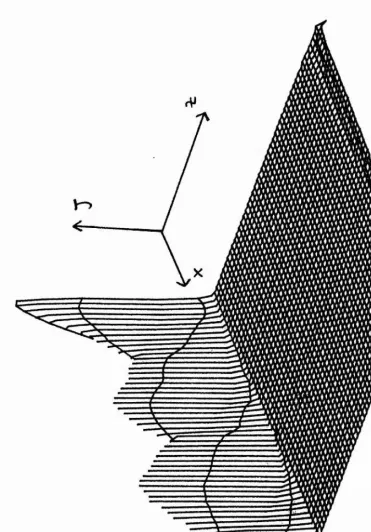
when two islands with different ja, n numbers overlap and coalesce, or in
3
the Earth's geomagnetic tail during a substorm (Figures 3.1, 3.2). We Ig chose to impose symmetry in both the x- and y-directions, which may be
exploited to reduce the number of grid points required, and hence the f| j| computer time needed for each run. Instead of considering the whole
system (Figure 3.3), we may instead examine only one quadrant (Figure i;j 4 3.4). This precludes the occurrence of some asymmetric tearing phenomena j
but will otherwise give exactly the same information. H
For convenience, we assign numbers to label each of the four | '“I numerical boundaries, as shown on figure 3.4. In analytical form the |
boundary conditions are 3
o o
4
Figure 3.1 Coalescence of magnetic islands
.1
u
m
[image:52.659.64.561.61.795.2]>
Co
G.
f+
«eating) X
figure 3.4
^^ngie
quadrant
ofsystem
3, 3
-^ 3 Ù 3 p 3 R x
5 x ' S x ’ 3 x ’ 5 x ’ ° a X " ) t "
Sur face ■4_.Cürlvea inflow);
H X ^ ^ Ÿ ) P imposed (3.2.4)
where the variables and their non-dimensionalisation are defined in
Chapter 2.
To use an analytical expression for a boundary condition, we must find a numerically equivalent condition so that the code will assign
meaningful values to the gridpoints at the edge of the numerical box. For an axis of symmetry this is straightforward; we define the row or
column of points one gridpoint in from the boundary to be the edge of
the system, and calculate the values of all independent variables at the edge on the basis of their values two grid-points in. Specifying the
subscript on a variable as the index along the normal to each surface,
the boundary conditions for edges 1 and 2 are implemented as
Surface 1 (symmetry)
R I » R (3.2.5)
Surface
2
(symmetry)
b I ^ P \
R x x
- o
V
3. 4
-To Impose the values of all variables at the inflow boundary is
similarly straightforward (although the reader should note the risk of
overspecification mentioned in Section 2.3.3 and in Appendix A).
S.urface....4 (driven inflow)
R X ^ ^ R X ‘,w V X I Vx
^ - p
(3.2.7)
The implementation of a free-floating boundary illustrates a
limitation of the finite-difference technique. For an analytical
analysis of an astrophysical plasma a boundary may safely be taken to be
at infinity, but the computational domain must of necessity have a
finite number of gridpoints. One way to overcome this is to
isomorphically map the finite computational domain onto an infinite region, as did Weber (1978). However, the resolution becomes
correspondingly poor towards infinity so that an MHD wave propagating
into this region will eventually trigger a numerical instability
(Forbes, 1987). Alternatively, a Sommerfeld radiation condition
O C
may be used, where f is a flow variable and Vf- is the magnitude of the
local phase speed of the wave quantity (Orlanski, 1976; Han et al,
1983). Forbes (1987) observes that this condition forces the wave at the boundary to be outward propagating, giving a well-posed initial-
boundary-value problem. Despite this, numerical methods based on the full Sommerfeld condition may be prone to instability (Israeli and
3. 5
-Ve choose instead to implement the much simpler boundary condition
of first-order extrapolation of all variables:
(3.2.9) — = 0
where X k is the coordinate perpendicular to the surface under
consideration. Chu and Sereney (1974) have performed a comparison of
seven different methods of formulating boundary conditions at an outflow boundary for a one-dimensional hydrodynamical open-boundary problem. They found that only first-order extrapolation and a method based on
extrapolation of the characteristics (equivalent to the Sommerfeld condition) gave results consistent with the known analytical solution. The other, more complex methods gave less accurate results. Hence we
believe that this method is one of the best for the problem.
Given time, we would have improved these boundary conditions by
using the very similar method described by Caraerlengo and 0'Brien{^%**):
4 X ' - i l
<3.2.10)
>3 If the local wave is incoming, it does not change over an iteration, s|
while if the local wave is outgoing p is given by first order
j
extrapolation in space and time, approximating a Sommerfeld condition. I Alternatively a simple extrapolation may be combined with a wave-
3. 6
The initial conditions are
Vx — 0
Vz = 0
Bx= sin ( i r z /2 w ) ( z < w )
Bx= 1 ( z > w ) (3.2.11)
Bz = 0
P = 1
p = ( 1 + j3 - 1 ai 1 Bt )/2
where w is the width of the initial current sheet ( = 0.05) and the
ratio of gas to magnetic pressure, is 0.1. The pressure condition
ensures the system is in magnetohydrostatic equilibrium at t = 0.
VaglÆr-...p.at.^&.tlaL...g.QaLVê£slo.R. CQUtlûaa
Ve choose to use the magnetic vector potential A as a supplementary variable. Several advantages arose from this. Only A need be treated in
the the diffusive part of the program, rather than both components of
magnetic field, with a resulting saving in computing costs. Since g, - curl A, elementary vector identities ensure that div B = 0 identically at all times. However, routines to convert from A to B and back at every iteration were still required since the advective equations are cast in
terms of B. Also, more complex boundary conditions that impose A, Bx and Bz selfconsistently were required, and finding
■
The disadvantage is that a large number (at least 10%) of the gridpoints -ç must lie in this region, which is not modelling any physical processes.
3. 7
-workable expressions (especially at the corners of the box) proved to be
extremely difficult.
The calculation of B from A is straightforward. A two point formula is used to obtain the derivative of A in the x direction:
^ A
#4-1 — /\» — \)
X - %r-i (3.2.12)This gives full second order accuracy on the uniformly spaced axis. For
a similar accuracy order to hold in the z-direction a four point formula
would be required (Roache, 1976, p 20). We decided that the associated
complexity of the associated boundary conditions would have been too
expensive in development costs and implemented another two point formula |
(Schnack, 1978): j
B N 2_ N j + t — (\J— '
^ ^ t k + ^ - A . t
where
t t Si ~
t - t j ^
The truncation error is
(3.2.13)
(3.2.14)
A - t A +4: H A - 1
<3.2.15)
so that (3.2.13) is formally first order accurate, becoming second order
<3.2.17)
Z t +
t--T t--T t--T
’ <3.2.18)and thus we have ’effective’ second order accuracy.
To derive A from B proved to be a considerably more complex problem.
To calculate A one of the two first-order differential equations
must be integrated subject to the boundary conditions, and the first difficulty becomes apparent: if the vector potential is integrated up a
column or along a row two boundary conditions for A have to be imposed
on the solution of a first order system, leading to overspecification. The first approach tried for the driven reconnection problem (and
the one eventually adopted) was straightforward integration of the x-
component of magnetic field in the z-direction:
. f (3.2.19)
1
I
- 3. 8 - .1
A
5 V* (3.2.16)
A - 1
where r = 1 t ^ ^ a small constant. In this case (3.2.15) becomes
The coefficient of the first order term behaves like ÿ
3. 9
-The value of the tline-dependent vector potential was specified at the
inflow boundary and at the two rows further in, and the field was
integrated down to the bottom of the box. To maintain second order accuracy B was integrated over alternate pairs of points, an approach
used by Forbes and Priest (1982) . To check for consistency, the two
conversion routines BFROHA and AFROMB were run alternately on the intial magnetic field profile, and to within single precision VAX arithmetic
the results were consistent to 6 decimal places after several hundred
iterations.
With low values of this approach worked well, but decreasing
gave some noise in the field lines, which are here plotted as contours #
of constant A. The difficulty is probably purely numerical, in that the
equations which convert B from A are not being inverted in precisely the
same form. That is, while a three point formula is used to differentiate f
A, a two point formula derives A from B and so ’decoupling* can occur
between the values of A at odd and even rows. This gives rise to the M
noise, which is caused by rapid alternations of A from gridpoint to
gridpoint. This, nonphysical effect is probably not seen when low values
I"
of Rm are taken because the associated high Fourier modes and steep
■I gradients are damped out by the high resistivity. It is possible that % 3.
this is the cause of some of the numerical instabilities seen by Forbes 5
in his work (1982, 1983a, b>, as well as the Kolmogorov length-scale and
I
aliasing instabilities discussed in Chapter 2, section 5.
An obvious further approach would be to modify the vector potential
3 . 1 0
-Althüugh cheap to run, we did not have enough time to write and debug
this extension to the code.
3.,..2.^2 Compat Ibllity r.e.Iat i ohs
The MHD equations we solve in this chapter <2.1.1 - 2.1.4) are of mixed hyperbolic-parabolic character, since the introduction of
dissipation adds second-order terms to the system. With even a partly
hyperbolic system, the need to assign values to each of the variables on
boundaries over which there is a mass and field flux will lead to over specification and the consequent formation of a boundary layer. This
section describes a consistent formulation to avoid over-specification
by determining the values of some of the boundary variables from the
system of equations being solved. The method proceeds through
determining the characteristic equations of the system and transforming
them to lie along the projected characteristics as described in Appendix 3
I
A. A subset of the resulting compatability relations may then be solved; :|
the number will depend on how many variables cannot be specified at that 3
point, which in turn equals the number of characteristics leaving the
computational domain ( Courant and Hilbert, 1962, p 473 ). J
4
Hu and Vu (1985) give a full discussion of the characteristics of '
1
the two-dimensional ideal (purely hyperbolic) equations. Here we may . i
consider the simpler case of a one-dimensional scan of the ideal two- j
dimensional equations; ideal, because we assume resistive effects to be i
unimportant everywhere away from the x-point; one-dimensional, because
our numerical scheme scans in the x- or z-direction while ignoring
4- C v t - v s ] B
o r j: <3.2.21)
3.J3.1.3-- grQgraa. .de.yfi.1 opinent
Given the problem as defined in the previous sections, a suitable
combination of initial and boundary conditions had to be found which
allow the system to evolve in time to give asymptotically steady-state reconnection. For development purposes we omitted the use of any
compatability relations, as they invariably complicated the behaviour of
the system to such an extent that it was unclear which effects were
physical and which numerical. For instance, a crude approximation to the compatability relation was obtained by setting
3 . 1 1
-Cartesian geometry the projected characteristics will just lie along the
art boundary, where n is the unit normal to the boundary at the
specified point. Ve restrict further analysis to the z-t plane since the characteristic equations are primarily of interest to us in the context
of the driven inflow boundary (z = 0), and refer the reader to Appendix
A for a full treatment of the problem. For reference, we observe here
that for the inflow regime under consideration < -Vs ( Vin ( 0 ) only -Sj
1
one compatability relation need be solved, which is 'I
(Lx Rt Dt\/x - A
DtVk
<]
+
Bx
Bx
Bx Vx
(3.2.20)
I
4"
D:k p ::<)
|
where
m. ^ <3.2.22)