PUBLISHED ARTICLE:
Campbell, M. (2012) Changing Day Services: Do you agree?
Journal of
Intellectual Disabilities
16(3) 205–215.
CONTACT DETAILS FOR FURTHER INFORMATION:
Dr Martin Campbell
Senior Lecturer
School of Psychology
University of St. Andrews
St Andrews
KY16 9JP
Tel: 01334 462084
Fax: 01334 463042
TITLE:
Changing Day Services: Do you agree?
Abstract
Models of day services for people with intellectual disabilities in Scotland are changing, with the purpose, content and
availability being reviewed. There has been concern that a move to more flexible “alternative day opportunities” is driven
more by reduced budgets than a policy of modernising day services in response to individual needs.
During a day services review, a questionnaire was used to rate and to collect views on existing services from 60 carers,
service users and staff. This included evaluating day activities available, care plans, opening times, transport and the
most valued aspects of existing day services.
Respondents indicated general satisfaction with existing day services, although half believed that day services should be
reviewed. The most valued parts of day services were forming and building friendships, and a safe place to go.
Day services are highly valued by families and service users. Recommendations are made for a robust and transparent
review process.
Introduction
Models of day care provision for people with intellectual disabilities in Scotland are changing and there is value in
collecting the views of carers and service users at a local level, in relation to these proposed changes in service delivery.
In Scotland between 2003-2010 the number of adults attending day centres fell from 7443 to 6226, whilst the number
receiving “alternative day opportunities” (mostly community based use of existing resources) rose from 5543 to 7859.
The number of adults attending a day centre 5 days per week has decreased by approximately 10% over the same
period, and the number of adults using direct payments rose between 2001-2010 from 32 to 963 (Scottish Government,
2011). In 2009 more than a third of adults with an intellectual disability in Scotland did not attend a day centre and did
not have day opportunities (37%, 6,220 people known to services) (SCLD, 2010); 9% of people with an intellectual
disability were in further education of some kind in Scotland (2,524 people) . There is still relatively little evaluation
evidence about the outcomes achieved by different models of day care (Simons & Watson, 1999; Jinks & Redworth,
The policy for the “modernisation” of day services for people with intellectual disabilities in Scotland and in the rest of
the UK has significant implications for the quality of care, quality of services and quality of life that people will
experience, (e.g. Scottish Government 2010b; DoH 2007, 2008).
Policy developments in have focused on personalising services. The main rationale for changes in provision is to ensure
that people have real choices in how they spend their days. Proper consultation is crucial however to the process of
change when day services are being reviewed:
“It is clear from the evidence collected for this report that many people with learning disabilities and their family carers have positive experiences of the changes that have been made to day services. It is also clear that some people have not had a completely positive experience and feel let down by the lack of consultation, and involvement, of service users and family carers in deciding how new services will operate.” Same as You? National Implementation Group (Scottish Government, 2006).
The terms “day care” and “day services” have been used interchangeably. Day care is provided in day centres, and day
services have been usefully defined in components of “who” (adults with disabilities), “what” (the function, structured
programme) and “the setting” (centre/community based) (McVicker, 2004).
Buildings-based day services are being replaced increasingly with community based provision in the form of alternative
day opportunities. These typically involve activities based on existing community facilities - shopping, use of local
sporting/leisure facilities, cafes, outdoor activities, community centre classes, further education – but can extend to
more specialist activities, depending on the support required. With the aim of enhancing social and personal lives, the
legitimate purview of day services has changed from one of day time “occupation” and even containment, to one of
enablement (McConkey, Dunne and Blitz, 2009). New skills can be acquired through adult and further education,
employment, voluntary work, a variety of independence training activities and involvement in social enterprises or
community business.
A key objective of government policy in Scotland (Scottish Executive 2001) and England (Dept. of Health 2001) has
been to encourage people with intellectual disabilities to gain employment. This is for economic reasons, but also as an
evidence-based way of improving self-esteem and social integration. Employment is a valued outcome for people with
intellectual disabilities according to most evidence (Ridley, Hunter, et al, 2005; Beyer, Grove, Schneider et al, 2004;
There is some evidence that a small but growing number of people with intellectual disabilities are obtaining paid
employment through new initiatives (McConkey & Mezza, 2001; Beyer, 2004; Beyer & Robinson, 2009; Scottish
Government 2010a) and the latest UK government policy aims to have as many as possible jobs of at least 16 hours per
week for people with intellectual disabilities (Dept. of Health, 2009). The number of people with severe intellectual
disabilities in any kind of employment in Scotland has been estimated at 17% of the total known to services (Scottish
Government, 2010a) and a recent review of the evidence suggests there is still much to be done to implement policy in
practice:
“the literature supports the view that supported employment is both worthwhile at an individual and societal level and that there is much that can be done to improve employment rates for people with learning disabilities. However, at present, funding arrangements and policies are not in place” (p 80, Beyer & Robinson, 2009)
In the context of the redesign of day services, delivering improved outcomes is especially important and taking account
of the outcomes that are valued by service users and families is a crucial stage in the consultative process. These
outcomes were identified in interviews by Miller, Cooper, Cook et al (2008) and included:
Feeling safe
Having things to do
Seeing people
Being listened to
Having choice
Previous evaluations of day services that recorded service user views have identified gaps in formalised evaluation of
service users experience, access to education and employment related activities (Scottish Executive, 2000) and the need
for more practical changes to services, such as reducing travel time to and from the day centre, longer opening hours
and a more specific focus on social relations (Pahl, 1993; DHSSPS/PricewaterhouseCoopers, 2007).
There is some concern, however, amongst families and people with intellectual disabilities about why and how changes
to day services are being made. Local authorities, including day services, are under increasing financial pressure, being
been some concern that a move to more “flexible” day services has become driven more by a need for savings, rather
than in response to individual needs. It may be a mistake however, to view day service modernisation as an effective
cost-cutting measure, as alternative support in the community may cost the same (Pitt, 2010).
Special consideration is needed in the change process for those with profound, multiple and complex needs, to ensure
that suitable facilities, adequately trained staff and specialist resources are available in any new models of care (Leyin &
Kauder, 2009). For example, one study from The Netherlands found that 63% of the day centre activities for this group
were “care-related” e.g. waiting and resting, starting and finishing the day. Watching television or listening to music
represented a substantial part the remainder of the activities, according to this study (Putten & Vlaskamp, 2011).
Similarly, the proportion of time spent in group (28.9%) and individual (13.0%) activities is relatively low (Vlaskamp,
Hiemstra, Wiersma et al, 2007). In one study, the outcomes for people with higher support needs following closure of
two day services in one area were monitored. There was no significant increase in community activities or social
inclusion.
“Even though, for some individuals, some gains were recorded, overall these gains were considered a
poor return for the hours released from the closure of the day service facilities.” (Leyin & Kauder,
2009).
The consequences of not properly redesigning services, especially those for people with profound, multiple and
complex needs may be reduced hours of care and a poorer quality and less stable care package (Campbell, 2008; NHS
QIS 2006).
Some of the social benefits of day services are difficult to measure. Group activities, either formal or informal are more
difficult to organise without a buildings based service. For example, one study identified the empowerment that
occurred for participants both at an individual and collective level through involvement in a self-advocacy group
(Gilmartin & Slevin, 2010). The authors concluded that, “opportunities should be provided for adults with an
intellectual disability who are not attending day services to join self-advocacy groups in a community setting”, a
statement that might be interpreted as an endorsement for buildings-based day services, or as a recommendation for
Some support for the value of attending day services per se was provided by a recent study in Georgia, where day
services are not well developed (Makharadze, Kitiashvili & Bricout, 2010). Researchers compared level of
social-adaptive skills and social integration for day centre participants with those of non-attenders. Levels were higher in both
cases for those who attended day centres, although the two groups did not differ significantly on reported happiness.
The study concluded that day-care-centre users with intellectual disabilities enjoyed a greater degree of social
interaction and socialising opportunities than the comparison group.
In the study reported here an evaluation of the change process in day services was conducted in one Scottish area. A
total of 398 people with an intellectual disability use day services in Fife. The purpose of this small scale evaluation
was to gain:
an overview of how day services were rated, as a baseline for comparison with how services are evaluated
following the implementation stage of the current Day Services Review
an overview of how different aspects of the day services are prioritised
user and carers’ views on gaps in current service, that could be met in the new model of day service
This study service evaluation is planned as the “before” stage of a longitudinal “before and after” study of the day
service review over a number of years. In the longer term it should be apparent whether the review has been successful
in meeting the aims set out in the original proposals for review.
Methods
Participants
Participants were 36 carers, 18 service users and 6 care staff from day services for people with intellectual disabilities in
Fife, Scotland. These services are “town based” and carers were parents, brothers and sisters of services users from the
6 different Day Service Centres. Service users were all adults (aged 18-65) with a range of intellectual disabilities. Care
staff were Day Service officers from six different day services. In cases where service users were supported by known
carers to read and respond to the questions, these carers were excluded from responding to the questionnaire.
A steering group with representatives from service users, carers, staff and partner organisations organised the day
service review over a period of 6 months, supported by a number of working groups addressing different aspects of day
services (transport, employment, daytime activities, etc.) Contributors included:
Service users and parents/carers
People First ( Self Advocacy)
PAMIS, Enable (National charity organisations)
Day services staff (social work)
Assessment and care management (social work)
Education and NHS staff
Community services
Autism Spectrum Disorder (ASD) Coordinator (social work)
Disabilities Access Coordinator.
The consultation process involved a number of levels of engagement, including staff awareness days, focus groups with
voluntary day service providers, individual meetings and discussions with parent representatives, consultation events
with service users and carers (both day and evening sessions). Initial findings from the review were collated and shared
with participants, asking for feedback on the accuracy of what had been said at consultation meetings. Over 300 fully
completed questionnaires were analysed (of which over 50 were pictorial, adapted for use for participants who did not
read) expressing broad and specific views in response to key questions that the review had raised. The questionnaire
used for this study was subsequently developed from themes that emerged from this initial analysis of views.
Development of questionnaire
This questionnaire was jointly designed by the Local Authority and the University of St Andrews to allow carers,
service users and a small sample of care staff participants to rate and give views on existing services. The questionnaire
was piloted in one day service before it was administered more generally.
Participants were first asked, “Do you agree that there is a need for a review of Day Services in Fife?”
Day Services in your area
types of activities
the times that the Day Service is open
arrangements for:
o supporting needs
o making/keeping friendships
o taking part in community activities
o speaking to you about the service that is offered
o involving you in setting up and reviewing care plans
o for transport
o for catering
There were also 5 questions open ended questions, asking participants for views on:
the best part of the present Day Service
the most important part of the present Day Service
the part of the Day Service would you definitely change
the part of the Day Service would you definitely not change
what you would introduce that would be new to Day Services
There were five open ended questions asking participants about their views on existing services. There
was no restriction on the length of responses or on the number of responses to each question. Collective
heading were used to group responses to each question; see Results.
Procedure
The purpose of the questionnaires was explained to potential participants at review meetings at each of the centres. The
agreed to participate. Participants were told that their data will be treated with full confidentiality and that, if published,
would not be identifiable as theirs. A total of 60 questionnaires completed in full by 36 carers, 18 service users and 6
care staff. In some cases service users were supported by known carers to read and respond to the questions.
Completed questionnaires were coded by reference number, linked to contact details for each participant, including the
name of the day service.
These contact details were stored by Fife Council, with permission of participants, with a view to repeating the
evaluation exercise when the implementation stage of the Day services review is complete
Results
Of those who responded to the question, “Do you agree that there is a need for a review of Day Services
in Fife?” 30 answered “Yes”,and 12 answered “No”. The remaining 18 did not respond to this question.
Ratings on Existing Services
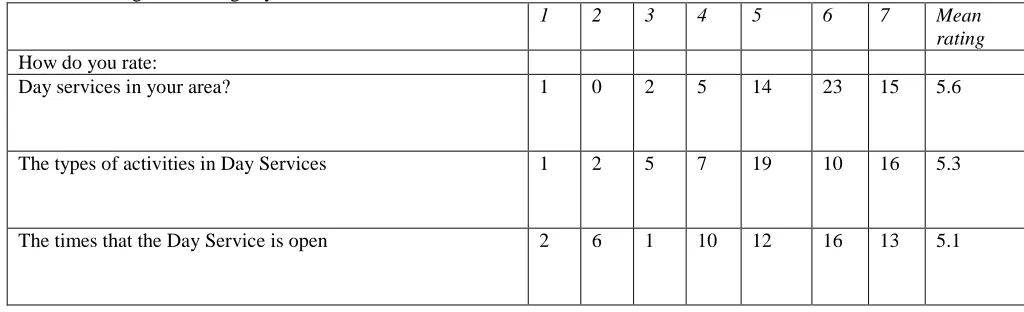
Responses on existing services were on a scale from 1-7. The rating averages have been calculated by
dividing the weighted values for each question by total number of respondents, i.e. for the first question
[(1*1)+(2*0)+(3*2)+(4*5)+(5*14)+(6*23)+(7*15)]/60. The responses are reported in Table 1. where 1
[image:10.612.81.593.541.697.2]is “very poor” and 7 is “excellent”.
Table 1: Rating the existing day services.
1 2 3 4 5 6 7 Mean
rating How do you rate:
Day services in your area? 1 0 2 5 14 23 15 5.6
The types of activities in Day Services 1 2 5 7 19 10 16 5.3
Arrangements for supporting needs 0 0 2 7 14 19 18 5.7
Arrangements for making/keeping friendships 0 1 8 3 12 17 19 5.6
Arrangements for taking part in community activities 0 2 5 9 14 15 15 5.3
Arrangements for speaking to you about the service that is offered*
0 3 5 10 9 15 12 5.2
Arrangements for involving you in setting up and reviewing care plans
0 3 9 7 11 12 18 5.2
Arrangements for transport 3 0 6 5 9 15 22 5.5
Arrangements for catering 2 3 6 10 7 9 23 5.3
TOTALS 9 20 49 73 121 151 171 5.3
*This question was not answered by the 6 members of care staff who completed the questionnaire
Views on Existing Services.
Numbers given below are for frequency of responses. Collective heading were used to group responses to
each question (e.g. For Q1, “Care and support”, “Meaningful activities” etc.). This reflect a range of
individual responses, expressing a similar view. For example, for Q1 “Meeting friends” includes
individual responses of “Seeing my mates”, “Being with my friends”, “Meeting with people I know”,
“Going somewhere that he knows people” etc.
Responses to the Question 1, “What is the best part of the present Day Service, in your view?” were as
follows:
Meeting friends 16; Care and support 11; Safe place to go 10; All activities 10; Meaningful activities
7; Something to do 6; Respite for carers 6; Being part of “one big family”/ The building/ Meeting
Responses to the Question 2, “What is the most important part of the present Day Service, in your view?”
were as follows:
Friendships /Safe environment 13; Somewhere to go 10; All activities in the building/ Respite for
parents/carers 9; Needs are met 8; Treated well 6; Learn new skills/ Transport 3; The staff/
Inside/outside activities/ Autism recognition/support 2; Inclusive communities/ Convenient/ Finding
jobs/ Choices 1.
Responses to the Question 3, “What part of the Day Service would you definitely change?” were as
follows:
None 17; Increase opening hours 10; Transport/More training 4; More activities/More community
involvement 3; More entertainment 2; More domestic skills/ More craft work/ More outings/ More
health staff available/ The term “Day Centre”/ Support for autism/ Early start/ Institutionalised
approaches/ More school involvement/ More advocacy/ Finding a dry, warm eating place at lunch, i.e.
not cars and shopping malls 1.
Responses to the Question 4, “What part of the Day Service would you definitely NOT change?” were as
follows:
Coming to the Day Centre 23; Don’t change anything 11; Transport 7; The staff 3; Choice making 2;
Disability sports/ Amount of support/ Days out/ Catering Activities/ Current hours 1.
Responses to the Question 5, “What would you introduce that would be new to Day Services?” were as
follows:
Nothing 14; More opening hours 11; Access for community groups 7; More things to do 5; More
employment training 4; More young people/More meeting of health needs 2; Shared info with
agencies/A new philosophy/ Breakfast clubs/ Evening clubs/ Autism support/ Dealing with aggression/
There were some common themes that emerged from this sample of service users, carers and staff:
There is general satisfaction with existing day services amongst those who responded. Table 1 shows mean
ratings above 4 across all of the quality measures used.
There was general satisfaction with existing services, although 50% of respondents believed that existing Day
Services should be reviewed.
The most valued parts of day services (Questions 1 & 2) were forming and building friendships, the activities
and the security of the day Service
An increase in opening hours was the most commonly requested change (Question 3), although no change
overall (Questions 4 & 5) was the most frequent response.
There was dissatisfaction in some areas. For example, around one third of participants rated the following
areas at “4” or less: the opening times of day services (19), ,arrangements for speaking to(18), and involving
individuals (19) in the service, reviewing care plans (19), and arrangements for catering (21).
The majority of participants who expressed a view about what to keep and what to change in day services said
that they preferred to keep things as they were (Questions 3, 4 & 5).
The day services were commonly seen as a safe environment or a safe place to go (Questions 3 & 4).
Respite for carers/parents was seen as a good and an important function of day services (Questions 1 & 2).
Discussion
The participants in this study, predominantly carers and services users, valued friendships, the security of the Day
Service and the activities provided there most highly. There was general satisfaction with existing day services, but
recognition of the need to review and update services, to adapt to changing needs. These results support some of the
It is important to note that all participants responded to the first ten questions (Table 1) but not to all of the open ended
questions (Questions 1-5). There are methodological difficulties of using questionnaires, including social desirability
responding, acquiescent and positional responding, and bias caused by those supporting people to complete
questionnaires. Most evidence suggests that closed questions have higher response rates but that open and explorative
questions may obtain fewer, but more valid responses (Cooke et al, 2000; Boynton, 2004) People with learning
disabilities, and especially those with more severe disabilities, have relatively few opportunities to express views about
services received, and this may have restricted the number of responses in the second part of the questionnaire in this
study. Finally the responses of carers, service users and the small number of staff were not analysed separately in this
study. This was done in an attempt to obtain an overview of the views of relevant “stakeholders” in day services,
although separate analysis of service users views, for example, would be possible. This was not done in this study in an
attempt to give a collective view of how services are seen by service usersandcarers, with a smaller representative
sample from staff also included. The needs of both service users and carers are met by day services. It is difficult to
extrapolate the results from this study more widely, but some common themes emerge.
The day centre is seen as a “social hub” and great value is placed on participation in activities based at day centres
(Judge et al, 2010). There is a need to differentiate different aspects of day services - the building, the services and the
relationships - and to evaluate outcomes of these separately in redesign (Pitt, 2010). 71% of those who responded and
50% of respondents overall expressed a view that new forms of day services are needed. This seems to be at odds with
the number of respondents who did not want changes made to day services (See responses to Questions 3,4 &5).
Perhaps there is a need for more differentiation here; service users and carers may be wary that changinganyaspect of
existing services will mean a comprehensive change to all of the service.
Theprocessof re-designing day services to meet aspirations of service users and carers and full consultation with all
people involved is crucial:
“If agencies are to deliver good outcomes to users, as increasingly emphasized in policy, this focus should
As local authority budgets in Scotland and elsewhere are reduced further, and services are pressured to spend wisely and
effectively, there is a danger of a blurring between modernisation of day services “policy” and simple cost cutting;
“more flexible” day services may become a euphemism for cheaper day services.Recommendation 15 of the Same as
You (Scottish Government, 2001) recommended more jointly commissioned, responsive services to support people in
the community through employment, lifelong learning and more social involvement. An evaluation of progress made
with implementing Same as You recommendations has recently been published (Scottish Government, 2012). This will
give an indication of how much has been achieved in developing day services over the last ten years.
Finally, there is one potentially telling response in Question 3 in this study; in response to the question,What part of the
Day Service would you definitely change one service user responded, “Finding a dry, warm eating place at lunch, i.e.
not cars and shopping malls”. Although this is only one response, it may be significant. Day opportunities and
accessing community facilities should mean that service users have the choice and the chance to experience activities
that they have identified as meaningful and valued; it should not mean, for example, being led around Garden Centres
or shopping malls in small groups, for hours without purpose. If the amount of day services is reduced there may be an
implicit assumption that carers will “pick up the slack”. This is a false economy. Most carers, and particularly the
growing number of older carers will require new forms of support and more resources to ensure that they remain
physically and mentally able to support their relatives.
In conclusion, the results from this small study support the view that day services are highly valued by families and
service users. Any changes to these services should be responsive to needs and should achieve outcomes that are
valued. The day service review process should be robust and transparent so that all views can be heard and the rationale
for modernising day services should be clearly explained.
References
Beyer, S. (2004) Working lives: the role of day centres in supporting people with learning disabilities into
Beyer, S., Grove, B., Schneider, J., Simons, K., Williams, V., Heyman, A., Swift, P. & Krijnen-Kemp, E.
(2004)Working lives: The role of day centres in supporting people with learning disabilities into employment.
Research Report No 203. Department for Work and Pensions/ Learning Disability Employment Research
Partnership, London.
Beyer, S. & Robinson, C. (2009) A Review of the Research Literature on Supported Employment: A
Report for the cross-Government learning disability employment strategy team. Welsh Centre for
Learning Disabilities, Cardiff University.
Boynton, PM, Selecting, designing, and developing your questionnaire, British Medical Journal, 328,
p.1312-1315.
Campbell, M. (2008).The importance of good quality services for people with complex health needs.
British Journal of Learning Disabilities. 36, 1, p. 32-37.
Cook, C., Heath, F. and Thompson, R. (2000). “A Meta-Analysis of Response Rates in Web- or Internet-Based
Surveys,”Educational & Psychological Measurement, 60(6), 821–836.
Dept. of Health (2001)Valuing People: A New Strategy for Learning Disability for the 21st Century. Dept. of
Health, London.
Dept. of Health (2007)Putting people first: a shared vision and commitment to the transformation of adult social care.
HM Government, London.
Dept. of Health (2008) Local Authority Circular: LAC (DH) Transforming Social Care, available at:
http://www.dh.gov.uk/prod_consum_dh/groups/dh_digitalassets/documents/digitalasset/dh_082139.pdf
Dept. of Health (2009) Valuing employment now - real jobs for people with learning disabilities. Dept. of
DHSSPS/PricewaterhouseCoopers (2007) Audit of Day Services- Final Report. Dept. of Health, Social
Services & Public Safety, Belfast.
Gilmartin, A. & Slevin, E. (2010) Being a member of a self-advocacy group: experiences of intellectually
disabled people.British Journal of Learning Disabilities, 38, 3, 152-159.
Jinks, A. M. & Redworth, F. (1998) Evaluation of an education programme designed to suggest possible
changes to leisure day service provision.Journal of Learning Disabilities for Nursing, Health and Social Care,
2, 2, 66-70.
Judge, J., Walley, R., Anderson, B. & Young, R. (2010) Activity, aging, and retirement: the views of a group
of Scottish people with intellectual disabilities.Journal of Policy and Practice in Intellectual Disabilities, 7, 4,
295-301.
Leyin, A. & Kauder, N. (2009) Social inclusion: life after ‘day services’. Tizard Learning Disability Review,
14, 2, 13-20.
Makharadze, T., Kitiashvili, A. & Bricout, J.C. (2010) Community-based day-care services for people with
intellectual disabilities in Georgia: a step towards their social integration.Journal of Intellectual Disabilities,
14, 4, 289-301.
McConkey, R. & Mezza, F. (2001) Employment Aspirations of People with Learning Disabilities Attending
Day Centres,Journal of Intellectual Disabilities,5, 4, 309-318.
McConkey, R. (2004) Pressures, Possibilities and Proposals: Northern Ireland Review of Day Services for
People with Learning Disabilities. University of Ulster/EHSSB.
McConkey, R., Dunne, J. and Blitz, N. (2009) Shared Lives: Building relationships and community with
people who have intellectual disabilities.Sense Publishers, Amsterdam.
McVicker, H. (2004)Defining day care. Department of Health, Social Services and Public Safety, Northern
Ireland.
Miller, M., Cooper, S-A., Cook, A. & Petch, A. (2008) Outcomes Important to People With Intellectual
Disabilities.Journal of Policy and Practice in Intellectual Disabilities, 5, 3, 150-158.
NHS Quality Improvement Scotland (2006) Involving people with learning disabilities, carers: evaluation report for
Pahl, J. (1993) Room for improvement.Community Care, 25.11.93, Inside Supplement, 7.
Pitt, V. (2010) Decline of the day centre.Community Care, 9.12.10, 22-23.
Putten, A. van der & Vlaskamp, C. (2011) Day services for people with profound intellectual and multiple
disabilities: an analysis of thematically organized activities. Journal of Policy and Practice in Intellectual
Disabilities,8, 1, 10-17.
Ridley, J. Hunter, S. & Infusion Cooperative (2005) “Go for it!”: Supporting People with Learning
Disabilities and/or Autistic Spectrum Disorders in Employment. Health and Community Care Research
Programme Research Findings No.45/2005. Edinburgh.
Scottish Executive (2001)The Same as You?Scottish Executive, Edinburgh.
Scottish Government (2006)Make My Day! The Same as You?National Implementation Group: Report of the
Day Services Sub Group. Scottish Government, Edinburgh.
Scottish Government (2010a) AWorking Life for All Disabled People: The Supported Employment Framework
for Scotland: Main Report. Scottish Government, Edinburgh.
Scottish Government (2010b)Self-Directed Support: A National Strategy for Scotland.Scottish Government,
Edinburgh.
Scottish Government (2011) Health Service Provision - People with Learning Disabilities. High Level
Summary of Statistics Trend. Scottish Government, Edinburgh.
Scottish Government (2012)A consultation report summarising the evidence which the Evaluation Team has
gathered about the progress on The same as you? from published evidence and from face-to-face interviews
with people with learning disabilities and family carers about their lives.Scottish Government, Edinburgh.
Simons, K. & Watson, D. (1999)New Directions for People with Learning disabilities in the 1990s; a review
of the research. University of Exeter, Exeter.
Vlaskamp, C., Hiemstra, S. J., Wiersma, L.A. & Zijlsrta, B.J. (2007) Extent, duration, and content of day
services' activities for persons with profound intellectual and multiple disabilities. Journal of Policy and