SMALL AND MEDIUM SIZED ENTERPRISES’ PREFERENCES
FOR COOPERATIVE PURCHASING
Onderzoek naar de voorkeuren van het MKB voor gezamenlijke inkoop
Master thesis
Auteur : J.H.M. Meenks
Studentnummer : s0054062
Datum : 03-06-2010
Studie : Master Business Administration
Track : Innovative Entrepreneurship and Business Development Instelling : Universiteit Twente
Afstudeercommissie :
Dr. M.L. Ehrenhard
Faculteit Bedrijf, Bestuur en Technologie Dr. R. Harms
VOORWOORD
‘De Europese economie verkeert in de grootste crisis sinds de Tweede Wereldoorlog, en mogelijk zelfs sinds de Eerste Wereldoorlog’, aldus Jean-Claude Trichet, president van de Europese Centrale Bank. Als gevolg van deze crisis zijn bedrijven massaal aan het zoeken naar manieren om te bezuinigen.
Een ‘mooiere’ tijd is bijna niet denkbaar voor het doen van onderzoek naar gezamenlijke inkoop; een samenwerkingsverband waarbij organisaties hun inkoopvolumes bundelen om op deze manier te besparen op de kosten van hun inkoop, of meer waar voor het bestede bedrag te krijgen. In de praktijk blijkt dat deze manier van inkopen hoofdzakelijk gebruikt wordt door grote institutionele instellingen als ziekenhuizen. Onder het MKB komt het bijna niet voor, terwijl eerder onderzoek uitgewezen heeft dat er toch behoorlijke bezuinigingen mee te realiseren zijn.
De huidige crisis lijkt daarom een ideale aanleiding voor een onderzoek naar hoe bedrijven uit het MKB kijken naar gezamenlijke inkoop, wat voor voordelen ze ermee willen behalen en aan welke richtlijnen de organisatie van zo’n inkoopsamenwerkingsverband zou moeten voldoen wil een organisatie overwegen deel te nemen. De eigenlijke aanleiding van dit onderzoek was mijn constatering dat er in bepaalde branches inefficiënt gewerkt werd doordat de markt enigszins versplintert was. Mijn interesse in inkoopsamenwerking werd gewekt door de redenering dat als alle bedrijven in een bepaald gebied van een enkele aanbieder gebruikt zouden maken ze minder voor deze diensten zouden betalen, enerzijds doordat de aanbieder minder kosten zou maken, anderzijds doordat ze dan ook scherpere prijzen konden bedingen. Op basis van deze interesse ben ik begonnen aan het schrijven van de masterthesis die nu voor u ligt.
Dat u nu begint te lezen in een thesis die bestaat uit begin, een middenstuk en – het
belangrijkst – een eind, is niet geheel en al mijn eigen verdienste. Grote dank gaat hierbij uit naar mijn begeleiders Michel Ehrenhard en Rainer Harms van de Universiteit Twente. Door hun positieve en creatieve bijdragen, niet aflatende steun en onleesbare kriebels in de kantlijn van tal van proefversies hebben zij er voor gezorgd dat dit project niet in de planningsfase is blijven steken.
Daarnaast wil ik mijn vader en moeder, mijn vriendin Marleen en overige familie en vrienden bedanken voor de steun en interesse aan mij betoond tijdens het afstuderen.
Als laatste wil ik de organisaties op Bedrijventerrein Twentekanaal bedanken voor de antwoorden die zij gegeven hebben op al mijn vragen, en zonder wie dit onderzoek niet mogelijk was geweest.
1 SMALL AND MEDIUM SIZED ENTERPRISES’ PREFERENCES
FOR COOPERATIVE PURCHASING Maarten Meenks
Abstract
This study aims to identify the preferences of SME’s concerning cooperative
purchasing and purchasing groups. Cooperative purchasing can lead to savings in the
procurement processes of purchasing group members but can also produce benefits in other
area’s through, amongst others,information sharing amongst members, better relations with
suppliers, value-added pricing and increased market access. Overall, cooperative purchasing
can improve the market position of organizations. Most study’s concerning cooperative
purchasing focus on large organizations and institutions, while cooperative purchasing
amongst SME’s remains an area not yet extensively studied. Research however does indicate
that cooperative purchasing can benefit SME’s in the same way it does larger (institutional)
organizations. Therefore, this study focuses on cooperative purchasing amongst SME’s.
To identify the preferences of SME’s concerning cooperative purchasing and
purchasing groups this study uses a conjoint analysis, which models client trade-offs among
multi-characteristic products or services. The model supposes that alternative product
concepts can be defined as a series of specific levels of a broad set of properties (or
attributes). First, relevant attributes of group purchasing are identified through a
literature-review. Second, levels are assigned to the attributes. Through a stratified design, the five most
relevant attributes were identified. With these five attributes, a fractional factorial design was
generated. Respondents were asked to rank-order the generated combinations of
attribute-levels called profiles. On this data, a conjoint analysis was performed.
Results from the conjoint analysis show that respondents value the extent of group
2 strategic value to their companies. Valued second most important attribute is the amount of
flexibility members of a purchasing group have in their procurement. SME’s prefer to
cooperate on a non-contract base, keeping their procurement processes flexible. A focus on
long-term advantages is seen as more important than a focus on short-term advantages.
The paper is concluded by a discussion of the results and their implications for the
establishment of a purchasing group.
1.
INTRODUCTION
Cooperative Purchasing has existed for a long time. It is defined as the cooperation between two or more organizations in a purchasing group in one or more steps of the
purchasing process by sharing and/or bundling their purchasing volumes, information, and/or resources. A purchasing group is defined as an organization in which cooperative purchasing processes take place. (Schotanus and Telgen, 2007). The goal of a purchasing group in general is to combine purchasing volumes to amass bargaining power (Chipty and Snyder, 1999). The phenomenon however has not been extensively researched. Especially cooperative (horizontal) purchasing between industrial organizations has received little attention in
3 large, institutional organizations (Essig, 2000; Mudambi, Schrunder and Mongar, 2004). This insight resulted in a larger output of publications on different aspects and dimensions of cooperative purchasing. This attention seems to have been growing mainly due to the
increased awareness and importance of the purchasing function (Schotanus & Telgen, 2006). Still, articles on cooperative purchasing often focus on the mechanisms behind group purchasing or study existing purchasing groups. The question what characteristics potential members prefer to see in a purchasing group still remains unanswered. Since a purchasing group depends on amassing purchasing power from its members to achieve successes for those members, the willingness of organizations to join a purchasing group is an important issue. Given that fact, a detailed analysis of the preferences potential members of a purchasing group have concerning that purchasing group itself seems a useful addition to the body of literature concerning cooperative purchasing. Therefore, the central research question of this research paper is:
What characteristics of a purchasing group do potential members prefer ?
Since the majority of available literature focuses on cooperative purchasing in large public institutions, this study wants to focus on cooperative purchasing in an emergent field: cooperative purchasing between privately owned small and medium sized enterprises.
To answer the central question, a literature review on purchasing groups will be conducted, identifying relevant characteristics of purchasing groups and group purchasing in general (section two). Section three will describe the methodology used to study the
4
2.
THEORY
Cooperative purchasing dates back as far as ancient Egypt and Babylon (Wooten, 2003). More recent developments started with the establishments of co-op’s by farmers (among others) with the goal to combine their purchasing power (Hendrick, 1997). But it is only a development of recent decades that cooperative purchasing is gaining attention of scholars, leading to a larger output of articles on the subject. But still, the body of literature is not complete. The question what SME’s prefer in a purchasing group remains unanswered. It is however an important issue. The characteristics or attributes a purchasing group has determines, amongst others, whether a potential member will be interested in joining the group. Knowledge about SME preferences could lead to purchasing groups being set-up in a way that persuades more organizations to join, making purchasing groups more powerful in terms of buying power and thus potentially more successful.
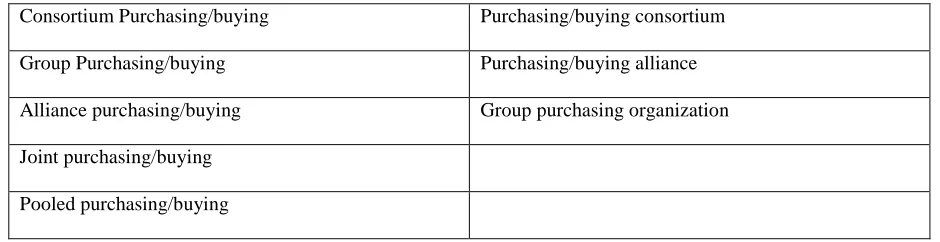
[image:6.595.61.531.589.710.2]Because no literature exists on attributes of purchasing groups, a literature review has been conducted on relevant papers to find the attributes a purchasing group has. Three scientific databases (Picarta, Web of Science and Science Direct) have been searched using different synonyms for cooperative purchasing and purchasing group. The synonyms used are listed in Table 1.
Table 1: Synonyms of cooperative purchasing and purchasing group used for literature review
Consortium Purchasing/buying Purchasing/buying consortium
Group Purchasing/buying Purchasing/buying alliance
Alliance purchasing/buying Group purchasing organization
Joint purchasing/buying
5 These terms were used to search in papers’ titles and abstracts published in the last 10 years. From the search results, papers focusing solely on the healthcare sector have been discarded since these papers focus either on large institutional organization who’s situations are to different from the target population of this study. Also, papers on the formal modeling of cooperative purchasing have been discarded since they focus solely on (mathematical) mechanisms of cooperation, for instance the game theoretic approach to cooperation. On the remaining papers, a forward and backward search has been conducted.
The identified purchasing group characteristics are structure, flexibility, advantages, extent of group negotiations, geographic scope, uniformity of members and suppliers. These characteristics of a purchasing group are discussed in the sub-sections below.
2.1 Structure, the organization of a purchasing Group
6 confederate structure involve measure of control and buying power of the purchasing group, leading to lower purchasing prices.
It seems that there are actually two sub-characteristics concerning the structure of a purchasing group: group size and measure of control. The first sub-characteristic concerns the number of other members participating in the purchasing group. When there are 25 or more members, it becomes hard to maintain a confederate-type structure (Nollet and Beaulieu, 2003). Measure of control concerns the amount of control individual members have over the actions of a purchasing group. In a confederate structure, members have a relatively high measure of control over the actions of the purchasing group as a whole, in a autonomous structure, they have a relatively low measure of control.
2.2 Flexibility, the relation between purchasing group and member
Another important aspect of structure is the nature of relations between the purchasing group and its members (Nollet and Beaulieu, 2003). Flexibility for members plays a key role in this relation. A purchasing group can offer total flexibility to its members by not enforcing those members to buy certain (amounts of) products or services. At the other end of the spectrum is a relation in which members are bound by contract to purchase certain (amounts of) products or services through the purchasing group, which means they lose flexibility in their purchasing processes.
7 The second type of relationship is based upon guarantees (through contracts) that members purchase the products and services through the purchasing group, in order to be a member of that purchasing group. In this type of relationship, flexibility of the purchasing group members is limited but the purchasing group itself is able to guarantee a firm quantity to its suppliers in exchange for advantages for its members.
2.3 Advantages that purchasing groups deliver to their members
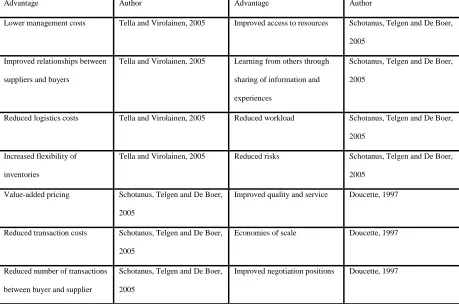
The reasons organizations join purchasing groups is because they can offer a stronger bargaining position and can achieve lower prices, higher service levels, or a combination of both (Doucette, 1997). Others have identified other advantages purchasing groups can bring an organization. Known advantages of participating in a purchasing group are listed in Table 2.
8 Table 2: Advantages of cooperative purchasing
Advantage Author Advantage Author
Lower management costs Tella and Virolainen, 2005 Improved access to resources Schotanus, Telgen and De Boer,
2005
Improved relationships between
suppliers and buyers
Tella and Virolainen, 2005 Learning from others through
sharing of information and
experiences
Schotanus, Telgen and De Boer,
2005
Reduced logistics costs Tella and Virolainen, 2005 Reduced workload Schotanus, Telgen and De Boer,
2005
Increased flexibility of
inventories
Tella and Virolainen, 2005 Reduced risks Schotanus, Telgen and De Boer,
2005
Value-added pricing Schotanus, Telgen and De Boer,
2005
Improved quality and service Doucette, 1997
Reduced transaction costs Schotanus, Telgen and De Boer,
2005
Economies of scale Doucette, 1997
Reduced number of transactions
between buyer and supplier
Schotanus, Telgen and De Boer,
2005
Improved negotiation positions Doucette, 1997
Advantages realized by a purchasing group can be seen as a characteristic of that purchasing group. The advantages identified (see table 1) however show overlap and are not suitable as characteristics. Therefore, to generalize, advantages are proposed that capture the meaning of the identified advantages but are more general. Proposed are short term
advantages and long term advantages. Short term advantages impact on costs directly and in a straight forward manner; paying less for the same (amount of) goods. Reduced costs are the result of a decreased purchasing price due to amongst others a stronger negotiating position, reduced number of transactions, reduced logistics costs and improved access to markets. Long term advantages arise later on and are the result of amongst others lower management costs, increased flexibility in inventories and learning from others. Both short and long term
9 which they occur is determined largely by the focus the purchasing group has concerning the advantages it aims to bring its members.
2.4 Extent of group negotiations, the goods and services negotiated over by the group
The extent of group negotiations specifies which products and/or services the purchasing group procures for its members. In order to achieve benefits for its members, a procurement strategy is used which identifies the area’s most likely to generate potential savings, and then to use the approaches making it possible to do so (Nollet and Beaulieu, 2003). The extent of group negotiations seems particularly interesting for starting purchasing groups, since their success depends on organizations participating. If this means that
participating organizations will have to face a significant amount of uncertainty, their willingness to participate will be less than in cases where there’s (almost) no extra
uncertainty. A radical change in the procurement processes for common commodities poses no real threat for an organization; it does not make an organization vulnerable and does not significantly increase the degree of uncertainty an organization has to deal with. When it concerns the procurement of goods of strategic importance to purchasing group members, the situation changes. A radical change in the procurement processes for these types of goods and/or services results in uncertainty for an organization, and makes an organization
10 2.5 Geographic Scope of a purchasing group
The geographic scope pertains to the location of purchasing group members, being regional or (inter)national. A regional scope has the advantage that the ties between members and between members and purchasing group are closer, making relationships stronger and easier to coordinate. In such a regional setting, communication between group members is easier kept on a sufficient level than in a purchasing group with a national- or international scope. Advantage of a national scope is that the number of purchasing group members can be bigger, improving the buying volume and therefore the negotiating strength of the purchasing group (Nollet and Beaulieu, 2003).
2.6 Uniformity of purchasing group members
Uniformity can be defined as the likeliness in procedures and cultures of purchasing group members (Schotanus, Telgen and De Boer, 2007) Especially in the earlier stages of the evolution of a purchasing group individual member influences are important as the group will often be relatively small (Nollet and Beaulieu, 2003) and an individual member will
11 Based on this theory, transaction costs are lower when organizations are more alike, as there is less uncertainty and less fine tuning is necessary.
2.7 Suppliers
A purchasing group tries to provide benefits for its members by obtaining price concessions from its suppliers (Doucette, 1997). From a member point-of-view, membership of a purchasing group could mean that the suppliers they have used and are familiar with, are discarded in favor of other suppliers. This could mean throwing overboard a valuable
relationship, in which is invested by an organization, to pursue potential cost savings. Also, changing suppliers could mean that the customer has to modify their product specifications. Switching suppliers can lead to uncertainty. Therefore, the willingness of organizations to join a purchasing group could decline.
3. METHOD
To answer the central research question: ‘What characteristics of a purchasing group do potential members prefer ?’, this study will use a conjoint analysis to assess the
preferences of SME’s regarding purchasing groups. Therefore we will discuss conjoint analysis as a research method first. In the second part, we will discuss the particular research method used in this study.
3.1 Conjoint Analysis
12 each attribute level (Murphy, Cowan, Henchion and O’Reilly, 2000). Conjoint analysis
models the tendency of client trade-offs among multi-characteristic products or services. The model supposes that alternative product concepts can be defined as a series of specific levels of a broad set of characteristics called attributes in conjoint analysis.
Conjoint analysis allows the investigation of ‘theories in use’ as opposed to ‘espoused theories of action’ (Argyris and Schon, 1974). Theories in use are theories implied by real actions, like choosing between two options and are studied using real time methods. Espoused theories of action are ‘text-book’ theories, the theories people say they use, and are studied by post-hoc methods. Theories in use are often more useful since they predict real-life behavior better than espoused theories of actions. Real-time methods overcome many of the potential research biases associated with post-hoc methods such as, self-reporting biases, retrospective reporting biases, and difficulty collecting contingent decision data (Choi and Shepherd, 2004). Real-time methods collect information about the ‘in use’ decision policy as the decision is being made, whereas post-hoc methods collect data about a decision after the decision has been made.
Measurement in conjoint analysis can be done in various ways on various scales, but there are generally two broad flavors of conjoint analysis: “traditional’ conjoint analysis and choice-based conjoint analysis. The former typically uses data collected from sequential ratings, rankings or graded (rated) paired comparisons followed by an analysis using simple linear models; and the latter typically uses data collected from a series of choices (from “choice sets”), followed by an analysis using probabilistic choice models (Louviere, Eagle and Cohen 2005).
13 appropriate sample, design an instrument data collection and analyze the data. These five task are described below.
3.2 Attributes
To conduct a conjoint analysis, attributes have to be derived from theory. It is important to identify the attributes critical for the product/service being studied, which are then operationalized by assigning either relative values to the information attributes (e.g. high or low) or concrete values (e.g. $1 million or $1,000). Conjoint analysis however has a downside. The number of attributes that can be used is limited. A large number of attributes results in a large amount of profiles (different combinations of attribute levels), depending on the number of attributes and levels. The total numbers of profiles can be calculated by the formula N =ܮ, whereby A stands for the number of attributes and L stands for the number of levels each attribute has,. For example, an experiment involving eight attributes and two levels per attribute results in 2଼ or 256 possible profiles. Judging that much profiles is often a too large a task for respondents. If that number gets to high, respondents lose focus, and produce biased results. Therefore, a maximum number of 8 attributes is recommended, with most studies using three to five (Sheperd and Zachrakis, 1999).
3.2.1 Cooperative purchasing attributes
During the literature review, nine attributes were identified, which represents the first step in a conjoint analysis. Nine attributes with the minimum number of 2 levels per attribute would result in 2ଽ=512 possible profiles that would have to be judged by respondents. This problem could be solved by using specialized software, but this option was discarded in favor of the more traditional method of rank-order conjoint, since that method is more
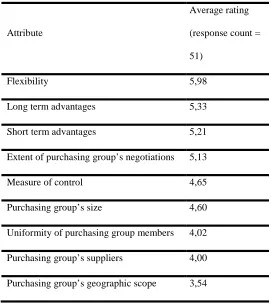
14 attributes had to be downsized to a number that would facilitate data-collection without the risk of overwhelming respondents with a task so large they would either refuse to fulfill or that would produce bias. Downsizing the number of attributes used in the actual conjoint analysis was done by a stratified design. A first questionnaire asked respondents to rate the attributes according to their importance to the respondents if they were to participate in a group purchasing initiative. The five attributes rated as most important to respondents were included in the second questionnaire on which the actual conjoint analysis was based (for results of the first questionnaire, see Table 4). From that questionnaire, the following five attributes rated the most important were included in the main study: Flexibility, long-term advantages, short-term advantages, extent of purchasing group’s negotiations and measure of control.
3.3 Scenario’s, the profiles ranked by respondents
Scenario’s are actually the combinations of different levels of attributes called profiles that have to be rated by the respondents in order to make conjoint analysis possible. There are two primary approaches used to create scenarios: attribute driven and actual case derived. Attribute driven conjoint analysis uses an experimental design that involves every
combination of attribute levels, called a factorial design (Sheperd and Zachrakis, 1999). Using a full factorial design however often results in a large amount of profiles, depending on the number of attributes and levels. Therefore, researchers often use a fractional factorial design, reducing the number of profiles that have to be tested.
15 values are derived from the actual situation. Thus, the subject can better relate the simulated decision to an actual decision (Sheperd and Zachrakis, 1999).
3.3.2 Scenario’s used in this study
This study uses an attribute-driven approach to create scenario’s because this is an experimental study. There are no actual cases that can be used to derive levels from. Therefore, the levels used in this study are general. To ensure a clear distinction between levels for respondents, a dichotomous set-up was chosen for every attribute. This also reduces the number of profiles that have to be included in the survey and therefore reduces complexity for respondents. Below, the levels per attribute are defined.
For the first attribute, Group Size, twenty-five members can be considered a breaking point in deciding on the structure of a purchasing group (confederate vs. autonomous) according to Nollet and Beaulieu (2003). Therefore, the levels low (n<25) and high (n≥25) were chosen.
For the second attribute, Measure of Control, it is harder to distinguish between levels. It is not possible to set a hard (numerical)line between levels. The dichotomous set-up however results in a situation where even these ‘soft’ attributes can have fairly distinct levels, clear to the respondents. The levels chosen for this attribute are again low (no/little control) and high (good/great measure of control).
For the third attribute, Flexibility, the levels chosen are low and high. Distinction between these levels is made by the absence (or presence) of contracts binding participants to a purchasing group for purchasing certain goods. A low flexibility means that participants are bound by contract to purchase certain amounts of goods so the purchasing group can
16 purchasing group. The purchasing group cannot guarantee minimum purchasing volumes to suppliers or has to actively promote certain goods to its members.
The levels for both the attributes Short and Long Term Advantages are low and high. A low level for either sort of advantage means that purchasing group does not specifically focuses on achieving these sorts of advantages for its members. It does not mean that these advantages will not occur. A high level means that the purchasing group specifically strives to achieve these advantages for its members.
The procurement strategy specifies the extent of group negotiations, answering the question which products/services should be negotiated over by the purchasing group (Nollet and Beaulieu, 2003) The extent of group negotiations has impact on the amount of uncertainty a members experiences, but also on the possible advantages they can receive from
participating. Nollet and Beaulieu expect the extent to evolve over time, starting with a few common commodities and expanding in time to goods with more strategic value to members. Therefore, the levels chosen for this attribute are low (extent is limited to common
commodities) and high (extending to goods of strategic importance)
17 Uniformity of group members is identified as one of the key success-factors in group
purchasing (Polychronakis and Syntetos, 2007). Uniformity in this relation is seen as likeliness in procedures and cultures (Schotanus, Telgen and De Boer, 2007) For this study however, uniformity is seen as acting in the same branche. The chosen levels for this attribute are: Low (members come from all lines of business ) and high ( members come from the same line of business).
The attribute suppliers is an external attribute. Switching suppliers can be a source of uncertainty for members of a purchasing group. The levels chosen for this attribute are: keeping own suppliers and switching suppliers. The possibility to use the same suppliers could lower barriers for potential members to become purchasing group members, while having to switch suppliers might do the opposite.
18 Profile number 6:
Card ID
Measure of
control Flexibility
Short-term
advantages
Long-term
advantages
Extent of GPO
negotiations
6 High Control Low flexibility Focus on short
term advantages
No focus on
long-term
advantages
Common
commodities
Profile number 8:
Card ID
Measure of
control Flexibility
Short-term
advantages
Long-term
advantages
Extent of GPO
negotiations
8 High Control Low flexibility No focus on
short term
advantages
Focus on
long-term advantages
Common
commodities
Respondents were asked to rank-order these 8 profiles according to their preferences if they were to join a purchasing group.
3.4 Sample
The size of the sample in conjoint studies varies greatly. In one report (Cattin and Wittink, 1982), the authors state that the sample size in commercial conjoint studies usually ranges from 100 to 1,000, with 300 to 550 the most typical range. In another study (Akaah and Korgaonkar, 1988), it is found that smaller sample sizes (less than 100) are typical. However, as conjoint analysis can investigate an individual’s decision making, a sample of one is
19 The population for this research paper consists of SME’s located at Businesspark Twentekanaal, Hengelo. This business park was chosen because of park managements interest in group purchasing, which resulted in the desire to have insights in preferences of
organizations located at the park concerning this topic. First a database of all organizations located at this business park was constructed using data from the chamber of commerce. The initial database consisted of 566 entries. Because this study focuses on preferences of
potential purchasing group-members, and in particular SME’s, the initial database was edited according to rules found in Table 3.
After editing the database according to the rules stated above, 195 entries remained forming the population for this study. The 195 organization were classified using the main sector-division the chamber of commerce uses. These sectors are: construction (23); retail (39); finance (7); wholesale (45); industry (52); agriculture, forestry and fishery (1); personal services (6); transportation (3); business services (18) and miscellaneous (1).
Table 3: Rules for editing the database-entries
All legal persons, foundations and secondary establishments fall outside the targeted population. These entries
often have no purchasing organizations, or no authorization to determine their own purchasing policies.
All holdings and ‘beheer’ entries fall outside the targeted population, since they do not purchase anything for
their operations.
All entries that are different parts of the same organization are substituted for the organizations name.
All entries that are parts of another organization not located at Business park Twentekanaal fall outside the
targeted population.
All entries that have filed for bankruptcy fall outside the targeted population.
All entries that seem to be dormant fall outside the targeted population. Entries with no known
20 The 195 organizations were approached to take part in the first part of the study, of which 133 responded (68,2 %), with a non-response of 31,8% . A Chi-square goodness-of-fit test comparing the sectors in the population and in the sample shows that the sample gives a good representation of the total population at a .05 α. (Chi-square = 1,94, with 9 degrees of
freedom)
Of the 133 respondents, 51 organizations (38,3%) indicated they were interested in cooperative purchasing. 82 (61,7%) organizations indicated they were not interested in cooperative purchasing. The main reasons given by these organizations were: cooperative purchasing would not deliver benefits because of the nature of the organizations, the benefits of cooperative purchasing would not outweigh the investments required. For the second part of the study, the 51 organizations that indicated to be interested in cooperative purchasing during the first questionnaire were asked to rank-order the 8 generated profiles with different combinations of the attribute levels (for more info on profiles, see §3.3.2.) Of the 51
organizations, 41 (80,4%) completed the second survey, leading to a non-response of 19,7%.
3.5 Instrument Design
21 consistency. The research instrument should contain clear instructions (including relevant term definitions), the conjoint experiment and a post-experiment questionnaire that can include questions regarding characteristics of the respondent (Sheperd and Zachrakis, 1999).
For the data collection for both the first and second questionnaire a web-based
instrument was chosen. A web-based instrument requires less time from both researchers and respondents, making it possible to reach a larger population and increase the response rate. For the first part of this study, an invitation letter was sent to all organizations in the sample inviting them to a landing page on the university domain
(www.utwente.nl/inkoop-samenwerking) where additional information could be found, as well as the hyperlink to the actual questionnaire. After the invitation letter, non-responders were contacted by phone to again invite them to partake in the study.
The sample for the second part of the study consisted of 51 organizations that had indicated they were interested in cooperative purchasing. These organizations were invited by an email to participate in the second part of the study, containing a hyperlink to the
questionnaire. After the email, non-responders were again contacted by phone inviting them again to the second part of the study.
3.6 Data Analysis
Regression analysis and analysis of variance (ANOVA) are the two statistical methods
22 coefficients should be very high in valid analyses. Values close to one indicated strong
agreement between the average product ratings and the predicted utilities from the conjoint model.
Analysis of the data has been done with the Conjoint module of SPSS 17.0 software. A conjoint analysis results in a utility score, called a part-worth, for each factor level, as well as an importance score for the attribute. The utility scores, analogous to regression
coefficients, provide a quantitative measure of the preference for each factor level, with larger values corresponding to greater preference. The utility scores are expressed in a common unit, allowing them to be added together to give the total utility, or overall preference, for any combination of factor levels. These utility scores then constitute a model for predicting the preference of any product profile.
4. RESULTS
To downsize the number of attributes used in the actual conjoint analysis, a first questionnaire was sent to respondents in which they were asked to score the nine attributes identified in the literature review based on their importance to the respondents, if their
23 Table 4: Importance rating per attribute, based on scores given by respondents on a 7-point Likert Scale
ranging from very insignificant (score =1) to very important (score=7)
Attribute
Average rating
(response count =
51)
Flexibility 5,98
Long term advantages 5,33
Short term advantages 5,21
Extent of purchasing group’s negotiations 5,13
Measure of control 4,65
Purchasing group’s size 4,60
Uniformity of purchasing group members 4,02
Purchasing group’s suppliers 4,00
Purchasing group’s geographic scope 3,54
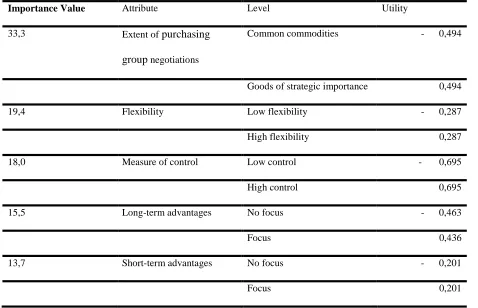
With the survey rank-orders obtained from the second questionnaire, utility
24 the level of an attribute with an importance score of 40 right is twice as important as getting the level of an attribute with an importance score of 20 right.
Table 5: Importance values and utility scores.
Importance Value Attribute Level Utility
33,3 Extent of purchasing
group negotiations
Common commodities - 0,494
Goods of strategic importance 0,494
19,4 Flexibility Low flexibility - 0,287
High flexibility 0,287
18,0 Measure of control Low control - 0,695
High control 0,695
15,5 Long-term advantages No focus - 0,463
Focus 0,436
13,7 Short-term advantages No focus - 0,201
Focus 0,201
Extent of group negotiations is the attribute that has the heaviest impact on the choice of the respondents for a particular profile, with a calculated relative importance of 33,3 on a scale of 100 (with five attributes a score of 20 being the average score). This is in
contradiction with the results of the first questionnaire, where this attribute was rated fourth important. From the results it shows that in general, the 41 organizations have quite a strong preference for a purchasing group that focuses on goods of strategic importance to their organization (utility score = 0,494).
The second most important attribute is flexibility, with a calculated relative
25 although this attribute is rated as second important, there is no strong preference for high flexibility.
Rated most important after that is measure of control, with an outspoken preference for a high level of control, with an utility score of .695.
Long-term advantages is the attribute that has an importance value of 15,5 and has been evaluated by the organizations as being more important than short-term advantages. The organizations prefer a focus on long-term advantages with a .463 utility score. A focus on short-term advantages has an utility score of .201.
The concurrent validity measures how well the estimated values reflect the input data. Thus the concurrent validity measures the internal consistency of the data. The correlation coefficients Pearsons R and Kendalls tau are used to measure the concurrent validity
(Backhaus, Erichson, Plinke & Weiber, 2003) Internal validity checks showed that observed rankings and rankings predicted by utility scores from the conjoint analysis were highly correlated (Kendall’s tau=0.786 and Pearson’s R=0.990)
5. DISCUSSION
5.1 Key findings
This study investigated the preferences of SME’s on purchasing group attribute-levels. Until now, studies dealing with cooperative purchasing among SME’s have almost always focused on existing purchasing groups, while preferences of potential members of purchasing groups have not been studied. These preferences are however of great importance since purchasing groups depend on purchasing power, which is given to them by their members.
26 purchasing group. There is also tension between the expected evolvement of the extent of group negotiations from common commodities to a wider array of goods and services (Nollet and Beaulieu, 2003). If a purchasing group would be formed accordingly, less potential members would be interested in joining the group than if the group would start out with an extent of negotiations that was broader, reaching into goods and services of strategic
importance. Second most important attribute for SME’s is the amount of flexibility they keep in their purchasing operations. SME’s prefer to join a purchasing group that does not oblige them to purchase a certain – agreed upon – amount of goods and/or services through the purchasing group, although this preference is relatively low. Together, extent of group negotiations and flexibility have an importance score of 52,7, meaning that these two attributes are responsible for more than half the impact on an organizations decision on purchasing group membership.
SME’s strongly prefer a large amount of control over the actions of the purchasing group. This limits the size of a purchasing group, but does permit closer ties between
members, increases communication and inter-group learning. It also is coherent with the fact that SME’s prefer a purchasing group to focus on long term advantages rather than on short term advantages. Short term advantages are reached by amassing buying power to achieve benefits like lower prices or better services. Long term advantages are more often reached trough close communication with other members, learning from each other and cooperating intensively with suppliers.
27 5.2 Limitations
There are certain limitations present in this study. During the literature review nine key attributes were identified by the researcher out of an accumulation of concepts and definitions, some vastly overlapping and others only identified by one sole author. With an increase in attributes and levels, the number of possible profiles increases exponentially making the task for respondents tedious or incomprehensible. This would lead to dropout, and is therefore to be avoided. This limitation to conjoint analysis lead to the exclusion of four attributes out of the nine identified in the literature research. Also, it lead to the choice to only use two levels per attribute, resulting in a rather black and white picture of attribute levels, where there are at least some shades of grey to be expected.
Another limitation to this study is influenced by attributes and their levels, but mainly has to do with data collection. Initially, the setup of the survey made so that respondents had to rank 4 profiles per question. This had to be repeated several times to be able to rank the total of eight profiles, since every configuration has to be rated against all the others. Tests of this setup showed that this task was tedious to respondents; they conceived a lot of repetition and thought the survey would take too long. Therefore it was decided to show all profiles at once. This made the task for respondents less repetitive, but also made the task more difficult for respondents since they had to compare all eight profiles at once. This could have produced some bias, although no serious abnormalities were found during the analysis.
Also, the population for this study was limited to SME’s located at a single business park. This makes it hard to generalize to SME’s in a broader area, or even nation-wide.
5.3 Future research
28 establishment of a purchasing group among SME’s, since a purchasing group cannot exist without members and needs sufficient buying power to deliver benefits to its members. Further research on this topic is needed to collect more data on preferences on the attributes tested in this study. More data will lead to better generalizations about preferences concerning purchasing groups. It is also needed to gain insights in preferences concerning the attributes that were not included in the conjoint analysis. This is emphasized by the fact that the preliminary study to reduce attributes produced a different picture of the importance of attributes than the conjoint analysis did. It is possible that the preliminary study ruled out attributes in favor of others, that in a conjoint analysis would have been proven more important.
Further research should also be done on purchasing groups among SME’s from the starting point onwards. In the end, the goal of further research should be a model of
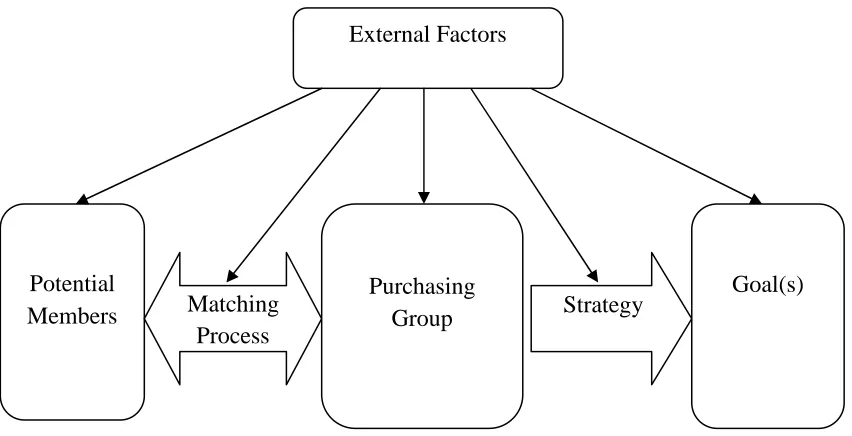
cooperative purchasing among SME’s that gives a clear picture of how a purchasing group can be established and can be successful. A proposition of such a model is depicted below (figure 1).
The model gives an overview of a purchasing group and its purpose. On the left are potential members. These are all organizations that fit the demands group purchasing
organizations make for their members. But potential members have their preferences when it comes to group purchasing organizations. A potential member might for instances be
29
Figure 1: proposition of a model of cooperative purchasing among SME’s
Between these potential members and the purchasing group, there is a matchmaking process. Potential members have their preferences concerning the purchasing group, which in
its turn is characterized by the attributes and attribute-levels it has. If both match sufficiently, a potential member might decide to become an actual member.
As said, the purchasing group can be characterized by its attributes and their levels. One of those attributes is on what sort of advantages it wants to focus to bring its members. Based upon this attribute, the purchasing group tries to achieve certain goals, which are to be realized by a certain strategy, depending on the goals.
The entire purchasing group-process is influenced by external factors, like suppliers, legislative powers or competitors.
Further research should be done on all factors depicted in the model. Suggestions for research questions are:
• What types of organizations are typically interested in joining purchasing groups? Potential
Members Matching Process
Purchasing
Group Strategy
30
• What type of organization typically prefers a certain type (profile) of purchasing
group?
• How does goal establishment work within purchasing groups?
• What strategies are deployed to achieve these goals?
• What external factors are influencing purchasing groups, how are they doing that and
what are the results?
5.4 Practical implications
The success of a purchasing group is typically measured by the advantages it can bring to its members. In order to gain these advantages, purchasing groups amass buying power from those members. Therefore, it is important that organizations want to join purchasing groups, since the more buying power a purchasing group has, the more successful it will (potentially) be. This study shows that the majority of organizations is not interested in joining a purchasing group, and that the organizations that are, have preferences concerning the purchasing groups organization, or attributes.
31 suppliers. It involves a learning process from all parties involved. Study results show that SME’s prefer to achieve these advantages in a way that preserves their flexibility in their purchasing processes and lets them have a large measure of control over the course of the group. These preferences have implications concerning other group attributes. They suggest that a purchasing group preferably consists of a relatively small number of members, since the high measure of control and the focus on long term advantages are hard to realize with a group that is too large. It also suggests that the group consists preferably of relatively uniform members, since cooperatively purchasing goods of strategic importance and realizing long-term advantages is easier when members are uniform because the goods/services in question will relatively be the same. Also, uniform members tend to have the same goals and cultures, making working alongside each other more productive.
Therefore, drawing on the results of this study and the implications those results have on other attributes of a purchasing group, a starting purchasing group on Businesspark Twentekanaal would ideally have the following characteristics:
The purchasing group:
• Focuses on the procurement of goods of strategic importance
• Focuses on achieving long-term advantages for its members
• Consists of 25 or less members
• Consists of relatively uniform members in terms of branche, culture and
goals
• Grants members control over its actions and direction
• Does not oblige members to purchase through the group
32 Therefore, a starting purchasing group should be aware of preferences their potential members have. Clear choices concerning the levels of attributes have to be made and communicated, so that the starting purchasing group at least appeals to the targeted potential members.
6. References
Akaah, I., & Korgaonkar, P. (1988). A conjoint investigation of the relative importance of risk relievers in direct marketing. Journal of Advertising Research , 38-44.
Argyris, C., & Schon, D. (1974). Theory in Practice: Increasing Professional Effectiveness. San Fransisco: Jossey-Bass.
Associates, M. &. (2000). The role of Group Purchasing Organizations in the US Healthcare System. Washington: Higpa.
Backhaus, K., Erichson, B., Plinke, W., & Weiber, R. (2003). Multivariate Analysemethoden: Eine anwendungsorientierte Einführung. Berlin: Springer-Berlin.
Cattin, P., & Wittink, D. (1982). Commercial Use of Conjoint Analysis: A Survey. Journal of Marketing , 44-53.
Chipty, T., & Snyder, C. (1999). The role of firm size in bilateral bargaining: a study of the cable television industry. Review of Economics and Statistics 81 , 326-340.
Choi, Y., & Shepherd, D. (2004). Entrepreneurs' Decisions to Exploit Opportunities. Journal of Management , 30 (3), 377-395.
Doucette, W. (1997). Influences on member commitment to group purchasing organizations. Journal of Business Reserach , 183-189.
Essig, M. (2000). Purchasing consortia as symbiotic relationships:developing the concept of `consortium sourcing'. European Journal of Purchasing & Supply Management , 13-22. Hendrick, T. (1997). Purchasing consortiums: Horizontal alliances among firms buying common goods and services What? Who? Why? How? Center for Advanced Purchasing Studies. Available at http://www.capsresearch.org/ReportPDFs/ConsortAll.pdf.
Kescinocak, P., & Savasaneril, S. (2008). Collaborative Procurement Among Competing Buyers. Naval Research Logistics , 516-540.
33 Louviere, J., Eagle, T., & Cohen, S. (2005). Conjoint Analysis: Methods, Myths and much more. Censco Working Paper .
Mudambi, R., Schrunder, C., & Mongar, A. (2004). How Co-operative is Co-operative Purchasing in Smaller Firms? Long Range Planning Journal , 85-102.
Murphy, M. C. (2000). Irish consumer preferences for honey. British Food Journal . Nollet, J. B. (2005). Should an Organization Join a Purchasing Group. Supply Chain Management , 11-17.
Nollet, J., & Beaulieu, M. (2003). The development of group purchasing: An empirical study in the healthcare sector. Journal of Purchasing and Supply Management , 3-10.
Pedersen, J. (1996, June). Product standardization playing to win. In Vivo , pp. 15-20. Polychronakis, Y. S. (2007). ‘Soft’ supplier management related issues: An empirical investigation. International Journal of Production Economics , 431-449.
Schotanus, F., & Telgen, J. (2006). Developing a typology of organisational forms of cooperative purchasing. Journal of Purchasing & Supply Management , 53-68.
Schotanus, F., Telgen, J., & De Boer, L. (2007). Success factors for managing purchasing groups: an empirical survey. International Purchasing&Supply Education&Reserach Association , 245-257.
Schotanus, F., Telgen, J., & De Boer, L. (2005). Unfair division of gains under equal price in cooperative purchas.
Sheperd, D., & Zachrakis, A. (1999). 'Conjoint analysis: a new methodological approach for researching the decision policies of venture capitalists. Venture Capital , 197-217.
Spekman, R. F. (1998). Alliance management: A view from the past and a look to the future. Journal of Management Studies , 747-772.
Tella, E., & Virolainen, V.-M. (2005). Motives behind purchasing consortia. International Journal of Production Economics , 161-168.