Integrating stakeholders in the development of
an Antibiotic Stewardship Program
Sonja Ewering (s0195561)
1st supervisor: M. J. Wentzel
2nd supervisor: Dr. J.E.W.C. van Gemert-Pijnen
S. Ewering 2 Contents
Samenvatting ... 3
Summary ... 4
1. Introduction ... 5
2. Method ... 10
2.1. Quickscan ... 10
2.1.1. Study design ... 10
2.1.2. Procedure ... 10
2.1.3. Data collection and analysis ... 10
2.2. Workshop ... 11
2.2.1. Study design ... 11
2.2.2. Participants ... 11
2.2.3. Materials ... 12
2.2.4. Procedure ... 12
2.2.5. Data collection and analysis ... 13
3. Results ... 14
3.1. Quickscan ... 14
3.2. Workshop ... 29
3.2.1 Context ... 29
3.2.2. Difficulties ... 30
3.2.3. Opinions about ASP ... 33
4. Discussion ... 34
5. Conclusion ... 36
References ... 37
Appendix ... 40
Appendix 1 – References quickscan ... 40
Appendix 2 – Codetree, tasks, problems and solutions ... 42
S. Ewering 3 Samenvatting
Doel: Onverantwoord antibioticagebruik kan resistentie tegen antibiotica en infecties veroorzaken. Een mogelijkheid om dit probleem te voorkomen zijn zogenoemde Antibiotic Stewardship Programma„s (ASP„s). Binnen de EurSafety Health-Net project groep, een program die erop gericht is om patiëntveiligheid te verhogen en Healthcare Associated Infections (HCAI) te verlagen, word een ASP ontwikkeld, die op een holistische aanpak gebaseerd is. Deze studie geeft een overzicht van effectieve ASP„s, de huidige problemen met antibiotica en evalueert de samenstelling van de stakeholders, die bij de ontwikkeling en implementatie van een ASP worden betrokken.
Methode: Een literatuur quickscan werd uitgevoerd in Scopus, Web of Science, ScienceDirect, PsycINFO, Medline en Google Scholar tussen maart and mei 2011. Verdere studies werden met de sneeuwbalmethode gevonden. Studies die op de verbetering van antibioticagebruik gericht zijn werden geïncludeerd.
Verder werd een focusgroep in combinatie met een stakeholder meeting met het zorgpersoneel van een longafdeling uitgevoerd. Een verpleegkundige, twee longartsen, een arts-assistent longgeneeskunde, een arts-assistent interne, een apotheker, een manager, een staffunctionaris, een teamhoofd en een arts-microbioloog hebben deelgenomen.
Resultaten: In de quickscan werden twaalf studies geïdentificeerd en geanalyseerd. ASP strategieën zoals education en guideline, review en feedback, formulary en restriction of een combinatie van computer assistance en education en guideline, computer assistance en formularies en restriction, computer assistance en review and feedback, formulary en restriction en review en feedback bleken effectief te zijn. Positieve uitkomsten waren verbeterde gedragsfactoren, medische en organisatie uitkomsten.
Tijdens de workshop werden informatie over de organizational context, inclusief de stakeholder‟s en hun taken, informatie en communicatie processen en problemen op de afdeling, verzameld.
Conclusie: Antibiotic Stewardship Programma„s bestaand uit een enkele strategie of een
S. Ewering 4 Summary
Purpose: Inappropriate use of antibiotics can cause antibiotic resistance and infections. One way to tackle this problem is an Antibiotic Stewardship Programs (ASPs). Within EurSafety Health-Net, an organization aiming at enhancing patient's safety and reducing Healthcare Associated Infections (HCAI), an Antibiotic Stewardship Program based on a holistic approach is developed. This study gives an overview of effective ASPs, the current problems around antibiotics and evaluates the constellation of stakeholders involved during the development and implementation-phase of an ASP.
Method: A literature quickscan was performed in Scopus, Web of Science, ScienceDirect, PsycINFO, Medline and Google Scholar between March and May 2011. Additional articles were obtained by snowball-method. Studies had to be aim at the improvement of antibiotic usage, to be included.
In addition a focus group in combination with a stakeholder meeting with the healthcare professionals of a pulmonary ward was conducted. A nurse, two lung physicians, a lung assistant physician, an internal assistant physician, a pharmacist, a manager, a administration assistant, a nurse manager and a consultant clinical microbiology took part.
Results: In the quickscan twelve studies were identified and analyzed. ASP strategies like education and guideline, review and feedback, formulary and restriction or a combination of computer assistance and education and guideline, computer assistance and formulary and restriction, computer assistance and review and feedback, formulary and restriction and review and feedback were proven to be effective. Positive study outcomes were improved behavioral, medical and organization outcomes.
In the workshop information about the organizational context, including the stakeholders and their tasks, the information and communication processes, and difficulties on the ward were gained.
S. Ewering 5 1. Introduction
Problems with infections
Inappropriate use of antibiotics can result in the development of (multi-) resistant strains of bacteria: bacteria can adjust to changes in their environment and can become resistant to antibiotics as a sort of defense mechanism (Högberg, Heddini, & Cars, 2010). Due to bad hygiene measures and missing infection control those resistant clones start reproducing and spreading. Multidrug-resistant bacteria can cause infections, which are difficult to treat. There are antibiotics for numerous multiple resistances, but due to their wanton use, dangerous bacterial strains get the chance to grow (Nicolaou, Boddy, Bräse, & Winssinger, 1999) and antibiotics which were proven effective before become useless. According to French (2010) we are even faced with the potential loss of antimicrobial therapy. In a survey (Hersh, Beekmann, Polgreen, Zaoutis, & Newland, 2009) more than 80% of respondents reported that they believe antibiotic resistance is a highly important problem nationwide. Since carriers of antibiotic resistance might transmit their resistance to others, whole communities or hospitals are affected by this problem.
Nevertheless, a large number of healthcare professionals still deal careless with antibiotics. According to Owens and Ambrose (2007) various studies and surveys suggest that as much as 50% of antimicrobial usage is not appropriate. Several ways how antibiotics can be misapplied are too long duration of therapy, the use of broad-spectrum antibiotics instead of narrow-spectrum antibiotics, intravenous therapy although an oral therapy might be equally effective or no knowledge about the latest status of antibiotic resistance and therefore treating with the wrong antibiotics (Frank, 2010).
S. Ewering 6 Infection prevention and control
An example of a multi-resistance of antibiotics is the methicillin-resistant Staphylococcus aureus infection, in short MRSA. Many guidelines aiming at the control and prevention of MRSA are available (Humphreys, 2007) and they all recommend the general principles of early detection and isolation. In general Humphreys (2007) concludes that steps should be taken before an organism becomes endemic. One effective way to prevent the development of MRSA infections is strict adherence to hand hygiene protocols (Gould, Drey, Moralejo, & Chudleigh, 2010). Patients who are at risk of developing infections, so called 'at risk' patients, can be affected via the hands of healthcare workers due to insufficient hand hygiene. Therefore disinfection and hand hygiene are essential to prevent cross-infection of patients by healthcare workers (Burke, 2003). Additionally the facility environment and medical equipment need to be cleaned and decontaminated on a regular basis (Rebmann & Aureden, 2011 in press).
Another strategy following the principle of early detection and isolation is the search&destroy policy. The search&destroy policy is a Scandinavian program which aims at the reduction of MRSA (Higgins, Lynch, & Gethin, 2009).The program, which is also used in the Netherlands, takes several steps to reduce resistance. First of all, according to Kluytmans (2007, in Higgins et al., 2009) at admission patients who are possible carriers have to be identified and screened. Secondly, these 'at-risk' patients will be moved to single rooms and will be pre-emptive isolated until the results of MRSA test will confirm the absence or presence of MRSA. In average this procedure takes take 4 to 5 days (Kluytmans, 2007). Following this strategy no resistant micro-organisms can spread and infect other patients. Since approximately only 5% of these patients in fact carry MRSA (Kluytmans, 2007), this strategy often leads to unnecessary isolation days which on the other hand is associated with high costs. Therefore additional measurements are needed.
S. Ewering 7 Antibiotic Stewardship Program
An Antibiotic Stewardship Program (ASP) aims at the proper and responsible use of antibiotics and can therefore help to lower healthcare costs and enhance patient's safety.
MacDougall and Polk (2005) define an ASP as „an ongoing effort by a health care institution to optimize antimicrobial use among hospitalized patients in order to improve patient outcomes, ensure cost-effective therapy, and reduce adverse sequelae of antimicrobial use (including antimicrobial resistance)‟ (p.640). MacDougall and Polk (2005) suggest that generally Antibiotic Stewardship Programs should be established and led by a committee consisting of specialists. These committees should be led by an infectious disease specialist and include 'appropriate personnel from the microbiology, infection control, and pharmacy departments' (p.652).
An ASP can either consist of a single strategy or a bundle of interventions can be combined. Some example of Antibiotic Stewardship measures, according to Rebmann and Rosenbaum (2011, in press) include 'educating prescribing clinicians on the proper use of antimicrobial therapy, practicing formulary restriction, implementing a prior approval program, practicing streamlining (i.e., switching therapy to a narrower spectrum agent once susceptibility testing results are available), and cycling antibiotics'. Additional examples are prior authorization (Hersh et al., 2009), hand hygiene (Whitby et al., 2006) and guidelines, review and feedback and computer assistance (MacDougall and Polk, 2005). According to Hulscher, Grol, and van der Meer (2010) ASPs include finding a balance between the potent effectiveness of antibiotics for individual patients and the risks of increased resistance, harm to patients and increased treatment costs. For instance, since broad-spectrum antibiotic use can result in new, highly virulent antibiotic resistance (French, 2010) prescribing narrow-spectrum antibiotics instead of broad-narrow-spectrum antibiotics, if possible, were beneficial. This would improve patient's safety and also minimize unnecessary costs to the healthcare system.
Hence, successful ASPs can save costs, obviate medication errors, enhance therapeutic outcomes and limit the development of antibiotic resistance (Hersh et al., 2009). What it comes down to is what Owens (2008) concludes: ASPs should improve the overall quality of care.
Uptake and Implementation
S. Ewering 8 infection control practitioners, authorities like hospital leadership and national health authorities should be involved in the development process (MacDougall and Polk, 2005). An integrated approach, including all stakeholders, should be adopted (Okeke et al., 2011, in press) to succeed in the uptake and implementation of an ASP.
The EurSafety Health-Net Antibiotic Stewardship Program
EurSafety Health-Net is a network that aims at enhancing patient‟s safety and cross-border infection protection. In cooperation with international project partners EurSafety Health-Net promotes safe care in the border areas. Due to careless usage of antibiotics, antibiotic resistance plays an important role within the overall aim of infection control. Therefore within the EurSafety Health-Net project group of the University of Twente an Antibiotic Stewardship Program that makes use of eHealth technologies will be developed. Following eHealth technologies can possibly be used within an ASP: applications for eLearning, digital decision aids, approval programs, digital prescribing programs or online platforms for healthcare professionals which provide information about infectious diseases and the use of antibiotics.
As mentioned above several guidelines have been introduced before but there seems to be no standard procedure yet for establishing an ASP that has been proven to be successful. Hence, a careful planning from the beginning is essential. According to Stroetmann, Artmann, and Stroetmann (2011) national eHealth strategies and implementation roadmaps can function as plans of the development of eHealth interventions. Yusof, Papazafeiropoulou, Paul, and Stergioulas (2008) found that for the development of health information systems (HIS) either human or organizational issues or subjective issues are taken into consideration. Further they state that it is possible to combine different measures like technology, human and organization in a single HIS framework. The HOT-fit framework, introduced and tested by Yusofa, Kuljis, Papazafeiropoulou, and Stergioulas (2008), incorporate these dimensions in the evaluation of HIS. Their study shows that the adoption of a system can positively be influenced by a combination of „the right user attitude and skills base together with good leadership, IT-friendly environment and good communication‟ (p.386)
S. Ewering 9
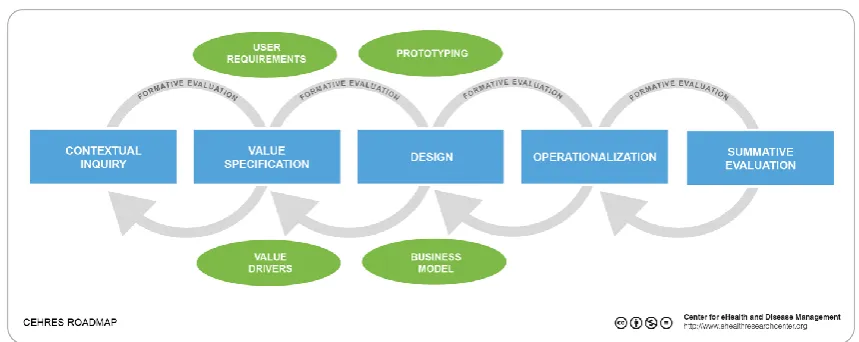
Figure 1. ceHRes Roadmap
First of all, in the Contextual inquiry-phase background information about the environment are collected and healthcare problems specified. In case of the Antibiotic Stewardship Program this means, that background information about the ward will be collected and possible problems concerning for instance antibiotic resistance or the antibiotic prescribing process will be identified. Furthermore intended users, here healthcare professionals, and the needs of all stakeholders are identified. Secondly the values of the stakeholders must be specified. This includes determining and ranking the values and afterwards formulating the eHealth goals based on the outcomes. In addition functional and organizational requirements to realize the values must be defined (van Limburg and van Gemert-Pijnen, 2011). In the third phase, the Design phase, based on the outcomes of the first two phases mock-ups will be designed and tested. During the fourth stage for the operationalization necessary strategies and activities are chosen and at the end, in the fifth phase, a summative evaluation takes place, which includes measuring the eHealth outcomes. The process is iterative, this means that each step will be repeated and the content and design of a technology can always adjusted to the values and needs of the stakeholders.
On the basis of the ceHRes Roadmap the project team from the University of Twente will develop and implement an ASP at the pulmonary ward of the Medisch Spectrum Twente (MST) in Enschede.
This study focuses on the primary process of healthcare and how an ASP can be integrated in the care setting, based on the first two steps of the above mentioned model. Hence, this study assesses the user requirements, gives a qualitative insight in the context and specifies the values. Therefore following questions will be examined and answered:
1. What kinds of Antibiotic Stewardship strategies are effective? 2. What are the current problems in the antibiotic prescribing process? 3. How are the stakeholders involved in the process?
S. Ewering 10 2. Method
2.1. Quickscan
2.1.1. Study design
The study is based on the above mentioned research model, the roadmap. A quickscan is a useful method to get a general overview of the literature (Nijhof, Van Gemert-Pijnen,
Dohmen, & Seydel, 2009). In order to get an overview of effective Antibiotic Stewardship programs a literature quickscan was executed.
2.1.2. Procedure
For the literature scan a search was performed in following databases (between March and May 2011): Scopus, Web of Science, ScienceDirect, PsycINFO, Medline and Google Scholar. Studies were found based on following search terms: “antibiotic guideline”, “antibiotic policies”, “antibiotic policy”, “antibiotic prescribing”, “antibiotic pulmonary”, “antibiotic stewardship”, “cap AND resistance”, “clinical support systems”, “community acquired pneumonia AND prevention”, “community acquired pneumonia AND strategies”, “infection prevention AND antibiotics”, “infection prevention”, “pneumonia AND antibiotic”, “pneumonia AND resistance”, “pneumonia AND stewardship”, “pulmonary ward AND stewardship” and “resistance AND strategies”. The search terms were then reused with “antimicrobial” instead of “antibiotic”. Only studies published after the year 2000 were taken into consideration. Interventions had to consist of at least one strategy aiming at the change of antibiotic usage to be included. Possible strategies were education and guidelines, formularies and restriction, screening, review and feedback, computer assistance, antibiotic cycling and hygiene measures. Studies only aiming at outpatient settings were excluded and interventions aiming at inpatient settings were included. Studies aiming at both, inpatient and outpatient settings were included. Studies that had to be purchased and survey- and review-studies were excluded.
In addition to the search in the databases, the references of relevant articles were checked for further, related papers. This is the so-called snowball-method, which is a useful way to find many relevant articles relatively easy and quick. The literature study served as a preparation for the following workshop.
2.1.3. Data collection and analysis
S. Ewering 11 extracted and summarized.
2.2. Workshop
2.2.1. Study design
In addition to the literature scan a workshop based on the above mentioned research model was conducted. The purpose of the workshop was gaining further contextual information about the ward, where the ASP will be implemented within the project group of EurSafety Health-Net. The ward was the pulmonary ward of the Medisch Spectrum Twente, a non-teaching hospital with 1070 beds in Enschede (in the Netherlands). The workshop was a combination of a focus group and a stakeholder meeting. A focus group is a variant of a qualitative group interview, which is recommended to get insight into background information of participants and which is helpful to produce ideas and inventory them into categories (Baarda, de Goede, & Teunissen 2009). It was chosen for a qualitative study because it allows for unexpected information, reactions and outcomes (Baarda et al., 2009). The workshop had the purpose of getting an overview of the context of the organization, the use of antibiotics and identifying the stakeholders, their tasks and possible problems and solutions. Additionally the workshop aimed at identifying the values and needs of the stakeholders. Both, the workshop and the workshop protocol were planned and developed based on literature in cooperation with the EurSafety Health-Net team of the University of Twente. The team consisted of a consultant clinical microbiology, two doctoral candidates, two professors and a bachelor student.
2.2.2. Participants
S. Ewering 12 2.2.3. Materials
For the workshop several materials were prepared in cooperation with the EurSafety Health-Net team of the University of Twente. A script which served as a guide for the workshop was written. It gave an overview and a time table of each planned step of the workshop. A routine case, which was presented during the workshop, was developed in cooperation with a physician to make it as close to reality as possible. The case functioned as food for thought and to narrow down the following discussions to the problem of antibiotics. In order to get discussions going, questions based on literature were prepared. The script can be found in Appendix 3.
2.2.4. Procedure
The 2.5-hours-workshop took place in a conference room of the pulmonary ward of the MST on 10 May 2011. For all participants badges were prepared which were spread randomly around the table to prevent the formation of hierarchic groups. Each participant was given a portfolio which contained an informed consent form, all tasks that would be done during the workshop, a printed version of the PowerPoint presentation, and an information folder about EurSafety Health-Net and the ASP technology, the Dashboard. Every participant received free drinks and a free meal sponsored by the hospital.
In the beginning a short introduction took place in which the purpose of the study and workshop was explained. No information about Antibiotic Stewardship Programs was given at that point to do not influence the participants in their upcoming answers. After common consent of recording the workshop was obtained the recorders were switched on and the participants introduced themselves.
Subsequently the routine case was presented. It was read out aloud and could be followed either in the portfolio or in the presentation. First the participants were asked to identify their role in that case and give a description of their own tasks in this specific case. After everybody had noted his answers, the results were compiled and written down on a sheet. At all times participants were invited to give feedback on or to discuss the results.
In the next exercise everybody had to identify possible communicators they interact with and name their information resources. The results were written down on another blank paper. This task aimed at the different information resources the participants might ask for help. After everybody had written down his resource on its own, the results were again collected and discussed openly.
S. Ewering 13 be given to a problem that is less important or critical. The postits were then collected and ordered by categories, which were identified from the literature review. All in all the participants were given eight different categories to chose from: knowledge/education, documentation/availability of protocol/guidelines/registration of dossier, information/politics and report of outcomes, communication, resources/time/staff, coordination/responsibility, commitment/adherence to politics/support, Quality of healthcare and others.
After collecting the postits, the results were discussed again in the group. The participants were then asked to identify possible stakeholders or if they miss anybody they think would be involved in the problem, anybody who has a stake in it. Furthermore they were asked to make suggestions about possible solutions.
Subsequently the results of the literature review and Antibiotic Stewardship Programs as a possible solution were presented. The possibility of a combination of an ASP and technology was explained and participants were then given the chance to discuss the topics mentioned during the presentation.
2.2.5. Data collection and analysis
During the workshop the video material was recorded by a webcam connected to a laptop and the audio material was taped by two voice recorders lying on the table to facilitate observation. All created posters and sheets were photographed, stored and notes were taken. The content of the posters was copied and summarized in a computer file and the audio material was literally transcribed. The high quantity of data was reduced by sorting, summarizing and categorizing the data (Boeije, 2008). Therefore the transcription was analyzed in an open, axial and selective coding process.
S. Ewering 14 3. Results
3.1. Quickscan
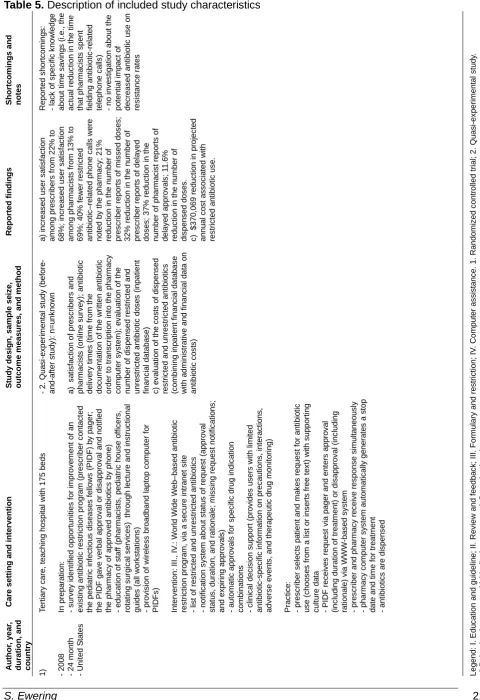
In the literature quickscan it was searched for studies which aim at the problems related to the usage of antibiotics. After scanning of the titles of the studies 196 studies were identified. After inspection of the abstracts twelve studies about an intervention aiming at the usage of antibiotics were included in the quickscan. The data were extracted and summarized in Table 5. All studies are arranged in alphabetical order by the name of the author. The first column gives information about the reference, the year of the study, the duration and the country. The second column includes information about the care setting and gives a description of the intervention. The interventions were categorized according to the used strategies (see Table 1.). The third column includes information about the study design, the sample seize, outcomes measures and the corresponding method. The Study designs were divided into two categories (see Table 2.). In the next column the findings of the studies are. Both the outcome measures and the outcomes of the studies were divided into three categories (see Table 3.) The last column includes the by the authors reported shortcomings, and if relevant the shortcomings identified by the researcher and notes.
Table 1. Division of interventions
Category Antibiotic strategy
I. Education and guideline
II. Review and feedback
III. Formulary and restriction
IV. Computer assistance
Table 2. Division of study designs
Category Study Design
1. Randomized controlled trial
2. Quasi-experimental study
Table 3. Division of outcome measures and outcomes
Category Outcome measures
a)
Behavioral: improved antibiotic usage (expenditure, delivery times, appropriateness
of therapy/prescription), satisfaction and adherence rates (usage of implemented
system)
b) Medical: reduced antibiotic resistance, infection, and mortality rates
S. Ewering 15
Care settings and Interventions
The studies were divided into different care settings. Four studies took place in a secondary care setting2,4,6,11 and six studies in a tertiary care setting1,3,7,8,10,12. Two settings were not further specified5,9. Eight studies were conducted at a teaching hospital1,3,4,5,6,7,8,10, three interventions were performed at a non-teaching hospital5,6,12, and three settings were not further specified2,9,11. Half of the studies took place in the United States1,4,5,6,8,9, two studies were performed in Italy2,12 or the United Kingdom7,11 and the remaining two studies were conducted in Australia3 and France10.
Seven studies2,4,5,6,8,9,12 used a single Antibiotic Stewardship strategy. The other five1,3,7,10,11 used a combination of different strategies. Used strategies were education and guideline5,6,8,11,12, review and feedback3,4,7,9,10, computer assistance1,3,10,11 and formulary and restriction strategies1,2,3,7. Found combinations of strategies were education and guideline with computer assistance11, review and feedback with computer assistance10, formulary and restriction with computer assistance1,3, review and feedback with formulary and restriction7. Seven studies2,3,4,5,9,11,12 included an Antibiotic Stewardship team or committee, consisting of the head of pharmacy department2, infectious disease specialists2,4,5,9,12, pharmacologist experts2,4, medical executives of the hospital2,5, physicians3,5,9,12, pharmacists3,5,9,12, epidemiologists3, psychologists3, software engineers3, nurses5, investigators9, infection control nurses12, and microbiologists12. The team of one study was not further specified11. The interventions were targeted at prescribers1,3,5,11,12, pharmacists1,8, physicians1,4,6,7,8,9,10, nurses2,6,8, nurse-practitioners9, medical students4 and other medical staff2.
Outcome Measures
All of the twelve studies measured some behavioral outcomes, including satisfaction rates1, antibiotic expenditure1,2,3,4,7,11,12, antibiotic delivery times1, appropriateness of therapy or prescription4,6,8,9 and the use of the implemented system3,5,8,10. Eight studies3,4,5,6,7,10,11,12 measured medical outcomes like antibiotic resistance rates3,7,10,11,12, mortality rates3,4,5, and infection rates7,12. Seven studies1,2,3,4,5,6,8 measured organizational outcomes like antibiotic costs1,2,8, length of stay4,5,6 and hospitalization5.
Behavioral effects
Ten studies resulted in behavioral changes1,3,4,6,7,8,9,10,11,12. Behavioral changes were expressed in improved antibiotic usage, satisfaction and adherence rates.
Improved antibiotic usage
S. Ewering 16 records1,3,7,11,12, data from the laboratory3,7,10,11,12, financial databases1,8 and patient/medical records3,6,8,9,10 were used to measure the effects of the interventions. One study9 additionally made use of a survey to collect data. The effects were either analyzed before and after1,8,9,10 the implementation, within a time-series analysis3,7,11,12 or were measured between two groups4,6.
Used strategies involved education and guideline6,8,11,12, review and feedback4,7,9,10, formulary and restriction1,3,7 and computer assistance1,3,10,11. In one study a guideline about criteria to define stability for switch from intravenous to oral antibiotic therapy and hospital discharge was implemented through educational mailing6. In two other studies an order form for surgical antibiotic prophylaxis to optimize choice, dose, and duration of antibiotic use was implemented through education8,12 via written communication, posters, and presentations8 or via a two hour training program and a one-day meeting session with academic presentation and discussion12 respectively. In one study4 structured feedback on appropriateness of antibiotic use was given by an infectious disease physician and an infectious disease clinical pharmacist after reviewing a list with ordered targeted drugs and medical records of patients. Another study9 included the review of antibiotic prescriptions by the primary investigator and an infectious disease specialist in academic detailing sessions. Additionally reminders and antibiotic guides were distributed to hospitalists.
Other studies used a combination of strategies. Antibiotic approval was, for example, obtained from pediatric infectious diseases fellows or automatically via a WWW-based restriction program, which also included a notification system about approval status and clinical decision support1 or from the infectious disease clinician via an intranet-based restriction program3. Another intervention included a restrictive narrow-spectrum antibiotic policy on prescriptions and Clostridium difficile infection (CDI) which was reinforced by feedback on antibiotic use and pocket cards7. Another example of a bundle of interventions is a computer-generated alert that gives information about the patient, like the identity, location, date of sampling of pBC and gram stain results, to the infectious disease specialist to review and accordingly inform physician in charge by phone about results10. In another study formal lectures about an electronically available antibiotic guideline and appropriate antibiotic usage were given and a senior microbiologist routinely attended at ward rounds11.
S. Ewering 17 shortened duration of inappropriate therapy4, the decreased amount of inappropriate antibiotic use/prescriptions4,9, the reduction of duration of intravenous antibiotic therapy6, an appropriate weight-based dose-adjustment8, an appropriate dosing interval8, and higher counseling rates concerning antibiotic usage10.
Improved satisfaction rates
In one study1 improved satisfaction rates were reported. The study consisted of a combination of formulary and restriction and computer assistance. Satisfaction rates were measured by an online survey before and after implementation. Among both prescribers and pharmacists satisfaction rates increased.
Adherence rates
The usage of the implemented system was measured in one study10. An infectious disease specialist gave recommendations on ongoing therapy, initiation of therapy, diagnosis and withdrawal of antibiotic administration. The counseling rate was measured before and after the implementation of a computer-generated alert. Almost half of all positive blood cultures prompted counseling. The adherence rates accordingly led to improved antibiotic usage with regard to deescalating therapy, oral switch and reduction of the planned duration of therapy.
Medical effects
Five studies resulted in improved medical outcomes5,6,7,11,12 like resistance, infection and mortality rates. In one study fewer medical complications were reported that were not further specified6.
Reduced antibiotic resistance rates
Two studies reported a reduction in resistance rates11,12, expressed in a decrease in MRSA isolations and prevalence12 and reduced MRSA bacteraemia rate, reduced MRSA colonization in screening specimens and reduced level of MRSA positive screenings11. Since MRSA isolation rate might differ from true infection rate the result must be handled with caution. Pharmacy11,12, laboratory11,12 and active surveillance records12 were used to measure the outcomes. One study7 resulted in no change in MRSA rates.
Reduced infection rates
A reduction in infection rates was reported in two studies7,12. In one study a restrictive narrow-spectrum antibiotic policy was reinforced7 and in the other an antibiotic surgical prophylaxis protocol on MRSA was introduced12. Decreased infections rates associated with the intervention7 and surgical site and blood stream infections could be reduced12.
Reduced mortality rates
S. Ewering 18 recommendations for antibiotic timing and selection, was implemented through formal presentations, academic detailing, letters, reminders, preprinted order sheets and reporting of outcome data to providers. Data from the hospital database and pharmacy records were used to measure the outcomes before and after the implementation of the guideline. The intervention resulted in a reduction of 30-day mortality among admitted patients. In other studies 30-day mortality rate remained the same3,4.
Organizational effects
Four studies showed changes in organizational outcomes1,2,4,8. Improved organizational outcomes were cost savings and reduced length of stay.
Antibiotic cost savings
A reduction in antibiotic costs was observed in three studies1,2,8. Cost savings were expressed in reduced annual costs associated with restricted antibiotic use1, reduced antibiotic drug costs due to the implementation of a computerized antibiotic approval system2 and in reduced surgical prophylaxis costs related to the introduction of an order form for surgical antibiotic prophylaxis8. Outcomes were measured before and after implementation1,8 and within a time-series analysis2 by means of the financial1,8 and administrative1 databases. The method of one study2 was not specified.
Reduced length of stay
The length of stay could significantly be reduced in one study4. The median length of stay of patients in the intervention group was one day shorter than the median length of stay in the control group. In other studies the length of hospital stay remained the similar3 or the reduction was not significant6.
Shortcomings and notes
Except in one study2, in all studies some shortcomings were reported. In five studies data about infection7,8 or resistance rates1,4, economic data7, antibiotic or guideline5 use were missing. Other factors leading to the study outcomes3,8,11,12, cross-contamination4,9 or interaction between groups6 could not be excluded in seven studies. In three studies it was not possible to generalize their findings6,10,12 and in two studies there was no difference or no significant difference in the medical outcomes6,11. In four studies the mortality rate3,4,6, length of stay3,6 or resistance rates7 remained similar. In one study no statistical tests were used11. Furthermore in all studies Hawthorne effects might be present.
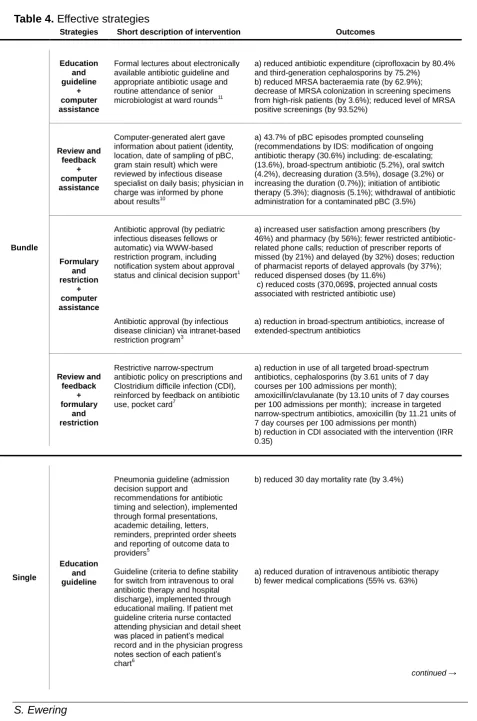
S. Ewering 19 Table 4. Effective strategies
Strategies Short description of intervention Outcomes
Bundle
Education and guideline
+ computer assistance
Formal lectures about electronically available antibiotic guideline and appropriate antibiotic usage and routine attendance of senior microbiologist at ward rounds11
a) reduced antibiotic expenditure (ciprofloxacin by 80.4% and third-generation cephalosporins by 75.2%)
b) reduced MRSA bacteraemia rate (by 62.9%); decrease of MRSA colonization in screening specimens from high-risk patients (by 3.6%); reduced level of MRSA positive screenings (by 93.52%)
Review and feedback
+ computer assistance
Computer-generated alert gave information about patient (identity, location, date of sampling of pBC, gram stain result) which were reviewed by infectious disease specialist on daily basis; physician in charge was informed by phone about results10
a) 43.7% of pBC episodes prompted counseling (recommendations by IDS: modification of ongoing antibiotic therapy (30.6%) including: de-escalating; (13.6%), broad-spectrum antibiotic (5.2%), oral switch (4.2%), decreasing duration (3.5%), dosage (3.2%) or increasing the duration (0.7%)); initiation of antibiotic therapy (5.3%); diagnosis (5.1%); withdrawal of antibiotic administration for a contaminated pBC (3.5%)
Formulary and restriction
+ computer assistance
Antibiotic approval (by pediatric infectious diseases fellows or automatic) via WWW-based restriction program, including notification system about approval status and clinical decision support1
a) increased user satisfaction among prescribers (by 46%) and pharmacy (by 56%); fewer restricted antibiotic-related phone calls; reduction of prescriber reports of missed (by 21%) and delayed (by 32%) doses; reduction of pharmacist reports of delayed approvals (by 37%); reduced dispensed doses (by 11.6%)
c) reduced costs (370,069$, projected annual costs associated with restricted antibiotic use)
Antibiotic approval (by infectious disease clinician) via intranet-based restriction program3
a) reduction in broad-spectrum antibiotics, increase of extended-spectrum antibiotics
Review and feedback
+ formulary
and restriction
Restrictive narrow-spectrum antibiotic policy on prescriptions and Clostridium difficile infection (CDI), reinforced by feedback on antibiotic use, pocket card7
a) reduction in use of all targeted broad-spectrum antibiotics, cephalosporins (by 3.61 units of 7 day courses per 100 admissions per month);
amoxicillin/clavulanate (by 13.10 units of 7 day courses per 100 admissions per month); increase in targeted narrow-spectrum antibiotics, amoxicillin (by 11.21 units of 7 day courses per 100 admissions per month)
b) reduction in CDI associated with the intervention (IRR 0.35)
Single
Education and guideline
Pneumonia guideline (admission decision support and
recommendations for antibiotic timing and selection), implemented through formal presentations, academic detailing, letters, reminders, preprinted order sheets and reporting of outcome data to providers5
b) reduced 30 day mortality rate (by 3.4%)
Guideline (criteria to define stability for switch from intravenous to oral antibiotic therapy and hospital discharge), implemented through educational mailing. If patient met guideline criteria nurse contacted attending physician and detail sheet was placed in patient‟s medical record and in the physician progress notes section of each patient‟s chart6
a) reduced duration of intravenous antibiotic therapy b) fewer medical complications (55% vs. 63%)
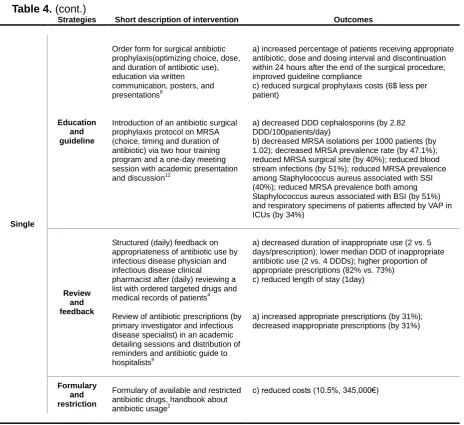
S. Ewering 20 Table 4. (cont.)
Strategies Short description of intervention Outcomes
Single
Education and guideline
Order form for surgical antibiotic prophylaxis(optimizing choice, dose, and duration of antibiotic use), education via written
communication, posters, and presentations8
a) increased percentage of patients receiving appropriate antibiotic, dose and dosing interval and discontinuation within 24 hours after the end of the surgical procedure; improved guideline compliance
c) reduced surgical prophylaxis costs (6$ less per patient)
Introduction of an antibiotic surgical prophylaxis protocol on MRSA (choice, timing and duration of antibiotic) via two hour training program and a one-day meeting session with academic presentation and discussion12
a) decreased DDD cephalosporins (by 2.82 DDD/100patients/day)
b) decreased MRSA isolations per 1000 patients (by 1.02); decreased MRSA prevalence rate (by 47.1%); reduced MRSA surgical site (by 40%); reduced blood stream infections (by 51%); reduced MRSA prevalence among Staphylococcus aureus associated with SSI (40%); reduced MRSA prevalence both among Staphylococcus aureus associated with BSI (by 51%) and respiratory specimens of patients affected by VAP in ICUs (by 34%)
Review and feedback
Structured (daily) feedback on appropriateness of antibiotic use by infectious disease physician and infectious disease clinical
pharmacist after (daily) reviewing a list with ordered targeted drugs and medical records of patients4
a) decreased duration of inappropriate use (2 vs. 5 days/prescription); lower median DDD of inappropriate antibiotic use (2 vs. 4 DDDs); higher proportion of appropriate prescriptions (82% vs. 73%) c) reduced length of stay (1day)
Review of antibiotic prescriptions (by primary investigator and infectious disease specialist) in an academic detailing sessions and distribution of reminders and antibiotic guide to hospitalists9
a) increased appropriate prescriptions (by 31%); decreased inappropriate prescriptions (by 31%)
Formulary and restriction
Formulary of available and restricted antibiotic drugs, handbook about antibiotic usage2
c) reduced costs (10.5%, 345,000€)
Legend: a) Behavioral outcomes; b) Medical outcomes; c) Organizational outcomes.
S. Ewering 21 Table 5. Description of included study characteristics
S hort c o m ings a n d note s R e p o rt e d s h o rt c o mi n g s : - lac k o f s p e c if ic k n o w led g e a b o u t ti me s a v ing s ( i. e ., t h e a c tu a l re d u c tion in th e t im e th a t p h a rma c is ts s p e n t field ing a n tibio ti c -r e lat e d te lep h o n e c a lls ) - n o inv e s tiga tion a b o u t th e p o te n tial im p a c t o f d e c re a s e d a n tibio ti c u s e o n re s is ta n c e r a te s Legend: I . E d u c a tion a n d g u ide lin e ; II . R e v iew a n d f e e d b a c k ; II I. For mular y a n d r e s tr ic tion ; IV . C o mpu te r a s s is ta n c e . 1 . R a n d o mi z e d c o n tr o lle d t rial ; 2 . Qu a s i-e x p e rim e n ta l s tu d y. a ) B e h a v ior a l o u tc o me s ; b ) Med ic a l o u tc o me s ; c ) Or g a n iz a tion a l o u tc o me s . R e port e d fi n di n gs a ) inc re a s e d u s e r s a tis fa c tion a mon g p re s c ribe rs f ro m 2 2 % t o 6 8 % ; inc re a s e d u s e r s a ti s fa c tion a mon g p h a rmac is ts f ro m 1 3 % t o 6 9 % ; 4 0 % f e w e r re s tr ic te d a n tibio ti c –r e lat e d p h o n e c a lls w e re n o te d b y t h e p h a rmac y ; 2 1 % re d u c tion in t h e n u mbe r o f p re s c ribe r re p o rt s o f m is s e d d o s e s ; 3 2 % r e d u c tion in t h e n u mbe r o f p re s c ribe r re p o rt s o f d e lay e d d o s e s ; 3 7 % r e d u c tion in t h e n u mbe r o f p h a rma c is t re p o rt s o f d e lay e d a p p ro v a ls ; 1 1 .6 % re d u c tion in t h e n u mbe r o f d is p e n s e d d o s e s . c ) $ 3 7 0 ,0 6 9 r e d u c tion in p ro jec te d a n n u a l c o s t a s s o c ia te d w it h re s tr ic te d a n tibio ti c u s e . S tud y des ig n, s a m p le s e iz e , outc om e m e a s ure s , a n d m e thod - 2 . Qu a s i-e x p e ri men ta l s tu d y ( b e fo re -and -a ft e r s tu d y ): n =u n k n o w n a) s a ti s fa c tion o f p re s c ribe rs a n d p h a rmac is ts ( o n lin e s u rv e y ); a n tibi o ti c d e liv e ry t imes ( ti me fr o m th e d o c u men ta tion o f th e w rit te n a n tibi o tic o rd e r to t ra n s c rip tion in to t h e p h a rmac y c o mpu te r s y s te m) ; e v a lua tion o f th e n u mbe r o f d is p e n s e d r e s tr ic te d a n d u n re s tr ic te d a n tibio ti c d o s e s ( inp a tien t fina n c ial d a ta b a s e ) c ) e v a lua tion o f th e c o s ts o f d is p e n s e d re s tr ic te d a n d u n re s tr ic te d a n tibio ti c s (c o mbinin g inp a tien t fina n c ial d a ta b a s e w it h a d mi n is tr a ti v e a n d f ina n c ial d a ta o n a n tibio ti c c o s ts ) C a re s e tt ing a n d int e rv e nt io n T e rt iar y c a re , te a c h ing h o s p it a l w it h 1 7 5 b e d s In p re p a ra tion : - s u rv e y ide n tif ied o p p o rt u n it ies f o r im p ro v e m e n t o f a n e x is ting a n tibio tic r e s tr ic tion p ro g ra m (p re s c ribe r c o n ta c ted th e p e d iat ri c in fe c tiou s d is e a s e s f e llo w s ( P ID F ) b y p a g e r; th e P ID F g a v e v e rb a l a p p ro v a l o r d is a p p ro v a l a n d n o ti fied th e p h a rmac y o f a p p ro v e d a n tibio ti c s b y p h o n e ) - e d u c a tion o f s ta ff ( p h a rma c is ts , p e d iat ric h o u s e o ff ic e rs , ro ta ting s u rg ic a l s e rv ic e s ) t h ro u g h lec tu re a n d in s tr u c tion a l g u ide s ( a ll w o rk s ta tion s ) - p ro v is ion o f w ire les s b ro a d b a n d l a p to p c o mpu te r fo r P ID F s ) In te rv e n tion : II I. , IV .: W o rld W ide W e b –ba s e d a n tibio ti c re s tr ic tion p ro g ra m , v ia a s e c u re in tr a n e t s it e - lis t o f re s tr ic te d a n d u n re s tr ic te d a n tibio ti c s - n o tif ic a tion s y s te m a b o u t s ta tu s o f re q u e s t (a p p ro v a l s ta tu s , d u ra tion , a n d r a tion a le; mi s s ing r e q u e s t n o tif ic a tion s ; a n d e x p irin g a p p ro v a ls ) - a u to mat ic a p p ro v a ls f o r s p e c if ic d ru g ind ic a tion c o mbina tion s - c lin ic a l d e c is ion s u p p o rt ( p ro v ide s u s e rs w it h li m it e d a n tibio ti c -s p e c if ic inf o rmat ion o n p re c a u tion s , int e ra c tion s , a d v e rs e e v e n ts , a n d t h e ra p e u ti c d ru g mon it o ring ) P ra c tic e : - p re s c ribe r s e le c ts p a tien t a n d ma k e s r e q u e s t fo r a n tibio tic u s e ( c h o o s e s f ro m a li s t o r ins e rt s f re e t e x t) w it h s u p p o rt ing c u lt u re d a ta - P ID F r e c e iv e s r e q u e s t v ia p a g e r a n d e n te rs a p p ro v a l (inc lud ing d u ra tion o f tr e a tmen t) o r d is a p p ro v a l (in c lud ing ra tion a le) v ia W W W -b a s e d s y s te m - p re s c ribe r a n d p h a rmac y r e c e iv e r e s p o n s e s im u lt a n e o u s ly - p h a rmac y c o mp u te r s y s te m a u to mat ic a lly g e n e ra te s a s to p d a te a n d t im e f o r tr e a tmen t - a n tibio ti c s a re d is p e n s e d A ut hor , y e a r, durat ion , a n d c ountry
1) - 2008 - 2
S. Ewering 22 S hort c o m ings a nd note s R e p o rt e d s h o rt c o mi n g s : - a p p ro v a l s y s te m w a s n o t e n fo rc e d in th e I C U , w h e re a s ign if ic a n t p e rc e n ta g e o f b ro a d -s p e c tr u m a n tibio ti c s i s u s e d - it w a s n o t p o s s ib le to d if fe re n tia te c o m mun it y -a c q u ire d fr o m n o s o c o mi a l inf e c tion s , s o s o me c h a n g e s in h o s p it a l e c o log y mi g h t h a v e b e e n mas k e d b y a lar g e n u mbe r o f c o m mu n it y -a c q u ire d b a c te ria a ls o b e ing is o lat e d N o te s : 3 0 -d a y mor ta lit y r a te a n d t h e len g th o f s ta y re maine d s imi lar Legend: I . E d u c a tion a n d g u ide lin e ; II . R e v iew a n d f e e d b a c k ; II I. For mular y a n d r e s tr ic tion ; IV . C o mpu te r a s s is ta n c e . 1 . R a n d o mi z e d c o n tr o lle d t rial ; 2 . Qu a s i-e x p e rim e n ta l s tu d y. a ) B e h a v ior a l o u tc o me s ; b ) Med ic a l o u tc o me s ; c ) Or g a n iz a tion a l o u tc o me s . R e port e d fi n di n gs c ) re d u c tion o f a n tibio ti c d ru g c o s ts b y 1 0 .5 % ( a s a v ing o f 3 4 5 ,0 0 0 E u ro s ) a ) re d u c tion in b ro a d -s p e c tr u m a n tibio ti c s ( th ird - a n d f o u rt h -g e n e ra tion c e p h a los p o rin s , g ly c o p e p tide s , c a rb a p e n e ms , a mi n o g ly c o s ide s a n d q u ino lon e s ); inc re a s e o f e x te n d e d -s p e c tr u m p e n ic illi n u s e S tud y des ig n, s a m p le s e iz e , outc om e m e a s ure s , a n d m e thod - 2 . Qu a s i-e x p e ri men ta l s tu d y ( ti m e -s e ries a n a ly s is ): n =u n k n o w n a) c o n s u mpt ion o f a n tibio tic s ( met h o d n o t s p e c if ied ) c ) c o s ts a n d t h e c o s t o f D D D ( me th o d n o t s p e c if ied ) - 2 . Qu a s i-e x p e ri men ta l s tu d y ( ti m e -s e ries a n a ly s is ): n =u n k n o w n a) n u mbe r o f ti mes t h e a p p ro v a l s y s te m w a s u s e d f o r e a c h d ru g , d o c to rs u s ing th e s y s te m a n d t h e p a rt ic u lar ind ic a tion s th a t w e re n o mi n a te d ( in -b u ilt a u d it t ra il) ; d ru g c o n s u mpt ion ( h o s p it a l p h a rm a c y re c o rd s ) b) a n tibio ti c r e s is ta n c e ( is o lat e s d a ta f ro m h o s p it a l mi c ro b iolo g y lab o ra to ry ); in -h o s p it a l mor ta lit y r a te (rev iew o f a ll p a tien ts w it h a p o s it iv e b loo d c u lt u re f o r a Gr a m -n e g a tiv e b a c illus ) c ) len g th o f h o s p it a l s ta y C a re s e tt ing a n d int e rv e nt io n S e c o n d a ry c a re , h o s p it a l w it h 2 5 0 0 b e d s In te rv e n tion : II I. : R e s tr ic tion f o rmul a ry - a f o rmular y o f a v a ila b le a n d r e s tr ic te d a n tibio ti c d ru g s w a s c re a te d b y a c o mm it te e ( h e a d o f p h a rmac y d e p a rt men t, inf e c tiou s d is e a s e s p e c iali s ts , p h a rma c o log is t e x p e rt a n d med ic a l e x e c u tiv e o f th e h o s p it a l) - handbook about an ti bi ot ic us e (d os age, rout e of adm ini s tra ti on, p h a rmac o -d y n a mi c a n d p h a rmac o k ine ti c n o te s a n d s p e c tr u m o f a c tion ) a n d r a tion a le w a s p u b lis h e d a n d s e n t to t h e med ic a l s ta ff a n d n u rs e s T e rt iar y c a re , te a c h ing h o s p it a l w it h 3 6 5 b e d s B e fo re : - p ilo t s y s te m a d d re s s ing t h ird -g e n e ra tion c e p h a lo s p o rins w a s re lea s e d in J a n u a ry 2 0 0 1 - a n tibio ti c f o rmular y w it h a li s t o f re s tr ic te d a n tibio tic s b y D ru g a n d The ra p e u tic s C o m mi tt e e o f th e h o s p it a l In te rv e n tion : II I. , IV .: C o mpu te riz e d a n tibio tic a p p ro v a l s y s te m (c A A S , c a lle d i A p p ro v e ) (d e s ign e d b y c linic ian s ( b o th jun ior a n d s e n ior ), p h a rma c is ts , e p ide mi o log is ts , p s y c h o log is ts a n d s o ft w a re e n g ine e rs ) - p re s c ribe r o b ta ine d a p p ro v a l v ia a n y n e tw o rk e d c o mpu te r w o rk s ta tion t h ro u g h o u t th e h o s p it a l o r a lt e rn a tiv e ly v ia t e lep h o n e - p re s c rip tion o f re s tr ic te d a n tibio ti c d ru g s w a s a p p ro v e d v ia c o mpu te r b y inf e c tiou s d is e a s e ( ID ) re g is tr a rs - a p p ro v a l o f s e riou s inf e c tion s t rig g e re d a v is u a l a ler t fo r th e I D re g is tr a r to r e v iew t h e p a tien t - ap pr ov als w er e st or ed in th e sy st em‟ s da ta ba se a nd c ou ld be v iew e d in r e a l-tim e ( a n d p rint e d ) b y t h e c lin ic a l a n d p h a rmac y s ta ff - th e ra p y w a s n o t w it h h o ld fr o m p a tien ts , b u t if a p p ro v a l w a s n o t o b ta ine d w it h in 2 4 h , p h a rmac y w o u ld c o n ta c t ID r e g is tr a r to fo llo w -u p t h e p a tien t A ut hor , y e a r, durat ion , a n d c ountry
2) - 2000 - 4
mon th s - It a ly
3) - 2008 - 7
S. Ewering 23 S hort c o m ings a n d note s R e p o rt e d s h o rt c o mi n g s : - po te nt ial f or “ cr os s-co nt ami na tion ” be tw ee n th e int e rv e n tion a n d c o n tr o l g ro u p s d u ring t h e t rial c o u ld n o t b e r e mo v e d - th e s tu d y w a s c o n d u c te d a mon g int e rn a l med ic ine w a rd t e a ms a n d d id n o t inc lud e t e a m s w o rk ing in int e n s iv e c a re u n it s a n d o n o th e r med ic a l s u b s p e c ialt ies - it w a s n o t p o s s ib le to mea s u re t h e e ff e c t o n t h e d e v e lop men t o f a n tibio tic re s is ta n c e in th e h o s p it a l N o te s : - n o d if fe re n c e s in mor ta lit y ra te s R e p o rt e d s h o rt c o mi n g s : - a c c u ra te c a lc u lat ion o f th e p n e u mon ia s e v e rit y ind e x re q u ire s p ro s p e c ti v e , p ro to c o l-d ire c te d d a ta c o lle c tion , w h ic h w a s n o t fe a s ible in a c o mm u n it y -b a s e d s tu d y in v o lv ing 2 8 ,6 6 1 e p is o d e s . C o mor b idit y inf o rmat ion w a s a v a ila b le o n ly f o r th e 2 6 .9 % o f s tu d y p a tien ts w h o w e re a d mi tt e d - ide n tif ic a tion o f p n e u mon ia b y I C D -9 -C M c o d ing h a s p o te n tial e rr o rs Legend: I . E d u c a tion a n d g u ide lin e ; II . R e v iew a n d f e e d b a c k ; II I. For mular y a n d r e s tr ic tion ; IV . C o mpu te r a s s is ta n c e . 1 . R a n d o mi z e d c o n tr o lle d t ri al ; 2 . Qu a s i-e x p e rim e n ta l s tu d y. a ) B e h a v ior a l o u tc o me s ; b ) Med ic a l o u tc o me s ; c ) Or g a n iz a tion a l o u tc o me s . R e port e d fi n di n gs a ) med ian d u ra tion o f ina p p ro p riat e u s e w a s s ign if ic a n tly s h o rt e r in th e int e rv e n tion g ro u p ( 2 .0 v s . 5 .0 d a y s /p re s c ript ion i n c o n tr o l g ro u p ); int e rv e n tion g ro u p h a d low e r med ian d a ily d e fine d d o s e s o f ina p p ro p riat e a n tibio ti c u s e ( 2 .0 v s . 4 .0 D D D s ); p ro p o rt ion o f appropri at e ant ibi ot ic pres c ri p ti on s w a s s ign if ic a n tly h igh e r in th e int e rv e n tion g ro u p ( 8 2 % v s . 7 3 % fo r e mpir ic ( R R =1 .1 4 , 9 5 % C I 1 .0 4 –1 .2 4 ), 8 2 % v s . 4 3 % f o r d e finit iv e ( R R =1 .8 9 , 9 5 % C I 1 .5 3 – 2 .3 3 ) a n d 9 4 % v s . 7 0 % f o r e n d a n tibio ti c u s a g e ( R R =1 .3 4 , 9 5 % C I 1 .2 5 –1 .4 3 )) c ) med ian len g th o f s ta y o f p a tien ts tr e a te d b y t h e int e rv e n tion g ro u p w a s s h o rt e r (7 v s . 8 d a y s ) b ) re d u c tion in 3 0 -d a y mor ta lit y b y 3 .4 % ( fr o m 1 3 .4 % t o . 1 1 % ) a mon g a d mi tt e d p a tien ts S tud y des ig n, s a m p le s e iz e , outc om e m e a s ure s , a n d m e thod - 1 . R a n d o mi z e d c o n tr o lle d t rial : n =1 2 - tw o c o n d it ion s : int e rv e n tion : n =6 , c o n tr o l (s ta n d a rd o f c a re ): n =6 ; ra n d o mi z a tion e a c h mon th b y u s in g a ra n d o m n u mbe r lis t med ic ine t e a m s s ta ff e d b y p h y s ic ia n s fr o m E mor y U n iv e rs it y w h ic h t re a t inp a tien ts a t GMH a n d f u n c tion ind e p e n d e n t o f o n e a n o th e r w e re inc lud e d a) p ro p o rt ion o f a p p ro p riat e p re s c ript ion s fo r e mpir ic t h erapy ; p ro p o rt ion o f appropri at e pres c ri p ti ons f or de fi ni ti v e th e ra p y ; p ro p o rt ion o f a p p ro p riat e e n d a n tibio ti c u s a g e ; v o lu me o f ina p p ro p riat e a n tibio ti c u s e in d a ily d e fine d d o s e s (DDD) ; d u ra tion o f ina p p ro p riat e a n tibio ti c u s e in d a y s b) c lin ic a l o u tc o me o f in -h o s p it a l m o rt a lit y c ) h o s p it a l len g th o f s ta y met h o d : u s a g e d a ta f ro m Gr a d y M e mor ial H o s p it a l - 2 . Qu a s i-e x p e ri men ta l s tu d y ( b e fo re -and -a ft e r s tu d y ): n =2 8 ,6 6 1 c a s e s o f p n e u mon ia - im mun o c o mpe te n t p a tien ts > 6 5 y e a rs w it h c o mm u n it y -a c q u ire d p n e u mo n ia - tw o c o n d it ion s , p re im p le men ta tio n : int e rv e n tion : n =5 4 ,0 4 8 , c o n tr o l: n = 1 0 ,7 5 8 p o s ti mpleme n ta tion : int e rv e n tion : n =5 2 ,5 4 7 , c o n tr o l: n =1 1 ,3 0 8 a) g u ide lin e u s e ( p h a rmac y b ill ing re c o rd s a llo w e d ide n ti fic a tion o f th e f ir s t a d mi n is te re d a n tibio ti c s )h o s p it a liz a tion b ) 3 0 d a y mor ta lit y r a te s c ) len g th o f s ta y C a re s e tt ing a n d int e rv e nt io n S e c o n d a ry c a re , te a c h ing h o s p it a l w it h 9 5 3 b e d s In te rv e n tion : II .: Mu lt idi s c iplina ry A n tim ic ro b ial U til iz a tion T e a m (A U T) c o n s is ting o f a n inf e c tiou s d is e a s e p h y s ic ian a n d a n inf e c tiou s d is e a s e s c lin ic a l p h a rmac is t - 1 2 med ic ine t e a m s c o n s is ting o f fa c u lt y a tt e n d ing p h y s ic ian , a s e n ior r e s ide n t, t w o ju n ior r e s ide n ts , a n d 1 –2 med ic a l s tu d e n ts - int e rv e n tion g ro u p : a c a d e mi c d e ta iling b y t h e A U T - s ta n d a rd o f c a re : g iv e n ind ic a tion -b a s e d g u ide lin e s f o r p re s c ript ion o f b ro a d s p e c tr u m a n tibio ti c s - e a c h mon th a ll med ic ine t e a ms r e c e iv e d p o c k e t-s iz e d c a rd s ( c o n ta ine d Gr a d y Memor ial H o s p it a l g u ide lin e s f o r u s e o f a n tibio ti c a g e n ts a n d t h e u s e o f th e t a rg e te d s tu d y d ru g s ) - A U T p ro v ide d s tr u c tu re d f e e d b a c k t o p re s c ribin g p h y s ic ian s o n a p p ro p riat e n e s s o f a n tibio ti c u s e ( p h o n e o r fa c e t o f a c e mee ting ) - A U T r e c e iv e d d a ily li s t fr o m p h a rmac y w it h n e w o rd e re d ta rg e te d d ru g s a n d med ic a l re c o rd s o f p a tien ts w e re re v iew e d b y o n e o f th e r e v iew e rs - d a ily a u d it o f mi c ro b iolo g ic d a ta w a s c o n d u c te d f o r p a tien ts re c e iv ing t a rg e te d d ru g s - e a c h p re s c rip tion w a s c las s if ied a s a p p ro p riat e b y A U T d ire c to r (b lin d e d t o t e a m a llo c a tion ) a n d i f n e c e s s a ry re c o mm e n d a tion s w e re mad e C a re s e tt ing u n s p e c if ied , b o th t e a c h ing a n d n o n -t e a c h ing h o s p it a ls w it h b e tw e e n 1 4 a n d 5 2 0 b e d s In te rv e n tion : I. : P n e u mon ia g u ide lin e - d e v e lop men t o f p n e u mon ia g u id e lin e b y a t e a m (f a mi ly p ra c ti c e , e mer g e n c y med ic ine , in te rn a l med ic ine , inf e c tiou s d is e a s e , p u lmon a ry p h y s ic ian s , re s p ira to ry t h e ra p is ts , n u rs e s , p h a rmac is ts , a n d a d mi n is tr a tiv e p e rs o n n e l) - mon th ly t e a m mee ting t o r e v iew l o c a l d a ta , u s e r s u g g e s tion s , a n d n e w ly p u b lis h e d inf o rmat ion - a d mi s s ion d e c is ion s u p p o rt a n d r e c o mm e n d a tion s f o r a n tibio ti c t im ing a n d s e le c tion - im p lemen ta tion t h ro u g h f o rmal p re s e n ta tion s , a c a d e mi c d e ta iling , let te rs , re mi n d e rs b y p h a rmac e u ti c a l re p re s e n ta ti v e s , p re p rint e d o u tp a ti e n t a n d a d m is s ion o rd e r s h e e ts a n d r e p o rt ing o f o u tc o me d a ta t o p ro v ide rs A ut hor , y e a r, durat ion , a n d c oun try
4) - 2009 - 1
0 mon th s - U n it e d S ta te s
5) - 2000 - 2
S. Ewering 24 S hort c o m ings a n d note s - re s u lt s a re r e lied o n o p e ra tion a l d e fini tion s a n d g u ide lin e u s e w a s n o t a s s e s s e d d ire c tl y - g u ide lin e u ti liz a tion a mon g a ff iliat e d p h y s ic ian s w a s in c o mple te d u ring t h e s tu d y p e riod R e p o rt e d s h o rt c o mi n g s : - o n ly 4 0 % o f e ligib le p a tien ts w it h p n e u mon ia w e re e n ro lle d in th e t rial , w h ic h li mi ts t h e g e n e ra liz a b ilit y o f th e s tu d y find ing s - s tu d y d id n o t h a v e a d e q u a te p o w e r to d e te c t s mall d if fe re n c e s in le n g th o f s ta y - th e n a tu re o f th e g u ide lin e int e rv e n tion p re c lud e d b lin d ing t h e t re a ting p h y s ic ian s o r s tu d y n u rs e s to p a tien t tr e a tmen t a s s ign men ts - a lt h o u g h r a n d o mi z a tion a t th e p h y s ic ian g ro u p le v e l w a s p e rf o rmed t o mi n imi z e th e e ff e c ts o f th e int e rv e n tion a mon g p h y s ic ian s in t h e c o n tr o l g ro u p , it is p o s s ible t h a t th e ir pr a c tic e s ma y h a v e b e e n inf lue n c e d b y int e ra c tion s w it h p h y s ic ian s in th e int e rv e n tion g ro u p d u ring t h e c o u rs e o f th e s tu d y Legend: I . E d u c a tion a n d g u ide lin e ; II . R e v iew a n d f e e d b a c k ; II I. For mular y a n d r e s tr ic tion ; IV . C o mpu te r a s s is ta n c e . 1 . R a n d o mi z e d c o n tr o lle d t rial ; 2 . Qu a s i-e x p e rim e n ta l s tu d y. a ) B e h a v ior a l o u tc o me s ; b ) Med ic a l o u tc o me s ; c ) Or g a n iz a tion a l o u tc o me s . R e port e d fi n di n gs a ) re d u c tion o f d u ra tion o f int ra v e n o u s a n tibio ti c t h e ra p y in int e rv e n tion a rm b ) fe w e r med ic a l c o mp lic a tion s d u ring t h e ind e x h o s p it a liz a tion in int e rv e n tion g ro u p ( 5 5 % v s . 6 3 % ) S tud y des ig n, s a m p le s e iz e , outc om e m e a s ure s , a n d m e thod met h o d : u s a g e d a ta f ro m h o s p it a l d a ta b a s e - 1 . R a n d o mi z e d c o n tr o lle d t rial ( s e v e n -s it e , c lu s te r) : n =1 1 6 ( 6 0 8 p a tien ts ) - tw o c o n d it ion s : int e rv e n tion : n =5 7 (2 8 3 p a tien ts ), c o n tr o l: n =5 9 ( 3 2 5 p a tie n ts ) - inc lud e d p h y s ic ian g ro u p s w e re li k e ly t o tr e a t p a tien ts w it h c o mm u n it y -a c q u ire d p n e u mon ia a n d h a d med ic a l s ta ff p riv ile g e s a t a p a rt ic ip a ting s it e a n d p ra c ti c e d in a g e n e ra lis t s p e c ialt y o r a n int e rn a l med ic ine s p e c ialt y -r a n d o mi z a tion s tr a tif ied o n p ra c ti c e t y p e a n d g ro u p s iz e /p a tien t v o lu me; n o b lin d ing o f p h y s ic ian s a n d r e s e a rc h n u rs e s ; p a tien ts w e re n o t inf o rmed o f th eir ph ys ic ian s‟ t re at men t as sign men t a) d u ra tion o f int ra v e n o u s a n tibio ti c th e ra p y b) med ic a l o u tc o me s c ) d if fe re n c e s in th e r a te s o f d is c o n tinu a tion a n d h o s p it a l d is c h a rg e ; len g th o f s ta y met h o d : c h a rt r e v iew C a re s e tt ing a n d int e rv e nt io n S e c o n d a ry c a re , b o th t e a c h ing a n d n o n -t e a c h ing h o s p it a ls In te rv e n tion : I. : Gu ide lin e i mpleme n ta tion - b o th s tu d y a rm s : - d e liv e re d t o p h y s ic ian s b y e d u c a tion a l mail ing ( d e s c ribin g th e r a tion a le f o r th e g u ide lin e a n d a w rit te n v e rs ion o f th e gu ide lin e, s ign ed b y ho sp ita l‟s u tili za tion man ag emen t d ire c to r) - int e rv e n tion a rm , mult if a c e te d : - p a tien t s ta b ilit y w a s a s s e s s e d p ro s p e c tiv e ly e a c h d a y b y re s e a rc h n u rs e s b e g inn ing o n h o s p it a l d a y 3 - im p lemen ta tion o f a n e v ide n c e -b a s e d , mult if a c e te d gu ide lin e ( inc lud ing c lin ic a l c rit e ria t o d e fine s ta b ilit y f o r s w it c h f ro m int ra v e n o u s t o o ra l a n tibio ti c t h e ra p y a n d f o r h o s p it a l d is c h a rg e ) - plac emen t of d et ai l s he et in pa tie nt ‟s med ic al r ec or d on ce a p a tien t met g u ide lin e c ri te ria fo r s ta b ili ty , a f o llo w -up re c o mm e n d a tion t o t h e a tt e n d ing p h y s ic ian , a n d a n o ff e r to arrange fol low -u p h o me n u rs ing c a re - p lac e men t o f d e ta il s h e e t in th e p h y s ic ian p ro g re s s n o te s se ct ion o f ea ch p at ien t‟s c ha rt a nd r es ea rc h nu rs e c o n ta c te d ( te lep h o n e , fa c e t o f a c e ) a tt e n d in g p h y s ic ian t o s ta te t h a t th e p a tien t met g u ide lin e c ri te ria A ut hor , y e a r, durat ion , a n d c ountry (c o n t. )
6) - 2003 - 1