Selecting and evaluating a benefits management method for IT projects
Master thesis Business Information Technology
U
NRESTRICTEDImportant: This version of this thesis is unrestricted and does not contain confidential information. The complete thesis
is confidential and therefore not available to the public.
Enschede, February 25th 2011
Author
Kelvin Divendal [email protected]
Graduation committee
Abstract
Whenever large resources will be used in a project, most organizations develop a business case to justify the required investments. The investments are justified by estimated future benefits resulting from the project. However, only 30% of IT projects delivers the expected benefits.
Heineken Netherlands wants to manage its IT-related projects using the expected benefits as guidance, and review progress during the project and following its completion. The goals of the IT department are to increase the amount of realized benefits and to make the added value of the department more explicit. Benefits management is the approach to identify, plan and manage the delivery of benefits. Several benefits management methods have been developed in research and practice, but it is unknown which one is best suited for Heineken. Therefore, the goal of this study is to find the best benefits management approach for Heineken and to learn from its execution in practice.
The best benefits management method for Heineken is selected from seventeen methods found in a systematic literature search. Based on criteria from interviews at Heineken and criteria from a case study at Philips, the Cranfield method is selected. The method is subsequently evaluated in two pilot projects, resulting in the following findings:
Full benefits management for must do projects (legal, fiscal or technical) is not feasible, but taking a moment to identify potential additional benefits is still very useful.
A workshop facilitator should make sure that all participants have a good and shared understanding of the definitions used.
In contrary to results from the Philips case study, the pilot participants want to assess benefits realization during project execution. They value the benefit ‘thinking’ process.
The Benefit Dependency Network helps people who created it with reasoning about a project in other meetings. It provides a better overview than benefit templates.
Individual benefits are useful to guide project execution, not to evaluate project success. Project success should be evaluated using the combination of all benefits in a project.
Following the evaluation of the Cranfield method, a deployment plan for benefits management in IT projects at Heineken is developed. The deployment plan contains one-time activities for adopting benefits management and recurring activities for using benefits management. The lessons learned from the evaluation and from feedback of Heineken stakeholders are included in the deployment plan.
Preface
Executing your graduation project at a beer brewery; it must be every student’s dream!
Perhaps most students from Enschede would dream of an internship at Grolsch, the local pride. But I was very happy to get the opportunity to graduate at one of the world’s largest brewers; Heineken. After experiencing the company and its brands at the Heineken Business Course, arrangements for my graduation internship at the IT department were quickly made. Looking back at the last six months, I can confidently say that it was a great learning experience and an incredibly inspiring time. Six months of hard work has resulted in this thesis and a benefits management approach for Heineken, ready for use.
During the graduation project I was supported by a lot of people, who I hereby want to thank for their great help. I wish to thank Christiaan and Silja, my university supervisors, for their enthusiasm, valuable ideas, sharp remarks and their invested time to read the growing amount of pages in this thesis. I would like to thank Matthieu, my company supervisor, for his close involvement in my assignment, the valuable brainstorming sessions, his candid feedback and the friendly collaboration. Many other people at Heineken were directly involved in the process of my research; as pleasant colleagues and sometimes also as workshop participants or interviewees. I wish to thank all of them for the good times and the nice cooperation. Apart from the people directly involved, I would like to thank Aniek and my friends and family for their support and encouragement.
Have fun reading, Kelvin
Table of contents
Abstract ... iii
Preface ... v
List of tables ... ix
List of figures ... xi
List of abbreviations ... xiii
1 Introduction ... 1
1.1 Background ... 1
1.2 Research setting ... 1
1.2.1 Project management at IT HNL ... 2
1.2.2 Project portfolio management at IT HNL ...3
1.2.3 Benefits management at IT HNL ... 4
1.3 Problem statement ... 5
1.4 Structure of the thesis ... 5
2 Research approach ... 7
2.1 Research questions ... 7
2.2 Research method ... 7
2.2.1 Literature study ... 8
2.2.2 Unstructured interviews ... 8
2.2.3 Exploratory case study ... 8
2.2.4 Exclusion criteria and multi-criteria analysis ... 9
2.2.5 Participatory action research ... 9
2.3 Deliverables ... 10
3 Theoretical background ... 11
3.1 Business case ... 11
3.2 Business benefits ... 11
3.3 Benefits management ... 12
3.4 Benefits management methods ... 13
3.4.1 Validated methods developed in research ... 14
3.4.2 Unvalidated methods developed in research ... 17
3.4.3 Methods developed in practice ... 18
3.4.4 Comparison of methods ... 20
4 Benefits management method selection ... 23
4.1 Definition of criteria ... 23
4.1.1 HNL interviews ... 23
4.1.2 Philips case study ... 26
4.2 Method selection ... 28
4.2.1 Shortlist selection with exclusion criteria ... 28
4.2.2 Final selection with multi-criteria analysis ... 30
4.3 A further elaboration of the Cranfield method ... 32
4.3.1 History and foundation ... 32
4.3.2 Optimization of the method ... 33
5 Benefits management evaluation in pilot projects ... 41
5.1 Selection and description of two pilot projects ... 41
5.1.1 Excise Movement and Control System project ... 41
5.1.2 Heineken Digital project ... 42
5.2 Evaluation in pilot projects ... 42
5.2.1 Excise Movement and Control System pilot evaluation ... 43
5.2.2 Heineken Digital pilot evaluation ... 44
5.2.3 Evaluation of Cranfield method optimization ... 45
5.2.4 Questionnaire results ... 47
5.3 Pilot evaluation findings and lessons learned ... 48
6 Heineken benefits management plan ... 49
6.1 Adopting benefits management ... 49
6.1.1 Setting the stage: Value Management Maturity ... 50
6.1.2 Ensuring business involvement ... 50
6.1.3 Roadmap for deployment ... 51
6.2 Using benefits management ... 53
6.2.1 Project management ... 53
6.2.2 Portfolio management ... 57
7 Final remarks ... 61
7.1 Conclusion ... 61
7.2 Contributions ... 62
7.2.1 Contributions for research ... 62
7.2.2 Contributions for practice ... 63
7.3 Research validity ... 63
7.3.1 Internal validity ... 63
7.3.2 External validity ... 64
7.4 Limitations and further research ... 65
References ... 67
Appendix A Interviews in Philips case study ... 71
Appendix B Presentation slides for final method selection ... 73
Appendix C Outcomes analytic hierarchy process ... 79
Appendix D Value Management Maturity ... 85
Appendix E Benefits management questionnaire ... 87
Appendix F EMCS pilot results ... 89
Appendix G Heineken Digital pilot results ... 91
Appendix H Presentation slides for benefits workshop ... 93
List of tables
Table 1.1 High-level fund procedure for IT projects at HNL ... 4
Table 2.1 Structure of the thesis ... 8
Table 3.1 Benefits management methods identified in literature ... 14
Table 3.2 Comparison of benefits management methods ... 21
Table 4.1 Shortlist of benefits management methods ... 30
Table 4.2 Suggested areas to look for potential benefits (Oude Maatman & Eckartz, 2010) ... 36
Table 4.3 Classifying the benefits by the explicitness of the contribution (Ward & Daniel, 2006) .. 37
Table 6.1 Planned activities for adopting and for using benefits management ... 49
Table 6.2 Activities, governance and tools for using benefits management ... 53
Table F.1 Details for benefit ‘Cost reduction’ ... 89
Table F.2 Details for benefit ‘Green (by) IT’ ... 90
Table F.3 Details for benefit ‘Increased customer satisfaction’ ... 90
Table F.4 Details for benefit ‘Cost leadership’ ... 90
Table F.5 Details for benefit ‘Continue export business’ ... 90
Table G.1 Details for benefit ‘Better availability’ ... 91
Table G.2 Details for benefit ‘Better sponsorship utilization’ ... 92
Table G.3 Details for benefit ‘1-on-1 communication’ ... 92
Table G.4 Details for benefit ‘Leading in digital initiatives’... 92
Table G.5 Details for benefit ‘Customer value mapped’ ... 92
List of figures
Figure 1.1 HeiProject for regular and lite projects ... 2
Figure 1.2 HeiProject for consultancy projects ...3
Figure 1.3 Structure of the thesis ... 5
Figure 2.1 Research model ... 7
Figure 3.1 Three-dimensional ERP benefit classification framework (Eckartz, Daneva, Wieringa, & van Hillegersberg, 2009) ... 11
Figure 3.2 The four “ares” in benefits management (Thorp, 2003) ... 12
Figure 3.3 Benefits Dependency Network (Peppard, Ward, & Daniel, 2007) ... 13
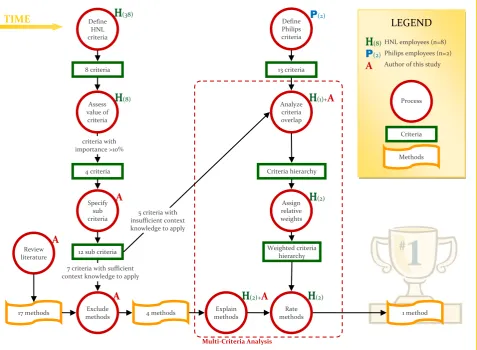
Figure 4.1 Benefits management method selection process ... 23
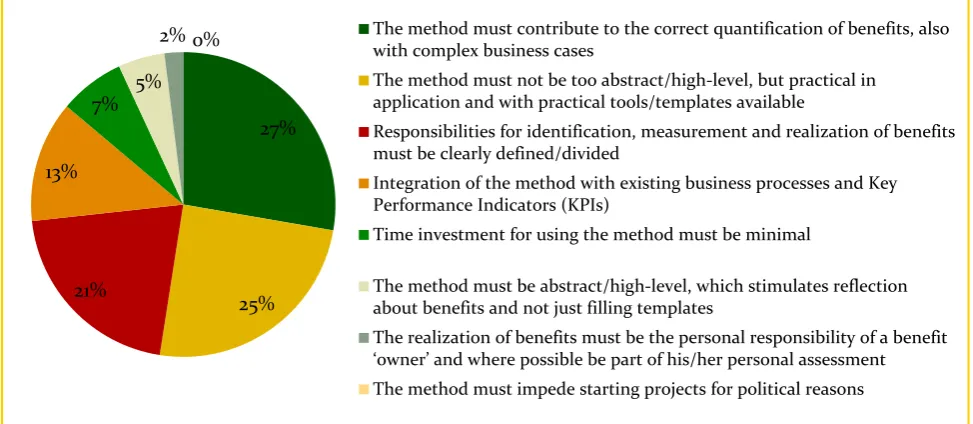
Figure 4.2 Requirements of HNL stakeholders with their relative importance ... 25
Figure 4.3 Pair wise comparison of alternatives (step 5) in MakeItRational ... 31
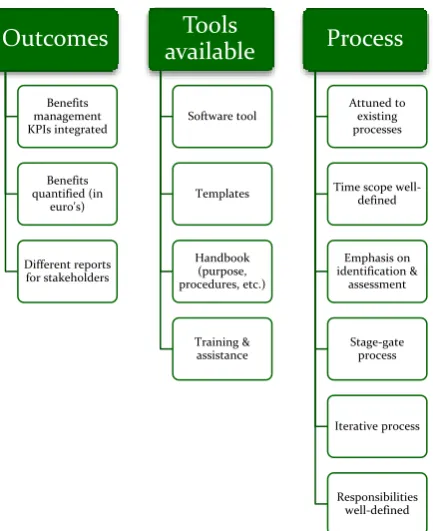
Figure 4.4 Hierarchy of criteria for AHP (step 2) ... 31
Figure 4.5 Overall alternatives ranking with relative weights (step 7) ... 32
Figure 4.6 Overall alternatives comparison with relative weights (step 7) ... 32
Figure 4.7 Benefits management process (Ward & Daniel, 2006) ... 34
Figure 4.8 Typical drivers for different application types (Ward & Daniel, 2006) ... 35
Figure 4.9 Benefit template (Eckartz, Katsma, & Oude Maatman, 2011) ... 37
Figure 5.1 Measurements of average knowledge about benefits management ... 47
Figure 5.2 Increase of knowledge about benefits management ... 47
Figure 5.3 Measurements of average attitude towards benefits management ... 47
Figure 5.4 Improvement of attitude towards benefits management ... 47
Figure 6.1 Value Management Maturity Model ... 50
Figure 6.2 Ensuring business involvement ... 51
Figure 6.3 Roadmap for benefits management transformation ... 52
Figure 6.4 Benefits management process integrated with HeiProject ... 54
Figure 6.5 Example of monthly benefits report ... 58
Figure C.1 Relative weight of main criteria ... 79
Figure C.2 Relative global weight of Outcomes sub criteria ... 79
Figure C.3 Relative global weight of Process sub criteria ... 80
Figure C.4 Relative global weight of Tools sub criteria ... 80
Figure C.5 Alternatives ranking on Outcomes sub criteria with relative local weights ... 81
Figure C.6 Alternatives ranking on Process sub criteria with relative local weights ... 81
Figure C.7 Alternatives ranking on Tools sub criteria with relative local weights... 81
Figure C.8 Overall alternatives comparison on Outcomes sub criteria with relative local weights .. 82
Figure C.9 Overall alternatives comparison on Process sub criteria with relative local weights ... 82
Figure C.10 Overall alternatives comparison on Tools sub criteria with relative local weights ... 82
Figure C.11 Sensitivity analysis for Outcomes criterion (calculated weight: 35,86%) ... 83
Figure C.12 Sensitivity analysis for Process criterion (calculated weight: 12,43%) ... 83
Figure C.13 Sensitivity analysis for Tools criterion (calculated weight: 51,71%)... 83
Figure F.1 EMCS Benefits Dependency Network ... 89
List of abbreviations
ABR Active Benefit Realization AHP Analytic Hierarchy Process BDN Benefits Dependency Network
BeReal Benefits Realization and Management framework BI Business Intelligence
BPM Business Process Modeling BPS Business Process Simulation BRA Benefit Realization Approach BRM Benefit Realization Management BSC Balanced Scorecard
CIO Chief Information Officer CSF Critical Success Factor
EMCS Excise Movement and Control System ERP Enterprise Resource Planning
ES Enterprise System
EU European Union
HNL Heineken Netherlands IS Information System IT Information Technology
IT HNL Information Technology department at Heineken Netherlands KPI Key Performance Indicator
LE Latest Estimates MCA Multi-criteria analysis
MSP Managing Successful Programmes
MT Management Team
OGC Office of Government Commerce OP Operational Plan
PAR Participatory action research
PM Project Management
PMO Project Management Office PNBF Perceived Net Benefit Flow
PRINCE2 Projects IN Controlled Environments
RACI Responsible, Accountable, Consulted, Informed
SMART Specific, Measurable, Achievable, Relevant and Time bounded SVP Senior Vice President
Val IT IT Value Delivery
1
Introduction
This chapter provides the reader with an insight into the research area of the thesis. The chapter starts with a discussion of the background, followed by a description of the context in which the study is performed and a brief assessment of benefits management within the Information Technology department at Heineken Netherlands. Finally, the problem statement is explained.
1.1
Background
Whenever large efforts or resources will be used in a new project, most organizations develop a business case to capture the reasoning for initiating the project and to justify the required investments. The investments are justified by estimated future benefits resulting from the project. Research demonstrates that only 30% of IT projects delivers the expected benefits (Nelson, 2007). Many organizations exaggerate benefits and put the business case aside during the project execution (Ward, Daniel, & Peppard, 2008). Benefits management is an approach to identify, plan and manage the delivery of benefits. Clear identification and a detailed plan of how expected benefits will be realized are essential at the inception of a project. The plan is used to manage the project execution and to review progress and achievement both during the project and following its completion (Peppard, Ward, & Daniel, 2007). Several approaches to benefits management have been developed in order to guide projects through a controlled, well-managed set of activities to achieve the desired benefits. A systematic review of the benefits management literature by Braun, Ahlemann and Riempp (2009) reveals that the pioneering work of Ward, Taylor and Bond (1996) has structured the discipline early on and has been adopted as a basis by other researchers.
1.2
Research setting
The study is performed within the Information Technology (IT) department at the Dutch operating company of beer brewer Heineken. Heineken is one of the world’s largest brewers and is committed to growth and remaining independent. The brand that bears the founder’s family name – Heineken – is available in almost every country on the globe and is the world’s most valuable international premium beer brand. Heineken’s aim is to be a leading brewer in each of the markets in which it operates and to have the world’s most valuable brand portfolio. The principal international brand is Heineken, but the Group brews and sells more than 200 international premium, regional, local and specialty beers and ciders.
At Heineken Netherlands (HNL), production takes place at breweries in Zoeterwoude, Den Bosch and Wijlre. In 2010 the total production was around 15,5 million hectoliters, of which 2/3 is exported to 150 countries. Worldwide production was around 125 million hectoliters. The most important products in the Netherlands are Heineken, Amstel and Brand. Many innovative products and packagings are produced like Jillz, Wieckse Rosé and the draught keg (‘tapvat’). Heineken employs 55.000 people worldwide, of which 3.500 work for HNL.
Services, Vrumona). Three service delivery teams – managed services, infrastructure services and SAP services – are responsible for internal service delivery to customer teams, including contract management. The PMO is responsible for the proper realization of all projects and for IT architecture, portfolio management, reporting and the business case development process.
1.2.1 Project management at IT HNL
At HNL, projects originate in the business departments. Every department manages its own project portfolio, focusing on budgeting of (total) project costs and capacity management of resources. IT HNL uses the project management methodology HeiProject, which is based on PRINCE2 (Projects IN Controlled Environments) (Office of Government Commerce, 2009), to perform its projects. A distinction is made between three types of projects; regular projects, lite projects and consultancy projects. The distinction between a regular project and a lite project is made with the help of three criteria; if a project is not cross-organizational, the duration is less than
six months and the budget is less than a threshold euro value, it is generally considered a lite project. A project is considered a consultancy project when no changes to existing applications or systems and no development of new applications or systems are required, for example the development of a report or the preparation of a Request for Proposal. A set of templates and tools is available to support the HeiProject methodology.
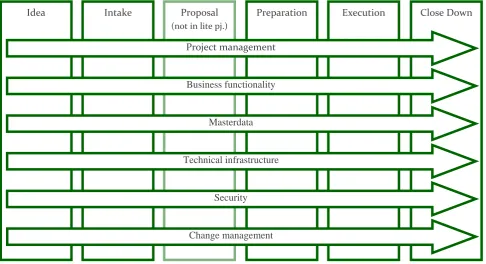
The methodology for regular projects consists of six phases: (i) Idea, (ii) Intake, (iii) Proposal, (iv) Preparation, (v) Execution and (vi) Close Down. Lite projects consist of five phases; the Proposal phase is dropped. Through the phases, six ongoing processes are executed for (i) project management, (ii) business functionality, (iii) masterdata, (iv) technical infrastructure, (v) security and (vi) change management. The process for regular and lite projects is depicted in Figure 1.1.
[image:18.595.55.542.485.749.2]For consultancy projects, four phases are defined: (i) Idea, (ii) Intake, (iii) Execution,
Figure 1.1 HeiProject for regular and lite projects
Idea Intake Proposal
(not in lite pj.)
Preparation Execution Close Down
Project management
Business functionality
Masterdata
Technical infrastructure
Security
and (iv) Close Down. Through the four phases, only one ongoing process is executed; project management. The process for consultancy projects is depicted in Figure 1.2.
Figure 1.2 HeiProject for consultancy projects
The purpose of the Idea phase is to determine whether the project idea submitted by the business department is aligned with operational goals of HNL and the department. In the Intake phase the project impact and interdependencies are determined, and the idea is further detailed. The Proposal phase is used to further scope requirements in order to make a proposal for the business department. Project prerequisites are planned and managed in the Preparation phase, after which the solution is delivered in the Execution phase. Attention is paid to delivery of the solution according to plan, on time, on budget and with the agreed quality. In Close Down the project is completed and stabilized in the production environment.
In the Intake phase, a compulsory document to be created is the Assignment Letter. In this deliverable the customer from the business department approves a high level description of the assignment, containing the objective, deliverables, scope, assumptions, preconditions and budget indication. The Assignment Letter is developed in cooperation between the customer, a Business IT Manager (who is responsible for the IT service delivery for the customer’s business department) and (prospective) key users. In the Proposal phase the document is further elaborated in the Proposal, containing among others a more detailed indication of budget.
1.2.2 Project portfolio management at IT HNL
The HeiProject methodology is applicable to individual projects. For the overall project portfolio, there are bi-weekly, monthly and quarterly reporting activities, and yearly planning activities.
1.2.2.1 Bi-weekly project portfolio report
A bi-weekly project portfolio report is shared with all IT Project Managers and Business IT Managers. It contains the status of every running project and the schedule of every running and planned project. The status shows information regarding project progress vs. schedule, costs on track, resource issues, interdependency issues, scope changes, and general issues. A schedule shows the planned project phase (see Figure 1.1) for each month. The project portfolio is discussed in a monthly meeting with the Manager PMO and the Business IT Managers, in which the project portfolio report is an information source.
1.2.2.2 Monthly cost report
A monthly cost report is shared with all IT Project Managers and with the Controllers of the business departments. It mainly contains the summarized direct costs (invoices) and hours worked for every business department, which can be viewed separately for every project. These costs are charged by IT HNL to the business departments. The cost reports are also input for meetings of the Management Teams (MT) of the business departments.
1.2.2.3 Quarterly latest estimates report
A quarterly Latest Estimates (LE) report if sent to the West European Region (WER) IT department by IT HNL. It contains cost estimates by the Business IT Managers. It is obligatory for IT HNL to report the LE, but so far no one at the WER IT department has responded or undertaken any activities in response to the reports.
Idea Intake
Exe-cution
Close Down
1.2.2.4 Yearly operational plan and project portfolio plan
Every year the Operational Plan (OP) and a project portfolio for the next year are developed at IT HNL. The OP contains the running costs that are charged to the business departments. The OP and portfolio are developed and reviewed in several iterations. The process starts around July 15th, when the Controller IT and the Business IT Managers in a few iterations develop a first draft. The Business IT Managers and the business departments discuss the departments’ IT demands for next year’s project portfolio. Around September 1st the first OP and project portfolio drafts are finished. Both documents are sent to the business departments, who review the IT costs, and are then sent to the WER IT department, who checks inconsistencies in functional topics. After these reviews the documents are finalized in December. In January of the next year a final budget and target are granted by the WER IT department.
1.2.3 Benefits management at IT HNL
For regular and lite projects a business case is usually developed, for consultancy projects this is not done. The business case is developed in cooperation between a business department
and the IT department. Whether or not a business case is developed for regular projects is determined in the funding procedure by the person authorized to accept or reject the fund. The fund procedure for IT projects is shown in Table 1.1. Euro values have been replaced by a threshold character. Who is/are responsible for accepting or rejecting a fund depends on the business department where the fund originates and the size of the fund.
There are no company-wide policies for the business case development process. Business departments use different criteria to decide whether it is necessary to develop a business case and there are examples where senior management overrules these criteria.
The business case is not often used as a guide for project portfolio management nor is it changed during project execution. A developed business case contains a detailed indication of costs and deliverables, but no concrete indication of benefits that are intended to be realized with help of the deliverables.
During project execution little attention is paid to benefit realization. Most attention is on realization of products (new website, server) instead of the benefits which these products serve (cost reduction, efficiency improvement). Table 1.1 High-level fund procedure for IT projects at HNL
An exception report has to be created when costs change, required number of working hours change, risks are signaled, functional changes are requested or a deliverable does not meet the agreements. Nobody at IT HNL is responsible for checking whether the business benefits are still realizable when changes occur during project execution. After project completion, it is up to the business department to decide whether or not to assess the realization of benefits. Most of the time this is not assessed and the benefit realization is taken for granted.
HNL wants to put more focus on benefits realization. For IT HNL this is particularly important, because they want to make their added value more explicit. Only projects for which a business case is developed are in scope of this research. Because of the absence of a business case, consultancy projects are out of scope.
1.3
Problem statement
HNL wants to manage its IT-related projects using the expected benefits as guidance, and review progress during the project and following its completion. Several benefits management methods and frameworks have been developed in research and practice (Eckartz, Daneva, Wieringa, & van Hillegersberg, 2009). HNL wants to use a benefits management method that matches with the organization’s goals and culture, the organization’s requirements and the existing project management approach as shown in Figure 1.1. They want to select the best suited method for HNL and then deploy it in the organization with a structured approach. Sufficient explanation and room to get
acquainted with benefits management are necessary to secure good use of the method.
1.4
Structure of the thesis
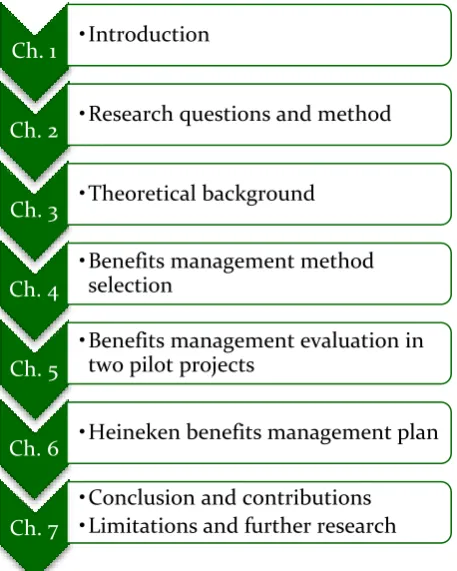
In chapter 2 the research approach is provided including the research questions and the research methods used. Chapter 3 provides a theoretical background for the concepts that are used throughout the thesis and a literature study of benefits management methods. In chapter 4 the best method for Heineken is selected and described. Chapter 5 evaluates the method in two pilots. A deployment plan for benefits management at Heineken is presented in chapter 6. Finally, chapter 7 discusses the study results together with theoretical and practical implications.
[image:21.595.317.546.384.670.2]Figure 1.3 shows the contents of the seven chapters of the thesis.
Figure 1.3 Structure of the thesis Ch. 1 •Introduction
Ch. 2 •Research questions and method
Ch. 3 •Theoretical background
Ch. 4
•Benefits management method selection
Ch. 5
•Benefits management evaluation in two pilot projects
Ch. 6 •Heineken benefits management plan
Ch. 7
2
Research approach
This chapter provides information on the research approach of this study. It introduces the research questions and their interconnections. The methods used to answers the research questions are explained and the deliverables for HNL are stated.
2.1
Research questions
The main research question is defined in line with the problem statement in section 1.3:
What is the best benefits management
approach for IT HNL and what can be
learned from its execution?
In order to answer the main research question the following sub questions are answered:
Q1. What benefits management methods are
known in literature?
Q2. What are the requirements for a benefits management method at HNL?
a. What are the requirements from
stakeholders at HNL?
b. What are good practices from a
comparable company?
Q3. What is the best benefits management
method for IT-projects at HNL?
Q4. How should benefits management be
deployed at HNL?
a. How should benefits management be
deployed according to literature?
b. What good practices are learned
when executing the benefits
management method in practice?
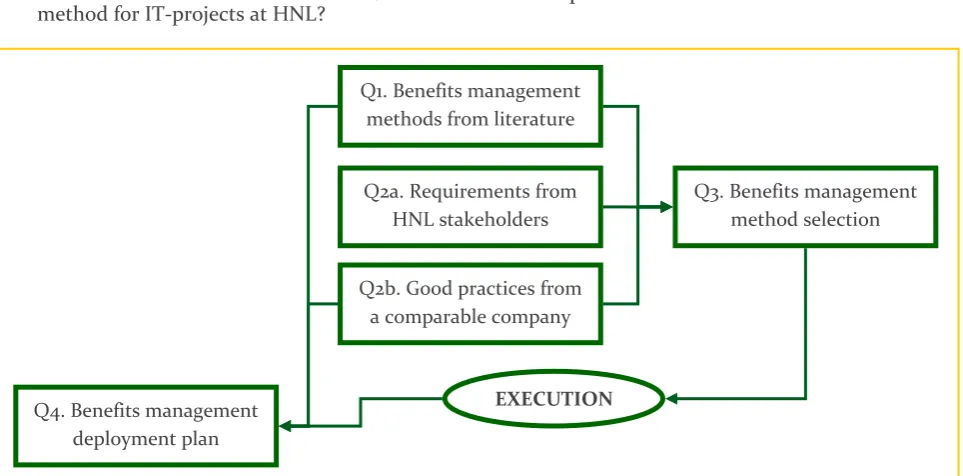
The best benefits management method for HNL (Q3) is selected from the methods identified in literature (Q1) with help of the identified requirements (Q2). A plan for deployment of the selected method at HNL is developed (Q4).
2.2
Research method
The focus of this research is on the four research questions identified in the previous section. The interconnection between the research questions is shown in the research model in Figure 2.1.
[image:23.595.59.541.504.742.2]The following sections elaborate on the research methods used to answer the research questions. Table 2.1 on the next page provides an overview of the research methods used to answer each research question, including the location of the method description, the process description and the results.
Figure 2.1 Research model
Q1. Benefits management methods from literature
Q2a. Requirements from HNL stakeholders
Q2b. Good practices from a comparable company
Q3. Benefits management method selection
Q4. Benefits management deployment plan
Table 2.1 Structure of the thesis
Activity Research method Method descirption Results descirption
Q1 Literature study Systematic literature review 2.2.1 3.4
Q2 Requirements collection
HNL interviews Unstructured interviews 2.2.2 + 4.1.1.1 4.1.1.4 Philips case study Exploratory case study 2.2.3 + 4.1.2.1 4.1.2.4
Q3 Benefits management method selection 2.2.4
Shortlist selection Exclusion criteria 4.2.1 4.2.1.2 Final selection Analytic Hierarchy Process 4.2.2 4.2.2.2 + 4.3
Q4 Benefits management method evaluation 2.2.5 5.3
Pilot projects selection Inclusion criteria 5.1 5.1.1 + 5.1.2 Pilot projects evaluation Participatory action research 5.2 5.2.3 Questionnaire Likert scale questionnaire 5.2 5.2.4
2.2.1 Literature study
Q1 is answered through literature study. The literature study is planned, executed and evaluated based on the methodological guidelines by Webster and Watson (2002). The aim of the literature search is to find as many benefits management methods as possible. Both scientific and non-scientific search engines and electronic databases are consulted. The following inclusion criteria are applied to the discovered methods: (i) the method is classified as a framework, model, method or methodology either by its author or by an author referring to the method, and (ii) the method discusses benefits identification, benefits realization, benefits assessment or a combination of them. Both criteria must be met for the method to be included in this study.
2.2.2 Unstructured interviews
Q2a is answered by examining existing HNL documents, methods on project management, unstructured interviews with both project management experts and project managers at IT HNL, and with stakeholders from the finance department and the business departments. The goal of the interviews is to collect requirements for a benefits management method from stakeholders at HNL and to gain knowledge about the HNL organization.
Two types of interviews are executed; individual interviews with a stakeholder and
group meetings where questions are answered by individual group members. In the individual interviews, a stakeholder answers questions about his/her requirements. In the group meetings, a presentation about the goals and approach of this study is given, followed by a discussion where questions are answered by individuals and these answers are discussed with the group. Ten people are individually interviewed and around thirty people are involved in two group meetings.
No specific questions are prepared for the interviews, but all interview questions have the goal to answer one main question:
What are your requirements for a benefits management method with regard of your role/function and with regard of your knowledge about (IT) HNL?
2.2.3 Exploratory case study
The case study is performed at Philips, a multinational company in healthcare, consumer lifestyle and lighting. Philips is comparable to Heineken by its turnover, amount of employees, amount of operating countries and strategy. Two and a half years ago Philips introduced benefits management and has since then used it in practice. Two Philips employees with experience in setting up benefits management and with benefits management in practice are interviewed. In the interviews, the interviewees are asked to describe the situation and practices at the Philips IT department. Then a set of prepared questions is used to ask for details and clarification.
2.2.4 Exclusion criteria and multi-criteria analysis
Q3 is answered by matching the methods found in literature (Q1) with requirements from (IT) HNL (Q2a) and practices at a comparable company (Q2b). The matching is done in two steps. First a shortlist is created by excluding the identified methods not matching a set of exclusion criteria. The remaining methods are then compared using Multi-criteria analysis (MCA). The Analytic Hierarchy Process (AHP) invented by Thomas Saaty (1980) is used to conduct the MCA. The AHP helps decision makers to find the decision that best suits their needs and their understanding of the problem, rather than prescribing a “correct” decision. It enables them to build a hierarchy with all relevant quantitative and qualitative criteria. By using the hierarchy one can judge how well the alternatives fit the goal.
The following steps are taken in the AHP:
1. Select a goal of the MCA
2. Construct a hierarchy of criteria
3. Assign a relative weight to each criterion by pair wise comparisons
4. Add the alternatives (the benefits
management methods)
5. Complete the model with pair wise
comparisons between alternatives in context of the criteria
6. Check the consistency of the judgments 7. Calculate the overall preference
8. Conduct a sensitivity analysis
2.2.5 Participatory action research
The selected benefits management method (Q3) is used in two projects; one project which is just started and one project which is almost finished. Using these two projects as pilots gives the opportunity to investigate both the start and the ending of the project lifecycle. The pilots are executed with a Participatory action research (PAR) approach. PAR aims at involving an action component that causes positive change and it requires the collaborative involvement of the ‘community of research interest’ (Walter, 2009). The approach is intended to have some real world effects and is guided by a research topic that emerges from the community of interest. The role of the author of this study is to implement PAR in such a way that a mutually agreeable outcome for all participants is produced. The author’s main practical role is to nurture participants to the point where they can take responsibility over the process themselves and carry on when the researcher leaves, but other practical roles to be adopted are those of planner, catalyzer, observer, reporter, teacher and facilitator. The research role is to evaluate the process, participants’ feedback and participants’ attitude and knowledge.
role of facilitator and observer. He documents the participants’ suggestions on a whiteboard, which noticeably gives him a different role than the participants.
To answer Q4b, the execution of the benefits management method at the two pilot projects is evaluated with both project stakeholders and stakeholders from IT HNL. Possible actions for improvement are identified. The participants’ knowledge about and attitude towards benefits management is measured before and after they participate in the workshops (i.e., a “before” and “after” measure) using a questionnaire. The evaluation of the pilots (Q4b) is combined with literature on the selected benefits management method (Q4a). Together they form the sources for a deployment plan (Q4) for benefits management at IT HNL.
2.3
Deliverables
The results delivered for IT HNL alongside the thesis are (i) documentation of the selection process for a benefits management method, (ii) a deployment plan for the selected benefits management method and (iii) a set of tools and templates for its practical application.
The documentation of the selection process for a benefits management method shows specifications and rankings for every investigated method, which explains the choices made. Intermediate deliverables for documenting the selection process are (i) a longlist of benefits management methods known in literature, (ii) a best practices document from the case study, and (iii) requirements documentation from stakeholders at IT HNL.
The deployment plan deals with among others the required management information, assigned responsibilities, required changes in the current project- and portfolio methods, connections with WER reports and do’s and don’ts for the execution of the method.
3
Theoretical background
This chapter provides a theoretical background on the major concepts that are relevant for the study. It introduces business cases, business benefits, and benefits management, and it discusses benefits management methods found in literature. Instead of giving an in-depth literature analysis of the subjects, it aims to familiarize the reader with the concepts.
3.1
Business case
Most organizations today develop a business case to capture reasoning for initiating a project and to justify the required investments. A business case is a tool that supports planning and decision making, generally developed to show the financial and other business consequences if an action or decision is taken (Schmidt, 2002). A business case can also ensure commitment from business managers to achieving the intended benefits, to identify how the combination of IT and business changes will deliver the identified benefits and to create a basis for reviewing whether the expected business benefits are actually realized (Ward, Daniel, & Peppard, 2008).
However, many organizations use a business case solely to obtain funding approval for the financial investments and not to actively manage the project (Ross & Beath, 2002). They often exaggerate benefits in their business case to obtain funding and put the business case aside during the actual project execution (Ward, Daniel, & Peppard, 2008).
3.2
Business benefits
A business benefit is defined by Ward and Daniel (2006, p. 384) as “an advantage on behalf of a particular stakeholder or group of stakeholders.” Following this definition, a business benefit is only successfully realized when the stakeholder of the benefit values it positively.
Business benefits can be classified in several ways; they can be either tangible or intangible since not every benefit can be quantitatively measured (Murphy & Simon, 2001), there are IT benefits and organizational benefits, and they can be on an operational, managerial or strategic level. The most structured, complete and detailed framework for benefit classification has five high level dimensions and twenty-one detailed benefit dimensions (Shang & Seddon, 2002). Most of the classifications found in literature have been integrated in a three-dimensional conceptual framework for Enterprise Resource Planning (ERP) benefit classification (Eckartz, Daneva, Wieringa, & van Hillegersberg, 2009), depicted in Figure 3.1.
The term ‘disbenefit’ is used in many benefits management approaches and it is interpreted in a number of ways: a disadvantage, something objectionable, something that makes a situation unfavorable, or undesirable effects of an investment. Ward, Taylor and Bond (1996) highlight that potential disbenefits of an investment should always be
Figure 3.1 Three-dimensional ERP benefit classification framework (Eckartz, Daneva, Wieringa, & van Hillegersberg, 2009)
Operational Managerial Strategic
Process Customer Finance Innovation HR
considered and they define those as the adverse impact on a business or an organization. Bannister (2008) makes the distinction between anticipated and unanticipated disbenefits. Anticipated disbenefits can be costs or risks and they should be managed; they should be part of a business case. Unanticipated benefits have to be managed in a reactive manner since they arise (i) as unexpected or unintended side-effects, (ii) from unforeseen use of technology, or (iii) as creation of new risks (e.g. new forms of fraud).
3.3
Benefits management
Benefits management is “the process of organizing and managing such that the potential benefits arising from the use of IS/IT are actually realized” (Ward & Daniel, 2006, p. 384). Other names often used in research and practice to refer to benefits management are Benefit Realization (Bradley, 2010) and Value Management (Swanton & Draper, 2010).
One of the factors that differentiate successful from less successful companies in their deployment of IT is the decision of the management to evaluate IT investments before and after they occur (Ward, Daniel, & Peppard, 2008). This shows the potential impact of benefits management for companies who do not (yet) evaluate their IT investments in such an extensive way. For benefits management, clear identification and a detailed plan of how expected benefits will be realized are essential at the start of a project. The plan is used to manage the project deployment and to review progress during the project execution and following its completion (Bradley, 2010).
Several approaches to benefits management have been developed in order to guide projects through a controlled, well-managed set of activities to achieve the desired benefits. A systematic review of the benefits management literature by Braun, Ahlemann and Riempp
(2009) reveals that the pioneering work of Ward, Taylor and Bond (1996), who developed the Cranfield Benefits Management Model, has structured the discipline early on and has been adopted as a basis by other researchers. Benefits management has only recently been included in popular program management and project management methodologies. Managing Successful Programmes (MSP) (Office of Government Commerce, 2007) and PRINCE2 (Office of Government Commerce, 2009), both established by the UK government, have generic processes for benefits management in place since 2007 and 2009 respectively.
The framework developed by John Thorp (2003) is in the form of four basic questions – the four “ares”. The four “ares” are summarized in Figure 3.2. The benefits management process is surrounded by processes of other activities like strategic planning, program and portfolio management, change management, systems development, project management, risk management, and investment appraisal.
Figure 3.2 The four “ares” in benefits management (Thorp, 2003)
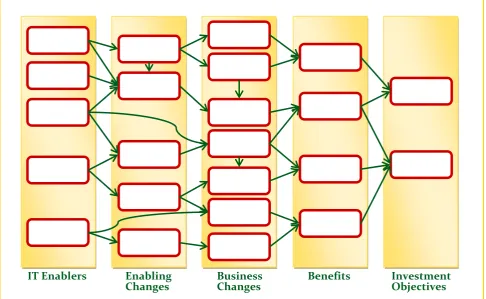
Several tools have been developed to support one or more phases of benefits management. Well-known tools are a Benefits Realization Plan (Ward & Daniel, 2006), Benefits Influence Matrix, Benefit Review Plan (Office of Government Commerce, 2009), Risk Benefit Matrix (Remenyi & Sherwood-Smith, 1998), and several checklists (Thorp, 2003), but the most used tool is the Benefits Dependency Network (BDN). With use of the BDN, shown
Benefits Alignment
Are we doing them the right way?
Are we getting the benefits?
Are we getting them done well?
Integration Capability/Efficiency Are we doing
in Figure 3.3, business benefits can be explicitly linked with necessary business changes to deliver those benefits and the essential IT functionality both to drive and enable these changes (Peppard, Ward, & Daniel, 2007).
3.4
Benefits management methods
Several methods (frameworks, conceptual models, process models, etc.) are developed for benefits management or for one or several phases in benefits management. A literature search with the aim to find as many benefits management methods as possible is planned, executed and evaluated based on the methodological guidelines by Webster and Watson (2002).
The data sources and search engines consulted include both scientific and non-scientific databases. The following three scientific databases are consulted: (i) Scopus, (ii) Science Direct and (iii) Google Scholar. There is an overlap between the databases, but a multiple-database search strategy has the advantages of ensuring a coverage including additional
sources (unique coverage) and taking advantage of differences in indexing across databases to increase the chances of retrieving relevant items that are in both databases (incremental retrieval) (McGowan & Sampson, 2005). Google Scholar has been criticized for including low-impact journals and conference proceedings, and even gray literature (Jacsó, 2006). However, since this literature search aims at finding as many methods as possible, whether developed in research or in practice, Google Scholar and even the non-scientific Google search engine are included as data sources.
[image:29.595.55.542.453.752.2]The following search strings are used, avoiding language bias: (i) benefits management, (ii) benefit management, (iii) benefits realization (US), (iv) benefit realization (US), (v) benefits realisation (UK), (vi) benefit realisation (UK), (vii) value management and (viii) value engineering. Boolean OR is used to join the keywords in one search query. The compilation of the search strings is a learning process.
Figure 3.3 Benefits Dependency Network (Peppard, Ward, & Daniel, 2007)
IT Enablers Enabling Business Benefits Investment
Many of these words are found in a benefits management literature review by Brain, Ahlemann and Riempp (2009). After some experimentation, these keywords return relevant results.
After the identification of potential sources, all titles and abstracts are screened to extract the ones considered relevant for this study. Sources are considered relevant when (i) the method is classified as a framework, model, method or methodology either by its author or by an author referring to the method, and (ii) the method discusses benefits identification, benefits realization, benefits assessment or a combination of them.
In the following sections an overview of available methods is drawn; methods developed and validated in research, methods developed in research that are not (yet) validated, and methods developed in practice. An overview of the identified methods is shown in Table 3.1.
3.4.1 Validated methods developed in research
In this section seven methods for benefits management that are developed and validated in research are discussed.
3.4.1.1 Cranfield Process Model of Benefits Management
The Cranfield Process Model of Benefits Management (Peppard, Ward, & Daniel, 2007;
Ward, Daniel, & Peppard, 2008; Ward, Taylor, & Bond, 1996; Ward & Daniel, 2006) has structured the discipline of benefits management research early on and has been adopted as a basis by other researchers. It consists of five phases and it uses the BDN as its core tool. Using the tool, benefits are explicitly linked to the IT and to the business changes that are required to deliver the benefits. Non-financial benefits are also recognized in the benefits management process. The BDN can be used both for problem-based and innovation-based projects. An important feature of the model is the recognition of feedback in the process. It highlights that the benefits realization plan can be changed during its execution or during in-between evaluations. The need for benefits realization was introduced “not to make good forecasts but to make them come true” (Ward, Taylor, & Bond, 1996). To each benefit an owner is assigned, who personally gains the benefit or represents the interests of the group of stakeholders that gain the benefit. The owner’s job is to ensure that a plan is in place to make sure the benefit is realized and to work closely with the project team. In the implementation of benefits management, two more roles are introduced: the project sponsor and the business project manager.
The model has been developed in the UK in both public and private sectors. It has been Table 3.1 Benefits management methods identified in literature
Validated methods developed in research
Unvalidated methods developed in research
Methods developed in practice
3.4.1.1. Cranfield Process Model of Benefits Management 3.4.1.2.Benefit Identification
Framework
3.4.1.3. ERP benefits framework 3.4.1.4.Active Benefit Realization 3.4.1.5.Conceptual model for
evaluation of IT projects 3.4.1.6.The IT Benefits Measurement
Process
3.4.1.7.ISSUE Methodology
3.4.2.1.Model of Benefits Identification 3.4.2.2.Benefits realization capability
model
3.4.2.3.Extended Benefit Framework 3.4.2.4.Benefits Realization and
Management framework
3.4.3.1. Benefit Realization Approach 3.4.3.2.PRINCE2 Benefit Review Plan 3.4.3.3.MSP Benefits Realization
Management 3.4.3.4.Benefit Realization
Management
validated in empirical research, for example in 2007 when a survey was performed in the Benelux and the UK on the state of practice in managing benefits from IT investments (Ward, De Hertogh, & Viaene, 2007). Findings from the survey showed that organizations which are more successful at delivering benefits from their IT investment projects are more likely to have a comprehensive approach to managing benefits.
3.4.1.2 Benefit Identification Framework
The Benefit Identification Framework (Shang & Seddon, 2002) is mostly used to summarize benefits in the years after an Enterprise System (ES) implementation, but can be used more broadly for planning, management, measuring and evaluation of benefits. It provides the most complete and referred to list of possible benefits from an ES implementation in current literature. The list of benefits is consolidated into five benefit dimensions; operational, managerial, strategic, IT infrastructure and organizational.
For each categorized benefit, a distinction is made between tangible and intangible benefits, measures are formulated and the link with a business change is made. Perceived net benefit flow (PNBF) graphs are used to depict how long it will take for a benefit to be realized and what path the realization will follow. The framework is drawn upon experience from cases of ES vendors, where every organization achieved benefits in at least two dimensions. It has been validated in 233 case studies. Operational (73%) and infrastructure benefits (83%) were the most achieved benefits.
3.4.1.3 ERP benefits framework
The ERP benefits framework (Chand, Hachey, Hunton, Owhoso, & Vasudevan, 2005) makes use of the balanced scorecard (BSC) approach for evaluation of ERP system performance. It integrates Kaplan and Norton’s (1996) BSC
dimensions – process, customer, finance, innovation – with Zuboff’s (1985) goals of information systems – automate, informate, transformate. Combining the dimensions gives twelve options for classifying goals of ERP systems, which helps to develop success measures by raising key questions necessary to achieve those goals and by assigning a metric to each question.
The ERP benefits framework can be used to identify benefits and measures for ERP implementations, but it must be noted that the framework is very specific on ERP systems and very broad on measures.
The framework has been validated in a case study, where the authors showed that ERP systems impact all the four dimensions of a BSC at the organization level. This demonstrates that the framework is capable of contributing to the business strategy of a company.
3.4.1.4 Active Benefit Realization
The Active Benefit Realization (ABR) is a process for managing information systems’ development through a continuous evaluation approach, with the goals of increased business benefit delivery from IT and reduction of waste and time to market (Remenyi, White, & Smith, 1997; Remenyi & Sherwood-Smith, 1998). The iterative process of ABR is based on the evaluation of progress and continues until the project has been concluded.
there are three possible outcomes: the three initial pictures are updated, the project is reformed if there are not sufficient resources, or the project is terminated if it became irrelevant to the organization’s business requirements.
There are two notable process steps: the possibility of project termination is not found in many other methods, and the evidence collection as an explicit process step gives clear direction to progress measurement. Tools used in ABR are Business Picture, Financial Picture, Project Picture, Stakeholder-benefit matrix, Critical Success Factor (CSF)-benefit matrix and Risk-benefit matrix. ABR has a focus on finance with a comprehensive list of costs and monetized tangible benefits, required payback, return on investment, net present value and financial ratios. Stakeholders in the project are identified and their role and responsibilities are described. In the stakeholder-benefit matrix, the stakeholders are linked to benefits from which they profit.
The evidence to support the arguments of ABR is drawn both from literature and empirical work, but no validation of ABR was done. A search for other research validating ABR yielded no results.
3.4.1.5 Conceptual model for evaluation of IT projects
The conceptual model for evaluation of IT projects has been developed to determine whether or not to invest in an IT project and to evaluate the investments during project execution and after project completion (Gunasekaran, Love, Rahimic, & Miele, 2001). The model offers intangible and non-financial performance measures, and strategic information. Many other methods lack these aspects. The model helps to identify strategic, tactical and operational considerations and to identify intangibles, financial tangibles and non-financial tangibles for a project. The
model is on a highly conceptual level and offers few guidelines for practical application. Validation of the model was performed in a case study, where the application of the model in the real world was studied.
3.4.1.6 The IT Benefits Measurement Process
The IT Benefits Measurement Process is a framework for measuring the benefits of IT for a specific application to the construction sector and is supported by a computer based tool (Andresen, et al., 2000). The framework is a synthesis of current best practice in the assessment of IT costs and benefits and current industry practice. The identified process of benefits measurement contains a subsequent set of eight activities, which can be performed multiple times in a loop. The process has a broad scope and includes benefit identification, benefits realization and evaluation of the process. Someone is made responsible for the measurement and achievement of every identified benefit.
The framework has been validated in three UK construction organizations where it was tested and applied in action research case studies, and using three historical studies of construction organizations.
3.4.1.7 ISSUE Methodology
and business process simulation, which can be potentially effective mechanisms to make benefits quantifiable and to experiment with alternative information system investments. The ISSUE Methodology and business process simulation technique have been validated in a case study which demonstrates the feasibility of the approach in a practical setting.
3.4.2 Unvalidated methods developed in research
In this section four methods for benefits management developed in research that are not (yet) validated are described.
3.4.2.1 Model of Benefits Identification
The model of benefits identification is a process model with loosely defined, overlapping, iterative activities (Changchit, Joshi, & Lederer, 1998). The focus of the model is solely on the identification of benefits, not on other aspects of benefits management. The subsequent steps of the process are (i) problem identification, (ii) mini-study of current business processes, (iii) mini-design of proposed business processes and (iv) comparison of benefits of current and proposed processes. The process model has feedback loops that allow returning to the problem identification from every phase. In addition to the development of the model, uncertainty in benefit identification and importance of persuasion are two important themes following from the study. Stakeholders were feeling uncertain about their ability to identify benefits and persuading users to feel committed to the project and to realizing the benefits was at least as important as identifying the benefits.
The model is based on interviews in 24 projects at 13 organizations. The study suggests that future researchers validate the model, but a search for research validating the model yielded no results.
3.4.2.2 Benefits realization capability model
The benefits realization capability model is a conceptual model derived from extensive research into best practices for benefits management (Ashurst & Doherty, 2003; Ashurst, Doherty, & Peppard, 2008). It consists of a continuous process through an evolving organizational context using four competences for benefits management: (i) benefits planning, (ii) benefits delivery, executing organizational change, (iii) benefits review, on-going measurement and management, and (iv) benefits exploitation, ensure the long-term delivery of benefits. Stakeholder identification and linking them to benefits are processes identified in the referenced literature of the benefits realization capability model, but that is not adapted in the model itself. The conceptual model has no extensive guidelines for its practical use and no practical tools are developed or suggested.
The benefits realization capability model has not yet been validated. The authors suggest future research to explore and validate the model “because of the novelty of this research, both in terms of its focus and approach” (Ashurst, Doherty, & Peppard, 2008).
3.4.2.3 Extended Benefit Framework
The framework is empirically derived from iterative content analysis of data gathered from more than 60 case study organizations. It has not yet been applied and validated in practice.
3.4.2.4 Benefits Realization and Management framework
The Benefits Realization and Management framework (BeReal) has been developed with a focus on capital investments within healthcare infrastructures and can be used to drive, manage and measure the performance of a project (Yates, Sapountzis, Lou, & Kagioglou, 2009). BeReal differentiates benefits management into four phases: (i) benefits management strategy & benefits realization case, (ii) benefits profile & benefits mapping, (iii) benefits realization plan, and (iv) benefits evaluation and review. The benefits management process is aligned with the healthcare investment, development and decision making processes.
BeReal has been tested through case studies at different stages of the lifecycle of a healthcare program. It is difficult to validate the whole framework in one case study, as the whole cycle of such a healthcare program spans from 20 to 30 years. Not every phase of BeReal has been tested, nor has the use of BeReal in all subsequent phases.
3.4.3 Methods developed in practice
In this section six methods for benefits management that are developed in practice are described.
3.4.3.1 Benefit Realization Approach
The Benefit Realization Approach (BRA) is a proprietary benefits realization methodology developed by Thorp (2003) for a multinational business consulting firm, DMR Consulting, that was later acquired by Fujitsu (Fujitsu Consulting, 2010). It is mostly developed in practice and it provides a basis for using IT to deliver business results more consistently and
predictably. BRA is currently packaged into ResultsStation, one of the five process domains of Macroscope business transformation methodology by Fujitsu Consulting (2010). Thorp has also lead the development of the Val IT Framework (IT Governance Institute, 2008), which is discussed in section 3.4.3.6.
There are three fundamentals and three conditions in BRA that organizations must meet in order to successfully deploy it. The fundamentals are (i) a shift from stand-alone IT project management to business program management, (ii) a shift from competition among projects to portfolio management, and (iii) a shift from traditional project management cycles to full cycle governance. The necessary conditions are (i) activist accountability to identify business owners of investment programs, (ii) relevant measurement in the benefits realization process, and (iii) proactive management of change to give people ownership stakes in programs.
3.4.3.2 PRINCE2 Benefit Review Plan
The Office of Government Commerce (OGC) is a government organization in the United Kingdom, working with public sector organizations to help them deliver improved success from programs and projects. PRINCE2 is as process-based approach for project management, established in 1996 by the OGC. The PRINCE2 Benefit Review Plan is a plan for evaluation of benefits, used to define how and when a measurement of the achievement of a project’s benefits can be made (Office of Government Commerce, 2009). It is also used for post-project measurement activities. The responsibility for benefits reviews transfers from the executive management to the corporate or program management as the project closes, because the post-project reviews need to be funded and resourced.
3.4.3.3 MSP Benefits Realization Management
OGC’s publication MSP represents the UK government’s view on the program management principles and techniques (Office of Government Commerce, 2007). OGC identifies benefits management as fundamental to the realization of benefits from new capabilities delivered by projects within the program. Emphasis is on identification, quantification and measurement, assignment of owners, realization and tracking of benefits. MSP Benefits Realization Management has been heavily influenced by the Cranfield Process Model of Benefits Management (Ward & Daniel, 2006) and Benefit Realization Management (Bradley, 2010). The model indicates dependencies between a typical benefits management process and the steps for managing a major delivery program at a high level. It maps the main benefits management steps into the standard delivery stages described in MSP. Roles and responsibilities in benefits management are described for many roles, e.g. program manager, benefits
realization manager, business change manager and program office. Apart from this, MSP prescribes the use of a benefits distribution matrix to show the positive or negative impact of each benefit on the identified stakeholders.
3.4.3.4 Benefit Realization Management
Benefit Realization Management (BRM) is a practical model using measures to track performance throughout and beyond a project’s life, enabling elimination of wasted investment and more and earlier realization of benefits (Bradley, 2010). BRM fits closely with MSP and PRINCE2. It has even had an influence on Benefits Realization Management in MSP and they share many tools. Despite its influence on other methods, BRM has – in Bradley’s own words – “limited practical track record on which to rely” (Bradley, 2010). Roles and responsibilities for benefits management are identified in the BRM method. A few examples are benefit facilitator, program manager, enabling project manager, steering group and sponsor. The purpose, organizational position, authority and accountability, skills and experience, and time commitment for each role is described. Relations between benefits management functions and organizational roles are drawn.
3.4.3.5 Project Benefits Management
responsible for some sub processes, but there is no directed approach.
3.4.3.6 Val IT Framework 2.0
Val IT (IT Value Delivery) Framework 2.0 is a framework for the governance of IT-enabled business investments (IT Governance Institute, 2008). It extends COBIT, a well-known framework for IT governance. Val IT focuses on the investment decision and the realization of benefits, while COBIT focuses on the execution. Val IT defines three main activities: value governance, portfolio management and investment management. For each activity a set of guidelines is available with a high-level description of the processes within each activity. For every guideline, roles and responsibilities are defined in RACI charts (Kofman, Yaeli, Klinger, & Tarr, 2009). The RACI chart decomposes the process into a set of key activities, indicating for each of these activities who should be responsible, accountable, consulted and informed. No detailed guidelines, processes or tools are given for benefits management; Val IT is a high-level framework.
The development of Val IT was led by John Thorp, who also developed the Benefit Realization Approach (Thorp, 2003) earlier in his career. The Benefit Realization approach provided the basis for the Val IT framework and is discussed in section 3.4.3.1.
3.4.4 Comparison of methods
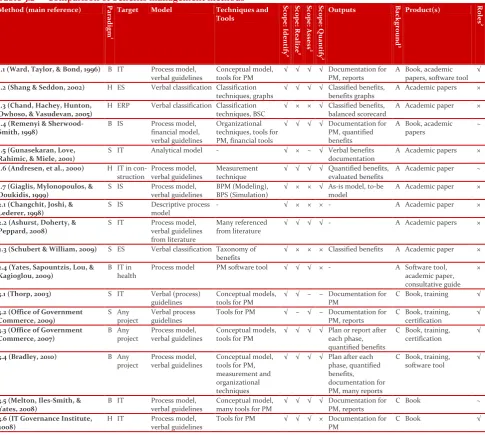
Seventeen methods for benefits management are identified. There are significant differences between the methods. For example, some methods do not give guidelines for realization of benefits, while others do not discuss benefit identification. An overview has been constructed comparing the methods and showing their differences with help of six basic characteristics used in a framework developed by Avison and Fitzgerald (2006) to compare methodologies: philosophy (paradigm,
objectives, domain and target), model, techniques and tools, scope, outputs, and practice (background, user base, players and product). The comparison makes use of the characteristics that are found to be of importance based on preliminary results of HNL stakeholder interviews. The comparison is shown in Table 3.2.
The philosophy consists of the principle(s) that underlie a methodology. The paradigm of the philosophy can be either science or systems