John L. Sherman 1,2,3 Charles M. Citrin1
,3 A. J. Barkovich4 Bruce J. Bowen 1
Received December 30, 1985; accepted after revision July 14, 1986.
'Magnetic Imaging of Washington, 5550 Friend-ship Blvd., Chevy Chase, MD 20815. Address re-print requests to J. L. Sherman.
2Department of Radiology, Uniformed Services University of the Health Sciences, Bethesda, MD 20814.
3Department of Radiology, George Washington University School of Medicine, Washington, D.C. 20037.
'Department of Radiology, Walter Reed Army Medical Center, Washington, D.C. 20307-5001. AJNR 8:59-64, January/February 1987 0195-6108/87/0801-0059
© American SOCiety of Neuroradiology
MR Imaging of the
Mesencephalic Tectum:
Normal and Pathologic Variations
59
Variations of the quadrigeminal plate (mesencephalic tectum) were determined on midline sagittal MR images of the brain in 93 patients without known mesencephalic abnormalities and in 10 patients with known aqueductal stenosis or obstruction. Meas-urements of the thicknesses of the superior and inferior colliculi and the length of the tectum were made on the midline sagittal section. Images were obtained with a 0.5 T system with spin-echo pulse sequences using a TE of 30 or 40 msec with a TR of 500-1500 msec. The average thickness of the superior and inferior colliculi was about 5 mm, but the range was from 2-7 mm on the midline sagittal section. Abnormally thin colliculi appeared to have no clinical significance while abnormal thickness was observed in patients with neoplastic disease, sarcoidosis, and mesencephalic "beaking." While most neoplasms have abnormal signal intensity on T2-weighted images, small lesions may be difficult to perceive on transaxial images due to volume averaging or noncontig-uous sections. Measurements of the tectum, on the commonly obtained midline sagittal section, may be useful for patients with small infiltrative lesions.
The lamina quadrigemina (roof or tectum) of the midbrain is occupied by four
small swellings or eminences, the superior (anterior) and inferior (posterior) colliculi. Before the advent of MR imaging subtle abnormalities of superior and inferior colliculi could be evaluated only by intracranial pneumoencephalography [1, 2], metrizamide-assisted CT ventriculography, or cisternography [3-7]. MR is able to depict the superior and inferior colliculi with a high degree of consistency but there have been no studies of the variation of the colliculi on MR. Small aberrations of the normal architecture can be easily seen, allowing early diagnosis and accurate
localization of small mass lesions. This report documents the normal range of the
tectum and compares the appearance of the tectum in patients with normal and abnormal MR findings.
Materials and Methods
We evaluated the midline sagittal cerebral MR examinations of 103 patients referred for a variety of indications. Two groups of patients were identified.
Group 1 included 93 patients with normal MR examinations or with abnormalities that did not involve the mesencephalon, including patients with cerebral atrophy. The group consisted of 52 females and 41 males ranging in age from 5 years to 77 years (average age, 42 years). Tectal measurements derived from these patients are not age-adjusted.
Group 2 was composed of 10 patients with aqueductal stenosis or tumors involving the mesencephalic region. There were seven women and three men in this group, ranging in age from 24 years to 38 years (average age, 31 years). Six patients had a clinical and imaging diagnosis of aqueductal stenosis, two patients had astrocytomas involving the mesenceph-alon, one patient had neurosarcoidosis causing aqueductal stenosis, and one patient had gliosis or a low-grade tumor of the tectum causing aqueductal stenosis.
60 SHERMAN ET AL. AJNR:8, January/February 1987
sequences with 256 complex samples/views and 256 views. The
resultant 256 x 256 image was then interpolated to a 512-element
display matrix. Field-of-view for these examinations was either 25 or 30 cm, resulting in a pixel size (before interpolation) of 0.98 or 1.17 mm, respectively. Sampling times were 24 msec, and sampling bandwidth 5 KHz. The section thickness was 5 mm. Slice profiles
were approximately trapezoidal, with 1-mm transitional zones
(inter-slice gap) on either side of a flat region of the nominal thickness.
T1-weighted or "balanced" T1-T2 images were evaluated. These were obtained with a TE of 30 or 40 msec with a TR of 500-1500 msec. In most cases an SE 500/40 sequence was used. Images that
were degraded by patient motion or artifact were rejected.
Measurements to the nearest millimeter were made of the maximal
cross-sectional diameter in anteroposterior plane of the inferior and
superior colliculi on the midline sagittal section (Fig. 1). All measure-ments were made using the relative centimeter scale provided on the
2x magnified hard-copy images. The mid-sagittal section was chosen
because it was the most easily recognizable and reproducible. Meas-urements were made from the posterior margin of the colliculus along
a line drawn perpendicular to the posterior margin of the aqueduct of
Sylvius. No attempt was made to separately identify right-sided
colliculi from left-sided colliculi. Point-to-point measurements of the length of the tectal plate were made from the superior margin of the superior colliculus to the inferior margin of the inferior colliculus. All measurements were obtained by the same person, who used the hard-copy magnified images.
Results
Group 1
Superior Colliculus
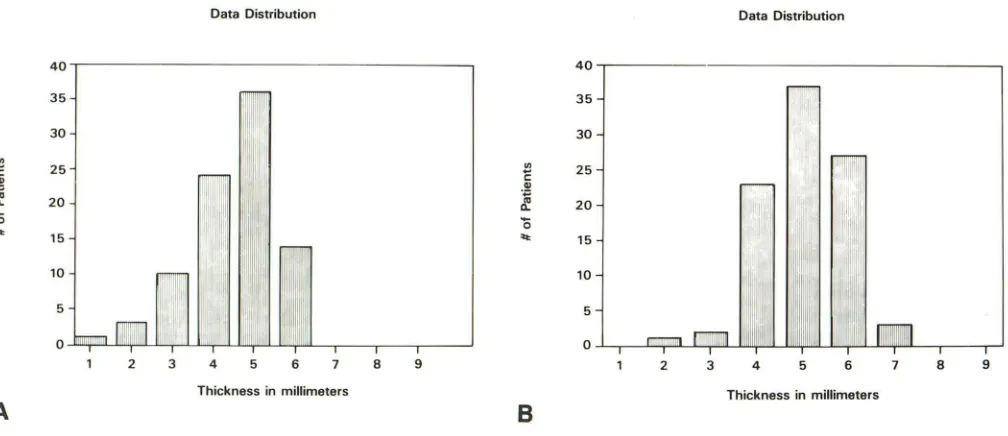
The measurements of the diameter of the superior colliculus ranged from 1-6 mm (Fig. 2). The average diameter was 4.5 mm, and the standard deviation was 1.1 mm. The 95%
Data Distribution
40
35
30
'"
E 25 .~
&
20'0
'"
1510
5
0
2 3 4 5 6 7 8 9
Thickness in millimeters
A
Fig. 1.-Midline measurements of the superior (A) and inferior (B) colliculus.
confidence levels were 2.4 mm and 6.6 mm. The data distri-bution is portrayed in Figure 1 A. Four patients fell below the 95% confidence level, three with diameters of 2 mm and one with a diameter of 1 mm. None of these patients had symp-toms that could be attributed to mesencephalic abnormalities.
Fig. 2.-Normal patient, midline sagittal section. SE 800/40. Superior colliculus (solid arrow) measures 5 mm; inferior colliculus (open arrow) measures 6 mm.
Data Distribution
40
35
30
'"
25 E.,
&
20 '0'"
1510
5
0
2 3 4 5 6 7 8 9
Thickness in millimeters
B
[image:2.612.317.559.169.417.2] [image:2.612.55.559.489.707.2]AJNR:8. January/February 1987 MR OF THE MESENCEPHALIC TECTUM 61
Inferior Colliculus
The inferior colliculus measurements varied from 1-7 mm,
with an average diameter of 5 mm. The standard deviation
was 1.0 mm, and the 95% confidence levels were calculated
to be 3.0 mm and 7.1 mm. The data distribution is portrayed
in Figure 1 B. Note the slight tendency for larger inferior colliculi when compared with the superior colliculi. One patient fell below the 95% confidence level with a measurement of 2
mm. This patient was one of those with a small superior
colliculus.
Size Variations Within Patients
The colliculi were equal in size in 32 cases. The inferior
colliculus was 1 mm larger than the superior colliculus in 42 cases, 2 mm larger in seven cases, and 3 mm larger in one
case. The inferior colliculus was 1 mm smaller than the
superior colliculus in 10 cases and 2 mm smaller in one case.
Quadrigeminal Plate Length
The length of the quadrigeminal plate varied from 10-1B
mm, with an average length of 13.4 mm. The standard devia
-tion was 1.B mm, and the 95% confidence levels were 9.B
mm and 17 mm. Two patients fell below the 95% confidence
level: one is a 63-year-old woman with generalized brain atrophy but no visual symptoms and the other is a 60-year-old man with minor periventricular white-matter disease but
no visual symptoms. The length of the tectum in one patient
was 1B mm, which is 1 mm above the 95% confidence level.
This patient is an 1B-year-old man with a Chiari type I
malfor-mation with 30 mm of tonsillar herniation and normal
ventri-cles. He was randomly selected and was not excluded
be-cause his mesencephalon initially appeared normal. He had down beating nystagmus due to cerebellar tonsillar herniation
but had no signs of a mesencephalic disorder.
Group 2
Five patients with aqueductal stenosis had normal meas-urements (Fig. 3) and the remaining five had collicular
diame-ters greater than the 95% confidence levels determined in the normal series. All these patients had aqueductal stenosis or obstruction. Two of the patients with abnormal tectal
meas-urements had proven astrocytomas involving the tecta I plate,
periaqueductal gray matter, and adjacent areas. In one of
these patients the superior colliculus measured B mm and the
inferior colliculus measured 7 mm (Fig. 4). The tumor was
approximately 15 mm long. MR clearly showed the intraaxial
location of the tumor although CT suggested an extraaxial
location. In the other patient with a tumor the inferior colliculus
measured B mm and the superior colliculus measured 7 mm.
The tumor was approximately 25 mm long. One patient has
systemic sarcoidosis with presumed neurosarcoidosis
involv-ing the aqueduct and tectum. The inferior colliculus measured
9 mm and the superior colliculus measured 7 mm. Increased
intensity was present in the two astrocytomas and in the
Fig. 3.-38-year-old woman with aqueductal stenosis without tecta I enlargement. SE 700/40 midline sagittal section. Superior colliculus is 5 mm thick; inferior colliculus is 4 mm thick.
sarcoid lesion on SE 2500/BO pulse sequences. One patient
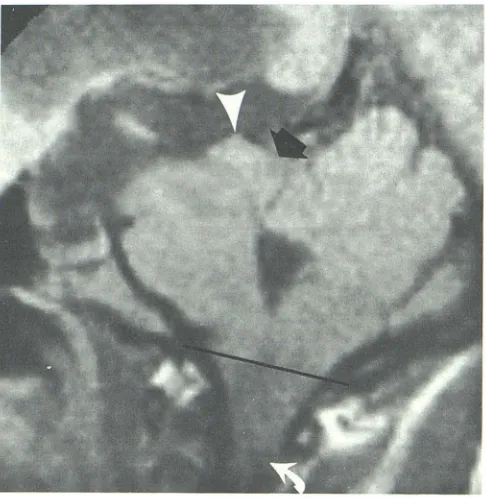
with cerebellar tonsillar herniation of 20 mm had
mesence-phalic beaking and enlargement of the tectum. In this patient
the inferior and superior colliculi measured 9 mm and
ap-peared fused (Fig. 5). The tectum was 17 mm long (1 mm
over the 95% confidence level for normals). The quadrigeminal
plate cistern had a "V" shape on axial MR and CT images.
There was no evidence of increased intensity on an SE 2400/
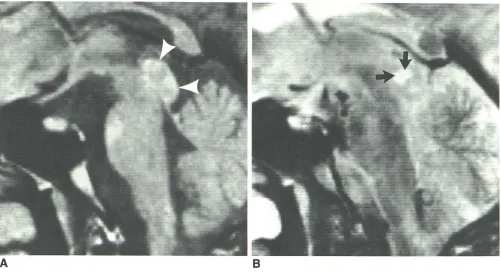
BO pulse sequence. One patient with acquired aqueductal
obstruction had diffuse enlargement of the tectum (Fig. 6).
The tectal plate was 20 mm long. The superior colliculus
measured 9 mm and the inferior colliculus measured B mm.
Focal increased intensity was present in the superior colliculus
on the SE 2500/BO sequence. The abnormal increased signal
was more difficult to appreciate on the 10-mm axial sections
using the same pulse sequence because of the bright intensity
of the adjacent quadrigeminal plate cistern and the slice
angulation. There was no evidence of abnormal enhancement on the CT scan. This patient has been followed for 3 years
without definite change on CT. The histologic diagnosis is
unknown at this time, but the MR appearance is most com
-patible with a low-grade glioma or extensive gliosis.
Discussion
There have been several reports detailing the evaluation of
mesencephalic tumors using CT [B], CT cisternography, or
CT ventriculography [3-5]. MR has been shown to have high
sensitivity in the detection of brainstem tumors and has been
advocated as a replacement for metrizamide CT cisternog
-raphy [9]. While these reports have been helpful because of
[image:3.614.314.557.86.328.2]62 SHERMAN ET AL. AJNR:8. January/February 1987
Fig. 4.-Astrocytoma.
A, SE 1700/40. Coronal section through tectum. Tumor is primarily left-sided but extends across midline (arrows).
B, SE 800/40. Midline sagittal section. Superior colliculus measures 8 mm (arrowhead). Aqueduct is obstructed.
Fig. 5.-Chiari malformation with mesencephalic "breaking." Midline
sagittal section. SE 850/30. Tectum is thickened (9 mm) and slightly
elongated (17 mm) (white arrowhead). Colliculi appear fused (black arrow).
Note cerebellar tonsillar herniation (white arrow). Foramen magnum is
indicated by black line.
has been no mention of the normal range of variation of the superior and inferior colliculi. Most tumors will be detected
because of the their prolonged T2 values. However, small
lesions may be difficult to perceive on axial sections because of variable slice angulation, partial-volume effect, and low contrast compared with CSF in the adjacent quadrigeminal plate cistern. T1-weighted midline sagittal sections are
com-monly acquired for slice localization and also as an adjunct to
the T2-weighted axial examinations. A thorough knowledge
of the variations seen on these sections is therefore important.
Inversion-recovery or short spin-echo techniques are
ad-vocated for use in conjunction with intravenous contrast
agents for MR imaging, such as Gd-OTPA [10, 11]. These
agents will allow identification of blood-brain barrier
disrup-tion. Some infiltrating brainstem gliomas do not have alteration
of the blood-brain barrier [8, 12] and thus will be detected only as an area of anatomic abnormality. Familiarity with the
variations in the tectum may allow detection of small
low-grade gliomas in these instances.
Our data reveals a mean diameter of 4.5 mm and 5.0 mm
for the superior and inferior colliculi, respectively. The 95%
confidence level range
(+/-
2 SO) is between 2.4 mm and6.6 mm for the superior ccilliculus and 3.0 mm and 7.1 mm
for the inferior colliculus. Combining these figures and round
-ing the numbers to the nearest millimeter results in a mean
diameter of 5 mm with a range of 2-7 mm. This correlates
[image:4.612.54.560.88.362.2] [image:4.612.53.296.429.678.2]AJNR:8, January/February 1987 MR OF THE MESENCEPHALIC TECTUM 63
A
B
Fig. S.-Probable neoplasm of tectum (no pathologic diagnosis). Midline sagittal sections.
A, SE 800/40. Tectal plate is 20 mm long and diffusely enlarged (arrowheads). Superior colliculus is 9 mm thick; inferior colliculus is 8 mm thick. Aqueduct is compressed.
B, SE 2500/80. Note area of abnormal increased intensity in tecta I plate (arrows).
They measured the diameters of the colliculi on lateral pneu-moencephalographic tomograms and found that the colliculi ranged from approximately 3-6 mm with a mean value of about 5 mm (after correction for magnification). There were no patients with measurements greater than 7 mm in our normal group (Fig. 1); however, four patients had measure-ments below 3 mm (2 SD below the mean). None of these patients had evidence of mesencephalic disease. Variations
in the tectal thickness below the mean value do not appear to have any clinical significance.
Patients with aqueductal stenosis can be divided into two groups, those with normal tectal thicknesses (Fig. 3) and those with an enlarged tectum (Figs. 4, 5, and 6). Aqueductal stenosis due to a web, localized ependymal gliosis, or viral infection (mumps, influenza, parainfluenza-2, reovirus) is not
associated with enlargement of the tectum [13-15]. Patients with colliculi thicknesses of 8 mm or more must be evaluated for a possible infiltrating lesion. Primary and metastatic tumors as well as granulomatous disease, periaqueductal gliosis, and hamartomas can cause enlargement of the tectum [12,
16-19]. When the tectum is enlarged on a T1-weighted sagittal sequence, a T2-weighted sagittal sequence should be
ob-tained in addition to, or as a replacement for, the T2-weighted
axial scan. Two of our patients with proven astrocytomas and the patient with neurosarcoidosis had increased signal inten-sity in the lesion on the T2-weighted pulse sequences. In-creased intensity was also present in the enlarged tectum of
one other patient in whom we suspect a low-grade glioma, but there is no histologic diagnosis. In the latter patient and in the patient with sarcoid, the increased intensity was difficult
to appreciate on the axial images and was recognized only by comparing the T2-weighted sagittal images with the
T2-weighted axial images.
Patients with the Chiari II malformation may have anomalies of the mesencephalon ranging from slight loss of the
inter-collicular groove to fusion of the colliculi into an elongated
beak-shaped structure [20, 21]. Two of our patients with the
Chiari I malformation had slight elongation of the tecta I plate,
and in one the colliculi appeared fused and increased in diameter to 2 mm above the 95% confidence level (Fig. 5). In cases with enlarged colliculi, there should be careful analysis
of the hindbrain for possible Chiari malformation. Deformity
of the midbrain indistinguishable from "beaking" may rarely
be observed in patients with non-Chiari aqueductal stenosis and in patients with the Dandy-Walker malformation [21].
The T1-weighted midline sagittal section is frequently ob
-tained as part of the MR examination. The anatomy of this
section is easily recognizable and reproducible. Recognition
of the normal and pathologic variations of the mesencephalic
tectum is important to ensure accurate interpretation.
ACKNOWLEDGMENT
Our thanks to Arlene Kisliuk and Mary Anne Thomas for their help
[image:5.612.57.558.91.364.2]64 SHERMAN ET AL. AJNR:8, January/February 1987
REFERENCES
1. Taveras JM, Wood EH. Intracranial pneumography. In: Taveras
JM, Wood EH. Diagnostic neuroradiology, Vol. 1. Baltimore:
Williams & Wilkins, 1976:231-541
2. Bentson JR, Keesey JC. Pneumoencephalography of
progres-sive supranuclear palsy. Radiology 1974; 113: 89-94
3. Strand RD, Baker RA, Ordia IJ, Arkins TJ. Metrizamide
ventric-ulography and computed tomography in lesions about the third
ventricle. Radiology 1978;128: 405-41 0
4. Glanz S, Geehr RB, Duncan CC, Piepmeier JM.
Metrizamide-enhanced CT for evaluation of brain stem tumors. AJR
1980;134:821-824
5. Steele JR, Hoffman JC. Brainstem evaluation with CT
cisternog-raphy. AJR 1981;136:287-292
6. Mawad ME, Silver AJ, Hilal SK, Ganti SR. Computed tomography
of the brainstem with intrathecal metrizamide. Part I: The normal
brainstem. AJNR 1983;4: 1-11, AJR 1983;140:553-563
7. Chakeres DW, Kapila A. Brainstem and related structures:
nor-mal CT anatomy using direct longitudinal scanning with
metriz-amide cisternography. Radiology 1983;149:709-715
8. Bilaniuk L T, Zimmerman RA, Littman P, et al. Computed
tomog-raphy of brainstem gliomas in children. Radiology 1980;134: 89-95
9. Han JS, Bonstelle CT, Kaufman B, et al. Magnetic resonance
imaging in the evaluation of the brainstem. Radiology
1984;150:705-712
10. Graif M, Bydder GM, Steiner RD, Young IR. Gd-DTPA in MR
imaging of malignant brain tumors. Presented at the 71 st annual
meeting of the Radiological Society of North America, Chicago,
November 1985
11. Felix R, Fiegler W, Schorner W, Laniado M, Claussen C, Niendorf
HP. MR imaging of brain tumors using Gd-DTPA. Presented at
the 71 st annual meeting of the Radiological Society of North
America, Chicago, November 1985
12. Sanford RA, Bebin J, Smith RW. Pencil gliomas of the aqueduct
of Sylvius. Report of two cases. J Neurosurg 1982;57:690-696
13. Johnson RT. Hydrocephalus following viral infections: The
pa-thology of aqueductal stenosis developing after experimental
mumps viral infection. J Neuropathol Exp Neurol 1968;27:
591-606
14. Salam MZ. Stenosis of the aqueduct of Sylvius. In: Vinken PJ,
Gruyn GW eds. Handbook of clinical neurology, Vol. 30, Con
-genital malformations ofthe brain and skull. New York:
Elsevier-North Holland Biomedical Press, 1977:609-622
15. Russell DS. Observations on the pathology of hydrocephalus. Medical Research Council SRS 265. Impression NO.3. London:
Her Majesty's Stationery Office, 1966
16. Rubinstein LJ. Tumors and tumor-like lesions of
maldevelopmen-tal origin. In: Tumors of the central nervous system. Fascicle 6.
Atlas of tumor pathology. Washington, D.C.: Armed Forces In-stitute of Pathology, 1972:285-309
17. Moffie D, De Visser BWO, Stefanko SZ. Parinaud's syndrome. J
Neurol Sci 1983;58: 175-183
18. Ho K-L. Tumors of the cerebral aqueduct. Cancer 1982;49:
154-162
19. Yamamoto KT, Iwasaki Y, linuma K, Takahashi Y. A case of
quadrigeminal hamartoma. Acta Neuropathol (8erl) 1985;
68: 155-159
20. Adelola A. Mesencephalic spur (beaking deformity of the tectum)
in Arnold-Chiari malformation. J Neurosurg 1976;45:315-320
21. Naidich TP, Pudlowski RM, Naidich JB. Computed tomographic
signs of Chiari II malformation II: midbrain and cerebellum. Ra