Maintaining the Causal
Thread of Execution in
Distributed and
Multilanguage Software
Rik Schutte
Twente Research and Educati0n on Software Engineering
Faculty of Electrical Engineering, Mathematics and Computer Science
University of Twente
Netherlands
EXAMINATION COMMITTEE
dr. S. Malakuti dr. ing. C.M. Bockisch prof. dr. ir. M. Aksit
i
Abstract
Runtime verification is a technique used to check the execution trace of a program against specified properties. During the execution of a program, the changes in the state of the program are observed and are verified against the specified properties of the program.
We want to apply runtime verification to check sequences of events, which are distributed (they are generated in separate processes, which communicate with each other) and span multiple programming languages. There are currently two E-Chaser versions, which supply separate solutions for multiple language and distributed software. In this thesis we combine these two versions to create a new solution.
The solution is given in two parts. The first part of the solution is about the call graph approach, in which we try to generate call graphs of multiple language software. From a call graph we try to deduce structural information. Due to the problems related to combining call graph of different programming languages, a different approach was taken. The second part describes a new verification system design which extends the previous E-Chaser versions.
ii
Table of Content
1 Introduction ... 1
1.1 State of the Art of Verification and Validation Techniques ... 1
1.2 Architecture of Runtime Verification Tools ... 2
1.3 Running Example ... 3
1.4 Problem Statement ... 5
1.5 An Overview of the Solution ... 6
1.6 Scope of the Thesis ... 8
2 Solution 1: Generating Optimized Monitors ... 9
2.1 Background ... 11
2.1.1 Call Graph ... 11
2.1.2 Java RMI ... 12
2.1.3 JNI ... 15
2.1.4 Tool Reviews ... 17
2.2 Overview of the Approach ... 18
2.3 Call Graph Generator ... 20
2.3.1 Call Graph Model ... 20
2.3.2 Java Call Graph Generation ... 21
2.3.3 C Call Graph Generation ... 22
iii
2.4.1 RMI ... 25
2.4.2 JNI - C to Java ... 25
2.4.3 JNI – Java to C ... 28
2.5 Trace Analyzer and Code Generator ... 29
2.6 Conclusions ... 29
3 Solution 2: Outline Monitors ... 30
3.1 Goal ... 30
3.1.1 Overview of the Approach ... 30
3.1.2 Orchestration ... 32
3.1.3 New Program Flow ... 32
3.1.4 Program Architecture ... 33
3.2 Causal Thread Storage ... 34
3.3 Background ... 34
3.3.1 Function & Method Call Interception ... 34
3.3.2 Language Independent Protocol ... 34
4 Maintaining the Causal Thread of Execution from C to Java ... 36
4.1 Compose/CwC Problems ... 36
4.2 Overview ... 36
4.3 Callee-Side Proxy (Java JNI Hook) ... 37
4.4 C JNI Call Finder ... 39
4.4.1 Finding JNI Calls ... 39
4.4.2 Extracting Information ... 40
4.5 C JNI Replacement Code Generator ... 40
4.5.1 JNI to Java JNI Hook Matching ... 40
iv
4.6 Helper Functions for Parameter Conversion ... 44
4.6.1 Invocation Types ... 44
4.6.2 Primitive Conversion ... 44
4.6.3 JValue Conversion ... 45
4.6.4 JValue Array Conversion ... 46
4.6.5 Variadic List Conversion ... 46
4.7 Limitations ... 47
5 Maintaining the Causal Thread of Execution from Java to C ... 48
5.1 Overview ... 48
5.2 Java JNI Call Finder ... 49
5.3 Java JNI Replacement Stubs Generator ... 50
5.4 Java Prolog Fact Generator ... 51
5.5 Java JNI Interceptor ... 52
5.6 C JNI Header Generator ... 52
5.6.1 Java to C Name Matching ... 54
6 Demonstration ... 55
6.1 Example Programs ... 55
6.2 Execution ... 56
6.2.1 Testing Java to C ... 56
6.2.2 Testing C to Java ... 57
7 Conclusion & Future Work ... 59
7.1 Call Graph Extraction ... 59
7.2 Maintaining the Causal Thread ID ... 59
7.3 Distribution Transparency ... 60
v
7.5 Future Work ... 61
7.5.1 Optimization of Monitoring ... 61
7.5.2 Other Future Work ... 62
8 References ... 63
Appendix A: Reviews of other Runtime Verification Systems ... 66
A.1 MOP ... 66
A.2 TraceMatches ... 66
A.3 RMOR ... 67
A.4 Java-MaC ... 67
vi
List of Figures
Figure 1-1: Typical architecture of a runtime verification tools ... 3
Figure 1-2: Architecture of the document editing sofware ... 4
Figure 1-3: Sequence of events to store a document ... 5
Figure 1-4: Architecture of the second E-Chaser version ... 7
Figure 2-1: Architecture of a non-distributed program with inlined verification system ... 10
Figure 2-2: Architecture of a distributed program with external verification process ... 11
Figure 2-3: Example call graph ... 12
Figure 2-4: Architecture of a RMI program ... 13
Figure 2-5: Flow of information in the call graph generation tool ... 19
Figure 2-6: UML Class Diagram of Method, CMethod and JavaMethod classes ... 21
Figure 3-1: E-Chaser's architecture for the proposed solution ... 31
Figure 3-2: Call flow interception approach ... 33
Figure 3-3: Architecture of a distributed program with external verification process ... 33
Figure 4-1: New control flow from C to Java ... 37
Figure 5-1: New control flow from Java to C ... 49
Figure 6-1: The editor's user interface ... 55
vii
List of Tables
Table 3-1: SOAP libraries for several programming languages ... 35
Table 4-1: JNI function call and Java hook matches ... 41
viii
List of Code Fragments
Code Fragment 2-1: Extension of the java.rmi.Remote interface ... 13
Code Fragment 2-2: Implementation of the DocumentStore interface ... 14
Code Fragment 2-3: The server side of Java RMI ... 14
Code Fragment 2-4: The client side of Java RMI ... 15
Code Fragment 2-5: Java JNI code ... 15
Code Fragment 2-6: Filestore skeleton ... 15
Code Fragment 2-7: C JNI code ... 16
Code Fragment 2-8: Excerpt of example output of Cflow for the filestore written in C ... 23
Code Fragment 2-9: C JNI code excerpt ... 25
Code Fragment 2-10: JNI function name build-up ... 27
Code Fragment 2-11: Overloaded Java method's JNI signature ... 29
Code Fragment 4-1: Example JNI invocation from C to Java ... 38
Code Fragment 4-2: Implementation of the objectJniHook method ... 39
Code Fragment 4-3: Implementation of the intJniHook method ... 39
Code Fragment 4-4: Grammar of the JNI method names in C ... 40
Code Fragment 4-5: Example replacement invocation ... 42
Code Fragment 4-6: Signature of the convertJvalueToJobject function ... 45
Code Fragment 4-7: Signature of the convertJvalueArrayToJobjectArray function ... 46
ix
Code Fragment 5-1: Original Java code... 50
Code Fragment 5-2: Java code after generation of extra method ... 50
Code Fragment 5-3: Signature of new target method ... 52
Code Fragment 5-4: Invocation of the javah tool ... 53
Code Fragment 5-5: Example of a stub implementation ... 53
Code Fragment 5-6: Syntax of target function ... 54
Code Fragment 6-1: Java to C original output ... 56
Code Fragment 6-2: Java to C adapted output ... 56
Code Fragment 6-3: Original C to Java test output ... 57
Code Fragment 6-4: Adapted C to Java test output ... 58
Code Fragment B-1: Example varargs JNI invocation ... 69
Code Fragment B-2: Example varargs JNI invocation replacement code ... 71
Code Fragment B-3: Example jvalue array JNI invocation and its replacement code ... 72
Code Fragment B-4: Example jvalue array JNI invocation replacement code ... 73
Code Fragment B-5: Variadic function invocation example ... 73
Code Fragment B-6: Example jvalue array JNI invocation ... 74
Code Fragment B-7: Example replacement code for a jvalue array JNI invocation ... 75
1
1
Introduction
Complex software usually consists of multiple subsystems, which are possibly implemented in different languages and/or are distributed across multiple processes. A behavior of such software is usually accomplished by a sequence of causally-dependent events, which span across multiple subsystems. The term causality refers to the relationship between an event (the cause) and a second event (the effect), where the second event is a consequence of the first.
An example of such software is embedded software in which subsystems are often written in different languages. Usually parts of the system are written in languages that are best suited for the task. For example: High level programming languages are used for user interaction and lower level languages for communicating with hardware and other low level components.
Another example is applications that use a network infrastructure, such as applications which use a service-oriented architecture. These applications consist of multiple subsystems, which can be accessed remotely.
This chapter first provides the necessary background on runtime verification tools. Second, it explains the example software that is used as the case study throughout the thesis. A discussion of problem statement is provided followed by the scope of the thesis.
1.1
State of the Art of Verification and Validation Techniques
There are several verification and validation techniques available. We will give a short overview of these techniques.
Static analysis is the analysis of code without executing the program. A strength of static analysis is that it can find errors that may only appear under very specific conditions when the program is executed. A weakness of static analysis is that it does not deal with a running program and it may not be able to verify properties depending on runtime context [37].
2 Some properties of programs may not be verifiable in a model, since a model may not contain all the logic that the original program has [38].
Testing checks a result against an expectation of a program, during runtime. An expectation can be captured in a test case which is performed by a tester, who uses the program through its user interface. Another option is to write specific code for the purpose of testing the program. A strength is that the program is tested during execution, which allows the runtime context (e.g. user input) to be part of the testing. A weakness is that a test suite is almost never complete, since not all paths in a program can be easily tested. Another weakness of testing is that the program being tested is not executed in its target environment [39].
Runtime verification techniques are used to check the execution trace of a program against specified properties of the program. During the execution of a program, the changes in the state of the program are observed and are verified against the specifications. If any failure is detected, diagnosis and recovery actions may be performed. Runtime verification is introduced as a complement to the other techniques to verify a program in its target environment. A strength of runtime verification is that it functions during the execution of a program, unlike static analysis. It also works in the actual execution environment of the program, unlike testing. Another strength is that it tests the actual program, and not a model, like model checking.
Due to the complexity of software it is not possible to detect all failures of the software before its actual execution. Runtime verification techniques can be used to detect (and act upon) failures that are only visible during the execution of a program.
1.2
Architecture of Runtime Verification Tools
3
Events
Actions Properties
Specification Layer
Verification Layer
Compiler Source
Code
Modified Source
Code
Handlers Monitors
Observers
[image:13.612.80.453.72.317.2]Specifications
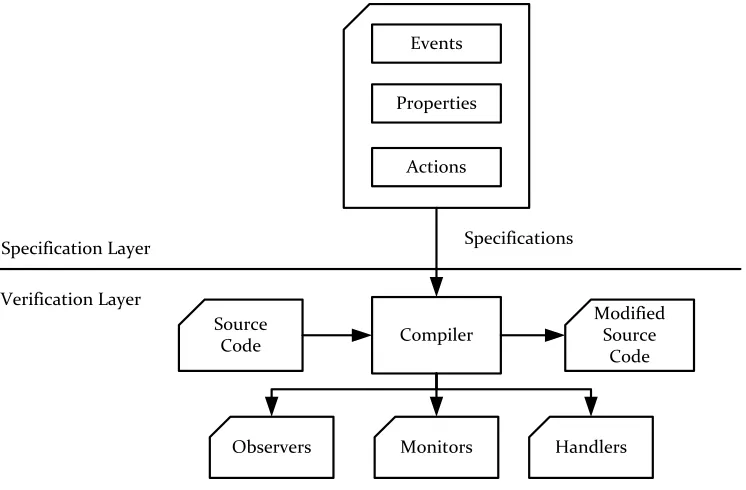
Figure 1-1: Typical architecture of a runtime verification tools
In the specification layer the events, properties and actions are specified. Events represent changes in the state of a program. Properties are logical predicates over events, expressed in a formalism. Actions specify functionality (usually written in code), which is executed once a property is validated or violated.
In the verification layer the compiler takes as input the original source code and specifications. The compiler generates the observers, monitors, handlers and modified source code. Observers are generated from events, monitors from properties and handlers from actions.
Observers are responsible of notifying monitors about the occurrence of the specified events. Monitors are in charge of verifying the occurred events against the logical predicates and depending on the result of verification they call the corresponding handlers, if there are any. Likewise, handlers are in charge of executing the functionality specified in actions.
1.3
Running Example
4
document-client document-server
Java (user interface)
C (filestore) Java
[image:14.612.108.507.74.154.2](server) JNI RMI
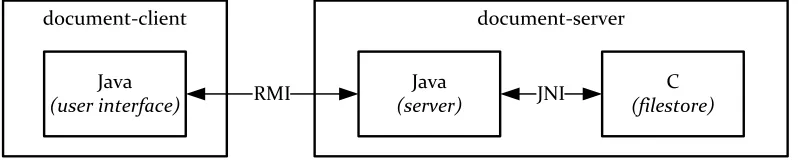
Figure 1-2: Architecture of the document editing sofware
The document-client is implemented in Java, and the document-server is implemented in Java and C. The C code of the document-server performs the saving of the document to disk, whereas the Java code acts as a server for the document-client. The C code in the document-server is also called the filestore. The document-client and document-server communicate through Java RMI. The Java and C code communicate through JNI.
Java RMI (Remote Method Invocation) [44] is the remote procedure calls API of Java. It allows remote procedure calls between Java processes. JNI (Java Native Interface) [41] is a layer that enables Java code running inside a virtual machine to call and be called from C.
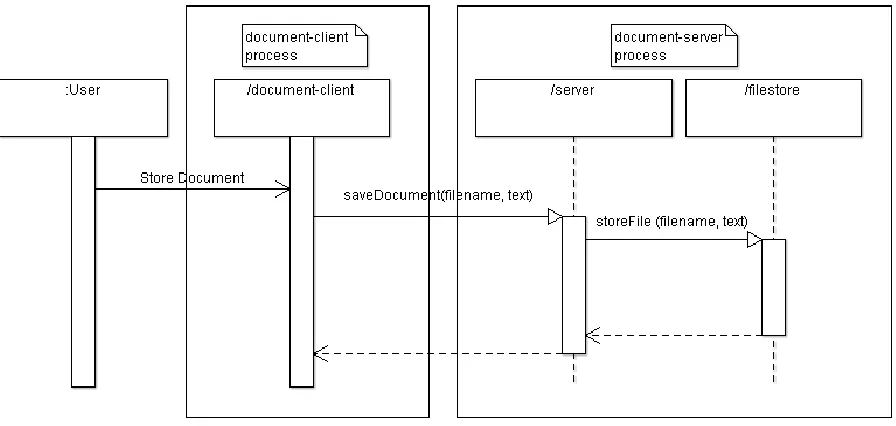
5 Figure 1-3: Sequence of events to store a document
This running example illustrates a program that is both distributed and written in multiple languages. It is an example of the complex software that we mentioned in the introduction of this chapter. The running example should be supported through changing the E-Chaser, which we have chosen as our verification system. The reasons for choosing E-Chaser are that there are two versions which separately support multilanguage programs and distributed programs. We will explain E-Chaser further, later in this chapter.
1.4
Problem Statement
To be able to apply runtime verification to check such sequences of events, a runtime verification technique must be able to deal with multiplicity of processes and languages, both in its specification layer and verification layer.
There are several runtime verification tools introduced in the literature as the study in [1, 2] shows, they fall short in dealing with the multiplicity of processes and languages.
E-Chaser is a runtime verification tool developed in the TRESE group, which aims at overcoming the shortcomings of the existing RV tools. E-Chaser is an extension to the aspect-oriented language and compiler Compose*.
Two versions of E-Chaser are available. The first version aims at supporting multiple language software, and has the following characteristics:
6
Since E-Chaser is based on Compose*, it can generate code for Java, .NET and C/C++
It only supports the verification of multiple languages software, through a distributed setup, because the synchronization process always runs in a separate process.
Specifications are not distribution transparent, because each separate module running in a separate process needs a separate specification.
The second version [2] aims at supporting distribution and has following characteristics:
Distribution transparent specification. This means that only one specification is needed to for our case study example. If we wish to write a trace that matches the events in Figure 1-3, we will only need one specification instead of the two necessary in the previous E-Chaser version.
A compiler that infers the distribution structure through code analysis, and accordingly generates code for observers, monitors and handlers.
Only Java software which makes use of RMI is supported.
Current versions of E-Chaser either provide multiple language or multiple process (distributed) support. Because there are a lot of programs that are distributed and written in multiple programming languages, we wish to verify these. To achieve it we will combine the two versions of E-Chaser into a new version.
1.5
An Overview of the Solution
We wish to extend the second version of E-Chaser and integrate our new solution into it. We reuse the architecture of the second E-Chaser version, because 1) its specification is language independent and 2) its specification is distribution transparent.
7 Figure 1-4: Architecture of the second E-Chaser version
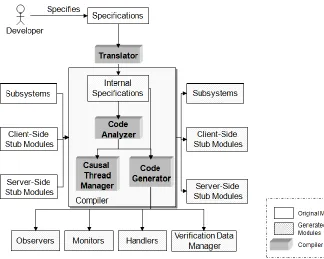
In the second version of E-Chaser, the developer first writes a specification in which the events, properties and actions are defined. The Translator converts this specification to an internal specification. The internal specification is hidden from the developer. A more complete overview with additional information about the internal specification and the conversion can be found in [1] and [2].
The Code Analyzer extracts a call graph of the program and identifies remote methods. The Causal Thread Manager modifies the client and server-side stub modules of remote method invocations, so it can maintain the causal thread of execution. The Code Generator generates the code, based on the provided information by the Code Analyzer and the Causal Thread Manager. The generated code consists of the observers, monitors, handlers and the Verification Data Manager, which is executed in the central verification process. It also generates the (modified) subsystems, client and server-side stub modules.
To support this, we explored a solution in which we keep the functionality of the Translator and Causal Thread Manager. We want to change the Code Analyzer. It must generate call graphs of programs, in which remote method calls and the usage of JNI can be found. The Code Generator must use the call graph to create code, which works for a program that is distributed and written in multiple languages.
8 necessary to generate optimized monitors for the verification system. Connecting Java and C call graphs was impossible, because the edges from C to Java depended on runtime information. Therefore we implemented a different solution.
The other solution creates (a part of) a verification framework that is distribution independent and thus does not rely on inferring the distribution of the program. In this solution the specification, Translator, internal specification and Causal Thread Manager keep the same functionality. The Code Analyzer still generates the information needed for the Causal Thread Manager to function, but it also has to find JNI calls in Java and C source code. The Code Generator has to generate adapted JNI calls and insert them at the location of the original JNI calls. For a complete implementation of the solution, additional changes to the Code Generator are needed. It is regarded as future work.
1.6
Scope of the Thesis
In this thesis we focus on programs that are written in Java and C and that use JNI for communication between the two languages. We also focus on the usage of Java RMI for remote communication and the creation of distributed programs.
9
2
Solution 1: Generating Optimized
Monitors
We want to deduce the distribution structure of the program, so that we can generate optimized observers, monitors and handlers. The optimization lies in the generated architecture. If a non-distributed program is verified, then the verification system is generated as part of the program. If the program is distributed, then the verification system is partly run in a separate process.
This chapter explains a possible solution to extract a call graph of multiple language and distributed programs, which are developed in C and Java and make use of RMI and JNI. The call graph is used to deduce the structure of the program. After explaining the goal of the chapter and giving background information we will explain our approach step by step.
We want to support distributed and multilanguage software in both the specification and the verification layer. In the specification we want to keep 1) language independence and 2) distribution transparency (as provided by the second version of E-Chaser). In the verification layer we want to infer the distribution structure of the program and accordingly generate observers, handlers and monitors. If the program is not distributed, we generate a verification system that is added to the original program. If the program is distributed, we generate a verification system that (partially) runs in a separate process.
To infer the distribution structure, we extract the call graph and analyze each path in the call graph to see whether the specified sequence of events occur in the path. If so, we check the path to see whether it is multilanguage and distributed.
10 Figure 2-1: Architecture of a non-distributed program with inlined verification system
The document editor is shown as being a non-distributed system. In the original case study it was a distributed system, but in case we would put the client (GUI) in the same process as the server and filestore, the program would consist of one single process without any RMI calls. In such a program, we can run the Verification Data Manager in the same process as the whole program. The Verification Data Manager is a component that contains the verification information, such as the state of traces. The Java Observer gets the events from the Java Source Code and sends them to the Verification Data Manager. The C Observer gets its event from the C Source Code. The C Observer sends its events to the Verification Data Manager through JNI calls.
11 Verification Process DocumentClient DocumentServer JNI Calls RMI Calls Verification Data (SOAP)
Events Events Events
Verification Data (SOAP) Java Source Code (client) Java Source Code (server) C Source Code (filestore) = Process
= Verification Code
= Original Code Java Observer & Verifier (Java) Java Observer & Verifier (Java)
[image:21.612.74.535.69.392.2]C Observer & Verifier (C) Verification Data Manager (Java) Verification Data (SOAP)
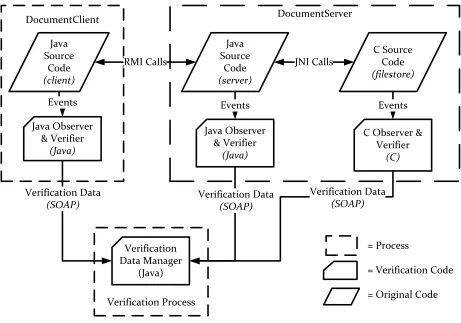
Figure 2-2: Architecture of a distributed program with external verification process
Both the Java Source Code on the client and the server report their events to their respective Java Observer & Verifier. The Java Observer & Verifier then retrieves verification data from the Verification Data Manager through RMI calls and checks the received event against the verification data. The Verification Data Manager runs in a separate process called the Verification Process. The C Source Code reports its events to the C Observer & Verifier. The C Observer & Verifier reports its events to a special piece of Java code, called the Java Event Bridge & Verifier, which retrieves the verification data and checks the events.
2.1
Background
2.1.1
Call Graph
12
F()
G()
H()
[image:22.612.158.461.73.198.2]I() J()
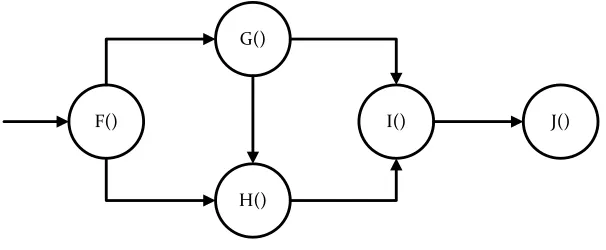
Figure 2-3: Example call graph
Figure 2-3 shows a very simple example of a call graph. It starts at a function call to F(), which in turn calls G() and H(). G() itself calls I(), but also H(). H() calls I() also. I() itself calls J().
There are two basic call graph types. Static and dynamic call graphs [40]. Static call graphs are generated without program execution. It may not contain all edges (when some edges cannot be statically determined, e.g. function pointers) or may not be totally precise and feature edges that are not actually executed (polymorphism). Dynamic call graphs are generated during the execution of a program and may not contain all edges, since it may be possible that not every statement of the program is executed.
2.1.2
Java RMI
The architecture of a RMI program is given in Figure 2-4. The server provides one or more interfaces that extend java.rmi.Remote interface. Inside these interfaces, the server defines the remote methods that can be called by clients. The server implements the interfaces.
The RMI compiler generates stub and skeleton classes for each of these remote interfaces. A stub is the client side code that is generated and it implements the remote interface and the remote communication for the developer. A skeleton does the same on the server side.
When a client invokes a remote method, the call goes to stub, where the generated code takes care of the remote communication (including marshalling the object). On the server side, the skeleton handles the communication and continues the flow of the program on the server side implementation object of the remote interface.
13
Stub Skeleton Server
[image:23.612.72.537.73.202.2]Client Network
Figure 2-4: Architecture of a RMI program
Usage of Java RMI can be inferred from the Java code, because both sides of the communication access the java.rmi.registry package. This however does not mean that code from the package is actually used. Therefore, we need to look at statement that invokes methods that are part of an interface that extends the java.rmi.Remote interface. The code examples are from the case study that we introduced in the first chapter.
The code in Code Fragment 2-1 shows an example of a remote interface.
1 package nl.utwente.rschutte; 2
3 import java.rmi.Remote;
4 import java.rmi.RemoteException; 5
6
7 public interface DocumentStore extends Remote { 8
9 public String storeDocument(String name, String text) throws RemoteException; 10
11 }
Code Fragment 2-1: Extension of the java.rmi.Remote interface
There are two important lines in Code Fragment 2-1. The first is line 7, in which the interface DocumentStore extends the interface java.rmi.Remote interface. At line 9, there is the storeDocument method declaration in the interface, with the name and text arguments of the type java.lang.String.
14 1 ...
2
3 public class DocumentStoreImpl extends UnicastRemoteObject implements DocumentStore {
4
... 5
6 public String storeDocument(String name, String text) { 7 System.out.println("Stored: " + name + " | " + text); 8
9 FileStore fs = new FileStore();
10 String result = fs.storeFile(name, text); 11
13 return result;
14 }
15
... 16
17 } 18
Code Fragment 2-2: Implementation of the DocumentStore interface
At line 3, we see that the DocumentStoreImpl class implements the DocumentStore interface. Lines 6 – 14 shows the implementation of the storeDocument(String, String) method, which was defined by the DocumentStore interface.
The server registers objects in the RMI registry. This is done in Code Fragment 2-3 line 5. The variable store is registered under the name “store”. In the same code fragment on line 4 the registry is located.
1 try {
2 DocumentStoreImpl store = new DocumentStoreImpl(); 3
4 Registry registry = LocateRegistry.getRegistry(); 5 registry.rebind("store", store);
6 } catch (RemoteException e) { 7 e.printStackTrace(); 8 }
Code Fragment 2-3: The server side of Java RMI
15 1 try {
2 Registry registry = LocateRegistry.getRegistry();
3 DocumentStore store = (DocumentStore) registry.lookup("store"); 4 String result = store.storeDocument(this.getName(), this.getText()); 5 } catch ( Exception e ) {
6 e.printStackTrace(); 7 }
Code Fragment 2-4: The client side of Java RMI
2.1.3
JNI
JNI [41] is a layer that enables Java program to call and be called by C or C++ code. As such, there are two cases, Java calling C/C++ and C/C++ calling Java.
An example of Java to C source code is given in Code Fragment 2-5. The code is taken from our document editor case study.
1 package nl.utwente.rschutte; 2
3 public class FileStore { 4
5 static {
6 System.loadLibrary("filestore");
7 }
8
9 public native String storeFile(String fileName, String text); 10
11 }
Code Fragment 2-5: Java JNI code
There are two points of interest about the JNI usage. In the class initializer the library “filestore” is included (lines 5 - 7). This loads the methods that are implemented in the “filestore” library. The method declaration in (line 9) is a JNI method (which is a method with a native implementation). It can be recognized by the “native” qualifier. The method declaration can be recognized by the “native” qualifier. The empty stub of the method can be found in Code Fragment 2-6.
The Java method shown in Code Fragment 2-5 stub has a C function as its implementation.
1 #include <jni.h>
2 #include "nl_utwente_rschutte_FileStore.h" 3
4 JNIEXPORT jstring JNICALL Java_nl_utwente_rschutte_FileStore_storeFile 5 (JNIEnv * jnienv, jobject obj, jstring filename, jstring text) { 6 }
16 An empty function can be generated by the javah tool [21], which is part of the standard JDK. Code Fragment 2-6 shows the empty function definition that has been generated from the Java JNI code in Code Fragment 2-5. The implementation is left out for brevity. The first line is a reference to jni.h which is the header file with the common JNI declarations. The other header file (line 2) contains a declaration of the function on lines 4 - 6. The function on lines 4 – 6 is the implementation of the method declaration given on line 9 of Code Fragment 2-5.
The opposite direction of communication is from C to Java. An example of an invocation of a Java method from C is given in Code Fragment 2-7. It shows the invocation of the main method of a program located in the nl.utwente.rschutte.Editor class from C code. From C, there are many functions which can be used to find methods in a Java program. A list of these functions can be found at [13].
1 #include <jni.h> 2
3 int main() { 4 JavaVM * jvm;
5 JNIEnv* env = create_vm(&jvm); 6
7 jclass editorClass; 8 jmethodID mainMethod; 9
10 editorClass = (*env)->FindClass(env, "nl/utwente/rschutte/Editor"); 11 mainMethod = (*env)->GetStaticMethodID(env, editorClass, "main", 12 "([Ljava/lang/String;)V");
13
14 (*env)->CallStaticVoidMethod(env, editorClass, mainMethod, NULL); 15
16 (*jvm)->DestroyJavaVM(jvm); 17
18 return 0; 19 }
Code Fragment 2-7: C JNI code
In order to determine that a piece of C code invokes Java code, we look for functions that are part of JNI API. The JNI API has a subset of functions which are used to invoke Java methods. Just the inclusion or import of the JNI header (jni.h on line 1) does not indicate the invocation of Java from C.
In line 10 the nl.utwente.rschutte.Editor class is loaded. It contains the main method of the Java program. The main method is found in lines 11 and 12. The main method of the Java program is invoked via the function CallStaticVoidMethod in line 14.
17
2.1.4
Tool Reviews
For the extraction of call graph we use existing tools. A small overview of the available tools will be given to show the options. Some tools are not specifically aimed at generating call graphs; however they still generate information that can be used for this purpose.
The criteria for the tools are as follows:
The tools needs to generate call graphs for either C or Java
The generated call graph should be available to our tool in a format that allows further processing
A potential combination of Java and C tools should be available at a single platform, so they can be included in our solution.
Soot
Soot [15] is a Java optimization framework, which uses Java byte code as input. A call graph can be obtained by using the Class Hierarchy Analysis option. Soot has to run in whole program mode to be able to generate a call graph. Unlike most call graph tools, it uses the compiled code to generate a call graph. It can be used as a library for any other Java program. Soot only works for Java.
GNU CFlow
CFlow [16] is a tool specifically aimed at extracting call graphs from C source code. It generates a textual representation of the call graph. It can generate a caller-callee call graph as well as the reverse callee-caller graph. The textual representation of the call graph makes it easier for further processing. CFlow is only available for the Unix platforms (or similar, Linux, OSX etc.).
Doxygen
Doxygen [17] is a documentation system for several programming languages, including Java, C, C++ and C#. It generates documentation based upon a set of documented source files. However, it is also able to generate structural information of the program to aid a programmer in finding his way in a large source distribution. Doxygen works at the source code level.
18
GProf
GProf [18] is a profiling tool for C programs. It performs dynamic analysis. GProf can generate call graphs based on the execution of a program. This is a drawback, because potentially not all functions in a program are covered in each run. An advantage of a GProf is that the call graph is represented as text and can be easily processed.
CScope
CScope [20] is a C source code browser, in which source code is presented in a structured way. The user must first index the source code that he wants to browse. The result is stored in a special database, which can be accessed by the CScope program. A call graph of the C source code is not immediately generated, however for each function the caller and callees can be found. As such, a call graph can be built if this information is used for every function. CScope is only available for the Unix platforms (or similar, Linux, OSX etc.).
Conclusion
For the Java call graph generation we will use Soot, as it can be included into the program through the usage of a Java runtime library and it can generate a complete call graph of the program that can be processed further.
For the C source code, we have chosen to use Cflow. It is easy to use for our goal as it can be run from the commandline and the output can be parsed, so it can be loaded into our tool.
GProf creates a call graph during the execution of a program and thus may not contain all edges of the call graph. CScope holds the call graph information in an internal database and thus does not allow an external program to reuse its information. Doxygen’s call graphs are generated as an image which makes reuse of the information very hard.
2.2
Overview of the Approach
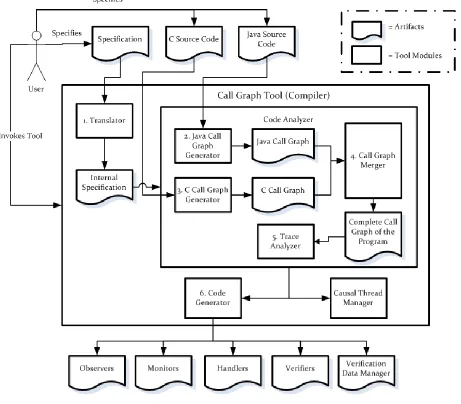
19 Figure 2-5: Flow of information in the call graph generation tool
The flow of information and the order of the executed tasks is shown in Figure 2-5. The inputs of the program are the specification by the user and the Java and C source code. Source code is specified by the Compose* BuildConfig.xml. As our tool will become an integrated part of the previous E-Chaser version, we can use its BuildConfig.xml file, which already contains a list of files that need to be compiled. We need to organize these files by programming language, so the files are analyzed by the proper tools. At the end of this step we provide the list of files in an organized manner for the rest of the tool.
20 represent distributed calls (RMI) and edges that show usage of JNI. These edges need to be deduced, because they cross the programming language border and thus are not generated by the tools for Java and C source code. In order to obtain these missing edges, we need to analyze the call graph for invocations of native methods in Java and the usage of specific JNI functions in C. Through analyzing Java RMI invocations we can find distribution. RMI has a stub in the form of a method signature on an interface and the content of the method can be found at the implementing class.
In this complete program call graph must find the events in the paths of the call graph. For each path we will want to find whether it is distributed and whether it spans multiple programming languages (5). After deducting this information, we use it to generate monitors (6). In the following section, we explain each step in detail.
In comparison with the second E-Chaser’s architecture (shown in Figure 1-4), there are no changes to the input and the output. The developer still defines the specification and the source code (for both Java and C). The Translator remains the same; it transforms the specification by the developer into an internal specification. It is explained in chapter 1. The handling of RMI code remains the same. The functionality of the Code Analyzer (with regards to RMI) and the Causal Thread Manager also remain the same. The Code Analyzer, however, gets extra functionality. The call graph extractor becomes part of the Code Analyzer, and its information is given to the Code Generator. The Code Generator will still generate the usual RMI code, but now also takes into account the structure of the program. It will try to generate one of the two architectures mentioned in Figure 2-1 or Figure 2-2, based on the information provided by the call graph extractor.
2.3
Call Graph Generator
The Call Graph Generator consists of three component. The C Call Graph Generator, the Java Call Graph Generator and the Call Graph Merger. The Call Graph Merger glues the Java and the C call graphs into one call graph of the whole program. In the next three sections, each component is described.
2.3.1
Call Graph Model
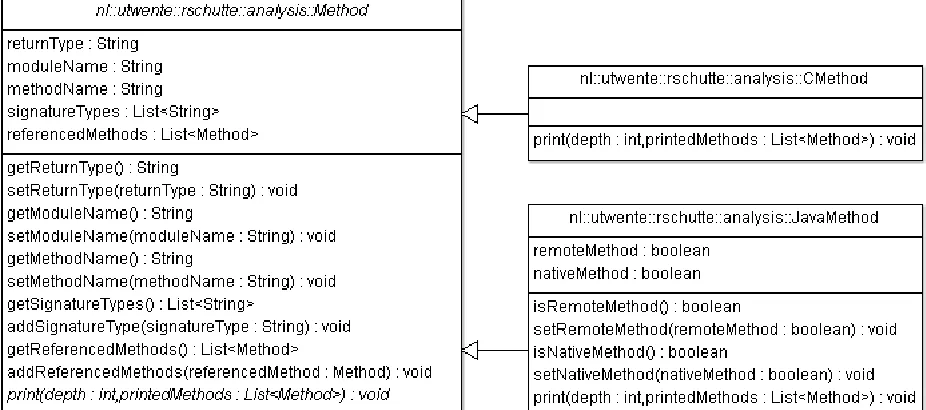
21 Figure 2-6: UML Class Diagram of Method, CMethod and JavaMethod classes
There is an abstract base class Method which holds data and methods that are applicable for most types of methods and functions. The CMethod and JavaMethod classes are realizations of the Method class. Both of them have specific methods and data that are being kept for their purposes. The CMethod only has a different print method, but the Java method also has flags for keeping track of native and remote methods. A Method has a set of referenced methods stored in the referencedMethods list, these are the edges of the call graph.
For both method types the returntype, the modulename, method- or functionname and the signature types are stored. The referenced methods list is an ordered list of methods or functions that is called from the C function of Java method.
Each Method class and its subclasses have a print() method. This method prints the call graph starting from this method, while excluding recursive calls. It is used to get an overview of the call graph that is generated by the tool.
2.3.2
Java Call Graph Generation
As the second step, the Java files are received by Java Call Graph Generator. It uses the Soot tool, which analyzes the program’s source and extracts the call graph.
22 graph model, in which we can include both Java and C call graphs. This call graph model is given in Figure 2-6.
We do not explore a call graph solely from the main method and continue from there, since we want to get an overview of all the methods. This is necessary, because the Java source code can be used as a library from other languages, such as C. Therefore, some code may not be invoked from the main method of a program, but may still be used by source code outside of Java. Without including those Java methods, some source code may not be part of the call graph, while it is part of a multilanguage program.
Limitations of Java Call Graph Generation
Libraries
Soot is able to build a call graph of the internals of Java libraries, for example the standard JDK libraries, since it also works on compiled code. The C tools that we have reviewed can not analyze code after it has been compiled, it needs plain source code. Therefore the code in libraries can not be included in the call graphs of C programs. This shows a mismatch between the two approaches.
Analyzing the internals of libraries may be useful if we want to check the usage of certain classes of the standard Java library by the Java library itself as well as by the program that is being analyzed. A complete overview of the usage of a certain method can be given. For C this would be impossible, unless the actual source of the library is given.
Java Reflection
Method calls through Java reflection are not added to the call graph of the analyzed program. This is due to the parameterized nature of the calls. It is similar to other problems found, like C to Java JNI and function pointers. The actual targets of these calls are only known during runtime.
2.3.3
C Call Graph Generation
This chapter describes step 3 of the approach which is illustrated in Figure 2-5.
In order to get a more useful call graph we run Cflow with the following options.
The --number option is used to get a number in front of each call graph node. These numbers are also used as a reference number in case of recursion or when the function has been previously explored (Cflow refers to this number).
The --brief option. It is used to generate a more compact call graph, which requires less effort to parse.
23 separate branch of the call graph needs to be explored. The reverse call graph makes sure any function in the program is listed, instead of just the functions that are called from the main function or from functions called indirectly from the main function.
1 GetStringUTFChars():
2 Java_nl_utwente_rschutte_FileStore_storeFile() <JNIEXPORT jstring JNICALL Java_nl_utwente_rschutte_FileStore_storeFile (JNIEnv *jnienv,jobject obj,jstring filename,jstring text) at nl_utwente_rschutte_FileStore.c:17>
3 Java_nl_utwente_rschutte_FileStore_storeFile() <JNIEXPORT jstring JNICALL Java_nl_utwente_rschutte_FileStore_storeFile (JNIEnv *jnienv,jobject obj,jstring filename,jstring text) at nl_utwente_rschutte_FileStore.c:17> [see 2]
4 NewStringUTF():
5 Java_nl_utwente_rschutte_FileStore_storeFile() <JNIEXPORT jstring JNICALL Java_nl_utwente_rschutte_FileStore_storeFile (JNIEnv *jnienv,jobject obj,jstring filename,jstring text) at nl_utwente_rschutte_FileStore.c:17> [see 2]
6 fclose():
7 Java_nl_utwente_rschutte_FileStore_storeFile() <JNIEXPORT jstring JNICALL Java_nl_utwente_rschutte_FileStore_storeFile (JNIEnv *jnienv,jobject obj,jstring filename,jstring text) at nl_utwente_rschutte_FileStore.c:17> [see 2]
8 fopen():
9 Java_nl_utwente_rschutte_FileStore_storeFile() <JNIEXPORT jstring JNICALL Java_nl_utwente_rschutte_FileStore_storeFile (JNIEnv *jnienv,jobject obj,jstring filename,jstring text) at nl_utwente_rschutte_FileStore.c:17> [see 2]
10 fprintf():
11 Java_nl_utwente_rschutte_FileStore_storeFile() <JNIEXPORT jstring JNICALL Java_nl_utwente_rschutte_FileStore_storeFile (JNIEnv *jnienv,jobject obj,jstring filename,jstring text) at nl_utwente_rschutte_FileStore.c:17> [see 2]
12 strcat():
13 Java_nl_utwente_rschutte_FileStore_storeFile() <JNIEXPORT jstring JNICALL Java_nl_utwente_rschutte_FileStore_storeFile (JNIEnv *jnienv,jobject obj,jstring filename,jstring text) at nl_utwente_rschutte_FileStore.c:17> [see 2]
Code Fragment 2-8: Excerpt of example output of Cflow for the filestore written in C
The output of Cflow is then read by the C call graph generator. An example output of the Cflow tool is given in Code Fragment 2-8. The linenumbers are part of the output and are not just added for ease of reference. Children of function are distinguished through indentation.
24 We have created an ANTLR grammar to read and parse the output of Cflow, it can be found in Code Fragment B-8. The resulting Abstract Syntax Tree (AST) is then interpreted information is gathered. For a basic overview, see [43].
For a C function only the name of the function is necessary information, since it is identifying. In contrast to Java methods in which, the argument types and the defining class are also important. For a C function these are not necessary to identify a function, since a C function has to have a unique name.
The C Call Graph Generator then uses the information from the interpretation of the Cflow output to build a call graph according to the model given in Figure 2-6. It uses the same model as the Java Call Graph Generator.
Limitations of C Call Graph Generation
C Function Pointers
In C, function pointers are often used to achieve a form of abstraction, like simulating inheritance. The actual execution of a function is dependent on runtime values, which are used to select a function. Another use of function pointers is that of a callback function. An often used example is that of a sorting routine where the comparison function is provided through a function pointer.
Callback Functions
Callback functions in C are often implemented through the usage of function pointers. Therefore, they are not added to the call flow graph for the same reason as any other function pointer based function call.
In Java, callback methods are often implemented by anonymous inner classes. These can be added through the usage of the Soot tool. As such, it is a problem that is limited to C.
2.4
Merging of Call Graphs
This section describes step 4 of the approach which is illustrated in Figure 2-5 and it is performed by our call graph merger. For our current tool we use JNI as a way to communicate between Java and C (both directions), and Java RMI for distributed communication.
25
2.4.1
RMI
RMI calls are denoted by the isRemote boolean property. It is a private variable of the Method class. If a method is remote, the client and server part will automatically be connected by the Java call graph generator. A method can only be declared once in a class and have only one implementation. On the client side, there will be no outgoing edges from the method, because there is no implementation. On the server side, the method is already added and outgoing edges can be added from the server implementation to the client.
2.4.2
JNI - C to Java
An example of a JNI call is given in Code Fragment 2-7. A small excerpt with the relevant lines is given in Code Fragment 2-9. We will show why the target node on the call graph of a JNI call cannot be found statically.
1 int main() { 2 JavaVM * jvm;
3 JNIEnv* env = create_vm(&jvm); 4
...
5
6 editorClass = (*env)->FindClass(env, "nl/utwente/rschutte/Editor"); 7 mainMethod = (*env)->GetStaticMethodID(env, editorClass, "main", 8 "([Ljava/lang/String;)V");
9
10 (*env)->CallStaticVoidMethod(env, editorClass, mainMethod, NULL); 11
...
Code Fragment 2-9: C JNI code excerpt
Problem
26 The exact target of the (*env)->CallStaticVoidMethod(env, editorClass, mainMethod, NULL) method call (line 14) can not be determined, since the values of editorClass and mainMethod cannot be statically determined. Their value is only known during runtime.
To still find the target of the function call there are several options available. We will discuss these next.
Program Slicing
Through program slicing one can determine the possible values of variables. A program slice is a set of statements from a program that influences the value of a chosen point of interest, for example a variable. A slice can be used to determine the values of the class and the method that is being invoked from C to Java. [42]
To find the value in the example of editorClass the possible values of the second parameter needs to be determined. The second parameter provides enough information about the actual class being loaded. The content can be used to deduce the fully qualified class name in Java. Once we can deduce the value of the editorClass variable we can use this to deduce the value of
mainMethod variable.
The mainMethod variables content is based on three parameters. The second parameter is the class (in this case the editorClass variable) to find a method from. The third is the name of the method being called and the fourth which contains the parameters. The third and fourth variable both need to be deduced. If these three values are deduced the potential methods in the Java program can be found.
The advantage of this approach is that it is relatively precise. The set of potential methods can in most cases be severely limited even though there may still be some methods in the set that are not invoked. The disadvantage is that this approach is relatively expensive to compute and to implement.
Program Execution
A possibility would be to actually execute the program with additional code that analyzes the target of the JNI invocation. During execution information is retrieved for every instance of JNI invocation code.
The advantage of this method is that only methods are found that are indeed possible targets. The set of potential candidates is not polluted with methods that can never be invoked.
27 need to be performed to form a complete list of candidate methods. This option also departs from the way that the rest of the program is analyzed, through static analysis.
JNI Method Name
Through analyzing the build-up of the name for the JNI methods we can deduct certain information about the actual method that is invoked. Example JNI methodnames are
CallIntMethod, CallNonvirtualObjectMethodV and CallStaticFloatMethodA. The method names can be matched by the regular expression shown in Code Fragment 2-10. A complete list of the JNI methods can be found at [13].
Methodname ::= “Call” [“Static” | ”Nonvirtual”]? <Type> “Method” [“V” | ”A”]? Type ::= [“Object” | “Boolean” | “Byte” | “Char” | “Short” | “Int” | “Long” | “Float” | “Double” | “Void”]
Code Fragment 2-10: JNI function name build-up
The keyword Static means that a static method is being invoked. The Nonvirtual keyword means that the method is not invoked through the normal inheritance hierarchy and the actual method that is pointed to should be invoked, not an overriding submethod. The <Type> part is the return type of the method that is invoked. The last letter V or A denotes how the parameters are passed to the Java method and is of no consequence for the Java side of the invocation. However, if both V and A are missing it means that all the arguments have to be listed in the function call after the method id. If this is the case, the number of arguments can be measured.
Through this analysis we can find out whether the invoked method: is static, has a return type and what that type is, is called virtually or non-virtual and if it is invoked with arguments. If it is invoked through a list of arguments with a “varargs”-type invocation, the number of arguments can be determined. By taking these properties of the potential methods into account, all methods that do not match these criteria can be filtered out of the list of potential target methods.
A benefit of this method is that it leaves no methods out that may be potentially invoked. A disadvantage is that this method only narrows down the options and does not give a definitive answer. In some scenarios this approach may still yield a large amount of methods.
No Fix
28 used by future projects as they may consider the call graph to be too unreliable to be used for further development.
Conclusion
We have not implemented any of the options discussed. The program slicing approach is too difficult and too large to implement for this thesis. The program execution option only provides edges that are actually executed. As such, not all edges may be explored. The analysis of the JNI function name leaves in many possible Java methods, which creates a call graph with many edges that do not exist. Not fixing the call graph and merging every Java invocation from C with every Java method is considered worse than the analysis of the JNI function name.
2.4.3
JNI
–
Java to C
The other direction of communication in JNI is from Java to C. To connect the graph, there are two steps that need to be taken. First we derive the C function name from the Java method signature and the second step is to connect the Java method and C function in the call graph.
Deriving C Function Name
To connect nodes from Java to C, we can match the name of the Java method stub with the C skeleton. C JNI headers are generated by the javah tool. Because the tool has consistent results, we can derive the name of the C function that is being called from the Java native method and we can use it to link a Java JNI call to a C function directly.
The name of the JNI function is deduced from the Java method name. A C JNI function name starts with “Java_”. Appended to that is the Java package name in which the dots are replaced with underscores. The last part of the C function name is the actual Java method name; it is added with an underscore prefixed.
The arguments of a JNI C function are also derivable. The first argument is always the JNIEnv interface through which the JVM instance from which the JNI call is made can be found. The second argument is the Java object instance on which the JNI method was called. The remaining arguments are the arguments of Java method. Java primitives and Strings are converted to their JNI equivalents and Java objects are converted to the jobject type.
29 JNIEXPORT jstring JNICALL Java_rik_Main_testMethod__Ljava_lang_String_2I
(JNIEnv *, jobject, jstring, jint);
Code Fragment 2-11: Overloaded Java method's JNI signature
Connecting the Edges
Because the C function name can be determined from the Java method name, we can check every Java method in the Java call graph and check whether it has the “native” qualifier. It is stored in the JavaMethod object in the nativeMethod boolean. For such a method, we can find the C function name. This function is also available in the call graph, but as a CMethod instance. Since the name of a function is unique in C, we can easily determine the CMethod that needs to be added to the referencedMethods list of the Method object.
2.5
Trace Analyzer and Code Generator
Step 5 (Trace Analyzer) and 6 (Code Generator) of Figure 2-5 cannot be executed, since we have found that we were not able to connect JNI calls (Java invocations in C) from C to Java at step 4, because they rely on runtime values. A complete call graph of the program can therefore not be generated. We have shown alternatives and we have decided not to use them, because they are unfeasible, or too imprecise.
2.6
Conclusions
The Java and C language combination cannot be supported. More generally, any two languages that depend upon a layer that is dependent upon runtime variable values cannot be determined by a call graph approach. A different approach to verifying multilanguage and distributed program needs to be found which takes into account layers with these characteristics. As a result, we have only implemented step 2 (extracting a call graph from Java source code), 3 (extracting a call graph from C source code) and only a part of step 4 (merging of the call graphs in Java and C) of this solution.
30
3
Solution 2: Outline Monitors
As we have shown in Chapter 2, we were unable to extract the call graph of a program which is precise enough. This chapter explains an alternative solution to verify distributed programs written in multiple languages. Again we focus on programs written in C and Java and using RMI and JNI.
In this chapter we will give background information, explain our approach and the steps necessary to reach our goal.
3.1
Goal
The goal of this solution is again to verify programs that are distributed and written in multiple languages, but the approach is different. We will generate an architecture similar to the architecture of Figure 2-2, but with a few changes. Again the specification is: 1) distribution transparent and 2) language independent.
In the previous solution we could not determine the call graph of a multilanguage and distributed program. In this solution we will design a verification system that works independently of the distribution of the program.
3.1.1
Overview of the Approach
31 Figure 3-1: E-Chaser's architecture for the proposed solution
The Specification, Translator and Internal Specification are the same as the original E-Chaser as well as the previously proposed solution. There are two parallel paths for the C (steps 2 and 3) and Java source code (steps 4 - 7). The C path takes the C Source Code as input and outputs Modified C Source Code. The Java path takes Java Source Code as input and outputs Modified Java Source Code and C JNI Replacement Headers Code.
32 C JNI Replacement Code Generator creates parameterization code which takes the place of the original JNI code. The result is Modified C Source Code.
The Java path consists of the Java JNI Call Finder, which passes a list of Java JNI calls to the Java JNI Replacement Stubs Generator. It is the only new module for Java in the Code Analyzer. The other steps are all part of the Code Generator. The Java JNI Replacement Stubs Generator creates Java JNI stubs that replace the original stubs, which results in Modified Java Source Code. Next, the Java Prolog Fact Generator creates Prolog facts and stores them in the Compose* prolog fact database. The C JNI Headers Generator creates the content, which is C source code, for the JNI stubs generated by the Java JNI Replacement Stubs Generator, which results in C JNI Replacement Headers Code.
The E-Chaser functionality regarding the usage of RMI stays the same as in the previous version of E-Chaser. The Causal Thread Manager, the Code Analyzer and Code Generator keep the original RMI functionality. The Code Analyzer and Code Generator are extended with the new functionality.
Steps 1 and 2 are related to C to Java JNI calls. These steps are described in chapter 4. The steps 3 - 6 are related to Java to C JNI calls and are described in chapter 5.
3.1.2
Orchestration
We create a single interface for the user to communicate with, to make the tool easier to use. We call it the Orchestrator module, see Figure 3-1. The interface orchestrates the C to Java and Java to C compilers. It also takes care of the dependencies for compilation and execution of the program. The separate binaries of the C and Java code also need to be configured and started with the right parameters to be executed.
3.1.3
New Program Flow
We want to parameterize the original JNI calls. Java methods with a native implementation can be found, because their signature contains the keyword “native”. JNI calls are statements that invoke a method with a native implementation. In C we can find calls that invoke Java methods, because there is a static list of JNI invocation functions through which Java methods can be called. Usage of such a function indicates a JNI call.
33 receiver of the Generated JNI Call. It stores the causal thread id and continues the original call flow, by restoring the original JNI call from the parameters of Generated JNI Call and invoking it.
Figure 3-2: Call flow interception approach
3.1.4
Program Architecture
The architecture of the generated program is shown in Figure 3-3. The RMI Calls and JNI Calls include both the original and the newly created calls.
Verification Process DocumentClient DocumentServer JNI Calls RMI Calls Events (SOAP)
Events Events Events
Events (SOAP) Java Source Code (client) Java Source Code (server) C Source Code (filestore) = Process
= Verification Code
= Original Code Java Observer & Verifier (Java) Java Observer & Verifier (Java) C Observer & Verifier (C) Verification System (Java) Events (SOAP)
[image:43.612.92.523.362.672.2]34 The Java Observer & Verifiers again retrieve the verification data from the Verification System and verify the generated event. The C Observer & Verifier does the same for C code. One of the changes in the architecture compared to Figure 2-2 is the direct communication of C source code (the C Observer & Verifier) with the remote Verification System. This can be done, because we have chosen to remove the usage of RMI from the verification system and chosen SOAP for the communication between the Verification System and the Verifiers.
3.2
Causal Thread Storage
The causal thread is stored and retrieved inside the Caller and Callee-Side Proxies. For each supported programming language (C and Java) different storage code is written. The causal thread id needs to be globally available. In Java we can use a static field or a singleton object. In C we can use a global variable.
For the causal thread storage to be able to support multiple threads of execution, the generation, storage and retrieval of the causal thread id needs to be thread safe. The implementation can use the ThreadLocal class of the Java API to achieve this.
3.3
Background
For the previous solution, we have described how we could find RMI and JNI calls, the same applies to this solution.
3.3.1
Function & Method Call Interception
As part of the original functionality of Compose*, it can intercept method and function invocations in the base program. This functionality can be reused by our tool. To intercept a JNI method or function call, prolog facts can be added to the repository. These prolog facts will instruct the compiler to generate code that will reroute invocations of these JNI methods and function calls to special handling code. The information necessary to achieve this are the method- or functionname that needs to be intercepted and the class or file in which the method or function is defined. Both can be retrieved from the source code and the file in which the source code is written.
3.3.2
Language Independent Protocol
35
Language Libraries
Java Apache Axis
C gSOAP
C++ gSOAP, Apache AXIS
[image:45.612.63.547.73.144.2]C# ASP.NET Web Services
Table 3-1: SOAP libraries for several programming languages
36
4
Maintaining the Causal Thread of
Execution from C to Java
In this chapter we will describe how C to Java JNI calls are handled by our tool. These are steps 1 (C JNI Call Finder) and 2 (C JNI Replacement Code Generator) of Figure 3-1. Steps 1 and 2 together generate the Caller-Side Proxy. However, first we will explain the Callee-Side Proxy, which is a Java class that is the same for every Java program that is being verified, because it is the target of every parameterized JNI call from C to Java.
4.1
Compose/CwC Problems
Compose/CwC is the Compose* implementation for C. We were unable to use Compose/CwC for our implementation as the current version has compilation problems. For this reason, the control flow of the program is changed, by modifying the original source code and replacing the JNI calls instead of intercepting the call flow.
4.2
Overview
37 Figure 4-1: New control flow from C to Java
As shown, the Original JNI Call is removed from the program. It is replaced by the Caller-Side Proxy, which does a call to the Callee-Side Proxy (which is the Java JNI Hook), from which the original call flow continues. The new JNI call also holds the causal thread id.
The Caller-Side Proxy has to be generated based on the original JNI call.
4.3
Callee-Side Proxy (Java JNI Hook)
The Java JNI Hook is the implementation of the Callee-Side Proxy. It is a Java class, which is inserted in every Java program that is being verified by our tool. It receives the generated JNI function call. The Java JNI Hook receives the Caller-Side Proxy’s call and gets the causal thread id and the parameterized method call (target object, target method and parameters) as parameters. The Java JNI Hook stores the causal thread id and invokes the parameterized method call through Java’s reflection API.
38 1 JavaVM * jvm;
2 JNIEnv* env = create_vm(&jvm); 3
4 jclass editorClass; 5 jmethodID mainMethod; 6
7 editorClass = (*env)->FindClass(env, "nl/utwente/rschutte/Editor"); 8
9 (*env)->CallStaticVoidMethod(env, editorClass, (*env)->GetStaticMethodID(env, editorClass, "main", "([Ljava/lang/String;)V"), NULL);
10
11 (*jvm)->DestroyJavaVM(jvm); 12
13 return 0;
Code Fragment 4-1: Example JNI invocation from C to Java
The first parameter is the JNI environment. The Java hook class and method (dependant on whether it is static or not, as described earlier) need to be added as the second and the third parameter. The fourth parameter is the causal thread id which is saved in a standardized place. The fifth parameter is actual object or class (when invoking statically) on which the method is called. The sixth parameter is the reflected method which needs to be called. The seventh parameter is a jobjectArray with all the original function parameters converted to Java types.
The class JNIHook is the implementation of the Java JNI Hook. For each method on the JNIHook class the first argument is the causal thread id (named “causalThreadId”). This thread id holds the information about the causal thread of the application. The second argument is the actual object instance that the method needs to be invoked on. The third argument is a list of arguments for the original JNI method call. These will be passed to the original method call through Java’s reflection API. For each Java return type a hook method is available.
Each method also has a static variant. The second argument of this type of function is the class on which the method is called instead of the actual object instance.
39 1 public static Object objectJniHook(String causalThreadId, Object object, Method method, Object[] args)
2 {
3 Object result = null; 4
5 try {
6 result = method.invoke(object, args); 7 } catch (Exception e) {
8 e.printStackTrace();
9 }
10
11 return result; 12 }
Code Fragment 4-2: Implementation of the objectJniHook method
These methods use the reflection API of Java to call the original target method as it was parameterized on the C side of the communication.
The objectJniHook and its static equivalent staticObjectJniHook are also called by any other hook method that has a return type. This is possible by casting the result to the proper type. An example is the intJniHook shown in Code Fragment 4-3.
1 public static int intJniHook(String causalThreadId, Object object, Method method, Object[] args)
2 {
3 Integer result = (Integer) objectJniHook(causalThreadId, object, method, args); 4 return result;
5 }
Code Fragment 4-3: Implementation of the intJniHook method
The usage of the objectJniHook is shown in line 3. The result is also casted on the line to an Integer object, which is returned on line 4.
4.4
C JNI Call Finder
The C JNI Call Finder