Multi-Way, Multilingual Neural Machine Translation
with a Shared Attention Mechanism
Orhan Firat
Middle East Technical University [email protected]
Kyunghyun Cho
New York University University of MontrealYoshua Bengio CIFAR Senior Fellow
Abstract
We propose multi-way, multilingual neural machine translation. The proposed approach enables a single neural translation model to translate between multiple languages, with a number of parameters that grows only lin-early with the number of languages. This is made possible by having a single atten-tion mechanism that is shared across all lan-guage pairs. We train the proposed multi-way, multilingual model on ten language pairs from WMT’15 simultaneously and observe clear performance improvements over models trained on only one language pair. In partic-ular, we observe that the proposed model sig-nificantly improves the translation quality of low-resource language pairs.
1 Introduction
Neural Machine Translation It has been shown that a deep (recurrent) neural network can success-fully learn a complex mapping between variable-length input and output sequences on its own. Some of the earlier successes in this task have, for in-stance, been handwriting recognition (Bottou et al., 1997; Graves et al., 2009) and speech recogni-tion (Graves et al., 2006; Chorowski et al., 2015). More recently, a general framework of encoder-decoder networks has been found to be effective at learning this kind of sequence-to-sequence mapping by using two recurrent neural networks (Cho et al., 2014b; Sutskever et al., 2014).
A basic encoder-decoder network consists of two recurrent networks. The first network, called an en-coder, maps an input sequence of variable length
into a point in a continuous vector space, resulting in a fixed-dimensional context vector. The other re-current neural network, called a decoder, then gener-ates a target sequence again of variable length start-ing from the context vector. This approach however has been found to be inefficient in (Cho et al., 2014a) when handling long sentences, due to the difficulty in learning a complex mapping between an arbitrary long sentence and a single fixed-dimensional vector. In (Bahdanau et al., 2014), a remedy to this issue was proposed by incorporating anattention mecha-nismto the basic encoder-decoder network. The at-tention mechanism in the encoder-decoder network frees the network from having to map a sequence of arbitrary length to a single, fixed-dimensional vec-tor. Since this attention mechanism was introduced to the encoder-decoder network for machine trans-lation, neural machine transtrans-lation, which is purely based on neural networks to perform full end-to-end translation, has become competitive with the exist-ing phrase-based statistical machine translation in many language pairs (Jean et al., 2015; Gulcehre et al., 2015; Luong et al., 2015b).
Multilingual Neural Machine Translation Ex-isting machine translation systems, mostly based on a phrase-based system or its variants, work by di-rectly mapping a symbol or a subsequence of bols in a source language to its corresponding sym-bol or subsequence in a target language. This kind of mapping is strictly specific to a given language pair, and it is not trivial to extend this mapping to work on multiple pairs of languages.
A system based on neural machine translation, on the other hand, can be decomposed into two
ules. The encoder maps a source sentence into a con-tinuous representation, either a fixed-dimensional vector in the case of the basic encoder-decoder net-work or a set of vectors in the case of attention-based encoder-decoder network. The decoder then generates a target translation based on this source representation. This makes it possible conceptually to build a system that maps a source sentence in any language to a common continuous representa-tion space and decodes the representarepresenta-tion into any of the target languages, allowing us to make a multi-lingual machine translationsystem.
This possibility is straightforward to implement and has been validated in the case of basic encoder-decoder networks (Luong et al., 2015a). It is however not so, in the case of the attention-based encoder-decoder network, as the attention mecha-nism, or originally called the alignment function in (Bahdanau et al., 2014), is conceptually language pair-specific. In (Dong et al., 2015), the authors cleverly avoided this issue of language pair-specific attention mechanism by considering only a one-to-many translation, where each target language de-coder embedded its own attention mechanism. Also, we notice that both of these works have only eval-uated their models on relatively small-scale tasks, making it difficult to assess whether multilingual neural machine translation can scale beyond low-resource language translation.
Multi-Way, Multilingual Neural Machine Trans-lation In this paper, we first step back from the currently available multilingual neural translation systems proposed in (Luong et al., 2015a; Dong et al., 2015) and ask the question of whether the attention mechanism can be shared across multi-ple language pairs. As an answer to this question, we propose an attention-based encoder-decoder net-work that admits a shared attention mechanism with multiple encoders and decoders. We use this model for all the experiments, which suggests that it is indeed possible to share an attention mechanism across multiple language pairs.
The next question we ask is the following: in which scenario would the proposed multi-way, mul-tilingual neural translation have an advantage over the existing, single-pair model? Specifically, we consider a case of the translation between a
low-resource language pair. The experiments show that the proposed multi-way, multilingual model gener-alizes better than the single-pair translation model, when the amount of available parallel corpus is small. Furthermore, we validate that this is not only due to the increased amount of target-side, monolin-gual corpus.
Finally, we train a single model with the pro-posed architecture on all the language pairs from the WMT’15; English, French, Czech, German, Rus-sian and Finnish. The experiments show that it is indeed possible to train a single attention-based net-work to perform multi-way translation.
2 Background: Attention-based Neural Machine Translation
The attention-based neural machine translation was proposed in (Bahdanau et al., 2014). It was mo-tivated from the observation in (Cho et al., 2014a) that a basic encoder-decoder translation model from (Cho et al., 2014b; Sutskever et al., 2014) suffers from translating a long source sentence efficiently. This is largely due to the fact that the encoder of this basic approach needs to compress a whole source sentence into a single vector. Here we describe the attention-based neural machine translation.
Neural machine translation aims at building a sin-gle neural network that takes as input a source se-quence X = (x1, . . . , xTx) and generates a
corre-sponding translationY = y1, . . . , yTy
. Each sym-bol in both source and target sentences,xt oryt, is an integer index of the symbol in a vocabulary.
The encoder of the attention-based model en-codes a source sentence into a set of context vec-tors C = {h1,h2, . . . ,hTx}, whose size varies
w.r.t. the length of the source sentence. This con-text set is constructed by a bidirectional recurrent neural network (RNN) which consists of a forward RNN and reverse RNN. The forward RNN reads the source sentence from the first token until the last one, resulting in the forward context vectors
n−→
h1, . . . ,−→hTx
o
, where
− →h
t=−→Ψenc
−→
ht−1,Ex[xt]
,
reverse RNN in an opposite direction, resulting in
n←−
h1, . . . ,←−hTx
o
, where
←−
ht=←Ψ−enc
←−
ht+1,Ex[xt]
.
− →Ψ
enc and ←Ψ−enc are recurrent activation func-tions such as long short-term memory units (LSTM, (Hochreiter and Schmidhuber, 1997)) or gated re-current units (GRU, (Cho et al., 2014b)). At each position in the source sentence, the forward and re-verse context vectors are concatenated to form a full context vector, i.e.,
ht=
h−→
ht;←h−t
i
. (1)
The decoder, which is implemented as an RNN as well, generates one symbol at a time, the trans-lation of the source sentence, based on the context set returned by the encoder. At each time steptin the decoder, a time-dependent context vector ct is computed based on the previous hidden state of the decoderzt−1, the previously decoded symbol y˜t−1
and the whole context setC.
This starts by computing the relevance score of each context vector as
et,i =fscore(hi,zt−1,Ey[˜yt−1]), (2)
for alli = 1, . . . , Tx. fscore can be implemented in various ways (Luong et al., 2015b), but in this work, we use a simple single-layer feedforward network. This relevance score measures how relevant thei-th context vector of the source sentence is in deciding the next symbol in the translation. These relevance scores are further normalized:
αt,i = PTexp(x et,i) j=1exp(et,j)
, (3)
and we callαt,ithe attention weight.
The time-dependent context vector ct is then the weighted sum of the context vectors with their weights being the attention weights from above:
ct= Tx
X
i=1
αt,ihi. (4)
With this time-dependent context vector ct, the previous hidden state zt−1 and the previously
de-coded symboly˜t−1, the decoder’s hidden state is
up-dated by
zt= Ψdec(zt−1,Ey[˜yt−1],ct), (5)
whereΨdecis a recurrent activation function. The initial hidden state z0 of the decoder is
ini-tialized based on the last hidden state of the reverse RNN:
z0=finit
←−
hTx
, (6)
wherefinitis a feedforward network with one or two hidden layers.
The probability distribution for the next target symbol is computed by
p(yt=k|y˜<t, X)∝egk(zt,ct,E[˜yt−1]), (7)
where gk is a parametric function that returns the unnormalized probability for the next target symbol beingk.
Training this attention-based model is done by maximizing the conditional log-likelihood
L(θ) = N1 XN n=1
Ty
X
t=1
logp(yt=y(tn)|y<t(n), X(n)),
(8)
where the log probability inside the inner summa-tion is from Eq. (7). It is important to note that the ground-truth target symbolsyt(n)are used during training. The entire model is differentiable, and the gradient of the log-likelihood function with respect to all the parametersθ can be computed efficiently by backpropagation. This makes it straightforward to use stochastic gradient descent or its variants to train the whole model jointly to maximize the trans-lation performance.
3 Multi-Way, Multilingual Translation
Problem Definition We assume N > 1 source languages X1, X2, . . . , XN and M > 1 tar-get languages Y1, Y2, . . . , YM , and the avail-ability of L ≤ M ×N bilingual parallel corpora
{D1, . . . , DL}, each of which is a set of sentence pairs of one source and one target language. We uses(Dl)andt(Dl)to indicate the source and target languages of thel-th parallel corpus.
For each parallel corpus l, we can directly use the log-likelihood function from Eq. (8) to define a pair-specific log-likelihood Ls(Dl),t(Dl).
Then, the goal of multi-way, multilingual neu-ral machine translation is to build a model that maximizes the joint log-likelihood function
L(θ) = L1 PLl=1Ls(Dl),t(Dl)(θ). Once the training
is over, the model can do translation from any of the source languages to any of the target languages included in the parallel training corpora.
3.1 Existing Approaches
Neural Machine Translation without Attention In (Luong et al., 2015a), the authors extended the basic encoder-decoder network for multitask neu-ral machine translation. As they extended the ba-sic encoder-decoder network, their model effectively becomes a set of encoders and decoders, where each of the encoder projects a source sentence into a com-mon vector space. The point in the comcom-mon space is then decoded into different languages.
The major difference between (Luong et al., 2015a) and our work is that we extend the attention-based encoder-decoder instead of the basic model. This is an important contribution, as the attention-based neural machine translation has become de facto standard in neural translation literatures re-cently (Jean et al., 2014; Jean et al., 2015; Luong et al., 2015b; Sennrich et al., 2015b; Sennrich et al., 2015a), by opposition to the basic encoder-decoder. There are two minor differences as well. First, they do not consider multilinguality in depth. The authors of (Luong et al., 2015a) tried only a sin-gle language pair, English and German, in their model. Second, they only report translation perplex-ity, which is not a widely used metric for measur-ing translation quality. To more easily compare with other machine translation approaches it would be important to evaluate metrics such as BLEU, which counts the number of matchedn-grams between the
generated and reference translations.
One-to-Many Neural Machine Translation The authors of (Dong et al., 2015) earlier proposed a multilingual translation model based on the attention-based neural machine translation. Unlike this paper, they only tried it on one-to-many trans-lation, similarly to earlier work by (Collobert et al., 2011) where one-to-many natural language process-ing was done. In this settprocess-ing, it is trivial to extend the single-pair attention-based model into multilingual translation by simply having a single encoder for a source language and pairs of a decoder and attention mechanism (Eq. (2)) for each target language. We will shortly discuss more on why, with the attention mechanism, one-to-many translation is trivial, while multi-way translation is not.
3.2 Challenges
A quick look at neural machine translation seems to suggest a straightforward path toward incorporating multiple languages in both source and target sides. As described earlier already in the introduction, the basic idea is simple. We assign a separate encoder to each source language and a separate decoder to each target language. The encoder will project a source sentence in its own language into a common, language-agnostic space, from which the decoder will generate a translation in its own language.
Unlike training multiple single-pair neural trans-lation models, in this case, the encoders and de-coders are shared across multiple pairs. This is com-putationally beneficial, as the number of parameters grows only linearly with respect to the number of languages (O(L)), in contrary to training separate single-pair models, in which case the number of pa-rameters grows quadratically (O(L2).)
The attention mechanism, which was initially called a soft-alignment model in (Bahdanau et al., 2014), aligns a (potentially non-contiguous) source phrase to a target word. This alignment process is largely specific to a language pair, and it is not clear whether an alignment mechanism for one language pair can also work for another pair.
The most naive solution to this issue is to have
O(L2) attention mechanisms that are not shared
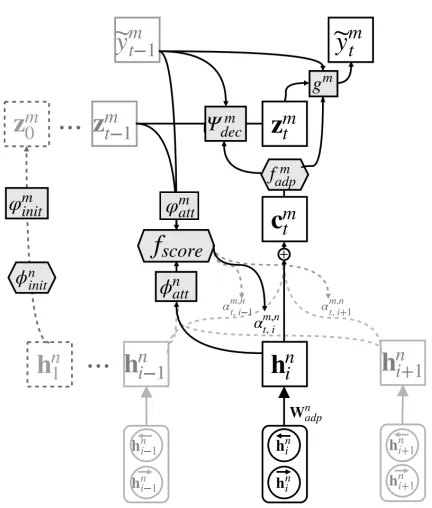
Figure 1: One step of the proposed multi-way. multilingual Neural Machine Translation model, for then-th encoder and them-th decoder at time stept. Shaded boxes are parametric functions and square boxes represent intermediate variables of the model. Initializer network is also illustrated as the left-most network with dashed boxes. Notice, all the shared components are drawn with diamond boxes. See Sec. 4 for details.
target languages. This is the approach employed in (Dong et al., 2015), where each decoder had its own attention mechanism.
There are two issues with this naive approach. First, unlike what has been hoped initially with mul-tilingual neural machine translation, the number of parameters again grows quadratically w.r.t. the num-ber of languages. Second and more importantly, having separate attention mechanisms makes it less likely for the model to fully benefit from having mul-tiple tasks (Caruana, 1997), especially for transfer learning towards resource-poor languages.
In short, the major challenge in building a multi-way, multilingual neural machine translation is in avoiding independent (i.e., quadratically many) at-tention mechanisms. There are two questions be-hind this challenge. The first one is whether it is even possible to share a single attention mechanism across multiple language pairs. The second ques-tion immediately follows: how can we build a neural translation model to share a single attention
mecha-nism for all the language pairs in consideration?
4 Multi-Way, Multilingual Model
We describe in this section, the proposed multi-way, multilingual attention-based neural machine translation. The proposed model consists of N
encoders {Ψn
enc}Nn=1 (see Eq. (1)), M decoders {(Ψm
dec, gm, finitm)}Mm=1 (see Eqs. (5)–(7)) and a
shared attention mechanismfscore(see Eq. (2) in the single language pair case).
Encoders Similarly to (Luong et al., 2015b), we have one encoder per source language, meaning that a single encoder is shared for translating the lan-guage to multiple target lanlan-guages. In order to han-dle different source languages better, we may use for each source language a different type of encoder, for instance, of different size (in terms of the number of recurrent units) or of different architecture (con-volutional instead of recurrent.)1 This allows us to efficiently incorporate varying types of languages in the proposed multilingual translation model.
This however implies that the dimensionality of the context vectors in Eq. (1) may differ across source languages. Therefore, we add to the origi-nal bidirectioorigi-nal encoder from Sec. 2, a linear trans-formation layer consisting of a weight matrixWn
adp and a bias vectorbn
adp, which is used to project each context vector into a common dimensional space:
hn
t =Wnadp
h−→
ht;←h−t
i
+bn
adp, (9)
whereWn
adp ∈Rd×(dim − →h
t+dim←−ht)andbn
adp ∈Rd. In addition, each encoder exposes two transfor-mation functionsφn
attandφninit. The first transformer
φn
att transforms a context vector to be compatible with a shared attention mechanism:
˜
hnt =φnatt(hnt). (10)
This transformer can be implemented as any type of parametric function, and in this paper, we simply ap-ply an element-wisetanhtohn
t.
The second transformer φn
init transforms the first context vectorhn
1 to be compatible with the
initial-izer of the decoder’s hidden state (see Eq. (6)):
ˆ hn
1 =φninit(hn1). (11)
Similarly toφn
att, it can be implemented as any type of parametric function. In this paper, we use a feedforward network with a single hidden layer and share one networkφinitfor all encoder-decoder pairs. Decoders We first start with an initialization of the decoder’s hidden state. Each decoder has its own parametric function ϕm
init that maps the last context vectorhˆn
Tx of the source encoder from Eq. (11) into
the initial hidden state:
zm0 =ϕminit(ˆhnTx) =ϕminit(φninit(hn1))
ϕm
initcan be any parametric function, and in this pa-per, we used a feedforward network with a single tanhhidden layer.
Each decoder exposes a parametric function ϕm att that transforms its hidden state and the previously decoded symbol to be compatible with a shared at-tention mechanism. This transformer is a paramet-ric function that takes as input the previous hidden statezm
t−1and the previous symboly˜tm−1and returns
a vector for the attention mechanism:
˜
zmt−1=ϕmatt zmt−1,Emy y˜tm−1 (12)
which replaceszt−1 in Eq. 2. In this paper, we use
a feedforward network with a single tanh hidden layer for eachϕm
att.
Given the previous hidden statezm
t−1, previously
decoded symbol y˜m
t−1 and the time-dependent
con-text vector cm
t , which we will discuss shortly, the decoder updates its hidden state:
zt= Ψdec zmt−1,Emy y˜tm−1, fadpm(cmt ),
where fm
adp affine-transforms the time-dependent context vector to be of the same dimensionality as the decoder. We share a single affine-transformation layerfm
adp, for all the decoders in this paper.
Once the hidden state is updated, the probability distribution over the next symbol is computed ex-actly as for the pair-specific model (see Eq. (7).)
# Symbols # Sentence
# En Other Pairs
[image:6.612.328.522.60.146.2]En-Fr 1.022b 2.213b 38.85m En-Cs 186.57m 185.58m 12.12m En-Ru 50.62m 55.76m 2.32m En-De 111.77m 117.41m 4.15m En-Fi 52.76m 43.67m 2.03m
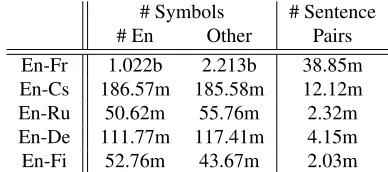
Table 1:Statistics of the parallel corpora from WMT’15. Sym-bols are BPE-based sub-words.
Attention Mechanism Unlike the encoders and decoders of which there is an instance for each lan-guage, there is only a single attention mechanism, shared across all the language pairs. This shared mechanism uses the attention-specific vectors h˜n t and˜zm
t−1from the encoder and decoder, respectively.
The relevance score of each context vectorhn t is computed based on the decoder’s previous hidden statezm
t−1and previous symboly˜tm−1:
em,nt,i =fscore
˜ hn
t,˜zmt−1,y˜tm−1
These scores are normalized according to Eq. (3) to become the attention weightsαm,nt,i .
With these attention weights, the time-dependent context vector is computed as the weighted sum of theoriginalcontext vectors:cm,nt =PTx
i=1αm,nt,i hni. See Fig. 1 for the illustration.
5 Experiment Settings
5.1 Datasets
We evaluate the proposed multi-way, multilingual translation model on all the pairs available from WMT’15–English (En)↔French (Fr), Czech (Cs), German (De), Russian (Ru) and Finnish (Fi)–, to-talling ten directed pairs. For each pair, we concate-nate all the available parallel corpora from WMT’15 and use it as a training set. We use newstest-2013 as a development set and newstest-2015 as a test set, in all the pairs other than Fi-En. In the case of Fi-En, we use newsdev-2015 and newstest-2015 as a devel-opment set and test set, respectively.
Data Preprocessing Each training corpus is tok-enized using the tokenizer script from the Moses de-coder.2 The tokenized training corpus is cleaned
fol-2https://github.com/moses-smt/
lowing the procedure in (Jean et al., 2015). Instead of using space-separated tokens, or words, we use sub-word units extracted by byte pair encoding, as recently proposed in (Sennrich et al., 2015b). For each and every language, we include 30k sub-word symbols in a vocabulary. See Table 1 for the statis-tics of the final, preprocessed training corpora. Evaluation Metric We mainly use BLEU as an evaluation metric using the multi-bleu script from Moses.3 BLEU is computed on the tokenized text after merging the BPE-based sub-word symbols. We further look at the average log-probability assigned to reference translations by the trained model as an additional evaluation metric, as a way to measure the model’s density estimation performance free from any error caused by approximate decoding.
5.2 Two Scenarios
Low-Resource Translation First, we investigate the effect of the proposed multi-way, multilingual model on low-resource language-pair translation. Among the six languages from WMT’15, we choose En, De and Fi as source languages, and En and De as target languages. We control the amount of the parallel corpus of each pair out of three to be 5%, 10%, 20% and 40% of the original corpus. In other words, we train four models with different sizes of parallel corpus for each language pair (En-De, De-En, Fi-En.)
As a baseline, we train a single-pair model for each multi-way, multilingual model. We further finetune the single-pair model to incorporate the target-side monolingual corpus consisting of all the target side text from the other language pairs (e.g., when a single-pair model was trained on Fi-En, the target-side monolingual corpus consists of the tar-get sides from De-En.) This is done by the recently proposed deep fusion (Gulcehre et al., 2015). The latter is included to tell whether any improvement from the multilingual model is simply due to the in-creased amount of target-side monolingual corpus. Large-scale Translation We train one multi-way, multilingual model that has six encoders and six decoders, corresponding to the six languages from
3https://github.com/moses-smt/
mosesdecoder/blob/master/scripts/generic/ multi-bleu.perl
Size Single Single+DF Multi
Fi
→
En 100k200k 5.06/3.967.1/6.16 4.98/3.997.21/6.17 8.84/6.2/5.177.53
400k 9.11/7.85 9.31/8.18 11.09/9.98
800k 11.08/9.96 11.59/10.15 12.73/11.28
De
→
En 210k420k 18.32/17.32 18.51/17.62 19.81/14.27/13.2 14.65/13.88 16.96/16.2619.63 840k 21/19.93 21.69/20.75 22.17/21.93
1.68m 23.38/23.01 23.33/22.86 23.86/23.52
En
→
De 210k420k 11.44/11.57 11.71/11.16 12.63/14.28/14.25 14.88/15.05 15.01/12.6815.67
840k 17.09/17.44 17.21/17.88 17.33/18.14
[image:7.612.315.548.59.217.2]1.68m 19.09/19.6 19.36/20.13 19.23/20.59
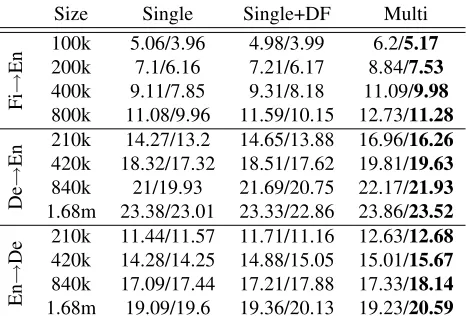
Table 2:BLEU scores where the target pair’s parallel corpus is constrained to be 5%, 10%, 20% and 40% of the original size. We report the BLEU scores on the development and test sets (separated by /) by the pair model (Single), the single-pair model with monolingual corpus (Single+DF) and the pro-posed multi-way, multilingual model (Multi).
WMT’15; En, Fr, De, Cs, Ru, Fi→En, Fr, De, Cs, Ru, Fi. We use the full corpora for all of them. 5.3 Model Architecture
Each symbol, either source or target, is projected on a 620-dimensional space. The encoder is a bidirec-tional recurrent neural network with 1,000 gated re-current units (GRU) in each direction, and the de-coder is a recurrent neural network with also 1,000 GRU’s. The decoder’s output function gk from Eq. (7) is a feedforward network with 1,000 tanh hidden units. The dimensionalities of the context vectorhn
t in Eq. (9), the attention-specific context vectorh˜n
t in Eq. (10) and the attention-specific de-coder hidden state h˜m
t−1 in Eq. (12) are all set to
1,200.
We use the same type of encoder for every source language, and the same type of decoder for every target language. The only difference between the single-pair models and the proposed multilingual ones is the numbers of encoders N and decoders
M. We leave those multilingual translation specific components, such as the ones in Eqs. (9)–(12), in the single-pair models in order to keep the number of shared parameters constant.
5.4 Training
Fr (39m) Cs (12m) De (4.2m) Ru (2.3m) Fi (2m)
Dir →En En→ →En En→ →En En→ →En En→ →En En→
(a)
BLEU De
v Single 27.22 26.91 21.24 15.9 24.13 20.49 21.04 18.06 13.15 9.59 Multi 26.09 25.04 21.23 14.42 23.66 19.17 21.48 17.89 12.97 8.92
Test SingleMulti 27.9428.06 27.8829.7 20.3220.57 13.2913.84 24.2024 20.5921.75 23.4422.44 19.3919.54 12.6112.24 9.238.98
(b)
LL De
v Single -50.53 -53.38 -60.69 -69.56 -54.76 -61.21 -60.19 -65.81 -88.44 -91.75 Multi -50.6 -56.55 -54.46 -70.76 -54.14 -62.34 -54.09 -63.75 -74.84 -88.02
[image:8.612.77.535.59.186.2]Test SingleMulti -43.34-42.22 -45.07-46.29 -60.03-54.66 -64.34-64.80 -57.81-53.85 -60.23-59.55 -60.65 -60.29 -88.66 -94.23-54.49 -58.63 -71.26 -88.09
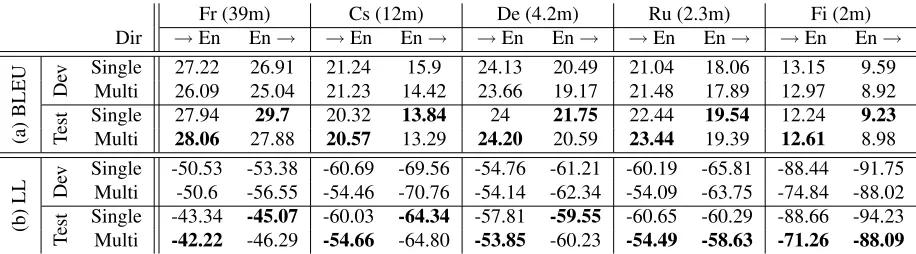
Table 3:(a) BLEU scores and (b) average log-probabilities for all the five languages from WMT’15.
Ba, 2015) as an adaptive learning rate algorithm. We use the initial learning rate of2·10−4and leave all
the other hyperparameters as suggested in (Kingma and Ba, 2015). Each SGD update is computed us-ing a minibatch of 80 examples, unless the model is parallelized over two GPUs, in which case we use a minibatch of 60 examples. We only use sentences of length up to 50 symbols during training. We clip the norm of the gradient to be no more than1(Pascanu et al., 2012). All training runs are early-stopped based on BLEU on the development set. As we ob-served in preliminary experiments better scores on the development set when finetuning the shared pa-rameters and output layers of the decoders in the case of multilingual models, we do this for all the multilingual models. During finetuning, we clip the norm of the gradient to be no more than5.4
Schedule As we have access only to bilingual cor-pora, each sentence pair updates only a subset of the parameters. Excessive updates based on a sin-gle language pair may bias the model away from the other pairs. To avoid it, we cycle through all the language pairs, one pair at a time, in FiEn, DeEn, FrEn, CsEn, RuEn order. 5 Initial experiments on random scheduling across pairs and increasing the number of consecutive updates for a pair did not give better results and left as a future work.
Model Parallelism The size of the multilingual model grows linearly w.r.t. the number of languages. We observed that a single model that handles six source and six target languages does not fit in a
4All the training details as well as the code is available at
http://github.com/nyu-dl/dl4mt-multi. 5indicates simultaneous updates on two GPUs.
single GPU6 during training. We address this by distributing computational paths according to differ-ent translation pairs over multiple GPUs, following (Ding et al., 2014). The shared parameters, mainly related to the attention mechanism, is duplicated on both GPUs.
In more detail, we distribute language pairs across multiple GPUs such that those pairs in each GPU shares either an encoder or decoder. This allows us to avoid synchronizing a large subset of the parame-ters across multiple GPUs. Only the shared attention mechanism, which has substantially less parameters, is duplicated on all the GPUs. Before each update, we build a minibatch to contain an approximately equal number of examples per GPU in order to min-imize any discrepancy in computation among mul-tiple GPUs. Each GPU then computes the gradient w.r.t. the parameters on its own board and updates the local parameters. The gradients w.r.t. the atten-tion mechanism are synchronized using direct mem-ory access (DMA). In this way, we achieve near-linear speed-up.
6 Results and Analysis
Low-Resource Translation It is clear from Ta-ble 2 that the proposed model (Multi) outperforms the single-pair one (Single) in all the cases. This is true even when the single-pair model is strength-ened with a target-side monolingual corpus (Sin-gle+DF). This suggests that the benefit of general-ization from having multiple languages goes beyond that of simply having more target-side monolingual corpus. The performance gap grows as the size of target parallel corpus decreases.
Further, directly adding monolingual data from all languages during training, e.g. like an auto-encoder, En→ En, De→De etc. is straightforward. In fact, experiments based on the autoencoder reconstruc-tion criterion resulted in rapid memorizareconstruc-tion, copy-ing source tokens without capturcopy-ing semantics, re-sulting in worse performance. Exploring ways to leverage unlabeled data and regularizing the mono-lingual paths in the multi-way, multimono-lingual architec-ture, is therefore left as a future work.
Large-Scale Translation In Table 3, we observe that the proposed multilingual model outperforms or is comparable to the single-pair models for the ma-jority of the all ten pairs/directions considered. This happens in terms of both BLEU and average log-probability. This is encouraging, considering that there are twice more parameters in the whole set of single-pair models than in the multilingual model.
Note that, the numbers are below state-of-the-art neural MT systems, which use large vocabu-laries, unknown replacements techniques and en-sembling. We mainly focused on comparing the proposed model against single-pair models without these techniques in order to carefully control and an-alyze the effect of having multiple languages. It is indeed required in the future to analyze the conse-quence of having both multiple languages and other such techniques in a single model.
It is worthwhile to notice that the benefit is more apparent when the model translates from a foreign language to English. This may be due to the fact that all of the parallel corpora include English as ei-ther a source or target language, leading to a better parameter estimation of the English decoder. In the future, a strategy of using a pseudo-parallel corpus to increase the amount of training examples for the decoders of other languages (Sennrich et al., 2015a) should be investigated to confirm this conjecture.
7 Conclusion
In this paper, we proposed multi-way, multilingual attention-based neural machine translation. The pro-posed approach allows us to build a single neural network that can handle multiple source and target languages simultaneously. The proposed model is a step forward from the recent works on multilingual neural translation, in the sense that we support
atten-tion mechanism, compared to (Luong et al., 2015a) and multi-way translation, compared to (Dong et al., 2015). Furthermore, we evaluate the proposed model on large-scale experiments, using the full set of parallel corpora from WMT’15.
We empirically evaluate the proposed model in large-scale experiments using all five languages from WMT’15 with the full set of parallel corpora and also in the settings with artificially controlled amount of the target parallel corpus. In both of the settings, we observed the benefits of the pro-posed multilingual neural translation model over having a set of single-pair models. The improve-ment was especially clear in the cases of translating low-resource language pairs.
We observed the larger improvements when trans-lating to English. We conjecture that this is due to a higher availability of English in most parallel corpora, leading to a better parameter estimation of the English decoder. More research on this phe-nomenon in the future will result in further improve-ments from using the proposed model. Also, all the other techniques proposed recently, such as ensem-bling and large vocabulary tricks, need to be tried to-gether with the proposed multilingual model to im-prove the translation quality even further. Finally, an interesting future work is to use the proposed model to translate between a language pair not included in a set of training corpus.
Acknowledgments
We acknowledge the support of the following agen-cies for research funding and computing support: NSERC, Calcul Qu´ebec, Compute Canada, the Canada Research Chairs, CIFAR and Samsung. OF thanks the support by TUBITAK (2214/A). KC thanks the support by Facebook and Google (Google Faculty Award 2016).
References
Dzmitry Bahdanau, Kyunghyun Cho, and Yoshua Ben-gio. 2014. Neural machine translation by jointly learning to align and translate. InICLR 2015.
IEEE Computer Society Conference on, pages 489– 494. IEEE.
Rich Caruana. 1997. Multitask learning.Machine learn-ing, 28(1):41–75.
Kyunghyun Cho, Bart van Merri¨enboer, Dzmitry Bah-danau, and Yoshua Bengio. 2014a. On the properties of neural machine translation: Encoder–Decoder ap-proaches. In Eighth Workshop on Syntax, Semantics and Structure in Statistical Translation, October. Kyunghyun Cho, Bart Van Merri¨enboer, Caglar
Gul-cehre, Dzmitry Bahdanau, Fethi Bougares, Holger Schwenk, and Yoshua Bengio. 2014b. Learn-ing phrase representations usLearn-ing rnn encoder-decoder for statistical machine translation. arXiv preprint arXiv:1406.1078.
Jan K Chorowski, Dzmitry Bahdanau, Dmitriy Serdyuk, Kyunghyun Cho, and Yoshua Bengio. 2015. Attention-based models for speech recognition. In
Advances in Neural Information Processing Systems, pages 577–585.
Ronan Collobert, Jason Weston, L´eon Bottou, Michael Karlen, Koray Kavukcuoglu, and Pavel Kuksa. 2011. Natural language processing (almost) from scratch.
The Journal of Machine Learning Research, 12:2493– 2537.
Weiguang Ding, Ruoyan Wang, Fei Mao, and Graham W. Taylor. 2014. Theano-based large-scale visual recog-nition with multiple gpus. arXiv:1412.2302.
Daxiang Dong, Hua Wu, Wei He, Dianhai Yu, and Haifeng Wang. 2015. Multi-task learning for multi-ple language translation. ACL.
Alex Graves, Santiago Fern´andez, Faustino Gomez, and J¨urgen Schmidhuber. 2006. Connectionist temporal classification: labelling unsegmented sequence data with recurrent neural networks. InProceedings of the 23rd international conference on Machine learning, pages 369–376. ACM.
Alex Graves, Marcus Liwicki, Santiago Fern´andez, Ro-man Bertolami, Horst Bunke, and J¨urgen Schmidhu-ber. 2009. A novel connectionist system for un-constrained handwriting recognition. Pattern Analy-sis and Machine Intelligence, IEEE Transactions on, 31(5):855–868.
Caglar Gulcehre, Orhan Firat, Kelvin Xu, Kyunghyun Cho, Loic Barrault, Huei-Chi Lin, Fethi Bougares, Holger Schwenk, and Yoshua Bengio. 2015. On us-ing monolus-ingual corpora in neural machine translation.
arXiv preprint arXiv:1503.03535.
Sepp Hochreiter and J¨urgen Schmidhuber. 1997. Long short-term memory. Neural computation, 9(8):1735– 1780.
S´ebastien Jean, Kyunghyun Cho, Roland Memisevic, and Yoshua Bengio. 2014. On using very large target vo-cabulary for neural machine translation. InACL 2015.
S´ebastien Jean, Orhan Firat, Kyunghyun Cho, Roland Memisevic, and Yoshua Bengio. 2015. Montreal neural machine translation systems for wmt’15. In
Proceedings of the Tenth Workshop on Statistical Ma-chine Translation, pages 134–140, Lisbon, Portugal, September. Association for Computational Linguis-tics.
Diederik Kingma and Jimmy Ba. 2015. Adam: A method for stochastic optimization. The International Conference on Learning Representations (ICLR). Minh-Thang Luong, Quoc V Le, Ilya Sutskever, Oriol
Vinyals, and Lukasz Kaiser. 2015a. Multi-task sequence to sequence learning. arXiv preprint arXiv:1511.06114.
Minh-Thang Luong, Hieu Pham, and Christopher D Manning. 2015b. Effective approaches to attention-based neural machine translation. arXiv preprint arXiv:1508.04025.
Razvan Pascanu, Tomas Mikolov, and Yoshua Bengio. 2012. On the difficulty of training recurrent neural networks. arXiv preprint arXiv:1211.5063.
Rico Sennrich, Barry Haddow, and Alexandra Birch. 2015a. Improving neural machine translation models with monolingual data. arXiv preprint arXiv:1511.06709.
Rico Sennrich, Barry Haddow, and Alexandra Birch. 2015b. Neural machine translation of rare words with subword units.arXiv preprint arXiv:1508.07909. Ilya Sutskever, Oriol Vinyals, and Quoc VV Le. 2014.