Can You See the (Linguistic) Difference?
Exploring Mass/Count Distinction in Vision
D. Addison Smith1, Sandro Pezzelle1,
Francesca Franzon3, Chiara Zanini4, Raffaella Bernardi1,2 1CIMeC,2DISI, University of Trento
3University of Padova 4University of Z¨urich
{first.last}@{unitn.it1,2|unipd.it3|uzh.ch4}
Abstract
This work explores the linguistic distinction betweencountandmassnouns in the visual modal-ity. Since the former class typically refers to well-defined, countable objects, with the latter proto-typically including less countable substances, we explore to which extent the linguistic distinction is grounded in the visual representations of the entities denoted by count/mass nouns. Using visual features extracted from a state-of-the-art Convolutional Neural Network (CNN), we show that the entities referred to asmassexhibit a lower variance both internally (i.e. intra-image) and externally (i.e. inter-image) compared tocount. That is, various instances of substances are internally more ho-mogeneous and externally more consistent to each other than are count. We compare variance across various CNN layers and show that it is indicative of the categorization when low-level features of the images are used, whereas any effect disappears when experimenting with higher-level, more abstract representations.
1
Introduction
The distinction between massand count nouns is undoubtedly one of the most investigated topics in formal linguistics, at least since Cheng (1973) (see Fieder et al. (2014) for a brief review). At the simplest, descriptive level of analysis, mass nouns are usually paired with substances (e.g. water, flour, sand, etc.), cannot be inflected in plural form, and are preceded by indefinite determiners like ‘some’, ‘much’, ‘a little’, etc. In contrast, count nouns refer to isolable, well-defined objects (e.g. bicycle, house, tree, etc.), can take plural number, and are preceded by definite determiners like ‘a/an’, ‘every’, ‘each’, etc. Such a division is of course an oversimplification and leaves an uncertain zone in which semantic features do not map directly into morphosyntactic properties. In fact, nouns denoting the same referents may be used as mass in one language and as count in another (e.g. ‘capelli’ in Italian is countable, whereas ‘hair’ is mass). Moreover, nouns denoting aggregates like ‘rice’ or collections of semantically related objects such as ‘furniture’ or ‘mail’ may occur in mass contexts. While the status of these latter nouns is largely debated in literature (see Chierchia (1998); Doron and M¨uller (2010) for very opposite positions), substances in contrast are unanimously considered mass. Many theories have been proposed based either on the syntactic or the denotational aspects of the two groups (see among others Chomsky (1967); Allan (1980); Pelletier and Schubert (1989)). We do not enter into this debate and focus on a rather unexplored venue.
our hypothesis, we employ a computational model trained to classify objects in images. We test whether
mass-substanceimages are internally (i.e. among the various regions of the same image) more
[image:2.595.118.483.202.368.2]homo-geneous, and externally (i.e. among the various instances of the same entity) more consistent compared to entities denoted by count nouns (see Figure 1). In other words, ‘substances’ should be distinguished from ‘objects’ by means of the lowervarianceof their visual features (somewhat similar to Kiela et al. (2015) in a lexical entailment detection task). Though similar with respect to shape, entities denoted by count nouns are likely to be very different with respect to many other low-level visual features (surface, texture, color, etc.). As a consequence, they would require higher-level operations to be recognized and classified as belonging to a particular entity class.
Figure 1: Left: images representing the count noun ‘building’. Right: images representing the mass noun ‘flour’. As can be noted, the former exhibits much more variability compared to the latter, both internally (i.e. among regions of the same image) and externally (i.e. among different images of the same entity).
Notable works have advanced the understanding of the perceptual cues linked to material recogni-tion (Sharan (2009); Sharan et al. (2014)). To our knowledge, the present study is the first attempt to investigate the mass/count distinction in vision as linked to a linguistic perspective, namely the relation-ship between visual features and a grammaticalized opposition attested in language. The motivation is indeed different from the group of studies taking into account the distinction betweenthingsandstuff in the computer vision community (Tighe and Lazebnik (2010, 2013); Mottaghi et al. (2014); Caesar et al. (2016)). Caesar et al. (2016), for example, recently proposed an enriched version of the popular COCO dataset (Lin et al. (2014)) containing pixel-level annotation forstuff in addition to the source annotation
forthings. In this resource, however, the stuff class does not align with themasscategory defined
2
Dataset
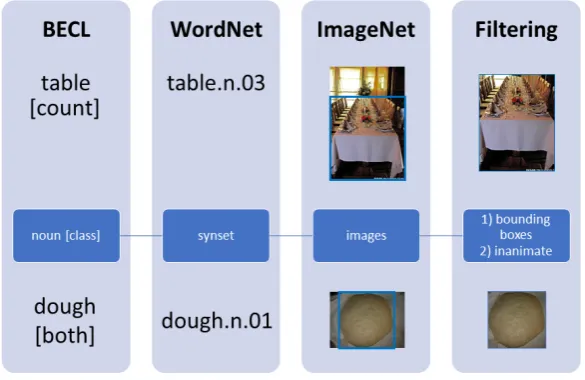
[image:3.595.152.445.286.476.2]To obtain mass/count categorization of nouns, and more specifically categorization of their respective senses, the Bochum English Countability Lexicon (BECL) (Kiss et al. (2016)) is used. This resource maps synsets within WordNet (Miller (1995)) to their respective countability classes, with noun senses annotated as eithermass,count,both, orneitherbased on a series of syntactic patterns. The annotation occurs at the sense level, and a given noun can therefore have various senses belonging to distinct count-ability classes. Since our intention is to approach the matter from a vision perspective, we first check how many of the labeled synsets are available within ImageNet (Deng et al. (2009)), with an additional requirement that the images have available bounding box annotations. Among the available synsets are 36 mass, 58both, and a remarkable 686count.1 This could well be a byproduct of the fact that count nouns are seemingly easier to annotate with bounding boxes given that they are discrete instances and are more often present in the foreground of an image. For this reason it could also be argued that more pictures are taken of count objects in general, which could explain the synset availability bias within ImageNet with regard to mass/count nouns.
Figure 2: Various steps performed in building the dataset.
Investigation into the synsets annotated as mass reveals entities such as various sports (‘soccer’, ‘basketball’, etc.) whose corresponding images depict countable entities such as players or balls. We also encounter collective nouns such as ‘equipment’, ‘furniture’, ‘luggage’, ‘housing’, and ‘artwork’, which are merely collections of countable objects. The both category is therefore more suitable for our purposes given that the senses fit the prototypical idea of a mass noun as a substance. This both
categorization in BECL is intuitive given that mass nouns can also be used in count contexts, i.e. ‘two wines’ which would refer either to two glasses (containers) of wine or perhaps to two different types of wine. In any case, nouns contained in this class (‘flour’, ‘sugar’, ‘grain’, etc.) are also viable from a vision perspective given their propensity for bounding box annotations. Since thebothcategory captures mass-substance nouns, we henceforth refer to it simply as mass. Of these 58 mass noun senses none are animate, and so to avoid any possible confounding effects due to animacy we also constrain the countable objects to be inanimate, choosing the 58 most frequent where frequency is a BECL metric based on the Open American National Corpus (OANC). Images for the 58 + 58 synsets are downloaded and cropped according to bounding box annotations. Figure 2 illustrates the various steps followed to build the dataset, with descriptive statistics of the dataset reported in Table 1.
1
#syns #uniq nouns #imgs (avg) #imgs (range) OANC freq (avg) OANC freq (range) mass 58 56 214.66 64 - 705 112.6 10 - 447
[image:4.595.166.433.364.522.2]count 58 53 303.93 60 - 1467 1435.16 33 - 4121
Table 1: Descriptive statistics of the dataset. From left to right, (1) number of synsets, (2) number of unique nouns among synsets, (3) average number of images per synset, (4) min, max number of images per synset, (5) average linguistic (OANC) frequency of the noun, (6) min, max frequency of the noun.
3
Experiments
To investigate the progression from the low-level, more concrete image features to the more abstract rep-resentations, we use a deep Convolutional Neural Network (CNN). This state-of-the-art CNN, namely the VGG-19 model (Simonyan and Zisserman (2014)), is pretrained on ImageNet ILSVRC data (Rus-sakovsky et al. (2015)). VGG-19 consists of 5 blocks of convolutional layers (hence,Conv), each fol-lowed by a max pooling layer which extracts the most relevant features and hence reduces the dimensions of the feature vector. After the fifth convolutional block, 3 fully-connected layers (fc) are implemented. We evaluate 4 out of the 5 convolutional blocks (Conv2-Conv5) by extracting the outputs of the first and last layers for each block2 and the output of the 3 fully-connected layers (fc6,fc7, andfc8). Con-volutional layers are expected to capture low-level features (e.g. edges, texture, color, etc.) while the fully-connected layers compute abstract ones (see LeCun et al. (2015)). We check at which layer the
massandcountsynsets significantly differ with respect to their variance.
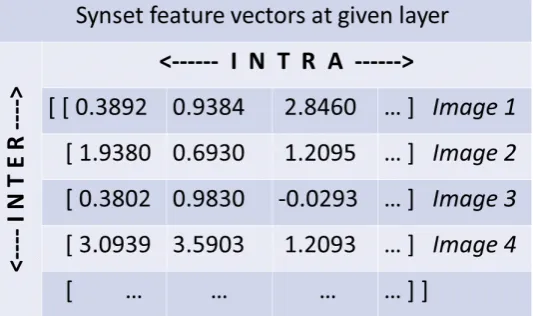
Figure 3: Toy representation of the two types of variance computed, i.e.intra-andinter-image.
Two types of variance are computed for all cropped images of a given synset: intra-vector (intra-image) variance andinter-vector (inter-image). See Figure 3 for a toy representation of both types of variance.
Intra-imageAfter extracting and storing the feature vector for an image of a given synset at a given layer of the CNN, the variance of the feature vector is computed and subsequently averaged with the variances for all other images of the synset. This provides us with the mean intra-image variance, or the average variability within a single image of a given synset. This constitutes a measure of the relative homogeneity of the object, and picks up on the general complexity of the corresponding noun/sense.
Inter-imageFor the second type of variance,inter-vector variance, feature vectors for all images of a given synset are first extracted and stored from a given layer of the neural network. In this case, we cal-culate ‘vertical’ or column-wise variance among each individual dimension for all images of the synset, after which the dimension variances are averaged. This provides us with theinter-image variance, or the variability between distinct images of the same synset, which is a measure of the relative consistency
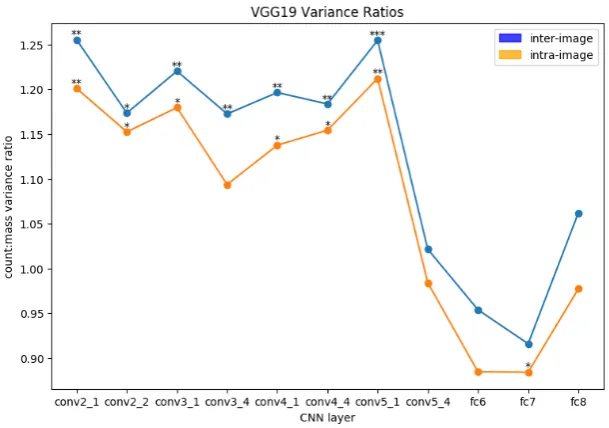
Figure 4: Difference between mass/count variance through the various layers of the network in both
intra-(orange) andinter-(blue) settings.***refers to a significant difference at p<.001,**at p<.01,*at
p<.05.
between instances of a given entity and its corresponding noun/sense.
Both types of variance are computed using the original, full-size vectors as extracted from the net-work.3 That is, we do not employ any dimensionality reduction technique that could cause information loss affecting the variance values. To determine whether there is a significant difference betweenmass
andcountnouns, a two-tailed t-test is performed for each type of variance and for each layer of the CNN.
4
Results
We find both intra-image andinter-image variances to be significantly lower for massnouns as com-pared tocountnouns throughout all tested convolutional layers up untilConv5 1, with only one excep-tion (intra-image variance inConv3 4). From Conv5 4, in contrast, the difference becomes no longer significantly different, again with just one exception (intra-image variance infc7).
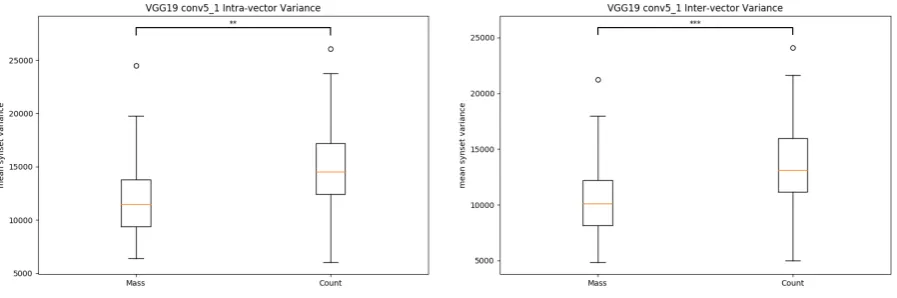
Figure 4 shows this pattern of results obtained across the investigated layers. For visualization pur-poses, we plot the ratiobetween count and mass variance at each layer. As can be seen, this value is higher than1through the early layers, showing that count variance is higher than mass variance. Most importantly, within these layers (encoding low-level visual features) the difference in variance is overall very significant (as shown by the stars on the top of each ‘node’). Throughout the convolutional blocks, the ratio indicating the difference between the two classes increases after the max pooling step is ap-plied. This process ends atConv5 1, when the more abstract visual features start to be computed by the network. Here, we observe quite a big drop in the count/mass ratio, showing that the two variances first become very similar and eventually ‘change sign’ (i.e. mass variance becomes higher than count). How-ever, the difference in variance within these layers is generally not significant. Interestingly, at the last steps, especially atfc8, the ratio between the two variances stabilizes around1, likely indicating that vi-sual representations at this stage are abstract enough not to encode any information about the mass/count distinction. Zooming into the layers,Conv5 1turns out to be the layer where the difference in variance between mass/count synsets is highest for both settings (see Figure 5).
In Table 2 we report top-10 highest variance and bottom-10 lowest variance synsets obtained from
Conv5 1 intra- variance Conv5 1 inter- variance
top-10 bottom-10 top-10 bottom-10
[image:6.595.131.468.69.235.2]magazine 01 (c) range 04 (c) magazine 01 (c) egg yolk 01 (m) salad 01 (m) dough 01 (m) shop 01 (c) range 04 (c) shop 01 (c) mountain 01 (c) salad 01 (m) dough 01 (m) church 02 (c) mesa 01 (c) machine 01 (c) mountain 01 (c) machine 01 (c) flour 01 (m) church 02 (c) mesa 01 (c) floor 02 (c) milk 01 (m) stage 03 (c) milk 01 (m) press 03 (c) glacier 01 (m) press 03 (c) flour 01 (m) stage 03 (c) butter 01 (m) floor 02 (c) butter 01 (m) pasta 01 (m) egg yolk 01 (m) brunch 01 (m) glacier 01 (m) brunch 01 (m) floor 04 (c) building 01 (c) sugar 01 (m)
Table 2: Synsets with highest (top-10) and lowest (bottom-10) variance in bothintra-andinter-settings. Underlined synsets are those belonging to the lesser-represented class in a given column. The bottom-10 columns are presented starting from lowest variance and in ascending order.
this Conv5 1 layer. As expected, most synsets in the top-10 columns belong to the count class (c),
with synsets in the bottom-10 being mostly included in the mass class (m). Moreover, it can be noted that most of the synsets in theintra-setting also appear in theinter-setting, sometimes with an almost perfect alignment. Finally, by looking at the nouns that fall outside the expected pattern, we foresee some interesting cutting-edge cases (i.e. mass in top-10, count in bottom-10). ‘Mountain’ and ‘range’ (here with the sense of ‘a series of hills or mountains’), for instance, are count nouns whose visual texture is intuitively homogeneous, as well as ‘salad’ and ‘pasta’ which are mass nouns referring to entities that consistde factoof many isolable parts, and thus vary more on average across instances.
Figure 5: Boxplots reporting distribution of synset variance in bothintra-(left) andinter-(right) setting
for Conv5 1 layer. Mass/count variance distribution is reliably different at p<.01 (left) and p<.001
(right).
5
Discussion
We show that mass-substance nouns have significantly lower intra- and inter-image variance than do count nouns, which is shown throughout the early convolutional layers of a state-of-the-art CNN. This could be useful in applications such as Visual Question Answering (VQA) or image caption generation, where a proper understanding of countability can lead to better responses and descriptions.
[image:6.595.75.524.429.578.2]visual properties belonging to the opposing mass/count class. Interestingly, count nouns which are la-beled as ‘stuff’ in thethingsvs.stuff distinction, namely ‘mountain’, ‘door’, etc. (see Introduction), are found to behave more like mass in our experiments. More in general, there seems to be a visual
con-tinuumranging from mass-substance all the way to count nouns. Similarly, recent studies in linguistics
point to the fact that the distribution of nouns with respect to their syntactic contexts of occurrence is not consistent with a dichotomist division of the lexicon in two clear-cut classes of ‘mass’ and ‘count’ nouns (Zanini et al. (2016)). Also, metalinguistic judgments collected in various languages point to an inter-pretation of mass and count nouns as poles of a continuous distribution (Kulkarni et al. (2013)). Further investigations on the relation between the visual features of referents and cross-linguistic features are thus desirable.
Finally, the outcome showing lower variance for mass nouns in the inter-image setting might seem surprising, given that count nouns should overall refer to more well-defined objects, and thus more con-sistent in shape. However, this pattern of results is confirmed by literature dealing with object recognition in humans (Cichy et al. (2016)), where it is proposed that shape is a somewhat higher-level cognitive fea-ture. In fact, when perceiving the real world, each visual experience of an entity is almost unique, due to changes in things such as orientation, lighting, and distance. This lack of invariance does not obstruct object recognition in the human observer, but its mechanisms are yet to be fully understood (DiCarlo et al. (2012)).
Acknowledgments
We kindly acknowledge Raquel Fernandez, Angeliki Lazaridou, Roberto Zamparelli, and Marco Marelli for their valuable insights and feedback. We are grateful to the Erasmus Mundus European Master in Language and Communication Technologies (EM LCT) for the scholarship provided to the first author. Moreover, we gratefully acknowledge the support of NVIDIA Corporation with the donation of the GPUs used in our research.
References
Allan, K. (1980). Nouns and countability. Language, 541–567.
Caesar, H., J. Uijlings, and V. Ferrari (2016). COCO-Stuff: Thing and Stuff Classes in Context. arXiv
preprint arXiv:1612.03716.
Cheng, C. Y. (1973). Response to Moravcsik. In J. Hintikka, J. M. E. Moravcsik, and P. Suppes (Eds.),
Approaches to Natural Language, pp. 286–288. Dordrecht: Reidel.
Chierchia, G. (1998). Reference to kinds across language. Natural language semantics 6(4), 339–405.
Chomsky, N. (Ed.) (1967). Aspects of the Theory of Syntax. Cambridge. Mass: MIT Press.
Cichy, R. M., A. Khosla, D. Pantazis, A. Torralba, and A. Oliva (2016). Comparison of deep neural networks to spatio-temporal cortical dynamics of human visual object recognition reveals hierarchical correspondence.Scientific reports 6.
Deng, J., W. Dong, R. Socher, L.-J. Li, K. Li, and L. Fei-Fei (2009). Imagenet: A large-scale hierarchical image database. InComputer Vision and Pattern Recognition, 2009. CVPR 2009. IEEE Conference on, pp. 248–255. IEEE.
DiCarlo, J. J., D. Zoccolan, and N. C. Rust (2012). How does the brain solve visual object recognition?
Neuron 73(3), 415–434.
Fieder, N., L. Nickels, and B. Biedermann (2014). Representation and processing of mass and count nouns: a review.Frontiers in psychology 5.
Kiela, D., L. Rimell, I. Vulic, and S. Clark (2015). Exploiting image generality for lexical entailment detection. InProceedings of the 53rd Annual Meeting of the Association for Computational Linguistics
(ACL 2015), pp. 119–124. ACL.
Kiss, T., F. J. Pelletier, H. Husic, J. M. Poppek, and R. N. Simunic (2016). A Sense-Based Lexicon for Count and Mass Expressions: The Bochum English Countability Lexicon. InProceedings of LREC.
Kulkarni, R., S. Rothstein, and A. Treves (2013). A statistical investigation into the cross-linguistic distribution of mass and count nouns: Morphosyntactic and semantic perspectives. Biolinguistics 7, 132–168.
LeCun, Y., Y. Bengio, and G. Hinton (2015). Deep learning. Nature 521(7553), 436–444.
Lin, T.-Y., M. Maire, S. Belongie, J. Hays, P. Perona, D. Ramanan, P. Doll´ar, and C. L. Zitnick (2014). Microsoft COCO: Common objects in context. In European Conference on Computer Vision, pp. 740–755. Springer.
Miller, G. A. (1995). Wordnet: a lexical database for English. Communications of the ACM 38(11), 39–41.
Mottaghi, R., X. Chen, X. Liu, N.-G. Cho, S.-W. Lee, S. Fidler, R. Urtasun, and A. Yuille (2014). The role of context for object detection and semantic segmentation in the wild. InProceedings of the IEEE
Conference on Computer Vision and Pattern Recognition, pp. 891–898.
Pelletier, F. J. and L. K. Schubert (1989). Mass expressions. In Handbook of philosophical logic, pp. 327–407. Springer.
Russakovsky, O., J. Deng, H. Su, J. Krause, S. Satheesh, S. Ma, Z. Huang, A. Karpathy, A. Khosla, M. Bernstein, et al. (2015). ImageNet large scale visual recognition challenge. International Journal
of Computer Vision 115(3), 211–252.
Sharan, L. (2009). The perception of material qualities in real-world images. Ph. D. thesis, Mas-sachusetts Institute of Technology.
Sharan, L., R. Rosenholtz, and E. H. Adelson (2014). Accuracy and speed of material categorization in real-world images.Journal of vision 14(9), 12–12.
Simonyan, K. and A. Zisserman (2014). Very deep convolutional networks for large-scale image recog-nition. arXiv preprint arXiv:1409.1556.
Tighe, J. and S. Lazebnik (2010). Superparsing: scalable nonparametric image parsing with superpixels.
Computer Vision–ECCV 2010, 352–365.
Tighe, J. and S. Lazebnik (2013). Superparsing. International Journal of Computer Vision 101(2), 329–349.
Zanini, C., S. Benavides-Varela, R. Lorusso, and F. Franzon (2016). Mass is more: The conceiving of (un) countability and its encoding into language in 5-year-old-children. Psychonomic Bulletin &