the Mass Count Distinction
Ryo Nagata1, Takahiro Wakana2, Fumito Masui2, Atsuo Kawai2, and Naoki Isu2
1 Hyogo University of Teacher Education, 942-1 Shimokume, Yashiro, 673-1494 Japan
Mie University, 1577, Kurimamachiya, Tsu, 514-8507, Japan
{wakana, masui, kawai, isu}@ai.info.mie-u.ac.jp
Abstract. This paper proposes a method for detecting errors concern-ing article usage and sconcern-ingular/plural usage based on the mass count distinction. Although the mass count distinction is particularly impor-tant in detecting these errors, it has been pointed out that it is hard to make heuristic rules for distinguishing mass and count nouns. To solve the problem, first, instances of mass and count nouns are auto-matically collected from a corpus exploiting surface information in the proposed method. Then, words surrounding the mass (count) instances are weighted based on their frequencies. Finally, the weighted words are used for distinguishing mass and count nouns. After distinguishing mass and count nouns, the above errors can be detected by some heuristic rules. Experiments show that the proposed method distinguishes mass and count nouns in the writing of Japanese learners of English with an accuracy of 93% and that 65% of article errors are detected with a precision of 70%.
1
Introduction
Although several researchers [1,2,3] have shown that heuristic rules are effective to detecting grammatical errors in the English writing of second language learn-ers, it has been pointed out that it is hard to write heuristic rules for detecting article errors [1]. To be precise, it is hard to write heuristic rules for distinguish-ing mass and count nouns which are particularly important in detectdistinguish-ing article errors. The major reason for this is that whether a noun is a mass noun or a count noun greatly depends on its meaning or its surrounding context (Refer to Pelletier and Schubert [4] for detailed discussion on the mass count distinction). Article errors are very common among Japanese learners of English [1,5]. This is perhaps because the Japanese language does not have an article system similar to that of English. Thus, it is favorable for error detecting systems aiming at Japanese learners of English to be capable of detecting article errors. In other words, such systems need to somehow distinguish mass and count nouns in the writing of Japanese learners of English.
R. Dale et al. (Eds.): IJCNLP 2005, LNAI 3651, pp. 815–826, 2005. c
In view of this background, we propose a method for automatically dis-tinguishing mass and count nouns in context to complement the conventional heuristic rules for detecting grammatical errors. In this method, mass and count nouns are distinguished by words surrounding the target noun. Words surround-ing the target noun are collected from a corpus and weighted based on their occurrences. The weighted words are used for distinguishing mass and count nouns in detecting article errors.
Given the mass count distinction, errors concerning singular/plural usage, which are also common in the writing of Japanese learners of English, can be detected as well as article errors. For example, given that the nouninformation is a mass noun,informations can be detected as an error. Considering this, we include errors concerning singular/plural usage in the target errors of this paper. Hereafter, to keep the notation simple, the target errors1will be referred to as article errors.
The next section describes related work on distinguishing mass and count nouns. Section 3 proposes the method for automatically distinguishing mass and count nouns. Section 4 describes heuristic rules for detecting article errors based on the mass count distinction given by the proposed method. Section 5 discusses results of experiments conducted to evaluate the proposed method.
2
Related Work
Several researchers have proposed methods for distinguishing mass and count nouns in the past. Allan [6] has presented an approach to distinguishing nouns that are used only as either mass or count based on countability environments. This distinction is called countability preferences. Baldwin and Bond [7,8] have proposed several methods for learning the countability preferences from cor-pora2. Bond and Vatikitis-Bateson [9] have shown that nouns’ countability can be predicted using an ontology3. O’Hara et al. [10] have proposed a method for classifying mass and count nouns based on semantic information (Cyc ontological types [11]).
Unfortunately, it is difficult to apply the above methods to complement the conventional heuristic rules for detecting grammatical errors. The meth-ods [6,7,8,9] are not enough for the purpose, because the majority of nouns can be used as both mass and count depending on the surrounding context [12]. The methods [9,10] cannot be readily applicable to the purpose because they work only when semantic information on nouns is given. It would be difficult to extract semantic information from nouns in the writing of learners of English.
1 The details of the target errors are shown in Sect. 4. 2
They define four way countability preferences: fully countable, uncountable, bipar-tite, and plural only.
3
Distinguishing Mass and Count Nouns
In the proposed method, decision lists [13] are used to distinguish mass and count nouns. Generally, decision lists are learned from a set of manually tagged training data. In the proposed method, however, training data can be automatically generated from a raw corpus.
Section 3.1 describes how to generate training data. Section 3.2 describes how to learn decision lists from the training data. Section 3.3 explains the method for distinguishing mass and count nouns using the decision lists.
3.1 Generating Training Data
To generate training data, first, instances of the target noun that head their noun phrase (NP) are collected from a corpus with their surrounding words. This can be simply done by an existing chunker or parser.
Then, the collected instances are tagged with mass or count by tagging rules. For example, the underlinedchicken:
Example 1. ... are a lot of chickens in the roost ... is tagged as
Example 2. ... are a lot of chickens/count in the roost ... because it is in plural form.
We have made tagging rules based on linguistic knowledge [6,14,12]. Figure 1 and Table 1 represent the tagging rules. Figure 1 shows the framework of the tag-ging rules. Each node in Fig. 1 represents a question applied to the instance in ques-tion. For example, the root node reads “Is the instance in question plural?”. Each leaf represents a result of the classification. For example, if the answer is ‘yes’ at the root node, the instance in question is tagged with count. Otherwise, the question at the lower node is applied and so on. The tagging rules do not classify instances as mass or count in some cases. These unclassified instances are tagged with the symbol ‘?’. Unfortunately, they cannot readily be included in training data. For simplicity of implementation, they are excluded from training data.
Table 1.Words used in the tagging rules
(a) (b) (c)
the indefinite article much the definite article another less demonstrative adjectives
one enough possessive adjectives each all interrogative adjectives
— sufficient quantifiers
t
modified by one of the words in Table 1(a)?
modified by one of the words in Table 1(b)?
modified by one of the words in Table 1(c)?
Fig. 1.Framework of the tagging rules
Note that the tagging rules can be used only for distinguishing mass and count nouns in texts containing no errors. They cannot be used in the writing of Japanese learners of English that may contain errors including article errors; they are based on article and the distinction between singular and plural.
Finally, the tagged instances are stored in a file with their surrounding words. Each line in the file consists of one of the tagged instances and its surrounding words as shown in Example 2. The file is used as training data for learning a decision list.
3.2 Learning Decision Lists
A decision list consists of a set of rules that are learned from training data. Each rule matches with the template as follows:
Ifa condition is true, thena decision. (1) To define the template in the proposed method, let us have a look at the following two examples:
Example 3. I read the paper.
Example 4. Thepaper is made of hemp pulp.
Taking this observation into account, we define the template based on words surrounding the target noun. To formalize the template, we will use a random variableM C that takes eithermassor countto denote that the target noun is a mass noun or a count noun, respectively. We will also usewandC to denote a word and a certain context around the target noun, respectively. We define three types ofC:np,−k, and +kthat denote the contexts consisting of the noun phrase that the target noun heads,k words to the left of the noun phrase, and kwords to its right, respectively. Then the template is formalized by
If a wordwappears in the contextC of the target noun, then the target noun is distinguished asM C. Hereafter, to keep the notation simple, the template is abbreviated to
wC →M C. (2)
Now rules that match with the template can be learned from the training data generated in Sect. 3.1. All we need to do is to collect words inC from the training data. Here, the words in Table 1 are excluded. Also, function words such as pronouns and auxiliary verbs, cardinal and quasi-cardinal numerals, and the target noun are excluded. All words are reduced to their morphological stem and converted entirely to lower case when collected. For example, the following tagged instance:
Example 5. She ate a piece of fried chicken/mass for dinner. would give a set of rules that match with the template: Example 6.
piece−3→mass, f rynp→mass, dinner+3 →mass for the target nounchicken beingmass whenk= 3.
In addition to the above rules, a default rule is defined. It is based on the target noun itself and used when no other confident rules4 are found in the decision list for the target noun. It is defined by
t→M Cmajor (3)
wheretandM Cmajor denote the target noun and the major case ofM Cin the training data, respectively. Equation (3) reads “If the target noun appears, then it is distinguished as the major case”.
The log-likelihood ratio [15] decides in which order rules in a decision list are applied to the target noun in novel context. It is defined by
logp(M C|wC) p(M C|wC)
(4)
4
whereM C is the exclusive event ofM Cand p(M C|wC) is the probability that
the target noun is used asM Cwhenwappears in the contextC. For the default rule, the log-likelihood ratio is defined by
logp(M Cmajor|t)
p(M Cmajor|t) (5)
It is important to exercise some care in estimatingp(M C|wC). In principle,
we could simply count the number of times thatw appears in the contextC of the target noun used asM Cin the training data. However, this estimate can be unreliable, whenwdoes not appear often in the context. To solve this problem, using a smoothing parameterα[16], p(M C|wC) is estimated by
p(M C|wC) =
f(wC, M C) +α
f(wC) +mα
(6)
wheref(wC) andf(wC, M C) are occurrences ofwappearing inC and those in
C of the target noun used as M C, respectively. The constantm is the number of possible classes, that is, m= 2 (mass or count) in our case, and introduced to satisfyp(M C|wC) +p(M C|wC) = 1. In this paper,αis set to 0.5. Likewise,
p(M Cmajor|t) is estimated by
p(M Cmajor|t) =
f(t, M Cmajor) +α
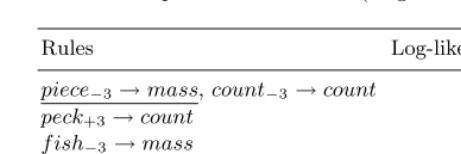
f(t) +mα (7) Rules in a decision list are sorted in descending order by (4) and (5). They are tested on the target noun in novel context in this order. Rules sorted below the default rule are discarded because they are never used as we will see in Sect. 3.3. Table 2 shows part of a decision list for the target noun chicken that was learned from a subset of the BNC (British National Corpus) [17]. Note that the rules are divided into two columns for the purpose of illustration in Table 2; in practice, they are merged into one just as shown in Table 3.
On one hand, we associate the words in the left half with food or cooking. On the other hand, we associate those in the right half with animals. From this observation, we can say that chicken is a count noun in the sense of an animal but a mass noun when referring to food or cooking, which agrees with the knowledge presented in previous work [18].
Table 2.Rules in a decision list (target noun:chicken,k= 3)
Mass Count
wC Log-likelihood ratiowC Log-likelihood ratio
piece−3 1.49 count−3 1.49
f ish−3 1.28 peck+3 1.32
dish−3 1.23 pignp 1.23
skin+3 1.23 run−3 1.23
Table 3.An example of a decision list (target noun:chicken,k= 3)
Rules Log-likelihood ratio
piece−3→mass,count−3→count 1.49
peck+3→count 1.32
f ish−3 →mass 1.28
dish−3→mass,pignp→count,· · · 1.23
: :
3.3 Distinguishing the Target Noun in Novel Context
To distinguish the target noun in novel context, each rule in the decision list is tested on it in the sorted order until the first applicable one is found. It is distinguished by the first applicable one. If two or more applicable rules (e.g., “piece−3 →mass” and “count−3 →count” in Table 3) are found, it is distin-guished by the major decisions of the two or more applicable rules. For example, suppose there are three applicable rules and two of them are for mass nouns (one of them is for count nouns). In this case, the target noun is distinguished as mass. Ties are broken by rules sorted below the ties. If ties include the default rule, it is distinguished by the default rule.
The following is an example of distinguishing the target nounchicken. Sup-pose that the decision list shown in Table 3 and the following sentence are given: Example 7. I ate a piece ofchicken with salad.
It turns out that the first rule “piece3→mass” in Table 3 is applicable to the instance. Thus, it is distinguished as a mass noun.
It should be noted that rules sorted below the default rule are never used because the default rule is always applicable to the target noun. This is the reason why rules sorted below the default rule are discarded as mentioned in Sect. 3.2.
4
Heuristic Rules for Detecting Article Errors
So far, a method for distinguishing mass and count nouns has been described. This section describes heuristic rules for detecting article errors based on the mass count distinction given by the method.
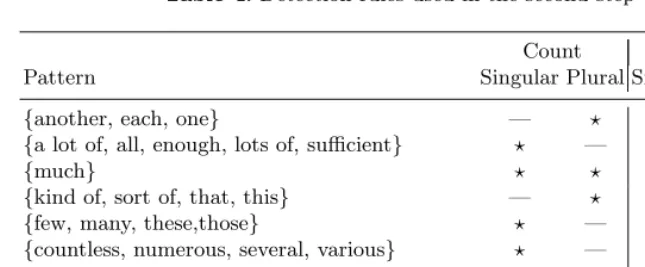
Article errors are detected by the following three steps. Rules in each step are examined on each target noun in the target text.
Table 4.Detection rules used in the second step
Count Mass
Pattern Singular Plural Singular Plural
{another, each, one} —
{a lot of, all, enough, lots of, sufficient} — —
{much} —
{kind of, sort of, that, this} — —
{few, many, these,those} —
{countless, numerous, several, various} —
cardinal number except one —
{any, some, no,’s genitives} — — —
{interrogative adjectives,possessive adjectives} — — —
Table 5.Detection rules used in the third step
Singular Plural a the φ a theφ
Mass – –
Count – – – –
plural count nouns, singular mass nouns, and plural mass nouns that are mod-ified byanother,each, or one are erroneous. The symbol “—” denotes that no error can be detected by the table. If one of the rules in Table 4 is applied to the target noun, the third step is not applied.
In the third step, article errors are detected by the rules described in Table 5. The symbols “a”, “the”, and “φ” in Table 5 denote the indefinite article, the definite article, and no article, respectively. The symbols “” and “—” are the same as in Table 4. For example, “” in the third row and second column denotes that the singular mass nouns modified by the indefinite article is erroneous.
In addition to the three steps, article errors are detected by exceptional rules. The indefinite article that modifies other than the head noun is judged to be erroneous (e.g., *an expensive). Likewise, the definite article that modifies other than the head noun and adjectives is judged to be erroneous (e.g., *the them).
5
Experiments
5.1 Experimental Conditions
A subset of essays5 written by Japanese learners of English were used as the target texts in the experiments. The subset contained 30 essays (1747 words). A native speaker of English who was a professional rewriter of English recognized 62 article errors in the subset.
5
The British National Corpus (BNC) [17] was used to learn decision lists. Spoken data were excluded from the corpus. Also, sentences the OAK system6, which was used to extract NPs from the corpus, failed to analyze were excluded. After these operations, the size of the corpus approximately amounted to 80 million words (the size of the original BNC is approximately 100 million words). Hereafter, unless otherwise specified, the corpus will be referred to as the BNC. Performance of the proposed method was evaluated by accuracy, recall, and precision. Accuracy is defined by
No. of mass and count nouns distinguished correctly
No. of distinguished target nouns . (8) Namely, accuracy measures how accurately the proposed method distinguishes mass and count nouns. Recall is defined by
No. of article errors detected correctly
No. of article errors in the target essays. (9) Recall measures how well the proposed method detects all the article errors in the target essays. Precision is defined by
No. of article errors detected correctly
No. of detected article errors . (10) Precision measures how well the proposed method detects only the article errors in the target essays.
5.2 Experimental Procedures
First, decision lists for each target noun in the target essays were learned from the BNC. To extract noun phrases and their head nouns, the OAK system was used7. An optimal value fork(window size of context) was estimated as follows. For 23 nouns8shown in [12] as examples of nouns used as both mass and count nouns, accuracy was calculated using the BNC and ten-fold cross validation. As a result of settingk= 3,10,50, it turned out thatk= 3 maximized the average accuracy. Following this result,k= 3 was selected in the experiments.
Second, the target nouns were distinguished whether they were mass or count by the proposed method, and then article errors were detected by the mass
6 OAK System Homepage: http://nlp.cs.nyu.edu/oak/ 7
We evaluated how accurately training data can be generated by the tagging rules using the OAK system. It turned out that the accuracy was 0.997 against 2903 instances of 23 nouns shown in [12] which were randomly selected from the BNC; 1694 of those were tagged with mass or count by the tagging rules and 1689 were tagged correctly. The five errors were due to the OAK system.
8
count distinction and the heuristic rules described in Sect. 4. As a preprocessing, spelling errors in the target essays were corrected using a spell checker.
Finally, the results of the detection were compared to those done by the native-speaker of English. From the comparison, accuracy, recall, and precision were calculated.
Comparison of performance of the proposed method to that of other meth-ods is difficult because there is no generally accepted test set or performance baseline [19]. Given this limitation, we compared performance of the proposed method to that of Grammarian9, a commercial grammar checker. We also com-pared it to that of a method that used only the default rules in the decision lists. We tested them on the same target essays to measure their performances.
5.3 Experimental Results and Discussion
In the experiments, the proposed method distinguished mass and count nouns in the target essays with accuracy of 0.93. This means that the proposed method is effective to distinguishing mass and count nouns in the writing of Japanese learners of English. From this result, we can say that the proposed method can complement the conventional heuristic rules for detecting grammatical errors.
Because of the high accuracy of the proposed method, it detected more than half of the article errors in the target essays (Table 6). Of the undetected article errors (22 out of 62), only four were due to the misclassification of mass and count nouns by the proposed method. The rest were article errors that were not detected even if the mass count distinction was given. For example, extra definite articles such as “I like *the gardening.” cannot be detected even if whether the noun “gardening” is a mass noun or a count noun is given. Therefore, it is necessary to exploit other sources of information than the mass count distinction to detect these kinds of article error. For instance, exploiting the relation between sentences could be used to detect these kinds of article error.
The proposed method outperformed the method using only the default rules in both recall and precision. This means that words surrounding the target nouns are good indicators of the mass count distinction. For example, the proposed method correctly distinguished the target noun place in the phrase beautiful place as a count noun by “beautif ulnp→count” and detected an article error
from it whereas the method using only the default rules did not.
Table 6.Experimental results
Method Recall Precision
Proposed 0.65 0.70
Default only 0.60 0.69 Grammarian 0.13 1.00
9
In precision, the proposed method was outperformed by Grammarian; since Grammarian is a commercial grammar checker, it seems to be precision-oriented. The proposed method made 17 false-positives. Of the 17 false-positives, 13 were due to the misclassification of mass and count nouns by the proposed method. Especially, the proposed method often made false-positives in idiomatic phrases (e.g., by plane). This result implies that some methods for handling idiomatic phrases may improve the performance. Four were due to the chun-ker used to analyze the target essays. Since the chunchun-ker is designed for ana-lyzing texts that contain no errors, it is possible that a chunker designed for analyzing texts written by Japanese learners of English reduces this kind of false-positive.
6
Conclusions
This paper has proposed a method for distinguishing mass and count nouns to complement the conventional heuristic rules for detecting grammatical errors. The experiments have shown that the proposed method distinguishes mass and count nouns with a high accuracy (0.93) and that the recall and precision are 0.65 and 0.70, respectively. From the results, it follows that the proposed method can complement the conventional heuristic rules for detecting grammatical errors in the writing of Japanese learners of English.
The experiments have also shown that approximately 35% of article errors in the target essays are not detected by the mass count distinction. For future work, we will study methods for detecting the undetected article errors.
Acknowledgments
The authors would like to thank Sekine Satoshi who has developed the OAK System. The authors also would like to thank three anonymous reviewers for their advice on this paper.
References
1. Kawai, A., Sugihara, K., Sugie, N.: ASPEC-I: An error detection system for English composition. IPSJ Journal (in Japanese) 25(1984) 1072–1079
2. McCoy, K., Pennington, C., Suri, L.: English error correction: A syntactic user model based on principled “mal-rule” scoring. In: Proc. 5th International Confer-ence on User Modeling. (1996) 69–66
3. Schneider, D., McCoy, K.: Recognizing syntactic errors in the writing of second language learners. In: Proc. 17th International Conference on Computational Lin-guistics. (1998) 1198–1204
5. Izumi, E., Uchimoto, K., Saiga, T., Supnithi, T., Isahara, H.: Automatic error detection in the Japanese learners’ English spoken data. In: Proc. 41st Annual Meeting of the Association for Computational Linguistics. (2003) 145–148 6. Allan, K.: Nouns and countability. J. Linguistic Society of America 56 (1980)
541–567
7. Baldwin, T., Bond, F.: A plethora of methods for learning English countability. In: Proc. 2003 Conference on Empirical Methods in Natural Language Processing. (2003) 73–80
8. Baldwin, T., Bond, F.: Learning the countability of English nouns from corpus data. In: Proc. 41st Annual Meeting of the Association for Computational Lin-guistics. (2003) 463–470
9. Bond, F., Vatikiotis-Bateson, C.: Using an ontology to determine English count-ability. In: Proc. 19th International Conference on Computational Linguistics. (2002) 99–105
10. O’Hara, T., Salay, N., Witbrock, M., Schneider, D., Aldag, B., Bertolo, S., Panton, K., Lehmann, F., Curtis, J., Smith, M., Baxter, D., Wagner, P.: Inducing criteria for mass noun lexical mappings using the Cyc KB, and its extension to WordNet. In: Proc. 5th International Workshop on Computational Semantics. (2003) 425–441 11. Lenat, D.: CYC: A large-scale investment in knowledge infrastructure.
Communi-cations of the ACM38(1995) 33–38
12. Huddleston, R., Pullum, G.: The Cambridge Grammar of the English Language. Cambridge University Press, Cambridge (2002)
13. Rivest, R.: Learning decision lists. Machine Learning2(1987) 229–246
14. Gillon, B.: The lexical semantics of English count and mass nouns. In: Proc. Special Interest Group on the Lexicon of the Association for Computational Linguistics. (1996) 51–61
15. Yarowsky, D.: Unsupervised word sense disambiguation rivaling supervised meth-ods. In: Proc. 33rd Annual Meeting of the Association for Computational Linguis-tics. (1995) 189–196
16. Yarowsky, D.: Homograph Disambiguation in Speech Synthesis. Springer-Verlag (1996)
17. Burnard, L.: Users Reference Guide for the British National Corpus. version 1.0. Oxford University Computing Services, Oxford (1995)
18. Ostler, N., Atkins, B.: Predictable meaning shift: Some linguistic properties of lexical implication rules. In: Proc. of 1st SIGLEX Workshop on Lexical Semantics and Knowledge Representation. (1991) 87–100