Learning beyond datasets: Knowledge Graph Augmented Neural
Networks for Natural language Processing
Annervaz K M∗
Indian Institute of Science, Accenture Technology Labs
Somnath Basu Roy Chowdhury∗†
IIT Kharagpur
Ambedkar Dukkipati Indian Institute of Science
Abstract
Machine Learning has been the quintessen-tial solution for many AI problems, but learn-ing models are heavily dependent on spe-cific training data. Some learning models can be incorporated with prior knowledge using a Bayesian setup, but these learning models do not have the ability to access any orga-nized world knowledge on demand. In this work, we propose to enhance learning models withworld knowledgein the form of Knowl-edge Graph (KG) fact triples for Natural Lan-guage Processing (NLP) tasks. Our aim is to develop a deep learning model that can ex-tract relevant prior support facts from knowl-edge graphsdepending on the task using atten-tion mechanism. We introduce a convolution-based model for learning representations of knowledge graph entity and relation clusters in order to reduce the attention space. We show that the proposed method is highly scalable to the amount of prior information that has to be processed and can be applied to any generic NLP task. Using this method we show sig-nificant improvement in performance for text classification with 20Newsgroups (News20) & DBPedia datasets, and natural language infer-ence with Stanford Natural Language Infer-ence (SNLI) dataset. We also demonstrate that a deep learning model can be trained with sub-stantially less amount of labeled training data, when it has access to organized world knowl-edge in the form of a knowlknowl-edge base. 1 Introduction
Today, machine learning is centered around al-gorithms that can be trained on available task-specific labeled and unlabeled training samples. Although learning paradigms like Transfer Learn-ing (Pan and Yang, 2010) attempt to incorporate
∗
equal contribution †
Main work done during internship at Accenture Technol-ogy Labs
knowledge from one task into another, these tech-niques are limited in scalability and are specific to the task at hand. On the other hand, humans have the intrinsic ability to elicit required past knowl-edge from the world on demand and infuse it with newly learned concepts to solve problems.
The question that we address in this paper is the following: Is it possible to develop learning mod-els that can be trained in a way that it is able to infuse a general body of world knowledge for pre-diction apart from learning based on training data?
World-Knowledge
Base X
+
Xw
[image:1.595.308.529.387.485.2]X0 f Y
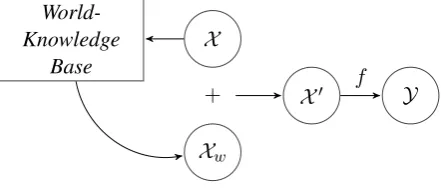
Figure 1: The Basic Idea:X is the feature input andY is the prediction. The relevant world knowledge for the taskXw, is retrieved and augmented with the feature
input before making the final prediction
By world knowledge, we mean structured gen-eral purpose knowledge that need not be domain specific. Knowledge Graphs (Nickel et al., 2016a) are a popular source of such structured world knowledge. Knowledge Graphs represent infor-mation in the form of fact triplets, consisting of a subject entity, relation and object entity (exam-ple: <Italy, capital, Rome>). The entities
rep-resent the nodes of the graph and their relations act as edges. A fact triple (subject entity,
re-lation, object relation) is represented as (h, r, t).
Practical knowledge bases congregate information from secondary databases or extract facts from unstructured text using various statistical learn-ing mechanisms, examples of such systems are NELL (Mitchell et al., 2015) and DeepDive (Niu
et al., 2012). There are human created knowledge bases as well, like Freebase (FB15k) (Bollacker et al., 2008) and WordNet (Miller et al., 1990). The knowledge present in these knowledge bases includes common knowledge and partially cov-ers common-sense knowledge and domain knowl-edge (Song and Roth, 2017). Knowlknowl-edge Graphs and Knowledge Bases are conceptually equivalent for our purpose and we will use the name inter-changeably in this paper.
We illustrate the significance of world knowl-edge using a few examples. For the example of a Natural Language Inference (NLI) prob-lem (MacCartney, 2009), consider the two follow-ing statements, A:The couple is walking on the sea shore and B: The man and woman are wide awake. Here, for a learn-ing model to infer B from A, it should have ac-cess to the common knowledge that “The man and womanandThe couplemeans the same” since this information may not be specific for a particular inference. Further, it is not possible for a model to learn all such correlations from just the labeled training data available for the task.
Consider another example of classifying the news snippet,Donald Trump offered his condolences towards the hurricane victims and their families in Texas. We cannot classify it as a political news unless we know the facts<Donald Trump,
president, United States> and <Texas, state,
United States>. We posit that machine learning
models, apart from training them on data with the ground-truth can also be trained to fetch relevant information from structured knowledge bases in order to enhance their performance.
In this work, we propose a deep learning model that can extract relevant support facts on demand from a knowledge base (Mitchell et al., 2015) and incorporate it in the feature space along with the features learned from the training data (shown in Figure 1). This is a challenging task, as knowledge bases typically have millions of fact triples. Our proposed model involves a deep learning mecha-nism to jointly model this look-up scheme along with the task specific training of the model. The look-up mechanism and model is generic enough so that it can be augmented to any task specific learning model to boost the learning performance. In this paper, we have established superior per-formance of the proposed KG-augmented models
over vanilla model on text classification and natu-ral language inference.
Although there is a plethora of work on knowledge graph representation (Nickel et al., 2016a) (Mitchell et al., 2015) (Niu et al., 2012) from natural language text, no attempt to augment learning models with knowledge graph informa-tion have been done. To the best of our knowledge this is the first attempt to incorporate world knowl-edge from a knowlknowl-edge base for learning models.
2 Knowledge Graph Representations Knowledge Graph entities/relations need to be en-coded into a numerical representation for process-ing. Before describing the model, we provide a brief overview of graph encoding techniques. Var-ious KG embedding techniques can be classified at a high level into: Structure-based embeddings andSemantically-enriched embeddings.
Structure-based embeddings: TransE (Bordes et al., 2013) is the introductory work on knowl-edge graph representation, which translated sub-ject entity to obsub-ject entity using one-dimensional relation vector (h + r = t). Variants of the
TransE (Bordes et al., 2013) model uses transla-tion of the entity vectors over relatransla-tion specific sub-spaces. TransH (Wang et al., 2014b) introduced the relation-specific hyperplane to translate the en-tities. Similar work utilizing only the structure of the graph include ManifoldE (Xiao et al., 2015b), TransG (Xiao et al., 2015a), TransD (Ji et al., 2015), TransM (Fan et al., 2014), HolE (Nickel et al., 2016b) and ProjE (Shi and Weninger, 2017).
In our experiments we have used the DKRL (Xie et al., 2016) encoding scheme as it em-phasizes on the semantic description of the text. Moreover, DKRL fundamentally uses TransE (Bordes et al., 2013) method for encoding struc-tural information. Therefore, we can retrieve rele-vant entities & relation and obtain the complete the fact usingt=h+r. This reduces the complexity
of fact retrieval as the number of entities/relations is much less compared to the number of facts, thus making the retrieval process faster.
3 The Proposed Model
Conventional supervised learning models with pa-rametersΘ, given training dataxand labely, tries
to maximize the following function
max
Θ P(y|x,Θ)
The optimized parametersΘare given as,
Θ = argmax
Θ
logP(y|x,Θ)
In this work, we propose to augment the super-vised learning process by incorporation of world knowledge featuresxw. The world knowledge
fea-tures are retrieved using the datax, using a
sepa-rate model where, xw = F(x,Θ(2)). Thus, our
modified objective function can be expressed as
max
Θ P(y|x, xw,Θ (1))
where, Θ = {Θ(1),Θ(2)}. The optimized
pa-rameters can be obtained using the equation
Θ = argmax
Θ
logP(y|x, F(x,Θ(2)),Θ(1))
The subsequent sections focus on the formula-tion of the funcformula-tionFwhich is responsible for fact
triple retrieval using the data samplex. Here it is
important to note that, we are not assuming any structural form forP based on F. So the method
is generic and applicable to augment any super-vised learning setting with any form forP, only
constraint being P should be such that the error
gradient can be computed with respect to F. In
the experiments we have used softmax using the LSTM (Greff et al., 2015) encodings of the input as the form for P. As forF, we use soft
atten-tion (Luong et al., 2015; Bahdanau et al., 2014) using the LSTM encodings of the input and appro-priate representations of the fact(s). Based on the
representation used for the facts, we propose two models(a) Vanilla Model (b) Convolution-based
entity/relation cluster representation, for fact re-trieval in the subsequent sections.
3.1 Vanilla Model
The entities and relationships of KG are encoded using DKRL, explained earlier. Letei ∈Rmstand
for the encoding of the entity i and rj ∈ Rm
stands for jth relationship in the KG. The input
text in the form of concatenated word vectors, x = (x1, x2, . . . , xT) is first encoded using an
LSTM (Greff et al., 2015) module as follows,
ht=f(xt, ht−1)
and
o= 1
T T
X
t=1
ht,
ht ∈ Rnis the hidden state of the LSTM at time t,f is a non-linear function andT is the sequence
length. Then a context vector is formed fromoas
follows,
C= ReLU(oTW),
where,W ∈ Rn×m represent the weight
parame-ters. The same procedure is duplicated with sepa-rate LSTMs to form two sepesepa-rate context vectors, one for entity retrieval (CE) and one for
relation-ship retrieval (CR).
As the number of fact triples in a KG is in the order of millions in the vanilla model, we resort to generating attention over the entity and relation space separately. The fact is then formed using the retrieved entity and relation. The attention for the entity,eiusing entity context vector is given by
αei =
exp(CETei) |E|
P
j=0
exp(CETej)
where|E|is the number of entities in the KG. Similarly the attention for a relation vectorriis
computed as
αri =
exp(CT Rri) |R|
P
j=0
exp(CT Rrj)
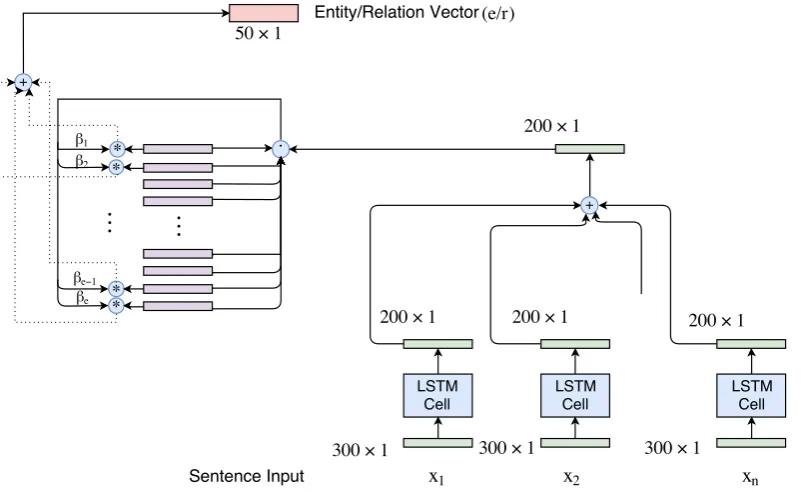
Figure 2: Vanilla Entity/Relationship Retrieval Block Diagram
values of individual retrieved entity/relation vec-tors.
e=
|E|
X
i=0
αeiei r =
|R|
X
i=0
αriri
Figure 2 shows the schematic diagram for en-tity/relation retrieval. After the final entity and relation vectors are computed, we look forward to completion of the fact triple. The KG embed-ding technique used for the experiment is DKRL which inherently uses the TransE model assump-tion (h+r≈t). Therefore, using the subject entity
and relation we form the object entity ast=e+r. Thus the fact triplet retrieved isF = [e, r, e+r],
whereF ∈ R3m. This retrieved fact information
is concatenated along with the context vector (C) of inputxobtained using LSTM module. The final
classification labelyis computed as follows,
F0 = ReLU(FTV)
y= softmax([F0 :C]TU)
where, V ∈ R3m×u andU ∈ R2u×u are model
parameters to be learned. y is used to compute the cross entropy loss. We minimize this loss av-eraged across the training samples, to learn the various model parameters using stochastic gradi-ent descgradi-ent (Bottou, 2012). The final predictiony, now includes information from both dataset spe-cific samples and world knowledge to aid in
en-hanced performance. While jointly training the at-tention mechanism tunes itself to retrieve relevant facts that are required to do the final classification.
3.2 Pre-training KG Retrieval
Figure 3: Separately Training Knowledge Graph Retrieval and Jointly Training the Full Model
at the time of joint training. However, the key problem of attention mechanism having to cover a large span of entities/relation, remained.
3.3 Convolution-based Entity and Relation Cluster Representation
In this section, we propose a mechanism to re-duce the large number of entities/relationships over which attention has to be generated in the knowledge graph. We propose to reduce the atten-tion space by learning the representaatten-tion of similar entity/relation vectors and attending over them.
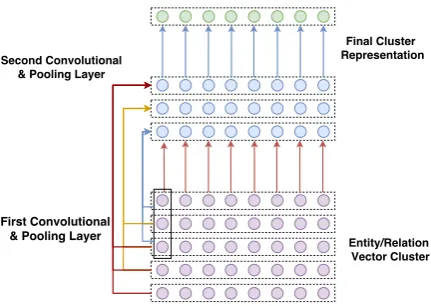
Figure 4: Convolution model cluster representation In order to cluster similar entity/relation vec-tors, we usedk-means clustering (Bishop, 2006)
and formed l clusters with equal number of
en-tity/relation vectors in each cluster. Each of the clusters were then encoded using convolu-tional filters. The output of the k-means
clus-tering is a sequence of entity/relation vectors
{eT
1, eT2,· · ·, eqT}, whereei∈Rm. For each
clus-ter these vectors were stacked to formE as the 2-D input to the CNN encoder, where E ∈ Rm×q.
During experimentation for finding a suitable
fil-ter shape, it was observed that using 2-D filfil-ters the model failed to converge at all. Therefore, we inferred that the latent representation of two dif-ferent indices in the vectorei, should not be
tam-pered using convolution. We then resorted to use 1-D convolution filters which slide along only the columns ofE, as shown Figure 4. The stride length alongy-axis is the window lengthk. The output of
the convolution layer is expressed as,
E0(i, j) =WT[ei,j, ei+1,j, . . . , ei+k−1,j]T
where,E0(i, j)is the(i, j)thelement of the output
matrixE0 andW ∈ Rkis the convolution weight
filter. A pooling layer followed the convolution layer in order to reduce the parameter space, we used 1-D window only along the y-axis similar
to the convolutional kernel mentioned above. We used a two layered convolution network with the stride lengthk& max-pool windowsnis adjusted
to obtain outputEi ∈ Rm, whereiis the cluster
index. Similar procedure of clustering followed by the encoding of the cluster entities is done for relations as well. Thus both the entity and rela-tion space were reduced to contain fewer elements, one each for each cluster. After the compact entity space E and relation space R is formed, we
[image:5.595.74.290.414.567.2]ac-curacy output remained within an error bound of
±0.5%. In various permutations, the
representa-tions learned by the convolution operator for clus-ters varies, but it does not affect the overall re-sults. Regarding the interpretation of what con-volution operator learns, the operator is applied along each dimension of the entity/relationship vector, to learn a representation of the clusters. This representation includes information from rel-evant entities in the cluster, as the relrel-evant entities varies across tasks, the representation learned us-ing convolution also adapts accordus-ingly. It is anal-ogous to learning relevant features from an im-age, in our case the convolution layer learns the features focusing on relevant entities/relations in a cluster pertaining to the task.
4 Experiments and Evaluations
Our experiments were designed to analyze whether a deep learning model is being improved when it has access to KG facts from a relevant source. The selection of knowledge graph has to be pertinent to the task at hand, as currently there is no single knowledge base that contains multi-ple kinds of information and can cater to all tasks. We illustrate with results that the performance of a deep learning model improves when it has ac-cess to relevant facts. We also illustrate that as the model learns faster with access to knowledge bases, we can train deep learning models with substantially less training data, without compro-mising on the accuracy. In the subsequent sec-tion we briefly describe the datasets and associated Knowledge Bases used.
Datasets and Relevant Knowledge Graphs
In our experiments, we have mainly used the popular text classification dataset 20Newsgroups (Lichman, 2013) and the Natural Language In-ference dataset, Stanford Natural Language Infer-ence (SNLI) corpus (Bowman et al., 2015). We have also done experiments on DBPedia ontology classification dataset1, with a very strong
base-line. These datasets are chosen as they share do-main knowledge with two most popular knowl-edge bases, Freebase (FB15k) (Bollacker et al., 2008) and WordNet (WN18) (Bordes et al., 2013). The training and test size of the datasets are men-tioned in Table 1.
1http://wiki.dbpedia.org/
services-resources/dbpedia-data-set-2014
Dataset Train Size Test Size # Classes
News20 16000 2000 20
SNLI 549367 9824 3
DBPedia 553,000 70,000 14
Table 1: Dataset Specifications
Freebase (FB15k) (Bollacker et al., 2008) con-tains facts about people, places and things (con-tains 14904 entities, 1345 relations & 4.9M fact triples), which is useful for text classification in 20Newsgroups (Lichman, 2013) dataset. On the other hand, WordNet (WN18) (Bordes et al., 2013) (has 40943 entities, 18 relations & 1.5M fact triples) contains facts about common day-to-day things (example: furniture includes bed), which can help in inference tasks like SNLI. Both the knowledge bases are directed graphs, due to fewer number of relations WN18 the entities are more likely to be connected using the same type of relations. For experiments relating to both the datasets 20Newsgroups & SNLI we used the stan-dard LSTM as the classification module. As iter-ated earlier, our KG based fact retrieval is indepen-dent of the base model used. We show improve-ment in performance using the proposed models by KG fact retrieval. We use classification accu-racy of the test set as our evaluation metric.
4.1 Experimental Setup
All experiments were carried on a Dell Precision Tower 7910 server with Quadro M5000 GPU with 8 GB of memory. The models were trained using the Adam’s Optimizer (Kingma and Ba, 2014) in a stochastic gradient descent (Bottou, 2012) fash-ion. The models were implemented using Ten-sorFlow (Abadi et al., 2015). The relevant hyper-parameters are listed in Table 2. The word embed-dings for the experiments were obtained using the pre-trained GloVe (Pennington et al., 2014)2
vec-tors. For words missing in the pre-trained vectors, the local GloVe vectors which was trained on the corresponding dataset was used.
4.2 Results & Discussion
Table 3 shows the results of test accuracy of the various methods proposed on the datasets News20 & SNLI. We observe that incorporation of KG facts using the basic vanilla model improves the performance slightly, as the retrieval model was
Hyper-parameter News20 SNLI
Batch size 256 1024
Learning rate 0.05 0.05 Word Vector Dimension 300 300
Sequence Length 300 85
LSTM hidden-state Dimension 200 200 KG Embedding Dimension 50 50
# Clusters 20 20
# Epochs 20 20
Table 2: Hyper-parameters which were used in experi-ments for News20 & SNLI datasets
not getting trained effectively. The convolution-based model shows significant improvement over the normal LSTM classification. While tuning the parameters of the convolution for clustered enti-ties/relations it was observed that smaller stride length and longer max-pool window improved performance. For News20 dataset we show an improvement of almost 3% and for SNLI an im-provement of almost 5%.
The work is motivated more from the perspec-tive of whether incorporation of world knowl-edge will improve any deep learning model rather than beating the state-of-the-art performance. Al-though LSTM is used to encode the input for the model as well as the retrieval vector, as mentioned earlier, these two modules need not be same. For encoding the input any complex state-of-the-art model can be used. LSTM has also been used to generate the retrieval vector. For DBPedia ontol-ogy classification dataset, we have used a strong baseline of 98.6%, and after augmenting it with KG (Freebase) using convolution based model we saw an improvement of∼0.2%. As the baseline is
stronger, the improvement quantum has decreased. This is quite intuitive as complex models are self-sufficient in learning from the data by itself and therefore the room available for further improve-ment is relatively less. The improveimprove-ment as ob-served in the experiments is significant in weaker learning models, however it is also capable of im-proving stronger baselines as is evident from the results of DBPedia dataset.
4.3 Reducing Dataset Size Requirements for Training Deep Learning Models
We hypothesized that as Knowledge Graph is feeding more information to the model, we can achieve better performance with less training data.
Model Accuracy
News20 SNLI
Plain LSTM 66.75% 68.73%
[image:7.595.309.498.305.473.2]Vanilla KG Retrieval 67.30% 69.20% Convolution-based KG 69.34% 73.10%
Table 3: Test accuracy of approaches in News20 using FB15K & SNLI datasets using WN18
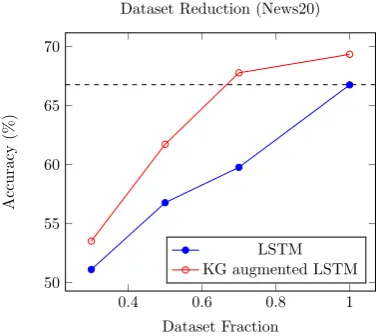
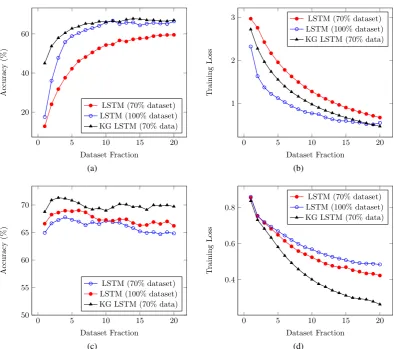
To verify this we have performed experiments on varying dataset fractions for 20Newsgroups dataset as shown in Figure 5. From the plot, we observe that KG augmented LSTM with 70% data outperforms the baseline model with full dataset support, thereby reducing the dependency on la-beled data by 30%.
0.4 0.6 0.8 1 50
55 60 65 70
Dataset Fraction
Accuracy
(%)
Dataset Reduction (News20)
LSTM KG augmented LSTM
Figure 5: Accuracy Plot over dataset fractions for base-line and KG augmented model for News20
0 5 10 15 20 20
40 60
Dataset Fraction
Accuracy
(%)
LSTM (70% dataset) LSTM (100% dataset) KG LSTM (70% data)
(a)
0 5 10 15 20
1 2 3
Dataset Fraction
T
raining
Loss
LSTM (70% dataset) LSTM (100% dataset) KG LSTM (70% data)
(b)
0 5 10 15 20
50 55 60 65 70
Dataset Fraction
Accuracy
(%)
LSTM (70% dataset) LSTM (100% dataset) KG LSTM (70% data)
(c)
0 5 10 15 20
0.4 0.6 0.8
Dataset Fraction
T
raining
Loss
LSTM (70% dataset) LSTM (100% dataset) KG LSTM (70% data)
(d)
Figure 6: (a) Accuracy Plot over training epochs for LSTM (using full & 70% dataset) and KG augmented LSTM (using 70% dataset ) for News20 task (b) Corresponding Training Loss plots for the aforementioned methods using News20 dataset (c) Accuracy Plot over training epochs for LSTM (using full & 70% dataset) and KG augmented LSTM (using 70% dataset ) for SNLI task (d) Corresponding Training Loss plots for the aforementioned methods using SNLI dataset
models, which is hard to come by.
5 Relevant Previous Work
The basic idea of infusing general world knowl-edge for learning tasks, especially for natural lan-guage processing, has not been attempted before. For multi-label image classification, the use of KGs has been pursued recently by (Marino et al., 2016). In this work, they first obtain labels of the input data (using a different model), use these la-bels to populate features from the KG and in turn use these features back for the final classification. For NLP tasks the information needed may not necessarily depend on the final class, and we are directly using all the information available in the input for populating the relevant information from the knowledge graphs. Our attempt is very differ-ent from Transfer Learning (Pan and Yang, 2010).
[image:8.595.103.498.65.414.2]6 Conclusion & Future Work
In this work we have illustrated the need for in-corporating world knowledge in training task spe-cific models. We presented a novel convolution-based architecture to reduce the attention space over entities and relations that outperformed other models. With significant improvements over the vanilla baselines for two well known datasets, we have illustrated the efficacy of our proposed meth-ods in enhancing the performance of deep learning models. We showcased that the proposed method can be used to reduce labeled training data re-quirements of deep learning models. Although in this work we focused only on NLP tasks and using LSTM as the baseline model, the proposed approach is applicable for other domain tasks as well, with more complicated deep learning mod-els as baseline. To the best of our knowledge this is the first attempt at infusing general world knowledge for task specific training of deep learn-ing models.
Being the first work of its kind, there is a lot of scope for improvement. A more sophisticated model which is able to retrieve facts more ef-ficiently from millions of entries can be formu-lated. Currently we have focused only on a flat attention structure, a hierarchical attention mech-anism would be more suitable. The model uses soft attention to enable training by simple stochas-tic gradient descent. Hard attention over facts using reinforcement learning can be pursued fur-ther. This will further help in selection of multi-facts, that are not of similar type but relevant to the task. The convolution based model, helped to reduce the space over entities and relationships over which attention had to be generated. How-ever more sophisticated techniques using similar-ity based search (Wang et al., 2014a; Mu and Liu, 2017) can be pursued towards this purpose. The results from the initial experiments illustrates the effectiveness of our proposed approach, advocat-ing further investigations in these directions.
References
Mart´ın Abadi, Ashish Agarwal, Paul Barham, Eugene Brevdo, Zhifeng Chen, and Craig Citro et al. 2015. TensorFlow: Large-scale machine learning on het-erogeneous systems. Software available from ten-sorflow.org.http://tensorflow.org/. Dzmitry Bahdanau, Kyunghyun Cho, and Yoshua
Ben-gio. 2014. Neural machine translation by jointly
learning to align and translate. arXiv preprint arXiv:1409.0473.
Christopher M Bishop. 2006. Pattern recognition and machine learning. springer.
Kurt Bollacker, Colin Evans, Praveen Paritosh, Tim Sturge, and Jamie Taylor. 2008. Freebase: a collab-oratively created graph database for structuring hu-man knowledge. In Proceedings of the 2008 ACM SIGMOD international conference on Management of data. AcM, pages 1247–1250.
Antoine Bordes, Nicolas Usunier, Alberto Garcia-Duran, Jason Weston, and Oksana Yakhnenko. 2013. Translating embeddings for modeling multi-relational data. In Advances in neural information processing systems. pages 2787–2795.
L´eon Bottou. 2012. Stochastic Gradi-ent Tricks, Springer, volume 7700, page 430445. https://www.microsoft. com/en-us/research/publication/
stochastic-gradient-tricks/.
Samuel R. Bowman, Gabor Angeli, Christopher Potts, and Christopher D. Manning. 2015. A large an-notated corpus for learning natural language infer-ence. In Proceedings of the 2015 Conference on Empirical Methods in Natural Language Processing (EMNLP). Association for Computational Linguis-tics.
Miao Fan, Qiang Zhou, Emily Chang, and Thomas Fang Zheng. 2014. Transition-based knowledge graph embedding with relational mapping properties. InPACLIC. pages 328–337. Xavier Glorot, Antoine Bordes, and Yoshua Bengio.
2011. Domain adaptation for large-scale sentiment classification: A deep learning approach. In Pro-ceedings of the 28th international conference on ma-chine learning (ICML-11). pages 513–520.
Klaus Greff, Rupesh Kumar Srivastava, Jan Koutn´ık, Bas R Steunebrink, and J¨urgen Schmidhuber. 2015. Lstm: A search space odyssey. arXiv preprint arXiv:1503.04069.
Guoliang Ji, Shizhu He, Liheng Xu, Kang Liu, and Jun Zhao. 2015. Knowledge graph embedding via dy-namic mapping matrix. InACL (1). pages 687–696. Yoon Kim. 2014. Convolutional neural net-works for sentence classification. arXiv preprint arXiv:1408.5882.
Diederik Kingma and Jimmy Ba. 2014. Adam: A method for stochastic optimization. arXiv preprint arXiv:1412.6980.
M. Lichman. 2013. UCI machine learning repository.
Minh-Thang Luong, Hieu Pham, and Christopher D Manning. 2015. Effective approaches to attention-based neural machine translation. arXiv preprint arXiv:1508.04025.
Bill MacCartney. 2009. Natural language inference. Ph.D. thesis, Citeseer.
Kenneth Marino, Ruslan Salakhutdinov, and Abhinav Gupta. 2016. The more you know: Using knowl-edge graphs for image classification. arXiv preprint arXiv:1612.04844.
Tomas Mikolov, Kai Chen, Greg Corrado, and Jef-frey Dean. 2013. Efficient estimation of word representations in vector space. arXiv preprint arXiv:1301.3781.
George A Miller, Richard Beckwith, Christiane Fell-baum, Derek Gross, and Katherine J Miller. 1990. Introduction to wordnet: An on-line lexi-cal database. International journal of lexicography 3(4):235–244.
Tom M Mitchell, William W Cohen, Estevam R Hr-uschka Jr, Partha Pratim Talukdar, Justin Betteridge, Andrew Carlson, Bhavana Dalvi Mishra, Matthew Gardner, Bryan Kisiel, Jayant Krishnamurthy, et al. 2015. Never ending learning. InAAAI. pages 2302– 2310.
Yadong Mu and Zhu Liu. 2017. Deep hashing: A joint approach for image signature learning. In AAAI. pages 2380–2386.
Maximilian Nickel, Kevin Murphy, Volker Tresp, and Evgeniy Gabrilovich. 2016a. A review of relational machine learning for knowledge graphs. Proceed-ings of the IEEE104(1):11–33.
Maximilian Nickel, Lorenzo Rosasco, Tomaso A Pog-gio, et al. 2016b. Holographic embeddings of knowledge graphs. InAAAI. pages 1955–1961. Feng Niu, Ce Zhang, Christopher R´e, and Jude W
Shavlik. 2012. Deepdive: Web-scale knowledge-base construction using statistical learning and in-ference.VLDS12:25–28.
Sinno Jialin Pan and Qiang Yang. 2010. A survey on transfer learning. IEEE Transactions on knowledge and data engineering22(10):1345–1359.
Jeffrey Pennington, Richard Socher, and Christopher D Manning. 2014. Glove: Global vectors for word representation. InEMNLP. volume 14, pages 1532– 1543.
Karl Ridgeway. 2016. A survey of inductive biases for factorial representation-learning. arXiv preprint arXiv:1612.05299.
Baoxu Shi and Tim Weninger. 2017. Proje: Embed-ding projection for knowledge graph completion. In AAAI. pages 1236–1242.
Richard Socher, Danqi Chen, Christopher D Manning, and Andrew Ng. 2013. Reasoning with neural ten-sor networks for knowledge base completion. In Advances in neural information processing systems. pages 926–934.
Yangqiu Song and Dan Roth. 2017. Machine learn-ing with world knowledge: The position and survey. arXiv preprint arXiv:1705.02908.
Jingdong Wang, Heng Tao Shen, Jingkuan Song, and Jianqiu Ji. 2014a. Hashing for similarity search: A survey. arXiv preprint arXiv:1408.2927.
Zhen Wang, Jianwen Zhang, Jianlin Feng, and Zheng Chen. 2014b. Knowledge graph embedding by translating on hyperplanes. In AAAI. pages 1112– 1119.
Han Xiao, Minlie Huang, Yu Hao, and Xiaoyan Zhu. 2015a. Transg: A generative mixture model for knowledge graph embedding. arXiv preprint arXiv:1509.05488.
Han Xiao, Minlie Huang, Lian Meng, and Xiaoyan Zhu. 2017. Ssp: Semantic space projection for knowledge graph embedding with text descriptions. InAAAI. pages 3104–3110.
Han Xiao, Minlie Huang, and Xiaoyan Zhu. 2015b. From one point to a manifold: Knowledge graph em-bedding for precise link prediction. arXiv preprint arXiv:1512.04792.
Ruobing Xie, Zhiyuan Liu, Jia Jia, Huanbo Luan, and Maosong Sun. 2016. Representation learning of knowledge graphs with entity descriptions. InAAAI. pages 2659–2665.