Proceedings of NAACL-HLT 2018, pages 1697–1705
Generating topic-oriented summaries using neural attention
Kundan Krishna Adobe Research [email protected]
Balaji Vasan Srinivasan Adobe Research [email protected]
Abstract
Summarizing a document requires identifying the important parts of the document with an objective of providing a quick overview to a reader. However, a long article can span sev-eral topics and a single summary cannot do justice to all the topics. Further, the interests of readers can vary and the notion of impor-tance can change across them. Existing marization algorithms generate a single sum-mary and are not capable of generating mul-tiple summaries tuned to the interests of the readers. In this paper, we propose an attention based RNN framework to generate multiple summaries of a single document tuned to dif-ferent topics of interest. Our method outper-forms existing baselines and our results sug-gest that the attention of generative networks can be successfully biased to look at sentences relevant to a topic and effectively used to gen-erate topic-tuned summaries.
1 Introduction
Automatic text summarization is the task of gen-erating/extracting short text snippet that embodies the content of a larger document or a collection of documents in a concise fashion. Traditionally, researchers have used extractive methods for sum-marization - where a set of sentences is selected from an article and concatenatedas-isto form the summary. Extractive methods are limited by their inability to paraphrase the content of the article using new sentences and hence are very different from the summaries created by humans, who para-phrase a given article to generate summaries. Re-cent works on summarization have come up with sequence-to-sequence models for generating sum-maries in a word-by-word fashion, thus ‘generat-ing’ new sentences.
As articles get longer, it might span several topics and therefore, a single summary is often
insufficient to satisfy the interests of the reader. In these cases, it is desirable to produce sum-maries that are aligned to the topical interests of reader to enable better consumption. Extractive summarization uses sentence-level features (Yang et al., 2017) that have been leveraged for pro-ducing query-focused or topic-based summaries. However, for RNN-based frameworks, such tuned summary generation is non-obvious due to the ab-sence of explicit content based features.
To extend the advantages of abstractive summa-rization and generate topic-tuned summaries, we propose a neural encoder-decoder based frame-work which takes an article along with a topic of interest as input and generates a summary tuned to the target topic of interest. Our method works by training a neural framework to pay higher at-tention to parts of the input articles relevant to given topic. To overcome the lack of dataset con-taining articles with multiple topic-oriented sum-maries, we use a novel approach to artificially create a topic-centric training corpus from the CNN/Dailymail dataset (Hermann et al., 2015; Nallapati et al.,2016) for training our model.
Table 1 shows an article with different sum-maries generated by the proposed approach tuned towards the topics of politics, finance and social aspects. It can be seen that thebusiness oriented summary talks about IMF’s estimates about in-crease in taxes and the summary forpoliticstalks about how it relates to the government’s upcoming budget. The summary for thesocialtopic elabo-rates on universal basic income and social security. Thus, for the same article, the proposed approach is capable of generating different summaries tuned to the input topic of interest.
Title:IMF backs Universal Basic Income in India, serves Modi govt a political opportunity
Article:Ahead of Union Budget 2018, the Narendra Modi-led govern-ments last full-year budget to be presented in February, the International Monetary Fund (IMF) has made a strong case for India adopting a fis-cally neutral Universal Basic Income by eliminating both food and fuel subsidies ...
Business:imf claim eliminating energy “ tax subsidies ” would require a increase in fuel taxes and retail fuel prices such as petrol prices and tax of rs400 ($ 6) per tonne on coal consumption ...
Politics:narendra modi-led government ’s last full-year budget to be pre-sented in february. the international monetary fund has made a strong case for india adopting a fiscally neutral universal basic income by eliminating both food and fuel subsidies ...
Social: universal basic income is a form of social security guaranteed to citizens and transferred directly to their bank accounts and is being debated globally ...
Table 1: Topic oriented summaries generated by our method for an article (fromLiveMint) touching multi-ple topics
2 Related Work
Traditional methods for summarization (Nenkova and McKeown,2011) extract key sentences from the source text to construct the summary. Early works on abstractive summarization were focused on sentence compression based approaches (Filip-pova,2010;Berg-Kirkpatrick et al.,2011; Baner-jee et al.,2015) which connected fragments from multiple sentences to generate novel sentences for the summary or template based approaches that generated summaries by fitting content into a tem-plate (Wang and Cardie, 2013; Genest and La-palme,2011).
With the advent of deep sequence to se-quence models which generated text word-by-word (Sutskever et al.,2014), attention based neu-ral network models have been proposed for sum-marizing long sentences. Rush et al.(2015) first demonstrated the use of neural networks to gen-erate shorter forms of long sentences. Nallapati et al. (2016) proposed a neural approach for ab-stractive summarization of large articles by apply-ing the sequence to sequence model. See et al. (2017) further improved the performance on ab-stractive summarization of articles by introducing the ability to copy words from the source article (Gulcehre et al., 2016) using a pointer network (Vinyals et al., 2015), in addition to generating new words. However, all these frameworks focus on generating a single summary, and do not sup-port topic-tuned summary generation. We use the architecture bySee et al. as the starting point for our work and develop a method to generate topic-tuned summaries.
There have been some works on extending ex-tractive summarization towards topical tuning.Lin
and Hovy (2000) proposed the idea of extract-ing topic-based signature terms for summariza-tion. Given a topic and a corpus of documents relevant and not relevant to the topic, a set of words characterizing each topic is extracted using a log-likelihood based measure. Sentences which contain these chosen words are assigned more importance while summarizing. Conroy et al. (2006) further extended the method for query-based multi-document summarization by consid-ering sentence overlap with both query terms and topic signature words.
However, all these works rely on identifying sentence level features to compute topic affini-ties that are leveraged for choosing topic specific sentences for the summary. Since sequence-to-sequence frameworks generate text in a word-by-word fashion, incorporating sentence level statis-tics is not feasible in this framework. Therefore, we modify the attention of the network to focus on topic-specific parts of the input text to generate the tuned summaries.
3 Topic aware pointer-generator network Our method builds on top of the pointer-generator network ofSee et al.which consists of an encoder and a decoder both based on LSTM architecture. Our contribution is a modified encoder to encode the article in a topic-sensitive manner. However, for the sake of completeness, we shall provide an overview of the entire network, and will reuse no-tations from their work to a large extent.
Given an input article as a sequence of words
a = w1, w2. . . wn, and a scaled one-hot topic
vector ut, where t is a topic in a predefined set
of topics T, the network produces a summary s = s1, s2, . . . , sk pertaining to the topic t. The
topic-vectorut has a non-zero value c > 0 only
for the entry corresponding to the desired topic
t of the summary. c designates the amount of
bias that should be put towards the topic while generating the summary, higher values suggest-ing higher bias. The input article is passed through an embedding layer to transform them to lower-dimensional embedding m1, m2, . . . , mn.
The topic one-hot vector ut is concatenated to
each of the embedding to create the sequence (m1, ut),(m2, ut), . . . ,(mn, ut). This sequence
is passed to a bidirectional LSTM encoder which computes a sequence of hidden statesh1, h2, ..hn.
is also a LSTM, and it serves as the initial hidden state of the decoder. At each decoding step of the decoder, an attention distributionat is calculated
over all words of the input article,
eti = vTtanh(Whhi+Wsst+batt) (1)
at = softmax(et) (2)
Here, st is the hidden state of the decoder at
timestept, andv, Wh, Ws andbatt are model
pa-rameters.
The attention model can be thought of as a prob-ability distribution over words in the source text, which aids the decoder in generating the next word in the summary using words in the source text that have higher attention. Since the encoder has infor-mation about what is the topic of interest, the hi
are calculated in such a way that the correspond-ing areas of the article receivcorrespond-ing high attention are relevant to the topic. We demonstrate this later in Section4.2. The decoder uses this attention to cal-culate a context vectorh∗t as a weighted sum of the
encoder hidden states to determine the next word that is to be generated.
h∗t = n
X
i=1
atihi, (3)
At each decoding time step, the decoder net-work also gets as input yt, the last word in the
summary generated so far and computes a scalar
pgen denoting the probability of the network
gen-erating a new word from the vocabulary.
pgen =σ(wThh∗t+wsTst+wyTyt+bgen) (4)
where wh, ws, wy, bgen are trained vectors. The
network probabilistically decides based on pgen,
whether to generate a new word from the vocabu-lary or copy a word from the source text using the attention distribution.
For each word win the vocabulary, the model
calculatesPvocab(w), the probability of the word
getting newly generated next. Pvocab is calculated
by passing a concatenationstandh∗t through a
lin-ear transformation with sigmoid activation. Also, for each wordw0in the input article, its total
atten-tion received yields its probability of being copied. Since some words occur in the vocabulary and also the input article, they will have non-zero proba-bilities of being newly generated as well as being copied. Therefore, the total probability ofwbeing
the next word generated in the summary, denoted bypis given by,
p(w) =pgenPvocab(w)+(1−pgen)
X
i:wi=w
ati (5)
The second term allows the framework to choose a word to copy from the input text using the atten-tion distribuatten-tion.
The pointer-generator network further employs a coverage mechanism which modifies the loss function to encourage diversity in attention distri-butions over time steps. This prevents the network from repeating the same phrases again while gen-erating a summary. To handle out-of-vocabulary words, the pointer-generator network also appends them to the vocabulary before the article is en-coded.
The training loss is set to be the average nega-tive log-likelihood of the ground truth summaries. The model is trained using back-propagation and the Adagrad gradient descent algorithm (Duchi et al.,2011).
Alternate to the the proposed architecture, one can append the topic vector to the initial hidden state of the encoder, or the initial state of the de-coder. However, in our experiments, these ap-proaches did not produce the desired tuning. An-other alternative would be to use differentWh
at-tention matrix for each different topic and learn topic specific attention biases. This again did not perform well, perhaps due insufficient data avail-able to train each topic’sWh.
3.1 Generating the training data
The problem of generatingmultipledifferent sum-maries of thesame document based on topics of interest requires a set of articles, each of them (a) annotated with multiple (ut, s) pairs, where
t is a topic, and s is the summary of a oriented
to topict. However, existing datasets for
an approach create such a dataset artificially. The dataset is created in two steps.
We begin with fixing the set of topics for con-sideration and learn a word frequency based rep-resentation for each topic by using a corpus of ar-ticles where each article is labelled with a topic. For our experiment, we use the dataset of news ar-ticles tagged with topics likepolitics,sports, edu-cationetc. released at the2017KDD Data Science + Journalism Workshop (VoxMedia). We group the articles by the topics, so that all articles having topic t are represented by the set St. We
repre-sent each topictas a vectoret= (n1, n2, . . . , nv)
wherev =|V|is the size of vocabulary of words
V = {w1, w2, ..., wv} and ni is the number of
times wordwi occurs in St. We normalize et to
sum to1.
We then take a corpus of articles with hu-man generated summaries as a collection of(a, s) pairs. For our purposes, we use the CNN-Dailymail dataset which has articles with sum-maries. We create an intermediatedataset which consists of (a, ut, s)pairs, where ut is a one-hot
representation of the topic t of summary s. We
begin with labeling each summary with a topic by computing the dot-product between summary (in its bag-of-words representation) and the topic vec-tors extracted in the previous step. Let< vs, et >
indicate the dot-product between the bag of words representation of summary s and the topic
vec-tor for topic t. For each topic ti,sim(s, ti) =<
vs, eti >is the similarity of summarysto the topic
ti. Let’s say that ti has the highest similarity to
summarysandtj has the second highest
similar-ity. Then we say that summaryshas topictiwith
confidencec = sim(s,ti)
sim(s,tj). If the confidence is less than a threshold (set to 1.2 in our experiments), we drop the article and summary from our dataset. This enures that the intermediate dataset does not include summaries with more than one dominant topic. If the confidence is greater than the thresh-old, we add the triple(a, uti, s)to the intermediate dataset, where the vectorutikeeps the value corre-sponding totiequal to the confidencec, instead of 1as commonly done in one-hot vectors. This al-lows us to retain the confidence ofsbeing of topic tiwhile training our model.
To generate the final dataset, we follow the steps below:
1. Randomly pick(a1, ut1, s1)and(a2, ut2, s2)
from the intermediate dataset such thatt1 6=
t2.
2. Make a new article a0 by sequentially
pick-ing up lines froma1anda2. Each addition of
a new line is done by randomly selecting one ofa1ora2and extracting out a new line from
the beginning of it. This ensures that the lines froma1occur in the same order ina0as
orig-inally ina1, and the same thing is true fora2
too. This ensures that the sequential flow of content is retained in the merger.
3. Add(a0, ut1, s1)to the final dataset.
4. Repeat step2to get a new articlea00and add
(a00, ut2, s2)to the final dataset.
5. Discard (a1, ut1, s1) and (a2, ut2, s2) from
the intermediate dataset.
6. Repeat steps1−5until the entire intermedi-ate dataset is exhausted or all remaining in-stances in it have the same topic.
The created final dataset is used to train the pro-posed neural network for summarization. Since every article in the final dataset is a combination of two original articles, and the target summary to be generated is of one of them, the model must learn to distinguish between content coming from the two original articles. The randomization of po-sition of sentences from each original article while merging, ensures that there is no position-specific bias that the model can use either. Since the two original articles have different topics, and the only information given to the model to hint whose sum-mary is to be generated is the topic of one of them, the model is forced to learn what content is more relevant to the given topic and generate a summary accordingly.
We ended up with112,360articles in our final dataset since many article-summary pairs from the CNNDailymail dataset were dropped due to insuf-ficient confidence about their topics. Out of this, 103,666were used for training,4,720for valida-tion, and3,974for testing.
4 Experimental Evaluation
To position our method against existing works, we use the following summarizers as our baselines.
Our first baseline is thevanilla pointer
gener-ator (PG) described in the original work of See
desired topic of summary when generating a sum-mary. For an unbiased evaluation, we use ex-actly those unmerged article-summary pairs of the CNN/Dailymail dataset for training and validation which were eventually incorporated in the final dataset. Then the trained model is applied to gen-erate summaries of the test set of the final dataset. Our next baseline is afrequency-based extrac-tionmethod that selects lines from the input arti-cle which are strongly aligned to the desired topic
ut. For each sentence, the relevance to each of the
predefined topics is calculated using a dot product between their vector representations. The sentence is designated to the topic having the maximum rel-evance score, and the strength of alignment is the ratio of the the highest and the second highest rel-evance scores.
We extract all the sentences in the article which are aligned to the target topic, and run it through the pointer-generator network to create the sum-mary. We refer to this baseline as abstractive summarizer with frequency based extraction
(Freq-Abs). Alternatively, we take k sentences
which have the highest strength of alignment with the target topic to create a purely extractive sum-mary. kwas set to3in accordance with the aver-age number of sentences in the summaries of the training set (2.83). We call this method tive summarizer with frequency based extrac-tion (Freq-Ext).
Our last baseline is atopic-signature based
ap-proachwhich also works by extracting sentences
from the article which are aligned to the target topic. However, the selection of sentences is based on topic signatures as described byLin and Hovy (2000) and Conroy et al. (2006) instead of word frequencies. A topic signature is a set of words relevant to the topic. For any given sentence, the number of signature terms of each topic is com-puted. The sentence is designated to belong to the topic which has the highest number of its signature terms occurring in it.
The topic signature is determined based a set of documents T relevant to the topic, and a set
of background documentsT0 that is indicative of
general topics. It is assumed that in T and T0,
the occurrence of each wordwfollows a binomial
distribution with probability of occurrencep. The
likelihood of observingTandT0is calculated
un-der two hypotheses - one where the probability of occurrence ofwisp1inT andp2 inT0 such that
p1 > p2, and the other where it is p in both T
andT0. The ratio of likelihoods is calculated and
words for which this ratio is the highest are in-cluded as part of the topic’s signature.
We extracted topic signatures using the sum-maries of the training dataset as our corpus. For each topic t, the corresponding summaries form the topic specific corpus T, and the remaining
summaries make the background corpus. Table2 shows a subset of the topic signatures.
Topic Signature words
business stock, firm, rate, google, worth, companies education children, teacher, parents, schools, test entertainment actor, star, league, movie, will, taylor
health disease, brain, people, risk, league, infection, blood military arrested, police, car, officer, year, officers, killed, charged politics party, campaign, secretary, democrats, bill, congress social church, rich, life, woman, sex, identity, gender, will sports scored, united, league, nfl, cup, england, beat, game technology app, solar, launch, ipod, app, earth, energy, oil
Table 2: Words from signatures of different topics
Analogous to Freq-Abs and Freq-Ext, we try two alternatives here as well - abstractive sum-marizer with signature based extraction
(Sign-Abs) andextractive summarizer with signature
based extraction (Sign-Ext).
4.1 Performance on the created dataset
We used the 3,974 article-topic-summary tuples from our final dataset to evaluate the performance of the summarizers. The models were given the input article and topic and the generated summary was compared with the ground truth summary. We use ROUGE scores to measure the quality of summaries. ROUGE scores measure the preci-sion, recall and f-measure for the occurrence of
n-grams in the generated summary with respect to
the reference human generated summary. We use the ROUGE-1, ROUGE-2and ROUGE-Lvariants
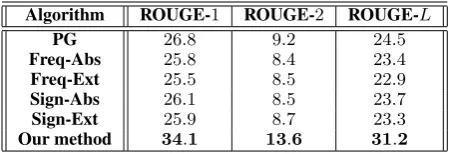
(Lin and Och, 2004) which look at unigram, bi-gram and longest common subsequence overlaps between generated and reference summaries. Ta-ble3 shows the ROUGE F1 scores for the topic-based summaries generated by different methods. It is easy to see that the proposed method yields the best performance across all the baselines.
Algorithm ROUGE-1 ROUGE-2 ROUGE-L
PG 26.8 9.2 24.5
Freq-Abs 25.8 8.4 23.4 Freq-Ext 25.5 8.5 22.9 Sign-Abs 26.1 8.5 23.7 Sign-Ext 25.9 8.7 23.3
[image:6.595.71.298.63.140.2]Our method 34.1 13.6 31.2
Table 3: ROUGE F1 scores obtained by various meth-ods on the final test set
Article:spain ’s 2-0 defeat by holland on tues-day brought back bitter memories of their dis-astrous 2014 world cup , but coach vicente del bosque will not be too worried ...
Summary:hollandbeatspain 2-0 at the
ams-terdam arena on tuesdaynight
Article: it ’s 11 years since arsenal won the
title. they went from invincibles to incapables ...
Summary:arsene wenger ’ssidehave 15 wins
in 17appearances
Table 4: Summaries where our model uses new words not seen in the input article
4.2 Performance on multi-topic articles
We ran the proposed model on original articles from CNN-DailyMail dataset which were not part of the final dataset used for training. Since the articles were not annotated with topics, we gen-erated summaries for all the different topics. We then detected articles where the method generated different summaries for different topics suggest-ing the presence of more than one topic in the arti-cle. Table5shows a few summaries generated by the proposed approach where different summaries were generated aligned to the input topics. The first article talks about the dropping of a player from a football squad. The summary oriented to themilitary topic talks about the assault of a po-lice officer by the player and his criminal history. The sportssummary talks about the player’s fate in the remaining games of the season.
Similarly, we have different summaries for the second article, where theeducationoriented sum-mary talks about the educational affiliations of the suspects and disciplinary procedures, whereas the militarysummary talks about the arrests. Note that these are among the original articles in the dataset which were not used for creating any of the articles in our final data used for training the model.
We also observe that the attention distribution
Title: Paul McGowan won’t be risked in final six games of the season, as Dundee boss Paul Hartley looks to help troubled midfielder
Military: dundee rogue paul mcgowan has been handed his third conviction after assaulting a police of-ficer . mcgowan escaped a jail sentence but was placed under a restriction ...
Sports: paul hartley has warned that paul mcgowan may not feature in any of the team ’s remaining six games this season because he will not risk playing the troubled midfielder this season ...
Title: Third suspect arrested in alleged Panama City gang rape
Education: ryan calhoun has been a student at mid-dle tennessee state university . the two are students and have been “ placed on temporary suspension and disci-plinary procedures ...
Military: sheriff ’s office : third person has been ar-rested in the case of an alleged spring break gang rape that was videotaped on a crowded stretch of panama city beach , the bay county , florida , sheriff ’s office said . the arrests come after a woman told police ... Title: University of Michigan will go forward with ’American Sniper’ screening
Military: kyle was fatally shot at a texas shooting range in 2013 . kyle cooper was nominated for an os-car for his portrayal of chris kyle , a navy seal and most lethal sniper in u.s. military history ...
Education:university of michigan has decided to pro-ceed with a screening of the film “ american sniper ” despite objections from some students . more than 200 signed a petition ...
Title: The Pope’s old iPad sells for $30,500
Business:the motorcycle sold for $ 284,000 at auction , more than 10 times its normal sales price . a harley motorcycle jacket signed by francis sold for nearly $ 68,000 . ...
Education:... the proceeds will go to a school in mon-tevideo , uruguay . it ’s not the first time a papal hand-me-down has gone for big bucks . ...
Table 5: Topic oriented summaries generated by our method for articles from CNN-Dailymail dataset
varies according to the input topic of summary. We investigate the amount of cumulative attention (defined as coverage bySee et al.) that is received by each term summed over all the decoding steps during generation. An example of the variation in attention over an input article is shown in Figure1. The degree of yellow hue is used to represent the value of coverage for each term. For the topic mil-itary, words likejailandassualtingreceive higher attention, whereas for the topicsportswords like gamesandplayerare highlighted. Figure1(b) also shows an example where our model summarizes by skipping a clause (“which kick off at 3pm”).
4.3 Human evaluation of performance
(a) Coverage for the topicmilitary
(b) Coverage for the topicsports
Figure 1: Variation in the attention coverage while summarizing an article for different topics
the best performing baseline - the topic signature based abstractive summarizer (Sign-Abs), and the vanilla pointer-generator.
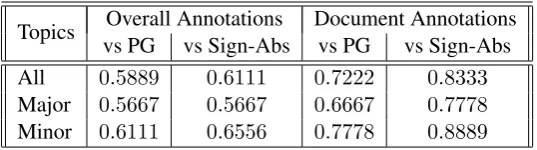
We fetched articles touching multiple topics us-ing the NYTimes Search API1, which allows to search for articles on NYTimes which appear in the news desk for a topic (the major topic) and are tagged with another topic (the minor topic). For different pairs of topics, we retrieved relevant ar-ticles using the API and randomly selected few of them to generate summaries tuned to the two top-ics using our method and the baselines. We re-trieved 18 total articles for the evaluation. Each article had two topics leading to36(article,topic) pairs for the summary generation. For each (arti-cle,topic) pair, annotators were shown two sum-maries - one generated by our method and the other by one of the baselines. The task was to choose the summary more relevant to the topic. Each such task was annotated by10 different an-notators. Every annotator was assigned9tasks and 1extra dummy task to check if they were paying attention. Annotations from evaluators who an-swered incorrectly to the dummy task were dis-carded. We had a total of 720annotations from the human evaluation and their summary is shown in Table6.
The value under “Overall annotations” refers to the fraction of all human responses across all
1https://developer.nytimes.com/
documents which rated the summary produced by our method better than the alternate summary pro-duced by the compared baseline method. Under-standably, the proposed approach is comparable in the preference to both the baselines for the major topic (0.5667) - since most standard summaries will cover the primary topic of the input. How-ever, for the minor topic, it can be seen that the proposed approach is better than the baselines.
The value under “Document annotations” indi-cates the fraction of times the proposed method was preferred by half or more of the annotators for a document-topic pair. It is easy to see that the pro-posed approach clearly outperforms the baselines under this scenario. The difference in performance is even more significant for summaries generated for the non-major topic since our approach is capa-ble of efficiently generating tuned summaries for minor topics as well.
5 Conclusion
fea-Topics vs PGOverall Annotationsvs Sign-Abs Document Annotationsvs PG vs Sign-Abs
[image:8.595.165.434.62.137.2]All 0.5889 0.6111 0.7222 0.8333 Major 0.5667 0.5667 0.6667 0.7778 Minor 0.6111 0.6556 0.7778 0.8889
Table 6: Evaluation of summaries of the proposed approach against Pointer Generator Framework and Topic Signature based Summarizer by human annotators
ture based methods for topic oriented summariza-tion using word frequencies or log likelihood ra-tios.
References
Siddhartha Banerjee, Prasenjit Mitra, and Kazunari Sugiyama. 2015. Multi-document abstractive sum-marization using ilp based multi-sentence compres-sion. InIJCAI. pages 1208–1214.
Taylor Berg-Kirkpatrick, Dan Gillick, and Dan Klein. 2011. Jointly learning to extract and compress. In
Proceedings of the 49th Annual Meeting of the Asso-ciation for Computational Linguistics: Human
Lan-guage Technologies-Volume 1. Association for
Com-putational Linguistics, pages 481–490.
John M Conroy, Judith D Schlesinger, and Dianne P O’Leary. 2006. Topic-focused multi-document summarization using an approximate oracle score.
In Proceedings of the COLING/ACL on Main
con-ference poster sessions. Association for
Computa-tional Linguistics, pages 152–159.
Hoa Trang Dang. 2005. Overview of duc 2005. In Pro-ceedings of the document understanding conference. volume 2005, pages 1–12.
John Duchi, Elad Hazan, and Yoram Singer. 2011. Adaptive subgradient methods for online learning and stochastic optimization. Journal of Machine
Learning Research12(Jul):2121–2159.
Katja Filippova. 2010. Multi-sentence compression: Finding shortest paths in word graphs. In Pro-ceedings of the 23rd International Conference on
Computational Linguistics. Association for
Compu-tational Linguistics, pages 322–330.
Pierre-Etienne Genest and Guy Lapalme. 2011. Framework for abstractive summarization using text-to-text generation. InProceedings of the
Work-shop on Monolingual Text-To-Text Generation.
As-sociation for Computational Linguistics, pages 64– 73.
Caglar Gulcehre, Sungjin Ahn, Ramesh Nallapati, Bowen Zhou, and Yoshua Bengio. 2016. Pointing the unknown words. InProceedings of the 54th An-nual Meeting of the Association for Computational
Linguistics (Volume 1: Long Papers). volume 1,
pages 140–149.
Karl Moritz Hermann, Tomas Kocisky, Edward Grefenstette, Lasse Espeholt, Will Kay, Mustafa Su-leyman, and Phil Blunsom. 2015. Teaching ma-chines to read and comprehend. InAdvances in
Neu-ral Information Processing Systems. pages 1693–
1701.
Chin-Yew Lin and Eduard Hovy. 2000. The auto-mated acquisition of topic signatures for text sum-marization. InProceedings of the 18th conference on Computational linguistics-Volume 1. Association for Computational Linguistics, pages 495–501. Chin-Yew Lin and Franz Josef Och. 2004.
Auto-matic evaluation of machine translation quality us-ing longest common subsequence and skip-bigram statistics. InProceedings of the 42nd Annual
Meet-ing on Association for Computational LMeet-inguistics.
Association for Computational Linguistics, page 605.
LiveMint. 2017. IMF backs Universal Basic Income in India, serves Modi govt a political opportunity. [Online; accessed 8-Dec-2017].
Ramesh Nallapati, Bowen Zhou, Cicero dos Santos, C¸a glar Gulc¸ehre, and Bing Xiang. 2016. Abstrac-tive text summarization using sequence-to-sequence rnns and beyond. CoNLL 2016page 280.
Ani Nenkova and Kathleen McKeown. 2011. Auto-matic summarization. Foundations and TrendsR in
Information Retrieval5(2–3):103–233.
Paul Over, Hoa Dang, and Donna Harman. 2007. Duc in context. Information Processing & Management
43(6):1506–1520.
Alexander M Rush, Sumit Chopra, and Jason Weston. 2015. A neural attention model for abstractive sen-tence summarization. In Proceedings of the 2015 Conference on Empirical Methods in Natural
Lan-guage Processing. pages 379–389.
Abigail See, Peter J Liu, and Christopher D Manning. 2017. Get to the point: Summarization with pointer-generator networks. InProceedings of the 55th An-nual Meeting of the Association for Computational
Linguistics (Volume 1: Long Papers). volume 1,
pages 1073–1083.
Oriol Vinyals, Meire Fortunato, and Navdeep Jaitly. 2015. Pointer networks. InAdvances in Neural
In-formation Processing Systems. pages 2692–2700.
VoxMedia. 2017. Data science + journalism @ kdd 2017. https://sites.google.com/view/ dsandj2017/datasets. [Online; accessed 8-Dec-2017].
Lu Wang and Claire Cardie. 2013. Domain-independent abstract generation for focused meeting summarization. InACL (1). pages 1395–1405.