Original Article
Association between the IL-6 rs1800796 (-572C/G)
polymorphism and chronic obstructive pulmonary
disease risk: a meta-analysis
Gui-Yi Ji1*, Xiao-Yan Tang1*, Shou-Quan Wu1, Yu Wang1, Qian-Qian Liu2, Jing-Can Wu1, Andrew J Sandford3, Jian-Qing He1
Departments of 1Respiratory and Critical Care Medicine, 2Laboratory Medicine, West China Hospital, Sichuan
University, Chengdu, Sichuan, China; 3Centre for Heart Lung Innovation, University of British Columbia, St. Paul’s
Hospital, Vancouver, BC, Canada. *Equal contributors.
Received December 20, 2015; Accepted March 5, 2016; Epub July 15, 2017; Published July 30, 2017
Abstract: Interleukin-6 (IL-6), a pleiotropic proinflammatory and immunomodulatory cytokine, is highly involved in
the pathogenesis of chronic obstructive pulmonary disease (COPD). Thus we conducted a meta-analysis to inves-tigate the relationship between the IL-6 rs1800796 (-572C/G) polymorphism and COPD risk. We conducted a lit-erature search up to April 20, 2015, using the PubMed, Embase and Chinese National Knowledge Infrastructure (CNKI) databases. Studies published in languages other than English or Chinese were excluded. A total of 413 COPD cases and 596 controls in 3 case-control studies were included in this study. The results of our meta-analysis
sug-gested that the IL-6 rs1800796 (-572C/G) was significantly associated with COPD in a codominant genetic model
(GC vs. GG, OR: 0.45, 95% CI: 0.28-0.72; CC vs. GG, OR: 0.20, 95% CI: 0.09-0.46). Moreover, no publication bias was detected in this study.
Keywords: Chronic obstructive pulmonary disease, interleukin-6, meta-analysis, polymorphism, susceptibility
Introduction
Chronic obstructive pulmonary disease (COPD) is a major global health problem characterized by progressive airflow limitation that is not fully reversible. Chronic inflammation of the airways and pulmonary parenchyma results in partially reversible but progressive obstruction of the peripheral airways [1]. Numerous risk factors are related to COPD and its progression, but cigarette smoking is by far the most important of cigarette smokers develop COPD [2, 3]. Although the causal mechanisms underlying COPD are still not fully understood, a genetic susceptibility to COPD has been strongly su- ggested.
Inflammatory cytokines are one of the predomi-nant underlying mechanisms in COPD [4]. Cy- tokines play important roles in inflammatory responses and are also critical in the regulation of progression of inflammation diseases [5]. Cytokines are central to the pathogenesis of COPD, as they play important roles in many
pathophysiological processes such as the ch- ronic inflammatory process and emphysema [4].
Interleukin-6 (IL-6), a pleiotropic pro-inflamma -tory and immunomodula-tory cytokine, secreted by airway epithelial cells, has been identified as a candidate gene for COPD [6]. An important role of IL-6 is to act as a mediator of the acute phase response and the highly variable levels of acute and chronic inflammation attributed to this cytokine are thought to play a leading role in disease progression [6].
00genomes.org/). The IL6 rs1800796 G allele was significantly associated with the suscepti-bility to Enterovirus 71 encephalitis in Chinese Han patients [8]. The IL6 rs1800795 (-174G/C) polymorphism was strongly related to coron- ary artery disease [9]. In addition, IL6 promo- ter polymorphisms have been associated with higher risk of multiple sclerosis severity [10] and rheumatic heart disease [11].
In pulmonary diseases, several studies reve- aled that IL-6 is associated with skeletal mus-cle weakness in COPD [12] as well as with ex- acerbations pulmonary infections in COPD pa- tients [13]. Moreover, in the murine lung, over-expression of IL-6 resulted in airway inflamma-tion and emphysema-like airspace enlarge-ment [14]. Furthermore, IL-6, at the transcrip- tional level, can up-regulate C-reactive protein, an important mediator of the acute phase reac-tant [15]. C-reactive protein has been related to lung function decline in smoking-induced COPD and lung function levels in healthy individuals [16].
Over the past few years, the association of gene polymorphisms with COPD risk has been well studied, including the rs1800796 polymor-phism in the IL-6 gene. However, consistent results have not been provided in those studies and our meta-analysis was performed to inves-tigate the association of the IL-6 rs1800796 with risk of COPD. A meta-analysis can be used as a powerful tool to draw conclusions from pooled data. It utilizes quantitative methods to pool the data from individual studies where individual sample sizes are small [17].
Material and methods
Search strategy
Our team conducted the literature search by using PubMed, Embase and Chinese National Knowledge Infrastructure (CNKI) databases, including all studies up to April 20, 2015. We limited the analysis to studies published in English or Chinese. We used following search terms: interleukin 6 or IL-6, and polymorphism or variant or SNP (single nucleotide polymor-phism) or genotype, and chronic obstructive pulmonary disease or COPD.
Data extraction
With the inclusion and exclusion criteria, two
studies included in this meta-analysis were required to meet the following criteria: (1) case-control study in design; (2) evaluation of the IL6 rs1800796 polymorphism and COPD suscepti-bility; (3) genotype frequencies in both cases and controls were available. Criteria for exclu-sion in the meta-analysis were: (1) IL6 polymor-phisms other than rs1800796; (2) duplicated reports; (3) languages other than English or Chinese. We did not consider unpublished data. We selected the study with the higher sample size, when the same group using overlapping sets of cases and published more than one article. We would solve disagreement by dis-cussion before reaching a consensus.
Statistical analysis
We presented the data as odds ratio (OR) with 95% confidence interval (CI). GG, GC and CC are the genotypes of the IL6 rs1800796 polymor-phism. OR1, OR2 and OR3 were calculated as follows: OR1: CC vs. GG; OR2: GC vs. GG; OR3: CC vs. GC. Pairs of differences (OR1, OR2 and OR3) were used to calculate the most appropri-ate genetic model as follows: if OR1 = OR2 ≠ 1 and OR3 = 1, then it suggests a dominant model; if OR1 = OR3 ≠ 1 and OR2 = 1, then it suggests a recessive model; if OR2 = 1/OR3 ≠ 1 and OR1 = 1, then it suggests a overdomi-nant model; if OR1 > OR2 > 1 and OR1 > OR3 > 1 (or OR1 < OR2 < 1 and OR1 < OR3 < 1), then it suggests a codominant model [18].
linear regression test, were utilized to check for potential publication bias, and P < 0.05 was considered significant publication bias [21]. All analyses were conducted using Revman 5.3 and Stata 13.1.
Results
Studies included in the meta-analysis
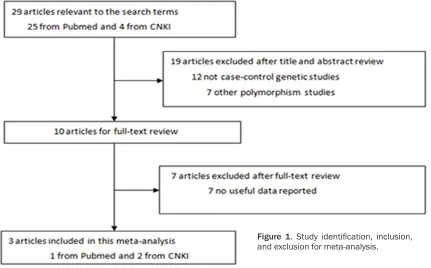
Twenty-nine studies were related to the search terms. After scrutinizing the titles, abstracts and articles, 26 studies were excluded, be- cause they were case reports, included other polymorphisms of IL-6, or contained insufficient data. Thus 3 articles [22-24] with 3 case-con-trol studies for the IL6 rs1800796 matched the inclusion criteria (Figure 1). The three included studies were hospital-based and used the poly-merase chain reaction restriction fragment le- ngth polymorphism genotyping method. Of the
3 included articles, 1 was published in English, and 2 were published in Chinese (Table 1). Quantitative synthesis
For the purpose of selecting the most appropri-ate genetic model, OR1, OR2 and OR3 were cal-culated. Results revealed OR1 = 0.201, OR2 = 0.445 and OR3 = 0.535 for rs1800796, sug-gesting a codominant genetic model (GC vs. GG; CC vs. GG). The pooled effect size showed that there was a significant association of IL6 rs800796 with the risk of COPD (GC vs. GG OR: 0.45, 95% CI: 0.28-0.72, P = 0.001, fixed mo- del; CC vs. GG OR: 0.20, 95% CI: 0.09-0.46, P = 0.00001) (Figures 2, 3).
Test of heterogeneity
[image:3.612.93.524.75.343.2]In order to detect heterogeneity among the included studies, the Q-test and I2 statistics
Table 1. Main characteristics of included studies
Ref. Country Race Genotyping Source of controls COPD Controls
[image:3.612.92.524.379.438.2]Total CC CG GG Total CC CG GG HWE (p) [24] China Asian PCR-RFLP Healthy population 192 108 60 24 195 147 42 6 0.1745 [25] China Asian PCR-RFLP Healthy population 30 23 2 5 30 29 1 0 0.9260 [23] Spain European PCR-RFLP Healthy population 191 1 18 172 371 1 65 305 0.2006 Abbreviations: HWE, Hardy-Weinberg equilibrium; PCR, polymerase chain reaction; RFLP-restriction fragment length polymorphism.
Figure 1. Study identification, inclusion,
the fixed model was utilized to synthesize the data for this analysis.
Publication bias
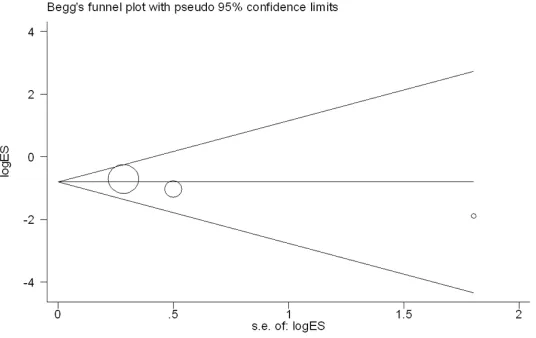
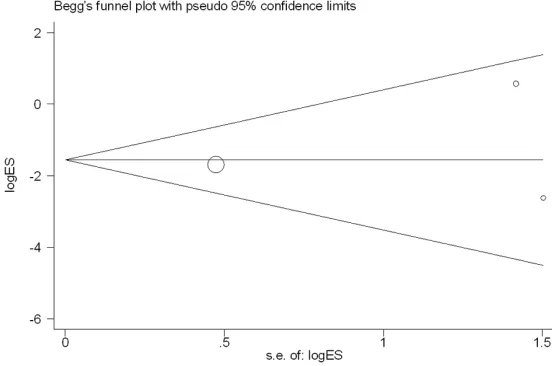
[image:4.612.94.521.74.200.2]We utilized Begg’s funnel plot and Egger’s test to test publication bias among the selected publica-tions. The funnel plots of this st- udy showed no significant asym-metry in this meta-analysis (Fi- gures 4, 5). Moreover, publication bias was not observed by Begg’s rank correlation test (GC vs. GG: P = 0.296; CC vs. GG: P = 1) or Egger’s linear regression test (GC vs. GG: P = 0.195; CC vs. GG: P = 0.770).
[image:4.612.94.519.249.370.2]Figure 2. Forest plots of OR with 95% CI for the association of the IL6 rs1800796 and COPD risk (GC vs. GG).
Figure 3. Forest plots of OR with 95% CI for the association of the IL6 rs1800796 and COPD risk (CC vs. GG).
Figure 4. Begg’s funnel plot for evaluation of publication bias in the in-cluded studies on the associations of the IL6 rs1800796 with COPD risk (GC vs GG).
were employed. Significant heterogeneity was not revealed between all studies in GC vs GG and CC vs GG comparisons (codominant model) for the rs800796 polymorphism (I2 = 0%, P = 0.71; I2 = 30%, P = 0.24, respectively). Thus,
Discussion
[image:4.612.92.360.420.589.2]imbal-ance within the protease-antiprotease system, and overloads the detoxification system [25]. Even though smoking is the most important risk factor for COPD, only a small proportion of smokers develop this disease. Therefore, addi-tional factors such as environmental, genetic and epigenetic components, are thought to play important roles in the development of COPD [3]. The combination of these risk factors alters lung development and immunity and results in the predisposition for COPD. While environmental factors play crucial roles in the etiology of COPD, genetic factors also seem to have important effects in disease susceptibility and severity [26]. However, the fundamental molecular mechanisms that result in COPD development are not fully understood. Some studies have established that inflammatory cytokines play an important role in the patho-genesis of COPD and its progress [3]. In addi-tion, many genetic factors were identified to play important roles in the etiology of COPD and its progression. Therefore, genetic marker-based risk assessment might offer new preven-tative and therapeutic strategies.
As mentioned above, IL6, a well-characterized pleiotropic proinflammatory and immunomodu-latory cytokine, possibly plays a role in chronic inflammation as well as COPD. The rs1800796 polymorphism is located in the promoter region of IL6 and therefore could affect IL6 gene tran-scription and protein expression both in vivo and in vitro [27]. Although several studies
sons why some of the OR estimates vary between studies.
Individual studies with a small sample size might have not sufficient statistical power to detect a risk factor of small effect. Loannidis JP have suggested that pooled ORs generated from large sample sizes have the ability to increase the statistical power of the results and that combining data from multifarious studies has the advantage of decreased random errors [28]. Thus, for the purpose of gaining more pre-cise results, we conduct a meta-analysis to evaluate whether a correlation exists between the IL6 rs1800796 polymorphism and risk of developing COPD.
This meta-analysis is the first study to summa-rize the correlation between the rs18000796 polymorphism and COPD risk. To identify genet-ic variants associated with this illness, much effort has been expanded to explore the asso-ciation between them via case-control study or cohort studies. After statistical analysis, the pooled effect size showed that the IL6 rs1800796 was significantly associated with COPD susceptibility in a codominant genetic model, indicating that allele C had a decreas- ed risk for COPD compared with allele G. We did not observe any significant heterogeneity between all studies in the GC vs. GG and CC vs. GG comparisons for rs1800796. However, complex genetic diseases differ from simple Mendelian diseases and since COPD is
poly-Figure 5. Begg’s funnel plot for evaluation of publication bias in the includ-ed studies on the associations of the IL6 rs1800796 COPD risk (CC vs GG).
[image:5.612.90.366.74.257.2]rea-genic, a single genetic variant is always inade-quate to predict the risk of this common dis-ease. Publication bias was not suggested in the meta-analysis, possibly due to the deliberate and circumspect search strategy and data extraction. In our meta-analysis we did not per-form sensitive analysis on account of the lack of sufficient original studies.
In summary, our meta analysis suggests that the IL6 rs1800796 C allele confers protection against COPD. Further studies with larger sam-ple sizes, well phenotyped COPD cases and matched controls, as well as more extensive data on individual and environmental factors are warranted.
Acknowledgements
This work was supported by the National Natural Science Foundation of China (Grant No. 81341092).
Disclosure of conflict of interest
None.
Address correspondence to: Dr. Jian-Qing He, De- partment of Respiratory and Critical Care Medicine, West China Hospital, Sichuan University, Chengdu, Sichuan, China. Tel: 01186-18980602293; Fax: 01186-85422571; E-mail: [email protected]
References
[1] Tuder RM and Petrache I. Pathogenesis of chronic obstructive pulmonary disease. J Clin Invest 2012; 122: 2749-2755.
[2] Anto JM, Vermeire P, Vestbo J and Sunyer J. Epidemiology of chronic obstructive pulmonary disease. Eur Respir J 2001; 17: 982-994. [3] Lokke A, Lange P, Scharling H, Fabricius P and
Vestbo J. Developing COPD: a 25 year follow up study of the general population. Thorax 2006; 61: 935-939.
[4] Caramori G, Adcock IM, Di Stefano A and Chung KF. Cytokine inhibition in the treatment of COPD. Int J Chron Obstruct Pulmon Dis 2014; 9: 397-412.
[5] Higashimoto Y, Yamagata T, Honda N, Satoh R, Sano H, Iwanaga T, Miyhara T, Muraki M, To-mita K, Tohda Y and Fukuda K. Clinical and
in-flammatory factors associated with body mass
index in elderly patients with chronic obstruc-tive pulmonary disease. Geriatr Gerontol Int 2011; 11: 32-38.
[6] He JQ, Foreman MG, Shumansky K, Zhang X, Akhabir L, Sin DD, Man SF, DeMeo DL, Litonjua
AA, Silverman EK, Connett JE, Anthonisen NR, Wise RA, Pare PD and Sandford AJ. Associa-tions of IL6 polymorphisms with lung function decline and COPD. Thorax 2009; 64: 698-704. [7] Ataie-Kachoie P, Pourgholami MH, Richardson
DR and Morris DL. Gene of the month: Interleu-kin 6 (IL-6). J Clin Pathol 2014; 67: 932-937. [8] Yuan AU, Li J, Liu PP and Chen ZB. Association
between interleukin-6 gene polymorphism and susceptibility to chronic obstructive pulmonary
disease. Inflammation 38 2013; 728-735.
[9] Galimudi RK, Spurthi MK, Padala C, Kumar KG, Mudigonda S, Reddy SG, Aiyengar MT, Sahu SK and Rani SH. Interleukin 6(-174G/C) variant and its circulating levels in coronary
ar-tery disease patients and their first degree rel
-atives. Inflammation 2014; 37: 314-321.
[10] Yan J, Liu J, Lin CY; Austrialia and New Zealand Multiple Sclerosis Genetics Consortium (AN-ZGene), Csurhes PA, Pender MP, McCombe PA, Greer JM. Interleukin-6 gene promoter-572 C allele may play a role in rate of disease pro-gression in multiple sclerosis. Int J Mol Sci 2012; 13: 13667-79.
[11] Rehman S, Akhtar N, Saba N, Munir S, Ahmed W, Mohyuddin A and Khanum A. A study on the association of TNF-alpha(-308), 6(-174), IL-10(-1082) and IL-1Ra(VNTR) gene polymor-phisms with rheumatic heart disease in Paki-stani patients. Cytokine 2013; 61: 527-531. [12] Yende S, Waterer GW, Tolley EA, Newman AB,
Bauer DC, Taaffe DR, Jensen R, Crapo R, Rubin
S, Nevitt M, Simonsick EM, Satterfield S, Harris T and Kritchevsky SB. Inflammatory markers
are associated with ventilatory limitation and muscle dysfunction in obstructive lung disease in well functioning elderly subjects. Thorax 2006; 61: 10-16.
[13] Shaw JG, Vaughan A, Dent AG, O’Hare PE, Goh F, Bowman RV, Fong KM and Yang IA. Biomark-ers of progression of chronic obstructive pul-monary disease (COPD). J Thorac Dis 2014; 6: 1532-1547.
[14] Kuhn C 3rd, Homer RJ, Zhu Z, Ward N, Flavell RA, Geba GP and Elias JA. Airway hyperrespon-siveness and airway obstruction in transgenic mice. Morphologic correlates in mice overex-pressing interleukin (IL)-11 and IL-6 in the lung. Am J Respir Cell Mol Biol 2000; 22: 289-295.
[15] Majello B, Arcone R, Toniatti C and Ciliberto G. Constitutive and IL-6-induced nuclear factors that interact with the human C-reactive protein promoter. EMBO J 1990; 9: 457-465.
[17] Cohn LD and Becker BJ. How meta-analysis in-creases statistical power. Psychol Methods 2003; 8: 243-253.
[18] DerSimonian R and Laird N. Meta-analysis in clinical trials. Control Clin Trials 1986; 7: 177-188.
[19] Mantel N and Haenszel W. Statistical aspects of the analysis of data from retrospective stud-ies of disease. J Natl Cancer Inst 1959; 22: 719-748.
[20] Higgins JP, Thompson SG, Deeks JJ and Altman DG. Measuring inconsistency in meta-analy-ses. BMJ 2003; 327: 557-560.
[21] Egger M, Davey Smith G, Schneider M and Minder C. Bias in meta-analysis detected by a simple, graphical test. BMJ 1997; 315: 629-634.
[22] Cordoba-Lanus E, de-Torres JP, Lopez-Aguilar C, Rodriguez-Perez MC, Maca-Meyer N, Monte-jo-de-Garcini A, Aguirre-Jaime A, Perez-Mendez L and Casanova C. Association of IL-6 gene polymorphisms and COPD in a Spanish popu-lation. Respir Med 2008; 102: 1805-1811. [23] Lu JJ, Liang YJ, Yin Q, Jia JH and Guo ZL.
Asso-ciation between interleukin-6 gene polymor-phism and susceptibility to chronic obstructive pulmonary disease. Journal of Tongji University (Medical Science) 2013; 31-34+40.
[24] Zhou AL, Yang WH, Long F, Chen LF and Li JH. Associations of IL6 promoter polymorphisms with COPD Book Associations of IL6 promoter polymorphisms with COPD. Chinese Journal of General Practice 2012; 1257-1258.
[25] Fischer BM, Pavlisko E and Voynow JA. Patho-genic triad in COPD: oxidative stress,
protease-antiprotease imbalance, and inflammation. Int
J Chron Obstruct Pulmon Dis 2011; 6: 413-421.
[26] Bosse Y. Genetics of chronic obstructive pul-monary disease: a succinct review, future ave-nues and prospective clinical applications. Pharmacogenomics 2009; 10: 655-667. [27] Kitamura A, Hasegawa G, Obayashi H,
Kamiu-chi K, Ishii M, Yano M, Tanaka T, YamaguKamiu-chi M, Shigeta H, Ogata M, Nakamura N and Yoshika-wa T. Interleukin-6 polymorphism (-634C/G) in the promotor region and the progression of di-abetic nephropathy in type 2 diabetes. Diabet Med 2002; 19: 1000-1005.