Random Walks and Neural Network Language Models
on Knowledge Bases
Josu Goikoetxea, Aitor Soroa and Eneko Agirre IXA NLP Group
University of the Basque Country Donostia, Basque Country
{josu.goikoetxea,a.soroa,e.agirre}@ehu.eus
Abstract
Random walks over large knowledge bases like WordNet have been successfully used in word similarity, relatedness and disambigua-tion tasks. Unfortunately, those algorithms are relatively slow for large repositories, with significant memory footprints. In this pa-per we present a novel algorithm which en-codes the structure of a knowledge base in a continuous vector space, combining random walks and neural net language models in or-der to produce novel word representations. Evaluation in word relatedness and similar-ity datasets yields equal or better results than those of a random walk algorithm, using a dense representation (300 dimensions instead of 117K). Furthermore, the word representa-tions are complementary to those of the ran-dom walk algorithm and to corpus-based con-tinuous representations, improving the state-of-the-art in the similarity dataset. Our tech-nique opens up exciting opportunities to com-bine distributional and knowledge-based word representations.
1 Introduction
Graph-based techniques over Knowledge Bases (KB) like WordNet (Fellbaum, 1998) have been widely used in NLP tasks, including word sense disambiguation (Agirre et al., 2014; Moro et al., 2014), semantic similarity and semantic relatedness between terms (Agirre et al., 2009; Agirre et al., 2010; Pilehvar et al., 2013). For instance, Agirre et al. (2009; 2010) apply a random walk algorithm based on Personalized PageRank to WordNet,
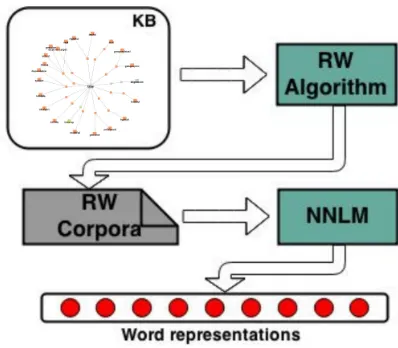
pre-Figure 1: Main architecture for generating KB word embeddings. A random walk algorithm over the KB produces a synthetic corpus, which is fed into a NNLM to produce continuous word representations.
senting the best results to date among WordNet-based methods for the well-known WS353 word-similarity dataset (Finkelstein et al., 2001). For each target word, the method performs a personal-ized random walk on the WordNet graph. At con-vergence, the target word is represented as a vector in a multi-dimensional conceptual space, with one dimension for each concept in the KB. The good results of the algorithm contrast with the large di-mensionality of the vectors that it needs to produce, 117K dimensions (one per synset) for WordNet.
In recent years a wide variety of Neural Network Language Models (NNLM) have been successfully employed in several tasks, including word similarity (Collobert and Weston, 2008; Socher et al., 2011;
[image:1.612.327.526.239.413.2]Turian et al., 2010). NNLM extract meaning from unlabeled corpora following the distributional hy-pothesis (Harris, 1954), where semantic features of a word are related to its co-occurrence patterns. NNLM learn word representations in the form of dense scalar vectors in n-dimensional spaces (e.g. 300 dimensions), in which each dimension is a la-tent semantic feature. The representations are ob-tained by optimizing the likelihood of existing un-labeled text. More recently, Mikolov et al. have developed simpler NNLM architectures (Mikolov et al., 2013a; Mikolov et al., 2013b; Mikolov et al., 2013c), which drastically reduced computational complexity by deleting the hidden layer, enabling to compute accurate word representations from very large corpora. The representations obtained by these methods are compact, taking 1.5G for 3M words on 300-dimensional space, and have been shown to out-perform other distributional corpus-based methods on several tasks, including the WS353 word similar-ity dataset (Baroni et al., 2014).
In this work we propose to encode the meaning of words using the structural information in knowl-edge bases. That is, instead of modeling the mean-ing based on the co-occurrences of words in corpora, we model the meaning based on random walks over the knowledge base. Each random walk is seen as a context for words in the vocabulary, and fed into the NNLM architecture, which optimizes the likelihood of those contexts (cf. Fig. 1). The resulting word representations are more compact than those pro-duced by regular random walk algorithms (300 vs. tens of thousands), and produce very good results on two well-known benchmarks on word related-ness and similarity: WS353 (Finkelstein et al., 2001) and SL999 (Hill et al., 2014b), respectively. We also show that the obtained representations are com-plementary to those of random walks alone and to distributional representations obtained by the same NNLM algorithm, improving the results.
Some recent work has explored embedding KBs in low-dimensional continous vector spaces, repre-senting each entity in a k-dimensional vector and characterizing typed relations between entities in the KB (e.g. born-in-city in Freebase or part-of in Word-Net) as operations in the k-dimensional space (Wang et al., 2014). The model estimates the parameters which maximize the likelihood of the triples, which
can then be used to infer new typed relations which are missing in the KB. In contrast, we use the rela-tions to explicitly model the context of words, in two complementary approaches to embed information in KBs into continuous spaces.
2 NNLM
Neural Network Language Models have become a useful tool in NLP on the last years, specially in se-mantics. We have used the two models proposed in (Mikolov et al., 2013c) due to their simplicity and effectiveness in word similarity and related-ness tasks (Baroni et al., 2014): Continuous Bag of Words (CBOW) and Skip-gram. The first one is quite similar to the feedforward Neural Network Language Model, but instead of a hidden layer it has a projection layer, and thus all the words are pro-jected in the same position. Word order has thus no influence in the projection. The training crite-rion is as follows: knowing previous and subsequent words in context, the model maximizes the proba-bility of the predicting the word in the middle. The Skip-gram model uses each current word as an input to a log-linear classifier with a continuous projec-tion layer, and predicts the previous and subsequent words in a context window.
Although the Skip-gram model seems to be more accurate in most of the semantic tasks, we have used both variants in our experiments. We used a publicly available implementation1.
3 Random Walks and NNLM
Our method performs random walks over KB graphs to create synthetic contexts which are fed into the NNLM architecture, creating novel word represen-tations. The algorithm used for creating the contexts is a Monte Carlo method for computing the PageR-ank algorithm (Avrachenkov et al., 2007).
We consider a KB as undirected graph G = (V, E), where V is the set of concepts andE rep-resents links among concepts. We also need a dic-tionary, an association from words to KB concepts. We construct an inverse dictionary that maps graph vertices with the words than can be linked to it.
The inputs of the algorithm are: 1) the graphG= (V, E), 2) the inverse dictionary and 3) the
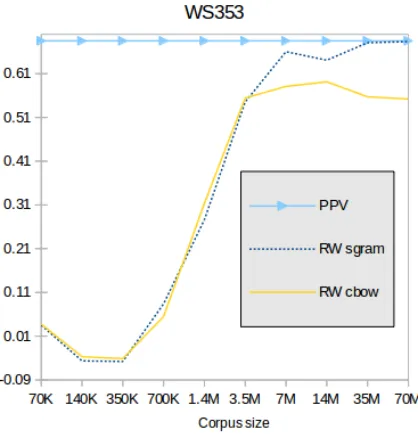
Figure 2: Spearman results on relatedness (WS353) for different corpus sizes (in sentences).
ing factor α2. In our experiments we used
Word-Net 3.0 with gloss relations3, which has 117.522
nodes (synsets) and 525.356edges (semantic rela-tions). Regarding the dictionary, WordNet already contains links from words to concepts. The dictio-nary includes the probability of a concept being lexi-calized by a specific word, as estimated by the Word-Net team from their hand-annotated corpora. Both dictionary and graph are freely available4.
The method first chooses a vertex at random from the vertex setV, and performs a random walk start-ing from it. At each step, the random walk might terminate with probability(1−α)or choose a neigh-bor vertex at random with probabilityα. Each time the random walk reaches a vertex, a word is emitted at random using the probabilities in the inverse dic-tionary. When the random walk terminates, the se-quence of emitted words forms the pseudo sentence which is fed to the NNLM architecture, and the pro-cess starts again choosing a vertex at random until a maximum number of pseudo sentences have been generated.
Our method creates pseudo sentences like the fol-lowing:
2The damping factor is the only parameter of PageRank. 3http://wordnet.princeton.edu/glosstag.shtml
4http://ixa2.si.ehu.eus/ukb
Figure 3: Spearman results on similarity (SL999) for different corpus sizes (in sentences).
(1) amphora wine nebuchadnezzar bear retain long
(2) graphology writer write scribble scrawler heedlessly in haste jot note notebook
These examples give us clues of the kind of the implicit semantic information that is encoded in the generated pseudo-corpus. Example 1 starts with am-phora following with wine (with which amphoras are usually filled with), nebuchadnezzar (a partic-ular bottle size) and finishing with words that are related to wine storage, like bear,retain and long. Example 2 shows a similar phenomenom; it starts with graphology, follows with the closely related
writer, thenwriter, finishing with names and adjec-tives of different variants of writing, such as scrib-ble, scrawler, heedlessly, in haste and jot; finally, the context ends with note and notebook. Note that our method also produces multiword terms like
in haste.
4 Experiments
[image:3.612.72.281.64.281.2]SL999 WS353 Skip-gram 0.442 0.686
RWSGRAM 0.520 0.683
RWCBOW 0.486 0.591
[image:4.612.343.511.55.167.2]PPV 0.493 0.683
Table 1: Spearman correlation results for our meth-ods (RWSGRAM, RWCBOW) on WordNet random
walks, compared to just random walks (PPV), and Skip-gram on text corpora.
window size 5. In order to check how many iter-ations of the random walk algorithm are needed to learn good word representations, we produced up to
70·106contexts. The the damping factor (α) of the
random walk algorithm was set to0.85, a usual value (Agirre et al., 2010). All parameters were thus set to default, and we only explored different corpus sizes. The word representations were evaluated on WS353 (Finkelstein et al., 2001) and SL999 (Hill et al., 2014b), two datasets on word relatedness and word similarity, respectively. In order to compute the similarity of two words, it suffices to calculate the cosine between the respective word representa-tions. The evaluation measure computes the rank correlation (Spearman) between the human judg-ments and the system values.
In order to contrast our results with the two related techniques, we used UKB5, a publicly available
im-plementation of Personalized PageRank (Agirre et al., 2014), and ran it over the same graph as our proposed methods. We used it out-of-the-box with a damping value of 0.85. We also downloaded the embeddings learnt by (Mikolov et al., 2013a) using Skip-gram over a large text corpus6. We used the
same cosine algorithm to compute similarity with all word representations. To distinguish one word representation from the other, we will call our mod-els RWCBOWand RWSGRAMrespectively (RW for
random-walk), in contrast to the original Person-alized PageRank algorithm (PPV) and the corpus-based embeddings learned using Skip-grams (Skip-gram).
Figures 2 and 3 show the learning curves on the WS353 and SL999 datasets relative to the number
5http://ixa2.si.ehu.eus
6https://code.google.com/p/word2vec/
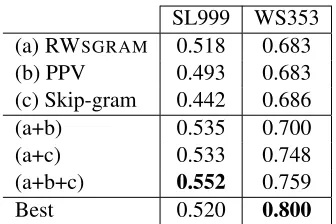
SL999 WS353 (a) RWSGRAM 0.518 0.683
(b) PPV 0.493 0.683 (c) Skip-gram 0.442 0.686 (a+b) 0.535 0.700 (a+c) 0.533 0.748 (a+b+c) 0.552 0.759 Best 0.520 0.800
Table 2: Combinations and best published results: SL999 (Hill et al., 2014a), WS353 (Radinsky et al., 2011).
of contexts produced by the random walks on Word-Net. The results show that WordNet representa-tions grow quickly (around 7 million contexts), con-verging around 70M, obtaining practically the same results as PPV for WS353, and better results for SL9997.
The results at convergence are shown in Table 1, together with those of PPV and Skip-gram. Regard-ing SL999, we can see that the best results are ob-tained with RWSGRAM, improving over PPV and
Skip-gram. Regarding WS353, all methods except RWSGRAMobtain similar results. The results show
that our methods are able to effectively capture the information in WordNet, performing on par to the original PPV algorithm, and better than the corpus-based Skip-gram on the SL999 dataset. Note that the best published results for WS353 using WordNet are those of (Agirre et al., 2010) using PPV, which report0.685.
In order to see if the word representations that we learn are complementary to those of PPV and Skip-gram, we combined the scores produced by each word representation. Given the potentially different scales of the similarity values, we assigned to each item the average of the ranks of the pair in each out-put. The top part of Table 2 repeats the three rel-evant systems. The (a+b) row reports an improve-ment in both datasets, showing that RWSGRAM on
WordNet is complementary to PPV in WordNet, and is thus a different representation, even if both use the same knowledge base. The (a+b) and (a+b+c) show that corpus-based Skip-grams are also
tary, yielding incremental improvements. In fact, the combination of all three improves over the best pub-lished results on SL999, and approaches the best re-sults for WS353, as shown in the last row of the Ta-ble. The state of the art on SL999 corresponds to (Hill et al., 2014a), who training a Recurrent Neu-ral Net model on bilingual text. The best results on WS353 correspond to (Radinsky et al., 2011), who combine a Wikipedia-based algorithm with a corpus-based method which uses date-related infor-mation from news to learn word representations.
Note that we have only performed some simple combination to show the complementarity of each information source. More sophisticated combina-tions (e.g. learning a regression model) could further improve results.
We have performed some qualitative analysis, which indicates that there is a slight tendency for corpus embeddings (with the window size used in the experiments) to group related words (e.g. physics - proton), and not so much similar words (e.g. vodka - gin), while our KB embeddings in-clude both. This analysis agrees with the results in Table 1, where all KB results are better than corpus-based Skip-gram for the semantic similarity dataset (SL999). In passing, note that the best published re-sults to date on similarity (Hill et al., 2014a) use em-beddings learnt from bilingual text which suggests that bilingual corpora are better suited to learn em-beddings capturing semantic similarity.
5 Conclusions
We have presented a novel algorithm which encodes the structure of a knowledge base in a continuous vector space, combining random walks and neural net language models to produce new word represen-tations. Our evaluation in word relatedness and sim-ilarity datasets has shown that these new word repre-sentations attain similar results to those of the orig-inal random walk algorithm, using 300 dimensions instead of tens of thousands. Furthermore, the word representations are complementary to those of the random walk algorithm and to corpus-based contin-uous representations, producing better results when combined, and improving the state-of-the-art in the similarity dataset. Hand inspection reinforces the observation that WordNet-based
A promising direction of this research is to lever-age multilingual Wordnets to produce cross-lingual embeddings.
On another direction, one of the main limitations of KB approaches is that they produce a relatively small number of embeddings, limited by the size of the dictionary. In the future we want to overcome this sparsity problem by combining both textual and KB based embeddings into a unified model. In fact, we think that our technique opens up exciting oppor-tunities to combine distributional and knowledge-based word representations.
It would also be interesting to investigate the in-fluence of the different semantic relations in Word-Net, either by removing certain relations or by as-signing different weights to them. This investiga-tion could give us deeper insights about the way our knowledge-based approach codes meaning in vector spaces.
Acknowledgements
This work was partially funded by MINECO (CHIST-ERA READERS project – PCIN-2013-002-C02-01, and SKaTeR project – TIN2012-38584-C06-02), and the European Commission (QTLEAP – FP7-ICT-2013.4.1-610516). The IXA group is funded by the Basque Government (A type Research Group).
References
Eneko Agirre, Enrique Alfonseca, Keith Hall, Jana Kravalova, Marius Pas¸ca, and Aitor Soroa. 2009. A study on similarity and relatedness using distribu-tional and WordNet-based approaches. InProceedings of Human Language Technologies: The 2009 Annual Conference of the North American Chapter of the As-sociation for Computational Linguistics, pages 19–27. Association for Computational Linguistics.
Eneko Agirre, Montse Cuadros, German Rigau, and Aitor Soroa. 2010. Exploring Knowledge Bases for Simi-larity. InLREC.
Eneko Agirre, Oier Lopez de Lacalle, and Aitor Soroa. 2014. Random walks for knowledge-based word sense disambiguation. Computational Linguistics, 40(1):57–84.
Marco Baroni, Georgiana Dinu, and Germ´an Kruszewski. 2014. Dont count, predict! a systematic comparison of context-counting vs. context-predicting semantic vec-tors. InProceedings of the 52nd Annual Meeting of the Association for Computational Linguistics, volume 1. Ronan Collobert and Jason Weston. 2008. A unified
ar-chitecture for natural language processing: Deep neu-ral networks with multitask learning. InProceedings of the 25th international conference on Machine learn-ing, pages 160–167. ACM.
Christiane Fellbaum. 1998. WordNet: An Electronic Lexical Database. Bradford Books.
Lev Finkelstein, Evgeniy Gabrilovich, Yossi Matias, Ehud Rivlin, Zach Solan, Gadi Wolfman, and Eytan Ruppin. 2001. Placing search in context: The con-cept revisited. InProceedings of the 10th international conference on World Wide Web, pages 406–414. ACM. Zellig S Harris. 1954. Distributional structure. Word. Felix Hill, KyungHyun Cho, S´ebastien Jean, Coline
Devin, and Yoshua Bengio. 2014a. Not all neural em-beddings are born equal. CoRR, abs/1410.0718. Felix Hill, Roi Reichart, and Anna Korhonen. 2014b.
Simlex-999: Evaluating semantic models with (genuine) similarity estimation. arXiv preprint arXiv:1408.3456.
Tomas Mikolov, Kai Chen, Greg Corrado, and Jeffrey Dean. 2013a. Efficient estimation of word representa-tions in vector space. arXiv preprint arXiv:1301.3781. Tomas Mikolov, Ilya Sutskever, Kai Chen, Greg S Cor-rado, and Jeff Dean. 2013b. Distributed represen-tations of words and phrases and their composition-ality. In Advances in Neural Information Processing Systems, pages 3111–3119.
Tomas Mikolov, Wen-tau Yih, and Geoffrey Zweig. 2013c. Linguistic regularities in continuous space word representations. InProceedings of NAACL-HLT, pages 746–751.
Andrea Moro, Alessandro Raganato, and Roberto Nav-igli. 2014. Entity linking meets word sense dis-ambiguation: a unied approach. Transactions of the Association of Computational Linguistics, 2:231–244, May.
Mohammad Taher Pilehvar, David Jurgens, and Roberto Navigli. 2013. Align, Disambiguate and Walk: a Unified Approach for Measuring Semantic Similarity. InProceedings of the 51st Annual Meeting of the As-sociation for Computational Linguistics, pages 1341– 1351, Sofia, Bulgaria.
Kira Radinsky, Eugene Agichtein, Evgeniy Gabrilovich, and Shaul Markovitch. 2011. A word at a time: com-puting word relatedness using temporal semantic anal-ysis. InProceedings of the 20th international confer-ence on World wide web, WWW ’11, pages 337–346, New York, NY, USA. ACM.
Richard Socher, Jeffrey Pennington, Eric H Huang, An-drew Y Ng, and Christopher D Manning. 2011. Semi-supervised recursive autoencoders for predicting sen-timent distributions. InProceedings of the Conference on Empirical Methods in Natural Language Process-ing, pages 151–161. Association for Computational Linguistics.
Joseph Turian, Lev Ratinov, and Yoshua Bengio. 2010. Word representations: a simple and general method for semi-supervised learning. InProceedings of the 48th Annual Meeting of the Association for Computational Linguistics, pages 384–394. Association for Computa-tional Linguistics.