Training Parsers on Incompatible Treebanks
Richard Johansson
Spr˚akbanken, Department of Swedish, University of Gothenburg Box 200, SE-40530 Gothenburg, Sweden
Abstract
We consider the problem of training a sta-tistical parser in the situation when there are multiple treebanks available, and these tree-banks are annotated according to different lin-guistic conventions. To address this problem, we present two simple adaptation methods: the first method is based on the idea of using a shared feature representation when parsing multiple treebanks, and the second method on guided parsing where the output of one parser provides features for a second one.
To evaluate and analyze the adaptation meth-ods, we train parsers on treebank pairs in four languages: German, Swedish, Italian, and En-glish. We see significant improvements for all eight treebanks when training on the full training sets. However, the clearest benefits are seen when we consider smaller training sets. Our experiments were carried out with unlabeled dependency parsers, but the meth-ods can easily be generalized to other feature-based parsers.
1 Introduction
When developing a data-driven syntactic parser, we need to fit the parameters of its statistical model on a collection of syntactically annotated sentences – a
treebank. Generally speaking, a larger collection of examples in the training treebank will give a higher quality of the resulting parser, but the cost in time and effort of annotating training sentences is fairly high. Most existing treebanks are in the range of a few thousand sentences.
However, there is an abundance of theoretical models of syntax and there is no consensus on how treebanks should be annotated. For some languages, there exist multiple treebanks annotated according
to different syntactic theories. Apart from German, Swedish, and Italian, which will be considered in this paper, there are important examples among the world’s major languages, such as Arabic and Chi-nese.
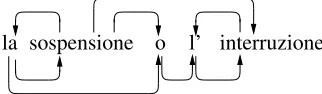
To exemplify how syntactic annotation conven-tions may differ in even such a simple case as un-labeled dependency annotation, consider the Italian
sentence fragment la sospensione o l’interruzione
(’the suspension or the interruption’) in Figure 1. As
we will see in detail in §3.1.3, there are two
Ital-ian treebanks: the ISST and TUT. If annotating as in the ISST treebank (drawn above the sentence)
determiners (la, l’) are annotated as dependents of
the following nouns (sospensione, interruzione); in
TUT (drawn below the sentence), we have the re-verse situation. There are also differences in how coordinate structures are represented: in ISST, the two conjuncts are directly conjoined and the con-junction attached to the first of them, while in TUT the conjunction acts as a link between the conjuncts.
o sospensione
[image:1.612.344.505.501.548.2]la l’ interruzione
Figure 1: Differences in dependency annotation styles.
Given the high cost of treebank annotation and the importance of a proper amount of data for parser de-velopment, this situation is frustrating. How could we then make use of multiple treebanks when train-ing a parser? A na¨ıve way would be simply to con-catenate them, but as we will see this results in a parser that performs badly on all the treebanks.
In this paper, we investigate two simple adapta-tion methods to bridge the gap between differing
syntactic annotation styles, allowing us to use more data for parser training. The first approach treats the problem of parsing with multiple syntactic an-notation styles as a multiview learning problem and addresses it by using feature representation that is partly shared between the views. In the second one we use a parser trained on one treebank to guide a new parser trained on another treebank. We evaluate these methods as well as their combination on four languages: German, Swedish, Italian, and English. In all four languages, we see a similar picture: the shared features approach is generally better when one of the treebanks is very small, while the guided parsing approach is better when the treebanks are more similar in size. However, for most training set sizes the combination of the the two methods achieves a higher performance than either of them individually.
2 Methods for Training Parsers on Multiple Treebanks
We now describe the two adaptation methods to leverage multiple treebanks for parser training. For clarity of presentation, we assume that there are two treebanks, although we can easily generalize to more. We use a common graph-based parsing tech-nique (Carreras, 2007); the approaches described here could be used in transition-based parsing as well.
In a graph-based parser, for a given sentence x
the task of finding the top-scoring parse yˆis stated
as an optimization problem of maximizing a linear objective function:
ˆ
y= arg max
y w·f(x, y).
Herewis a weight vector produced by some
learn-ing algorithm and f(x, y) a feature representation
that maps the sentence x with a parse tree y to
a high-dimensional vector; the adaptation methods presented in this work is implemented as
modifica-tions of the feature representation functionf. Since
the search space is too large to be enumerated, the maximization must be handled carefully, and how this is done determines the expressivity of the
fea-ture representation f. In the parser by Carreras
(2007) the maximization is carried out by a dynamic
programming procedure relying on crucial indepen-dence assumptions to break down the search space into tractable parts. The factorization used in this
approach allowsf to express features extracted not
only from single edges, as McDonald et al. (2005), but also from sibling and grandchild edges.
To understand the machine learning problem of training parsers on incompatible treebanks, we com-pare it to the related problem of domain adapta-tion: training a system for a target domain, using a large collection of training data from a source do-main combined with a small labeled or large unla-beled set from the target domain. Some algorithms for domain adaptation rely on the assumption that the differences between source and target
distribu-tionsPs and Pt can be explained in terms of a
co-variate shift: Ps(y|x) = Pt(y|x) for all x, y, but
Ps(x)6=Pt(x)for somex. In our case, we have the
reverse situation: the input distribution is at least in theory unchanged between the two treebanks, while the input–output relation (i.e. the treebank annota-tion style) is different. However, domain adaptaannota-tion and cross-treebank training can be seen as instances
of the more general problem of multitask learning
(Caruana, 1997). Indeed, one of the simplest and most well-known approaches to domain adaptation (Daum´e III, 2007), which will also be considered in this paper, should more correctly be seen as a trick to handle multitask learning with any machine learn-ing algorithm. On the other hand, there is no point in trying to use domain adaptation methods assum-ing a covariate shift, e.g. instance weightassum-ing, or any method in which the target data is unlabeled (Blitzer et al., 2007; Ben-David et al., 2010).
2.1 Sharing Feature Representations
of the two datasets are common and which are dif-ferent. The idea of using features that are shared be-tween the source and target training sets is a slight generalization of a well-known method for super-vised domain adaptation (Daum´e III, 2007).
In practice, this is implemented as follows.
As-sume that originally a sentencexwith a parse treey
was represented asf1(x, y)if it came from the first
treebank, andf2(x, y)if from the second treebank.
We then add ashared feature representationfstof1
andf2, and embed them into a single feature space.
The resulting feature vectors then become
f1(x, y)⊕02⊕fs(x, y) (1)
for a sentence from the first treebank, and
01⊕f2(x, y)⊕fs(x, y) (2)
for the second treebank. Here,01means an all-zero
vector with the dimensionality of the feature space
off1, and⊕is vector concatenation. Using this new
representation, the two datasets are combined and a single model trained. The hope is then that the learn-ing algorithm will store the information about the
re-spective particularities in the weights forf1 andf2,
and about the commonalities in the weights forfs.
The result of this process is a symmetric parser that can handle both treebank formats: when we parse a sentence at test time, we just use the representa-tion (1) if we want an output according to the first treebank and (2) for the second treebank.
In this work, f1, f2, and fs are identical: all of
them correspond to the feature set described by Car-reras (2007). However, it is certainly imaginable
that fs could consist of specially tailored features
that make generalization easier. In particular, using
a generalizedfswould allow us to use this approach
in more complex cases than considered here, for in-stance if the dependencies would be labeled with two different sets of grammatical function labels, or if one of the treebanks would use constituents rather than dependencies.
2.2 Using One Parser to Guide Another
The second method is inspired by work in parser combination, an idea that has been applied success-fully several times and relies on the fact that dif-ferent parsing methods have difdif-ferent strengths and
weaknesses (McDonald and Nivre, 2007), so that combining them may result in a better overall pars-ing accuracy. There are several ways to combine parsers; one of the simplest and most successful methods of parsing combination uses one parser as a guide for a second parser. This is normally im-plemented as a pipeline where the second parser ex-tracts features based on the output of the first parser. Nivre and McDonald (2008) used this approach for combining a graph-based and a transition-based parser and achieved excellent results on test sets for several languages, and similar ideas were proposed by Martins et al. (2008).
We added guide features to the parser feature
rep-resentation. However, the features by Nivre and
McDonald (2008) are slightly too simple since they only describe whether two words are directly con-nected or not. That makes sense if the two parsers are trying to predict the same type of representation, but will not help us if there are systematic annota-tion differences between the two treebanks, for in-stance in whether to annotate a function word or a lexical word as the head. Instead, following work in semantic role labeling and similar areas, we use a generalized notion of syntactic relationship that we
encode by determining a path between two nodes
in a syntactic tree. We defined the function Path(x,
y) as a representation describing the steps required
to traverse the parse tree fromxtoy, first the steps
up fromxto the common ancestoraand then down
fromatoy. Since we are working with unlabeled
trees, the path can be represented as just two inte-gers; to generalize to labeled dependency parsing, we could have used a full path representation as commonly used in dependency-based semantic role labeling (Johansson and Nugues, 2008).
We added the following path-based feature
tem-plates, assuming we have a potential head h with
dependent d, a sibling dependent s and grandchild
(dependent-of-dependent)g:
• POS(h)+POS(d)+Path(h,d)
• POS(h)+POS(s)+Path(h,s)
• POS(h)+POS(d)+POS(s)+Path(h,s)
• POS(h)+POS(g)+Path(h,g)
• POS(h)+POS(d)+POS(g)+Path(h,g)
To exemplify, consider again the example la
As-sume that we are parsing according to the ISST rep-resentation (drawn above the sentence) and we
con-sider adding an edge withsospensione as head and
la as dependent, and another parser following the
TUT representation (below the sentence) has cre-ated an edge in the opposite direction. The first feature template above would then result in a fea-ture NOUN+DET+(1,0), where (1,0) represents the path relationship between the two words in the TUT tree (one step up, no step down). Similarly, when the ISST parser adds the coordination edge between
sospensione and interruzione, it can make use of
the information that these two nouns are indirectly
connected in the output by the TUT parser; this is represented as a path (1,3). This is an example of a situation where we have a systematic correspon-dence where a single edge in one representation cor-responds to several edges in the other.
Like the multiview approach described above, this method is trivially adaptable to more complex situ-ations such as labeled dependency parsers with dif-fering label sets, or dependency/constituent parsing.
2.3 Combining Methods
The two adaptation methods are orthogonal and can easily be combined. When trying to improve the per-formance of a parser trained on the primary treebank
T1by leveraging a supporting treebank T2, we then
useT2in two different ways: first by training a guide
parser, and secondly by concatenating it toT1 using
a shared feature representation.
3 Experiments
We carried out experiments to evaluate the
cross-framework adaptation methods. The evaluations
were carried out using the official CoNLL-X eval-uation script using the default parameters. Since our parsers do not predict edge labels, we report unla-beled attachment scores in all tables and plots.
3.1 Treebanks Used in the Experiments
In our experiments, we used four languages: Ger-man, Swedish, Italian, and English. For each lan-guage, we had two treebanks. Our approaches cur-rently require that the treebanks use the same tok-enization conventions, so for Italian and Swedish we automatically retokenized the treebanks. We also made sure that the two treebanks for one language
used the same part-of-speech tag sets, by applying an automatic tagger when necessary.
3.1.1 German: Tiger and T ¨uBa-D/Z
For German, there are two treebanks available: Tiger (Brants et al., 2002) and T ¨uBa-D/Z (Telljo-hann et al., 2004). These treebanks are constituent treebanks, but dependency versions are available: T ¨uBa-D/Z (version 7.0) includes the dependency version in the distribution, while for Tiger we used the version from CoNLL-X (Buchholz and Marsi, 2006). The constituent annotation styles in the two treebanks are radically different: Tiger uses a very flat structure with a minimal amount of intermediate nodes, while T ¨uBa-D/Z uses a more elaborate struc-ture including topological field information. How-ever, the dependency versions are actually quite sim-ilar, at least with respect to attachment. The most common systematic difference we observed is in the annotation of coordination.
Both treebanks are large: for Tiger, the training set was 31,243 sentences and the test set 7,973 tences, and for T ¨uBa-D/Z 40,000 and 11,428 sen-tences respectively. We did not use the Tiger test set from the CoNLL-X shared task since it is very small. We applied the TreeTagger POS tagger (Schmid, 1994) to both treebanks, using the pre-trained Ger-man model.
3.1.2 Swedish: Talbanken05 and Syntag
As previously noted by Nivre (2002) inter alia,
Swedish has a venerable tradition in treebanking: there are not only one but two treebanks which must be counted among the earliest efforts of that kind. The oldest one is the Talbanken or MAMBA tree-bank (Einarsson, 1976), which has later been repro-cessed for modern use (Nilsson et al., 2005). The original annotation is a function-tagged constituent syntax without phrase labels, but the reprocessed re-lease includes a version converted to dependency syntax. The dependency treebank was used in the CoNLL-X Shared Task (Buchholz and Marsi, 2006), and we used that version version in this work.
have explicitly defined heads (Johansson, 2013). The two treebank annotation styles have signifi-cant differences. Most prominently, the Syntag an-notation is fairly semantically oriented in its treat-ment of function words such as prepositions and subordinating conjunctions: in Talbanken, a prepo-sition is the head of a prepoprepo-sitional phrase, while in Syntag the head is the prepositional complement. There are also some domain differences: Talbanken consists of student essays and public information, while Syntag consists of news text.
To make the two treebanks compatible on the to-ken level, we retoto-kenized Syntag – which handles punctuation in an idiosyncratic way – and applied a POS tagger trained on the Stockholm–Ume˚a Corpus (Gustafson-Capkov´a and Hartmann, 2006) to both treebanks. For Talbanken, we used 7,362 sentences for training and set aside a new test set of 3,680 sen-tences since the CoNLL-X test set is too small for serious experimental purposes – only 389 sentences. For Syntag, we split the treebank into 3,524 sen-tences for training and 1,763 sensen-tences for testing.
3.1.3 Italian: ISST and TUT
There are two Italian treebanks. The first is the Italian Syntactic–Semantic Treebank or ISST (Mon-temagni et al., 2003). Here, we used the version that was prepared (Montemagni and Simi, 2007) for the CoNLL-2007 Shared Task (Nivre et al., 2007).
The TUT treebank1 is a more recent effort. This
treebank is available in multiple constituent and de-pendency formats, and we have used the CoNLL-formatted dependency version in this work. The representation used in TUT is inspired by the Word Grammar theory (Hudson, 1984) and tends to be more surface-oriented than that of ISST. For in-stance, as pointed out above in the discussion of Figure 1, TUT differs from ISST in its treatment of determiner–noun constructions and coordination. It has been noted (Bosco and Lavelli, 2010; Bosco et al., 2010) that the TUT representation is easier to parse than the ISST representation.
We simplified the tokenization of both treebanks. In ISST, we split multiwords into separate tokens and reattached clitics to nonfinite verb forms. For
in-stance, a single tokena causa diwas converted into
1
http://www.di.unito.it/˜tutreeb/
three tokensa, causa, di, and the three tokens
trovar-se-lo into a single token trovarselo. In TUT, we applied the same conversions and also recomposed preposition–article and multiple-clitic contractions
that had been split by the annotators, e.g. della,
glieloetc.2 After changing the tokenization, we ap-plied the TreeTagger POS tagger (Schmid, 1994) to both treebanks, using the pre-trained Italian model
with the Baroni tagset3.
After preprocessing the data, we created training and test sets. For ISST, the training set was 2,239 and the test set 1,120 sentences, while for TUT the training set was 1,906 and the test set 954 sentences.
3.1.4 English: Two Different Conversions of the Penn Treebank
For English, there is no significant dependency treebank so we followed most previous work in us-ing dependency trees automatically derived from constituent trees in the large Penn Treebank WSJ
corpus (Marcus et al., 1993). Due to the fact
that there is a highly parametrizable constituent-to-dependency conversion tool available (Johansson and Nugues, 2007), we could create two dependency treebanks with very different annotation styles.
The first training set was created from sections 02–12 of the WSJ corpus. By default, the conversion tool outputs a treebank using the annotation style of the CoNLL-2008 Shared Task (Surdeanu et al., 2008); however we wanted to create a more surface-oriented style for this treebank, so we turned on
op-tions to make wh-words heads of relative clauses,
and possessive markers heads of noun phrases. This corpus had 20,706 sentences, and will be referred to as WSJ Part 1 in the experimental section.
The second training treebank was built from
sec-tions 13–22. For this treebank, we inverted the
value of most options in order to get a more seman-tically oriented treebank where content words are connected directly. In this treebank, we also used “Prague-style” annotation of coordination: the con-juncts are annotated as dependents of the conjunc-tion. This set contained 20,826 sentences, and will
2It should be noted that these conversions also make sense
from a practical NLP point of view, since a number of contrac-tions are homonymic with other words.
3
be called WSJ Part 2.
We finally applied both conversion methods to sections 24 and 23 to create development and test sets. The development set contained 1,346 and the test set 2,416 sentences. We did not change the tok-enization or part-of-speech tags of the WSJ corpora. Here, we should note that we have a slightly more synthetic and controlled experimental setting than for Swedish and German: the parsers are evaluated on the same test set, so we know that there is no
difference in test set difficulty. We also knowa
pri-orithat performance differences are not due to any
significant differences in genre, since all texts come from the same source (the Wall Street Journal) and tend to focus on business-oriented news.
3.2 Baseline Parsing Performance
As a starting point, we trained parsers on all tree-banks. In addition, we created a parser using a na¨ıve adaptation method by combining the training sets for each language, and training parsers on those three sets. We then applied all three parsers for every lan-guage on both test sets for that lanlan-guage. The re-sults for German, Swedish, Italian, and English are presented in Table 1.
Every parser performed well on the test set anno-tated in the same annotation style as its training set. As has been observed previously, surface-oriented styles are easier to parse than semantically oriented styles: The Talbanken and WSJ Part 1 parsers all achieve much higher performance on their respec-tive test sets than the Syntag and WSJ Part 2 parsers. The better performance of the Talbanken parser is also partly explainable by the fact that its training set is more than twice as large as the Syntag training set. Similarly for German, we see slightly higher performance for T ¨uBa-D/Z than for Tiger.
However, as can be expected every parser per-formed very poorly when applied to the test set us-ing the annotation style it was not trained on. For Swedish and English, the accuracy figures are in the range of 50-60, while the figure are a bit less poor for German since the two treebanks are more simi-lar. We also see, again unsurprisingly, that the na¨ıve combination baseline performs poorly in all situa-tions: we just get a “worst-of-both-worlds” parser that performs badly on both test sets.
GERMAN Acc. on Tiger Acc. on TBDZ
Tiger 87.8 72.0
T¨uBa-D/Z 71.8 89.4
Tiger+TBDZ 77.7 87.7
SWEDISH Acc. on ST Acc. on TB
Syntag 81.4 52.6
Talbanken 50.3 88.2
Syntag+Talbanken 61.8 82.7
ITALIAN Acc. on ISST Acc. on TUT
ISST 81.1 57.4
TUT 55.9 84.0
ISST+TUT 73.9 71.6
ENGLISH Acc. on WSJ 1 Acc. on WSJ 2
WSJ part 1 92.6 57.4
WSJ part 2 57.4 89.5
[image:6.612.314.545.59.294.2]WSJ parts 1+2 75.3 72.1
Table 1: Baseline performance figures.
3.3 Evaluation on the Full Training Sets
We trained new parsers using the shared features and
guided parsing adaptation methods described in§2.
Additionally, we trained parsers using both methods
at the same time; we refer to these parsers as
com-bined. Including the baseline parsers, this gave us 24 parsers to evaluate on their respective test sets.
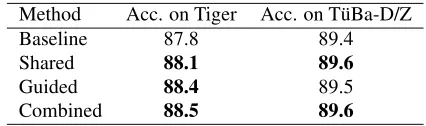
The results for German are given in Table 2. Here, we see that all three adaptation methods give
statis-tically significant4 improvements over the baseline
when parsing the Tiger treebank. In particular, the combined method gives a strong 0.7-point improve-ment, a 6% error reduction. For T ¨uBa-D/Z, the im-provements are smaller, although still significant ex-cept for the guided parsing method.
Method Acc. on Tiger Acc. on T¨uBa-D/Z
Baseline 87.8 89.4
Shared 88.1 89.6
Guided 88.4 89.5
Combined 88.5 89.6
Table 2: Performance figures for the German adapted parsers. Results that are significantly different from the baseline performances are written in boldface.
4
[image:6.612.319.532.555.618.2]Method Acc. on ST Acc. on TB
Baseline 81.4 88.2
Shared 81.3 88.3
Guided 82.5 88.4
[image:7.612.102.272.56.119.2]Combined 82.5 88.5
Table 3: Performance of the Swedish adapted parsers.
For Swedish, we have a similar story: we see stronger improvements in the weak parser. Since the Talbanken treebank is twice as large as the Syn-tag treebank and has a surface-oriented representa-tion that is easier to parse, this parser is useful as a guide for the Syntag parser: the improvements of the guided and combined Syntag parsers are statis-tically significant. However, it is harder to improve the Talbanken parser, for which the baseline is much stronger. 3 shows the results for the Swedish parsers.
Method Acc. on ISST Acc. on TUT
Baseline 81.1 84.0
Shared 81.5 84.4
Guided 81.7 84.3
[image:7.612.93.278.306.368.2]Combined 81.8 84.7
Table 4: Performance of the Italian adapted parsers.
When we turn to the English corpora, the adapta-tion methods again gave us a number of very large improvements. The results are shown in Table 5. The shared features and combined methods gave sta-tistically significant improvements for the WSJ Part 1 parser, and the guided parsing method an improve-ment that is nearly significant. However the most dramatic change is the 1.2-point improvement of the WSJ Part 2 parser, given by the guided parsing and combined methods. It is possible that this result partly can be explained by the fact that this exper-iment is a bit cleaner: in particular, as outlined in
§3.1.4, there are no domain differences.
Method Acc. on WSJ 1 Acc. on WSJ 2
Baseline 92.6 89.5
Shared 92.8 89.5
Guided 92.8 90.7
Combined 92.9 90.7
Table 5: Performance of the English adapted parsers.
For WSJ Part 2, we analyzed the differences between the baseline and the best adapted parser.
While there were improvements for all POS tags, the most notable one was in the attachment of conjunc-tions, where we got an increase from 69% to 75% in attachment accuracy, an 18% relative error reduc-tion. Here we saw a very clear benefit of guided parsing: since this treebank uses “Prague-style” co-ordination annotation (i.e. the conjunction governs the conjuncts), it is hard for the parser to handle va-lencies and selectional preferences when there is a conjunction involved. It has been noted (Nilsson et al., 2007) that this style of annotating coordination is hard to parse. Since the WSJ Part 1 parser uses a coordination style that is easier to parse, the WSJ Part 2 parser can rely on its judgment.
Although conclusions must be very tentative since we are testing on just four languages, we can make a few general observations.
• The largest improvements (absolute and
rela-tive) all happen in treebanks that are harder to parse. In particular, Syntag and WSJ Part 2 are harder to parse due to their representation, and to some extent this may be true for Tiger as well – its learning curve rises more slowly than for T ¨uBa-D/Z. Of course, in some cases (in partic-ular Syntag, but also Tiger) this may partly be explained by the training set being smaller, but not for WSJ Part 2. In these cases, the guided parsing method seems to be more effective.
• The languages where the shared features
method gives significant improvement for both treebanks are German and Italian, where we do not have the situation that one treebank is much larger or much easier to parse.
• The combination of the two methods gave
sig-nificant improvements in all eight cases, and had the highest performance in six cases.
3.4 The Effect of the Training Set Size
In order to better understand the differences between the adaptation methods, we analyzed the impact of training set size on the improvement given by the respective methods. Let us refer to the training tree-bank annotated according to the same style as the
test set as the primary treebank, and the other one
as thesupporting treebank. We carried out the
[image:7.612.86.285.586.649.2]101 102 103 104 105 Training set size (sentences)
0 10 20 30 40 50
Error reduction (percent)
Tiger error reduction
Shared Guided Combined
101 102 103 104 105
Training set size (sentences) 0
10 20 30 40 50
Error reduction (percent)
[image:8.612.102.265.62.341.2]T Ba-D/Z error reduction Shared Guided Combined
Figure 2: Error reduction by training set size, German.
training sentences in the primary treebank and keep-ing the size of the supportkeep-ing treebank constant.
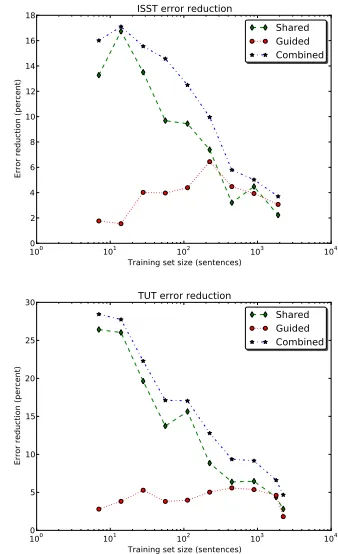
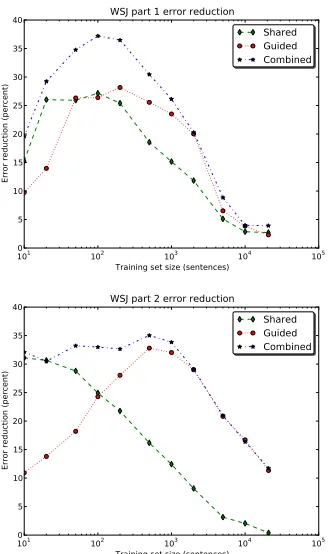
In order to highlight the differences between the three adaptation methods, we show error reduction plots in Figures 2, 3, 4, and 5 for German, Swedish, Italian, and English respectively. For each training
set size on thex axis, the plot shows the reduction
in relative error with respect to the baseline.
We note that every single one of the 24 adapted
parsers learns faster than the corresponding baseline parser. While we saw a number of significant
im-provements in§3.3 when using the full training sets,
the relative improvements are much stronger when the training sets are small- and medium-sized.
These plots illustrate the different properties of the two methods. Using a shared feature represen-tation tends to be very effective when the primary treebank is small: the error reductions are over 40 percent for German and over 25 percent for English. Guided parsing works best for mid-sized sets, and the relative effectiveness of both methods decreases as the size of the primary treebank increases. Again, we see that guided parsing is less effective if the guide uses an annotation style that is hard to parse.
101 102 103 104
Training set size (sentences) 0
2 4 6 8 10 12 14 16 18
Error reduction (percent)
Syntag error reduction
Shared Guided Combined
101 102 103 104
Training set size (sentences) 0
5 10 15 20 25
Error reduction (percent)
[image:8.612.344.505.64.340.2]Talbanken error reduction Shared Guided Combined
Figure 3: Error reduction by training set size, Swedish.
100 101 102 103 104
Training set size (sentences) 0
2 4 6 8 10 12 14 16 18
Error reduction (percent)
ISST error reduction
Shared Guided Combined
100 101 102 103 104
Training set size (sentences) 0
5 10 15 20 25 30
Error reduction (percent)
TUT error reduction
Shared Guided Combined
[image:8.612.337.506.379.656.2]In particular, for Swedish the Syntag parser never gives a very large improvement when guiding the Talbanken parser, and this is also true of both Italian parsers. To a smaller extent, this also holds for En-glish and German: the WSJ Part 2 and Tiger parsers are less useful as guides than their counterparts.
The combination method generally performs very well: in all eight experiments, it outperforms the other two for almost every training set size. Its per-formance is very close to that of the guided parsing method for larger training sets, when the effect of the shared features method is less pronounced.
101 102 103 104 105
Training set size (sentences) 0
5 10 15 20 25 30 35 40
Error reduction (percent)
WSJ part 1 error reduction Shared Guided Combined
101 102 103 104 105
Training set size (sentences) 0
5 10 15 20 25 30 35 40
Error reduction (percent)
[image:9.612.102.266.239.516.2]WSJ part 2 error reduction Shared Guided Combined
Figure 5: Error reduction by training set size, English.
4 Conclusion
We have considered the problem of training a de-pendency parser on incompatible treebanks, and we studied two very simple methods for addressing this problem, the shared features and guided parsing methods. These methods allow us to use more than one treebank when training dependency parsers. We evaluated the methods on eight treebanks in four languages, and had statistically significant improve-ments in all eight cases. In particular, for English
we saw a strong 1.2-point absolute improvement (an 11% relative error reduction) in the performance of a semantically oriented parser when trained on the full training set. For German, we also had very strong results for the Tiger treebank: a 6% error reduction. For Swedish, the parser trained on the small Syntag treebank got a boost from a guide parser trained on the larger Talbanken. In general, it seems to be eas-ier to improve parsers that use representations that are harder to parse.
For all eight treebanks, both methods achieved large improvements for small training set sizes, while the effect gradually diminished as the training set size increased. The shared features method was the most effective for very small training sets, while guided parsing surpassed it when training sets got larger. The combination of the two methods was also effective, in most cases outperforming both methods on their own. In particular, when using the full train-ing sets, this was the only method that had statisti-cally significant improvements for all treebanks.
While this work used an unlabeled graph-based dependency parser, our methods generalize naturally to other parsing approaches, including transition-based dependency parsing. Labeled parsing with incompatible label sets is easy to implement in the shared features framework by removing the label
in-formation from the shared feature representationfs,
and similar modifications offscould be carried out
to handle more complex situations such as combined constituent and dependency parsing. Furthermore, the paths used by the feature extractor in the guided parser can be extended without much effort as well. The models presented here are very simple, and in future work we would like to explore more com-plex approaches such as quasi-synchronous gram-mars (Smith and Eisner, 2009; Li et al., 2012) or au-tomatic treebank transformation (Niu et al., 2009).
Acknowledgements
References
Shai Ben-David, John Blitzer, Koby Crammer, Alex Kulesza, Fernando Pereira, and Jennifer Wortman Vaughan. 2010. A theory of learning from different domains.Machine Learning, 2010(79):151–175. John Blitzer, Mark Dredze, and Fernando Pereira. 2007.
Biographies, Bollywood, Boom-boxes and Blenders: Domain adaptation for sentiment classification. In
Proceedings of the 45th Annual Meeting of the Asso-ciation of Computational Linguistics, pages 440–447, Prague, Czech Republic.
Cristina Bosco and Alberto Lavelli. 2010. Annota-tion schema oriented validaAnnota-tion for dependency pars-ing evaluation. InProceedings of the Ninth Workshop on Treebanks and Linguistic Theories (TLT9), Tartu, Estonia.
Cristina Bosco, Simonetta Montemagni, Alessandro Mazzei, Vincenzo Lombardo, Felice Dell’Orletta, Alessandro Lenci, Leonardo Lesmo, Giuseppe Attardi, Maria Simi, Alberto Lavelli, Johan Hall, Jens Nils-son, and Joakim Nivre. 2010. Comparing the influ-ence of different treebank annotations on dependency parsing. InProceedings of the Seventh International Conference on Language Resources and Evaluation (LREC’10), pages 1794–1801, Valletta, Malta. Sabine Brants, Stefanie Dipper, Silvia Hansen, Wolfgang
Lezius, and George Smith. 2002. The TIGER tree-bank. InProceedings of the Workshop on Treebanks and Linguistic Theory, pages 24–41, Sozopol, Bul-garia.
Sabine Buchholz and Erwin Marsi. 2006. CoNLL-X shared task on multilingual dependency parsing. In
Proceedings of the Tenth Conference on Computa-tional Natural Language Learning (CoNLL-X), pages 149–164, New York City, United States.
Xavier Carreras. 2007. Experiments with a higher-order projective dependency parser. In Proceedings the CoNLL Shared Task, pages 957–961, Prague, Czech Republic.
Rich Caruana. 1997. Multitask learning. Machine Learning, 28(1):41–75.
Hal Daum´e III. 2007. Frustratingly easy domain adapta-tion. InProceedings of the 45th Annual Meeting of the Association of Computational Linguistics, pages 256– 263, Prague, Czech Republic.
Jan Einarsson. 1976. Talbankens
skrift-spr˚akskonkordans. Department of Scandinavian Languages, Lund University.
Sofia Gustafson-Capkov´a and Britt Hartmann. 2006. Manual of the Stockholm Ume˚a Corpus version 2.0. Stockholm University.
Richard Hudson. 1984.Word Grammar. Blackwell.
Jerker J¨arborg. 1986. Manual f¨or syntaggning. De-partment of Linguistic Computation, University of Gothenburg.
Richard Johansson and Pierre Nugues. 2007. Ex-tended constituent-to-dependency conversion for En-glish. InNODALIDA 2007 Conference Proceedings, pages 105–112, Tartu, Estonia.
Richard Johansson and Pierre Nugues. 2008. The ef-fect of syntactic representation on semantic role label-ing. In Proceedings of the 22nd International Con-ference on Computational Linguistics (Coling 2008), pages 393–400, Manchester, United Kingdom. Richard Johansson. 2013. Bridging the gap between
two Swedish treebanks. Northern European Journal of Language Technology. Submitted.
Zhenghua Li, Ting Liu, and Wanxiang Che. 2012. Ex-ploiting multiple treebanks for parsing with quasi-synchronous grammars. In Proceedings of the 50th Annual Meeting of the Association for Computational Linguistics (Volume 1: Long Papers), pages 675–684, Jeju Island, Korea.
Mitchell P. Marcus, Beatrice Santorini, and Mary Ann Marcinkiewicz. 1993. Building a large annotated cor-pus of English: the Penn Treebank. Computational Linguistics, 19(2):313–330.
Andr´e F. T. Martins, Dipanjan Das, Noah A. Smith, and Eric P. Xing. 2008. Stacking dependency parsers. InProceedings of the 2008 Conference on Empirical Methods in Natural Language Processing, pages 157– 166, Honolulu, United States.
Ryan McDonald and Joakim Nivre. 2007. Charac-terizing the errors of data-driven dependency parsing models. InProceedings of the 2007 Joint Conference on Empirical Methods in Natural Language Process-ing and Computational Natural Language LearnProcess-ing (EMNLP-CoNLL), pages 122–131, Prague, Czech Re-public.
Ryan McDonald, Koby Crammer, and Fernando Pereira. 2005. Online large-margin training of dependency parsers. InProceedings of 43rd Annual Meeting of the Association for Computational Linguistics (ACL’05), pages 91–98, Ann Arbor, United States.
Simonetta Montemagni and Maria Simi. 2007. The Ital-ian dependency annotated corpus developed for the CoNLL-2007 shared task. Technical report, ILC-CNR.
Treebank. In Anne Abeill´e, editor,Building and Using Syntactically Annotated Corpora. Kluwer, Dordrecht. Jens Nilsson, Johan Hall, and Joakim Nivre. 2005.
MAMBA meets TIGER: Reconstructing a Swedish treebank from antiquity. In Proceedings of NODAL-IDA Special Session on Treebanks.
Jens Nilsson, Joakim Nivre, and Johan Hall. 2007. Generalizing tree transformations for inductive depen-dency parsing. In Proceedings of the 45th Annual Meeting of the Association of Computational Linguis-tics, pages 968–975, Prague, Czech Republic. Zheng-Yu Niu, Haifeng Wang, and Hua Wu. 2009.
Ex-ploiting heterogeneous treebanks for parsing. In Pro-ceedings of the Joint Conference of the 47th Annual Meeting of the ACL and the 4th International Joint Conference on Natural Language Processing of the AFNLP, pages 46–54, Suntec, Singapore.
Joakim Nivre and Ryan McDonald. 2008. Integrating graph-based and transition-based dependency parsers. In Proceedings of ACL-08: HLT, pages 950–958, Columbus, United States.
Joakim Nivre, Johan Hall, Sandra K¨ubler, Ryan Mc-Donald, Jens Nilsson, Sebastian Riedel, and Deniz Yuret. 2007. The CoNLL 2007 shared task on depen-dency parsing. InProceedings of the CoNLL Shared Task Session of EMNLP-CoNLL 2007, pages 915–932, Prague, Czech Republic.
Joakim Nivre. 2002. What kinds of trees grow in Swedish soil? A comparison of four annota-tion schemes for Swedish. In Proceedings of the First Workshop on Treebanks and Linguistic Theories (TLT2002), Sozopol, Bulgaria.
Helmut Schmid. 1994. Probabilistic part-of-speech tag-ging using decision trees. InProceedings of Interna-tional Conference on New Methods in Language Pro-cessing, Manchester, United Kingdom.
David A. Smith and Jason Eisner. 2009. Parser adapta-tion and projecadapta-tion with quasi-synchronous grammar features. In Proceedings of the 2009 Conference on Empirical Methods in Natural Language Processing, pages 822–831, Suntec, Singapore.
Mihai Surdeanu, Richard Johansson, Adam Meyers, Llu´ıs M`arquez, and Joakim Nivre. 2008. The CoNLL-2008 shared task on joint parsing of syntactic and se-mantic dependencies. InCoNLL 2008: Proceedings of the Twelfth Conference on Natural Language Learn-ing, pages 159–177, Manchester, United Kingdom. Heike Telljohann, Erhard Hinrichs, and Sandra Kbler.