Some classes of sets of structures definable without quantifiers
James Rogers Earlham College
Dakotah Lambert Earlham College
Abstract
We derive abstract characterizations of the Strictly Piecewise Local (SPL) and Piecewise Locally Testable (PLT) stringsets. These gen-eralize both the Strictly Local/Locally Testable stringsets (SL and LT) and Strictly Piece-wise/Piecewise Testable stringsets (SP and PT) in that SPL constraints can be stated in terms of both adjacency and precedence.
We do this in a fully abstract setting which ap-plies to any class of purely relational models that label the points in their domain with some finite labeling alphabet. This includes, for ex-ample, labeled trees and graphs. The actual structure of the class of intended models only shows up in interpreting the abstract charac-terizations of the definable sets in terms of the structure of the models themselves.
1 Introduction
The ultimate goal of this paper is a characteriza-tion of the Piecewise Locally Testable and Strictly Piecewise Local classes of sets of strings. But in getting there we employ a very general technique that, with the exception of a single step (the defi-nition ofrealizability) applies to any class of rela-tional structures and yields:
• a quantifier-free logic that is propositional in the sense of “can be interpreted via truth ta-bles as a canonical, but uninteresting, class of models” (but not PC, as in Propositional Cal-culus),
• an algebraic setting that, modulo the defi-nition of realizability, provides an abstract characterization of the sets of structures de-finable in that logic, which may or may not be all that useful in itself, but which is strong enough to support more natural characteriza-tions.
The reason that definability with respect to these quantifier-free logics is interesting is that it identi-fies the sets of structures that are definable purely in terms of the explicit components of the struc-tures themselves, without any auxiliary mecha-nisms such as distinguishing points in terms inde-pendent of their labels (by assigning variables to them, for instance, or associating them with states) or refinements of the label alphabet (by adding features, for instance). This gives a near minimal notion of definability and a class of constraints that can be checked without inferring any information beyond what is explicitly present in the structure itself.
1.1 Overview of the paper
In Section2we introduce the Piecewise Local Hi-erarchy and provide some motivation for exploring its propositional levels. In Section3we introduce relational models and their local factors. These are ordinary mathematical models over a purely relational signature which include unary relations that we can interpret as labeling the points in the domain. Beyond that, while the actual structural properties of the models are given by a definition of what counts as an intended model, those proper-ties are inconsequential for nearly all of what fol-lows. As an example we define a class of word models, models for strings that include relations for both successor and precedence.
In Section5we consider sets of factors as mod-els of the logic rather than the relational struc-tures themselves. The function taking a structure to the set of its factors maps models of the first sort (the structures themselves) to models of the sec-ond (sets of factors). The advantage of this move is that the space of sets of factors is a finite Boolean Algebra. In this setting it is easy to prove that a set of sets of factors is Strictly Local if and only if (iff) it is a principal ideal in that space. The cost of this move is that not all sets of factors are the image of one of the intended relational structures. Those that are we refer to as beingrealizable.
We then return, in Section6, to the properties of the Locally and Strictly Locally Definable sets of structures and develop abstract characterizations of these classes. Up until this point, everything we have done applies to any class of relational struc-tures, regardless of the actual structural properties of the intended models (strings, for example, or trees). The characterization of the Local sets is valid for all classes of relational structures, but the last step of the characterization of the Strictly Lo-cally Definable sets depends critiLo-cally on the no-tion of realizability. The secno-tion ends by complet-ing the characterization for models of strcomplet-ings.
These characterizations can be hard to apply in their fully abstract form. In Section 7we fix the notion of realizability for models of strings over a signature that includes both successor and prece-dence, and derive closure properties that are gen-eralizations of the well-known characterizations of the Strictly Local (successor only) and Strictly Piecewise (precedence only) sets of strings.
In Section8we consider the learnability of the definable sets of structures. Following that we give both an example of a phonotactic constraint not that is SPL definable and one that separates SPL from both SF and the Tier-based Strictly Lo-cal stringset (defined there). We then close with some concluding remarks.
2 The Piecewise-Local Hierarchy
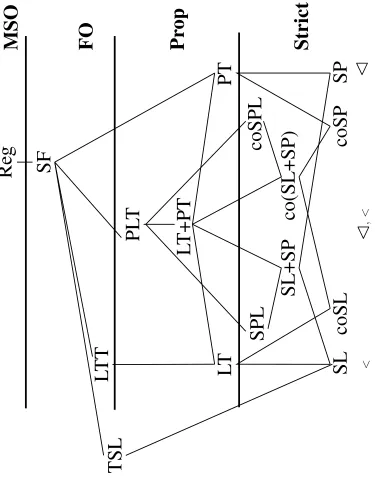
The Piecewise-Local Hierachy (Figure 1) or-ganizes the Local and Piecewise classes of stringsets, introduced in McNaughton and Papert (1971) and extended by Brzozowski and Simon (1973), Simon (1975), Straubing (1985), Thérien and Weiss (1985), Beauquier and Pin (1991) and others, on the basis of model-theoretic definability with respect to word models (see
Example 1) along two dimensions: signature (successor alone, less-than alone, or both) and strength of the logical machinery, from the propositional logic discussed below (Section4) to Monadic Second-Order.
The characterization of Regular stringsets by MSO definability is due to Medvedev (1964), Büchi (1960) and Elgot (1961). This work es-tablished the relationship between model-theory of ordered structures and computational structures that spawned the study of Descriptive and Struc-tural Complexity, Finite Model-Theory and other areas of Graph Theory, Abstract Algebra, Theo-rem Proving and Discrete Math. The character-ization of the Star-Free stringsets (SF—definable by regular expressions with complement but not Kleene-closure) by FO(<), First-Order definabil-ity with less-than (or both less-than and succes-sor, since successor is FO definable from less-than) is due to McNaughton and Papert (1971), which spawned the work of Brzozowski, Simon, Beauquier and Pin cited above. Thomas (1978) established the characterization of the Locally Threshold Testable (LTT) stringsets by FO defin-ability with successor alone, FO(+1).
Our exploration of the Piecewise-Local hier-archy was motivated by Heinz’s exploration of learnability of phonotactic stress patterns (Heinz, 2007). Our research group at Earlham College, over the course of several years, constructed com-putational tools to classify the patterns in the StressTyp2 (Goedemans et al.,2015) collection of stress patterns that have automata-theoretic se-mantics, about two-thirds of the 750 lects in the collection, covering a broad range of human lan-guages. These fall into 106 distinct patterns.
L
T
co
(S
L
+
S
P
)
S
P
S
L
co
S
L
co
S
P
L
T
T
S
P
L
co
S
P
L
S
L
+
S
P
P
ro
p
S
tr
ic
t
F
O
M
S
O
S
F
R
eg
T
S
L
P
L
T
L
T
+
P
T
P
T
<
⊳
,
<
[image:3.595.112.487.168.646.2]⊳
Dot Depth
Quant Rank
Quant Alt
β
β2 = B (( F in ∪ C o F in ) 2 ) S F B0 L T D E F R D E F G D E F F in ∪ C o F in ( = B ( F in ∪ C o F in ) ) F in C o F in L T T β2 i + 1 = β2( i + 1) = B (( F in ∪ C o F in ) 2 i ) B (Σ 1 ) d ef = ( B (( ∃ ~x )[ Π0 ]) B (Σ i ) d ef = ( B (( ∃ ~x )[Πi−
1 ]) F O ( < ) B (Σ 1 ) B (Σ 1 , 1 ) B (Σ 1 ,i )
[ i∈
N [ B (( F in ∪ C o F in ) i )] B ( M ( G D E F )) B1 d ef = B ( M ( B0 ) Bi = B ( M ( Bi − 1 ) L T O =
[ i∈
[image:4.595.97.509.80.698.2]N [ Bi ] β1 S L β3 = β4 = B (( F in ∪ C o F in ) 3 ) B (Σ 1 , 0 ) Σ0 = Π0 R eg
Some constraints, the requirement that if pri-mary stress falls on a heavy syllable it must be the first heavy syllable, for example, are not even de-finable in FO(+1). These are examples of long-distance phonotactics which are amenable to be-ing defined in terms of subsequences (sequences of symbols that occur in order but not necessarily adjacently). These are definable using less-than without the aid of successor; they are Piecewise Testable (PT) constraints. The Piecewise Testable stringsets were introduced by Simon (1975) and are the analog of the LT stringsets based on subse-quences rather than substrings. Some, the require-ment that primary stress does not fall on more than one syllable (culmanitivity), for example, can be expressed as conjunctions of negative piecewise literals, in SP (Rogers et al., 2010). Obligatori-ness, since the only factor involved is a single sym-bol, can be expressed as the complement of an SP stringset, it is co-SP, as well as co-SL.
Conjunctions of SL, co-SL and SP constraints (SL+co-SL+SP) cover 98 of the 106 patterns in the database. Of the remaining eight, two are properly regular, involving covert alternation. The rest are all of the form: if stress falls on a final syl-lable that is heavy, then a sylsyl-lable of some other type (an unstressed heavy, for example) does not occur. While LT they are not expressible as SL or SP constraints or their complement. They are, on the other hand expressible as a negative literal that uses both adjacency (for the identification of the final syllable) and less-than (for the long-distance aspect). This, in addition to the obvious theoreti-cal interest, is what led us to explore the Piecewise Locally (PLT) Testable and Strictly Piecewise Lo-cal (SPL) stringsets. Except for those two properly regular patterns, all of the automata-theoretic pat-terns in StressTyp2 are definable in SPL+co-SL.
2.1 Some Other Sub-Regular Hierarchies
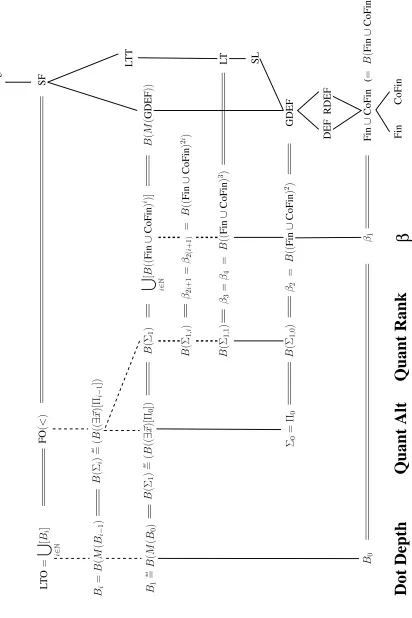
An alternative way of partitioning the Star-Free stringsets is via the dot-depth and β hi-erarchies (Figure 2). The former is due to Schützenberger(1965) andBrzozowski and Knast (1978). McNaughton and Papert (1971) had al-ready established that the Star-Free stringsets are equal to closure of the Locally Testable stringsets under mixed concatenation and Boolean operations (Locally Testable with Order, LTO). Brzozowski and Knast (1978) establishes an in-finite hierarchy, building from the class of
fi-nite and co-fifi-nite stringsets via concatenation clo-sure (M in the figure) followed by Boolean closure (B), alternately, which partitions LTO. Brzozowski and Simon (1973) refines the dot-depth 1 level into an infinite hierarchy built on concatenation of successively more factors, closed under Boolean operations. The second level (β2)
is equivalent to the class of Generalized Definite stringsets (GDEF, stringsets determined by their initial and final substrings); The third, equivalently fourth, level is equivalent to the LT stringsets.
Thomas(1982), using a somewhat different no-tion of word model, characterizes these with re-spect to FO definability. The dot-depth hierar-chy (albeit starting at GDEF for Σ0/Π0)
corre-sponds to the standard notion of quantifier alterna-tion. Theβ hierarchy corresponds toΣ1stratified
by quantifier rank.
The citations given here are a very sparse (and idiosyncratic) sample of the incredibly broad and deep body of work over the last 60 years that has its foundations in those initial results, a testament to the fundamental nature of the results. Perhaps the best route into the theories of word models is the books by McNaughton and Papert and by Straubing(1994).
3 Some definitions
3.1 Relational Models
To be precise about terminology, a relational sig-nature,R, is a ranked alphabet of relation symbols {Ri |i ∈ N}, where the symbols inRirepresent i-ary relations. LetR∗be the union of the symbols inRifor alli. We assume thatRis finite.
AnR-structure is a tupleA=hA, RA
1, R2A, . . .i
whereAis the domain and theRAi are interpreta-tions of the appropriate arity of symbols chosen fromR∗.
Example 1(Word Models). Letwbe a string over the alphabetΣ. Let|w|be the length ofw. AWord Modelforwis a structure:
M⊳,<
Σ (w) def
=hDw,⊳w, <w,⋊w,⋉w, Pσwiσ∈Σ
where:
Dw—is isomorphic to an initial segment
h0,1, . . . ,|w|+ 1i of N (the Natural num-bers).
⊳w—is the successor relation onDw.
⋊w—is the singleton set containing the minimum position inDw.
⋉w—is the singleton containing the maximum position inDw.
Pw
σ—is the set of positions inwat which the
sym-bolσoccurs.
The sets⋊w,⋉wandPw
σ , for eachσ ∈Σ
parti-tionDw(they are pairwise disjoint and their
union isDw).
LetM⊳,<
Σ denote the class of all word models over Σ.
This definition of a word model differs in cer-tain respects from definitions that may be famil-iar from prior work. In particular, the endmarkers
⋊,⋉are explicit in the structure and mark points that are adjoined to the ends of the set of positions in the string. Thus, ifw=hσ1, σ2, . . . , σ|w|i, then card(Dw) =|w|+ 2andi∈Pw
σ iffσi=σ. Also
this type of word model includes both the succes-sor and precedence relations. When we look at specific classes in the Piecewise Local sub-regular hierarchy we have, heretofore, employed reducts of this signature including one or the other of the ordering relations, but not both. Here we can ob-tain the same restrictions by varying parameters restricting their usefulness.
It is important to note that a structure is not nec-essarily a word model simply because it shares the same signature as these word models. In particu-lar, the interpretations of ‘Dw’, ‘⊳w’, ‘<w’, ‘⋊w’
and ‘⋉w’ are not arbitrary, but required to satisfy the axioms of finite discrete linear orders under the usual interpretation of the symbols. We re-fer to these as thestructuralrelations—they form the ‘bones’ of the intended class of structures— and we refer to those structures that satisfy the ax-ioms as the intended models. These notions gen-eralize to other classes of labeled relational struc-tures which exhibit particular structural properties. Word models corresponding to distinct strings dif-fer only in the size of the domain and in the inter-pretations of thePσ.1
In the core of this paper we temporarily turn to sets of factors (defined in Section3.3) as
mod-1
Although in this case, the interpretations of the Pσ is
not entirely free, either, in that we require those interpreta-tions, along with those of the end markers, to partition the domain. Relaxing that actually leads to a more flexible notion of string-like structures that are useful in many applications.
els, which characterize the freely generated struc-tures over the given signature, and encapsulate the theory of the intended structures in the notion of “realizability” (Section 5.3) which picks out the sets of factors that actually correspond to a par-ticular well-formed structure. The core results are valid independent of the definition of realizabil-ity, which puts the focus squarely on the defin-ing power of the quantifier-free logic, abstractdefin-ing away from properties that distinguish a class of in-tended models from another with the same signa-ture.
Henceforth, when we refer R-structures, we will mean the class of intended structures, how-ever that definition may be restricted. When we discuss the freely generated structures over the signatureR, including those that may not be well-formed, we will explicitly say so.
3.2 Homomorphisms and Embeddings
SupposeAandBareR-structures. The following definitions are from (Hodges,1993).
AhomomorphismfromAtoBis a (total) func-tionh:A→B such that:
R∈Riand~a∈RA⇒h(~a)∈RB. Note that this only requires that the images of the ~athat are in the interpretation of R in Aare in-cluded in the interpretation ofRinB. It says noth-ing about otherh(~a)that might also be included in RB.
Anembedding(or strong homomorphism) from AtoBis a (total) functionh:A→Bsuch thath is a homomorphism that is is strengthened to
R∈Riand~a∈RA⇔h(~a)∈RB We note the difference because “homomor-phism” is often taken in the stronger sense, but we necessarily need the weak sense. Otherwise if the image of A in B includes any tuple h(~a) in the domain of the interpretation of a relation RinB, thenAmust include the pre-image ofRB(h(~a))in RAas well. In this way the interpretation ofRin Bwould restrict the structure ofA.
3.3 Neighborhoods and factors
The next few definitions are based on those in Libkin(2004). The first two are ubiquitous in the Theory of Finite Models.
aroundainA(denotedBrA) is defined inductively
as follows:
B0A(a) = {a} BA
i+1(a) = BiA(a)∪
{a′ |(∃R∈R,
~a∈RA, a′′∈BiA(a)) [a′, a′′both occur in~a]}
The members ofBA
i (a)are all the members of
Athat are within distance iofain the Gaifmann graph ofA.
Definition 2(Connectivity). LetAbe anR struc-ture.
Aisk-connectediff for alla∈A,BkA−1(a) =
A.
Note that every k-connected domain is alsoj -connected for allj > k.
Definition 3(k-Factor). LetAandBbeR struc-tures.
Ais ak-factorofBiff2
1 : card(A)≤k
2 : Aiscard(A)-connected
3 : ∃h:A→B, a homomorphism
N.B. In this definition the set ofk-factors of a structure includes all of itsj-factors forj ≤k.
In general there will be many suchh. Each one picks out an occurrence of the factorAinB.
Let Fk(B)be the set of isomorphism classes of
the set of allk-factors of B. We will ignore the difference between an isomorphism class and a canonical representative of that class, so we can consider this to be a set of structures over an anonymous domain of cardinalityk.
Proposition 1. Ifcard(B) is finite then there are only finitely many distinct (up to isomorphism)k -factors ofB.
Lemma 1. If R is relational and finite then the cardinality of
Fk(R)
def
=[
B
[Fk(B)], BanR-structure.
is finite.
2
The term “factor” comes from the well known interpre-tation of strings in a monoid over concatenation, where the definition is immediate. We adopt this fully general defini-tion in order to extend it to arbitrary reladefini-tional structures, in-dependent of their specific properties.
Proof Sketch. If R is relational and finite then there are, up to isomorphism, only finitely many
R-structures of cardinality k. This is Exercise 6 (Pg. 10) of Hodges, an easy exercise.
We extend Fk to sets of structures in the
stan-dard way, as the union of the sets of k-factors of the structures in the set.
3.4 Supposingk < n
Suppose A is an R-structure, card(A) = k and R ∈Rn ⊆R, as above, and k < n. Then, by the pigeon-hole-principle,
(∀~a∈RA)[(∃a∈A)[
aoccurs in at least two places in~a]].
Let’s say that ann-ary relation is anti-reflexive if no individual occurs more than once in any of its tuples. If allR ∈Rare anti-reflexive then, for all
R∈Rn>k,RA =∅.
This is not deep. It just says that in the anti-reflexive case (which will be common) k-factors have nothing to say about relations of arity greater thank.
3.5 Aspects of partial orders
The following is taken, primarily, from MacLane and Birkhoff (1967, 1970). A par-tial orderis a set equipped with a partial ordering relation⊑that is reflexive, transitive and antisym-metric. If⊑is not antisymmetric, then it defines a quasiorder.3
A lattice is a partial order that is closed with respect to two binary operators: a greatest lower bound (meet, ∧) and least upper bound (join,∨). Meets and joins are idempotent, associative and commutative and satisfy the absorption law (x∧
(x∨y) =x=x∨(x∧y)). If they distribute over each other, then the lattice is distributive.
All finite lattices have a unique minimum ele-ment (⊥) and a unique maximum eleele-ment (⊤). If a lattice has a maximum and minimum element and every element has a complement with respect to these (x∧x =⊥) and (x∨x =⊤) then it is a complemented lattice. If it is complemented and distributive it is a Boolean lattice, equivalently, Boolean algebra. If the lattice is Boolean then ev-ery elementxhas a unique complementx.
3In our usage, the relationship between quasiorders and
An element aof a Boolean algebra is an atom iffa >⊥and there is nobsuch thata > b >⊥.
If a set S is partially ordered by⊑ and I is a non-empty subset of S that is downward closed (x ∈ I and y ⊑ x impliesy ∈ I) and each pair of elements inI has at least one upper bound inI, then I is anideal. If the ideal includes a unique maximum elementathen it is theprincipal ideal generated bya, which we will denoteI(a).Sand ⊑will always be clear from the context.
(Principal) filters are defined dually: upward closed and with lower bounds. We will denote the principal filter generated byaasF(a).
4 Local and Strictly Local Sets of Structures
Definition 4. LetRbe a relational signature and Gbe a subset of Fk(R).
LetL(G)def={A |Fk(A)⊆ G}.
ThenL(G)is astrictly local setofR-structures. A setSofR-structures is alocally definable set ofR-structures iff it is a Boolean combination of strictly local sets.4
4.1 Local Logics
4.1.1 Well-Formed Formulae
Let wffk(R) be the set of Boolean formulae in
which the atomic formulae are the factors in Fk(R). Usually we can be ambiguous aboutk,
let-ting it be determined by the formula itself.
4.1.2 Satisfaction with respect to
R-structures
EachR-structure provides a valuation of the for-mulae in wffk(R) based on its set of factors: if
f ∈Fk(R)andAis anR-structure then
A |=f ⇐⇒def f ∈Fk(A).
LetΦbe a set ofwff(R)formulae andAaR -structure. Then
A |= Φ⇐⇒def (∀ϕ∈Φ)[A |=ϕ]
4
Note that Locally Definable sets of strings form the classes that are usually referred to as Locally or Piecewise
Testable. InMcNaughton and Papert(1971), these are
spec-ified by sets of permitted initial and final strings of lengthk,
usuallyk−1in later work, along with sets of permitted
in-ternal strings of lengthk. In this particular model-theoretic
setting the endmarkers obviate the need for three sets of per-mitted factors, moreover “Testable” is more or less implied and we have, for the most part, replaced it with “Definable”. On the other hand, we have not been completely consistent in doing so. This inconsistency should not prove to be overly confusing.
and themodelsofΦis the set
Mod(Φ)def={A, aR-structure| A |= Φ}.
ΦisconsistentiffMod(Φ)6=∅.
Let Φ and Ψ be sets of wff(R) formulae. Φ
entails (logically implies) Ψ (Φ |= Ψ) iff, by definition, Mod(Φ) ⊆ Mod(Ψ) (i.e., for all R -structures A, A |= Φ ⇒ A |= Ψ). Φ and Ψ
are logically equivalent (Φ≡Ψ) iff, by definition,
Φ|= ΨandΨ|= Φ.
4.2 Local and Strictly Local Definitions
LetL=L(G)for someG ⊆Fk(R)be ak-strictly
local set ofR-structures. G is the set of permitted factors; the structures inL(G)may not include any factors but these. Let G = Fk(R) − G, the set
of forbidden factors ofL. Since Fk(R) is finite,
G is as well. ThenL includes all and only those structures that do not include any of the factors in G. Formally:
L=Mod(^
f∈G
[¬f]).
Lemma 2. A set ofR-structures is strictlyk-local iff it is the set of models of a conjunction of nega-tive literals ofwffk(R).
As usual, we interpret sets of formulae conjunc-tively, thus a set ofR-structures is strictlyk-local iff it isMod(Φ)whereΦ⊆ {¬f |f ∈Fk(R)}.
Lemma 3. Since a set of structures is local iff it is a Boolean combination of Strictly Locally Defin-able structures, a set ofR-structures isk-Locally Definable if it isMod(Φ)for anyΦ⊆wffk(R). 5 Definable sets of subsets of Fk(R)
Consider the space of subsets of Fk(R), partially
ordered by subset (this is thepowerset algebraof Fk(R)). It is a Boolean algebra in which ⊤ is
Fk(R),⊥is∅and the atoms are the singleton sets
of individual factors in Fk(R). We will refer to this
space of subsets asBk(R). Since Fk(R) is finite,
Bk(R)is as well.
Note that Fk maps R-structures to elements
of Bk(R); it is many-one and generally not
onto. While we have restricted our attention to R-structures that are formed, those well-formedness properties show up inBk(R) only in
the structure of the sets of factors. Bk(R) is the
Let A ⊑k B ⇐⇒def Fk(A) ⊆ Fk(B). This
in-duces a quasiorder onR-structures, in which two
R-structures Aand Bare equivalent with respect to⊑kiff they are logically equivalent with respect
towffk(R).
N.B. We denote the order relation of the pow-erset algebra ofBk(R)by ‘⊆’ and from this point
on reserve ‘⊑’ for the quasiorder it induces in the space ofR-structures.
We are ultimately interested in the properties of the definable sets in that space ofR-structures, but will derive them from the properties of the de-finable subsets of Bk(R). One of the advantages
of Bk(R) is that it is finite, while the set of R
-structures is infinite. More importantly, it has a simple and regular structure that is independent of the details of the properties of well-formedR -structures.
5.1 Satisfaction with respect to Sets of
k-factors
To that end, extend ‘|=’ to sets ofk-factors in the natural way: S ⊆ Fk(R) satisfiesf ∈ Fk(R)iff
f ∈ S, with the semantics of the Boolean con-nectives being defined in the usual way. In order to distinguish definable sets of sets of factors from definable sets ofR-structures, we will refer to the sets of sets of k-factors that satisfy a given ϕ ∈ wffk(R)asMod∗(ϕ) ={S ∈Bk(R)|S|=ϕ}.
The semantics of the logical connectives ‘∧’, ‘∨’ and ‘¬’ correspond directly to the order-theoretic operations ‘∧’, ‘∨’ and ‘·’. This is, of course, no coincidence.
5.2 Strictly Local Sets ofk-factors
Following Lemma2, a subset ofBk(R)is strictly
local iff it is Mod∗(V
f∈Φ[¬f]), for some Φ ⊆
Fk(R).
Note that if f ∈ Fk(R) then Mod∗(f) is the
principal filterF(f)inBk(R). Thus:
Lemma 4. A subset ofBk(R)is strictly local iff it
is the intersection of the complements of a (finite) set of principal filters inBk(R).
LetSbe a strictly local subset ofBk(R). Since
filters are upward-closed, their complements are downward-closed, as isS, the intersection of their complements. The elements of Sare necessarily subsets ofΦ(i.e., Fk(R)−Φ) andΦ ∈ S. Thus
S=I(Φ), the principal ideal generated byΦ. Lemma 5. IfSis a strictly local subset ofBk(R)
thenSis a principal ideal inBk(R).
Let S be any principal ideal in Bk(R). Since
ideals are downward closed, complements of ide-als are necessarily upward closed. Let Υ(S) be the set of minimal elements in S. Since Bk(R)
is finite, such minimal elements exist. Since it is a Boolean algebra, each of those elements gen-erates a principal filter in Bk(R). Then S =
S
υ∈Υ(S)[F(υ)]. Thus, S = T
υ∈Υ(S)[F(υ)].
Since Bk(R) is finite, so is Υ, thus S is strictly
local.
Theorem 1. A subset ofBk(R)is Strictly Locally
Definable iff it is a principal ideal.
5.3 Realizability
So properties of the strictly local subsets ofBk(R)
are, as promised, extremely simple. What we need now is an abstract characterization of the sets of strictly local sets of R-structures based on these properties.
Some caution is required here, since Fk, as a
map between the space of structures and the space of sets of factors, is not onto. The fact that an arbitrary set of factors is a subset of the set of factors of an R-structure A of the intended type does not necessarily mean that it is the set of fac-tors of a well-formed R-structure—for the word models of Example1 the factors will need to in-clude both ‘⋊’ and ‘⋉’, at least. That type of re-quirement is not, in general, Strictly-Locally De-finable. We have incorporated the properties of the intended models implicitly by considering only well-formed structures in our space of structures. The complexity of defining what it means to be well-formed is a meta-logical issue.
We do know that ifLis ak-strictly local set of
R-structures then Fk(L)is a subset of a principal
ideal in Bk(R). Moreover, everyR-structure that
maps into that ideal is in L. But not every ele-ment of that ideal is the image of a well-formed
R-structure. Those that are, we refer to as realiz-able.
Definition 5. A subset S of Fk(R) isrealizable
iff there is some set of well-formedR-structuresA such that Fk(A) =S.
Every strictly local set ofR-structures is the pre-image, under Fk, of the set of realizable elements
6 Structure of the Definable Sets of R-structures
Recall that⊑kis the quasiordering ofR-structures
that corresponds to⊆inBk(R).
6.1 A Closure Property of Strictlyk-Locally Definable Sets
Since Fk maps every strictly k-local set of R
-structures into an downward closed set inBk(R)
ifA ∈L, a strictlyk-local set ofR-structures, and B ⊑k Athen B ∈ Las well. Sok-strictly local
sets are all downward closed under⊑k.
But we know much more about Fk(L)than it is
downward closed. It is, in fact, a subset of a princi-pal ideal that is generated by some set ofk-factors, in particular theG of Definition4, and that every realizable subset ofG is the image of some struc-ture inL. So, k-strictly local sets will be closed under any operation that does not increase the set of k-factors of its operands and which preserves realizability.
Lemma 6. If ⊕ is an operation on R-structures such that the set of k-factors of the result is a subset of the union of the sets ofk-factors of the operands and which preserves realizability, then every strictlyk-local set ofR-structures is closed under⊕.
We will refer to such operations as being con-servative.
This is a closure condition on strictly k-local sets but not a characterization. The other direc-tion of the characterizadirec-tion depends on the theory of the well-formedR-structures, i.e., on the notion of realizability.
6.2 Characterization of the Local and Strictly Local Sets of Structures
6.2.1 Local Sets
Since ⊑k also corresponds to entailment with
re-spect towffk(R), twoR-structures are equivalent
with respect to ⊑k iff they are logically
equiva-lent with respect towffk(R). Thus sets ofk-local
R-structures cannot break the equivalence classes with respect to⊑k.
Even stronger, every such equivalence class is determined by the set of factors of the structures in the class.
Lemma 7. Let ≡k denote equivalence with
re-spect to ⊑k and [A]k
def
= {B | A ≡k B}. Then
[A]k=Mod(Vf∈Fk(A)[f]∧
V
f∈Fk(R)−Fk(A)[¬f])
Theorem 2. A set ofR-structuresLisk-local iff wheneverB ≡k Athen either both A,B ∈ L or
bothA,B 6∈L.
This is a completely general characterization. Everyk-local set ofR-structures, regardless of the theory of the structures, is the union of a set of equivalence classes with respect to≡k.
6.2.2 Strictly Local Sets
Note that, in the space of R-models, the inverse of ⊑k is conservative, that is, if L is k-Strictly
Piecewise Locally Definable (SPLk), w ∈ Land
v ⊑k w then v ∈ L. By definition it does not
increase the set ofk-factors, andvis trivially real-izable. This is very close to a characterization of SPLk, but not quite fully general.
Forf ∈Fk(R), with mild abuse of notation, let
Fk⊑(f) def= {A ∈ R | f ∈ Fk(A)}. This is the
set ofR-models, upper-closed with respect to⊑, that is generated by f. Similarly, letFk⊑(S), for S⊆Fk(R)be the union ofFk⊑(f)forf ∈S.
Lemma 8. Each of the following is a consequence of the preceding statements:
1. L∈SPLk.
2. L=T
f∈S
h
Fk⊑(f)i,S⊆Fk(R), finite.
3. w ∈ Landv ⊑k w ⇒ v ∈ L. (L is
down-ward closed with respect to⊑k.)
4. L=Fk⊑(S), for someS⊆Fk(R).
Proof. Each step is nearly immediate. By Lemma2, L ∈ SPLk ⇔ L = Mod(Vf∈G[¬f]), whereGis finite, and each of thef ∈ Ggenerates an upper-closed setFk⊑(f). Since these are upper-closed, their complements are downward closed with respect to⊑k, as is their intersection.
To see that 3 implies 4, the complement of L is upper-closed with respect to ⊑. Then S, the set of minimal points in L witnesses state-ment4. That such a set of minimal points exists is a consequence of the fact that there are no infi-nite properly descending sequences with respect to ⊑, which itself is a consequence of the finiteness ofBk(R).
no infinite sequences of strings that are pairwise unrelated by⊑. For certain classes of tree mod-els, it is a consequence of Kruskal’s Tree Theo-rem (Kruskal,1960), which is similar.
Theorem 3 (Characterization of Strictly Local Sets of Word Models). A set of word models is SPLkiff it is downward closed with respect to⊑k.
7 Strictly Piecewise Local Stringsets
SPL is the class of stringsets corresponding to the class of strictly local word models of Exam-ple 1. Since these models are linear, factors can be resolved into blocks of positions connected by ‘⊳’ which are, themselves, connected by ‘<’. In
the terminology of the Piecewise Local hierarchy, these are subsequences of substrings. Rather than a single parameter to indicate the size of a factor we usejto denote the maximum number of sub-strings andk to denote the maximum size of the substrings: SPLj,k.
Note that SPL1,kcoincides with the well known
class of SLk stringsets, which are all and only
those strictly definable in the reduct of our word models that eliminates the precedence relation. And SPLj,1 coincides with the SPj stringsets
which are all and only those strictly definable in the reduct of our word models that eliminates suc-cessor and the end markers.5
In what follows we use Fj,kand⊑j,krather than
the less precise Fjk+j−1and⊑jk+j−1.
We know, already that SPLj,ksets are closed
un-der ⊑j,k, and that M
⊳,<
Σ (v) ⊑j,k M
⊳,<
Σ (w) iff
Fj,k(M
⊳,<
Σ (v))⊆ Fj,k(M
⊳,<
Σ (w))(modulo
real-izability), and that, more generally, they are closed under every operation that is conservative in the sense of Lemma6. What we need is a natural oper-ation on strings that is conservative. That depends on realizability.
7.1 Realizability of sets of Fj,kfactors
Definition 6(Minimally Realizable). A set of fac-tors S ⊆ Fj,k(M
⊳,<
Σ ) isminimally realizable iff
there is a sequence of subsets of S: q0 ( q1 (
· · ·(qn(qn+1such that:6
5Since the contiguous blocks of a(j,1)-factor are all
sin-gle symbols the presence of ‘⊳’ is inconsequential for the
definable sets. Since⋊ < x <⋉for all positionsxin the
string, their presence is inconsequential as well.
6We denote these subsets asq
ito suggest the connection
to a finite state automaton, but we have no need to actually construct such an automaton.
q0 ={⋊}
qi+1 =Fj,k(wi·σi+1),
for somewi ∈ {⋊}Σ∗, σi+1 ∈Σ
such that Fj,k(wi) =qi
qn+1 =Fj,k(wn·⋉),
for somewn ∈ {⋊}Σ∗
such that Fj,k(wn) =qn
qn+1 =S.
In this case the S is the set of Fj,k-factors of
M⊳,<
Σ (w), where w = σ1σ2· · ·σn, and w is
a minimal witness that such a well-formed word model exists.
Note that every word model that is equivalent towwith respect to⊑j,k and also a witness of the
realizability ofSbut only those that have the same length asware minimal witnesses.
Everyw∈Σ∗is a witness of the realizability of Fj,k(M
⊳,<
Σ (w)). If|w| ≤ |v|for everyv ∈[w]j,k
then it is a minimal witness.
Proposition 2. A subset of Fj,k(M
⊳,<
Σ )is
realiz-able iff it is the union of a finite set of minimally realizable subsets of Fj,k(M
⊳,<
Σ ).
7.2 Some closure properties of SPLj,ksets
Using the characterization of Theorem3to prove non-definability in SPLj,k can be cumbersome.
The following closure conditions, extensions of the characterizations in earlier work on SLk and
SPj, may be somewhat easier to apply.
Theorem 4(Generalized Suffix-Substitution Clo-sure). SupposeLis SPLj,k.
Then if
• u1 ·x·v1 ∈ L and u2·x·v2 ∈ L, where
|x|=k−1,
• and either Fj−1,k(u1) ⊆ Fj−1,k(u2) or
Fj−1,k(v2)⊆Fj−1,k(v1)
thenu1·x·v2∈L.
Proof. From Lemma 6 we know that if substi-tution of suffixes under these conditions is con-servative then SPLj,k is closed with respect to
it. To see that it does not increase the set of Fj,k(M
⊳,<
Σ ) note, to begin with, that every F1,k
factor inu1·x·v2is also in eitheru1·xor inx·v2,
thus in F1,k(u1·x·v1)∪F1,k(u2·x·v2). Suppose
f1·f2 is a(j, k)-factor ofu1·x·v2, and thatf1
is a(i, k)-factor ofu1andf2a(j−i, k)-factor of
x·v2for somei >1(otherwise it is necessarily in
Fj−1,k(w)includes Fj−i,k(w)for all stringswand
i > 1, f1 ∈ Fj−1,k(u1), f2 ∈ Fj−1,k(v1) and
f1·f2 ∈Fj,k(u1·x·v1).
To see that realizability is maintained, note that u1·x·v2is a minimal witness in which the initial
segment (up throughx) of the sequence of subsets of factors is from the minimal witness for u1x ·
v1 and the final segment (fromx on) is from the
minimal witness foru2·xv2.
Theorem 5 (Generalized Subsequence Closure). Supposew∈L∈SPLj,k.
Then if
• w=u1x1vx2u2, where either|x1|=|x2|=
k−1 or u1 =εand|x1|< k−1 or u2 =ε
and|x2|< k−1
• and F1,k(x1x2)⊆F1,k(x1vx2)
thenu1x1x2u2 ∈L.
Proof. First of all, note that whenever f is in F1,k(u1x1x2u2) then either f ∈ F1,k(u1x1) or
f ∈ F1,k(x1x2) or f ∈ F1,k(x2u2). In each
case f is also in∈ F1,k(u1x1vx2u2). Thus the
blocks of k consecutive factors in u1x1x2u2
oc-cur in the same order inu1x1vx2u2. Consequently
Fj,k(u1x1x2u2)⊆Fj,k(u1x1vx2u2).
That this preserves realizability follows from the same reasoning as for Generalized Suffix Sub-stitution Closure.
8 Learnability
Strictly Local, Strictly Piecewise and Strictly Piecewise Local Stringsets were studied in a somewhat different form in Heinz (2007), where they were shown to be learnable in the limit from positive data in the sense ofGold(1967). InHeinz (2010b) he generalizes the learning algorithm to a broad class of stringsets on the based on the notion of string extension.
Let Abe a class of objects (factors, for exam-ple). Astring extension functionis a total function f, mappingΣ∗ to finite subsets ofA. Each finite subset ofAcan be interpreted as a grammarGby letting L(G) = {w ∈ Σ∗ | f(w) ⊆ G}. Each string extension function f determines a class of stringsets Lf, the class of all stringsets licensed
by subsets ofAin the range off.
Clearly Fj,k for word models is a string
exten-sion function, withA being the set of all factors of word models, and LFj,k is the class of Strictly
Local, Strictly Piecewise or Strictly Piecewise Lo-cal stringsets, depending on j and k. If we take A to be the powerset of the set of all factors of word models then f(w) def= {Fj,k(w)} is one, as
well, andLf is the class of Locally, Piecewise and
Piecewise Locally Definable sets.
A text for a stringset L is an enumeration of L∪ {#}in arbitrary order, possibly with repeats. Iftis a text, thent[i]denotes the initial segment t(0). . . t(i). The learning function φfor a string extension function f maps initial segments of a text to finite subsets ofA:
φf(t[i]) =
∅ ifi=−1
φf(t[i−1]) ift(i) = #
φf(t[i−1])∪f(t(i)) otherwise.
For sets of word models, this provides a practical learning algorithm.
More generally, Fkfor arbitraryRstructures is
an extension function for that class of structures. The issue in those cases is where the the enumer-ation of members of the set comes from. For non-phonotactic linguistic applications, it essentially requires an annotated sample. If the sample is less than fully characteristic, the learned grammar will undergenerate. On the other hand, in all cases it is useful even if the set is non-PLT. It will learn a set of constraints that define the minimal PLT approx-imation of that set. For an example of the useful-ness of these constraints see Rogers and Lambert (2017,to appear).
9 Some Examples from Phonology
In Section 2 we discussed the automata-theoretic patterns in the StressTyp2 database. The six that are Star-Free and require something more than SL+co-SL+SP can each be shown to include just one additional LT constraint of the form if stress falls on a final syllable that is heavy, then a syllable of some other type (an unstressed heavy, for ex-ample) does not occur. Formally these constraints can be expressed asH⋉´ → ¬X, which is logically equivalent to¬(X∧H⋉)´ . Since if this fails theX must precede the ultimate H´, we can capture this in SPL2,2with the constraint¬(X <H⋉)´ .
to factors that actually are present, in isolation, in the input string. (SeeRogers et al.(2012) for more on this notion of cognitive complexity.)
9.1 Separating PLT from SF and TSL
In their simplest form (Heinz et al., 2011), Tier-based Strictly Local (TSL) constraints are Tier-based on a subset of the input alphabet (the tier al-phabet) along with strictly local constraints in terms of that alphabet. Operationally, the in-put string is subjected to an alphabetic homo-morphism which erases all symbols except for those in the tier alphabet and the remaining string is checked against the SL constraint. The TSL stringsets are all Star-free, properly include the SL stringsets but are incomparable with the LT, PT and SP stringsets, although the intersection of TSL and SP includes long distance phonotac-tic patterns derived from asymmetric assimilation processes (Heinz,2010a).
The canonical separation between TSL and these classes is long distance phonotactic dissim-ulation patterns. As an example of the application of the closure conditions in Section 7.2, we can show that these patterns are not SPL or even PLT. Latin liquid dissimulation (LLD): every pair of ‘l’s is separated by at least one ‘r’ and every pair of ‘r’s is separated by at least one ‘l’:
(∀x, y)[ (x < y∧l(x)∧l(y))
→(∃z)[x < z∧z < y∧r(z)] ]
∧
(∀x, y)[ (x < y∧r(x)∧r(y))
→(∃z)[x < z∧z < y∧l(z)] ]
This definition demonstrates that LLD is SF. It is also TSL based on the tier alphabet{l, r}and the constraint¬(rr)∧ ¬(ll).
We can demonstrate that it is not SPLj,kfor any
j and kusing either Generalized Suffix Substitu-tion Closure (GSSC) or Generalized Subsequence Closure (GSSeqC),
9.1.1 Using GSSC Let
w1 =⋊(sjklsjkr)jk·sjk·lsjkr(sjklsjkr)⋉
and
w2=⋊(sjklsjkr)jksjkl·sjk·r(sjklsjkr)⋉.
Bothw1, w2∈L, but
⋊(sjklsjkr)jk·sjk·r(sjklsjkr)⋉6∈L.
Therefore, LLD is not SPLj,k for anyjandk.
9.1.2 Using GSSeqC
Let w3 ∈ L be a similar string, divided into
u1x1vx2u2as follows:
w3 =
⋊(sjklsjkr)jk·sk−1·sklsk·sk−1·r(sjklsjkr)⋉
Then|x1| = |x2| = k−1 and F1,k(x1x2) ⊆
F1,k(x1vx2), but
w4=u1x1x2u2
=⋊(sjklsjkr)jk·sk−1·sk−1·r(sjklsjkr)⋉
is not inL.
9.1.3 Using≡(j,k).
It is not hard to see that [W3](j,k) = [W4](j,k)
(equivalently Fj,k(W3) = Fj,k(W4)), where W3
and W4 are word models of w3 and w4
equiva-lently. Butw3satisfies LLD, whilew4does not.
10 Conclusion
We have explored the model theory of a type of propositional logic based on factors (connected fragments) of structures defined as labeled purely relational models and given characterizations of the Locally and Strictly Locally Definable sets of these structures. Using those tools, we have rived a characterization of the SPL and PLT de-finable stringsets, which completes the character-ization of the propositional levels of the main se-quence of the Piecewise Local hierarchy (See Fig-ure1).
SPL extends SL and SP by adding, on the one hand, precedence constraints and, on the other, ad-jacency constraints. The interplay of constraints of these types motivated the original definition of TSL and continues to motivate extensions of the class. But TSL remains incomparable with the sub-Star-Free part of the hierarchy. Ultimately, we hope to find a class of structures that will allow us to incorporate TSL in a natural way.
More importantly, we expect that these model-theoretic tools, when applied to trees and other types of labeled graphs will provide insight into lo-cal accounts of autosegmental structures (Jardine, 2017) and other multi-tiered structures as well as model-theoretic accounts of syntactic con-straints (e.g.Rogers(1998);Graf(2018)).
Acknowledgments
References
D. Beauquier and Jean-Eric Pin. 1991. Languages and scanners. Theoretical Computer Science, 84:3–21.
J.A. Brzozowski and R. Knast. 1978. The dot-depth hierarchy of star-free languages is infinite. Journal of Computer and System Sciences, 16(1):37 – 55.
J.A. Brzozowski and I. Simon. 1973. Characterization of locally testable events. Discrete Math, 4:243– 271.
J. R. Büchi. 1960. Weak second-order arithmetic and finite automata. Zeitschrift für mathematische Logik und Grundlagen der Mathematik, 6:66–92.
Calvin C. Elgot. 1961. Decision problems of finite au-tomata design and related arithmetics. Transactions of the American Mathematical Society, 98:21–51.
R. W. Goedemans, Jeffrey Heinz,
and Harry van der Hulst. 2015.
http://st2.ullet.net/files/files/ st2-v1-archive-0415.tar.gz. Retrieved 24 Jun 2015.
E.M. Gold. 1967. Language identification in the limit.
Information and Control, 10:447–474.
Thomas Graf. 2018. Why movement comes for free once you have adjunction. InProceedings of CLS 53, pages 117–137.
Jeffrey Heinz. 2007.The Inductive Learning of Phono-tactic Patterns. Ph.D. thesis, University of Califor-nia, Los Angeles.
Jeffrey Heinz. 2010a. Learning long-distance phono-tactics. Linguistic Inquiry, 41(4):623–661.
Jeffrey Heinz. 2010b. String extension learning. In
Proceedings of the 48th Annual Meeting of the As-sociation for Computational Linguistics, pages 897– 906, Uppsala, Sweden. Association for Computa-tional Linguistics.
Jeffrey Heinz, Chetan Rawal, and Herbert G. Tan-ner. 2011. Tier-based strictly local constraints for phonology. InProceedings of the 49th Annual Meet-ing of the Association for Computational LMeet-inguis- Linguis-tics, pages 58–64, Portland, Oregon, USA. Associa-tion for ComputaAssocia-tional Linguistics.
Graham Higman. 1952. Ordering by divisibility in ab-stract algebras. Proceedings of the London Mathe-matical Society, s3-2(1):326–336.
Wilfird Hodges. 1993. Model Theory. Cambridge Uni-versity Press, Cambridge, UK.
Adam Jardine. 2017. The local nature of tone-association patterns. Phonology, 34:385–405.
J. B. Kruskal. 1960. Well-quasi-ordering, the tree theo-rem, and Vazsonyi’s conjecture. Transactions of the American Mathematical Society, 95:210–225.
Leonid Libkin. 2004. Elements of Finite Model Theory. Texts in Theoretical Computer Science. Springer, Berlin and New York.
Saunders MacLane and Garrett Birkhoff. 1967, 1970.
Algebra. Macmillan, New York.
Robert McNaughton and Seymour Papert. 1971.
Counter-Free Automata. MIT Press.
Yu. T. Medvedev. 1964. On the class of events repre-sentable in a finite automaton. In Edward F. Moore, editor,Sequential Machines; Selected Papers, pages 215–227. Addison-Wesley. Originally published in Russian in Avtomaty, 1956, 385–401.
James Rogers. 1998. A Descriptive Approach to Language-Theoretic Complexity. CSLI Publica-tions, Stanford, CA.
James Rogers, Jeff Heinz, Margaret Fero, Jeremy Hurst, Dakotah Lambert, and Sean Wibel. 2012. Cognitive and sub-regular complexity. In Glyn Mor-rill and Mark-Jan Nederhof, editors,Formal Gram-mar 2012, volume 8036 of Lecture Notes in Com-puter Science, pages 90–108. Springer.
James Rogers, Jeffrey Heinz, Gil Bailey, Matt Edlef-sen, Molly Visscher, David Wellcome, and Sean Wibel. 2010. On languages piecewise testable in the strict sense. In Christian Ebert, Gerhard Jäger, and Jens Michaelis, editors, The Mathematics of Lan-guage: 10th and 11th Biennial Conference, MOL 10, Los Angeles, CA, USA, July 28-30, 2007, and MOL 11, Bielefeld, Germany, August 20-21, 2009, Revised Selected Papers, pages 255–265. Springer Berlin Heidelberg, Berlin, Heidelberg.
James Rogers and Dakotah Lambert. 2017. Extracting forbidden factors from regular stringsets. In Pro-ceedings of the 15th Meeting on the Mathematics of Language, pages 36–46. Association for Computa-tional Linguistics.
James Rogers and Dakotah Lambert. to appear. Extracting subregular constraints from regular stringsets. In press.
M.P. Schützenberger. 1965. On finite monoids hav-ing only trivial subgroups.Information and Control, 8(2):190 – 194.
Imre Simon. 1975. Piecewise testable events. In
Automata Theory and Formal Languages: 2nd Grammatical Inference conference, pages 214–222, Berlin. Springer-Verlag.
Howard Straubing. 1985. Finite semigroup varieties of the formv∗d.Journal of Pure and Applied Algebra,
36:53–94.
Howard Straubing. 1994. Finte Automata, Formal Logic, and Circuit Complexity. "Birkhäuser".
Wolfgang Thomas. 1982. Classifying regular events in symbolic logic. Journal of Computer and Systems Sciences, 25:360–376.