JU_CSE_TEMP: A First Step towards Evaluating Events, Time
Ex-pressions and Temporal Relations
Anup Kumar Kolya
1, Asif Ekbal
2and Sivaji Bandyopadhyay
31,3
Department of Computer Science and Engineering, Jadavpur University,
Kolkata-700032, India
2
Department of Computational Linguistics, Heidelberg University,
Heidelberg-69120, Germany
Email: [email protected]
1, [email protected]
2and [email protected]
3Abstract
Temporal information extraction is a popular and interesting research field in the area of Natural Language Processing (NLP). In this paper, we report our works on TempEval-2 shared task. This is our first participation and we participated in all the tasks, i.e., A, B, C, D, E and F. We develop rule-based systems for Tasks A and B, whereas the remaining tasks are based on a machine learning approach, namely Conditional Random Field (CRF). All our systems are still in their development stages, and we report the very initial results. Evaluation results on the shared task English datasets yield the precision, recall and F-measure values of 55%, 17% and 26%, respectively for Task A and 48%, 56% and 52%, respec-tively for Task B (event recognition). The rest of tasks, namely C, D, E and F were evaluated with a relatively simpler metric: the number of correct answers di-vided by the number of answers. Experi-ments on the English datasets yield the accuracies of 63%, 80%, 56% and 56% for tasks C, D, E and F, respectively.
1
Introduction
Temporal information extraction is, nowadays, a popular and interesting research area of Natural Language Processing (NLP). Generally, events are described in different newspaper texts, sto-ries and other important documents where events happen in time and the temporal location and ordering of these events are specified. One of the important tasks of text analysis clearly re-quires identifying events described in a text and
locating these in time. This is also important in a wide range of NLP applications that include temporal question answering, machine transla-tion and document summarizatransla-tion.
In the literature, temporal relation identifica-tion based on machine learning approaches can be found in Boguraev et el. (2005), Mani et al. (2006), Chambers et al. (2007) and some of the TempEval 2007 participants (Verhagen et al., 2007). Most of these works tried to improve classification accuracies through feature engi-neering. The performance of any machine learn-ing based system is often limited by the amount of available training data. Mani et al. (2006) in-troduced a temporal reasoning component that greatly expands the available training data. The training set was increased by a factor of 10 by computing the closure of the various temporal relations that exist in the training data. They re-ported significant improvement of the classifica-tion accuracies on event-event and event-time relations. Their experimental result showed the accuracies of 62.5%-94.95% and 73.68%-90.16% for event-event and event-time relations, respectively. However, this has two shortcom-ings, namely feature vector duplication caused by the data normalization process and the unreal-istic evaluation scheme. The solutions to these issues are briefly described in Mani et al. (2007). In TempEval 2007 task, a common standard da-taset was introduced that involves three temporal relations. The participants reported F-measure scores for event-event relations ranging from 42% to 55% and for event-time relations from 73% to 80%. Unlike (Mani et al., 2007; 2006), event-event temporal relations were not dis-course-wide (i.e., any pair of events can be tem-porally linked) in TempEval 2007. Here, the event-event relations were restricted to events within two consecutive sentences. Thus, these two frameworks produced highly dissimilar
sults for solving the problem of temporal relation classification.
In order to apply various machine learning al-gorithms, most of the authors formulated tempo-ral relation as an event paired with a time or an-other event and translated these into a set of fea-ture values. Some of the popularly used machine learning techniques were Naive-Bayes, Decision Tree (C5.0), Maximum Entropy (ME) and Sup-port Vector Machine (SVM). Machine learning techniques alone cannot always yield good accu-racies. To achieve reasonable accuracy, some researchers (Mao et al., 2006) used hybrid ap-proach. The basic principle of hybrid approach is to combine the rule-based component with ma-chine learning. It has been shown in (Mao et al., 2006) that classifiers make most mistakes near the decision plane in feature space. The authors carried out a series of experiments for each of the three tasks on four models, namely naive-Bayes, decision tree (C5.0), maximum entropy and sup-port vector machine. The system was designed in such a way that they can take the advantage of rule-based as well as machine learning during final decision making. But, they did not explain exactly in what situations machine learning or rule based system should be used given a particu-lar instance. They had the option to call either component on the fly in different situations so that they can take advantage of the two empirical approaches in an integrated way.
The rest of the paper is structured as follows. We present very brief descriptions of the differ-ent tasks in Section 2. Section 3 describes our approach in details with rule-based techniques for tasks A and B in Subsection 3.1, CRF based techniques in Subsection 3.2 for tasks C, D, E and F, and features in Subsection 3.3. Detailed evaluation results are reported in Section 4. Fi-nally, Section 5 concludes the paper with a direc-tion to future works.
2
Task Description
The main research in this area involves identifi-cation of all temporal referring expressions, events and temporal relations within a text. The main challenges involved in this task were first addressed during TempEval-1 in 2007 (Verhagen et al., 2007). This was an initial evaluation exer-cise based on three limited tasks that were con-sidered realistic both from the perspective of as-sembling resources for development and testing and from the perspective of developing systems capable of addressing the tasks. In TempEval
2007, following types of event-time temporal relations were considered: Task A (relation be-tween the events and times within the same sen-tence), Task B (relation between events and document creation time) and Task C (relation between verb events in adjacent sentences). The data sets were based on TimeBank, a hand-built gold standard of annotated texts using the Ti-meML markup scheme1. The data sets included sentence boundaries, timex3 tags (including the special document creation time tag), and event tags. For tasks A and B, a restricted set of events was used, namely those events that occur more than 5 times in TimeBank. For all three tasks, the relation labels used were before, after, overlap, before-or-overlap, overlap-or-after and vague. Six teams participated in the TempEval tasks. Three of the teams used statistics exclusively, one used a rule-based system and the other two employed a hybrid approach. For task A, the range of F-measure scores were from 0.34 to 0.62 for the strict scheme and from 0.41 to 0.63 for the relaxed scheme. For task B, the scores were from 0.66 to 0.80 (strict) and 0.71 to 0.81 (relaxed). Finally, task C scores range from 0.42 to 0.55 (strict) and from 0.56 to 0.66 (relaxed). In TempEval-2, the following six tasks were proposed:
A: The main task was to determine the extent of
the time expressions in a text as defined by the
TimeML timex3 tag. In addition, values of the features type and val had to be determined. The possible values of type are time, date, duration, and set; the value of val is a normalized value as defined by the timex2 and timex3 standards. B. Task was to determine the extent of the events in a text as defined by the TimeML event tag. In addition, the values of the features tense, aspect, polarity, and modality had to be determined. C. Task was to determine the temporal relation between an event and a time expression in the same sentence.
D. Temporal relation between an event and the
document creation time had to be determined.
E. Temporal relation between two main events in consecutive sentences had to be determined.
F. Temporal relation between two events, where
one event syntactically dominates the other event.
In our present work, use handcrafted rules for Task A and Task B. All the other tasks, i.e., C, D, E and F are developed based on the well known statistical algorithm, Conditional Random
1
Field (CRF). For CRF, we use only those fea-tures that are available in the training data. All the systems are evaluated on the TempEval-2 shared task English datasets. Evaluation results yield the precision, recall and F-measure values of 55%, 17% and 26%, respectively for Task A and 48%, 56% and 52%, respectively for Task B. Experiments on the other tasks demonstrate the accuracies of 63%, 80%, 56% and 56% for C, D, E and F, respectively.
3
Our Approach
In this section, we present our systematic ap-proach for evaluating events, time expressions and temporal relations as part of our first pation in the TempEval shared task. We partici-pated in all the six tasks of TempEval-2. Rule-based systems are developed using a preliminary handcrafted set of rules for tasks A and B. We use machine learning approach, namely CRF for solving the remaining tasks, i.e., C, D, E and F.
3.1 Rules for Task A and Task B
We manually identify a set of rules studying the various features available in the training data. There were some exceptions to these rules. How-ever, a rule is used if it is found to be correct most of the time throughout the training data. It is to be noted that these are the very preliminary rules, and we are still working on finding out more robust rules. Below, we present the rules for tasks A and B.
Task A. The time expression is identified by de-fining appropriate regular expression. The regu-lar expressions are based on several entities that denote month names, year, weekdays and the various digit expressions. We also use a list of keywords (e.g., day, time, AM, PM etc.) that de-note the various time expressions. The values of various attributes (e.g., type and value) of time expressions are computed by some simple tem-plate matching algorithms.
Task B. In case of Task B, the training data is initially passed through the Stanford PoS tagger2. We consider the tokens as the events that are tagged with POS tags such as VB, VBG, VBN,
VBP, VBZ and VBD, denoting the various verb expressions. Values of different attributes are computed as follows.
2
http://nlp.stanford.edu/software/tagger.shtml
a. Tense: A manually augmented suffix list such as: "ed","d","t" etc. is used to capture the proper tense of any event verb from surface level ortho-graphic variations.
b. Aspect: The Tense-Aspect-Modality (TAM) for English verbs is generally associated with auxiliaries. A list is manually prepared. Any oc-currence of main verb with continuous aspect leads to search for the adjacent previous auxil-iary and rules are formulated to extract TAM relation using the manually generated checklist. A separate list of auxiliaries is prepared and suc-cessfully used for detection of progressive verbs. c. Polarity: Verb-wise polarity is assigned by the occurrence of previous negation words. If any negation word appears before any event verb then the resultant polarity is negative; otherwise, the verb considered as positive by default.
d. Modality: We prepare a manual list that con-tains the words such as: may, could, would etc. The presence of these modal auxiliaries gives modal tag to the targeted verb in a sentence oth-erwise it is considered a non-modal.
e. Class: We select ‘occurrence’ to be class val-ue by default.
3.2 Machine Learning Approach for Tasks C, D, E and F
For tasks C-F, we use a supervised machine learning approach that is based on CRF. We con-sider the temporal relation identification task as a pair-wise classification problem in which the target pairs–a TIMEX3 tag and an EVENT–are modelled using CRF, which can include arbitrary set of features, and still can avoid overfitting in a principled manner.
Introduction to CRF. CRF (Lafferty et al., 2001), is used to calculate the conditional prob-ability of values on designated output nodes given values on other designated input nodes. The conditional probability of a state sequence
1, 2, ..., T
S
=<
s s
s
1,
2O
o
>
given an observation se-quence=<
o
,...,
o
T)
is calculated as:1 , 1 1
1
( | )
exp(
(
,
, ))
T K
k k t t
o t k
P s o
f s
s o t
Z
λ
Λ
= =
=
∑∑
−)
where,
f s
k(
t−1,
s o t
t,,
k
binary. To make all conditional probabilities sum up to 1, we must calculate the normalization factor,
0
1 1
exp(
(
,
, ))
T K
s k k t
t k
1 t,
Z
λ
f s
−s o t
= =
= ∑
∑ ∑
,which, as in HMMs, can be obtained efficiently by dynamic programming.
To train a CRF, the objective function to be maximized is the penalized log-likelihood of the state sequences given the observation sequence:
2 ( ) ( )
2 1
log(
(
|
))
2
N
i i k
i
L
P s
o
1
K
k
λ
σ
∧ ∧
=
=
∑
=
−
∑
>
,
where, { } is the labeled training da-ta. The second sum corresponds to a zero-mean,
( ) ( )
,
i i
o
s
<
2
σ
-variance Gaussian prior over parameters, which facilitates optimization by making the li-kelihood surface strictly convex.CRFs generally can use real-valued functions but it is often required to incorporate the binary valued features. A feature function
1 ,
(
,
,
k t t
)
f s
−s o t
has a value of 0 for most cases and is only set to 1, whens
t−1,
s
t are certain states and the observation has certain properties. Here, we set parameters λ to maximize the pe-nalized log-likelihood using Limited-memory BFGS (Sha and Pereira, 2003) a quasi-Newton method that is significantly more efficient, and which results in only minor changes in accuracy due to changes inσ
.We use the OpenNLP C++ based CRF++ pack-age3, a simple, customizable, and open source implementation of CRF for segmenting /labeling sequential data.
3.3 Features of Tasks C, D, E and F
We extract the gold-standard TimeBank features for events and times in order to train/test the CRF. In the present work, we mainly use the various combinations of the following features:
(i). Part of Speech (POS) of event terms: It de-notesthe POSinformation of the event.The fea-tures values may be either of ADJECTIVE, NOUN, VERB, and PREP.
(ii). Event Tense: This feature is useful to cap-ture the standard distinctions among the gram-matical categories of verbal phrases. The tense attribute can have values, PRESENT, PAST,
3
http://crfpp.sourceforge.net
FUTURE, INFINITIVE, PRESPART, PAST-PART, or NONE.
(iii). Event Aspect:It denotes the aspect of the events. The aspect attribute may take values, PROGRESSIVE, PERFECTIVE and PERFEC-TIVE PROGRESSIVE or NONE.
(iv). Event Polarity: The polarity of an event instance is a required attribute represented by the boolean attribute, polarity. If it is set to ’NEG’, the event instance is negated. If it is set to ’POS’ or not present in the annotation, the event in-stance is not negated.
(v). Event Modality: The modality attribute is only present if there is a modal word that modi-fies the instance.
(vi). Event Class: This is denoted by the ‘EVENT’ tag and used to annotate those ele-ments in a text that mark the semantic events described by it. Typically, events are verbs but can be nominal also. It may belong to one of the following classes:
REPORTING: Describes the action of a person or an organization declaring something, narrating an event, informing about an event, etc. For ex-ample, say, report, tell, explain, state etc.
PERCEPTION: Includes events involving the physical perception of another event. Such events are typically expressed by verbs like: see,
watch, glimpse, behold, view, hear, listen,
over-hear etc.
ASPECTUAL: Focuses on different facets of event history. For example, initiation,
reinitia-tion, termination, culmination, continuation etc.
I_ACTION: An intentional action. It introduces an event argument which must be in the text ex-plicitly describing an action or situation from which we can infer something given its relation with the I_ ACTION.
I_STATE: Similar to the I_ACTION class. This class includes states that refer to alternative or possible words, which can be introduced by sub-ordinated clauses, nominalizations, or untensed verb phrases (VPs).
STATE: Describes circumstances in which something obtains or holds true.
Occurrence: Includes all of the many other kinds of events that describe something that hap-pens or occurs in the world.
(vii). Type of temporal expression: It repre-sents the temporal relationship holding between events, times, or between an event and a time of the event.
(ix). Document Creation Time: The document creation time of the event.
4
Evaluation Results
Each of the tasks is evaluated with the Tem-pEval-2 shared task datasets.
4.1 Evaluation Scheme
For the extents of events and time expressions (tasks A and B), precision, recall and the F-measure are used as evaluation metrics, using the following formulas:
Precision (P) = tp/ (tp + fp) Recall (R) = tp/ (tp + fn) F-measure = 2 *(P * R)/ (P + R)
Where, tp is the number of tokens that are part of an extent in both keys and response,
fp is the number of tokens that are part of an ex-tent in the response but not in the key, and fn is the number of tokens that are part of an ex-tent in the key but not in the response.
An even simpler evaluation metric similar to the definition of ‘accuracy’ is used to evaluate the attributes of events and time expressions (the second part of tasks, A and B) and for relation types (tasks C through F). The metric, henceforth referred to as ‘accuracy’, is defined as below: Number of correct answers/ Number of an-swers present in the test data
4.2 Results
For tasks A and B, we identify a set of rules from the training set and apply them on the respective test sets.
The tasks C, D, E and F are based on CRF. We develop a number of models based on CRF using the different features included into it. A feature vector consisting of the subset of the available features as described in Section 2.3 is extracted for each of <event, timex>, <event, DCT>, <event, event> and <event, event> pairs in tasks C, D, E and F, respectively. Now, we have a training data in the form
(
,
, where, is the ith pair along with its feature vector and is it’s corresponding TempEval relation class. Models are built based on the training data and the feature template. The procedure of training is summarized below:)
i i
W T
Wii T
1. Define the training corpus, C.
2. Extract the corresponding relation from the training corpus.
3. Create a file of candidate features, in-cluding lexical features derived from the training corpus.
4. Define a feature template.
5. Compute the CRF weights λkfor every fK using the CRF toolkit with the training file and feature template as input.
During evaluation, we consider the following feature templates for the respective tasks:
(i) Task C: Feature vector consisting of current token, polarity, POS, tense, class and value; combination of token and type, combination of tense and value of the current token, combination of aspect and type of current token, combination of aspect, value and type of the current token. (ii) Task D: Feature vector consisting of current token and POS; combination of POS and tense of the current token, combination of polarity and POS of the current token, combination of POS and aspect of current token, combination of po-larity and POS of current token, combination of POS, tense and aspect of the current token. (iii). Task E: Current token, combination of event-class and event-id of the current token, combination of POS tags of the pair of events, combination of (tense, aspect) values of the event pairs.
(iv). Task F: Current token, combination of POS tags of the pair of events, combination of tense values of the event pairs, combination of the as-pect values of the event pairs, combination of the event classes of the event pairs.
Experimental results of tasks A and B are ported in Table 1 for English datasets. The re-sults for task A, i.e., recognition and normaliza-tion of time expressions, yield the precision, re-call and F-measure values of 55%, 17% and 26%, respectively. For task B, i.e., event recogni-tion, the system yields precision, recall and F-measure values of 48%, 56% and 52%, respec-tively. Event attribute identification shows the accuracies of 98%, 98%, 30%, 95% and 53% for
Task precision (in %)
recall (in %)
[image:6.595.63.288.69.125.2]F-measure (in %) A 55% 17% 26% B 48% 56% 52%
Table 1. Experimental results on tasks A and B
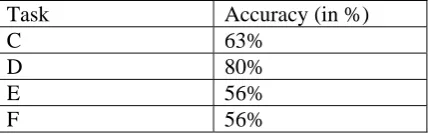
Evaluation results on the English datasets for tasks C, D, E and F are presented in Table 2. Ex-periments show the accuracies of 63%, 80%, 56% and 56% for tasks C, D, E and F, respec-tively. Results show that our system performs best for task D, i.e., relationships between event
and document creation time. The system
achieves an accuracy of 63% for task C that finds the temporal relation between an event and a time
expression in the same sentence. The system
per-forms quite similarly for tasks E and F. It is to be noted that there is still the room for performance improvement. In the present work, we did not carry out sufficient experiments to identify the most suitable feature templates for each of the tasks. In future, we would experiment after se-lecting a development set for each task; and find out appropriate feature template depending upon the performance on the development set.
Task Accuracy (in %)
C 63% D 80% E 56% F 56%
Table 2. Experimental results on tasks C, D, E and F
5
Conclusion and Future Works
In this paper, we report very preliminary results of our first participation in the TempEval shared task. We participated in all the tasks of Tem-pEval-2, i.e., A, B, C, D, E and F for English. We develop the rule-based systems for tasks A and B, whereas the remaining tasks are based on a machine learning approach, namely CRF. All our systems are still in their development stages. Evaluation results on the shared task English datasets yield the precision, recall and F-measure values of 55%, 17% and 26%, respectively for Task A and 48%, 56% and 52%, respectively for Task B (event recognition). Experiments on the English datasets yield the accuracies of 63%,
80%, 56% and 56% for tasks C, D, E and F, re-spectively.
Future works include identification of more precise rules for tasks A and B. We would also like to experiment with CRF for these two tasks. We would experiment with the various feature templates for tasks C, D, E and F. Future works also include experimentations with other ma-chine learning techniques like maximum entropy and support vector machine.
References
Boguraev, B. and R. K. Ando. 2005. TimeML Compliant Text Analysis for Temporal Rea-soning. In Proceedings of Nineteenth
Interna-tional Joint Conference on Artificial
Intelli-gence (IJCAI-05), Edinburgh, Scotland,
Au-gust, pages 997–1003.
Chambers, N., S., Wang, and D., Jurafsky. , 2007. Classifying Temporal Relations between Events. In Proceedings of the ACL 2007 Demo
and Poster Sessions, Prague, Czech Republic,
June, pages 173–176.
Lafferty, J., McCallum, A., and Pereira, F. Conditional Random Fields: Probabilistic Models for Segmenting and Labeling Se-quence Data. In Proceedings of 18th
Interna-tional Conference on Machine Learning,
2001.
Mani, I., B., Wellner, M., Verhagen, and J. Pustejovsky. 2007. Three Approaches to Learning TLINKs in TimeML. Technical
Re-port CS-07-268, Computer Science
Depart-ment, Brandeis University, Waltham, USA.
Mani, I., Wellner, B., Verhagen, M., Lee C.M., Pustejovsky, J. 2006. Machine Learning of Temporal Relation. In Proceedings of the
COLING/ACL, Sydney, Australia, ACL.
Mao, T., Li., T., Huang, D., Yang, Y. 2006. Hy-brid Models for Chinese Named Entity Rec-ognition. In Proceedings of the Fifth SIGHAN
Workshop on Chinese Language Processing.
Sha, F., Pereira, F. 2003. Shallow Parsing with Conditional Random Fields. In Proceedings of
HLT-NAACL, 2003.
Verhagen, M., Gaizauskas, R., Schilder, F., Hep-ple, M., Katz, G., Pustejovsky, and J.: SemE-val-2007 Task 15: TempEval Temporal Rela-tion IdentificaRela-tion. 2007. In Proceedings of the
SemEval-2007, Prague, June 2007, pages
[image:6.595.73.288.427.494.2]