Sequential Attention:
A Context-Aware Alignment Function for Machine Reading
Sebastian Brarda∗ Center for Data Science
New York University [email protected]
Philip Yeres∗ Center for Data Science
New York University [email protected]
Samuel R. Bowman Center for Data Science and Department of Linguistics
New York University [email protected]
Abstract
In this paper we propose a neural network model with a novel Sequential Attention layer that extends soft attention by assign-ing weights to words in an input sequence in a way that takes into account not just how well that word matches a query, but how well surrounding words match. We evaluate this approach on the task of read-ing comprehension (on theWho did What andCNN datasets) and show that it dra-matically improves a strong baseline—the Stanford Reader—and is competitive with the state of the art.
1 Introduction
Soft attention (Bahdanau et al.,2014), a differen-tiable method for selecting the inputs for a com-ponent of a model from a set of possibilities, has been crucial to the success of artificial neural net-work models for natural language understanding tasks like reading comprehension that take short passages as inputs. However, standard approaches to attention in NLP select words with only very in-direct consideration of their context, limiting their effectiveness. This paper presents a method to address this by adding explicit context sensitivity into the soft attention scoring function.
We demonstrate the effectiveness of this ap-proach on the task ofcloze-style reading compre-hension. A problem in the cloze style consists of a passagep, a questionq and an answera drawn from among the entities mentioned in the pas-sage. In particular, we use theCNNdataset ( Her-mann et al.,2015), which introduced the task into widespread use in evaluating neural networks for language understanding, and the newer and more
[image:1.595.317.519.224.528.2]∗These authors contributed equally to this work.
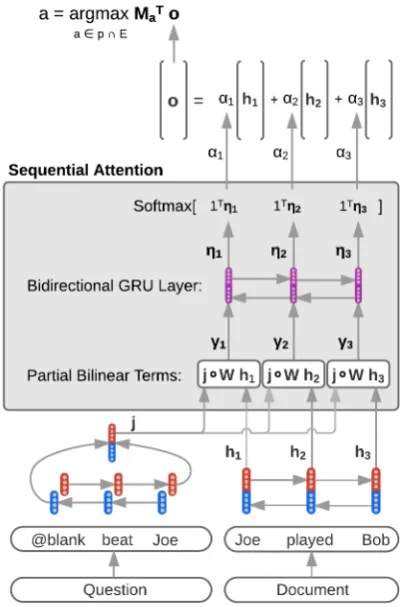
Figure 1: The Sequential Attention Model. RNNs first encode the question into a vector j and the document into a sequence of vectorsH. For each word index i in the document, a scoring vector
γiis then computed from j andhi using a
func-tion like the partial bilinear funcfunc-tion shown here. These vectors are then used as inputs to another RNN layer, the outputs of which (ηi) are summed
elementwise and used as attention scores (αi) in answer selection.
carefully quality-controlledWho did Whatdataset (Onishi et al.,2016).
In standard approaches to soft attention over passages, ascoring functionis first applied to ev-ery word in the source text to evaluate how closely
that word matches a query vector (here, a func-tion of the quesfunc-tion). The resulting scores are then normalized and used as the weights in a weighted sum which produces an output or context vector summarizing the most salient words of the input, which is then used in a downstream model (here, to select an answer).
In this work we propose a novel scoring func-tion for soft attenfunc-tion that we call Sequential At-tention(SA), shown in Figure1. In an SA model, a mutiplicative interaction scoring function is used to produce a scoringvector for each word in the source text. A newly-added bidirectional RNN then consumes those vectors and uses them to pro-duce a context-aware scalar score for each word. We evaluate this scoring function within the con-text of the Stanford Reader (Chen et al., 2016), and show that it yields dramatic improvements in performance. On both datasets, it is outper-formed only by theGated Attention Reader( Dhin-gra et al.,2016), which in some cases has access to features not explicitly seen by our model.
2 Related Work
In addition toChen et al.(2016)’sStanford Reader model, there have been several other modeling ap-proaches developed to address these reading com-prehension tasks.
Seo et al. (2016) introduced theBi-Directional Attention Flowwhich consists of a multi-stage hi-erarchical process to represent context at different levels of granularity; it use the concatenation of passage word representation, question word repre-sentation, and the element-wise product of these vectors in their attention flow layer. This is a more complex variant of the classic bi-linear term that multiplies this concatenated vector with a vector of weights, producing attention scalars. Dhingra et al.(2016)’sGated-Attention Readerintegrates a multi-hop structure with a novel attention mecha-nism, essentially building query specific represen-tations of the tokens in the document to improve prediction. This model conducts a classic dot-product soft attention to weight the query repre-sentations which are then multiplied element-wise with the context representations, and fed into the next layer of RNN. After several hidden layers that repeat the same process, the dot product between the context representation and the query is used to compute a classic soft-attention.
Outside the task of reading comprehension
there has been other work on soft attention over text, largely focusing on the problem of attending over single sentences. Luong et al. (2015) study several issues in the design of soft attention mod-els in the context of translation, and introduce the bilinear scoring function. They also propose the idea of attention input-feeding where the original attention vectors are concatenated with the hidden representations of the words and fed into the next RNN step. The goal is to make the model fully aware of the previous alignment choices.
In work largely concurrent to our own, Kim et al.(2017) explore the use of conditional random fields (CRFs) to impose a variety of constraints on attention distributions achieving strong results on several sentence level tasks.
3 Modeling
Given the tuple (passage, question, answer), our goal is to predictPr(a|d, q)wherearefers to an-swer, dto passage, andq to question. We define the words of each passage and question as d = d1, .., dm and q = q1, ..., ql, respectively, where exactly one qi contains the token@blank, repre-senting a blank that can be correctly filled in by the answer. With calibrated probabilities Pr(a|d, q), we take the argmaxaPr(a|d, q) where possible
a’s are restricted to the subset of anonymized en-tity symbols present in d. In this section, we present two models for this reading comprehen-sion task: Chen et al. (2016)’s Stanford Reader, and our version with a novel attention mechanism which we call theSequential Attentionmodel.
3.1 Stanford Reader
Encoding Each word or entity symbol is mapped to a d-dimensional vector via embedding matrix E ∈ Rd×|V|. For simplicity, we de-note the vectors of the passage and question as
d=d1, .., dm andq =q1, ..., ql, respectively.
TheStanford Reader(Chen et al.,2016) uses bidi-rectional GRUs (Cho et al., 2014) to encode the passage and questions. For the passage, the hid-den state is defined: hi =concat(−→hi,←h−i). Where
contextual embeddingsdiof each word in the
pas-sage are encoded in both directions. ←−
hi =GRU(←−−hi+1,di) (1)
− →
And for the question, the last hidden representa-tion of each direcrepresenta-tion is concatenated:
j =concat(−→jl, ←−
j1) (3)
Attention and answer selection The Stanford Reader uses bilinear attention (Luong et al.,2015):
αi=softmaxi(jWhi) (4) Where W is a learned parameters matrix of the bilinear term that computes the similarity between
j andhi with greater flexibility than a dot
prod-uct. The output vector is then computed as a linear combination of the hidden representations of the passage, weighted by the attention coefficients:
o=Xαihi (5)
The prediction is the answer,a, with highest prob-ability from among the anonymized entities:
a= argmax
a∈p∩entitiesM T
ao (6)
Here,Mis the weight matrix that maps the output to the entities, andMarepresents the column of a certain entity. Finally a softmax layer is added on top ofMT
aowith a negative log-likelihood objec-tive for training.
3.2 Sequential Attention
In theSequential Attention model instead of pro-ducing a single scalar value αi for each word in the passage by using a bilinear term, we define the vectors γi with a partial-bilinear term1. Instead
of doing the dot product as in the bilinear term, we conduct an element wise multiplication to produce a vector instead of a scalar:
γi =j◦Whi (7)
Where W is a matrix of learned parameters. It is also possible to use an element-wise multiplica-tion, thus prescinding the parametersW:
γi =j◦hi (8)
We then feed the γi vectors into a new
bidirec-tional GRU layer to get the hidden attention ηi
vector representation.
←η−
i =GRU(←−−ηi+1,γi) (9)
1Note that doing softmax over the sum of the terms of the
γivectors would lead to the sameαiof the Stanford Reader.
− →η
i =GRU(−−→ηi−1,γi) (10) We concatenate the directional η vectors to be consistent with the structure of previous layers.
ηi =concat(−→ηi,←η−i) (11)
Finally, we compute theα weights as below, and proceed as before.
αi=softmaxi(1>ηi]) (12)
o=Xαihi (13)
a= argmax
a∈p∩entitiesM T
ao (14)
4 Experiments and Results
We evaluate our model on two tasks, CNN and Who did What (WDW). For CNN, we used the anonymized version of the dataset released by
Hermann et al. (2015), containing 380,298 train-ing, 3,924 dev, and 3,198 test examples. For WDW we usedOnishi et al. (2016)’s data gener-ation script to reproduce theirWDW data, yielding
127,786training, 10,000dev, and10,000test ex-amples.2 We used the strict version ofWDW. Training We implemented all our models in Theano (Theano Development Team, 2016) and Lasagne (Dieleman et al.,2015) and used the Stan-ford Reader (Chen et al.,2016) open source im-plementation as a reference. We largely used the same hyperparameters as Chen et al. (2016) in the Stanford Reader: |V| = 50K, embedding size d = 100, GloVe (Pennington et al., 2014) word embeddings3 for initialization, hidden size h= 128. The size of the hidden layer of the bidi-rectional RNN used to encode the attention vec-tors is double the size of the one that encodes the words, since it receives vectors that result from the concatenation of GRUs that go in both directions,
η ∈ R256. Attention and output parameters were
2In the WDW data we found 340 examples in the strict
training set, 545 examples in the relaxed training set, 20 ex-amples in the test set, and 30 exex-amples in the validation set that were not answerable because the anonymized answer en-tity did not exist in the passage. We removed these examples, reducing the size of the WDW test set by0.2%, to9,980. We believe this difference is not significant and did not bias the comparison between models.
3The GloVe word vectors used were pretrained with 6
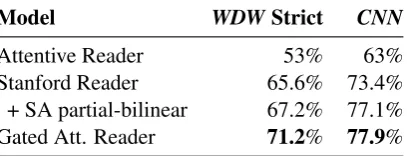
Model WDWStrict CNN
Attentive Reader 53% 63%
[image:4.595.81.285.64.142.2]Stanford Reader 65.6% 73.4% + SA partial-bilinear 67.2% 77.1% Gated Att. Reader 71.2% 77.9%
Table 1: Accuracy onWDW and CNN test sets
initialized from aU ∼ (−0.01,0.01)while GRU weights were initialized from a N ∼ (0,0.1). Learning was carried out with SGD with a learn-ing rate of 0.1, batch size of 32, gradient clipplearn-ing of norm 10 and dropout of0.2 in all the vertical layers4(including theSequential Attentionlayer).
Also, all the anonymized entities were relabeled according to the order of occurrence, as in the Stanford Reader. We trained all models for 30 epochs.
4.1 Results
Who did What In our experiments theStanford Reader(SR) achieved an accuracy of65.6%on the strictWDWdataset compared to the64%that On-ishi et al.(2016) reported. TheSequential Atten-tionmodel (SA) with partial-bilinear scoring func-tion got67.21%, which is the second best perfor-mance on theW DW leaderboard, only surpassed by the 71.2% from the Gated Attention Reader (GA) withqe-comm(Li et al.,2016) features and fixed GloVe embeddings. However, the GA model without qe-comm features and fixed embeddings performs significantly worse at67%. We did not use these features in our SA models, and it is likely that adding these features could further improve SA model performance. We also experimented with fixed embeddings in SA models, but fixed embeddings reduced SA performance.
Another experiment we conducted was to add
100K training samples from CNN to the WDW data. This increase in the training data size boosted accuracy by1.4%with the SR and1.8%
with the Sequential Attention model reaching a
69% accuracy. This improvement strongly sug-gests that the gap in performance/difficulty be-tween the CNN and theWDW datasets is partially related to the difference in the training set sizes
4We also tried increasing the hidden size to 200, using
200d GloVe word representations and increasing the dropout rate to 0.3. Finally we increased the number of hidden en-coding layers to two. None of these changes resulted in sig-nificant performance improvements in accordance withChen et al.(2016).
which results in overfitting.
CNN For a final sanity check and a fair compar-ison against a well known benchmark, we ran our Sequential Attention model on exactly the same CNNdata used byChen et al.(2016).
The Sequential Attention model with partial-bilinear attention scoring function took an average of 2X more time per epoch to train vs. theStanford Reader. However, our model converged in only 17 epochs vs. 30 for theSR. The results of training theSRonCNNwere slightly lower than the73.6%
reported byChen et al.(2016). TheSequential At-tention model achieved 77.1% accuracy, a 3.7%
gain with respect toSR.
4.1.1 Model comparison on CNN
After achieving good performance with SA we wanted to understand what was driving the in-crease in accuracy. It is clear that SA has more trainable parameters compared to SR. However, it was not clear if the additional computation re-quired to learn those parameters should be allo-cated in the attention mechanism, or used to com-pute richer hidden representations of the passage and questions. Additionally, the bilinear parame-ters increase the computational requirements, but their impact on performance was not clear. To an-swer these questions we compared the following models: i) SR with dot-product attention; ii) SR with bilinear attention; iii)SRwith two layers (to compute the hidden question and passage repre-sentations) and dot-product attention; iv)SRwith two layers and bilinear attention; v)SAwith ele-mentwise multiplication scoring function; vi)SA with partial-bilinear scoring function.
Surprisingly, the element-wise version of SA performed better than the partial-bilinear version, with an accuracy of 77.3%which, to our knowl-edge, has only been surpassed by Dhingra et al.
(2016) with theirGated-Attention Readermodel. Additionally, 1-layerSRwith dot-product atten-tion got0.3%lower accuracy than the 1-layerSR with bilinear attention. These results suggest that the bilinear parameters do not significantly im-prove performance over dot-product attention.
in-Figure 2: Representative sample output for the Stanford Reader and our model.
Model CNN Params
SR, dot prod. att. 73.1% 5.44×10⁶ SR, bilinear att. 73.4% 5.50×10⁶ SR, 2-layer, dot prod. att. 74.2% 5.83×10⁶ SR, 2-layer, bilinear att. 74.7% 5.90×10⁶ SA, element-wise att. 77.3% 5.73×10⁶ SA, partial-bilinear att. 77.1% 5.80×10⁶
Table 2: Accuracy on CNN test sets and number of trainable parameters for various Stanford Reader (SR) and Sequential Attention (SA) models.
creases were considerably less than the lift from using anSAmodel (and SA has fewer parameters).
4.2 Discussion
The difference between our Sequential Attention and standard approaches to attention is that we conserve the distributed representation of simi-larity for each token and use that contextual in-formation when computing attention over other words. In other words, when the bilinear atten-tion layer computes αi = softmaxi(jWhi), it only cares about the magnitude of the resultingαi (the amount of attention that it gives to that word). Whereas if we keep the vector γi we can also
know which were the dimensions of the distributed representation of the attention that weighted in that decision. Furthermore, if we use that information to feed a new GRU, it helps the model to learn how to assign attention to surrounding words.
Compared to Sequential Attention, Bidirec-tional attention flow uses a considerably more complex architecture with a query representations for each word in the question. Unlike theGated Attention Reader, SA does not require intermedi-ate soft attention and it uses only one additional RNN layer. Furthermore, in SA no dot product is required to compute attention, only the sum of the
elements of theηvector. SA’s simpler architecture performs close to the state-of-the-art.
Figure 2 shows some sample model behavior. In this example and elsewhere, SAresults in less sparse attention vectors compared toSR, and this helps the model assign attention not only to poten-tial target strings (anonymized entities) but also to relevant contextual words that are related to those entities. This ultimately leads to richer semantic representationso=Pαihiof the passage.
Finally, we found: i) bilinear attention does not yield dramatically higher performance com-pared to dot-product attention; ii) bilinear parame-ters do not improve SA performance; iii) Increas-ing the number of layers in the attention mech-anism yields considerably greater performance gains with fewer parameters compared to increas-ing the number of layers used to compute the hid-den representations of the question and passage.
5 Conclusion and Discussion
Acknowledgements
This paper was the result of a term project for the NYU Course DS-GA 3001, Natural Language Understanding with Distributed Representations. Bowman acknowledges support from a Google Faculty Research Award and gifts from Tencent Holdings and the NVIDIA Corporation.
References
Dzmitry Bahdanau, Kyunghyun Cho, and Yoshua Bengio. 2014. Neural machine translation by jointly learning to align and translate. CoRR
abs/1409.0473. http://arxiv.org/abs/1409.0473. Danqi Chen, Jason Bolton, and Christopher D.
Man-ning. 2016. A thorough examination of the cnn/daily mail reading comprehension task. CoRR
abs/1606.02858. http://arxiv.org/abs/1606.02858. Kyunghyun Cho, Bart van Merrienboer, C¸aglar
G¨ulc¸ehre, Fethi Bougares, Holger Schwenk, and Yoshua Bengio. 2014. Learning phrase repre-sentations using RNN encoder-decoder for statis-tical machine translation. CoRR abs/1406.1078.
http://arxiv.org/abs/1406.1078.
Bhuwan Dhingra, Hanxiao Liu, William W. Cohen, and Ruslan Salakhutdinov. 2016. Gated-attention read-ers for text comprehension. CoRRabs/1606.01549.
http://arxiv.org/abs/1606.01549.
Sander Dieleman, Jan Schlter, Colin Raffel, Eben Ol-son, Sren Kaae Snderby, Daniel Nouri, Daniel Mat-urana, Martin Thoma, Eric Battenberg, Jack Kelly, Jeffrey De Fauw, Michael Heilman, Diogo Moit-inho de Almeida, Brian McFee, Hendrik Weide-man, Gbor Takcs, Peter de Rivaz, Jon Crall, Gregory Sanders, Kashif Rasul, Cong Liu, Geoffrey French, and Jonas Degrave. 2015. Lasagne: First release. https://doi.org/10.5281/zenodo.27878.
Karl Moritz Hermann, Tom´as Kocisk´y, Edward Grefenstette, Lasse Espeholt, Will Kay, Mustafa Suleyman, and Phil Blunsom. 2015. Teach-ing machines to read and comprehend. CoRR
abs/1506.03340. http://arxiv.org/abs/1506.03340. Yoon Kim, Carl Denton, Luong Hoang, and
Alexander M. Rush. 2017. Structured at-tention networks. CoRR abs/1702.00887.
http://arxiv.org/abs/1702.00887.
Peng Li, Wei Li, Zhengyan He, Xuguang Wang, Ying Cao, Jie Zhou, and Wei Xu. 2016. Dataset and neural recurrent sequence labeling model for open-domain factoid question answering. CoRR
abs/1607.06275. http://arxiv.org/abs/1607.06275. Minh-Thang Luong, Hieu Pham, and
Christo-pher D. Manning. 2015. Effective approaches to attention-based neural machine translation. CoRR
abs/1508.04025. http://arxiv.org/abs/1508.04025.
Takeshi Onishi, Hai Wang, Mohit Bansal, Kevin Gim-pel, and David A. McAllester. 2016.Who did what: A large-scale person-centered cloze dataset. CoRR
abs/1608.05457.http://arxiv.org/abs/1608.05457. Jeffrey Pennington, Richard Socher, and
Christo-pher D. Manning. 2014. Glove: Global vectors for word representation. InEmpirical Methods in Nat-ural Language Processing (EMNLP). pages 1532– 1543.http://www.aclweb.org/anthology/D14-1162. Min Joon Seo, Aniruddha Kembhavi, Ali Farhadi,
and Hannaneh Hajishirzi. 2016. Bidirectional at-tention flow for machine comprehension. CoRR
abs/1611.01603.http://arxiv.org/abs/1611.01603. Theano Development Team. 2016. Theano: A
python framework for fast computation of math-ematical expressions. CoRR abs/1605.02688.