LIVING AND LEARNING TOGETHER:
INTEGRATING DEVELOPMENTAL SYSTEMS THEORY,
RADICAL EMBODIED COGNITIVE SCIENCE,
AND RELATIONAL THINKING IN THE STUDY OF SOCIAL LEARNING
Murillo Pagnotta
A Thesis Submitted for the Degree of PhD
at the
University of St Andrews
2018
Full metadata for this thesis is available in
St Andrews Research Repository
at:
http://research-repository.st-andrews.ac.uk/
Please use this identifier to cite or link to this thesis:
http://hdl.handle.net/10023/16386
This item is protected by original copyright
This item is licensed under a
Creative Commons Licence
Living and learning together:
Integrating developmental systems theory,
radical embodied cognitive science,
and relational thinking in the study of social learning
Living and learning together:
Integrating developmental systems theory,
radical embodied cognitive science,
and relational thinking in the study of social learning
Murillo Pagnotta
This thesis is submitted in partial fulfilment for the degree of
Doctor of Philosophy (PhD)
at the University of St Andrews
i
Declarations
Candidate’s declaration
I, Murillo Pagnotta, do hereby certify that this thesis, submitted for the degree of PhD, which is approximately 80000 words in length, has been written by me, and that it is the record of work carried out by me, or principally by myself in collaboration with others as acknowledged, and that it has not been submitted in any previous application for any degree.
I was admitted as a research student at the University of St Andrews in March 2014.
I received funding from an organisation or institution and have acknowledged the funder(s) in the full text of my thesis.
Date 08/08/2018 Signature of candidate
Supervisor’s declaration
I hereby certify that the candidate has fulfilled the conditions of the Resolution and Regulations appropriate for the degree of PhD in the University of St Andrews and that the candidate is qualified to submit this thesis in application for that degree.
Date 08/08/2018 Signature of supervisor
ii
Permission for publication
In submitting this thesis to the University of St Andrews we understand that we are giving permission for it to be made available for use in accordance with the regulations of the University Library for the time being in force, subject to any copyright vested in the work not being affected thereby. We also understand, unless exempt by an award of an embargo as requested below, that the title and the abstract will be published, and that a copy of the work may be made and supplied to any bona fide library or research worker, that this thesis will be electronically accessible for personal or research use and that the library has the right to migrate this thesis into new electronic forms as required to ensure continued access to the thesis.
I, Murillo Pagnotta, confirm that my thesis does not contain any third-party material that requires copyright clearance.
The following is an agreed request by candidate and supervisor regarding the publication of this thesis:
Printed copy
No embargo on print copy.
Electronic copy
No embargo on electronic copy.
Date 08/08/2018 Signature of candidate
iii
Underpinning Research Data or Digital Outputs
Candidate’s declaration
I, Murillo Pagnotta, hereby certify that no requirements to deposit original research data or digital outputs apply to this thesis and that, where appropriate, secondary data used have been referenced in the full text of my thesis.
iv
Contributions
Chapter 6
Prof. Greta Defeyter provided feedback on the study design. Lindsey Stevenson, a staff member of the Life Science Centre at the time of the study, acted as the facilitator in the activity. Liesbeth Verlinden, biologist, double-coded the video data for use in tests of inter-observer reliability. Dr Moreno Coco provided feedback on the interpretation of the results. All other work was carried out by me.
Chapter 7
v
General Acknowledgements
Foremost I thank my supervisor, Kevin Laland, for providing me with the opportunity to join his lab and undertake my PhD in such a vibrant environment. Thank you for your encouragement and support.
I wholeheartedly thank Susan Oyama, Tim Ingold, and Christina Toren, who have been extremely influential in my development over the past few years. I also thank Saadi Lahlou for the invitation to visit the London School of Economics and Moreno Coco for his collaboration in both empirical studies. Thank you to my friend Jerry Hogan for the initial support that made this all possible. I had the chance to visit the Konrad Lorenz Institute for Evolution and Cognition Research in Austria for a period of six months and I gratefully acknowledge their support.
I met many wonderful people in St Andrews along the way, and some deserve being mentioned explicitly. Thank you to James Ounsley and Charlotte Brand, with whom I shared the Mujetty Mansion, as well as Elena Miu, Cara Evans, Camille Troisi, Daniel Cownden, Daniel van der Post, Jessica van der Wal, Joe Stubbersfield, Wataru Toyokawa, and Emily Burdett. On a slightly different note, I also thank Ewa Bieniecka and Philipp Liehm for introducing me to the world of Argentine Tango. You have all made my time in St Andrews unforgettable.
I am indebted to Lindsey Stevenson, the maker-in-residence at the Life Science Centre, and John Jennings, a school teacher and a friend, who have given up their time to assist me in the empirical studies.
I am also extremely grateful to Katherine Meacham for her kindness, support, and efficiency in dealing with administrative matters throughout the years.
Finally, I would like to thank my family and my life partner, Édipo Castro, for all the love and support.
Funding
vi
Abstract
vii
Contents
Chapter 1 General Introduction ... 1
1.1 The idea of a (dis)continuity between nature and culture ... 1
1.2 Social learning as ‘transmission of information’ ... 6
1.3 This thesis ... 9
Chapter 2 Information in biology ... 11
2.1 Introduction and outline ... 11
2.2 What is information? An initial distinction ... 14
2.3 Information talk in biology ... 20
2.4 Summary and conclusion ... 39
Chapter 3 The flow of ontogeny... 43
3.1 Introduction ... 43
3.2 A processual view of life ... 44
3.3 Consequences of a processual view of life ... 59
3.4 Summary and conclusion ... 64
Chapter 4 The flow of behaviour ... 67
4.1 Introduction ... 67
4.2 What cognition is about ... 69
4.3 What behaviour is about ... 72
4.4 What produces the flow of behaviour? ... 82
4.5 Learning is a possible developmental consequence of behaviour ... 84
4.6 Summary and conclusion ... 87
Chapter 5 Living and learning socially ... 91
5.1 Introduction ... 91
viii
5.3 Communication as co-regulation of behaviour ... 95
5.4 An ecological view of learning socially ... 98
5.5 Categories of social learning ... 100
5.6 Characterizing cases of social learning: an initial suggestion ... 104
5.7 Teaching in humans and nonhuman animals ... 111
5.8 Summary and conclusion ... 117
Chapter 6 Learning through making together: coordinating behaviour in a joint making task. ... 121
6.1 Introduction ... 121
6.2 Method ... 129
6.3 Results ... 147
6.4 Discussion ... 160
Chapter 7 Learning through demonstration: a study of eye movements during observational learning of a manual task ... 169
7.1 Introduction ... 169
7.2 Method ... 177
7.3 Results ... 195
7.4 Discussion ... 215
Chapter 8 General Discussion ... 223
8.1 Summary of findings ... 223
8.2 Social learning: not transmission, but development... 226
8.3 Further work ... 232
8.4 Conclusion ... 234
Reference List ... 237
General introduction 1
Chapter 1
General Introduction
1.1
The idea of a (dis)continuity between nature and culture
One of the epistemological foundations of Modernity (roughly, the historical period after the Middle Ages) has been the belief that the human condition corresponds to a radical separation from the rest of nature, often described as due to culture or society (Descola & Pálsson, 1996; Latour, 1993). The term ‘culture’ itself has been used within the social sciences in a variety of different contexts and there is no consensual definition (see, for example, Geertz, 1973; Ingold, 2000, 2011a; Kroeber, 1917; Kroeber & Kluckhohn, 1952; Lévi-Strauss, 1966; Tylor, 1871). Nevertheless, it had generally been uncontentious that, whatever it is that makes humans unique, we could say that it belonged to the cultural domain. This is reflected in the historical separation between the natural and social sciences.
2 Chapter 1 The idea of culture as a domain related to, but ultimately distinct from, the biological process that is the living body acting in the world, has also been under criticism within anthropology. Ethnographers describing the immense variation in human ways of living have accumulated accounts for over a century which collectively indicate that thinking in terms of a nature-culture or nature-society opposition is neither a human universal nor a logical imperative, but rather a historical peculiarity within our own, so-called Western, European, Modern tradition (Descola & Pálsson, 1996). French anthropologist Claude Lévi-Strauss, the founder of Structural Anthropology, argued that the separation between nature and culture had had “the force almost of dogma” (Lévi-Strauss, 1992, p. 28) within the discipline. Throughout his work, he argued that culture should be taken as a heuristic tool and a relational concept – i.e., one that does not point to some concrete thing but to a differential relation between two ethnographic groups. In his words (Lévi-Strauss, 1963, p. 295):
What is called a ‘culture’ is a fragment of humanity which, from the point of view of the research at hand and of the scale on which the latter is carried out, presents significant discontinuities in relation to the rest of humanity. [. . .] Accordingly, the same set of individuals may be considered to be parts of many different cultural contexts: universal, continental, national, regional, local, etc., as well as familial, occupational, religious, political, etc.
General introduction 3 the cognitive sciences. In both authors’ work, the life of humans, and indeed of all living beings, is seen as a historical, relational process in which form is continually generated and transformed rather than being encoded (as genetic or cultural information) and expressed (in development or behaviour).
Among others, Tim Ingold has repeatedly, carefully, and passionately, argued that “it makes no sense to speak of ‘culture’ as an independent body of context-free knowledge” (Ingold, 2000, p. 37) or “as an internalised system of rules and meanings as distinct from manifest behaviour patterns and their artefactual products” (p. 159, his emphasis). Instead of taking the idea of a mind (or the individual) separated from the world as our point of departure, as implicit in many notions of culture related to the representational view of the mind, he argues we should take “the human condition to be that of a being immersed from the start, like other creatures, in an active, practical and perceptual engagement with constituents of the dwelt-in world” (Ingold, 2000, p. 43). Thus, human so-called ‘cultural’ behavioural variation should be understood, not in terms of representations being transmitted between people but as variation in the skills embodied in the process of development of each human organism engaged with his environment. Ingold (2000) acknowledges that his view was profoundly influenced by the work of philosopher of biology Susan Oyama on developmental systems theory as well as James Gibson’s ecological approach to visual perception.
Similarly, in her studies of child development and other topics, anthropologist Christina Toren (2008, 2012), makes no reference to culture or mental representations. These terms, along with the associated distinctions including biology-culture and body-mind, do not play the epistemic role of starting points. Instead, her starting point is the idea of social living, including learning, as a micro-historical process. Mind is not conceived of as a function of the brain “but of the whole human being in intersubjective relations with others in the environing world” (Toren, 2012). Toren (2012) acknowledges the influence in her approach of the autopoietic theory of Maturana and Varela (1980), the developmental work of Piaget, and phenomenology.
4 Chapter 1 did not believe in a radical separation between humans and other living things, and argued that other animals might exhibit something like culture. To refer to this possibility, he coined a neologism based on the sound of the English word: “kaluchua” (Nakamura & Nishida, 2006). Imanishi (2002) emphasized the unity and harmony of nature (humans included), the integrated and inseparable system formed by organism and its environment, and the need to recognize the simultaneous existence of similarities and differences among things. With this conviction, he appropriated and adapted methods originally from the social sciences, including identification of individuals and long-term observations of their behaviour and social relations, and applied them to the study of wild horses in Mongolia and, more famously, Japanese monkeys (Macaca fuscata) on the Koshima Island and chimpanzee in Africa.
Starting in the sixties with Imanishi, Jane Goodall and others, field studies in Africa revealed that chimpanzees live in social units (or communities) and establish lifelong social relationships (Nishida, 1968); use various tools (Goodall, 1964), including hammers to open hard nuts (Boesch & Boesch, 1981, 1984); hunt cooperatively or collectively (Boesch & Boesch, 1989); and might even actively teach in some circumstances (Boesch, 1991). It became clear that the behaviour of the chimpanzee, our most closely related species, was much more complex, diverse, and humanlike – or, conversely, that human behaviour was much more apelike – than ever realized. Following his ground-breaking research on the variability of chimpanzee behaviour across study sites, William McGrew argued throughout his career that the term ‘culture’ should apply to chimpanzees as well (McGrew, 1992, 2004; McGrew & Tutin, 1978; Whiten et al., 1999). I have looked at the history of attribution of culture to nonhuman animals and the tensions with anthropology in my masters dissertation (Pagnotta, 2014).
population-General introduction 5 level characteristic”. Thus redefined, the term could now be used more inclusively such that not only humans, but other species too, could be said to have culture. After decades of research on an increasing list of taxa, there is particularly good evidence of the phenomena described in such terms in chimpanzees (Hobaiter, Poisot, Zuberbuhler, Hoppitt, & Gruber, 2014; McGrew, 1992; Whiten et al., 1999), bonobos (Hohmann & Fruth, 2003), orangutans (van Schaik et al., 2003), whales and dolphins (Allen, Weinrich, Hoppitt, & Rendell, 2013; Whitehead & Rendell, 2015), birds (Aplin et al., 2015; Slagsvold & Wiebe, 2007), and fishes (Helfman & Schultz, 1984; Warner, 1988).
The idea that culture is not restricted to humans is one step away from the Modern view. However, the step consists mainly in arguing that humans are not the only animals to be both biological and cultural beings. There is a common argument in this literature (e.g., McGrew & Tutin, 1978; Whiten et al., 1999) that goes as follows: (1) anthropologists cannot agree on a definition of culture; (2) therefore, biologists are justified in providing their own definition; (3) with culture thus redefined, it is a concept that applies to nonhuman animals; (4) with this terminological issue settled, we can get on with the study of interest. This argument suggests that the use of the term ‘culture’ in relation to nonhuman animals never intended to question the Modern opposition between two domains (nature-culture) or the related oppositions as a reasonable premise. This was probably the case because behavioural scientists were focusing on the observations accumulating from their empirical work on animal behaviour in the field and in the lab more than on the critical discussion going on in the social sciences about the constitution of Modernity (Latour, 1993) and the establishment of the Modern Sciences (Stengers, 2000).
6 Chapter 1 contemporary anthropological criticism to the Modern oppositions (Descola & Pálsson, 1996; Ingold, 2000, 2011a, 2013; Ingold & Pálsson, 2013; Toren, 2012). Thus, the aim of this project is not simply to avoid sensitive terms but to begin the exploration of a new way of thinking about the phenomena of interest.
1.2
Social learning as ‘transmission of information’
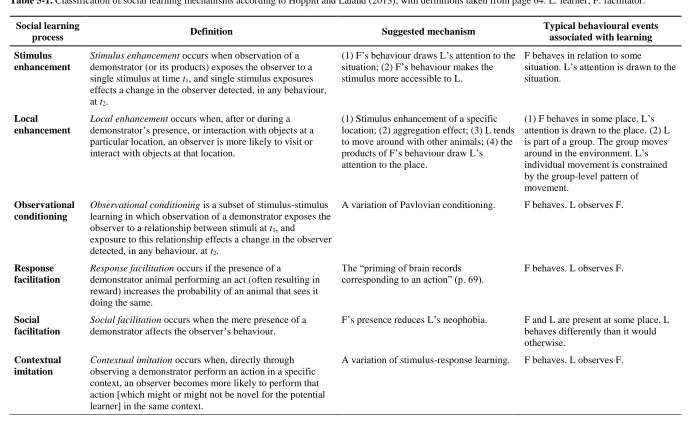
The notion of ‘social learning’ is central to this debate because it is considered to provide a conceptual link between biological phenomena and ‘cultural’ phenomena. This is the case because categories of social learning, such as stimulus/local enhancement, emulation, and imitation, are said to underlie the “cultural transmission” of knowledge and behaviour among individuals within and across generations, thus providing the mechanism that might lead to the establishment of group-typical behaviour patterns (Hoppitt & Laland, 2013; Mesoudi, 2011; Richerson & Boyd, 2005). Much of the currently influential and representative work on social learning and culture (such as Boyd & Richerson, 1985; Heyes, 1994, 2012, 2016; Hoppitt & Laland, 2013; Laland, Odling-Smee, & Feldman, 2001; Mesoudi, 2011; Richerson & Boyd, 2005; Tomasello, 1999; Tomasello, Carpenter, Call, Behne, & Moll, 2005) expresses or, at least partially, endorses a set of inter-related ideas about development, inheritance, evolution, cognition, and ‘culture.’ These ideas come from different fields including biology, the cognitive sciences, and some approaches to culture theory.
General introduction 7 Crucially, behavioural scientists studying social learning and culture added some of their own ideas to the list above. Arguably the main idea is that development – more specifically, the development of behaviour patterns through learning – depends on the ‘genetic information’ involved in making the body (including the animal’s cognitive structure responsible for learning), on ‘information’ acquired through individual learning,
and also on ‘cultural information’ acquired through social learning (Hoppitt & Laland, 2013). As Richerson and Boyd (2005, p. 6) put it, “we are largely what our genes and our culture make us”. Another idea is that inheritance includes the transgenerational transmission of ‘genetic information’ and also ‘cultural information’ (Mesoudi, 2011; Odling-Smee, Laland, & Feldman, 2003; Richerson & Boyd, 2005). As a consequence, evolution is viewed in terms of changes in the ‘genetic information’ and also changes in the ‘cultural information’ transmitted across generations in the population (Mesoudi, 2011; Odling-Smee et al., 2003; Richerson & Boyd, 2005). With regard to cognition, learning is thought of in terms of ‘acquiring information’ either socially or asocially (Heyes, 2012; Hoppitt & Laland, 2013).
It should be evident, given the way I chose to present the set of ideas above, that the term ‘information’ figures prominently in them. Consistent with this, the notion of culture, as currently used by behavioural scientists, is fundamentally associated with the idea of information being transmitted between individuals and across generations socially
rather than genetically (Hoppitt & Laland, 2013; Mesoudi, 2011; Richerson & Boyd, 2005). As Hoppitt and Laland (2013, p. 11) say, “culture is built upon socially learned and transmitted information... and does not apply to genetic information or to knowledge and skills that individuals acquire alone”. Some authors even identify ‘culture’ with ‘information’ and ‘mental state’: “Culture is information capable of affecting individuals’ behavior that they acquire from other members of their species through teaching, imitation, and other forms of social transmission... by information we mean any kind of mental state, conscious or not, that is acquired or modified by social learning and affects behavior” (Richerson & Boyd, 2005, p. 5).
8 Chapter 1 as the molecular processes within cells (metabolism), the typical sequence of changes throughout the lifespan (development), the similarities in the developmental trajectories of organisms related by genealogy (inheritance), the physiological processes within the central nervous system (perception, learning, cognition in general), the organism-environment interaction in real time (behaviour), the establishment, persistence, and change of population-level patterns of behaviour across generations (culture), or mental states. Using the same term without a clear understanding of what it might mean in each case can lead to confusion and equivocation, especially when crossing disciplinary borders. For this reason, I attempted to clarify the different meanings of the term ‘information’ in relation to these different contexts and I do my best to use the term consistently throughout.
A common thread runs through the set of inter-related ideas about development, inheritance, evolution, cognition, and culture I mentioned above. I will refer to it, following Oyama (1985/2000), as preformationism, understood as a way of thinking about how form arises in nature. Preformationism indicates the idea that form is already present in some configuration before it appears in another configuration. With regard to contemporary biology, this way of thinking supports, and is supported by, the metaphor that “the genome... is a set of instructions on how to make [an organism]” (Maynard Smith, 2000). Thus, biologists conventionally say that some aspects of biological form are already specified by ‘information’ encoded in the genome before they appear in the phenotype as a result of developmental processes. With regard to the behavioural sciences, this way of thinking supports, and is supported by, the idea that behaviour is the expression of the activity of the nervous system (Hogan, 2017). Thus, behavioural scientists conventionally say that some aspects of behavioural form are already specified by ‘information’ encoded in the brain before they appear in overt behaviour as the expression of neurophysiological activity. Mesoudi (2011, p. 2) gives an illustrative example of this preformationist way of thinking in the context of social learning and culture:
General introduction 9 codes such as written language, binary computer code, and
musical notation. And whereas genetic information is expressed as proteins and ultimately physical structures such as limbs and eyes, culturally acquired information is expressed in the form of behavior, speech, artifacts, and institutions.
1.3
This thesis
My intention is to avoid this way of thinking altogether and to begin the development of an alternative. I do this inspired by a set of authors. Susan Oyama (1985/2000, 2000b, 2015) offers a thorough critique of the various versions of the nature-nurture opposition and suggests a processual, relational way of thinking about development, inheritance, and evolution in which history and context-dependency are in the foreground. This way of thinking is known as ‘developmental systems theory’, where ‘theory’ is meant in a broad sense, as a general perspective. The term ‘developmental system’ refers to a target entity (for example, the animal under study) and the changing set of interdependent influences and interactants that make a difference in its persistence and change over time. These interactants might be detected at any scale of size and time and be located on either side of its boundaries (such as the cell membrane or the skin). I will also indicate a developmental system by using expressions such as ‘the organism-environment system’ or ‘the organism-in-the-environment’. Assuming a developmental systems perspective as a starting point involves adopting a view of life as a set of nested, multiscale processes unfolding in time and space; a view of causality in terms of relations of mutual constraints rather than in terms of linear antecedent-consequent relations; and a view of control as emerging in the contingent relations among interactants rather than as localized in a privileged factor (say, the genes in development and mental representations in behaviour). Following this approach, I conceive of ontogeny – the life span of organisms, in all its aspects – as a historical achievement, a process in which biological and behavioural forms are not ‘encoded’ and ‘expressed’ but rather continually generated and transformed.
Information in biology 11
Chapter 2
Information in biology
2.1
Introduction and outline
The received view in biology includes the idea that DNA carries information about the phenotype (Alberts et al., 2008; Futuyma, 1998; A. J. F. Griffiths, 2008; Maynard Smith, 2000; Mayr, 2004; Ridley, 2004). To take a representative example, a leading textbook on cell biology states that cells “use raw materials to create a network of catalysed reactions… according to an elaborate set of instructions encoded in the hereditary information” (Alberts et al., 2008, p. 401). When commenting on “[t]he colloquial use of informational terms” in molecular biology, the eminent evolutionary biologist John Maynard Smith wrote he was “not aware of any confusion arising because their meanings are not understood. In fact, the similarities between their meanings when referring to human communication and genetics are surprisingly close” (Maynard Smith, 2000, p. 178). Philosophers of biology, on the other hand, seem less optimistic, and have repeatedly argued that such information talk, though pervasive, is highly problematic because it encourages genetic determinism, essentialism, and the nature-nurture disjunction (Godfrey-Smith, 2007; P. E. Griffiths, 2001; Oyama, 1985/2000; Sarkar, 1996; Sterelny & Griffiths, 1999). This chapter explores this tension. More precisely, my goal is to provide critical answers to two related questions:
• Are biologists justified in using information talk to describe and explain molecular and developmental processes?
• Are biologists justified in attributing a special informational role to genes in molecular and developmental processes?
12 Chapter 2 segment of DNA sequence corresponding to a single protein or set of alternative protein variants (or to a single catalytic or structural RNA molecule for those genes that produce RNA but not protein)” (Alberts et al., 2008, p. 7).
As for ‘information,’ different notions coexist in the biological literature and their uses can be mutually inconsistent. The term often goes undefined and unindexed, and this does not help clarify its meanings across texts. Thus, to address these questions satisfactorily we must clarify what one might mean by ‘information’ in general and in the context of biology. I will distinguish between the communication-theoretic concept of the amount of information in a signal as the reduction of uncertainty associated with it (Shannon, 1948a); the situation-theoretic concept of the specific information carried by a signal as nomic dependence (Dretske, 1981) or constraint (Israel & Perry, 1990) between situations; the teleosemantic concept of information as biological function resulting from natural selection (Maynard Smith, 2000; Sterelny, Smith, & Dickison, 1996), and the concept of information as a difference that makes a difference for the system under study (Bateson, 1972; Oyama, 1985/2000).
In my discussion, I shall mention the roles genes play in molecular and developmental processes. In doing so, I will not dispute the conventional body of scientific knowledge and empirical observations in molecular biology, cell biology, and genetics, such as the model for the molecular structure of the DNA initially suggested by Watson and Crick (1953a, 1953b), the processes involving DNA which result in the production of mRNA (transcription) and proteins (translation), the reliable correlations that are observed between the sequence of nucleotides in the DNA and the sequence of amino acids in the corresponding polypeptide (the ‘genetic code’), or the measurable correlations between alleles (or in fact any feature of the developmental complex) and other phenotypic features. These will be taken as well-constructed scientific facts (Alberts et al., 2008; A. J. F. Griffiths, 2008). What will be open to critical evaluation are the questions of whether there are justifiable uses of informational concepts in these contexts, and whether the role genes play in development justify the common information talk.
Information in biology 13 the chapter is to make explicit some of the motivations for rejecting the received computational-representational model of the mind (Fodor, 1975). This model is based on the premise that cognition is about computation with representations and that the nervous system is fundamentally an input-output system that processes ‘information’ – which
sense of information is a question I will explore in the following chapters. Thus, the present discussion about ‘information’ in development is an essential step to our subsequent discussions about cognition, social learning and the relation between biology and culture.
14 Chapter 2
2.2
What is information? An initial distinction
2.2.1
Information as reduction of uncertainty in the mathematical theory of
communication
The initial development of the mathematical concept of information is associated with an interest in solving the technical problems faced by engineers working with the transmission of signals through telegraph and later telephone lines (Markowsky, 2013). It was in this context that Claude Shannon published his mathematical theory of communication in two articles in the technical journal of the Bell Telephone Laboratories where he worked (Shannon, 1948a, 1948b). Shannon’s work provided engineers with a systematic way to analyse specific communication systems and, for example, improve performance in signal transmission in existing telephone cables. He developed a simple and fairly abstract model of a communication system which includes signal (or message, state, and so on), noise, source, transmitter (or encoder), channel, receiver (or decoder), and destination. Because of its abstract formulation, we can think of the source as a person, an animal, a computer, a thing or any process which selects (intentionally or metaphorically) a signal from a set of possible alternatives. The transmitter or encoder transforms or encodes the message into a form suitable for transmission through the channel. The channel is the medium or the set of physical-chemical processes that transmits the signal to the receiver. The transmission of signals through the channel can be more or less affected by sources of noise. The receiver or decoder transforms or decodes the signal into a message that can be utilised by the destination. The destination
can also be a person, an animal, a computer, a thing or process which interprets or otherwise uses the message.
Information in biology 15 One way to reduce a set of alternatives to one is by asking a series of yes/no questions. The answer to each such question distinguishes the initial set into ever smaller groups which will eventually include only the one chosen message. Each answer can be represented by a binary digit or bit (e.g. 1 for yes and 0 for no, or the alternative states in a transistor) and thus each message in the set can be represented by a unique combination of the bits which represents the answers to such questions (e.g. 1010001). Therefore, we can use the number of the binary decisions required to identify the message at the source, 𝑠𝑖, as a measure of the amount of information (sensu Shannon entropy or reduction of uncertainty) associated with it, 𝐼. Following previous suggestions, Shannon defined this quantity as the negative logarithm (of base 2 for binary decisions) of the probability that a message is chosen by the source, 𝑝(𝑠𝑖), and is formalized as follows:
𝐼(𝑠𝑖) = − log2𝑝(𝑠𝑖)
Engineers are less concerned with particular messages and more with the average amount of information generated by the source and by the receiver, and especially with how they are coupled. The average amount of information produced by the source, 𝐼(𝑠), depends on the probability that each possible message is actually selected, 𝑝(𝑠𝑖), and the
amount of information each contains. This is given by the formula:
𝐼(𝑠) = − ∑ 𝑝(𝑠𝑖) log2𝑝(𝑠𝑖)
The same formula can be used to compute the average amount of information generated in the receiver. Then one can calculate, for example, how much information in the receiver correlates with information in the source and how much does not. In sum, according to the mathematical theory of communication, the amount of information
carried by a specific message is a measure of the reduction of uncertainty associated with its being chosen, which is relative to the alternatives being distinguished.
16 Chapter 2 significant aspect is that the actual message is one selected from a set of possible messages” (Shannon, 1948a, p. 379).
When you (the source) are talking to a friend (the destination) on the phone the sounds you make correlate with the electric signals generated in your device (the transmitter), which in turn correlate with the electric signals and thus the sounds generated in your friend’s device (the receiver and decoder) as constrained by the channel conditions linking them. As a result, your friend (the destination) can then try to make sense of what she hears. In this case we can say that some amount of information (sensu Shannon entropy or reduction of uncertainty) is transmitted between your mobiles. But this notion of information does not refer to the interpretation of the meaning of the message, which depends on sense-making abilities supported by linguistic conventions and the context in which communication occurs. Neither does it refer to what you intended to convey, or what your friend now thinks you meant. Anyone who has tried to communicate their ideas, or who tries to understand a message spoken or written in an unfamiliar language or about an unfamiliar topic, will have experienced that the meaning intended by the speaker and the meaning constructed by the listener can be frustratingly different. Shannon’s concept of information does not refer to what you might learn, from the signal or message, about other events or processes, regardless of the communicator’s intentions. To address these aspects of information, we must distinguish between the communication-theoretic concept of the amount of information (sensu Shannon entropy or reduction of uncertainty) and the semantic concept of the specific informational content, or specific information, associated with a message. This distinction was advanced by Dretske (1981) and is also developed in situation theory (Barwise & Perry, 1981; Devlin, 2006; Israel & Perry, 1990).
2.2.2
‘Information about’ as constraint between situations in situation
theory
Information in biology 17 a “characteristic exclusively of mental phenomena. No physical phenomenon exhibits anything like it” (Brentano, 1995, pp. 88-89, originally published 1874). More recently, philosophers have attempted to naturalize the notion (e.g., Barwise & Perry, 1981; Dennett, 1987; Dretske, 1981; Millikan, 1984).
Intentionality and (biological) meaning are also central to the way the average biologist ordinarily uses the term, such as in reference to the metaphor of a genetic code, the correlations between segments of DNA and phenotypic features, and the correlations between features in the environment and the behavioural or cognitive states of the perceiving-acting organism (Maynard Smith, 2000). In this section I will present some aspects of the semantic theory of information developed by Dretske (1981) and the situation theory as initially developed by Barwise and Perry (1981), both of which build on Shannon’s treatment. These works provide a clear path from the idea that any situation can generate some amount of information (sensu Shannon entropy or reduction of uncertainty) to the idea that signals or situations carry specific information about other signals or situations.
Despite the original context of interest, namely the telephone and other physical systems, the mathematical notion of information can be conceived in far more general terms. “Any situation”, as Fred Dretske explains, “may be taken, in isolation, as a generator of information. Once something happens, we can take what did happen as a reduction of what could have happened to what did happen and obtain an appropriate measure of the amount of information associated with the result” (Dretske, 1981, p. 14).
In addition, the concept of communication channel can also be conceived in more general terms. If the state of affairs or situation B depends on the state of affairs or situation A due to (lawful) regularities, then we can say that situation B carries specific information about situation A, and vice versa (Dretske, 1981).
Another way to express this semantic notion is to say that the specific information, or the informational content, of a signal or message is “the what-it-is-we-can-learn from that signal or message (in contrast to the how-much-we-can-learn)” (Dretske, 1981, p.
18 Chapter 2 A state of affairs contains information about X to just that extent
to which a suitably placed observer could learn something about X by consulting it. This, I suggest, is the very same sense in which we speak of books, newspapers, and authorities as containing, or having information about a particular topic.
For example, the volume of a liquid such as ethanol covaries with its surrounding temperature, and this regularity allows us to use ethanol to build thermometers: the values reading in the thermometer carries specific information (sensu constraint between situations or what-it-is-we-can-learn-from-it) about the air temperature and vice versa. Thus, the fact that the length of the ethanol column in the thermometer attached to my window is such and such carries the specific information that the air temperature outside is such and such. What that means is that I, the observer, can read the values on the thermometer and learn about how many layers I should wear before leaving the house. Crucially, relative to the constraint, the air temperature carries specific information about the ethanol column as well, by the same token.: If I go for a walk and experience that it is snowing, I can learn something about the value currently reading in the thermometer back home (e.g., that it is probably at or below zero degrees Celsius).
Consider the following question, which was implicitly hinted at above. Is specific information something objective – in the sense that it exists in the world independent from any observer or cognitive agent detecting it, or is specific information always information relativetosomeobserver? The answer is relevant for our discussion because biologists talk about information being in the DNA with an objective tone to it (Maynard Smith, 2000). Let me refer back to Shannon (1948a). In his account, information (sensu
reduction of uncertainty) is generated when one possibility is selected among alternative possibilities, and in this abstract formulation it does not depend on any observer. As for the semantic notion developed above, there is an unresolved tension around this point. On the one hand Dretske (1981, p. 57) considers that
Information in biology 19 something that was in this world before we got here. It was, I
submit, the raw material out of which minds were manufactured.
On the other hand, he also states that “how much information a signal contains, and hence what [specific] information it carries, depends on what the potential receiver already knows about the various possibilities that exist at the source” (Dretske, 1981, p. 79). What should count, one might ask, as the relevant possibilities being discriminated? “When a possibility becomes a relevant possibility is an issue that is, in part at least, responsive to the interests, purposes, and, yes, values of those with a stake in the communication process.” (Dretske, 1981, p. 132). Thus, on the one hand, specific information is “an objective commodity”, and on the other hand it is a relative concept that depends on the knowledge state of the information user. Dretske further says that specific information “has this social, relative, pragmatic dimension to it” (Dretske, 1981, p. 132), and the same applies to knowledge, which he defines as “information-produced belief” (Dretske, 1981, p. 92).
20 Chapter 2 Situation theorists write in a similar spirit. “What underlies the phenomenon of information”, say Israel and Perry (1990, p. 3), “is the fact that reality is lawlike; that what is going in one part of reality is related to what is going on in some other part of reality, by laws, nomic regularities, or as we shall say, constraints”. Because the world is
“knitted together by constraints… situations carry information. The fact that there is a situation of one type, carries the [specific] information that there are situations of the types that one involves” (Israel & Perry, 1990, p. 3). This passage refers to constraints as lawful regularities, as did Dretske (1981) but other authors suggest a more inclusive notion. “Constraints are linkages between situation types. They may be natural laws, conventions, logical (i.e., analytic) rules, linguistic rules, empirical, law-like correspondences, etc.”(Devlin, 2006, p. 608).
Note that this introduces the relation of intentionality or ‘aboutness’ into the picture, since the informational content conveyed by a situation is about some other situation. However, this relation is not between ‘mental phenomena’ and ‘physical phenomena’ as in Brentano (1995), but between situations (parts of the world). Thus, intentionality need not imply a distinction between the body and the mind.
So far, I have started to clear the conceptual ground and distinguished between two concepts: the amount of information (sensu Shannon entropy or reduction of uncertainty) associated with a signal and the specific information it conveys (sensu constraint between situations or what-it-is-we-can-learn-from-it). I will now finally move to our scientific context of interest and examine information talk in biology.
2.3
Information talk in biology
Philosopher of biology Sahotra Sarkar (1996) suggests that the term information was introduced in the molecular biology literature by James Watson and Francis Crick in their seminal discussion of the implications of their model for the structure of the DNA, where they (Watson & Crick, 1953a, p. 965) say:
Information in biology 21 The idea that genes carry information about proteins or the phenotype has since become widespread. It is indeed possible to talk about the process of protein synthesis, or even the entire development or ontogeny of organisms, using a version of Shannon’s model of communication (for a review and explicit defence of this talk in biology, see Maynard Smith, 2000). The DNA (or mRNA, it does not matter for the analogy) is the transmitter, the protein or phenotype is the receiver, and all non-genetic components of the developmental matrix, along with the constructive processes they take part in, constitute the constraints or channel conditions – which usually get lumped under the vague rubric ‘the environment’.
Suppose I follow a common experimental design and raise organisms with different alleles in very similar conditions; and suppose I find that different genotypes correlate with some aspect of the phenotype. If I ignore the complexities of actual developmental processes, then I might say that some amount of information (sensu Shannon entropy or reduction of uncertainty) was transmitted from genotype to phenotype by means of development. I might also say, following Dretske (1981) and Israel and Perry (1990), that the genotype carries specific information (sensu constraint between situations or what-it-is-we-can-learn-from-it) about the phenotype. I assume this analogy is not necessarily controversial; however, three points are in order.
The first point is that, whenever situation types are connected by constraints, specific information flows between situation tokens in both directions. Therefore, we might say that, for an observer, the genotype carries specific information about the phenotype and we might also say that the phenotype carries information about the genotype. As Godfrey-Smith tells us, “the information in the genes is something that only we, the observers and describers of genetic systems, use. This information is not part of any explanation of the biological role that the genes play within organisms. Here, genes are being used by us just as we might use tree rings [to infer the age of the tree]” (Godfrey-Smith, 2004, p. 278).
22 Chapter 2 learn about its probable genotype by consulting the phenotype. But in the received view, ‘information’ is used in a sense that is not consistent with “that commodity capable of yielding knowledge” to an observer (Dretske, 1981, p. 44). Rather, it is conceived of as being in the DNA in some objective or absolute sense, and as encoding instructions to create and maintain metabolism. I conclude that this use, so common among biologists, is different from the notion of specific information (sensu constraint between situations or what-it-is-we-can-learn-from-it) I have presented above.
The second point is that the distinction between source and channel conditions in a system of causal relations is a matter of convention. Suppose I use a spring scale to measure the mass of unknown materials. Given the instrument’s design and an appropriate gravitational field, the amount of mass in the material correlates with the state of the spring and, thus, with the position of the pointer. On the one hand, if the focus of attention is on the material being tested, I might say that the instrument’s design and the gravitational field compose the channel conditions and that the pointer (destination) carries specific information (sensu constraint between situations or what-it-is-we-can-learn-from-it) about the material (source). On the other hand, during calibration the focus of attention is on the inner functioning of the instrument itself rather than the materials being measured. To calibrate the scale, one must measure materials with known values of mass. This allows us to adjust the parameters of the instrument as required. Note, however, that now the pointer (destination) carries specific information about the state of the instrument (now the source) and the materials being measured fall into the background as part of the constraints or channel conditions.
Information in biology 23 the environment carries or conveys specific information (sensu constraint between situations or what-it-is-we-can-learn-from-it) about the phenotype.
This other symmetry in informational relations has been pointed out by several philosophers of biology in previous discussions on the topic (Godfrey-Smith, 2007; P. E. Griffiths, 2001; Oyama, 1985/2000, 2000a; Sarkar, 1996; Sterelny & Griffiths, 1999). For example, suppose I incubate eggs with clones of the American alligator (Alligator mississippiensis) at different temperatures. Depending on the specific temperature, the eggs will develop and become either females or males (Gilbert, 2000). In this case, for an observer with the appropriate background knowledge, the temperature of incubation carries specific information (sensu constraint between situations or what-it-is-we-can-learn-from-it) about the sex that one can expect the embryos to develop. If you incubate eggs at 30oC you can predict that all animals will probably become female, and if you know an animal’s sex you can infer the approximate range in temperature it experienced during the critical period.
Thus, any developmental resource should count as a legitimate source of specific information about development, and not just the genome. But I think no biologist would conclude, from the premise that the environmental variable under consideration carries specific information about the phenotype, that environmental features encode “an elaborate set of instructions” (Alberts et al., 2008, p. 401) for development. Yet, the notion that DNA does contain instructions is unlikely to raise an eyebrow. Some other premise is in place. I will return to this point later; first I must turn to another strategy to conceptualize information in biology.
2.3.1
The teleosemantic concept of intentional information as biological
function
24 Chapter 2 ‘nurture’, for a number of reasons” (Maynard Smith, 2000, p. 189). I will present and discuss his reasons further below (in section 2.3.3). For now, let us follow closely his attempt to justify “the current usage” of the term.
The starting point of his argument is to distinguish between what he calls two different contexts in which the notion of information is used in colloquial speech. The first context he mentions is related to Dretske’s (1981) semantic concept of specific information, or informational content, as nomic dependence: “for example, we may say that the form of a cloud provides information about whether it will rain”. The other context involves intentionality. “In biology,” he says, “the statement that A carries information about B implies that A has the form it does because it carries that information” (Maynard Smith, 2000, p. 189). To clarify the difference between the two contexts he says that a “DNA molecule has a particular sequence because it specifies a particular protein, but a cloud is not black because it predicts rain. This element of intentionality comes from natural selection” (Maynard Smith, 2000, p. 189). His thesis then is that “[t]he notion of information as it is used in biology… implies intentionality. It is for this reason that we speak of genes carrying information during development, and of environmental fluctuations not doing so” (Maynard Smith, 2000, p. 193).
His reference to intentionality deserves close attention. The only work referenced in this passage comes not from biology but from philosophy of mind. The cited work is
Information in biology 25 code meets the satisfaction criteria. Just as “there is information in the bit string, which has been programmed by selection [in the genetic algorithm]”, he suggests that the same is true for the information in the genes, arguing that “[t]his element of intentionality [present in the genes] comes from natural selection” (Maynard Smith, 2000, p. 190). Thus, he concludes that
the analogy… [between genetic algorithm and evolution by natural selection] justifies biologists in saying that DNA contains information that has been programmed by natural selection; that this information codes for the amino acid sequence of proteins; that, in a much less well understood sense, the DNA and proteins carry instructions, or a program, for the development of the organism; that natural selection of organisms alters the information in the genome; and finally, that genomic information is ‘meaningful’ in that it generates an organism able to survive in the environment in which selection has acted.
Let us follow him a bit further. He says that a “very similar conclusion about the concept of information in biology has been reached by Sterelny and Griffiths (1999)”. The passage he then quotes from these authors seems to support this: “In particular, they [Sterelny and Griffiths (1999)] write, ‘Intentional information seems like a better candidate for the sense in which genes carry developmental information and nothing else does’” (Maynard Smith, 2000, p. 193). As P. E. Griffiths (2001) points out, the strategy to define intentional information in terms of biological function derived from a history of selection relates to the teleosemantic strategy to naturalize ‘meaning’ (Millikan, 1984; Papineau, 1987). One well-developed version of the teleosemantic strategy in biology argues that it is legitimate to talk about a genome representing or carrying ‘information’ about the developed phenotype because “the genes have the biofunction of guiding phenotypic development” (Sterelny et al., 1996, p. 388).
26 Chapter 2 refer to these resources, which may be reliably available or passed on from parents to offspring, as additional, non-genetic inheritance systems. Suggestions are far reaching and include cytoplasmic factors, obligatory endosymbionts, environmental features, social interactions and learning opportunities (Jablonka, 1994; Jablonka & Lamb, 2005; Odling-Smee, Laland, & Feldman, 1996; Odling-Smee et al., 2003; Richerson & Boyd, 2005).
According to Godfrey-Smith (2007), one problem with the teleosemantic account is that it is not clear why semantic properties should be equated with biological function: “having a function in the rich historical sense is not generally sufficient for having semantic properties. Legs are for walking, but they do not represent walking. Enzymes are for catalysing reactions, but they do not instruct this activity” (Godfrey-Smith, 2007, p. 108).
Another problem with Maynard Smith’s argument, as I see it, is the following. Being directed more to justifying current usage rather than to provide a critical discussion, he takes for granted the received idea that DNA contains information in the sense of instruction or specification of form: “the genome is not a description of the adult form, but a set of instructions on how to make it: it is a recipe, not a blueprint” (Maynard Smith, 2000, p. 187). The idea “that the genome contains enough information to specify the form of the adult”, he suggests, “is a reasonable assumption, because it is hard to see where else the information is coming from” (Maynard Smith, 2000, p. 186). With this as a premise, he asks the, as he puts it, “hard question. If there is ‘information’ in DNA, copied to RNA, how did it get there?” (Maynard Smith, 2000, p. 180). His answer, as I pointed out, is that natural selection put it there. But, as I argued above, whatever clear definition of information one chooses, there is no empirically or theoretically justifiable way to find it only in the DNA but not in other components of the developmental matrix that also meet the defining criteria.
Information in biology 27 the sense of instructions on how to make organisms? Why is it so “hard to see” (Maynard Smith, 2000, p. 186) things from a different perspective? I suggest two reasons. The first reason is the well-constructed biological fact known as the genetic code. The second reason is a specific way of thinking about biological phenomena. I will examine each in turn.
2.3.2
The genetic code
The expression ‘genetic code’ refers to the reliable correlation that usually holds between the sequences of triplets of bases in the DNA – or, more accurately, in the messenger RNA (mRNA) – and the sequences of amino acids in the proteins they take part in producing. Proteins are synthesized in the cells within a complex network of chemical processes that involve a great many number of enzymes, ribonucleotides, ATP, ribosomes, DNA, transport RNA (tRNA), messenger RNA, amino acids, etc, all in a solution with the appropriate pH, pressure, and temperature. Given the typical chemical composition of a cell, specific triplets of bases in the DNA correlate with specific triplets of bases (codons) in the mRNA and with specific amino acids in the protein, but if any of these processes fail to obtain or is altered, no protein will be produced or the end product might be altered (Alberts et al., 2008).
The same set of predictable relations is observed in almost all living beings studied so far. For example, the triplet TAT in the transcribed portion of the DNA correlates with the codon AUA in the mRNA and this in turn correlates with an Isoleucine residue in the corresponding protein. These reliable associations can be represented in a table of correlations which is called the genetic code. The code is thus a condensed narrative
about these molecular processes, about their reliability and robustness within organisms, about their similarity across taxa, and about the scientific practices that justify referring to them as a well-constructed fact in biology.
28 Chapter 2 control development, but only that DNA sequences covary with phenotypic outcomes and thus may serve as a more or less reliable index for the developmental processes that construct them. Reliable correlations such as these exist because the world is “knitted together by constraints” (Israel & Perry, 1990, p. 3) and might extend far beyond proteins to any aspect of the phenotype being tracked.
The robust correlation between sequence of bases in the DNA and sequence of amino acids in the corresponding protein is a good candidate for the attribution of some
special roles to genes. For example, Godfrey-Smith suggests that “the crucial features of gene expression mechanisms… motivate the introduction of a symbolic or semantic mode of description” (Godfrey-Smith, 2007, p. 110). Furthermore he argues that the reliable correlation, which is commonly referred to as genes coding for the primary structure of proteins, “is one kind of informational or semantic property that genes and only genes have” (Godfrey-Smith, 2007, p. 110). It is not entirely clear what sense of information is being referred to in this passage but in other passages it is referred to as a “richer sense… sometimes called ‘semantic’ or ‘intentional’ information (Godfrey-Smith, 2007, p. 106) and associated with the teleosemantic strategy I mentioned above (Sterelny et al., 1996). In any case, he argues that the fact that genes reliably correlate with (or, in the common parlance, ‘code for’) the sequence of amino acids does justify attributing intentional information to genes but does not justify the promiscuous use of the term in other contexts: “this relation [of coding or specificity] ‘reaches’ only as far as the amino acid sequence. It does not vindicate the idea that genes code for whole-organism phenotypes, let alone provide a basis for the wholesale use of informational or semantic language in biology” (Godfrey-Smith, 2007, p. 110). Sarkar (2004) makes a similar point.
Information in biology 29 function of the polypeptides depend on more than their linear structure, and (4) properties of complex systems such as cells and multicellular organisms cannot be reduced to the properties of lower-level components (see below). All these facts blur the neat picture of DNA correlating with (or ‘coding for’) proteins as a special informational relation. I will expand on each in turn.
Firstly, exceptions to the so-called universal genetic code are known in many taxa, especially in their mitochondria. For example, in vertebrates the triplet AUA in a mitochondrial mRNA that is translated inside the organelle (rather than in the cytoplasm) will correlate with Methionine instead of Isoleucine (Osawa, Jukes, Watanabe, & Muto, 1992). The reason is because the mitochondrial tRNA that attaches to Methionine has a slightly different anticodon structure (Takemoto et al., 2009). In other words, imagine I conduct an experiment in which I put copies of the same DNA sequence to ‘code for’ proteins in two conditions: in the cytoplasm and in the mitochondria. What this design effectively does is keep the sequence of DNA bases constant while changing the chemical context. Once you know the location of transcription and translation, you can look at the appropriate table (either the ‘universal’ cytoplasmic code or the vertebrate mitochondrial code) and predict the linear structure of the protein that will be produced in each case. In this scenario, it is the location rather than the DNA sequence that covaries with the protein and therefore carries specific information (sensu constraint between situations or what-it-is-we-can-learn-from-it) about its structure. The sequence of bases in the DNA is an invariant contextual condition that is a part of the ‘channel condition’. If DNA carried semantic information in some absolute sense, its meaning would not change depending on the surrounding molecular context.
30 Chapter 2 its ontogenetic history. As above, if DNA carried ‘information’ in some objective sense, its content should not change depending on the surrounding molecular context.
Thirdly, the linear sequence of bases is a fundamental aspect of a protein but ultimately its function depends on its three-dimensional shape, and sometimes subunits aggregate to form the functional protein complex. These folding processes depend critically on the chemical context in which polypeptides emerge and may involve further modifications by other enzymes (e.g. glycosylation or phosphorylation). These folding processes are not specified as instructions in the sequence of bases and yet they are fundamental for the appearance of the final, functional form of the corresponding protein. Therefore, they have a legitimate role to play in causal accounts.
Fourthly, the fact that organisms are internally heterogeneous brings about the question of how to conceive the relations among a collection of molecules and the whole organism they compose. Zoom in on a digital picture of a lion and you see a collection of static, discrete pixels that together compose the complete image. Zoom in on the lion itself and what you see (or what I imagine you would see according to current scientific models) is not a static spatial composition of molecules but a buzzing network of chemical transformations which correspond to the different, ever-changing structures of the lion as described at different scales: cells, tissues, organs, and the lion’s whole body. Now move your attention to the furry skin of the animal and what you see is not a solid surface but a dynamically stable boundary that is continually being constituted as molecules flow in and out of cells, as the animal moves about perceiving and acting in its environment.
Information in biology 31 each other, then we are arguably more likely to produce narratives in which no single scale and no single class of components have primacy; in which the “gene combination” is not a set of instructions for the phenotype but rather one of its components; in which a shift from lower to higher level processes is conceived, not as a change from causes to effects, but rather as a change in “scale, vocabulary, concepts, and method” (Oyama, 1985/2000, p. 164) and as a matter of finding possible correspondences (Gottlieb, 2007; Kauffman, 1993; Levin, 2006; Maturana & Varela, 1980, 1992; Oyama, 1985/2000; Rose, 1981; Thelen & Smith, 1994).
The specificity in the relations between DNA and amino acids in proteins is what grounds the concept of a ‘genetic code’ and arguably what motivates the attribution of a special informational role to genes. The general conclusion I want to draw from the textbook facts briefly reviewed above is that this specificity cannot be attributed to the linear sequence of bases in the DNA structure independently of the biosynthetic processes they take part in. These processes are made possible by the structure and properties of both the DNA and the rest of the relevant chemical context, and this context is itself a dynamic process rather than a static set of ‘raw materials’ or ‘enabling conditions’.
The ‘genetic code’ is an epistemic abstraction, a well-constructed fact and a very useful and compact representation of the complex relations involving DNA, mRNA, the produced polypeptide, and so many other molecules. These relations should not be reified – they are not substantively there but are continually being generated in the cells. This is far from saying something like ‘DNA does not matter’ for the structure of the final protein because of course it does. This is also far from saying that ‘all components play the same role’ because of course they don’t. DNA plays a different role than, say, RNA polymerase, in protein synthesis. This is also far from ignoring that sequences of DNA (as well as other components of the developmental matrix) have a rich history of ‘selection’ that explains their current form.
What this does imply is that there are no logical grounds on which to support the statement that DNA sequences carry ‘information’ in the sense of instructions,
32 Chapter 2 the role DNA plays in development is that of the commander-in-chief, the locus of causal control, or the source of biological form is not only unnecessary to convey the idea of contingent specificity. It is empirically and theoretically unjustified.
I am in good company here. “There are numerous important differences between what DNA does in development and the roles played by other causal factors”, says P. E. Griffiths (2001, p. 410), “but these differences do not map onto a distinction between informational and material causation. The present atmosphere, in which information talk is only applied to genes… misleads people about the forms of explanation in molecular biology”. In a similar tone, Godfrey-Smith (2007, p. 112) agrees “that there is something definite about informational description of genes that encourages fallacies about genetic causation.” Something is lurking behind such that “the inferential habits and associations that tend to go along with the use of informational or semantic concepts lead us to think of genes as having an additional and subtle kind of extra causal specificity” (Godfrey-Smith, 2007, p. 113).
Following Oyama (1985/2000, 2000b, 2015), I suggest that this asymmetry in how genes, compared to everything else, figure in information talk in biology has to do with a certain view of development, inheritance, and evolution that usually goes unquestioned and mostly even unsaid as part of the received view. This is a way of thinking about biological phenomena which starts from the premise that genes play a special causal role
because they carry instructions or encode programs. This is a way of thinking in ‘nature’ and ‘nurture’ continue to be invoked even as authors indicate the inadequacy of the opposition. I will refer to this special role assigned to the genome as the “source of form”, for reasons that should become clear as we go along. I now must pick up a loose thread I had put to the side some time ago, and examine the reasons Maynard Smith gives to why “biologists draw a distinction between two types of causal chain, genetic and environmental, or ‘nature’ and ‘nurture’” (Maynard Smith, 2000, p. 189).