Ecological models explaining intention-behaviour disjunctions in ICT innovations in UK schools
Authors:
Colin Harrison 1, (Corresponding author) EARLI ID:earli0580 Carmen Tomás 2
Charles Crook 1
1 School of Education/Learning Sciences Research Institute, University of Nottingham 2 Centre for Academic Development and Quality, Nottingham Trent University
Email addresses:
[email protected] [email protected]
Corresponding author details:
Address:
School of Education Jubilee Campus
University of Nottingham Wollaton Road
Nottingham NG8 1BB UK
Ecological models explaining intention-behavior disjunctions in ICT innovations in UK schools
Authors:
Colin Harrison 1, (presenter) Presenter’s EARLI ID:earli0580 Carmen Tomás 2
Charles Crook 1
1 School of Education/Learning Sciences Research Institute, University of Nottingham 2 Centre for Academic Development and Quality, Nottingham Trent University
Email addresses:
[email protected] [email protected]
Abstract
This paper addresses the problem of non-significant intention-behavior effects in educational technology adoption, based on a reanalysis of data from the Impact09 project, a UK-government funded evaluation of technology use in high schools in England that had been selected as
representing outstanding Information and Communications Technologies (ICT) innovation. The reanalysis focuses on intentionality and teleology, and attempts to combine an ecological perspective with a critical analysis of the intention-behavior correlations among participants, particularly teachers and head teachers. The concept of self-regulation is also considered as a determinant of adoption. The study reports a qualitative analysis of extensive interview data from four schools, and makes use of Underwood’s concept of ‘linkage e-maturity’. Traditional models of technology acceptance that focused on achievement often assumed a steady trajectory of
innovation, but such studies failed to explain uneven patterns of adoption. In this reanalysis, an emphasis on learning practices rather than achievement, interpreted within local and system-wide ecological contexts, better explained uneven adoption patterns.
Keywords
Introduction
The relatively slow pace of adopting and embedding new technologies in education has been noted and studied for 20 years (Bruce, 1993, Johnson et al., 1994, Cuban, 2001, Harrison et al., 2004). More recently, a deeper understanding of the complex nature of school systems has shifted the focus of such studies from a simple causal approach at the level of the individual or institution to a more subtle and multi-faceted study of individuals and schools as components within ecological systems (Zhao, Lei and Frank, 2006; Crook et al., 2010).
Over the same period, information systems perspectives on technology adoption have evolved from the Technology Acceptance Model (TAM: Davis, 1989), with its emphasis on perceived usefulness and perceived ease of use, to extensions or critiques of the TAM model (Venkatesh et al. , 2003, Bagozzi, 2007) that foreground a teleological perspective. Venketash et al. (2003) placed a particular emphasis on gaining a deeper understanding of the intention-behavior linkage, while Bagozzi (2007) has argued that although a teleological perspective is essential, too often intention-behavior has been taken to be a causal linkage. Instead, Bagozzi suggests, more scrutiny of goal striving and of the social aspects of technology acceptance is needed.
In the Impact09 report (Crook et al., 2010), an ecological perspective on technology acceptance provided three benefits. At the micro level, it showed not only at how ICT could affect student engagement, but also how it impacted the nature of learning; at the meso level, it described the ways in which successful schools were integrating curriculum change using ICT; finally, at the macro level, it described not only changes in infrastructure, but also suggested some reasons why large-scale change had been successfully embedded.
One weakness of an ecosystem analysis, however, is that it is teleologically neutral: the metaphor of an ecosystem can capture some of the complexity of dynamic interactions at different levels of granularity within an organization, and it can also take account of external factors (such as political climate) that mirror the impact on biological ecosystems of factors such as climate. But biosystems are not goal-driven, and thus in this paper we prefer an analysis that combines ecological with teleological perspectives to provide a deeper and more critical examination of intention-behavior correlations.
ecological perspective with a critical analysis of the goals among participants. In this reanalysis we shall provide some case examples of classroom practice that will clarify what we mean by
‘embedded’ technology in educational settings, since this in our view represents the final goal of technology adoption. We shall also focus closely on the head teacher’s intentionality and role in encouraging and sustaining educational technology acceptance. In seeking to develop a perspective on technology adoption that combines teacher, head teacher and infrastructure factors, we shall make use of Underwood’s concept of ‘e-maturity’ (Underwood and Dillon, 2004; Underwood et al., 2007). Underwood’s maturity matrix does not have a strong emphasis on intentionality, but it does record a good deal of data on the range and depth of ICT embedding in a school, at learner, teacher and system levels, and is therefore a valuable proxy for indicating the extent of technology
acceptance across the whole ecosystem of a school. By looking at schools that were superficially similar, but on a deeper analysis were at very different levels of ‘e-maturity’, we hope to provide a fuller explanation of the causal factors that promote technology acceptance.
Theoretical background
What factors determine technology acceptance? Davis’s (1989) Technology Acceptance Model, with its particular focus on the two statistically robust factors of perceived usefulness and perceived ease of use, has been very influential in guiding information-systems approaches to understanding how and why individuals choose to adopt new technologies (Lee, Kozar, and Larsen, 2003). One of the attractions of the TAM model is its emphasis on intentionality, and this in turn has led to a focus on the relationship between intentions and behavior as key elements in the technology and
acceptance nexus. Bagozzi (2007) has developed this line of analysis, suggesting that a paradigm shift in the TAM model is needed to take account of such factors as external inhibitors of change, for example a limited freedom to act. In the analysis that will be developed in this paper, another limitation of the TAM model is highlighted, namely that the TAM focuses on individual behavior: an individual has intentions, and either changes his or her behavior or does not. An ecological
analysis, by contrast, attempts to broaden the lens of analysis, and to consider technology adoption from a multilevel perspective, looking not only at individuals, but also at groups and systems. This is what will be attempted in the present paper.
academic achievement’. In essence, the report argued that a number of previous studies
investigating impact had been limited in that they either focused on a single innovation or reported primarily on institutional level factors (see, for example, Johnson, Cox and Watson, 1994; Harrison et al., 2004). However, such studies paid insufficient attention to the contexts of learning. In the Impact09 project, the focus was not only on student achievement, but on the learning practices of the classroom and the contexts of ICT-supported learning.
In order to obtain an ecological perspective, the Impact09 project reported an analysis of 85
detailed lesson logs in which teachers across the nine schools recorded their use of learning spaces, their use of digital technology and the lesson outcomes in relation to student engagement and learning. The teachers who agreed to fill in the logs and the senior managers in each school were interviewed as part of a deep audit of ICT provision in each school that was conducted over two days. Additional one-hour follow-up interviews with the teachers were conducted after the
teachers’ log activity, the aim of which was to obtain a broader contextualisation of the technology use that supported their teaching. One of the more surprising findings of the Impact09 study was that across the nine schools, all of which were nationally recognised as in the vanguard of
technology adoption, there were striking differences in the degree to which ICT was embedded and used by students and teachers. Furthermore, it was found that traditional models of technology acceptance failed to explain these uneven patterns of ICT adoption. All nine schools had excellent ICT provision, with generous student-computer ratios. All nine schools had a declared policy of strong support for professional development of staff. All had wireless as well as wired networks, and articulated a goal of supporting ICT across the curriculum, using a learning platform to extend that use beyond the space and time boundaries of the school day. But the team did not encounter widespread and deeply embedded cross-curricular uses of technology in every school.
(Bagozzi, 2007, p. 245). Equally (and here we are condensing a much more detailed argument), the TAM focus on individuals’ technology acceptance, which, although important, ignores the fact that ‘more often than not’ (ibid, p. 247) we act in ways that are determined not so much by individual, but by group, cultural, or social aspects of technology acceptance.
In addition to a focus on socio-contextual factors, Bagozzi’s (2007) critique also drew attention to another sometimes-neglected aspect of intentionality, namely self-regulation. As Bagozzi argues (2007, p. 249-50), understanding self-regulatory processes is an important aspect of understanding system-level change. For change to be embedded, there needs to be a shift in the dynamics of agency: if self-regulation is to determine technology acceptance in significant ways, then a number of individual users’ values, dispositions, goals and intentions need to become aligned with those of the head teacher. If such alignment is not in place, then even if the principle of self-regulation is laudable, individual intentionality vectors may cancel each other out, leading to stasis rather than progress in terms of development. In the Impact09 reanalysis therefore, the team aimed to consider aspects of self-regulation as part of the focus on intentionality. As Bagozzi (2007, p. 244) put it, ‘self-regulation moderates the effects of desires on intentions’, and self-regulation thus becomes a mechanism driving the causal linkage between desires, intentions and behavior. In our later analysis, we shall follow Bagozzi’s socio-contextual approach by considering the
self-regulation of students as well as their teachers, because both student and teacher autonomy in technology adoption were end-state goals mentioned by head teachers in the Impact09 study.
In our view, Underwood’s concept of ‘maturity’, and specifically what she termed ‘linkage e-maturity’ can be very helpful here in developing a socio-contextual analysis of ICT adoption in schools, because they invite a focus on individual, group and system variables that together represent a much more clearly defined set of end-state goals than simple ‘technology acceptance’. Underwood and her colleagues defined ‘maturity’ as ‘the organizational readiness to deal with e-learning and the degree to which this is embedded in the curriculum’ (Underwood et al., 2010, p. 5). E-maturity in general was defined in relation to five areas of activity: connectivity, curriculum ICT policy, school leadership and management planning for ICT, and staff development in ICT. ‘Linkage e-maturity’, the fullest expression of e-maturity, was an index of the degree to which ICT is
embedded in teaching, learning and assessment practices across an institution. We suggest that Underwood’s linkage e-maturity articulates well with Bagozzi’s (2007) socio-contextual
perspective on technology acceptance, and we suggest that linkage e-maturity, rather than
Before we describe the approach to our reanalysis, however, it is important to bring in one more research perspective, and this relates to the emphasis that we propose to give to the intentionality of one individual: the head teacher in each of the schools. Broadly speaking, we share the view of Dinham (2005), who studied schools with ‘outstanding’ educational outcomes in 50 sites across Australia. He reported that the principal’s leadership was found to be the key factor in the achievement of deeply embedded change. Similarly, in a number of important studies of ICT innovation in the UK, (Davis et al, 1992; Davis, 1997; Somekh, 1998; Underwood et al., 2007; Underwood et al., 2010) have argued that the leadership of the head teacher was the most important determinant of embedded technological innovation in schools.
In the case studies that will be presented below, therefore, we shall attempt to identify some of the discontinuities between intentions and behaviors in the Impact09 project schools that might go some way towards explaining the significant differences in the pace of technology adoption that the Impact09 team encountered. We shall offer an ecological analysis of adoption in four schools, one of which had full linkage e-maturity, and three others that fall short, and shall look particularly closely at intention-behavior determinants, including self-regulation.
Methodology
The goal of our reanalysis was to review a substantial portion of the 80 hours of interview data and related field notes collected from nine schools that were core evidence sources of the Impact09 report (Crook et al., 2010), and to do so with a particular attention to the alignment or
non-alignment of behavior-intentionality vectors of participants within schools, then to relate this to the declared end-state outcome of each school, which was embedded technology acceptance. In the original report, the emphasis had been on identifying factors relating to adoption that were common across the nine schools, but at an early stage of the reanalysis a preliminary review of the data in relation to Underwood’s (Underwood et al., 2010, p. 5) model suggested that there were in fact some dramatic differences between schools in terms of linkage e-maturity, and it therefore appeared useful to make some detailed comparisons between the only school that appeared to meet every linkage e-maturity criterion and others that did not.
different aspects of incomplete linkage e-maturity were discussed, and the following were agreed by consensus:
Duke’s Wood School: teacher-level issues: uneven teacher buy-in to adoption
Birdsall School: student-level issues: uneven student engagement with technology Barleycroft School: system-level issues: adoption delayed by incomplete infrastructure
Having selected these four schools, the authors then reanalyzed all the interview data
(approximately 35 hours) and where appropriate consulted field notes and lesson logs from these schools, looking in particular for evidence of the intentionality of the participants in relation to technology adoption, including data on self-regulation, where it was available.
Results
It is important to reiterate that each of the four schools whose data were explored in this reanalysis was already nationally known and respected for high academic achievement, as well as for being in the vanguard of ICT innovation in education nationally. In each school, the student-computer ratio was close to or better than 2:1, significantly above the (then) national average for secondary schools of 4:1. Each of the four schools had won national recognition for its ICT provision, in most cases through the Becta ‘ICT Excellence Awards’. However, as we have already noted, achieving deep embedding of technology in teaching and learning in ways that involve every teacher and every student is a massive challenge, and at the time of the Impact09 research these four schools were at different stages in reaching that final goal. In the data from the cases that follow, we hope to capture some of the factors that were associated with congruence (Lowmoor School) or
discontinuity (Duke’s Wood, Birdsall and Barleycroft Schools) between the goals of the head teacher and senior managers in each school and the extent of technology adoption, as assessed through Underwood’s linkage e-maturity matrix.
As outlined above, data from each of the schools was reviewed, with particular emphasis on
intentionality. We shall present data from Lowmoor School first, and then that from the schools that fell short of full linkage e-maturity.
Case 1: Lowmoor School- full linkage e-maturity
visited as part of the Impact09 project that fully met Underwood’s (2007) criteria for achieving linkage e-maturity. The head teacher had been in the school for six years and had brought the school from achieving 30% of students meeting the national school-leaving criterion of public exam results up to 80%, and technology adoption was, he felt, a key element in this, not simply because it energized what had been pedestrian teaching, but because it was a lever for engaging students in learning outside school time, and also gaining the support of their parents. As the head teacher put it in an interview:
You know, children are in school for 15% of their time and we can control that by and large, but for me the real learning gains and the real totally almost untapped potential to use ICT to affect the other 85% of children’s lives and parents. It’s just a fascinating way to engage children and parents.[Head Teacher, Lowmoor School]
The head had a vision, and that vision indicated an intentionality vector targeted towards student self-regulation: ‘If the child doesn’t learn at half past two on a Thursday, for whatever reason, they ought to have the facility to be able to revisit that lesson in their own time and at their own pace’. This perspective led the head to put in place a Virtual Learning Environment (VLE- this term is preferred in the UK to the phrase Learning Management System, the latter being associated more with
narrow models of course delivery) that could be accessed by all students both in and out of school time. The Lowmoor system linked curriculum, learning and assessment in a transparent and dynamic way, the key to which was a very intuitive interface that was based on the individual student’s weekly timetable. From this, the student could click on a lesson (for example, Tuesday Period 3, Maths). This then led not only to the teacher’s lesson plan, but also links to additional resources, which might be videos, notes or other URLs. There would also be links to homework tasks, and to an e-portfolio into which work could be uploaded. Every teacher used the VLE every day, and was required to upload at least two new lessons every week. Every student used the VLE every day. As the head put it,‘ICT and learning, interactive learning, [is] happening in every
curriculum area, in every classroom, in every lesson every day of the week, all the time.’
second, every teacher of every subject had adopoted this mediating technology. In many ways, it was not possible for a teacher to operate professionally with a goal set that was orthogonal to that of the head teacher: the VLE was the hub of curriculum and learning activity, and students also had personal access to view their achievement levels and aspirational goals on the school’s
management and information system. They could see (and their parents could also see) the learning targets and achievement levels that they had attained and those that their teachers expected them to attain, which were roughly one year’s progress (using national norms) every six months. The head teacher’s secondary aim was for learning to be engaging- but his primary aim was to maximize school achievement, and all the technology was focused towards that goal, and towards maximizing the life chances of the students.
The research team collected thirteen hours of interview data from Lowmoor School, and in our reanalysis we failed to locate any evidence of intentionality vectors that were not congruent with those of the senior management. In terms of ‘linkage’ e-maturity, and depth of ICT embedding, therefore, Lowmoor seemed to be exceptional in terms of what had been achieved with new technologies. In our view, a number of factors had contributed to this. First, the head teacher’s vision of an integrated and coherent ICT policy was instantiated in a network that worked efficiently across subjects, and that required active participation from every teacher and every student. Second, the head’s staff development policy had been gentle and encouraging, but was actually non-negotiable. A teacher who couldn’t or wouldn’t accept it would have to leave the school. Third, the teleology related to technology use was not about making students independent learners, nor about increasing motivation- it was about adopting technology in order to improve attainment and improve students’ life chances; and these were goals that every teacher could accept and respect.
Case 2: Duke’s Wood School: teacher-level issues: uneven teacher buy-in to adoption Duke’s Wood School was located in a set of new buildings on the outskirts of a large conurbation. First impressions of the place of technology in learning at Duke’s Wood were very positive: the new buildings included some interesting flexible learning spaces, with large desks, comfortable seating areas and fast Internet links. But interviews revealed areas of potential intentionality-behavior conflict, with many staff, including those most active in technology adoption, having goals that were incongruent with those of the senior leadership.
of potential for slippage between the ‘vision’ of the consultant and the authority structures that go with headship. The ICT consultant told the team‘I come up with the ideas, then the head and I discuss how best to move forward, for example in staff development’. But on the consultant’s own account, this arrangement had not been successful in bringing about technology acceptance. He reported that ‘initially we tried quite sweeping strategies to move ICT forward- … [but] we found that identifying ‘ICT champions’ didn’t work… a blanket policy of staff development didn’t work… A ‘buddying system’ has been more successful, as has targeted staff development within each
department…. But staff confidence is mixed… confidence in moving beyond people’s comfort zone is patchy.’ In our view, it is possible that the head’s delegating responsibility for ICT policy may have contributed to a fragmented or incongruent set of intentionality goals across the school.
Second, this picture of possible intentionality conflict was supported by the teacher interviews that were conducted in the school. As the Impact09 project reported, there were a number of
outstandingly effective teachers in Duke’s Wood School who used technology in a rich variety of ways. However, two individual subject teachers and the ICT consultant told the team that there were also a number of teachers who steadfastly refused to use new technology in their lessons, and when challenged about this argued that they achieved good examination results without the use of technology, and therefore saw no reason to change. We would suggest that such views are
indicative of a significantly different goal set from that of the school leadership, and a negative disposition towards change that might be impervious to ‘buddying’ and most staff development approaches.
Third, the team learned that a senior teacher who had been designated ‘E-learning coordinator’ with responsibility for ICT leadership across the whole school, and who had developed a web site that was a resource bank used by teachers from all over the world, was in fact unwilling to transfer his resources into the school’s intranet. Indeed, he told the team that he planned to carry on
developing resources for his students and fellow teachers in ways that had no integration with the school’s Virtual Learning Environment (VLE). During his interview, he told the team that he had not accessed the school’s VLE ‘for a while’.
links (which they could manage independently of the school’s system) to integration with the school’s VLE. One key reason for defining such integration as part of ‘linkage’ e-maturity is the potential it has to bring together curriculum and assessment opportunities in a learning
environment that goes beyond the school gates. But this was not a model that the ICT consultant favored. He told the team ‘We’ve not been huge on the “anytime-anywhere learning” thing.... We threw a lot of money at this a few years ago, but battery life was short, and the logistics of deploying large numbers of laptops were impractical. We’re not overly enamored with mobile learning. It doesn’t work as well as those who have an interest in promoting this would claim.’ If the consultant who drives ICT policy in a school is not in favour of ‘anytime, anywhere learning’ because it is seen as impractical, then clearly there are going to be limits to the ICT trajectory of the school. In this sense there would seem to be self-imposed limits to the ICT ambitions and thus the e-maturity attainable at Duke’s Wood.
Case 3: Birdsall School: student-level issues: uneven student engagement with technology This school of 1100 students was in an affluent semi-rural area on the outskirts of a small town. ICT provision was very good, and the school web site proclaimed a particular emphasis on Web2.0 technologies and student autonomy in learning.
The head teacher at Birdsall School was a national expert on ICT in schools and a self-confessed ‘evangelist’ for technology. He indicated that he was very keen to promote the use of personal laptops, and the school had brought in a pilot scheme that provided a laptop for every Year 7 student. Focus group interviews suggested that the students were using them: one student said ‘At home we do most of our homework on the school laptops,’and this claim was supported by others in the focus group. However, as was the case with Duke’s Wood School, interviews with other
The interview data from Birdsall also provided information concerning the use of Moodle, the school’s chosen VLE, and this provided disturbing data on the lack of student use of the system. One teacher whom we interviewed was achieving national recognition for his work in his specialist subject, and his use of video recording, blogs, film and music to promote learning using the school’s VLE was greatly appreciated and widely praised by the management within the school. However, this colleague shared some surprising information relating to the school’s overall use of Moodle:
I have to be perfectly honest with you here, [Moodle] is all very well and good, but the giveaway is that if I show you the participants list -which is a very useful thing for teachers because it tells us who has used it and when-…apart from me, the last person that used it was 66 days ago…Daily logins on Moodle – which is supposedly compulsory for all subjects across the school. Daily [student] logins are about 30 and [there are] 1200 of us...(Head of
department, Birdsall School)
In our view, this deeper analysis of the ecology of the school suggests that Birdsall was some way from achieving ‘linkage’ e-maturity. There was very uneven depth of embedded technology at Birdsall School, and our analysis of intention-behavior correlations suggested that a number of discontinuities in goal vectors were likely to be slowing the pace of technological acceptance.
Case 4: Barleycroft School: system-level issues: adoption delayed by incomplete infrastructure
Barleycroft was a large and popular school in a multicultural area. New technologies, and particularly media production, had been a distinctive feature of the school for some years.
Barleycroft School was in many respects one of the most e-mature schools that the Impact09 project team encountered. One member of the school’s senior management team told us that the school had been one of those that worked with Jean Underwood to define e-maturity, and it was not therefore surprising that the school leadership had a carefully considered view of the relationship between ICT and learning:
ICT is only a tool- because there are some teachers who can fall in the trap of just using ICT for the sake of using ICT. And then you’ve got to ask yourself the question- What are my lesson objectives? and How best am I going to achieve those objectives? It may well be that a book or different media is better than using, you know, ICT. [Senior manager, Barleycroft School]
So we will say things like ‘By the end of the lesson we will want you to have achieved X, Y and Z.’ … so we can measure or gauge progress…. So yes, monitoring, you know, understanding what constitutes progression as well is a key area.[Senior manager, Barleycroft School]
The school did not share assessment data directly with students, but teachers used it regularly to set learning goals and evaluate progress, and this information was also shared with parents. An e-portfolio system was also used in some subject areas. Technology adoption was not seen as
something promoted only by teachers at Barleycroft. There were a number of interviews in which it was made clear to the team that teachers perceived their students as more knowledgeable than them in some areas, and just as well-positioned to enhance the learning of others. A member of the school management team was working with some of the most challenging students in the school, and she told the team that these students became highly motivated when they were given the opportunity to make a video as part of their work. Some of the students then became teachers- of their peers, and of their teacher:
I just said to one of the boys ‘Does anyone here know how to use [video editing software]’ and he said ‘Yes, I do. I’ll show you.’ And he taught me... So he taught me how to do it and he taught the other boys in the class. I didn’t know what I was doing. I kept saying ‘What do I do now?’ and he would say ‘Do this and do that.’ And then because he taught me, I taught Year 9 this year. But a lot of the kids already, you say to them ‘Who doesn’t know how to do it?’ and they’ll go ‘Oh no, I know.’ They all know.(Deputy head and teacher of English, Barleycroft School)
This experienced teacher’s relaxed eclecticism was characteristic of all the teachers we met at Barleycroft, including those who had been teaching only two or three years. In contrast to Duke’s Wood and Birdsall schools, and although the use of the VLE at Barleycroft was described by one senior teacher as ‘in its infancy’, all the teachers at Barleycroft welcomed the opportunities that were made possible by a VLE, and looked forward to exploiting them. One teacher told the team:
‘we had initial training[on Moodle]for about I think it was a day …, which wasn’t a lot really, and you were sent away with a folder. Since then I’ve had a little bit of a muck around with it and I actually, I’ve become very familiar, I’ve put a lot of information up on there and I think it’s the way forward.’ [Technology teacher, Barleycroft School].
The Deputy head with responsibility for ICT development was knowledgeable, idealistic and upbeat. He told the team ‘…I think in a sense new realms of meaning and understanding are created by new technologies coming online.,‘ and this optimism was not whimsical nor misplaced. The school had not reached the stage of full linkage e-maturity: not all departments were yet using the school’s VLE to extend children’s learning opportunities, and the integration of curriculum, learner and management data was not yet complete, but in nine hours of interviews the Impact09 team encountered no instances of intentionality or goal conflict, but rather many examples of teacher’s confidence in themselves and their students leading towards ever-deepening embedding of technology into effective learning practices. The teachers did not feel threatened when students themselves encouraged that professional development. As one student put it, ‘‘So why can’t we just upload it on Moodle? We do that in technology.’ And in an environment that encouraged and attended to student voice, there was vision and openness to new possibilities that demonstrated genuine excitement about the future:
Because, I mean, why do schools, why do children necessarily have to turn up and be in a building to learn… I don’t know. Maybe there’ll be more flexibility in terms of how the curriculum’s organised. … It could well be that mobile technologies allow students different ways of learning.[Senior manager, Barleycroft School]
Discussion -What factors inhibited or promoted ‘linkage’ e-maturity?
Government inspectors had rated all the schools in the Impact09 study as ‘excellent’ in terms of technology adoption, but the interview data told a more differentiated story. Duke’s Wood, Birdsall and Barleycroft Schools and were nationally recognized as ICT innovators, and had individual teachers who had won national awards for their ICT pedagogy, but in none of the three schools was networked technology fully embedded and integrated across the whole curriculum.
In Duke’s Wood and Birdsall our reanalysis identified a number of mismatches between the goals of the school, to make learning through the technology central, and the goals of some of the teachers, which were to integrate technology only when it seemed useful. The result of this was an ecosystem that was at least partly unbalanced, with tensions that were the result of these intentionality
In Lowmoor School, by contrast, there was intentionality congruence, between head, teachers and students, and a clear correlation between the head’s intentions and student and teacher behavior. One reason for this was the macrostructure of the ecosystem: the school had adopted a VLE platform that ran 24/7, and that integrated the school’s management systems with student
timetables and lesson resources. The other reasons were socio-contextual: the head’s intentionality and goals were public, clear and unchallenged; staff development was delivered one-to-one,
students were cooperative partners in their own learning, and peer assessment was encouraged. There was a high degree of congruence between head teacher vision and group norms in terms of social identity and self-regulation. Bagozzi (2007) suggests that self-regulation is ‘transcendental’, in the sense that its reasoning processes are composed of ideals rather than facts. We share that view, and would add that such an explanation adds depth to our understanding of the complex process of how decision-making becomes transformed into new behaviors. The teleology of technological change operates through human and systemic causal systems, with deterministic processes that are often felt and presumed rather than agentive. Bagozzi suggests that
transcendental processes are ‘not completely explicable deterministically’ (2007, p. 252). This may well be the case, but to recognise that these processes are important factors within the ecosystem is to gain a deeper understanding of the relationship between intentions and technology adoption.
Conclusions
What is it for technology to be ‘deeply embedded’, not only in a school’s expressed policies, but in its day-to-day learning and curriculum practices? In this reanalysis, we found Underwood’s ‘linkage’ e-maturity to be a helpful guide, not least because her maturity matrices had been developed and refined in negotiation with innovative schools (Underwood et al., 2007).
Underwood’s ‘linkage’ e-maturity placed a particular emphasis on two areas: first, the integration of information linking the curriculum, the learner, and the school’s management system; and second, the extent to which those systems were coherently connected in ways that supported teaching, learning and the intelligent distribution of information. In our view, Underwood’s characterization of e-maturity as a system-wide coherence linking curriculum, learning and assessment both
conceptually and physically is a very helpful one.
intentionality factors associated with adoption. Our reanalysis has attempted to show in more detail the ecology of change, and the ways in which even in ICT-innovating schools conflicting intentionality vectors can stifle or inhibit technological advance.
Acknowledgements
References
Bagozzi, R.P. (2007). The legacy of the Technology Acceptance Model and a proposal for paradigm shift.Journal of the Association for Information Systems, 8, (2), 244-254.
Bruce, B.C. (1993). Innovation and social change. In Bruce, BC, Peyton, JK, & Batson, E (Eds.) Network-Based Classrooms: Promises and Realities. Cambridge: Cambridge University Press.
Crook, C., Harrison, C, Farrington-Flint, L., Tomás, C. & Underwood, J. (2010).The Impact of Technology: Value-added classroom practice.Final Report. Coventry: Becta. Retrieved 5 July 2013, fromhttp://oro.open.ac.uk/34523/1/the_impact_of_technology.pdf.
Cuban, L. (2001).Oversold and Underused: Computers in the Classroom. Cambridge MA: Harvard University Press.
Davis, F. D. (1989). "Perceived usefulness, perceived ease of use, and user acceptance of information technology",MIS Quarterly13(3): 319–340.
Davis N, Taylor C, Tearle P and Wright B (1992), ‘Staff Development Strategies for Information Technology in Teacher Education, in Somekh, B (ed),Developing Information Technology in Teacher Education(DITTE), Number 6: National Council for Educational Technology (NCET).
Davis, N (1997), ‘Strategies for staff and institutional development for IT in education: an integrated approach’, in Somekh, B and Davis, N (eds.)Using Information Technology effectively in Teaching and Learning: Studies in Pre-Service and In-Service Teacher Education: Routledge.
Dinham, S. (2005). "Principal leadership for outstanding educational outcomes", Journal of Educational Administration, 43 (4), pp.338 – 356
Johnson, D C, Cox, M J Watson, D M (1994). ‘Evaluating the Impact of IT on Pupils' Achievements’, Journal of Computer Assisted Learning,10,138-156.
http://onlinelibrary.wiley.com/doi/10.1111/j.1365-2729.1994.tb00291.x/abstract.
Lee, Y., Kozar, K.A. , and Larsen, K.R.T. (2003). “The Technology Acceptance Model: Past, Present, and the Future,”Communications of the AIS, 12 752-780.
Somekh, B., Underwood, J., Convery, A., Dillon, G.,
Jarvis, J., Lewin, C., Mavers, D., Saxon, D., Sing, S., Steadman, S., Twining, P. and Woodrow, D. (2007). Evaluation of the ICT Test Bed ProjectFinal Report. Coventry: Becta.
Underwood, J and Dillon, G (2004). ‘Maturity Modelling: A Framework for Capturing the Effects of Technology’,Technology, Pedagogy and Education, 13(2), 213-224.
Underwood, Jean; Baguley, Thomas; Banyard, Philip; Coyne, Emily; Farrington-Flint, Lee and Selwood, Ian (2007).Impact 2007: Personalising Learning with Technology. Coventry: Becta. Retrieved 5 July 2013, fromhttp://oro.open.ac.uk/34533/1/Impact%202007.pdf
Underwood, Jean; Baguley, Thomas; Banyard, Philip; Dillon, Gayle; Farrington-Flint, Lee; Hayes, Mary; Le Geyt, Gabrielle; Murphy, Jamie and Selwood, Ian (2010).Understanding the Impact of Technology: Learner and School Level Factors.Coventry: Becta. Retrieved 5 July 2013, from http://oro.open.ac.uk/34529/1/Understanding%20the%20impact%20of%20technology.pdf
Venkatesh, V., Morris, M.G, Davis, G.B. and F.D. Davis, (2003, September), “User Acceptance of Information Technology: Toward a Unified View,”MIS Quarterly, 27 (3) 425-478.
Acknowledgements
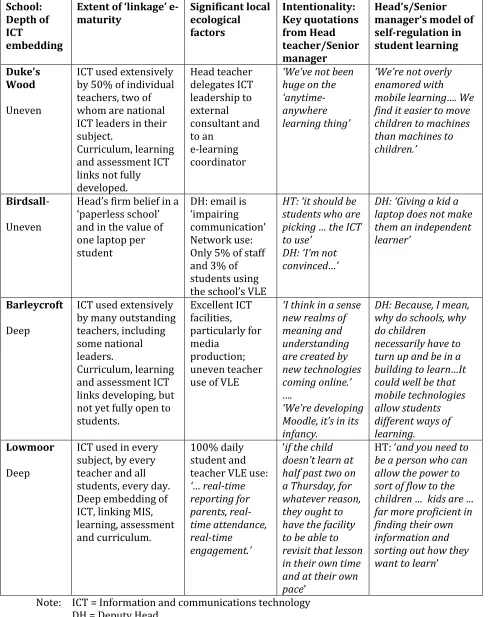
Table 1 Features of intentionality and e-maturity and in four Impact09 schools
School: Depth of ICT
embedding
Extent of ‘linkage’ e-maturity Significant local ecological factors Intentionality: Key quotations from Head teacher/Senior manager Head’s/Senior manager’s model of self-regulation in student learning
Duke’s Wood
Uneven
ICT used extensively by 50% of individual teachers, two of whom are national ICT leaders in their subject.
Curriculum, learning and assessment ICT links not fully developed. Head teacher delegates ICT leadership to external consultant and to an e-learning coordinator
‘We’ve not been huge on the ‘anytime-anywhere learning thing’
‘We’re not overly enamored with mobile learning…. We find it easier to move children to machines than machines to children.’
Birdsall-Uneven
Head’s firm belief in a ‘paperless school’ and in the value of one laptop per student
DH: email is ‘impairing communication’ Network use: Only 5% of staff and 3% of students using the school’s VLE
HT: ‘it should be students who are picking … the ICT to use’
DH: ‘I’m not convinced…’
DH: ‘Giving a kid a laptop does not make them an independent learner’
Barleycroft
Deep
ICT used extensively by many outstanding teachers, including some national leaders.
Curriculum, learning and assessment ICT links developing, but not yet fully open to students. Excellent ICT facilities, particularly for media production; uneven teacher use of VLE
‘I think in a sense new realms of meaning and understanding are created by new technologies coming online.’ ….
‘We’re developing Moodle, it’s in its infancy.
DH: Because, I mean, why do schools, why do children
necessarily have to turn up and be in a building to learn…It could well be that mobile technologies allow students different ways of learning.
Lowmoor
Deep
ICT used in every subject, by every teacher and all students, every day. Deep embedding of ICT, linking MIS, learning, assessment and curriculum.
100% daily student and teacher VLE use: ‘… real-time reporting for parents, real-time attendance, real-time engagement.’
‘if the child doesn’t learn at half past two on a Thursday, for whatever reason, they ought to have the facility to be able to revisit that lesson in their own time and at their own pace’
HT: ‘and you need to be a person who can allow the power to sort of flow to the children … kids are … far more proficient in finding their own information and sorting out how they want to learn’
Note: ICT = Information and communications technology DH = Deputy Head
HT = Head Teacher