Submission PDF
Focus on the success of others leads to selfish behavior
Pieter van den Berga,1, Lucas Mollemana,b,1& Franz J. Weissinga,2aTheoretical Biology Group, University of Groningen, P.O. Box 11103, 9700 CC Groningen, the NetherlandsbThe Centre for Decision Research and Experimental Economics (CeDEx), University of Nottingham, Sir Clive Granger Building, University Park, Nottingham NG7 2RD, UK1These authors contributed equally to this work2To whom correspondence should be addressed. E-mail: [email protected]
Submitted to Proceedings of the National Academy of Sciences of the United States of America
It has often been argued that the spectacular cognitive capacities of humans are the result of selection for the ability to gather, process and use information about other people. Recent studies show that humans strongly and consistently differ in what type of social information they are interested in. While some individuals mainly attend to what the majority is doing (frequency-based learning), others focus on the success that their peers achieve with their behavior (success-based learning). Here we show that such differences in social learning have important consequences for the outcome of social interactions. We report on a decision-making experiment where individuals were first classified as frequency-and success-based learners frequency-and subsequently grouped according to their learning strategy. When confronted with a social dilemma situation, groups of frequency-based learners cooperated consid-erably more than groups of success-based learners. A detailed analysis of the decision-making process reveals that these differ-ences in cooperation are a direct result of the differdiffer-ences in infor-mation use. Our results show that individual differences in social learning strategies are crucial for understanding social behavior.
cooperation | individual differences | cultural evolution | personality
| decision making Introduction
Acquiring information about others is a prominent feature of the human behavioral repertoire (1-3). Observing the behavior of others can allow individuals to improve their own knowledge and skills, but it can also be instrumental in anticipating how others will behave in future social interactions. Clues that help to predict how others will behave can allow for better coordination, or for being able to outsmart others for personal gain (4, 5). Indeed, the ability to keep a mental tab about the past actions of others has been put forward as one of the main mechanisms that allowed for the evolution of cooperation in humans (6, 7).
This focus on social information comes with a spectacular capacity to imitate. Imitation and other forms of social learning govern the spread of information between individuals and are therefore at the basis of cultural change. Indeed, it has been argued that these mechanisms of transmission underlie a pro-cess of cultural evolution, which is in many ways analogous to genetic evolution (8-10). Social learning has allowed humans to rapidly adapt to all kinds of environmental circumstances, and is ultimately responsible for the wide variety of languages, habits, forms of organization, and social norms that are found across cultures (11-14). Because of this, social learning and its group-level consequences have been the object of considerable scientific scrutiny. Laboratory studies and theoretical models have gone hand in hand in respectively identifying the social learning strate-gies that people use (15-18), and determining how these different strategies are shaped by selection (19-21) and affect the outcome of cultural evolution (22-26). The framework of cultural evolution has been successfully applied for a range of purposes, such as understanding the spread and the loss of technologies in human societies (27, 28) and inferring the ancestry of cultural traits such as language and political organization (39-31).
Although there has been extensive focus on identifying the rules that humans use to learn from each other, the possibility
that people may differ in the way they learn from others has long been ignored. Only recently, several studies (32-35) have suggested that there is substantial individual variation in the extent to which people use social information, and in the type of information they are interested in. Some individuals focus on information about the success of others (paying attention to both their decisions and the associated payoffs), whereas others are only interested in the frequencies with which behaviors occur in their social group (disregarding information about the payoffs others obtained). Moreover, individuals tend to use the same social learning strategy across different (social and non-social) contexts (34). However, it is not clear how the focus on different types of social information might affect the outcome of social interactions.
In this study, we examine the consequences of individual variation in human social learning strategies on the outcome of cooperative interactions. For this, we conducted a decision-making experiment that consisted of two parts that took place one month apart. In Part 1, subjects were divided in groups and con-fronted with a number of different interaction settings. In each interaction round, they were allowed to view a limited amount of information about their peers’previous behavior and earnings. In Part 2, we assorted the same subjects in groups based on the social learning strategies they had employed in Part 1, creating groups of success-based learners and frequency-based learners. These groups were confronted with a cooperation setting, in which each subject had to decide between a selfish option and an option that benefitted the group. We analyze the outcome of the interactions in these groups and investigate whether, and to what extent,
Significance
We report on a two-step decision-making experiment. The first part shows that humans differ consistently in the way they learn from others. Some individuals are success-based learners, who try to identify successful peers and mimic their behavior. Others are frequency-based learners, who tend to adopt the most frequent behavior in their group. The second part reveals that these differences in social learning have im-portant consequences for the outcome of social interactions. In situations where participants had to choose between a selfish option and an option benefitting their group, groups of frequency-based learners achieved considerably higher levels of cooperation than groups of success-based learners. This is the first clear experimental evidence that learning strategies are an important determinant of social behavior.
Reserved for Publication Footnotes
1 2 3 4 5 6 7 8 9 10 11 12 13 14 15 16 17 18 19 20 21 22 23 24 25 26 27 28 29 30 31 32 33 34 35 36 37 38 39 40 41 42 43 44 45 46 47 48 49 50 51 52 53 54 55 56 57 58 59 60 61 62 63 64 65 66 67 68
Submission PDF
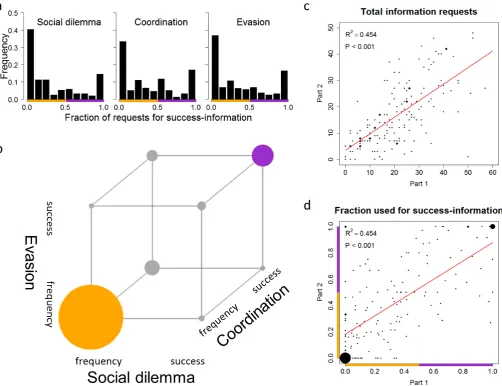
Fig. 1. Consistent individual differences in social learning strategies. In Part 1 of the experiment, 86.7% of all information requests fell into two categories: subjects either asked for frequency-information (i.e. the decisions of all four group members in the previous round) or they asked for success-information (i.e. the combination of decision and corresponding payoff for two group members in the previous round). (a) Classification of individuals with respect to the fraction of requests an individual targeted at success-information in Part 1 of the experiment. In each social context, the histogram reveals a U-shaped distribution: most individuals had extreme social learning strategies, either requesting mainly success-information or requesting mainly frequency-information. (b) Consistency of social learning strategies across the three social contexts in Part 1 of the experiment. For each context, individuals were classified as either focused on frequency (more than 50% of their requests used for frequency-information) or focused on success (more than 50% used for success-information). The graph depicts the 8 possible combinations of frequency- and success-focus across the three social contexts; the size of the circles indicating the number of individuals falling in each category. The individuals that were consistent over all social contexts are highlighted; consistent frequency-based learners (69) in orange and consistent success-based learners (23) in purple. 92 of the 145 subjects (63.4%) that requested information in at least one round of each social context were consistent across all three contexts. (c)Consistency in the number of information requests over time (between Part 1 and Part 2 of the experiment, summed over all social contexts) and (d)consistency in type of information requested between Part 1 and Part 2 (the fraction of information pieces requested that were used for success-information, over all social contexts). In both cand d, the size of the dots indicates number of individuals (the smallest dots representing single individuals), and the red lines represent linear regressions (in both cases,R2= 0.454,P< 0.001).
differences in cooperation can be traced back to differences in social learning style.
Results
In Part 1 of the experiment, 200 subjects were divided in groups of five and confronted with four different interaction contexts in randomized order (non-social, cooperation, coordination and evasion). In each context, they made decisions between two options for 20 consecutive interaction rounds. Their decision resulted in a payoff that depended on the type of the social interaction, the decisions of their fellow group members, and also included an element of random noise. Before making a decision, subjects were given the opportunity to view a maximum of four
‘pieces of information’ about their fellow group members at a
small cost, where one piece of information consisted of either a previous payoff or a previous decision of a fellow group member. The four interaction contexts we offered are consistent with those considered in our earlier study (34), but here we focus on the three social contexts.
The results of Part 1 fully confirm the earlier observation that there are marked individual differences in both the amount of social information that individuals request, and the type of infor-mation they are interested in (34). A large majority of inforinfor-mation requests (86.7%) were of two types: individuals either requested the decisions of the four fellow group members in the previous round (henceforth referred to as frequency-information), or they requested both the decision and the payoff of two fellow group members (success-information). Figure 1a classifies all individ-137
138 139 140 141 142 143 144 145 146 147 148 149 150 151 152 153 154 155 156 157 158 159 160 161 162 163 164 165 166 167 168 169 170 171 172 173 174 175 176 177 178 179 180 181 182 183 184 185 186 187 188 189 190 191 192 193 194 195 196 197 198 199 200 201 202 203 204
Submission PDF
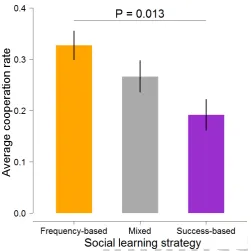
Fig. 2. Groups of frequency-based learners achieved higher levels ofcooper-ation than groups of success-based learners.Bars show average cooperation rates (±1 SEM) over all rounds of the social dilemma context in Part 2. Data are based on 16 groups of frequency-based learners, 8 mixed groups and 8 groups of success-based learners. TheP-value shown in the graph refers to a Tukey-Kramer test.
uals with respect to what type of information they requested in each social context. In all contexts, we find U-shaped dis-tributions, indicating that most subjects consistently focused on either frequency-information or success-information. Figure 1b demonstrates that most subjects were also consistent across the different contexts; almost two thirds of individuals always focused on the same type of information in all three social contexts.
In Part 2, 160 of the subjects that had participated in Part 1 were assorted in groups of five based on their social learning strategies, resulting in 16 groups of frequency-based learners, 8 groups of success-based learners, and 8 mixed groups (consisting of individuals with varying social learning strategies) as a control. These groups were confronted with the same interaction settings as in Part 1, again for 20 consecutive rounds, but the settings were presented in a different way (see Materials and Methods for details). Figure 1c and 1d show that individual information use was strongly correlated between Part 1 and Part 2. Subjects were consistent in both the extent to which they requested social information (Figure 1c) and the type of information that they focused on (Figure 1d). Apparently, subjects stuck to their social learning strategy for the one-month period separating Parts 1 and 2. In conclusion, the experiment provides independent confirma-tion for individual variaconfirma-tion in social learning strategies and their consistency across different contexts, and it suggests that these differences are stable over longer time periods.
Here we provide a detailed analysis of the effect of group assortment with respect to social learning on the subjects’ be-havior in the cooperation setting (see Figure S1 for the two other types of social interaction). The cooperation setting was a social dilemma; a situation in which individuals have to choose between their own interest (defection) and the interest of the group they are in (cooperation). In our experiment, cooperation raised the payoffs of all fellow group members, but came at a cost to the cooperating individual. Accordingly, it is advantageous to be in a group of cooperators, but defection is associated with
others. Also in this part, there was some random noise added to each payoff, so that it could occur that cooperation paid off better than defection (see Materials and Methods for details).
As shown in Figure 2, the group composition with regard to learning strategy had a systematic and significant effect on the level of cooperation achieved in the group (One-way ANOVA,
F= 4.772,P= 0.016). In particular, the cooperation level was significantly higher in groups of frequency-based learners than in groups of success-based learners (Tukey-Kramer test,P= 0.013), while the cooperation level in mixed groups (mostly composed of individuals with inconsistent learning strategies) was intermedi-ate. Due to the higher cooperation levels, average payoffs were significantly higher in groups of frequency-based learners than in groups of success-based learners (One-way ANOVA,F= 5.083,
P= 0.013; Tukey-Kramer test:P= 0.014). These results strongly suggest that differences in social learning strategies affect the outcome of social interactions.
How do the observed differences in cooperation level arise? One possibility is that frequency-based learners simply have a stronger tendency to cooperate. Our data do not support this: in the first round of the interaction, when decisions were not yet influenced by social information, cooperation levels did not differ between frequency-based learners and success-based learners (respectively 0.362±0.054 and 0.350±0.076; Fisher’s exact test,P
[image:3.595.52.304.71.322.2]= 0.839). Another possibility is that the different cooperation lev-els are the direct result of the different social learning strategies. To investigate this in more detail, we zoom in on how different types of social information affect subsequent behavior.
Figure 3a shows how subjects behaved after viewing success-information (both the decisions and the payoffs of two fellow group members in the previous round). Subjects were most likely to switch behavior (from cooperation to defection orvice versa) if they observed that others achieved substantially higher pay-offs with the opposite behavior. Interestingly, this effect was equally strong for subjects that defected in the previous round and subjects that cooperated. In addition, subjects were gener-ally conservative; if the observed payoff difference in favor of the other behavior was small, they tended not to change their behavior. Apart from this tendency to conservatism, the observed patterns are consistent with success-based learning as it is often implemented in models of cultural evolution (22, 26).
Figure 3b illustrates how subjects behaved after viewing frequency-information (the decisions of their four fellow group members in the previous round). In this case, the response to information was strongly affected by an individual’s own previous behavior. After having defected in the previous round, subjects were relatively likely to switch to cooperation (35% of the cases). Interestingly, this switching rate did not depend on the social information they just viewed; it was the same irrespective of the number of fellow group members that cooperated in the previous round. In contrast, subjects who had cooperated in the previous round were responsive to the information they received. The more cooperators they observed among their fellow group mem-bers, the more likely they were to continue cooperating them-selves. Although this latter pattern has an element of conformism, frequency-based learning as observed in our experiment is quite distinct from conformism as it is generally represented in models of cultural evolution (10, 25, 26). In such models, conformism is typically modelled by a symmetric S-shaped function indicating that copying a behavior becomes disproportionally more likely the more common the behavior is in the population, causing the common behavior to become even more common over time.
Could the differences in cooperation level between groups of frequency-based learners and groups of success-based learners (as shown in Figure 2) be fully explained by the response patterns to both types of information (Figure 3)? To investigate this, we 274
275 276 277 278 279 280 281 282 283 284 285 286 287 288 289 290 291 292 293 294 295 296 297 298 299 300 301 302 303 304 305 306 307 308 309 310 311 312 313 314 315 316 317 318 319 320 321 322 323 324 325 326 327 328 329 330 331 332 333 334 335 336 337 338 339 340
Submission PDF
Fig. 3. Cooperation rates after viewing frequency-information and success-information.(a) Probability of cooperation after viewing success-information about two fellow group members, as a function of the difference between the own previous payoff and the observed previous payoffs of others (only instances where the opposite behavior was observed are included). Both after cooperation (blue circles and lines) and after defection (red circles and lines), individuals were more likely to switch their behavior if they observed that the opposite behavior had yielded a higher payoff (logistic regressions, respectively d.f. = 282, P< 0.001; d.f. = 268,P< 0.001). (b) Probability of cooperation after viewing frequency-information about all four fellow group members, as a function of the number of fellow group members that cooperated in the previous round. Individuals that cooperated in the previous round (blue circles) were more likely to cooperate again if they observed that more fellow group members cooperated (blue line: logistic regression, d.f. = 703,P< 0.001). The number of observed cooperators did not have an effect on cooperation rates when individuals defected in the previous round (red circles; red line: logistic regression, d.f. = 763, P= 0.937). In both aandb, the size of the circles (as well as the numbers inside them) represent the number of observations. Data are based on pooled results from Part 1 and Part 2 of the experiment (the patterns are similar for both Parts separately; see Figure S2).
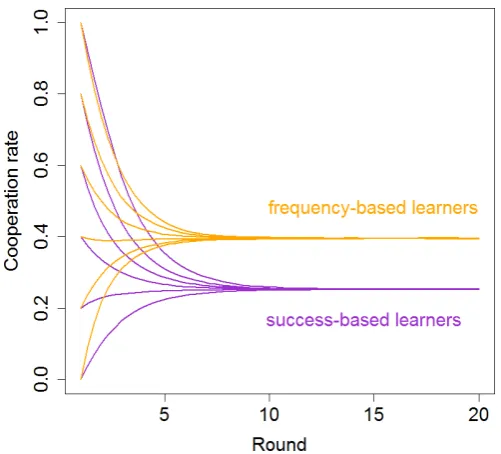
Fig. 4. Simulation of the effect of social learning strategy on cooperation in a social dilemma.Change in cooperation rates over time for groups of five, containing only frequency-based learners (orange lines) or only success-based learners (purple lines). Lines represent averages over 100,000 replicate simulations. For both scenarios, all possible starting conditions with regard to the initial number of cooperators are shown. The social learning strategies used in the simulations are simplified cartoon versions of the learning rules observed in the experiment (as shown in figure 3).
implemented simplified cartoon versions of the observed learning strategies in a simulation model. In the simulations, we used
the same payoff functions (and payoff noise level) as in the experiment, and assumed that individuals are equally likely to request information as observed in the experiment. The proba-bility of cooperating after not requesting information was also parameterized from our experimental observations. As illustrated in Figure 4, the differences in social learning rules can indeed account for the observed differences in cooperation.
Discussion
The results of our study can be summarized in three main points. First, our study confirms with an independent experiment that individuals differ systematically and consistently in their social learning strategies. Second, we show for the first time that the differences in learning strategies are stable over a longer time pe-riod, much like aspects of personality. Third, we demonstrate that individual differences in social learning strategies can strongly affect the outcome of social interactions. In particular, groups of success-based learners reach lower levels of cooperation than groups of frequency-based learners.
Our experiment was designed to investigate the effect of social learning strategies on the outcome of social interactions. Accordingly, we consider the finding that the cooperation level achieved in groups of success-based learners is considerably lower than cooperation in frequency-based learners the main result of this study. There were no differences in cooperation between frequency-based learners and success-based learners levels in the first interaction round. This suggests that the diverging coopera-tion levels do not result from differences in general cooperacoopera-tion tendencies, but are a direct result of how the learning strategies affect behavior. This is also supported by our simulation model. Intuitively, the effect of an individual’s social learning strategy on their cooperative behavior can be understood as follows. In a so-cial dilemma, defection yields individually higher payoffs than co-409
410 411 412 413 414 415 416 417 418 419 420 421 422 423 424 425 426 427 428 429 430 431 432 433 434 435 436 437 438 439 440 441 442 443 444 445 446 447 448 449 450 451 452 453 454 455 456 457 458 459 460 461 462 463 464 465 466 467 468 469 470 471 472 473 474 475 476
[image:4.595.52.303.411.638.2]Submission PDF
of cooperation. Frequency-based learners are not as focused on information about payoffs and are therefore less inclined to adopt the individually better-paying option (in this case, defection). Additionally, high levels of cooperation can be sustained by a positive feedback in groups of frequency-based learners: the more fellow group members are observed to cooperate, the higher the inclination of individuals to continue cooperation themselves.
Although this was not the main focus of our study, we provide strong support for our earlier finding (34) that humans differ consistently in their social learning strategies. On purpose, we modified the set-up of our experiment in several ways from that of our earlier study: groups were smaller, payoffs and informa-tion cost were different, the degree of random noise on payoffs was higher, and subjects were allowed to request fewer pieces of information. Despite these differences, the vast majority of subjects in both studies consistently used one of two learning strategies, irrespective of the social context. This strongly sug-gests that individual differences in social learning strategies are a robust phenomenon. This conclusion is further strengthened by the finding that the subjects of the present study tended to use the same learning strategy in Part 2 of the experiment as in Part 1. In other words, differences in social learning strategy seem to be stable over time, at least over a period of one month. Model studies suggest that such time-stability can have important implications, e.g. for signaling intentions and for coordinating behavior within groups (36-39). Yet, such time-stability is rarely investigated in experimental studies. Our study is a first step, but experiments spanning a longer time period and specifically designed to study time-stability are required to really judge the stability of differences in social learning strategies.
The finding that individuals differ systematically, stably, and consistently in their learning strategies has important implications for the interpretation of empirical data, irrespective of whether these data are collected in the lab or in a field setting. For example, an interesting recent study on social learning strategies in a social dilemma in 14 Indian villages neither found support for conformism, nor for success-based learning (40). However, this conclusion is based on a statistical analysis that implicitly assumes that the underlying population is homogeneous with respect to social learning strategies. Even if conformism or success-based learning are not observed at the aggregate level, it is very well possible that the population is heterogeneous, harboring two or more coexisting social learning strategies.
The idea that humans differ fundamentally in the way they gather information was already suggested by Jung (41), but has received relatively little attention in modern systems of personal-ity categorization such as the Five Factor Model (41, 43). This may be an important shortcoming; if individuals differ systematically in the way they collect, interpret and respond to information, they will also differ systematically in their behavior. This insight can have important implications for the interpretation of individ-ual differences. Observed behavioral variation need not reflect differences in mental, physiological, or motivational states, but may instead result from differences in social learning strategies. Experimental studies designed to distinguish between these po-tential causes can help provide proximate explanations of how consistent individual differences in behavior come about.
Why should individuals differ in the way they collect and respond to social information? Are these differences perhaps
‘adaptive’, that is, have they been shaped by (genetic or cultural) evolution? Questions like this currently play a central role in animal behavior studies (36, 44), where consistent individual differences have been described in hundreds of species across the entire animal kingdom (45, 46). Theoretical studies reveal that individual differences in social responsiveness (or ‘social sensitivity’) can arise through frequency-dependent selection,
tion their behavior on social information) and unresponsive types (that do not use information about others) (47). Differences in the use of social information may also be the result of evolution; modelling studies could shed more light on whether and how evolution could lead to such an outcome.
In the cooperation setting investigated in our study, groups of frequency-based learners achieved higher payoffs than groups of success-based learners. If frequency-based learning generally leads to superior payoffs, how can we explain that success-based learning still occurs in a social dilemma? This may be an ill-posed question. The fact that individuals consistently employ the same social learning strategy in different social contexts suggests that learning rules have not been tailored to perform optimally in every single context. This is in line with the view that evolution does not produce perfect behavior for every circumstance, but rather leads to the emergence of general-purpose strategies, or heuristics, that perform relatively well across the whole range of circumstances that an organism may face (48, 49). It is conceivable that frequency-based learning is superior under some circum-stances, while success-based learning is superior under other circumstances. Moreover, learning strategies might complement each other, leading to a faster spread of insights and technologies in groups harboring different learning strategies (34).
The link between frequency-based learning and coopera-tion has received quite some attencoopera-tion in the literature around the topic of ‘cultural group selection’. This literature discusses the spread of cooperation through competition between groups, when individuals use conformist learning: the disproportional tendency to copy the majority behavior. Since this type of frequency-based learning reduces variation within groups relative to variation between groups, it makes selection between groups more effective. Some have argued that this increases the scope for the cultural evolution of group-beneficial traits (such as coop-eration) (10, 50-54). However, conformism itself is neutral with regard to the content of behavior–it makes it extremely difficult for any behavior, including cooperation, to spread when initially rare (25, 55). Our experiment did not consider competition be-tween groups, but rather measured the consequences of different learning strategies for the spread of cooperation within groups. Although frequency-based learning was employed by a large pro-portion of the subjects, it was quite distinct from conformism as it is usually modeled. In fact, frequency-based learning as observed in our experiment did not reduce variation within groups; it led to intermediate levels of cooperation. Also, our results strongly suggest that frequency-based learning in a social dilemma is not neutral with respect to behavior; subjects that defected in the previous round responded to information quite differently from those who cooperated. It would be interesting to develop a model of cultural group selection including both individual differences in social learning strategies and more refined versions of frequency-based learning (as observed in our experiment). It is conceivable that such a model could not only explain the evolutionary stability of cooperation (due to cultural group selection), but also the spread of cooperation when initially rare.
Materials and methods
A total of 200 subjects (mostly students, mean age: 22.9, 68.5% female) participated in the study in a laboratory at the University of Groningen. Part 1 and Part 2 consisted of respectively ten and eight sessions of 20 subjects each. In both parts, subjects were confronted with four interaction contexts (in random order) of 20 rounds each, in groups of five. At the start of each session, subjects received written general instructions that were also read aloud by the experimenters. Before each interaction context, groups were reshuffled randomly, and subjects received specific instructions on their computer screens (see SI for screen shots and the general instructions of both parts). After this, subjects completed a short questionnaire to ensure they had understood the payoff-structure of the following context. In Part 1, decision-making was framed in a context of a choice between planting different crops on a farm. In Part 2, the context of decision-making was
546 547 548 549 550 551 552 553 554 555 556 557 558 559 560 561 562 563 564 565 566 567 568 569 570 571 572 573 574 575 576 577 578 579 580 581 582 583 584 585 586 587 588 589 590 591 592 593 594 595 596 597 598 599 600 601 602 603 604 605 606 607 608 609 610 611 612
Submission PDF
framed as investment choices in a stock market. The basic payoff structures of the contexts were the same between both parts, but the payoffs, noise on payoffs, and information cost in Part 2 were scaled with a factor 1.5 compared to Part 1 (here, values for Part 1 are given). Subjects were not aware of the identity of their group members, and were unable to see the computer screens of other participants. The experiment was run with the experimental software z-Tree (56) (code available upon request).
In each context, subjects decided between two options that remained the same in all rounds of that context (we used actual crop names (Part 1) and fictitious company names (Part 2), but here we will refer to the options asAandB). All subjects made their choice simultaneously, and were then shown the resulting payoff. Before each decision, subjects could choose to collect information about the members of their group, at a cost of 2 points. At the end of Part 2, subjects were paid in private proportional to the payoffs they had accumulated over both parts (100 points = 1 euro; mean earnings of subjects that participated in both parts:€69.93; max earnings:€94.30; min earnings€50.40). We ensured that participants could not end with a negative point total, by giving them a large enough endowment at the start of the experiment. Sessions lasted for approximately 90 minutes.
In the social dilemma (see SI for other contexts), payoffs of choosing
respectivelyAandBin Part 1 were given by and
, wherepdenotes the fraction of subjects in the group that chose optionA, andεis a stochastic component, drawn from a normal distribution with mean 0 and standard deviationσ( ). The one-shot version of this game has a single Nash equilibrium at , even though all subjects obtain
a higher payoff at . This shows that collective interests and individual interests are opposed to each other in this context.
Simulations were programmed in C++ (code available upon request). We tracked the cultural evolution of cooperation through 20 rounds for groups consisting either of only frequency-based learners or only payoff-based learners. In each round, individuals received payoffs for cooperation and defection as in the experiment (including noise on payoffs). Individuals used social information with a 36% probability (as in the experiment). If they did not request information, they had a 63% or 16% probability to cooperate, depending on whether they cooperated or defected in the previous round (as in the experiment). If they did request information, the probability of cooperation was determined by the logistic regressions shown in Figure 3. Success-based learners viewed two randomly chosen peers–if both these individuals had the same behavior as the focal individual in the previous round, the focal individual was assumed to stay with their previous behavior (with a probability of 1% to switch).
Acknowledgements.
We thank the Department of Sociology at the University of Groningen for access to their recruitment system and laboratory facilities. P.v.d.B. was supported by Grant NWO 022.033.49 of the Graduate Programme of the Netherlands Organisation for Scientific Research. L.M. was supported by an Ubbo Emmius scholarship of the University of Groningen and ERC grant project COOPERATION (ERC-Adg 295707). The experiments were subsidized by the Dr J.L. Dobberke Foundation.
1. Dunbar RIM (1998) The social brain hypothesis.Curr Anthropol6: 178-190. 2. Dunbar RIM, Schultz S (2007) Evolution in the social brain.Science317: 1344-1347. 3. Mesoudi A, Whiten A., Dunbar R (2006) A bias for social information in human cultural
transmission.Br J Psychol, 97: 405-423.
4. Byrne RW, Whiten A (eds) (1988)Machiavellian Intelligence: Social Expertise and the Evolu-tion of Intellect in Monkeys, Apes and Humans.(Clarendon Press, Oxford).
5. Whiten A, Byrne RW (eds) (1997)Machiavellian Intelligence II: Extensions and Evaluations.
(Cambridge University Press, Cambridge).
6. Nowak MA, Sigmund K (1998) Evolution of indirect reciprocity by image scoring.Nature
393: 573-577.
7. Wedekind C, Milinski M (2000) Cooperation through image scoring in humans.Science288: 850-852.
8. Dawkins R (1976)The Selfish Gene.(Oxford University Press, Oxford).
9. Cavalli-Sforza, LL, Feldman, M (1981)Cultural Transmission and Evolution.(Princeton University Press, Princeton).
10. Boyd R, Richerson PJ (1985)Culture and the Evolutionary Process.(University of Chicago Press, Chicago).
11. Gintis H (2000)Game Theory Evolving: A Problem-centered Introduction to Evolutionary Game Theory.(Princeton University Press, Princeton).
12. Boyd R, Richerson PJ, Henrich J (2011) The cultural niche: Why social learning is essential for human adaptation.Proc Natl Acad Sci U S A108: 10918-10925.
13. Mesoudi A (2011)Cultural Evolution: how Darwinian Theory can Explain Human Culture and Synthesize the Social Sciences.(University of Chicago Press, Chicago).
14. Whiten A, Erdal D (2012) The human socio-cognitive niche and its evolutionary origins.
Philos Trans R Soc B Biol Sci, 367: 2119-2129.
15. Traulsen A, Semmann D, Sommerfeld RD, Krambeck HJ, & Milinski M (2010) Human strategy updating in evolutionary games.Proc Natl Acad Sci U S A107: 2962-2966. 16. Morgan TJH, Rendell LE, Ehn M, Hoppitt WJE, Laland KN (2011) The evolutionary basis
of human social learning.Proc R Soc B Biol Sci279: 653-662.
17. Atkinsson C, O’Brien MJ, Mesoudi A (2012) Adult learners in a novel environment use prestige-biased social learning.Evol Psychol10: 519-537.
18. Hoppitt WJE, Laland KN (2013)Social Learning: an Introduction to Mechanisms, Methods and Models.(Princeton University Press, Princeton).
19. Laland KN (2004) Social learning strategies.Anim Learn Behav32: 4-14.
20. Kendal J, Giraldeau L, Laland KN (2009) The evolution of social learning rules: Payoff-biased and frequency-dependent Payoff-biased transmission.J Theor Biol260: 210-219. 21. Nakahashi W, Wakano JY, Henrich J (2012) Adaptive social learning strategies in temporally
and spatially varying environments.Hum Nat23: 386-418.
22. Henrich J (2001) Cultural transmission and the diffusion of innovations: Adoption dynamics indicate that biased cultural transmission is the predominate force in behavioral change.Am Anthr103: 992-1013.
23. Sigmund K, De Silva H, Traulsen A, Hauert C (2010) Social learning promotes institutions for governing the commons.Nature466: 861-863.
24. Rendell Let al.(2011) Cognitive culture: theoretical and empirical insights into social learning strategies.Trends Cogn Sci15: 68-76.
25. Molleman L, Pen I, Weissing FJ (2013) Effects of conformism on the cultural evolution of social behaviour.PLoS ONE8: e68153.
26. Molleman L, Quiñones AE, Weissing FJ (2013) Cultural evolution of cooperation: the interplay between forms of social learning and group selection.Evol Hum Behav34: 342-349. 27. Henrich J (2004) How adaptive cultural processes can produce maladaptive losses: the
Tasmanian case.Am Antiq69: 197-214.
28. Henrich J, Henrich, N (2010) The evolution of cultural adaptations: Fijian food taboos protect against dangerous marine toxins.Proc R Soc B Biol Sci277: 3715-3724.
29. Gray RD, Drummond AJ, Greenhill SJ (2009) Language phylogenies reveal expansion pulses and pauses in Pacific settlement.Science323: 479-483.
30. Currie TE, Greenhill SJ, Gray RD, Hasegawa T, Mace R (2010) Rise and fall of political
complexity in island South-East Asia and the Pacific.Nature467: 801-804.
31. Dunn M, Greenhill SJ, Levinson SC, Gray RD (2011) Evolved structure of language shows lineage-specific trends in word-order universals.Nature473: 79-82.
32. Efferson C, Lalive R, Richerson PJ, McElreath R, Lubell, M (2008) Conformists and mavericks: the empirics of frequency-dependent cultural transmission.Evol Hum Behav29: 56–64.
33. Mesoudi A (2011) An experimental comparison of human social learning strategies: payoff-biased social learning is adaptive but underused.Evol Hum Behav32: 334-342.
34. Molleman L, Van den Berg P, Weissing FJ (2014) Consistent individual differences in human social learning strategies.Nat Commun5: 4570.
35. Toelch U, Bruce MJ, Newson L, Richerson PJ, Reader SM (2014) Individual consistency and flexibility in human social information use.Proc R Soc Lond B Biol Sci, 281: 20132864. 36. Wolf M, Weissing FJ (2010) An explanatory framework for adaptive personality differences.
Philos Trans R Soc Lond B Biol Sci, 365: 3959-3968.
37. McNamara JM, Leimar O (2010) Variation and the response to variation as basis for successful cooperation.Philos Trans R Soc Lond B Biol Sci, 365: 2627-2633.
38. Wolf M, van Doorn GS, Weissing FJ (2011) On the coevolution of social responsiveness and behavioural consistency.Proc R Soc Lond B Biol Sci, 278: 440-448.
39. Wolf M, Weissing FJ (2012) Animal personalities: consequences for ecology and evolution.
Trends Ecol Evol, 27: 452-461.
40. Lamba S (2014) Social learning in cooperative dilemmas.Proc R Soc Lond B Biol Sci, 281: 20140417.
41. Jung CG (1971) Psychological types.Collected works vol. 6. (Princeton University Press, Princeton).
42. Digman JM (1990) Personality structure: Emergence of the Five-Factor Model.Annu Rev Psychol41: 417-440.
43. McCrae RR, John OP (1992) An introduction to the Five-Factor Model and its applications.
J Pers60: 175-215.
44. Wolf M, Van Doorn GS, Leimar O, Weissing FJ (2007) Life-history trade-offs favour the evolution of animal personalities.Nature447: 581-584.
45. Gosling SD (2001) From mice to men: what can we learn about personality from animal research?Psychol Bull, 127: 45-86.
46. Sih A, Bell A, Johnson JC (2004) Behavioural syndromes: an ecological and evolutionary overview.Trends Ecol Evol, 19: 372-378.
47. Wolf M, Van Doorn GS, Weissing FJ (2008) Evolutionary emergence of responsive and unresponsive personalities.Proc Natl Acad Sci U S A105: 15825-15830.
48. Gigerenzer G, Todd PM, ABC Research Group (1999).Simple Heuristics that Make us Smart.
(Oxford University Press, New York).
49. Fawcett TWet al.(2014) The evolution of decision rules in complex environments.Trends Cogn Sci, 18:153-161.
50. Henrich J, Boyd R (1998) The evolution of conformist transmission and the emergence of between-group differences.Evol Hum Behav19: 215-241.
51. Boyd R, Gintis H, Bowles S, Richerson PJ (2003) The evolution of altruistic punishment.
Proc Natl Acad Sci U S A100: 3531.
52. Guzmán AR, Rodríguez-Sickert C, Rowthorn R (2007) When in Rome, do as the Romans do: The coevolution of altruistic punishment, conformism, and cooperation.Evol Hum Behav
28: 112-117.
53. Scheuring I (2009) The evolution of generous cooperative norms by cultural group selection.
J Theor Biol257: 397-407.
54. Boyd R, Richerson PJ, Henrich J (2011) Rapid cultural adaptation can facilitate the evolution of large-scale cooperation.Behav Ecol Sociobiol65: 431-444.
55. Lehmann L, Feldman MW, Foster KR (2008) Cultural transmission can inhibit the evolution of altruistic helping.Am Nat172: 12-24.
56. Fischbacher U (2007) z-Tree: Zurich toolbox for ready-made economic experiments.Exp Econ2: 171-178.
681 682 683 684 685 686 687 688 689 690 691 692 693 694 695 696 697 698 699 700 701 702 703 704 705 706 707 708 709 710 711 712 713 714 715 716 717 718 719 720 721 722 723 724 725 726 727 728 729 730 731 732 733 734 735 736 737 738 739 740 741 742 743 744 745 746 747 748