MIMO Multi Carrier Interleave Division Multiple Access
System with Multiuser Detection: Performance Results
Prabagarane Nagaradjane1,Sai N. Chandrasekaran2, Kuttathatti Srinivasan Vishvaksenan3
1Department of Electronics and Communication Engineering, SSN College of Engineering,
SSN Institutions, Chennai, India
2The University of Kansas, Kansas, USA
3Department of ECE, SSN College of Engineering, SSN Institutions, Chennai, India
Email: [email protected], [email protected], [email protected] Received January 6, 2010; revised February 17, 2010; accepted March 16, 2010
Abstract
This paper provides the performance analysis of multi input multi output (MIMO) Multi carrier (MC) inter-leaver based multiple-access system with multiuser detection. Interleave-division multiple access (IDMA) is a scheme in which users are separated by employing different interleavers instead of different signatures as in a conventional code-division multiple-access (CDMA) scheme. The basic principle of IDMA is that the interleaver is different for different users. Interleavers are generated independently and randomly. At the re-ceiver, ZF, LLSE, VBLAST/ZF/MAP and VBLAST/LLSE/MAP detectors are employed. The performance of the system is analyzed for different channel conditions using extensive simulation runs based on Monte Carlo simulation trials. Simulation results divulge that VBLAST/LLSE/MAP detector results in significant performance amelioration compared to other detectors as applied to MC/IDMA system.
Keywords:CDMA, Channel Capacity, Iterative Decoding, Multi-User Detection
1. Introduction
This paper presents an approach to asynchronous multi-ple access scheme called interleave division multimulti-ple- access (IDMA) [1] system with MIMO support. In an IDMA scheme, different interleavers are used to distin-guish users as against different codes in a conventional code division multiple access (CDMA) system. In a conventional CDMA scheme, interleavers are placed before the spreaders and they are effective only when used in conjunction with channel coding [2,3]. Recently, a very interesting technique using chip-level interleavers was addressed in [1], which aims at mitigating inter-symbol interference (ISI) in multipath fading environ-ments. Many papers have discussed the role of interleav-ers in a multiple access systems [1,3]. IDMA inherits many benefits of CDMA; in particular, path diversity and mitigation of intra cell interference. Also all the users employ a common spreading sequence. Recent research on wireless communication systems has shown that using multiple antennas at both transmitter and receiver offers the possibility of communications at higher data rates compared to single antenna systems [4-6]. Multi input
as-414 P. NAGARADJANE ET AL.
sisted Multi Carrier interleave division multiple access (MIMO MC/IDMA) scheme with multiuser detection. We will show that the MIMO MC/IDMA scheme can provide better performance with the aid of VBLAST/ LLSE/MAP [5,6] detection technique. Also this approa- ch is independent of the number of users and gives better performance in multipath environment. The rest of the paper is organized as follows - the system model is pre-sented in Section 2. Section 3 gives the gist of signal detection techniques. Performance results will be pre-sented in Section 4. Eventually conclusions are drawn in Section 5.
2. System Model
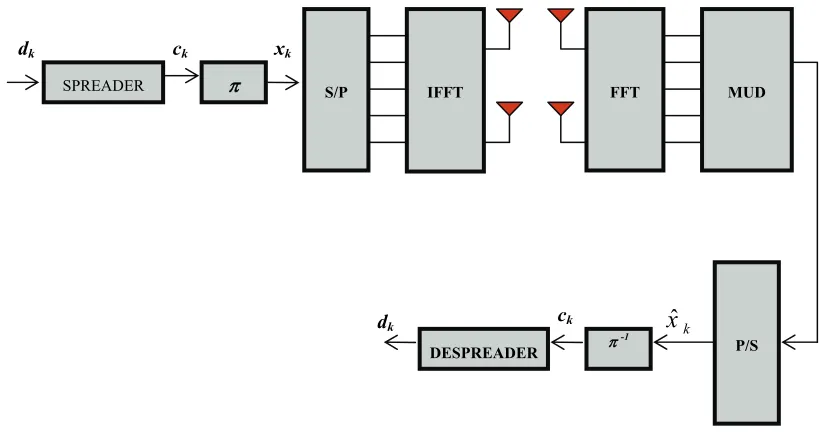
In this section, we introduce the IDMA scheme with Multi carrier modulation. The block diagram of MIMO MC/IDMA scheme is elucidated in Figure 1. In IDMA the interleavers are different for different users. Inter-leavers are generated independently and randomly. Dif-ferent interleavers separate the users and all the users employ a common spreading sequence. Interleavers, which are usually placed between forward error correc-tion (FEC) coding and spreading, is used to combat fad-ing effect in CDMA, whereas the arrangement of inter-leaving and spreading is reversed in IDMA. Now, dif-ferent interleavers distinguish distinct data streams. In IDMA, encoder block may do FEC encoding and spre- ading jointly. The spreader has no special function. In this paper we consider a single user MIMO MC IDMA system. Each of the synchronous user is equipped with M
transmit antennas and they communicate to a single base station, equipped with N receive antennas. MIMO profile is realized by using VBLAST (Vertical Bell Laboratories
Space Time architecture).
3. Symbol Detection Techniques
Considering a synchronous signal over a time variant cha- nnel, the received signal at the time instant j is given as
min( , )
1
( ) ( ) ( ), 1, 2,...,
m n k
k k k
r j H x j n j j J
(1)where Hk is the channel co-efficient for user k and {n (j)}
are samples of an AWGN process with variance = No/2. Here perfect knowledge of the channel state in-formation is assumed to be available at the receiver. In each use of the MIMO channel, a vector x = (x1, x2…xM)T
of complex numbers is sent and a vector r = (r1, r2,…,
rN)Tof complex numbers is received. We assume an
in-put-output relationship of the form
2
r = Hx + n (2) where H is a N × M matrix (N = number of transmit antennas and M = number of receive antennas) repre-senting the scattering effects of the channel and n = (n1,
n2,…, nN)T is the noise vector. Throughout, we assume
that H is a random matrix with independent complex Gaussian elements {hij} with mean 0 and unit variance,
denoted by hij ~N (0,1). We also assume throughout that n is i.i.d complex Gaussian random vector. The symbol detection problem considered in this paper is the problem of estimating the MIMO channel input vector x given the received vector r assuming that the receiver has perfect knowledge of H. The decision is made on a sym-bol-by-symbol basis. The next section discusses the various VBLAST detectors employed in our work.
[image:2.595.88.500.490.709.2]S/P IFFT FFT MUD
Figure 1. MIMO MC/IDMA system. SPREADER
dk ck xk
P/S
-1 DESPREADER
)
3.1. Zero-Forcing (ZF) Receiver
Zero-forcing (ZF) receiver is a low-complexity linear detection algorithm that outputs,
ˆ (ˆ
xQ xZF (3) where
ˆ
xZF = H+ r (4)
and H+ denotes the Moore-Penrose pseudo inverse of H,
which is a generalized inverse that exists even when H is rank-deficient.
3.2. Linear Least Square Error Receiver (LLSE)
LLSE receiver is also a linear detection algorithm that outputs
ˆ (ˆLLSE)
a Q a (5) where
ˆLLSE
a Wr (6) and when H and n are gaussian, W is the weight vector given by
1
( o N)
ρ ρ
W H HH N I
M M
(7)
3.3. V-BLAST Detection
The V-BLAST detection algorithm [6] is a recursive procedure that extracts the components of the transmitted vector x according to a certain ordering (k1, k2,…,kM) of
the elements of x, where, (k1, k2,…,kM) is a permutation
of (1,…, M). In VBLAST, this permutation depends on H
(which is known at the receiver by assumption) but not on the received vector r. The VBLAST/ZF algorithm is a variant of VBLAST derived from ZF rule. The algorithm determines the order of channels to be detected, performs
nulling and computes the decision statistics. It then slices the computed decision statistics and yields the decision by performing cancellation with the help of decision feedback, and finally computes the new pseudo-inverse for the next iteration. V-BLAST/ZF may be seen as a successive-cancellation scheme derived from the ZF scheme discussed in the previous section. The ZF rule creates a set of subchannels by forming
ˆ ( )
x H H x H n (8) The j'th such sub-channel has noise variance ||(H+)
j||2.N0
and the order selection rule prioritizes the sub-channel with the smallest noise variance.
3.4. VBLAST/MAP Detection Algorithm
In this section, a detection algorithm for MIMO channels, called VBLAST/MAP that combines the features of
VBLAST and MAP rules is used for symbol detection in a MC/IDMA system. This algorithm does not use the lay-ered structure of VBLAST, but uses a different strategy for channel processing order, inspired by the MAP rule. This algorithm is an extension of the well-known VBLA- ST algorithm. This VBLAST/MAP combines the elements of VBLAST algorithm and the maximum a-posteriori (MAP) rule. The original VBLAST algorithm is a multi- layer symbol detection scheme which detects symbols transmitted at different transmit antennas successively in a certain data-independent order. The VBLAST/ MAP algo-rithm differs from VBLAST only in the ordering strategy of the symbols detected. The complexity of the VBLAST/ MAP is higher than that of VBLAST; however, the per-formance improvement is significant.
3.5. V-BLAST/ZF/MAP Detection Algorithm
Using the same notation of VBLAST algorithm, VBL- AST/ZF/MAP algorithm may be described, as follows- VBLAST/ZF/MAP algorithm is identical to VBLAST/ ZF except for the ordering in which symbols are detected. Instead of selecting the next symbol to be detected accor- ding to the rule, here the set of all probable symbol deci-sions are ranked with respect to their a-posteriori prob-abilities of being correct, as estimated by pij. Thus, it is
important to emphasize that pij’s are not true MAP
prob-abilities but approximations to how probable it is that sij
= xj. Note that the index permutation (k1, k2,… ,kM)
pro-duced by VBLAST/ZF/MAP depends on both H and r, unlike VBLAST/ZF where the permutation depends only on H. Complexity of VBLAST/ZF/MAP is increased with respect to that of VBLAST/ZF by the computation steps involved. One major point about complexities of VBLAST/ZF and VBLAST/ZF/MAP is that, the former allows pre-computation of all weighting vectors whereas in the latter the weighting vector must be computed in real-time since it also depends on r. This increased com-plexity of VBLAST/ZF/MAP is justified by performance improvements. The algorithm is summarized as follows:
Initialization H W1
1
i
(9)Recursion
i i
i Wr
y
) ( i i Q y
s
} ... {
, 1 1
) | ( ) | (
f y s i
s y f
ij j k k
p A s ij ij
ij ij ij } { } ... { max arg 1 1 ij i i p k k j k k S xˆk i i
416 P. NAGARADJANE ET AL.
ri1rixˆki(H)ki
1 i
i k
W H 1
i
i (10)
3.6. V-BLAST/LLSE/MAP Detection Algorithm
This detection algorithm is akin to V-BLAST/ZF/MAP detection except the weight vector defined by the Equa-tion (7).
[image:4.595.318.526.77.250.2] [image:4.595.67.279.312.478.2]4. Performance Results
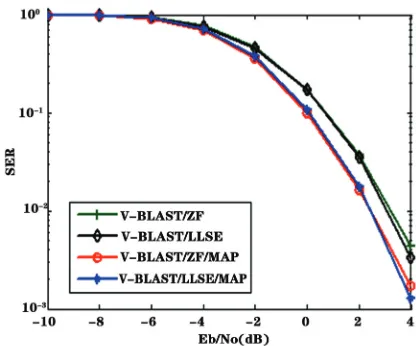
Figure 2 expounds the simulation results for an 8 × 12 MIMO MC/IDMA system employing ZF, LLSE, VBLAST/ZF and VBLAST/LLSE detectors. The modula-tion technique considered is 16-QAM and the Eb/N0 ranges
[image:4.595.69.275.523.693.2]between -10 dB and 4 dB. The symbol error rate SER is
Figure 2. Symbol error rates (SER) of VBLAST/ZF, VBL- AST/LLSE, ZF and LLSE receiver.
Figure 3. Symbol error rates (SER) of VBLAST/ZF/MAP and VBLAST/ZF receiver.
Figure 4. Symbol error rates (SER) of VBLAST/ZF, VBLA- ST/LLSE, VBLAST/ZF/MAP and VBLAST/LLSE/MAP receiver.
calculated by performing 10,000 trials at each Eb/N0 point.
A new realization of H was chosen in each trial and for each Eb/N0 value. The performance curves in Figure 2
show that VBLAST/LLSE provides significant improve-ment in SER compared to ordinary VBLAST/ZF, ZF and LLSE detector. Figure 3 elucidates the simulation results for an 8 × 12 MIMO MC/IDMA system employing VBLAST/ZF and VBLAST/MAP detectors. It is dis-cerned that VBLAST/MAP outperforms VBLAST/ZF detector. Figure 4 evinces the simulation results for an 8× 12 MIMO MC/IDMA system employing VBLAST/ZF, VBLAST/LLSE, VBLAST/ZF/MAP and VBLAST/LLSE /MAP receiver with 16QAM modulation. It is discerned that VBLAST/LLSE/MAP outperforms VBLAST/ZF/ MAP detector in terms of SER performance.
5. Conclusions
In this paper a multiple access scheme for 4G wireless communications has been considered based on interleav-ers. Problems in two major areas have been identified in this paper: efficient transmission technique and symbol detection in the presence of multi stream interference. A solution has been conceived to achieve the above. Simu-lation results have proved that the MIMO MC/IDMA in combination with VBLAST/LLSE/MAP multiuser de-tector can achieve significant performance improvement compared to ZF, LLSE, and VBLAST/ZF/MAP.
6
. References
[1] H. Schoeneich and P. A. Hoeher, “Adaptive Interleave- Division Multiple Access - A Potential Air Interface for 4G Bearer Services and Wireless LANs,” International Conference on Communications, 2004.
rnational
IEEE International Conference, WiCOM, October 2009.
Based Multiple Access System: A Proposal for 4G Mo-bile Communication with Iterative Chip-by-Chip Multi-User Detection,” Project Report, SSN Institutions, 2006. [3] N. Prabagarane, C. S. Nivedita, S. Padmini and C. Vijay,
“Interleave Division Multiple Access System with Itera-tive Multiuser Detection,” IEEE International Confer-ence and Exposition on Advanced Ceramics and Com-posites, February 2007.
[4] N. Prabagarane, M. Ramakrishnan, T. Divya, M. Tho- mas and B. Jalaja, “Performance Evaluation of Multi Stage Receivers for Coded Signals in MIMO Channels,” 4th IEEE WiCOM, October 2008.
[5] T. Divya, M. Thomas and B. Jalaja, “Performance Eva- luation of Multi Stage Receivers for Coded Signals in MIMO Channels,” Project Report, SSN Institutions, 2008.
[6] V. Arun, A. S. S. Vasan and L. Krishnan, “Investigations
on the Performance of MIMO Assisted Multi Carrier DS/CDMA System with Multiuser Detection for 4G Mo-bile Communications,” Project Report, SSN Institutions, 2009.
[7] I. E. Telatar, “Capacity of Multi-Antenna Gaussian Channels,” Europe Transportation and Telecommunica-tion, Vol. 10, No. 6, November-December 1999, pp. 585-595.
[8] P. Nagaradjane, A. S. S. Vasan and L. Krishnan, “A Ro-bust Space Time Co-Channel Interference Mitigation and Detection Technique for Multiuser MIMO Multicarrier DS/CDMA Systems,” Proceedings of IEEE Inte
Conference on Wireless Vitae,Montreal,2009.