Singular perception, multiple perspectives through ‘we’: Constructing intersubjective meaning in English and German
Richard Jason Whitt, The University of Strathclyde Abstract
This paper presents the results of a corpus-based investigation of the role of the first-person plural pronoun in the construction of intersubjective meaning among evidential perception verbs in written and spoken English and German (mainly written).
Whereas the first-person singular pronoun only signifies that the evidence rests solely with the speaker/writer, the first-person plural pronoun allows a much wider range of intersubjective meanings concerning the nature of the evidence. It is also shown how English and German perception verbs express intersubjective evidential meaning in a number of different complementation patterns, how the type of this meaning is often linked to these patterns, and how the use of the first-person plural pronoun can vary among and within these constructions.
1. Introduction
Recent investigations into the syntax, semantics, and pragmatics of perception verbs—those verbs denoting sight, sound, touch, smell, and taste—has revealed that this group of verbs provide a key means of lexical realizations of evidential meaning in languages such as English and German (Gisborne and Holmes 2007; Gisborne 2010; Whitt 2009, 2010, 2011).1 Consider, for example, the following:
(1) a. I hear Judith singing a Petula Clark song.
b. Ich höre Judith ein Lied von Petula Clark singen.
In (1a) and its German equivalent (1b), the speaker indicates that Judith is singing one of Petula Clark’s songs, and that s/he has auditory evidence that this event is taking place. That is, the speaker knows Judith is singing because s/he hears it happening. But notice how the nature of the evidence changes a bit when the first-person plural pronoun is used:
1Aikhenvald (2004) argues that the category of evidentiality should be restricted to
(2) a. We hear Judith singing a Petula Clark song. b. Wir hören Judith ein Lied von Petula Clark singen.
Here, the speaker indicates that s/he is not the only one who has heard Judith sing, but that an unspecified number (at least within this sentence) of other people have heard the event take place as well. That is, the evidence is accessible by a group of people rather than a single individual.
It has been taken for granted that evidentiality is a deictic category, as it involves speakers (or writers) providing evidence for the propositions they utter (Jakobson 1957 [1971]; de Haan 2001; Joseph 2003). Therefore, a sentence such as Mark hears Judith singing a Petula Clark song / Markus hört Judith ein Lied von
Petula Clark singen would not be considered evidential because the speaker is not
indicating s/he is in possession of any particular evidence for the proposition, but merely that some third person has auditorily perceived an event (cf. Biber and Finegan’s 1989 distinction between “speaker stance” and “secondary stance”). But what else besides evidence does a speaker/writer (hereafter S/W) index when s/he uses the first-person plural pronoun as the grammatical subject of an evidential perception verb? It was shown in Whitt (2011) that the use of the first-person plural pronoun allows the S/W not only to indicate that s/he—along with others—is in possession of perceptual evidence, but it also allows the S/W to “engage” the
audience with the evidence (Hyland 2005; cf. Nuyts 2001): that is, the use of the first-person plural pronoun can allow the S/W to bring certain evidence to the audience’s attention, use the evidence in a persuasive manner, and perhaps even concede that multiple interpretations of the same perceptual evidence are possible. This variety of uses does not occur when the singular first-person pronoun is used.
This essay will expand on arguments made in Whitt (2011) and focus
(wir) with evidential perception verbs. I will first provide a general overview of evidential perception verbs, then focus on the notions of subjectivity and
intersubjectivity as they relate to the first-person plural pronoun, discuss the corpora consulted for this study, and examine the behavior of the first-person plural pronoun among evidential uses of the verbs of visual (see, sehen) and auditory (hear, hören) perception in English and German.
2. The (Evidential) Verbs of Perception
Before embarking on our study of the first-person plural pronoun and evidential perception verbs, a few comments and delineations concerning this group of verbs is necessary. It is well known that there are five sensory modalities—sight, sound, touch, smell, and taste—covered by perception verbs in English and German. However, not all of these modalities share equal status when in comes to verb
frequency and semantic content. In his cross-linguistic typological study of perception verbs, Viberg (1983) found that certain sub-groups (i.e. verbs signifying specific modalities) enjoyed greater frequency in usage and a higher degree of polysemy than others. Hence he established the following hierarchy:
Sight > Hearing > Touch > Smell, Taste
“Subject-oriented” perception verbs are transitive verbs where the grammatical subject of the clause is also the perceiver, and they focus on the act of perception itself. Hear and hören in (1) and (2) are good examples. “Object-oriented” perception verbs, on the other hand, are intransitive and focus on the stimulus of perception as the grammatical subject of the clause, e.g. The music sounds loud. The object-oriented perception verbs are not irrelevant to discussions of evidentiality, but as they play a less significant role in constructions of collectivity and intersubjectivity than subject-oriented verbs do (Whitt 2011), they will not be discussed further in this study.
So what makes an perception verb evidential? It was mentioned in Section 1 that there must be a deictic component present, whereby the S/W points to his or her perception as the source of information for the proposition. But since subject-oriented perception verbs can be evidential only when a first-person grammatical subject appears, we must tease out this additional deictic component from the already existing indexical presence of person deixis via the pronoun. Contrast (3) from (4):
(3) a. I see the house. b. Ich sehe das Haus. (4) a. I see the house burning.
b. Ich sehe das Haus brennen.
In (3), the S/W states that s/he visually perceives a house, but this visual perception of an object is not evidence for some other proposition. In (4), however, this act of visual perception (proposition 1) provides the evidence for the second proposition in the sentence: namely, the house is burning. It is this additional deictic component of the S/W linking his or her act of perception as evidence for another proposition that is necessary for the perception verb to become evidential.2 The different syntactic
2This is not an uncontentious statement, as one could perhaps argue that in (3), the
configurations where one finds evidential perception verbs will be discussed in more detail in Section 5. And on a final note, the high degree of polysemy one sees evinced by perception verbs in general appears in the evidential domain as well (Sweetser 1990; Harm 2000; Whitt 2010): verbs of visual perception can point to evidence of a cognitive nature (like knowledge and understanding), auditory verbs can also be markers of hearsay, and verbs of tactile perception can include emotion and intuition in their stock of evidential meanings. And all verbs—including those of olfaction and gustation—point to inference as the source of evidence, while the connection between this inference and the source sensory modality can vary tremendously, i.e. the
inference may or may not be based on the sensory modality of the verb in question. Sometimes the relationship is purely metaphorical. This issue of polysemy will also be taken up in Section 5.
3. Subjectivity and Intersubjectivity
In very general terms, subjectivity in language concerns the degree to which the S/W’s presence in the discourse is realized linguistically, and it has been of interest to linguistics for quite a long time (see, for example, Bréal 1900: 229-238). With this very general definition, one can safely say that evidentiality is subjective because of its deictic nature. After all, it allows S/Ws to point to the evidence for the propositions they utter, thus making their presence in the discourse known. More recently, two competing—although not mutually exclusive in my opinion—views of subjectivity have gained prominence. Traugott’s (1982; 1989) view of subjectivity is diachronic in nature, concerned mainly with how certain linguistic items become markers of S/W’s the proposition of the subject’s perception has to provide the source for the
point of view. The Old English perception verb felan ‘to feel’ is a good example, which by the end of the Old English period had acquired the additional meaning of ‘to experience mentally’. This is Stage I of Traugott’s cline of subjectification, whereby items that describe external situations come to assume meanings of internal
(cognitive, evaluative, perceptual) situations as well. In Stage II, markers of external/internal situations assume textual or metalinguistic meanings: this is what happened with the Early Modern English observe ‘to perceive (that)’, which became ‘to state (that)’. Finally, in Stage III—when subjectification reaches its zenith— meanings become concentrated in S/W’s subjective attitudes and assessments. The development of epistemic modal meaning out of deontic modal meaning is the perennial example of full-blown subjectification. Although the notion of
subjectification is diachronic in nature, it is useful for synchronic analysis as well. Concerning (5) and (6), for example:
(5) a. I can see the boat capsizing. b. Ich sehe das Boot umkippen.
(6) a. I can see that Irene gets along with her parents.3 b. Ich sehe, dass Irene sich mit ihren Eltern gut versteht. In (5), the S/W has visual evidence that the boat is capsizing. Anyone else who has visual access to this event should also be able to report the same thing. In (6),
however, the perception verb see/sehe doesn’t indicate visual perception so much as it does inference (which is probably based on visual observation). This could be
considered more subjective than (5), which is based solely on an external event or stimulus.
3According to Palmer (2001: 47) the coupling of the modal verb can with a perception
Langacker’s (1990, 1999, 2008) approach to subjectivity is synchronic in nature and is more concerned with overt syntactic realizations of the deictic elements (the “ground”) in the discourse. Where there is more deixis, there is more subjectivity because the S/W is more “on stage” where the events are occurring:
(7) a. Vanessa jumped across the table.
b. Vanessa is sitting across the table from Veronica. c. Vanessa is sitting across the table from me. d. Vanessa is sitting across the table.
To Langacker, (7a) would be considered maximally objective because this event description is not dependent on the S/W’s point of view (that is, the S/W is maximally “off stage”). In (7b, c), on the other hand, the S/W traces a trajectory from Vanessa to someone else. And in (7d), this trajectory from Vanessa (to the self) is not even linguistically realized; the S/W is maximally “on stage” here, and the sentence is thus considered maximally subjective. Although such insights can prove helpful in dealing with evidential object-oriented perception verbs (Whitt 2011: 352), they don’t have much to say about subject-oriented perception verbs, where the overt marking of the perceiver (I or we) as subject is governed grammatically rather than pragmatically, i.e. the S/W has no choice but to indicate who the perceiver is, and so varying degrees of Langacker’s subjectivity simply don’t exist.
subjectification and intersubjectification, the latter being a subtype of the former.4 Concerning evidentiality, Nuyts (2001: 34) has developed a litmus test for
determining whether something is a marker of subjective or intersubjective evidential meaning: “does the speaker suggest that (s)he alone knows the evidence and draws a conclusion from it; or does (s)he indicate that the evidence is known to (or accessible by) a larger group of people who share the conclusion based on it?” So returning to examples (1) and (2), we can see that the auditory evidence appears to be available solely to the speaker in (1), but in (2), an unspecified number of other people in addition to the speaker have access to this evidence, as indicated by the first-person plural pronoun we. In Whitt (2011), it was shown that Nutys’ criterium for
distinguishing subjective and intersubjective evidentiality, although correct, fails to capture the wide array of possible intersubjective meanings found with evidential perception verbs. Not only can the S/W indicate that s/he is not the only one with access to specific perceptual evidence, but s/he can also use the first-person plural pronoun we as a means of bringing evidence to the addressee’s attention, or even in an attempt to guide or manipulate the addressee’s interpretation of such evidence (after all, the use of we can indicate an assumption of audience agreement, even when there is none). This is where Hyland’s (2005) notion of “stance and engagement” becomes quite useful. Although evidentiality has long been acknowledged to be part of
“speaker stance” (see, for example, Biber and Finegan 1989), little has been said as to how the S/W might “engage” the audience with certain information or evidence. According to Hyland (2005: 176), stance is an “attitudinal dimension” and
engagement is “an alignment dimension where writers acknowledge and connect to others, recognizing the presence of their readers, pulling them along with their
4After all, for something to assume intersubjective meaning, it must first be capable of
argument, focusing their attention, acknowledging their uncertainties, including them as discourse participants, and guiding them to interpretations”. And as we will soon see, it is the first-person plural pronoun we/wir that allows speakers and writers to engage their audience in a number of ways with the evidence at hand (see
Mühlhäusler and Harré 1990: 168-206 for a general discussion of the semantic breadth of the first-person plural pronoun in a number of the world’s languages).5
4. The Data
To see what variety of intersubjective evidential meanings are evinced by the first-person plural pronoun in English and German, the extant similarities and differences between these two languages, and if any recent diachronic developments have occurred, a number of corpora representing the Early Modern and Modern periods were searched. For English, the Helsinki (Early Modern section) and ARCHER Corpora were consulted. The Early Modern section of the Helsinki Corpus contains 551,000 tokens and covers the years 1500-1700. The ARCHER (A Representative Corpus of Historical English Registers) covers the years 1650-1990 and contains 1,789,309 tokens. For German, the Bonn Corpus of Early New High German, containing 608,000 tokens, was consulted for the period 1350-1699. The Goethe and Kant Corpora were consulted for eighteenth and nineteenth century data: the latter contains 3,338,068 tokens and the former contains 1,400,000 tokens. For twentieth century German, the DWDS (Digitales Wörterbuch der deutschen Sprache ‘Digital Dictionary of the German Language’)—containing ca. 100,000,000 tokens—was consulted. Because of the large size of the DWDS in comparison to the other corpora,
5Intersubjectivity does not factor anywhere in Langacker’s model of Cognitive
the number of attestations of high-frequency perception verbs (like sehen ‘see’ and hören ‘hear’) was often much higher than in other corpora. When this occurred, a
random sample similar in size to the data sets of other corpora was taken (see Whitt 2010).6
One obvious issue that arises concerning the corpora and the use of the first-person plural pronoun is the issue of genre, i.e. are certain uses of we or wir as indexes of intersubjective evidential meaning more prominent in certain genres than others? Due to the varying structures of the different corpora, such a question cannot be answered in a systematic way in the current study. It is hoped, however, that the findings discussed here will lead to genre-based investigations of evidentiality and the use of the first-person plural pronoun (for other genre-based investigations of this pronoun, see papers in this volume by Temmerman, Vladimirou, Vassileva, Fetzer, and Van de Mieroop).7
5. We/Wir and Evidential Verbs of Visual and Auditory Perception
6The Helsinki Corpus is available from ICAME (http://icame.uib.no/) and The Oxford
Text Archive (http://ota.ahds.ac.uk/), while the ARCHER Corpus is available only on site at universities with participating ARCHER consortium members (see
http://www.llc.manchester.ac.uk/research/projects/archer/ for more details). The Bonn Corpus of Early New High German is available online at
http://www.korpora.org/Fnhd/, as is the Kant Corpus (http://www.korpora.org/kant/) and the DWDS Corpus (http://www.dwds.de). The Goethe Corpus is available within the COSMAS II framework of the Institut für Deutsche Sprache (http://www.ids-mannheim.de/cosmas2/). All hyperlinks accessed on 21.11.11.
7Both the Helsinki and ARCHER Corpora aim to be multi-genre sample corpora for
I will now present the results of my corpus-based study on the use of the first-person plural pronoun as a marker of intersubjective meaning when used with
evidential verbs of visual (see and sehen) and auditory (hear and hören) perception. It was found that these perception verbs always signify evidential meaning when they occur in particular complementation patters or other syntactic collocations, and that particular evidential meanings are sometimes bound to specific patterns (cf. Hunston and Francis 2000). The patterns under investigation in this study are: Perception Verb (PV) + Finite Complementizer Clause (FCC), PV + Direct Object (DO) + Non-Finite Verb (NFV),8 Parentheticals, and PV external to the “evidentialized” clause (i.e. the clause for which there is evidence).
5.1 See and Sehen
In this section, I will discuss the effects of the first-person plural pronoun when it occurs as the grammatical subject of evidential see and sehen. The quantitative distribution of the complementation patterns and relative occurrences of the first-person plural grammatical subject can be found in Tables 1 and 2:9
PATTERN Helsinki ARCHER
PV + FCC
with we 50 9 (18%) 102 16 (15.7%)
PV + DO + NFV
with we 29 5 (17.2%) 137 20 (14.6%)
Parenthetical with we
5 2 (40%)
12 - External
with we
4 2 (50%)
12 -
Table 1: Frequencies of intersubjective evidential see in English language corpora
PATTERN Bonn Kant Goethe DWDS
PV + FCC with wir
18
5 (27.8%)
39
29 (74.4%)
73 19 (26%)
9
6 (66.7%)
8In English, the non-finite verbal complement in these constructions can be either an
infinitive, a present participle, or a past participle. In German, only infinitives and past participles are possible.
9For the frequencies of these evidential constructions relative to the use of the use of
PV + DO + NFV with wir 4 1 (25%) 20 4 (20%) 181 52 (28.7%) 4 1 (25%) Parenthetical with wir 1 1 (100%) 3 1 (33.3%) 13 - 2 - External with wir 1 - 3 2 (66.7%) 2 1 (50%) 1 -
Table 2: Frequencies of intersubjective evidential sehen in German language corpora From this data we see that the use of the first-person plural pronoun as grammatical subject varies considerably within and among the English and German language corpora. For the most part, the pronoun’s relative frequency is actually higher in low frequency constructions (namely, the parentheticals and external constructions), although wir does appear as subject a majority of the time in the DWDS cases of finite complementizer clause constructions—which are admittedly quite few when compared with the other corpora. Both the PV + FCC and PV + DO + NFV patterns enjoy the highest frequency of usage in both English and German, although the German wir appears as grammatical subject in these constructions more often than we does in English. And as far as diachronic developments are concerned, no clear evolution can be discerned in either English or German, for there is no clear-cut increase in frequency of we or wir from the Early Modern to the Modern period. 5.1.1 PV + FCC
We now turn out attention to the evidential meanings one finds when see or sehen takes a finite complementizer clause in its scope, and how the use of the first-person plural pronoun adds an intersubjective dimension to these meanings. Consider (8)-(11):
(8) Thus we see, that most Resinous Gums, that draw light bodies, do also, being moderately solicited by heat, (whether this be excited by the fire, or by Attrition or Contusion) emit steams. (Helsinki Corpus:
CESCIE3B, Robert Boyle, Electricity & Magnetism (1675-1676), pp. 11-12)
volt or less. (ARCHER: 1925dymo.s7b, E. G. Dymond, ‘On the Precise Measurement of the Critical Potentials of Gases,’ Proceedings of the Royal Society, London, Ser. A 107: 291-309)
(10) beschauen wir das Wachstum näh-er, so sehen wir, daß, inspect we the growth closely-more, then see we that.COMP
in-dem die Pflanze sich von Knoten zu Knoten, von Blatt zu in-that.DAT the plant REFL from joint to joint from leaf to
Blatt fortsetzt, in-dem sie sproßt, gleichfalls eine Fortpflanzung leaf continue in-that.DAT it sprout likewise a reproduction
geschehe, die sich von der Fortpflanzung durch Blüte occur that.RELREFL from the reproduction through flower.PL
und Frucht, welche auf einmal geschiehet, darin unterscheidet, and fruit which.REL at once occur therein differ
daß sie sukzessiv ist, daß sie sich in einer Folge that.COMP it successive be that.COMP it REFL in a.DAT series
Entwickelung-en zeigt. development-GEN.PL show
(Goethe Corpus: Zur Naturwissenschaft im Allgemeinen/Morphologie (1817-1824), Hamburger Ausgabe, Band 13, S. 99)
‘If we inspect the growth more closely, then we see that where the plant continues from joint to joint, from leaf to leaf, by sprouting sprouts, a reproduction also occurs, and this propagation differs from that which occurs with flowers and fruit, which occurs at once, and it is different insofar as it is successive, that shows itself to result as a consequence of a series of individual developments’.
(11) Wir sehen mehr und mehr, daß Länd-er, die we see more and more that-COMP country.PL-NOM.PL that.REL
bisher unsere Abnehmer waren, selbst zu-r Produktion hitherto we.POSS customer.PL be.PST REFL to-DAT.PL Production
übergehen. transition
(DWDS Corpus: “Deutscher Reichstag”, in: Vossische Zeitung (Morgen-Ausgabe), 04.03.1908, S. 15)
‘We see more and more that countries that hitherto were our customer, have themselves transitioned to production’.
It should be more than clear from these examples that when see or sehen takes a finite complementizer clause, the type of evidence is not restricted to literal visual
perception. Oftentimes there is a more metaphorical notion of knowledge or
evidence is presented to the audience. In (8), (10), and (11) on the one hand, it appears that the authors deploy the first-person plural pronoun not necessarily to indicate that a number of people have made this observation, but rather to draw this (visual) evidence to the audience’s attention and explain how exactly this evidence should be perceived. Thus in (10) Goethe brings various aspects of the plant’s growth—which is visually perceptable—to his audience’s attention and guides them step-by-step
through a series of observations. In (9), Dymond appears to go a step further with his use of we. Rather than merely bringing visual evidence to his readers’ attention, he then attempts to persuade his audience that a certain conclusion should be drawn from this evidence, i.e. when exactly the gas should appear and why this is indeed the case. These are perfect examples of Hyland’s (2005) notion of “engagement”: the authors use the first-person plural pronoun to bring evidence to their audience’s attention and then successively guide how they view and then interpret such evidence.
5.1.2. PV + DO + NFV
When a perception verb takes a direct object and a non-finite verb as its complement, more literal perception than found in uses such as (9) tends to be signaled:
(12) And yet ther is no greate cause, when we see the trees & herbes reviue agayn in their fittist place, that as much as nature will permitt, they may not soone dry & dye. (Helsinki Corpus: CEBOETH2, Queen Elizabeth (trans.), Boethius (1593), p. 67)
(13) In cool blood, yet with firm attachment, we now see blended in her, the peerlessness of enterprise, the deportment, ardor and heroism of the veteran, with the milder graces, vigor and bloom of her secreted, softer sex. (ARCHER Corpus: 1797mann.f4a, Deborah Sampson and Herman Mann, The Female Review)
(14) Gleichwohl sehen wir kein-en der-gleich-en sich nevertheless see we none-ACC.SG the-same-ACC.SG REFL
ausnehmend unterscheidend-en Fix-stern unter dem exceptionally distinguish-ACC.SG fix-star under the.DAT
Himmelsheere hervorschimmern. heaven glimmer.INF
(Kant Corpus: AA I, Allgemeine Naturgeschichte und Theorie des Himmels (1755), S. 328)
exceptionally distinguishes itself’.
(15) . . . und je lebendig-er irgend ein Wissen in uns
and ever lively-more something a knowledge in we.DAT
wird, desto mehr sehen wir uns getrieben, es in seinem become the more see we REFL drive.PST.PTCP it in it.POSS.DAT
Zusammenhange aufwärts und abwärts zu verfolgen. coherency upwards and downwards to pursue.INF
(Goethe Corpus: Tag- und Jahreshefte (?), Hamburger Ausgabe, Band 10, S. 498)
‘. . . and the more lively any knowledge becomes in us, the more we see ourselves compelled to pursue it upwards and downwards in its coherency’.
In (12) and (14), the perception being indicated appears quite literal: the “revival” and growth of the flora in (12) and the position of the stars in (14). Through the use of we and wir, the authors simply point out that such phenomena are there to see for anyone who cares to look. In (13), this sense of vision is more general, focusing on general observations in someone’s behavior than “vision” of one particular event or
phenomenon. There is also more a sense of engagement here, as the authors employ the first-person plural pronoun to draw the reader’s attention to the woman’s
demeanor, as if they were occupying the same physical space as the woman being described. Example (15) is quite interesting, for here, not only does Goethe draw his audience along for the ride with his choice of plural pronoun subject and reflexive pronoun object, but he also suggests that his audience should engage in these intellectual pursuits when they come to find any knowledge (irgend ein Wissen) exciting or interesting. Sehen maintains its general sense of observation here, but because its object is a reflexive pronoun, the observation is of the self (or selves, thanks to wir) engaging in intellectual endeavors. Or at least Goethe suggests this is what his audience should observe themselves doing in such a situation.
5.1.3 Parentheticals
Parenthetical constructions are particularly interesting, for unlike the other
because “they allow the S/W to interrupt the flow of discourse and make a comment to the addressee” (Whitt 2011: 356), i.e. they engage the audience with the evidence at hand. Still, parentheticals can have a variety of uses (see Whitt 2011; cf. Ifantidou 2001; Nuyts 2001) and the focus here will be on those few attestations involving the first-person plural pronoun:
(16) This course we see hath been very effectual in a short time, with some more ripe witted children, but othres of a slower apprehension (as the most and best commonly are) have been thus learning a whole year together . . . (Helsinki Corpus: CEEDUC3B, Charles Hoole, A New Discovery of the Old Art of Teaching Schoole (1660), p. 4)
(17) Und hierin hat also, wie wir sehen, die Mathematik einen Vorzug and herein have thus as we see the mathematics a.ACC priority
vor der Philosophie, daß die Erkenntniss-e der before the.DAT philosophy that.COMP the insight-NOM.PL the.GEN
erster-n intuitive, die der letzter-n hingegen nur former-.GEN.SG intuitive those the.GEN latter.GEN.SG however only
discursiv-e Erkenntnisse sind. discursive-NOM.SG realization.PL be
(Kant Corpus: AA IX, Logik (1800), S. 23)
‘And here mathematics has a priority over philosophy, as we see, for the insights of the former are intuitive, while those of the latter are, on the other hand, only discursive realizations’.
In both these instances, the evidential perception verb is not the main thrust of the proposition but rather a “personal aside” (Hyland 2005: 183) that allows the writer to emphasize to the reader that the specified conclusion is one that should in fact be reached when the observable evidence is taken into account. In (16), Hoole suggests that the positive effects of certain teaching practices should be clear to anyone who can observe them, while in (17), Kant suggests to his audience that they should also arrive at the conclusion that mathematics takes priority over philosophy.
5.1.4 External Constructions
(18) An inquisitiue man is a pratler: so vpon the like reason, a credulous man is a deceiuer: as we see it in fame, that hee that will easily beleeue rumors, will as easily augment rumors, and adde somewhat to them of his owne, which (^Tacitus^) wisely noteth, when he sayth: (\Fingunt simul creduntq\) ; so great an affinitie hath fiction and beleefe. (Helsinki Corpus: CEEDUC2B, Francis Bacon, The Twoo Bookes of the Proficience and Advancement of Learning (1605), 21V)
(19) Daß die Zwek-e der Vorsehung nicht immer die that.COMP the goal-NOM.PL the.GEN providence not always those
der Mensch-en seyn dürfen, sehen wir hieraus: Die Liebe the.GEN person-GEN.PL be.INF may see we herefrom the love
soll mehr auf Eltern als auf Kind-er gehen, aber die Natur shall more to parents than to child-ACC.PL go but the nature
wirkt umgekehrt. work backwards
(Kant Corpus: AA XIX, Erläuterungen zu A. G. Baumgartens Initia philosophiae practicae primae (1760), S. 464)
‘That the goals of providence may not always be those of people, we see from this: love should go more to parents than to children, but nature works the opposite way’.
In (18), Bacon points out that the credulous man is observable among the famous, and the object of see, the pronoun it, refers to information or a proposition located
elsewhere in the discourse (anaphorically in this instance concerning the previous statement on the nature of credulous men), rather than a specific entity. The use of we makes clear that such observations are there for all to see. In (19), an asyndetic relationship exists between the clause involving the perception verb and the proposition for which there is observable evidence, i.e. the nature of love between parent and child. Of course, the presence of the adverb hieraus ‘herefrom, from it’ adds a cataphoric element as well, as it points the reader onwards for more
information (although there is no formal conjunction linking the two clauses). And as with (18), the use of the first-person plural pronoun draws the reader along with Kant’s observations and suggests that these observations are available not just to Kant, but to his readership as well.
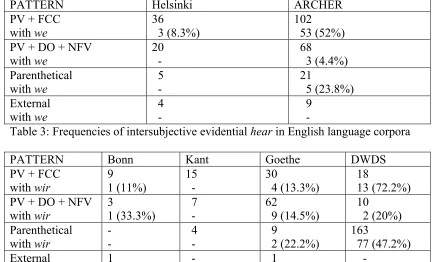
We now turn our attention to evidential uses of hear and hören, verbs of auditory perception, and what role the first-person plural pronoun plays in the construction of intersubjective evidential meaning among these verbs. Tables 3 and 4 present the quantitative distribution of the relevant constructions in the English and German language corpora:
PATTERN Helsinki ARCHER
PV + FCC
with we 36 3 (8.3%) 102 53 (52%)
PV + DO + NFV
with we 20 - 68 3 (4.4%)
[image:18.595.87.511.210.338.2]Parenthetical with we 5 - 21 5 (23.8%) External with we 4 - 9 -
Table 3: Frequencies of intersubjective evidential hear in English language corpora
PATTERN Bonn Kant Goethe DWDS
PV + FCC with wir 9 1 (11%) 15 - 30 4 (13.3%) 18 13 (72.2%) PV + DO + NFV
with wir 3 1 (33.3%) 7 - 62 9 (14.5%) 10 2 (20%) Parenthetical with wir - - 4 - 9 2 (22.2%) 163 77 (47.2%)
External 1
1 (100%) - - 1 - - -
Table 4: Frequencies of intersubjective evidential hören in German language corpora Unlike with see and sehen, the corpora do point to some sort of diachronic development with the use of the first-person plural pronoun as grammatical subject of evidential hear and hören: there is a noticeable increase in frequency of we from the Helsinki to the ARCHER Corpus, and in German, the use wir as subject increases in both the PV + FCC and parenthetical constructions.10 On the other hand—in contrast to see and sehen—there appear to be several more instances than with the visual
10Exactly what accounts for this infrequency is unclear, however. The DWDS Corpus,
[image:18.595.80.516.213.475.2]perception verbs where we or wir never appears as subject of certain complementation patterns involving hear or hören.
5.2.1 PV + FCC
The presence of hearsay evidence is what is almost exclusively indicated when either hear or hören appears with a finite complementizer clause. And when we/wir appears
as the subject, the availibility of this evidence to number of people—rather than just the S/W—is signaled:
(20) We hard that Capten Lawndrey (\and\) the French had taken St. Mychaels, one of the Azores in behalf of the King of Portingal. (Helsinki Corpus: CEDIAR2A, Richard Madox, The Diary of Richard Madox (1582), p. 133)
(21) Dieweil wir hie in dies-er Weissagung hören/ das Meanwhile we here in this-DAT.SG prophecy hear that.COMP
Gott auf seinen Sohn die Sünde geworffen/ vnd jhn God upon his.ACC son the sin.PL cast.PST.PTCP and he.ACC
zu-m Opffer für vns gemacht hat . . . to-the.DAT victim for we.ACC make.PST.PTCP have.AUX
(Bonn Corpus: Text 145, Johannes Mathesisu, Pasionale (1587), Blatt 51 Verso)
‘Meanwhile we hear here in this prophecy that God has cast the sins upon his son and has made him a sacrifice for us . . .’
In (20), Madox appears to indicate in his diary that he—along with an unspecified number of other people—can report about the French seizure of St. Michaels because they have hearsay evidence at their disposal. In (21), although there is hearsay
evidence at hand (via the prophecy), there is an additional sense of audience
engagement, as Mathesisu appears to bring this evidence to the audience’s attention (or at least remind them thereof) through the mention of the prophecy, i.e. he points his audience in the direction of the prophecy as the source of the hearsay evidence. 5.2.2 PV + DO + NFV
(22) wee can heare now and then a Harquebusse or a Musket goe off, which they doe seldome discharge in vaine . . . (Helsinki Corpus: CETRAV2A, John Taylor, The Pennyless Pilgrimage (1630), p. 136.C1)
(23) wir haben ganz null-e Gedichte wegen we have completely worthless-SG.ACC poem.PL because
lobenswürdig-er Rhythmik preisen hören. commenable-SG.GEN rhythmics praise.INF hear.INF
(Goethe Corpus: Schriften zur Literatur (?), Hamburger Ausgabe, Band 12, S. 350)
‘We have heard completely worthless poems praised because of their commendable rhythmics’.
Both events being described here are ones which can be perceived directly rather than indirectly through hearsay: the firing of muskets in (22) and the praising of worthless poems (nulle Gedichte) in (23). And both these events are perceived by a number of people besides the S/W (or, in the case of (23), assumed to have been perceived by others in addition to Goethe himself). This complementation is not completely
inconducive to marking hearsay evidence, however: in English, the use of the particle of in this construction shifts the focus from direct auditory perception to hearsay:
(24) We have heard too much, of the troops and ships coming over, we suppose you mean; we have not heard more, if more there be. (ARCHER: 1776leac.d4a, John Leacock, The Fall of British Tyranny)
In this instance, the arrival of the “troops and ships” is not perceived directly, but only reported to have happened. And the S/W, associating himself with a larger speech community through the use of we rather than I, indicates he is not the only one is possession of this hearsay evidence.
5.2.3 Parentheticals
When verbs of hearing appear in parenthetical constructions, they are always indicators of hearsay rather than direct auditory perception:
(25) On Friday last arrived here from London, via New-York, Mr. William Young, Botanist to their Britannick Majesties; with his wife, who is, we hear, a most amiable woman. (ARCHER Corpus:
(26) Der neue Sommer-fahrplan ist, wie wir hören, jetzt aus dem the new summer-schedule be.AUX as we hear now by the.DAT
Ministerium der öffentlich-en Arbeit-en der ministry the.GEN public-GEN.PL work-GEN.PL the.DAT
Eisenbahndirektion Berlin zugestellt worden. regional administrative office Berlin subpoena.PST.PTCP become.AUX
(DWDS Corpus: Berliner Tageblatt (Morgen Ausgabe), 03.03.1905, S. 5)
‘The new summer schedule, as we hear, has now been subpoenaed from the regional administrative office of Berlin by the Ministry of Public Works’.
Neither the behavior of Young’s wife in (25) nor the actions of the Ministry of Public Works in (26) are—or can be for that matter—perceived by direct auditory
perception. Rather, the writers here indicate that this is reported information, and they then make these reports (hearsay) available to their audience through the use of the first-person plural pronoun.
5.2.4 External Constructions
Unfortunately, in all of the examined corpora, there was only one instance of a first-person plural grammatical subject appearing with a verb of auditory perception in an external construction. Our attestation comes from the Bonn Corpus of Early New High German:
(27) Wir haben-s mit vnserm Ohr-en gehört/ vnsere we have-it with our.DAT ear-DAT.SG hear.PST.PTCP our.NOM.PL
Vätter haben-s vns erzehlt; Ein Tag verkündiget dem father.PL have-it we.DAT tell.PST.PTCP a day declare the.DAT
ander-n das Wort; vnnd eine Nacht gibt der anderen die other-DAT.SG the word and a night give the.DAT other-DAT.SG
die Wissenschafft. the scholarship.
(Bonn Corpus: Text 157, Johann Rosenthal, Außführliche Widerhol- und Vermehrung . . . (1653), S. 18)
‘We have heard it with our ears, our fathers told it to us: one day declares the word to the other, and one night gives scholarship to the other’.
be considered hearsay, and the evidence at hand (the propositional content of the set phrase) is one of received wisdom or common knowledge rather than completely new information (see Willett 1988, cf. Sweetser 1990: 23-48).
6. Conclusion
In this essay I have attempted to show how the use of the first-person plural pronoun with evidential verbs of perception allows speakers and writers not only to indicate their evidence for the proposition, but also to “engage” (Hyland 2005) their audience with the evidence at hand. Both English and German, the two languages under examination here, show great similarity in this domain. Instead of merely indicating the presence of evidence, which is what occurs with the first-person singular pronoun, the use of we and wir allows speakers and writers to indicate they share certain
evidence with a larger speech community, that they wish to disseminate this information to a larger community, or even that they are attempting to guide their audience’s interpretations of and conclusions based on this evidence. Evidential perception verbs appear in a number of complementation patterns, and the type of evidence expressed—and consequently the type intersubjective meaning conveyed— can differ from construction to construction (this has been more obvious with the verbs of auditory perception here). The verbs of visual perception can be used to indicate either vision or general observation (direct evidence) on the one hand or more internal mental states like knowledge and inference (indirect evidence) on the other hand. Similarly, the verbs of auditory perception are also capable of signaling either direct (hearing) or indirect (hearsay) evidence. Although diachronic data has been under consideration here, no significant developments in the domain of
References
Aikhenvald, Alexandra Y. 2004. Evidentiality. Oxford: Oxford University Press. Benveniste, Emile. 1971 (1966). Problems in General Linguistics, Mary E. Meek
(trans). Coral Gables, FL: The University of Miami Press.
Biber, Douglas and Edward Finegan. 1989. “Styles of stance in English: Lexical and grammatical marking of evidentiality and effect.” Text 9.1: 93-124.
Bréal, Michel. 1900. Semantics: Studies in the Science of Meaning, Mrs. Henry Cust (trans). London: Heinemann.
Chafe, Wallace. 1986. “Evidentiality in English Conversation and Academic Writing.” In Evidentiality: The Linguistic Coding of Epistemology, Wallace Chafe and Johanna Nichols (eds), 261-272. Norwood, NJ: Ablex Publishing Corp.
Diewald, Gabriele and Elena Smirnova. 2010. Evidentiality in German: Linguistic Realization and Regularities in Grammaticalization. Berlin/New York: de Gruyter.
Gisborne, Nikolas and Jasper Holmes. 2007. “A History of English Evidential Verbs of Appearance.” English Language and Linguistics 11.1, 1-29.
Gisborne, Nikolas. 2010. The Event Structure of Perception Verbs. Oxford: Oxford University Press.
Haan, Ferdinand de. 2001. “The relation between modality and evidentiality.” In Modalität und Modalverben im Deutschen, Reimar Müller and Marga Reis (eds), 201-216. Hamburg: Helmut Buske.
Harm, Volker. 2000. Regularitäten des semantischen Wandels bei Wahrnehmungsverben des Deutschen. Stuttgart: Steiner.
Hunston, Susan and Gill Francis. 2000. Pattern Grammar: A Corpus-Driven
Approach to the Lexcial Grammar of English. Amsterdam/Philadelphia: John Benjamins.
Hyland, Ken. 2005. “Stance and engagement: A model of interaction in academic discourse.” Discourse Studies 7.2: 173-192.
Ifantidou, Elly. 2001. Evidentials and Relevance. Amsterdam/Philadelphia: John Benjamins.
Jakobson, Roman. 1971 (1957). “Shifters, Verbal Categories, and the Russian Verb.” In Roman Jakobson: Selected Writings. Vol. II: Word and Language. The Hague: Mouton, 130-147.
Joseph, Brian D. 2003. “Evidentials: Summation, Questions, Prospects.” In Studies in Evidentiality, Alexandra Y. Aikhenvald and R. M. W. Dixon (eds), 307-327. Amsterdam/Philadelphia: John Benjamins.
Lakoff, George and Mark Johnson. 2003 [1980]. Metaphors We Live By. 2nd ed. Chicago: The University of Chicago Press.
Langacker, Ronald W. 1990. “Subjectification.” Cognitive Linguistics 1: 5-38. Langacker, Ronald W. 1999. “Losing Control: Grammaticalization, Subjectification,
and Transparency.” In Historical Semantics and Cognition, Andreas Blank and Peter Koch (eds), 147-175. Berlin/New York: de Gruyter.
Mühlhäusler, Peter and Rom Harré. 1990. Pronouns and People: The Linguistic Construction of Social and Personal Identity. Oxford: Blackwell.
Nuyts, Jan. 2001. Epistemic Modality, Language, and Conceptualization: A
Cognitive-Pragmatic Perspective. Amsterdam/Philadelphia: John Benjamins. Palmer, Frank R. 2001. Mood and Modality. 2nd ed. Cambridge: Cambridge
Smirnova, Elena. 2006. Die Entwicklung der Konstruktion würde + Infinitiv im Deutschen: Eine funktional-semantische Analyse unter besonderer
Berücksichtigung sprachhistorischer Aspekte. Berlin/New York: de Gruyter. —. 2010. Personal communication.
Sweetser, Eve E. 1990. From Etymology to Pragmatics: Metaphorical and Cultural Aspects of Semantic Structure. Cambridge: Cambridge University Press. Traugott, Elizabeth Closs. 1982. “From Propositional to Textual and Expressive Meanings: Some Semantic-Pragmatic Aspects of Grammaticalization.” In Perspectives in Historical Linguistics, W. P. Lehmann and Yakov Malkiel (eds), 245-271. Amsterdam/Philadelphia: John Benjamins.
—. 1989. “On the Rise of Epistemic Meaning in English: An Example of Subjectification in Semantic Change.” Language 65: 31-55.
—. 1997. “Subjectification and the Development of Epistemic Meaning: The Case of promise and threaten.” In Modality in Germanic Languages: Historical and Comparative Perspectives, Toril Swan and Olaf Jansen Westvik (eds), 185-210. Berlin/New York: de Gruyter.
— and Richard B. Dasher. 2002. Regularity in Semantic Change. Cambridge: Cambridge University Press.
Verhagen, Arie. 2005. Constructions of Intersubjectivity: Discourse, Syntax, and Cognition. Oxford: Oxford University Press.
Viberg, Åke. 1983. “The Verbs of Perception: A Typological Study.” Linguistics 21: 123-162.
Whitt, Richard J. 2009. “Auditory evidentiality in English and German: The case of perception verbs.” Lingua 119.7: 1083-1095.
—. 2010. Evidentiality and Perception Verbs in English and German. Oxford/Bern: Peter Lang.
—. 2011. “(Inter)Subjectivity and evidential perception verbs in English and German.” Journal of Pragmatics 43.1: 347-360.