ISSN Online: 2333-9721 ISSN Print: 2333-9705
DOI: 10.4236/oalib.1105968 Dec. 25, 2019 1 Open Access Library Journal
Generalized Shift-Splitting Preconditioner
for Saddle Point Problems with Block
Three-by-Three Structure
Linna Wang, Ke Zhang
*Department of Mathematics, Shanghai Maritime University, Shanghai, China
Abstract
We propose a generalized shift-splitting iteration method for saddle point problems with block three-by-three structure. As a new iteration method, the method converges to the unique solution of the saddle point problem uncon-ditionally. When exploited as a preconditioner, the spectral distribution of the preconditioned matrix is investigated. Numerical experiments show that the new variant is efficient in speeding up GMRES for solving the block three-by-three saddle point problem.
Subject Areas
Numerical Mathematics
Keywords
Saddle Point Problem, Generalized Shift-Splitting, Krylov Subspace, GMRES
1. Introduction
We consider the saddle point problems with the following block three-by-three structure
T T 0
0 or ,
0 0
A B x f
B C y g u b
C z h
− − = =
(1)
where A∈n n× is a symmetric positive definite matrix, B∈m n× and s m
C∈× are matrices of full row rank, f ∈n, g∈m and h∈s are given
vectors. The linear system of equations (1) has many practical applications in How to cite this paper: Wang, L.N. and
Zhang, K. (2019) Generalized Shift-Split- ting Preconditioner for Saddle Point Pro- blems with Block Three-by-Three Structure. Open Access Library Journal, 6: e5968.
https://doi.org/10.4236/oalib.1105968
Received: November 29, 2019 Accepted: December 22, 2019 Published: December 25, 2019
Copyright © 2019 by author(s) and Open Access Library Inc.
This work is licensed under the Creative Commons Attribution International License (CC BY 4.0).
http://creativecommons.org/licenses/by/4.0/
DOI: 10.4236/oalib.1105968 2 Open Access Library Journal scientific computing and engineering fields, including the constrained quadratic optimization problem, the constrained least squares problem and the computa-tional fluid dynamics [1].
In practice, the coefficient matrix in (1) is generally sparse and of large size. Therefore, iterative methods are usually preferred for their low memory requirement per iteration. Among these candidates, the Uzawa-type methods [2], the matrix splitting methods [3] and the Krylov subspace methods [4] have re-ceived much attention during the past decades. For instance, the Uzawa method [2] is a classical approach which is known for its low computational overhead and easy implementation. To improve the numerical performance, some Uza-wa-type variants have been proposed recently which include the inexact Uzawa [5] [6] [7], Uzawa-SOR [8] and Uzawa-PSS [9], etc. The other way for solving the saddle point problems is to exploit the matrix splitting. By using the Hermi-tian and skew-HermiHermi-tian splitting (HSS), Bai et al. [3] propose the HSS iteration method. Following this reasoning, some efficient variants such as the accelerated Hermitian and skew-Hermitian splitting (AHSS) [10], the modified Hermitian and skew-Hermitian splitting (MHSS) [11] and the relaxed Hermitian and skew- Hermitian splitting (RHSS) [12] have been proposed henceforth. Recently, the sophisticated Krylov subspace methods have been used to solve the saddle point problems. Due to the structure of the saddle point matrices, however, a slow convergence or even stagnation is often witnessed during the actual computation. Such drawback can be alleviated by employing an appropriate preconditioner. In the context of saddle point problems, many efficient preconditioners, to name just a few, the block diagonal preconditioners, the constrained preconditioners, the HSS-based preconditioners, have been developed; see [13] [14] [15] [16] and the more recent monograph [17] for detail.
In [18], Bai et al. propose a class of shift-splitting iteration method for solving non-Hermitian positive definite linear system Au b= . It can be recast in the following way. Suppose that A∈n n× is a non-Hermitian positive definite
ma-trix. Then the shift-splitting of the coefficient matrix A is given by
( )
( )
1(
)
1(
)
,2 2
A M= α −N α = αI A+ − αI A−
which leads naturally to the shift-splitting iteration scheme
( ) ( )
( )
1 1 1 , 0,1,2,
k k
u + =M−
α
Nα
u +M−α
b k=ge-DOI: 10.4236/oalib.1105968 3 Open Access Library Journal neralized saddle point problems and propose a modified generalized shift-splitting preconditioner [21].
By taking into account the special structure of (1), Cao [22] proposes shift- splitting preconditioners for solving (1). Motivated by [20] and [22], we devise a new generalized shift-splitting (GSS) iteration scheme for the structured linear system (1). A corresponding GSS preconditioner is induced to accelerate the convergence of GMRES. Theoretical results on the convergence of GSS iteration method and the eigenvalue distribution of the preconditioned matrix are also given.
The organization of this paper is as follows. In Section 2, we introduce the ge-neralized shift-splitting iteration method for solving the block three-by-three saddle point problem and look into its convergence property. In Section 3, we obtain a GSS preconditioner derived from the GSS iteration and analyze the spectrum of the preconditioned matrix. In Section 4, some numerical experi-ments are carried out to illustrate the effectiveness of GSS by comparing it with other shift-splitting preconditioners given in [22]. Finally, some conclusions are given in Section 5.
2. Generalized Shift-Splitting Iteration Method and Its
Convergence
The proposed generalized shift-splitting (GSS) iteration is based on the work of [22]. Therefore, it is reasonable for us to recap briefly the shift splitting used in [22] before introducing the new iteration method in this section.
In its simplest form, the shift splitting (SS) of the coefficient matrix in (1) goes as follows
(
)
(
)
T T
T T
1 1
2 2
0 0
1 1 ,
2 2
0 0
I I
I A B I A B
B I C B I C
C I C I
α α
α α
α α
α α
= + − −
+ − −
= − − −
−
(2)
where I is the identity matrix with conforming size. The parameter
α
in (2) is used to monitor the convergence of the SS iteration method and hence the spec-trum of the preconditioned matrix. In other words,α
plays the same role in adjusting the two block diagonal matrices in (2), i.e.,( ) ( )
T
and 0 . 0
m n m n s s
A B B
+ × + ×
∈ ∈
−
(3)
DOI: 10.4236/oalib.1105968 4 Open Access Library Journal splitting
(
)
(
)
(
)
(
)
T T T T 1 1 , , 2 2 0 01 1 .
2 0 2 0
M N
I A B I A B
B I C B I C
C I C I
α β α β
α α
α α
β β
= − = Ω + − Ω −
+ − − = − − − − (4)
Here α >0, β >0 and
I I I α α β
Ω =
. Then it is trivial to find that
the generalized shift-splitting (4) reduces to the shift-splitting (2) if
α β
= .Using the splitting (4), we obtain the following stationary iteration
1 ,
k k
GSS
u + = Γ u +c (5)
where 1
(
,) (
,)
GSS M−
α β
Nα β
Γ = , c M= −1
(
α β
,)
b and k=0,1,. To put it another way, the generalized shift-splitting method (GSS) for the block three-by- three saddle point problem (1) that can be stated as follows. Given an initial vector u0, computeT T
T 1 T
0 0
1 1
2 2
0 0
k k
I A B I A B f
B I C u B I C u g
C I C I h
α α α α β β + + − − − − = + − (6)
until uk converges, where k=0,1,.
It is known that the GSS iteration method (5) enjoys the unconditional con-vergence if the spectral radius of the iteration matrix ΓGSS is less than 1. The
following results are adapted from [22] and [23] which are instrumental in prov-ing such sound convergence property.
Lemma 1. Suppose that A∈n n× is a symmetric positive definite matrix, m n
B∈ × and C∈s m× are of full row rank. Let λ be an eigenvalue of the
saddle point matrix , then
( )
0.Re λ >
Proof. The proof can be found in ([22], Lemma 2.2).
Lemma 2. Let W∈n n× be a non-Hermitian positive semidefinite matrix
and E W
(
,δ) (
δI W) (
−1 δI W)
= + − be the extrapolated Cayley transform with
0
δ > . Then
1) the spectral radius of E W
(
,δ)
is bounded by 1, i.e., ρ(
E W(
,δ ≤)
)
1; 2) ρ(
E W(
,δ =)
)
1 if and only if the matrix W has a (reducing) eigenvalue of the form ιξ with ξ ∈ andι
the imaginary unit.Proof. See ([23], Theorem 2.1) for detail.
The following theorem on the convergence of GSS iteration method comes out as a result of Lemma 1 and Lemma 2.
Theorem 1. Suppose that A∈n n× is a symmetric positive definite matrix, m n
B∈ × and C∈s m× are matrices of full row rank. Let α >0 and β >0.
DOI: 10.4236/oalib.1105968 5 Open Access Library Journal
(
GSS)
1,ρ Γ <
i.e., the GSS iteration method converges to the unique solution of (1) uncondi-tionally.
Proof. By (4) and (5), we rewrite the iteration matrix ΓGSS as
(
) (
1)
12 12 12 1 21 21 12.
GSS I I
−
− − − − −
−
Γ = Ω + Ω − = Ω + Ω Ω − Ω Ω Ω
Let ˆ= Ω−12Ω−12. It is easy to see that
GSS
Γ is similar to the matrix
(
ˆ) (
1 ˆ)
ˆGSS I − I
Γ = + − . Therefore, it suffices to prove
ρ
( )
ΓˆGSS <1. By the construction of ˆ = Ω−12Ω−12, we have( )
( )
1 1 T 2 2 T1 1 T
1
1 2 T
1 2 0 ˆ 0 0 0 0 0 . 0 0
I A B I
I B C I
I C I
A B B C C α α α α β β α α α αβ αβ − − − − − − − = − − = − −
Since
α
andβ
are positive, then α−1A is a symmetric positive definite matrix, α−1B and( )
αβ −12Care matrices of full row rank. Thus ˆ is a nonsymmetric positive semi-definite matrix. Moreover, it follows from Lemma 1 that Re
( )
λ( )
ˆ >0. Therefore, it can be deduced from Lemma 2 that( )
ˆGSS 1ρ
Γ ≤ . The equalityρ
( )
ΓˆGSS =1 holds if and only if ˆ has a (reducing) eigenvalue of the formιξ
, which is impossible because Re( )
λ( )
ˆ >0. It turns out thatρ
( )
ΓˆGSS <1. As a result, ρ(
ΓGSS)
<1 which completes the proof.3. GSS Preconditioner and Its Properties
Though the GSS iteration method is proved to converge unconditionally, its convergence can be rather slow when compared with the involved Krylov sub-space methods [24]. In the context of linear system solvers, it is more interesting to exploit the generalized shift-splitting as a preconditioner to accelerate the Krylov subspace methods like GMRES.
In this section, we present the following generalized shift-splitting precondi-tioner (GSS) T T 0 1 . 2 0 GSS
I A B
B I C
C I α α β + = − −
(7)
When applying a preconditioner, the convergence of the preconditioned li-near system is closely related with the eigenvalue distribution. The following finding shows that the eigenvalues of GSS-preconditioned matrix 1
GSS−
DOI: 10.4236/oalib.1105968 6 Open Access Library Journal right preconditioning here such that the residual of the original saddle point problem is the same as that of its right-preconditioned counterpart.
Theorem 2. Suppose that A∈n n× is a symmetric positive definite matrix, m n
B∈ × and C∈ s m×
are matrices of full row rank. Let θ be an eigenvalue of 1
GSS−
, then
1− <θ 1. Proof. Since the preconditioned matrix 1
GSS−
is similar to 1
GSS−
, then it is only necessary to investigate the spectrum of 1
GSS−
. Since GSS =M
(
α β,)
, then it follows from (4) that(
)
(
)
(
)
(
)
(
(
)
(
)
)
1 1 1 , , , , , . GSS GSS GSS M NM M N
I
α β α β α β α β α β
− −
−
= −
= −
= − Γ
From Theorem 1, we know that 1− <θ 1, where θ is an eigenvalue of
1
GSS−
.
Before ending this section, we give some implementation details when apply-ing the GSS preconditioner. In actual computations, a matrix-vector product
1
GSS− r
is often needed which can be solved from the linear system GSSz r= .
Note that the preconditioner GSS can be decomposed as
1 T T T 1 T T T 1 T 1 0
1 0 1
2
0 0
1 0 0
1
0 0
0 0
0 0
1 0 .
1 0
GSS
I B I C C
I C
I
I A B I C C B
I C C
I
I
I C C B I
C I α β β α α β α β β α β β − − − + = − + + + ⋅ + ⋅ − + (8)
Let T T T T
1 , ,2 3
r= r r r and T T T T 1, ,2 3
z= z z z , where r z1, 1∈n,
2, 2 m
r z ∈
and r z3, 3∈s. By using the decomposition (8), we obtain the following
sub-routine for solving 1
GSS
z=− r.
1) Solve w1 from αI β1C C wT 1 2r2 β2C rT 3
+ = +
DOI: 10.4236/oalib.1105968 7 Open Access Library Journal 2) Solve z1 from
1
T T T
1 1 1
1 2
I A B I C C B z r B w
α α β − + + + = − ;
3) Solve w2 from αI β1C C wT 2 Bz1
+ =
;
4) Update z2 =w w1+ 2; 5) Update z3=β1 2
(
r Cz3− 2)
.In computing 1
GSS− r
, the computational overhead by GSS is the same as that by SS [22]. As indicated in the numerical examples, however, an appropriate choice of
(
α β,)
generally yields better numerical performance (concerning CPU time and iteration steps) than using a single parameterα
(as in SS). In this sense, the GSS can be regarded as a more promising variant than its prede-cessor SS.4. Numerical Experiments
In this section, we give some numerical experiments to illustrate the effective-ness of the new preconditioner GSS in terms of the number of iteration steps (iter), CPU time in seconds (time) and the relative residual norm (res). For completeness, we display both the number of restarts and the number of inner steps in the last restart; see, for instance, Table 3. The unconditioned GMRES(k), the shift-spliting-preconditioned GMRES(k) (SS) [22] and the relaxed shift- splitting-preconditioned GMRES(k) (RSS) [22] are employed for comparison, where k is the restarting frequency. In what follows, the right preconditioning is used for SS, RSS and GSS, the reason of which is given in Section 3. We set the restarting frequency k to be 5 and the initial guess u0 to be the zero vector. The right-hand side vector b in (1) is given by 10⋅rand m n s
(
+ + ,1)
. Allalgo-rithms mentioned above terminate if 6
2
2 10
i
b−u b < − within 1500
res-tarts, where ui is the ith iterate. Numerical experiments are carried out on a
laptop using MATLAB 2014b with Intel Core (8G RAM) under Windows 10 system.
The testing problem is adapted from [25]. It is a block three-by-three saddle point problem with A, B and C of the following structure
[
]
2 2 2 2 2 2 2 2 2 0 , 0 , , p p p p p pI T T I A
I T T I
B I F F I
C E F
× × × ⊗ + ⊗ = ∈ ⊗ + ⊗ = ⊗ ⊗ ∈ = ⊗ ∈
where T 1 tridiag 1,2, 12
(
)
p ph
×
= ⋅ − − ∈ , F 1 tridiag 0,1, 1
(
)
p ph
×
= ⋅ − ∈ ,
(
2)
diag 1, 1, , 1
E= p+ p − +p with ⊗ being the Kronecker product and
1 1 h
p
=
DOI: 10.4236/oalib.1105968 8 Open Access Library Journal
4.1. Choice of the Parameter Pair
(
α β
,
)
As mentioned in Section 2, the main motivation for embracing an extra para-meter
β
in GSS is to strike a balance in controlling the sub-matrices in (3). A proper choice ofα
andβ
will make the GSS preconditioner more appealing. As shown in (7), the GSS preconditioner GSS becomes closer to (half of) thesaddle point matrix as
α
andβ
decrease. This implies that the choice 0α β= = seems to be the optimal one. However, we do not suggest using ex-tremely small values of
α
andβ
for numerical concerns. Instead, we use the experimental (optimal) values ofα
andβ
in the following experiments.To this end, we first tabulate the CPU time of the GSS preconditioner with varying
α
andβ
for p=16 and p=32 in Table 1 and Table 2, respec-tively. The parameter pair(
α β,) (
= 0.01,0.001)
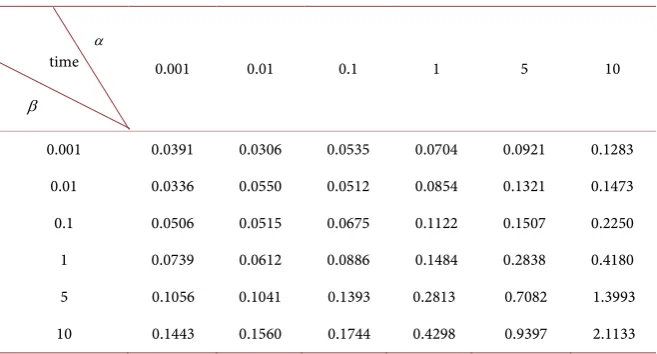
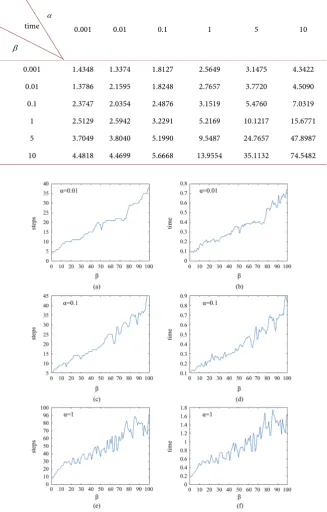
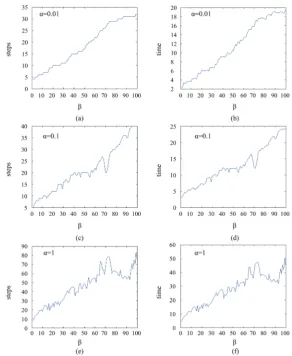
yields the shortest CPU time in both tables. To further verify this finding, we carry out more experiments in Fig-ure 1 and Figure 2 by depicting the number of total iteration steps1 and CPU time of GSS with varyingβ
whenα
is chosen to be 0.01, 0.1 and 1, respectively. Some remarks are in order. Loosely speaking, for a fixed value ofα
, the number of total iteration steps and CPU time increase asβ
goes up although there are some zigzags; see Figure 1 and Figure 2. Moreover, a similar pattern is also ob-served forβ
when the value ofβ
is fixed whileα
varies; for instance, when50
β
= , the total iteration steps increase asα
changes from 0.01 to 1, which reads readily by comparing the subplots (a), (c) and (e) in Figure 1. This justifies our choice of using(
α β,) (
= 0.01,0.001)
as the experimental optimal value. [image:8.595.210.539.488.665.2]Based on the above experiments, we use
(
α β,) (
= 0.01,0.001)
as the expe-rimental optimal choice forα
andβ
in GSS. As for the optimal value ofα
Table 1. CPU time of the GSS preconditioner with different values of α and β
(p=16). α
time
β
0.001 0.01 0.1 1 5 10
0.001 0.0391 0.0306 0.0535 0.0704 0.0921 0.1283 0.01 0.0336 0.0550 0.0512 0.0854 0.1321 0.1473 0.1 0.0506 0.0515 0.0675 0.1122 0.1507 0.2250 1 0.0739 0.0612 0.0886 0.1484 0.2838 0.4180 5 0.1056 0.1041 0.1393 0.2813 0.7082 1.3993 10 0.1443 0.1560 0.1744 0.4298 0.9397 2.1133
1By “total iteration steps”, we mean the total number of matrix-vector products associated with
1
GSS −
DOI: 10.4236/oalib.1105968 9 Open Access Library Journal in SS and RSS, we follow the choice α =0.01 used in [22] and regard it as the empirical optimal value.
4.2. Comparison with Other SS-Type Methods
[image:9.595.211.539.180.693.2]In this subsection, we compare the numerical performance of GSS with SS and
Table 2. CPU time of the GSS preconditioner with different values of α and β (p=32).
α time
β
0.001 0.01 0.1 1 5 10
0.001 1.4348 1.3374 1.8127 2.5649 3.1475 4.3422 0.01 1.3786 2.1595 1.8248 2.7657 3.7720 4.5090 0.1 2.3747 2.0354 2.4876 3.1519 5.4760 7.0319 1 2.5129 2.5942 3.2291 5.2169 10.1217 15.6771 5 3.7049 3.8040 5.1990 9.5487 24.7657 47.8987 10 4.4818 4.4699 5.6668 13.9554 35.1132 74.5482
DOI: 10.4236/oalib.1105968 10 Open Access Library Journal
Figure 2. Total iteration steps (left) and CPU time (right) of the GSS preconditioner for different values of α and β (p=32).
RSS regarding CPU time and iteration steps. It should be noted that all sub-linear equations involved in computing matrix-vector product −1r are solved by direct methods.
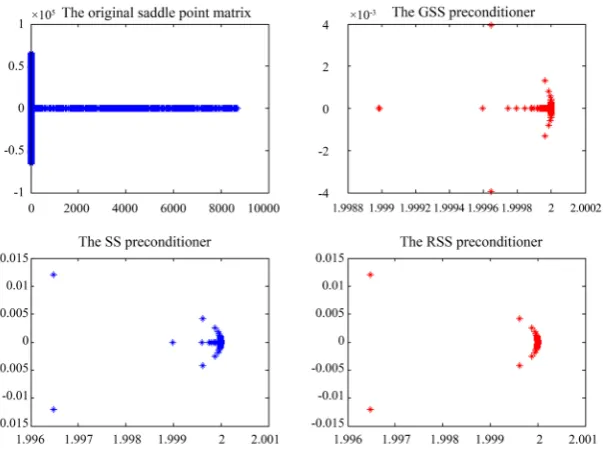
It is known that the spectrum imposes a great effect on the convergence of the preconditioned linear system. To begin with the discussion, we plot respectively the spectral distributions of the original saddle point matrix , the GSS-pre- conditioned matrix 1
GSS−
, the SS-preconditioned matrix 1
SS−
, and the RSS-preconditioned matrix 1
RSS−
DOI: 10.4236/oalib.1105968 11 Open Access Library Journal
Figure 3. Eigenvalue distributions of the unpreconditioned saddle point matrix and of three SS-type preconditioned matrices (p=32).
Table 3. Numerical results for three preconditioned GMRES methods with different grid sizes.
SS RSS GSS
size iter time res iter time res iter time res
16
p= 1(3) 0.0744 9.3431e−09 1(3) 0.0651 5.1792e−09 1(2) 0.0415 4.5483e−07
32
p= 1(3) 1.9894 8.5844e−09 1(3) 1.8084 4.4832e−09 1(2) 1.2381 3.4408e−07
48
p= 1(3) 16.5567 7.8697e−09 1(3) 16.2467 2.7591e−09 1(2) 10.9178 3.1121e−07
64
p= 1(3) 88.9495 7.6631e−09 1(3) 84.8754 2.641e−09 1(2) 57.3213 2.7896e−07
even if the problem size 4p2 soars. Fortunately, this desirable property has also
been carried over to GSS. Furthermore, GSS outperforms SS and RSS in that it requires the shortest CPU time and the least number of iteration steps in all test problems, as observed in Table 3. In light of this, we conclude that GSS is a competitive shift-splitting variant for solving the structured saddle point prob-lem (1).
5. Conclusion
[image:11.595.210.538.368.468.2]DOI: 10.4236/oalib.1105968 12 Open Access Library Journal convergence of GMRES. It is proved that the preconditioned matrix using the new preconditioner has a well-clustered spectrum which is verified by the nu-merical examples. Future works include finding the theoretically optimal choice of the parameters in the new scheme and develop other efficient shift-splitting preconditioners.
Acknowledgements
This work is supported by the National Natural Science Foundation (grant number: 11601323) and the Key Discipline Fund (2018) of College of Arts and Sciences in Shanghai Maritime University. The authors would like to thank the referees for their constructive suggestions.
Conflicts of Interest
The authors declare no conflicts of interest regarding the publication of this pa-per.
References
[1] Benzi, M., Golub, G.H. and Liesen, J. (2005) Numerical Solution of Saddle Point Problems. Acta Numerica, 14, 1-137.https://doi.org/10.1017/S0962492904000212 [2] Arrow, K.J., Hurwicz, L. and Uzawa, H. (1958) Studies in Nonlinear Programming.
Stanford University Press,Redwood City, CA.
[3] Bai, Z.-Z., Golub, G.H. and Ng, M.K. (2003) Hermitian and Skew-Hermitian Split-ting Methods for Non-Hermitian Positive Definite Linear Systems. SIAM Journal on Matrix Analysis and Applications, 24, 603-626.
https://doi.org/10.1137/S0895479801395458
[4] Bai, Z.-Z. (2015) Motivations and Realizations of Krylov Subspace Methods for Large Sparse Linear Systems. Journal of Computational and Applied Mathematics, 283, 71-78. https://doi.org/10.1016/j.cam.2015.01.025
[5] Bramble, J.H., Pasciak, J.E. and Vassilev, A.T. (1997) Analysis of the Inexact Uzawa Algorithm for Saddle Point Problems. SIAM Journal on Numerical Analysis, 34, 1072-1092. https://doi.org/10.1137/S0036142994273343
[6] Cao, Z.-H. (2003) Fast Uzawa Algorithm for Generalized Saddle Point Problems. Applied Numerical Mathematics, 46, 157-171.
https://doi.org/10.1016/S0168-9274(03)00023-0
[7] Bai, Z.-Z. and Wang, Z.-Q. (2008) On Parameterized Inexact Uzawa Methods for Generalized Saddle Point Problems. Linear Algebra and Its Applications, 428, 2900- 2932. https://doi.org/10.1016/j.laa.2008.01.018
[8] Zhang, J. and Shang, J. (2010) A Class of Uzawa-SOR Methods for Saddle Point Problems. Applied Mathematics and Computation, 216, 2163-2168.
https://doi.org/10.1016/j.amc.2010.03.051
[9] Cao, Y. and Yi, S.-C. (2016) A Class of Uzawa-PSS Iteration Methods for Nonsin-gular and SinNonsin-gular Non-Hermitian Saddle Point Problems. Applied Mathematics and Computation, 275, 41-49.https://doi.org/10.1016/j.amc.2015.11.049
DOI: 10.4236/oalib.1105968 13 Open Access Library Journal [11] Bai, Z.-Z., Benzi, M. and Chen, F. (2010) Modified HSS Iteration Methods for a
Class of Complex Symmetric Linear Systems. Computing, 87, 93-111. https://doi.org/10.1007/s00607-010-0077-0
[12] Cao, Y., Yao, L., Jiang, M. and Niu, Q. (2013) A Relaxed HSS Preconditioner for Saddle Point Problems from Meshfree Discretization. Journal of Computational and Applied Mathematics, 31, 398-421.https://doi.org/10.4208/jcm.1304-m4209 [13] Pan, J.-Y., Ng, M.K. and Bai, Z.-Z. (2006) New Preconditioners for Saddle Point
Problems. Applied Mathematics and Computation, 172, 762-771. https://doi.org/10.1016/j.amc.2004.11.016
[14] Benzi, M. and Guo, X.-P. (2011) A Dimensional Split Preconditioner for Stokes and Linearized Navier?-Stokes Equations. Applied Numerical Mathematics, 61, 66-76. https://doi.org/10.1016/j.apnum.2010.08.005
[15] Zhang, G.-F., Ren, Z.-R. and Zhou, Y.-Y. (2011) On HSS-Based Constraint Precon-ditioners for Generalized Saddle-Point Problems. Numerical Algorithms, 57, 273-287. https://doi.org/10.1007/s11075-010-9428-3
[16] Wang, N.-N. and Li, J.-C. (2019) A Class of New Extended Shift-Splitting Precondi-tioners for Saddle Point Problems. Journal of Computational and Applied Mathe-matics, 357, 123-145. https://doi.org/10.1016/j.cam.2019.02.015
[17] Rozložnk, M. (2018) Saddle-Point Problems and Their Iterative Solution. Birkhäu-ser.https://doi.org/10.1007/978-3-030-01431-5
[18] Bai, Z.-Z., Yin, J.-F. and Su, Y.-F. (2006) A Shift-Splitting Preconditioner for Non-Hermitian Positive Definite Matrices.Journal of Computational and Applied Mathematics, 24, 539-552.
[19] Cao, Y., Du, J. and Niu, Q. (2014) Shift-Splitting Preconditioners for Saddle Point Problems. Journal of Computational and Applied Mathematics, 272, 239-250. https://doi.org/10.1016/j.cam.2014.05.017
[20] Cao, Y., Tao, H. and Jiang, M. (2014) Generalized Shift Splitting Preconditioners for Saddle Point Problems, in Chinese. Mathematica Numerica Sinica, 36, 16-26. [21] Salkuyeh, D.K., Masoudi, M. and Hezari, D. (2015) On the Generalized Shift-Splitting
Preconditioner for Saddle Point Problems. Applied Mathematics Letters, 48, 55-61. https://doi.org/10.1016/j.aml.2015.02.026
[22] Cao, Y. (2019) Shift-Splitting Preconditioners for a Class of Block Three-by-Three Saddle Point Problems. Applied Mathematics Letters, 96, 40-46.
https://doi.org/10.1016/j.aml.2019.04.006
[23] Bai, Z.-Z. and Hadjidimos, A. (2014) Optimization of Extrapolated Cayley Trans-form with Non-Hermitian Positive Definite Matrix. Linear Algebra and Its Applica-tions, 463, 322-339.https://doi.org/10.1016/j.laa.2014.08.021
[24] Zhang, K., Zhang, J.-L. and Gu, C.-Q. (2017) A New Relaxed PSS Preconditioner for Nonsymmetric Saddle Point Problems. Applied Mathematics and Computation, 308, 115-129. https://doi.org/10.1016/j.amc.2017.03.022