https://www.scirp.org/journal/jdm ISSN Online: 2160-5858
ISSN Print: 2160-5831
DOI: 10.4236/jdm.2019.94016 Nov. 18, 2019 167 Journal of Diabetes Mellitus
Glycemic Control and Microvascular
Complications of Type 2 Diabetes among Saudis
Fahad S. Al-Shehri
University Diabetes Center, Riyadh, KSA
Abstract
Objective: To study the relation between level of glycemic control and dif-ferent micovascular complications of type 2 diabetes among Saudis. Patients and Methods: This hospital-based study analyzed the medical records of 343 type 2 diabetic patients attending the “University Diabetes Center” in “King Abdul-Aziz” University Hospital, in Riyadh City within 2006. Inclusion crite-ria comprised being adult, Saudi, type 2 diabetic, whose disease duration is more than one year, non-pregnant (for females). Results: Half of patients (50.4%) were not controlled (HbA1c > 8%). Vascular complications of di-abetes were mainly retinopathy (45.8%) or neuropathy (32.7%). Prevalence of nephropathy was 9.9%. Patients’ sex, age, marital status and occupation were not significant variables as regard their control of diabetes. Patient’s educa-tional status was significantly associated with degree of diabetes control; the higher the patient’s education the better the glycemic control (p = 0.002). Moreover, the longer the duration of diabetes, the worse the glycemic control (p < 0.001). All patients with manifest diabetes complications had worse gly-cemic control than those with no complications, including retinopathy (45.9% vs. 52.7%, respectively), neuropathy (38.4% vs. 55%, respectively, p = 0.004) and nephropathy (32.4% vs. 51.5%, p = 0.034). Conclusions: Glycemic con-trol among type 2 diabetics is a real challenge that should the health care team face in tertiary-care diabetes centers in KSA. Microvascular complications are common, especially among poorly controlled cases. Recommendations: The current goal for glycemic control at the University Diabetes Center (HbA1c < 8%) should be revised. Reasons for the high prevalence of failure of diabetes control should be investigated. There should be national campaigns to raise the public awareness as regard diabetes and also screening for hyperglycemia for the sake of early diagnosis of diabetes so as to minimize the incidence of diabetes complications.
Keywords
Type 2 Diabetes, Glycemic Control, Microvascular Complications How to cite this paper: Al-Shehri, F.S.
(2019) Glycemic Control and Microvascu-lar Complications of Type 2 Diabetes among Saudis. Journal of Diabetes Mellitus, 9, 167-175.
https://doi.org/10.4236/jdm.2019.94016
Received: January 21, 2019 Accepted: November 15, 2019 Published: November 18, 2019
Copyright © 2019 by author(s) and Scientific Research Publishing Inc. This work is licensed under the Creative Commons Attribution International License (CC BY 4.0).
http://creativecommons.org/licenses/by/4.0/
DOI: 10.4236/jdm.2019.94016 168 Journal of Diabetes Mellitus
1. Introduction and Aim of Study
Diabetes mellitus (DM) is a chronic illness that requires continuous medical care, patient self-management and education, not only to prevent acute compli-cations but also to reduce the risk of long-term complicompli-cations [1]. It is a cause for a growing public health concern in both developed and developing countries. Globally, the number of people with diabetes is expected to double between 2000 and 2030 while public awareness about this disease remains low [2]. In the Kingdom of Saudi Arabia (KSA), the overall prevalence of DM is 23.7% [3].
Despite modern treatment and self-monitoring of blood glucose, diabetes has detrimental effects on a range of health outcomes [4] [5]. Hyperglycemia is the major determinant of the risk of microvascular complications of diabetes [6]. Long-term microvascular complications of DM include retinopathy, nephropa-thy and neuropanephropa-thy [7].
To prevent microvascular complications of diabetes, the goal for glycemic control should be as low as is feasible without undue risk for adverse events or an unacceptable burden on patients. Treatment goals should be based on a dis-cussion of the benefits and harms of specific levels of glycemic control with the patient [8].
Above the target value HbA1c in type 2 diabetes appear to be risk markers for early occurrence of diabetic complications [9]. Several studies have demonstrat-ed the effects of improvdemonstrat-ed glycemiccontrol on delaying microvascular complica-tions of diabetes [10]. Monitoring of glycemic status is considered the corner-stone of care in diabetes. Monitoring aims mainly to assess extent of success in diabetes control and to achieve the best possible blood glucose control. Mea-surement of glycosylated hemoglobin (HbA1c) can quantify average glycemia over weeks and months, thereby complimenting day-to-day testing [11].
There are no fixed thresholds of glycemia for any type of complication of di-abetes, the specific target value of HbA1c for which one should aim is that the nearer to normal the HbA1c concentration the better. Different goals for good glycemic control have been considered [12]. Generally, HbA1c < 8% has been put to indicate good control [11] [13] [14]. However, some studies adopted a more strict level of HbA1c < 7%, with resulting fewer long-term microvascular com-plications [15] [16] [17] [18].
The Veterans Affairs Diabetes Trial is currently addressing the question of whether more intensive glycemic control will improve morbidity and mortality in older men with type 2 diabetes, in which 1792 subjects are being followed for 5 - 7 years, with a goal of HbA1C in the intensive group of 6% [19].
This study aimed to study the relation between level of glycemic control and different micovascular complications of type 2 diabetes among Saudis.
2. Patients and Methods
DOI: 10.4236/jdm.2019.94016 169 Journal of Diabetes Mellitus “University Diabetes Center” in “King Abdul-Aziz” University Hospital, in Riyadh City within 2006. Inclusion criteria comprised being adult, Saudi, type 2 diabetic, whose disease duration is more than one year, non-pregnant (for fe-males).
The following data were collected from patients’ records: Demographic cha-racteristics, last HbA1c level. A poor glycemic control was considered, according to the University Diabetes Center diagnostic criteria, if HbA1c > 8%, and micro-vascular complications were identified by presence of retinopathy (assessed by history of visual disturbance, history of cataract and fundus examination by an ophthalmologist), nephropathy (assessed by proteinuria or raised serum urea and creatinine after exclusion of other causes), neuropathy (assessed by a history of numbness or decreased sensation and evidence of decreased sensation or ref-lexes on neurological examination or evidence of electrophysiological testing).
Data analysis was carried out using the Statistical Package for Social Sciences (SPSS ver. 14.0). Descriptive statistics were applied (i.e. frequency, percentage). Proportions were compared by Chi-square Test. Significance level was set at p < 0.05.
3. Results
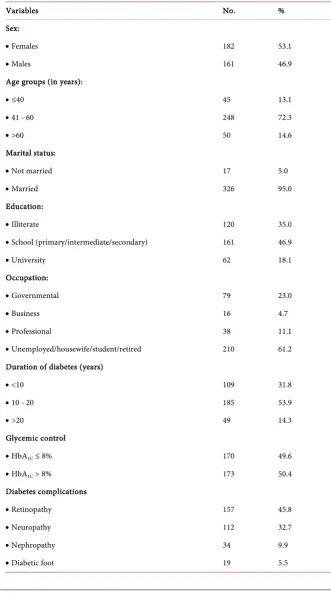
Table 1 shows that slightly more than half of diabetic patients were females (53.1%), about three fourths aged 41 - 60 years (72.3%), most patients were mar-ried (95%), almost one third of patients were illiterate (35%), while almost two thirds were not working (61.2%). More than half of patients (53.9%) were diag-nosed since 10 - 20 years. Half of patients (50.4%) were not controlled (i.e. their HbA1c > 8%). Vascular complications of diabetes were mainly retinopathy (45.8%) or neuropathy (32.7%). Prevalence of nephropathy was 9.9%.
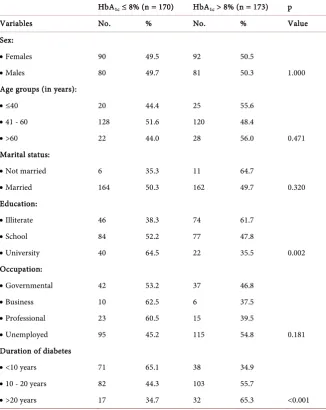
Table 2 shows that patients’ sex, age, marital status and occupation were not significant variables as regard their control of diabetes. Patient’s educational status was significantly associated with degree of diabetes control, the higher the patient’s education the better the glycemic control (p = 0.002). Moreover, the longer the duration of diabetes, the worse the glycemic control (p < 0.001).
Table 3 shows that all patients with manifest diabetes complications had worse glycemic control than those with no complications, including retinopathy (45.9% vs. 52.7%, respectively), neuropathy (38.4% vs. 55%, respectively, p = 0.004) and nephropathy (32.4% vs. 51.5%, p = 0.034).
4. Discussion
This study showed that half of type 2 diabetic patients were not controlled. This finding reflects the challenge of diabetes control in specialized tertiary-care di-abetes centers. In Jeddah, KSA, 77% of type 2 Saudi diabetic patients attending King Abdul-Aziz University Hospital have poor glycemic control (HbA1c > 8%)
DOI: 10.4236/jdm.2019.94016 170 Journal of Diabetes Mellitus type 2 black diabetics attending the diabetic clinic at a peri-urban hospital was noticed [20]. In Trinidad & Tobago, a poor glycemic control among 55.3% of type 2 diabetics was noticed [17].
Table 1. Characteristics of study sample (n = 343).
Variables No. %
Sex:
• Females 182 53.1
• Males 161 46.9
Age groups (in years):
• ≤40 45 13.1
• 41 - 60 248 72.3
• >60 50 14.6
Marital status:
• Not married 17 5.0
• Married 326 95.0
Education:
• Illiterate 120 35.0
• School (primary/intermediate/secondary) 161 46.9
• University 62 18.1
Occupation:
• Governmental 79 23.0
• Business 16 4.7
• Professional 38 11.1
• Unemployed/housewife/student/retired 210 61.2
Duration of diabetes (years)
• <10 109 31.8
• 10 - 20 185 53.9
• >20 49 14.3
Glycemic control
• HbA1C ≤ 8% 170 49.6
• HbA1C > 8% 173 50.4
Diabetes complications
• Retinopathy 157 45.8
• Neuropathy 112 32.7
• Nephropathy 34 9.9
DOI: 10.4236/jdm.2019.94016 171 Journal of Diabetes Mellitus Table 2. Distribution of level of diabetes control according to patients’ characteristics.
HbA1c ≤ 8% (n = 170) HbA1c > 8% (n = 173) p
Variables No. % No. % Value
Sex:
• Females 90 49.5 92 50.5
• Males 80 49.7 81 50.3 1.000
Age groups (in years):
• ≤40 20 44.4 25 55.6
• 41 - 60 128 51.6 120 48.4
• >60 22 44.0 28 56.0 0.471
Marital status:
• Not married 6 35.3 11 64.7
• Married 164 50.3 162 49.7 0.320
Education:
• Illiterate 46 38.3 74 61.7
• School 84 52.2 77 47.8
• University 40 64.5 22 35.5 0.002
Occupation:
• Governmental 42 53.2 37 46.8
• Business 10 62.5 6 37.5
• Professional 23 60.5 15 39.5
• Unemployed 95 45.2 115 54.8 0.181
Duration of diabetes
• <10 years 71 65.1 38 34.9
• 10 - 20 years 82 44.3 103 55.7
• >20 years 17 34.7 32 65.3 <0.001
Table 3. Distribution of microvascular complications according to level of diabetes control.
HbA1c ≤ 8% (n = 170) HbA1c > 8% (n = 173) p
Diabetes complications No. % No. % Value
-Retinopathy
• Absent 98 52.7 88 47.3
• Present 72 45.9 85 54.1 0.208
-Neuropathy
• Absent 127 55.0 104 45.0
• Present 43 38.4 69 61.6 0.004
-Nephropathy
• Absent 159 51.5 150 48.5
[image:5.595.209.538.541.734.2]DOI: 10.4236/jdm.2019.94016 172 Journal of Diabetes Mellitus The present study showed high prevalence rates of microvascular complica-tions among type 2 diabetics. These were mainly retinopathy (45.8%) or neuro-pathy (32.7%), while the prevalence of nephroneuro-pathy was 9.9%.
In Jeddah, neuropathy occupied the highest rank among complications of di-abetes (56.9%), followed by retinopathy (49.2%) and nephropathy (30.8%) [11]. In Kuwait, prevalence of retinopathy among type 2 diabetic patients is 40% [14]. In UAE, a high prevalence of nephropathy (61.2%) is among diabetic patients [7]. In Iran, retinopathy prevalence rate of 39.3% among type 2 diabetics and the prevalence of microalbuminuria and macroalbuminuria was 25.9% and 14.5% respectively [21]. In Turkey 60% of type 2 diabetics have neuropathy [22]. In Washington, USA, the main microvascular complications among type 2 diabetic patients were neuropathy (63%), retinopathy (18%) and nephropathy (6%) [23]. The variation in prevalence rates of different microvascular complications could be the result of different diagnostic methodologies used, or population characteristics differences.
The present study showed that some patients’ personal characteristics (i.e. sex, age, marital status and occupation) were not significant variables as regard their control of diabetes. However, patients’ educational status was significantly asso-ciated with their diabetes control, i.e. the higher the education status, the better the glycemic control. Moreover, this study showed that the longer the duration of diabetes, the worse its control (p < 0.001).
The glycemic control among type 2 diabetics was poor irrespective of sex, du-ration,educational status, withrecommended target values not being achieved in the majority ofpatients [20]. The literacy is a significant effect-modifier in de-termining diabetes control in a disease management program; the patients with lower literacy are more likely to achieve goal glycemic control [24]. However, No relation between educational status of diabetic patients and their glycemic con-trol [25].
The present study showed that patients with manifest microvascular compli-cations had significantly less diabetes control than those with no microvascular complications, including neuropathy (38.4% vs. 55%, respectively, p = 0.004), and nephropathy (32.4% vs. 51.5%, p = 0.034). Patients with retinopathy had less glycemic control than those with no retinopathy, though not statistically signifi-cant (45.9% vs. 52.7%, respectively, p = 0.208).
Similar results were reported by several studies. The poor glycemic control among type 2 diabetics is a major risk factor for developing nephropathy [26]. Poor glycemic control is a significant risk factor for neuropathy among type 2 diabetics [22]. As regard risk factors for retinopathy, the longer duration of di-abetes was the most significant independent factors associated with any retino-pathy and sight-threatening retinoretino-pathy [14].
DOI: 10.4236/jdm.2019.94016 173 Journal of Diabetes Mellitus disease. In type 2 diabetes, 21% of patients have retinopathy at the time of first diagnosis of diabetes and that > 60% of patients have retinopathy during the first 2 decades of disease [27].
The high prevalence of retinopathy, irrespective of the glycemic control, among diabetics of the current series, can be explained by the results of a na-tional Saudi study which show that, despite the readily available access to healthcare facilities in KSA, a large proportion of diabetics (27.9%) were una-ware of having DM, hence their late presentation and the high prevalence of DM-related complications [3].
5. Conclusion
Glycemic control among type 2 diabetics is a real challenge that should the health care team face in tertiary-care diabetes centers in KSA. Microvascular complications are common, especially among poorly controlled cases.
Recommendations
The current goal for glycemic control at the University Diabetes Center (HbA1c < 8%) should be revised. Reasons for the high prevalence of failure of diabetes control should be investigated. There should be national campaigns to raise the public awareness as regard diabetes and also screening for hyperglycemia for the sake of early diagnosis of diabetes so as to minimize the incidence of diabetes complications.
Conflicts of Interest
The author declares no conflicts of interest regarding the publication of this pa-per.
References
[1] American Diabetes Association (2003) Standards of Medical Care for Patients with Diabetes Mellitus. Diabetes Care, 26, S33-S50.
https://doi.org/10.2337/diacare.26.2007.S33
[2] Eljedia, A., Mikolajczyk, R.T., Kraemer, A. and Laaser, U. (2006) Health-Related Quality of Life in Diabetic Patients and Controls without Diabetes in Refugee Camps in the Gaza Strip: A Cross-Sectional Study. BMC Public Health, 6, 268. https://doi.org/10.1186/1471-2458-6-268
[3] Al-Nozha, M.M., Al-Maatouq, M.A., Al-Mazrou, Y.Y., Al-Harthi, S.S., Arafah, M.R., Khalil, M.Z., Khan, N.B., Al-Khadra, A., Al-Marzouki, K., Nouh, M.S., Ab-dullah, M., Attas, M., Al-Shahid, M.S. and Al-Mobeireek, A. (2004) Diabetes Melli-tus in Saudi Arabia. Saudi Medical Journal, 25, 1603-1610.
[4] Harris, M.I. (2000) Health Care and Health Status and Outcomes for Patients with Type 2 Diabetes. Diabetes Care, 23, 754-758.
https://doi.org/10.2337/diacare.23.6.754
[5] Reddy, S.S. (2000) Health Outcomes in Type 2 Diabetes. International Journal of Clinical Practice, Supplement, 113, 46-53.
Retino-DOI: 10.4236/jdm.2019.94016 174 Journal of Diabetes Mellitus
pathy Predicts Cardiovascular Mortality in Type 2 Diabetic Men and Women. Di-abetes Care, 30, 292-299.https://doi.org/10.2337/dc06-1747
[7] Al-Maskari, F., El-Sadig, M. and Norman, J.N. (2007) The Prevalence of Macrovas-cular Complications among Diabetic Patients in the United Arab Emirates. Cardi-ovascular Diabetology, 6, 24.https://doi.org/10.1186/1475-2840-6-24
[8] Qaseem, A., Vijan, S., Snow, V., Cross, J.T., Weiss, K.B. and Owens, D.K. (2007) Clinical Efficacy Assessment Subcommittee of the American College of Physicians. Glycemic Control and Type 2 Diabetes Mellitus: The Optimal Hemoglobin a1c Targets. A Guidance Statement from the American College of Physicians. Annals of Internal Medicine, 147, 417-422.
https://doi.org/10.7326/0003-4819-147-6-200709180-00012
[9] Svensson, M., Sundkvist, G., Arnqvist, H.J., Bjork, E., Goran, B., Bolinder, J., He-nricsson, M., Nystrom, L., Torffvit, O., Waernbaum, I., Ostman, J. and Eriksson, J.W. (2003) Signs of Nephropathy May Occur Early in Young Adults with Diabetes Despite Modern Diabetes Management: Results from the Nationwide Popula-tion-Based Diabetes Incidence Study in Sweden (DISS). Diabetes Care, 26, 2903-2909.
https://doi.org/10.2337/diacare.26.10.2903
[10] Skyler, J.S. (2004) Effects of Glycemic Control on Diabetes Complications and on the Prevention of Diabetes. Clinical Diabetes, 22, 162-166.
https://doi.org/10.2337/diaclin.22.4.162
[11] Al-Ghamdi, A.A. (2004) Role of HbA1c in Management of Diabetes Mellitus. Saudi Medical Journal, 25, 342-345.
[12] Stratton, I.M., Adler, A.I., Neil, H.A.W., Matthews, D.R., Manley, S.E., Cull, C.A., Hadden, D., Turner, R.C. and Holman, R.R. (2000) Association of Glycemia with Macrovascular and Microvascular Complications of Type 2 Diabetes (UKPDS 35): Prospective Observational Study. BMJ, 321, 405-412.
https://doi.org/10.1136/bmj.321.7258.405
[13] Okosun, I.S. and Dever, G.E.A. (2002) Abdominal Obesity and Ethnic Differences in Diabetes Awareness, Treatment, and Glycemic Control. Obesity Research, 10, 1241-1250.https://doi.org/10.1038/oby.2002.169
[14] Al-Adsani, A.M. (2007) Risk Factors for Diabetic Retinopathy in Kuwaiti Type 2 Diabetic Patients. Saudi Medical Journal, 28, 579-583.
[15] DCCT/EDIC Research Group (2000) Retinopathy and Nephropathy in Patients with Type 1 Diabetes Four Years after a Trial of Intensive Therapy. The New Eng-land Journal of Medicine, 342, 381-389.
https://doi.org/10.1056/NEJM200002103420603
[16] El-Kebbi, I.M., Ziemer, D.C., Cook, C.B., Miller, C.D., Gallina, D.L. and Phillips, L.S. (2001) Comorbidity and Glycemic Control in Patients with Type 2 Diabetes.
Archives of Internal Medicine, 161, 1295-1300. https://doi.org/10.1001/archinte.161.10.1295
[17] Apparico, N., Clerk, N., Henry, G., Seale, J., Sealy, R., Ward, S. and Mungrue, K. (2007) How Well Controlled Are Our Type 2 Diabetic Patients in 2002? An Obser-vational Study in North and Central Trinidad. Diabetes Research and Clinical Prac-tice, 75, 301-305. https://doi.org/10.1016/j.diabres.2006.06.026
DOI: 10.4236/jdm.2019.94016 175 Journal of Diabetes Mellitus
https://doi.org/10.1001/archinte.167.11.1137
[19] Abraira, C., Duckworth, W., McCarren, M., Emanuele, N., Arca, D., Reda, D. and Henderson, W. (2003) The Veterans Affairs Diabetes Trial (VADT). Cooperative Study of Glycemic Control and Complications in Diabetes Mellitus Type 2: Design of the Cooperative Study on Glycemic Control and Complications in Diabetes Mel-litus Type 2. Journal of Diabetes and Its Complications, 17, 314-322.
https://doi.org/10.1016/S1056-8727(02)00277-5
[20] Erasmus, R.T., Blanco, E.B., Okesina, A.B., Gqweta, Z. and Matsha, T. (1999) As-sessment of Glycaemic Control in Stable Type 2 Black South African Diabetics At-tending a Peri-Urban Clinic. Postgraduate Medical Journal, 75, 603-606.
https://doi.org/10.1136/pgmj.75.888.603
[21] Manaviat, M.R., Afkhami, M. and Shoja, M.R. (2004) Retinopathy and Microalbu-minuria in Type II Diabetic Patients. BMC Ophthalmology, 4, 9.
https://doi.org/10.1186/1471-2415-4-9
[22] Börü, U.T., Alp, R., Sargin, H., Koçer, A., Sargin, M., Lüleci, A. and Yayla, A. (2004) Prevalence of Peripheral Neuropathy in Type 2 Diabetic Patients Attending a Di-abetes Center in Turkey. Endocrine Journal, 51, 563-567.
https://doi.org/10.1507/endocrj.51.563
[23] Schellhase, K.G., Koepsell, T.D. and Weiss, N.S. (2005) Glycemic Control and the Risk of Multiple Microvascular Diabetic Complications. Family Medicine, 37, 125-130.
[24] Rothman, R., Malone, R., Bryant, B., Horlen, C., DeWalt, D. and Pignone, M. (2004) The Relationship between Literacy and Glycemic Control in a Diabetes Dis-ease-Management Program. The Diabetes Educator, 30, 263-273.
https://doi.org/10.1177/014572170403000219
[25] Morris, N.S., MacLean, C.D. and Littenberg, B. (2006) Literacy and Health Out-comes: A Cross-Sectional Study in 1002 Adults with Diabetes. Family Practice, 7,
49.https://doi.org/10.1186/1471-2296-7-49
[26] Forsblom, C.M., Groop, P.H., Ekstrand, A., Tötterman, K.J., Sane, T., Saloranta, C. and Groop, L. (1998) Predictors of Progression from Normoalbuminuria to Micro-albuminuria in NIDDM. Diabetes Care, 21, 1932-1938.
https://doi.org/10.2337/diacare.21.11.1932