© 2019, IRJET | Impact Factor value: 7.211 | ISO 9001:2008 Certified Journal
| Page 2561
UPQC System With an Improved Control
Method Under Distorted and Unbalanced Load
Condition
Kismat Patel
1,Prof. R.T. Patel
2PG Student
1Asst. Professor
2Electrical Engineering Department12, Government Engineering College, Bhuj.
---
Abstract:-In order to improve the power quality at the distribution side the unified power quality conditioner has become the most attractive solution. The unified power quality conditioner(UPQC) is consisting of both the series and shunt active power filters such that it can improve power quality both on the source side as well as on the load side. In this paper simplified control techniques have been described for controlling the shunt and series active power filters. For controlling the shunt active power filter two methods are analysed and the series active power filter is controlled by synchronous reference frame theory using three phase locked loop (PLL). The model for the control techniques of both the shunt and series active power filters have been presented.
Keywords:-Unified Power Quality Conditioner (UPQC), Active Power Filter(APF), Phase Locked Loop(PLL), Power Quality(PQ).
[I] INTRODUCTION
The unified power quality conditioner (UPQC) is one of the most preferable custom power device which can mitigate both voltage and current related power quality issues in the distribution system. The voltage related issues are mitigated by using series active power filter while the current related issues are cleared by using the shunt APF. As due to the nonlinear and distorted unbalanced load at the distribution side the power quality at the distribution side is getting poor day by day. Hence, in order to mitigate the harmonics introduced from the load side of the distribution system these active power filters plays a significant role. The voltage sags ,swells, harmonics, flickers all these voltage related problems are mitigated by using series APF with the three phase locked loop. While to eliminate current harmonics and improve power factor at the load side shunt APF is used. Hence, UPQC is one of the most commonly used custom power device which is capable to improve the power quality not only on the load side but also on the source side simultaneously with the reactive power compensation.
There are many control strategies to control the active power filters. This paper is presenting simplified method for controlling the shunt APF using the Constant Power Control Technique and the Synchronous Reference Frame Theory. While the series APF is being controlled by using simple Synchronous Reference Frame Theory with the help of three phase locked loop (PLL).
[II] Power Quality issues with their causes and effects
Power Quality is surely an important concern in most industries today, because of the increase in the number of load sensitive to power disturbances. The power quality is an index to quality of current and voltage available to industrial, commercial and household consumers of electricity. The problem regards both the utilities and customers. For the utilities, to provide adequate power quality is a moving objective because of changes in user equipment and requirements.
© 2019, IRJET | Impact Factor value: 7.211 | ISO 9001:2008 Certified Journal
| Page 2562
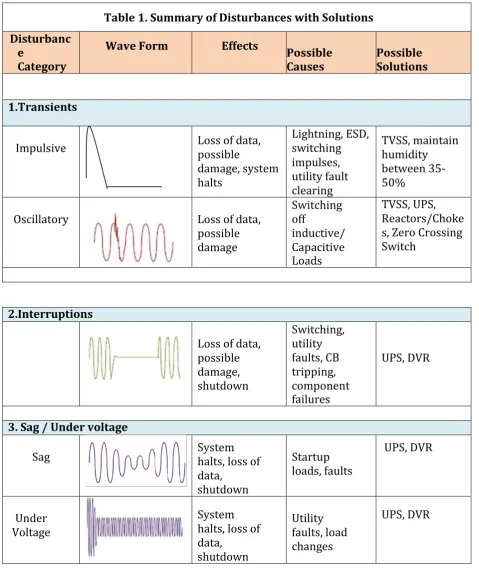
[image:2.595.67.547.174.750.2]Voltage sag in electrical grid are not always possible to avoid because of finite clearing time of faults that cause the voltage sag. Voltage sag are the common reason for interruption in production plants and for end user equipment malfunctions in general. In particular, tripping of equipment in a production line can cause production interruption and significant costs due to loss of production.
Table 1. Summary of Disturbances with Solutions
Disturbanc
e
Category
Wave Form
Effects
Possible
Causes
Possible
Solutions
1.Transients
Impulsive
Loss of data,
possible
damage, system
halts
Lightning, ESD,
switching
impulses,
utility fault
clearing
TVSS, maintain
humidity
between
35-50%
Oscillatory
Loss of data,
possible
damage
Switching
off
inductive/
Capacitive
Loads
TVSS, UPS,
Reactors/Choke
s, Zero Crossing
Switch
2.Interruptions
Loss of data,
possible
damage,
shutdown
Switching,
utility
faults, CB
tripping,
component
failures
UPS, DVR
3. Sag / Under voltage
© 2019, IRJET | Impact Factor value: 7.211 | ISO 9001:2008 Certified Journal
| Page 2563
4. Swell / Overvoltage
Swell
Nuisance
tripping,
Equipment
damage/
reduced
Life
Load changes,
utility faults
DVR , UPS,
Ferro resonant
control
Transformers
Overvoltage
equipment
damage/reduced
life
Load changes,
utility faults
DVR ,UPS,
Ferro resonant
control
Transformers
5. Waveform Distortion
DC Offset
Transformers
heated,
ground fault
current,
nuisance tripping
Faulty
rectifiers,
power supplies
Troubleshoot
and replace
defective
equipmen
t
Harmonics
Transformer
s heated,
System halts
Electronic
loads
(non-linear loads)
Reconfigure
distribution
, install
k-factor
transformers
Inter
harmonics
light flicker,
heating,
communicatio
n interference
faulty
equipment
Cyclo converter
freq.
converters,
induction
motor arcing
devices
Power
Conditioner,
Filters,
UPS
Notching
System halts,
data loss
Variable
speed drives,
arc welders,
light dimmers
Reconfigure
distribution,
relocate
sensitive
loads, install
filters, UPS
Noise
System halts,
© 2019, IRJET | Impact Factor value: 7.211 | ISO 9001:2008 Certified Journal
| Page 2564
6.Voltage Fluctuations
System
halts, light
flicker
Intermittent
operation of
load
equipment
Reconfigure
distribution,
Relocate
sensitive
loads,
UPS
7. Power Frequency Variations
Synchronous
equipment
failure, No
effect
on IT equipment
Standby
generators
ineffectivel
y
governed
Upgrade
generato
rgovern
or
[III]Control Strategies for Active Power Filters A.Shunt Active Power Filter
The SAPF technology is now a mature technology for providing harmonic current compensation, reactive power compensation, and neutral current compensation in AC distribution networks. It has evolved in the past quarter century with development in terms of varying configurations, control strategies, and solid-state devices. Shunt active power filters are also used to regulate the terminal voltage and suppress voltage flicker in three-phase systems. These objectives are achieved either individually or in combination depending upon the requirements, control strategy, and configuration that need to be selected appropriately. Shunt active power filter is considered as an ideal device for mitigating power quality problems. The shunt active power filters are basically categorized into three types, namely, single-phase two-wire, three-phase three-wire, and three-three-phase four-wire configurations, to meet the requirements of the three types of nonlinear loads on supply systems. Some single-phase loads such as domestic lights, ovens, TVs, computer power supplies, air conditioners, laser printers, and Xerox machines behave as nonlinear loads and cause power quality problems. Single-phase two-wire active power filters of varying configurations and control strategies have been investigated to meet the needs of single-phase nonlinear loads. Starting from 1971, many configurations of shunt active power filters have been developed and commercialized in UPS applications. Both current source converter with inductive energy storage and voltage source converter with capacitive energy storage are used to develop single-phase SAPFs. A major amount of AC power is consumed by three-phase loads such as ASDs with solid-state control and lately in the front-end design of many other electrical loads the active power filters have been incorporated. A substantial work has been reported on three-phase, three-wire APFs. Starting from 1976, many control strategies such as instantaneous reactive power theory (IRPT), synchronous frame d–q theory, synchronous detection method, notch filter method are used in the development of three-phase APFs. The problem of excessive neutral current is observed in three-three-phase four-wire systems mainly due to nonlinear unbalanced loads such as computer power supplies, fluorescent lighting, and so on. These problems of neutral current and unbalanced load currents in four-wire systems have been attempted to resolve through elimination/ reduction of neutral current, harmonic compensation, load balancing, and reactive power compensation.
© 2019, IRJET | Impact Factor value: 7.211 | ISO 9001:2008 Certified Journal
| Page 2565
signal processor (DSP) is used to implement the required control algorithm to generate gating signals for the solid-state devices of the VSC of the SAPF. The VSC used as SAPF is normally controlled in PWM current control mode to inject appropriate currents into the system. The SAPF also needs many passive elements such as a DC bus capacitor, AC interacting inductors, and small passive filters.
Fig.1:-Shunt Active Power Filter
Control of Shunt Active Power Filter:- Reference current signals for the control of SAPF have to be derived accordingly and these signals may be estimated using a number of control algorithms. There are many control algorithms available for the control of SAPFs. In this paper two control strategies are discussed.
i)Constant Power Control Technique
ii)Synchronous Reference Frame Theory
Constant Power Control Technique Clark Transformation : abc to αβ
Inverse Clark Transformation : αβ to abc
© 2019, IRJET | Impact Factor value: 7.211 | ISO 9001:2008 Certified Journal
| Page 2566
Instantaneous Active Power,
Instantaneous Reactive Power
Reference Current
Fig.2:-SAPF using Constant Power Control Technique
Synchronous Reference Frame Theory
p
v i
v i
q
v i
v i
p
p
p
q
q
q
*
* 2 2
1
c loss
c
v
v
i
p
p
v
v
i
v
v
q
Power loss in VSC and Required power to Charge Capacitor
loss
© 2019, IRJET | Impact Factor value: 7.211 | ISO 9001:2008 Certified Journal
| Page 2567
Fig.3:-SAPF using Synchronous Reference Frame Theory
B. Series Active Power Filter
Among the power quality problems (sags, swells, harmonics…) voltage sags are the most severe disturbances. In order to overcome these problems the concept of custom power devices is introduced recently. One of those devices is the series APF, which is the most efficient and effective modern custom power device used in power distribution networks. It is generally connected where sensitive loads are present at the load side.
A power electronic converter based series compensator that can protect critical loads from all supply side disturbances other than outages is called a series APF. It injects a set of three phase AC output voltages in series and synchronism with the distribution feeder voltages. The amplitude and phase angle of the injected voltages are variable thereby allowing control of the real and reactive power exchange between the device and the distribution system.
© 2019, IRJET | Impact Factor value: 7.211 | ISO 9001:2008 Certified Journal
| Page 2568
BASIC Series APF OPERATING PRINCIPLEThe series APF is operated by injecting three phase AC voltages in series with the three phase incoming network voltages during a sag, compensating for the difference between faulty and nominal voltages. All three phases of the injected voltages are of controllable amplitude and phase.
Voltage source inverters (VSI) fed from a DC link and supply the active and reactive power. Harmonics produced by the operation of VSI must be reduced to an acceptable limit fined by proper filtering scheme. VSI switches an impact on the harmonics produced. The required energy during sags has to be supplied by an energy source. The necessary amount of energy that must be delivered by the energy source depends on load MVA requirement, control strategy applied, deepest sag to be protected.
Control of Series APF:-The control of series active power filter is achieved by using simple Synchronous reference frame theory with the battery aided support system as shown in the fig.5 given below.
Fig.5:-Series APF using Synchronous Reference Frame Theory
Conclusion:-The proposed control techniques have been used to control both the shunt and series APF’S with the minimum measurements like load current and source voltages. The paper describes the basic principle of the control strategies. With these control strategies both the active power filters are able to mitigate voltage distortion and current harmonics on both the load as well as source side simultaneously with the reactive power compensation.
REFERENCES:-[1]Nikita Hari, K.Vijayakumar and Subhranshu Sekhar Dash, “A Versatile Control Scheme for UPQC for Power Quality Improvement”, Proceedings of the International Conference on Emerging Trends in Electrical and Computer Technology (ICETECT), pp 453-458, 23-24 March 2011.
[2] Srinivas Bhaskar Karanki, Mahesh K. Mishra and B. Kalyan Kumar, “Comparison of Various Voltage Source Inverter based UPQC Topologies”, Proceedings of the International Conference on Power and Energy Systems (ICPS), pp 1-7, December 2011.
© 2019, IRJET | Impact Factor value: 7.211 | ISO 9001:2008 Certified Journal
| Page 2569
[4] Malabika Basu, S. P. Das and Gopal K. Dubey, “Performance Study of UPQC-Q for Load Compensation and Voltage Sag Mitigation”, Proceedings of the IEEE 28th Annual Conference of the Industrial Electronics Society (IECON 02), Vol. 1, pp 698-703, November, 2002.
[5] V. Khadkikar, A. Chandra, A. O. Barry and T. D. Nguyen, “Application of UPQC to Protect a Sensitive Load on a Polluted Distribution Network”, IEEE Power Engineering Society General Meeting, 2006.
[6] A.Jeraldine Viji and M.Sudhakaran, “Generalized UPQC system with an improved Control Method under Distorted and Unbalanced Load Conditions”, Proceedings of the International Conference on Computing, Electronics and Electrical Technologies (ICCEET), pp 193-197, 2012.
[7] Morris Brenna, Roberto Faranda and Enrico Tironi, “A New Proposal for Power Quality and Custom Power Improvement: OPEN UPQC”, IEEE Transactions on Power Delivery, Vol. 24, No. 4, pp 2107-2116, October 2009.
[8] Vinod Khadkikar and Ambrish Chandra, “A New Control Philosophy for a Unified Power Quality Conditioner (UPQC) to Coordinate Load-Reactive Power Demand Between Shunt and Series Inverters” IEEE Transactions On Power Delivery, Vol. 23, No. 4, October 2008.
[9] V. Khadkikar,A. Chandra, A. O. Barry and T. D. Nguyen, “Application of UPQC to Protect a Sensitive Load on a Polluted Distribution Network”, IEEE Power Engineering Society, General Meeting, 2006
[10] B. S. Mohammed, K. S. Rama Rao and P. A. Nallagownden, “Improvement of Power Quality of a Two Feeder System using Unified Power Quality Conditioner”, Proceedings of the National Postgraduate Conference (NPC), pp 1-6, September 2011
[11]K. Palanisamy, J Sukumar Mishra, I. Jacob Raglend and D. P. Kothari, “Instantaneous Power Theory Based Unified Power Quality Conditioner (UPQC)”, 2010 Joint International Conference on Power Electronics, Drives and Energy Systems (PEDES), pp 1-5, 20-23 December 2010.
[12] G. Siva Kumar, B. Kalyan Kumar and Mahesh K. Mishra, “Mitigation of Voltage Sags with Phase Jumps by UPQC with PSO-Based ANFIS”, IEEE Transactions on Power Delivery, Vol. 26, No. 4, pp 2761-2773, October 2011.
[13] V. Khadkikar, A. Chandra, A. 0. Barry and T. D. Nguyen, “Conceptual Study of Unified Power Quality Conditioner (UPQC)”, Proceedings of the IEEE International Symposium on Industrial Electronics 2006, Canada, Vol. 2, pp 1088- 1093, July 2006.
[14] Subramanian Muthu and Jonathan M. Kim “Steady-State Operating Characteristics of Unified Active Power Filters”, twelfth annual Applied Power Electronics Conference and Exposition (APEC), Vol. 1, pp 199 – 205, February 1997.
[15]. PYCHADATHIL JAYPRAKASH, BHIM SINGH, D.P. KOTHARI, AMBRISH CHANDRA,2014. “Control Of Reduced Rating Dynamic Voltage Restorer With A Battery Energy Storage System” IEEE Transactions On Industry Applications, Vol. 50, No. 2, March / April 2014.
[16].S. RAJESH, M. K. MISHRA, SRIDHAR K. “Design And Simulation Of Dynamic Voltage Restorer Using Sinusoidal Pulse Width Modulation” 16th National Power Systems Conference, Dec 2010.
[17].ROSIL OMAR, N. ABD RAHIM “Modeling And Simulation For Voltage Sag / Swells Mitigation Using Dynamic Voltage Restorer” Australasian Universities Power Engineering Conference 2008.
© 2019, IRJET | Impact Factor value: 7.211 | ISO 9001:2008 Certified Journal
| Page 2570
[19].R SEDAGATHI, N M AFROOZI, Y NEMATI, A ROHANI, A R TOORANI,N JAVIDTASH, ALI HEYDARZADEGAN AND H SEDAGHATI“A Survey Of Voltage Sags And Voltage Swells Phenomena In Power Quality Problems” International Journal Of Scientific Research And Management (IJSRM), Page 458-462,|2013.
[20].JOSEPH SEYMOUR TERRY HORSLEY “The Seven Types of Power Problems” American Power Conversion 2005