© 2019, IRJET | Impact Factor value: 7.211 | ISO 9001:2008 Certified Journal
| Page 5637
Raghuvanahalli 560109(Karnataka)(India)
5
R Nithya Kumari(Guide), Assistant Prof. Dept. of Electronics & Communication Engineering, K.S Institute of
Technology, Kanakapura Road, Raghuvanahalli 560109(Karnataka)(India)
---***---ABSTRACT
:- Elections are the fundamental defining characteristics of any democracy that upholds the very meaning of a
system that is being governed by the people expressing their choices or articulate opinions in the form of voting. Now the voting mechanisms have evolved from leaps and bounds of simple hand written ballots to online voting systems. This project aims to build a Smart voting system using finger print recognition technology that allows any voter in INDIA to cast the vote to their respective constituency from anywhere in INDIA by going to their nearest voting booth in the place of stay. This project is used to maintain High level biometric security. The voter details are stored in Server database. Before entering the voting process that person should place the finger on to reader, the finger print scanner will read the image of fingerprint. After reading the details the microcontroller sends the details to the Web application through serial port. The Web application software maintains the person database. In “Smart Voting System” once a person casts his vote, the webpage gives a confirmation message that the vote is successfully registered and if a person’s age is less than 18 years then the LCD displays the message that he is not eligible to vote as his age is less than 18 also if a person tries to vote once again using his fingerprint, the web page will display that the vote is already casted successfully. The Election commission can login and check the results of the Election after the voting process is completed, also it can reset the votes and the update the candidate results every year.Key Words: Aadhar, Biometric, Electronic voting machine, Fingerprint and Voting system
I.
INTRODUCTION:-
India is a Democratic country every citizen above 18 years of age is eligible to elect their leaders. When a person’s age becomes 18 has the constitutional right to voluntarily enroll for voter id given by the Indian Election Commission (IEC). Voter ID is only used for electing purpose once in 5 years or on occurrence and voter card will not provide any government facility like Aadhaar, Citizens miss out to enroll for Voter card and even after getting the Voter card during the election time voter may neglect voting because voter is living in some other region which is far from his resident and voter is not ready to travel such a distance. To avail constructional voting right to every citizen, Smart Voting System is the best solution.
Nowadays with the rise in population the need for checking the validity of the voters has become a problem. As the modern communications and Internet, today are almost accessible electronically, the computer technology users, brings the increasing need for electronic services and their security. Usages of new technology in the voting process improve the elections in natural. This new technology refers to electronic voting systems where the election data is recorded, stored and processed primarily as digital information. In the past, usually, information security was used mostly in military and government institutions. But, now need for this type of security is growing in everyday usage.
II. PROPOSED
© 2019, IRJET | Impact Factor value: 7.211 | ISO 9001:2008 Certified Journal
| Page 5638
Fig. 1 Block diagram of Smart voting systemWill read the image of fingerprint of a person after reading the details the microcontroller sends these details to the JAVA application through serial port. The JAVA application software maintains the person database by which the person can proceed through the voting process.
III. FUNCTIONAL
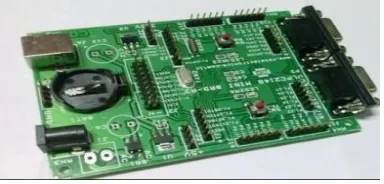
DESCRIPTION:-• We are using ARM LPC2148 microcontroller which acts as the fundamental block of the project which is going to handle all the major processing.
• First the finger print verification is done using the stored database ,also the person age is verified.
• Then the Candidates party name with respect to the voters constituency will be displayed on the laptop which is connected to the server.
• Then the voter can cast his valuable vote by clicking the corresponding party name and hitting the submit button.
• Then count increments in database and the winner is chosen based on all votes.
• The winner can be checked by logging in to the election commission.
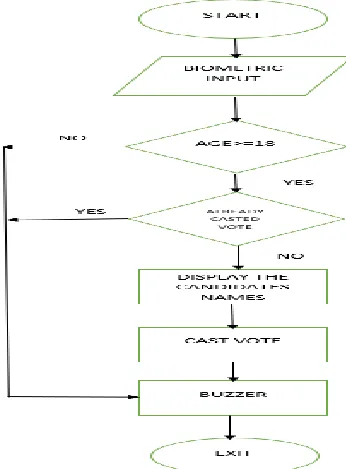
• The flow diagram in Fig 1.1 shows the entire process of the voting system.
[image:2.596.206.379.517.752.2]© 2019, IRJET | Impact Factor value: 7.211 | ISO 9001:2008 Certified Journal
| Page 5639
to 512 kB. A 128-bit wide memory interface and a unique accelerator architecture enable 32-bit code execution at the maximum clock rate. For critical code size applications, the alternative 16-bit Thumb mode reduces code by more than 30 % with minimal performance penalty. [image:3.596.221.413.293.385.2]Due to their tiny size and low power consumption, LPC2141/42/44/46/48 are ideal for applications where miniaturization is a key requirement, such as access control and point-of-sale. Serial communications interfaces ranging from a USB 2.0 Full-speed device, multiple UARTs, SPI, SSP to I2C-bus and on-chip SRAM of 8 kB up to 40 kB, make these devices very well suited for communication gateways and protocol converters, soft modems, voice recognition and low end imaging, providing both large buffer size and high processing power. Various 32-bit timers, single or dual 10-bit. ADC(s), 10-bit DAC, PWM channels and 45 fast GPIO lines with up to nine edge or level sensitive external interrupt pins make these microcontrollers suitable for industrial control and medical systems.
Fig. 1.1 ARM Microcontroller
ii)
FINGERPRINT SCANNER:-
Fingerprint processing includes two parts: fingerprint enrollment and fingerprint matching (the matching can be 1:1 or 1:N). When enrolling, user needs to enter the finger two times. The system will process the two time finger images, generate a template of the finger based on processing results and store the template. When matching, user enters the finger through optical sensor and system will generate a template of the finger and compare it with templates of the finger library. For 1:1 matching, system will compare the live finger with specific template designated in the Module; for 1:N matching, or searching, system will search the whole finger library for the matching finger. In both circumstances, system will return the matching result, success or failure.
Fig.1.2 Fingerprint Scanner
iii)LCD (Liquid Crystal Display):-
[image:3.596.218.419.543.621.2]© 2019, IRJET | Impact Factor value: 7.211 | ISO 9001:2008 Certified Journal
| Page 5640
Fig. 1.3 LCD Displayiv)
BUZZER:-Piezo buzzer is an electronic device commonly used to produce sound. BUZZER:-Piezo buzzer is based on the inverse principle of piezo electricity discovered in 1880 by Jacques and Pierre Curie. It is the phenomena of generating electricity when mechanical pressure is applied to certain materials and the vice versa is also true.
Fig. 1.4 Buzzer
V.SOFTWARE REQUIREMENT
i) EMBEDDED C:-
The use of C language to program microcontrollers is becoming too common and most of the time its not easy to build an application in assembly which instead you can make easily in C. So its important that you know C language for microcontroller which is commonly known as Embedded C. As we are going to use Keil C51. Embedded C is designed for programmers with desktop experience in C, C++ or Java who want to learn the skills required for the unique challenges of embedded systems. The C programming language is a popular and widely used programming language for creating computer programs. Programmers around the world Embrace C because it gives maximum control and efficiency to the programmer. If you are a programmer, or if you are interested in becoming a programmer, there are a couple of benefits you gain from learning C.
When designing software for a smaller embedded system with the 8051, it is very common place to develop the entire product using assembly code. With many projects, this is a feasible approach since the amount of code that must be generated is typically less than 8 kilobytes and is relatively simple in nature. If a hardware engineer is tasked with designing both the hardware and the software, he or she will frequently be tempted to write the software in assembly language. The trouble with projects done with assembly code can is that they can be difficult to read and maintain, especially if they are not well commented. Additionally, the amount of code reusable from a typical assembly language project is usually very low. Use of a higher-level language like C can directly address these issues.
A program written in C is easier to read than an assembly program. Since a C program possesses greater structure, it is easier to understand and maintain. Because of its modularity, a C program can better lend itself to reuse of code from project to project. The division of code into functions will force better structure of the software and lead to functions that can be taken from one project and used in another, thus reducing overall development time. A high order language such as C allows a developer to write code, which resembles a human’s thought process more closely than does the equivalent assembly code.
© 2019, IRJET | Impact Factor value: 7.211 | ISO 9001:2008 Certified Journal
| Page 5641
hardware if need be, yet provides you the functionality and abstraction of a higher order language.ii)KEIL COMPILER:-
Keil Software publishes one of the most complete development tool suites for 8051 software, which is used throughout industry. For development of C code, their Developer's Kit product includes their C51 compiler, as well as an integrated 8051 simulator for debugging. A demonstration version of this product is available on their website, but it includes several limitations This is the software that will be used for CECS-347. The C programming language was designed for computers, though, and not embedded systems. It does not support direct access to registers, nor does it allow for the reading and setting of single bits, two very important requirements for 8051 software. In addition, most software developers are accustomed to writing programs that will by executed by an operating system, which provides system calls the program may use to access the hardware. However, much code for the 8051 is written for direct use on the processor, without an operating system. To support this, the Keil compiler has added several extensions to the C language to replace what might have normally been implemented in a system call, such as the connecting of interrupt handlers.
The µVision3 IDE is a Windows-based software development platform that combines a robust editor, project manager, and make facility. µVision3 integrates all tools including the C compiler, macro assembler, linker/locator, and HEX file generator. The µVision3 IDE offers numerous features and advantages that help you quickly and successfully develop embedded applications. They are easy to use and are guaranteed to help you achieve your design goals. Keil Software is a industry standard development tools for the 8051 microcontroller family. Keil C Compilers, Macro Assemblers, Debuggers, Real-time Kernels, and Single-board Computers support ALL 8051-compatible derivatives.
The µVision3 IDE is a Windows-based software development platform that combines a robust editor, project manager, and makes facility. µVision3 integrates all tools including the C compiler, macro assembler, linker/locator, and HEX file generator.
iii) WEB PAGE DEVELOPING USING
HTML (Hypertext Markup
Language):-It is the predominant Mark-up language for web pages. Language):-It provides a means to describe the structure of text-based information in a document by denoting certain text as headings, paragraphs, lists, and so on and to supplement that text with interactive forms, embedded images, and other objects. HTML is written in the form of labels (known as tags), surrounded by angle brackets. HTML can also describe, to some degree, the appearance and semantics of a document, and can include embedded scripting language code which can affect the behaviour of web browsers and other HTML processors.
HTML can be used to display any type of document on the host computer, which can be geographically at a different location. It is a versatile language and can be used on any platform or desktop. HTML provides tags (special codes) to make the document look attractive. HTML tags are not case-sensitive. Using graphics, fonts, different sizes, colours, etc., can enhance the presentation of the document. Anything that is not a tag is part of the document itself.
iv)JAVASCRIPT:-
JavaScript is a script-based programming language that was developed by Netscape Communication Corporation. JavaScript was originally called Live Script and renamed as JavaScript to indicate its relationship with Java.
JavaScript supports the development of both client and server components of Web-based applications. On the client side, it can be used to write programs that are executed by a Web browser within the context of a Web page. On the server side, it can be used to write Web server programs that can process information submitted by a Web browser and then update the browser’s display accordingly.
© 2019, IRJET | Impact Factor value: 7.211 | ISO 9001:2008 Certified Journal
| Page 5642
statements can be included in HTML documents by enclosing the statements between a pair of scripting tags.VI. RESULTS
•
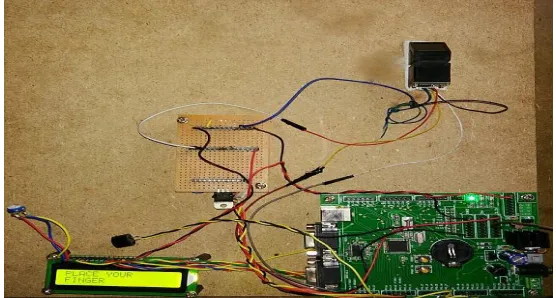
Fig. 1.5 shows the Actual circuit of the smart voting system.•
Fig. 1.6 shows the login page through which the voter can enter his aadhar id and login to cast his vote to his favourable candidate.•
Fig. 1.7 shows the confirmation that the vote is successfully casted.•
Fig. 1.8 shows the voting statistics(results) in the election commission page once the voting process is done.•
Fig. 1.9 shows the condition that the user is not eligible to vote since his age is less than 18 years. [image:6.596.159.437.220.369.2]Fig.1.5 Overview of proposed design
Fig. 1.6 Voter’s login page
[image:6.596.158.439.397.693.2]© 2019, IRJET | Impact Factor value: 7.211 | ISO 9001:2008 Certified Journal
| Page 5643
Fig. 1.8 Updated Voting StatisticsFig. 1.9 Person whose age is below 18 years
VII. APPLICATIONS AND FUTURE SCOPE
Can be used for college and university election
Used inside the parliament
Used to maintain account in the bank
Scanned fingerprint can be used for Govt applications
Especially for safe and Secure Voting using Biometric System.VIII. CONCLUSIONS
The proposed method is to build a Smart voting system using finger print recognition technology that allows any voter in INDIA to cast the vote to their respective constituency from anywhere in INDIA by going to their nearest voting booth in the place of stay. Also to develop a secure smart voting system based on biometric recognition which tried to overcome all the drawback which is in traditional or current voting system. The proposed system has many strong features like correctness, verifiability, convenience, security etc. For this system no requirement of an election officer, paper ballot or any electronic voting machine only the internet connection and fingerprint scanners are required one can vote from anywhere securely.
The proposed system provides Fingerprint authentication. In this system no voter can vote twice because the voter Fingerprint patterns will be linked to their Aadhaar Card. So that any user tries to vote twice is not possible in our proposed system since we are using fingerprint authentication.
Also the proposed method provides the voter to vote from any region with in India to their Residential Constituency from the nearest Voting Booth with a secure voting process without neglecting to vote.
IX. REFERENCES
[1] Shaik Mazhar Hussain, Chandrashekar Ramaiah, Rolito Asuncion, Shaikh Azeemuddin Nizamuddin, Rakesh Veerabhadrappa, “An RFID based Smart EVM System for Reducing Electoral Frauds” 2016 5th International Conference on Reliability, Infocom Technologies and Optimization (ICRITO) Sep. 7-9, 2016, AIIT, Amity University Uttar Pradesh, Noida, India.
[2] J. Deepika , S. Kalaiselvi , S. Mahalakshmi, S. Agnes Shifani, “Smart Electronic Voting System Based On Biometric Identification-Survey” 2017 Third International Conference on Science Technology Engineering & Management (ICONSTEM).
© 2019, IRJET | Impact Factor value: 7.211 | ISO 9001:2008 Certified Journal
| Page 5644
[4] Madhuri B, Adarsha M G, Pradhyumna K R, Prajwal B M, “Secured Smart Voting System using Aadhar”.[5] R. Devi, P. Sujatha, “A Study on Biometric and Multi-modal biometric system modules, Applications, Techniques and Challenges” Proc. IEEE Conference on Emerging Devices and Smart Systems (ICEDSS 2017) 3-4March 2017, Mahendra Engineering College, Tamilnadu, India.
[6] Kavitha. S. N, Shahila. K, Dr. Prasanna Kumar .S. C, “Biometrics Secured Voting System with Finger Print, Face and Iris Verification”.
[7] A. Piratheepan, S. Sasikaran, P. Thanushkanth, S. Tharsika, M. Nathiya, C. Sivakaran, N. Thiruchchelvan, K. Thiruthanigesan, “Fingerprint Voting System Using Arduino” Middle-East Journal of Scientific Research 25 (8): 1793-1802, 2017.
[8] Xuechao Yang, Xun Yi, Surya Nepal, Andrei Kelarev, and Fengling Han, “A Secure Verifiable Ranked Choice Online Voting System Based on Homomorphic Encryption” 10.1109/ACCESS. 2018. 2817518, IEEE Access.
[9] Alaguvel.R, Gnanavel.G, Jagadhambal.K “Biometrics using Electronic Voting System with Embedded Security”.