warwick.ac.uk/lib-publications
studying language at work.European Journal of International Management, 12 (1-2). pp. 8-27. doi:10.1504/EJIM.2018.10009383
Permanent WRAP URL:
http://wrap.warwick.ac.uk/84956 Copyright and reuse:
The Warwick Research Archive Portal (WRAP) makes this work by researchers of the University of Warwick available open access under the following conditions. Copyright © and all moral rights to the version of the paper presented here belong to the individual author(s) and/or other copyright owners. To the extent reasonable and practicable the material made available in WRAP has been checked for eligibility before being made available.
Copies of full items can be used for personal research or study, educational, or not-for-profit purposes without prior permission or charge. Provided that the authors, title and full
bibliographic details are credited, a hyperlink and/or URL is given for the original metadata page and the content is not changed in any way.
Publisher’s statement: © Inderscience 2017. A note on versions:
The version presented here may differ from the published version or, version of record, if you wish to cite this item you are advised to consult the publisher’s version. Please see the ‘permanent WRAP URL’ above for details on accessing the published version and note that access may require a subscription.
Setting an agenda for studying language at work
Abstract
This essay brings together IB and Sociolinguistic research on the use of language in multilingual
organisations and organising. We problematise core categories and underlying assumptions that have
been widely adopted in this field of research and to argue for a holistic and context sensitive approach.
Special attention is paid to the notion of national language and the multinational organization.
Scholars have started to argue for new ways of researching language in organisations and to call for
more processually oriented categories and meanings such as organising and languaging. Current core
categories such as monolingual/multilingual, small/large and national/multinational often remain
static, structural and binary and hence are not in sync with the fluidity and change of human activity
nor with the promise of the broader linguistic and discursive turns in social sciences. We argue for
multidisciplinary enquiry in this field of research. We propose theoretical and methodological
advances and close the paper with a future agenda for studying the dynamics of language in
multilingual settings.
Key words
Multilingual organisation, language use, categories, linguistic turn, discursive turn, international
1 Introduction
In international business (IB) research, work on language in multinational organisations has been
burgeoning (Brannen et al., 2014). Language has moved from being treated as an operative and
peripheral issue to becoming a strategic concern for a growing number of IB researchers (Luo and
Shenkar, 2006). Recent research has shown how language diversity in multinational corporations
(MNC) affects core management processes such as effectiveness of communication (Harzing and
Pudelko, 2014), knowledge transfer between subsidiary units (Peltokorpi and Vaara, 2014; Reiche et
al., 2015) and overall sense of belongingness and cohesion among geographically dispersed
employees (Neeley, 2017). IB research often takes a structuralist, design-based view of the
organisation and illustrates well the complex co-existence of multiple languages at work. This body
of work has provided us with rich empirical studies and is traditionally concerned with the use of
different (primarily national) languages, seen as distinct systems used in a professional setting.
Typically though IB work does not discuss the fluidity of practices and processes that are related to
situated and contextual choices employees make when deciding to use one language over the other at
work.
IB, however, is not the only discipline that has concerned itself with language use in multlilingual
organizations. Sociolinguistics and applied linguistics have also addressed multilingualism at work
which has attracted considerable attention (Angouri, 2014; Gunnarsson, 2014; Roberts, 2007). Recent
work in applied linguistics argues for a dynamic understanding of language use and a shift of focus
resources available to them and their corresponding linguistic practices (Auer and Wei, 2007).
Moving away from structuralism, current work focuses on the resources the speaker mobilises in
different contexts and the complexity of practices (see, for instance work by Canagarajah, 2013;
Otsuji and Pennycook, 2011; Wei, 2011). At the same time, sociolinguists turned to multilingualism
in the workplace and the young but established field of workplace discourse is a case in point (Holmes
and Stubbe, 2003). They criticised the prescriptive understanding of language as the static and fixed
national variety static, a view that dominates in IB research, and argued that prioritising a national
variety over any other variety is a political, not a linguistic choice1. Sociolinguists addressed the
relationship between language and power in language use and showed the dominance and
subordination between (national) languages and other varieties2.
Despite sharing complementary interests, theoretical and methodological traditions in applied and
sociolinguistic research have distinct trajectories, which often keep scholars and studies apart. The
same, if not deeper, disconnect is noted between IB, applied and sociolinguistics, notwithstanding the
common preoccupations with language use in multilingual organisations. These disciplines have
1 The term variety is used to avoid the, typically misleading, distinction between ‘language’ and ‘dialect’ and the
connotations of status and appropriateness that come with the former. Despite the various criteria commonly used by non-linguists to distinguish between the two (see Section 3.1), more often than not these criteria are political and not linguistic. Official/national languages often correspond to the linguistic variety of the most powerful groups in a given national context and hence the symbolic power associated with them. In line with this position we favour the term variety as a neutral one here.
2 We mainly focus here on socio- and applied linguistics in relation to IB research. There is a wealth of studies on
developed in parallel with limited dialogue between them and without engaging with each other. We
consider the dearth of conversation a limited and limiting position, which deprives the fields in
general and our research in particular from opportunities of cross-fertilisation and development.
Thus, the purpose of our essay is to connect these parallel worlds, which we believe offers
opportunities for dialogue not only between but also within disciplinary areas. We aim to scrutinize
the main analytical categories as well as their underlying assumptions and limitations that have
dominated research on language in multilingual organisations. The purpose of our critique is not to
put down earlier research, which has provided a wealth of insights, but to provide a direction for
future research and identify some priority areas for scholars sharing an interest in language use in the
multilingual workplace. Influenced by the postpositivist, postmodern thinking in social sciences, the
linguistic and discursive turns bring to the fore the dynamics of processes, fluidity and change in
organisational life. Consequently, scholars across disciplines are arguing for new ways of researching
language use. We wish to probe and advance the full potential of the linguistic and discursive turns,
which we believe will change the theoretical and methodological choices that have been prevalent in
our disciplines.
In what follows, we first discuss the linguistic and discursive turns in organisation studies. We
then turn to the role and language of the main categories that have been used to study multilingual
organisations in IB, applied and sociolinguistics and problematize these categories when applied to
the contemporary multilingual workplace. We offer a holistic and context sensitive approach to the
study of linguistic ecosystems (Angouri, 2017) and make the case for a multilayered and
multidisciplinary approach to better understand multilingualism in the workplace. In doing so, we
2 The linguistic and discursive turn in organisation studies
Researchers in organization studies often use the label ‘linguistic turn’ as a ‘catch all term’ with
multiple meanings3. For us, this vivid debate indicates above all that there is a longstanding interest
in and preoccupation with language among organisation scholars.
The article by Alvessson and Kärreman (2000) marks the linguistic turn in the realm of
organisation studies. They were among the first to refer explicitly to ‘linguistic turns’ (in plural) in
organisation studies and the broader social sciences Alvesson and Kärreman (2000, pp.141-142)
discuss the linguistic turns in three areas: (i) the very nature of language itself which is a philosophical
discussion of postmodernism, poststructuralism and social constructionism, (ii) diverse uses of
language as practice in empirical social contexts, and (iii) production of research texts as part of the
research process. In essence, these turns are about social reality and its relationship to language. The
fundamental problem that Alvesson and Kärreman (2000, p.13) tackle is that “language cannot mirror
social reality” (see also Phillips and Oswick, 2012) but constructs social reality. They criticise the
language-as-mirror practice that has dominated social sciences on the grounds that social phenomena
are far too complex to be reduced in this way and call for language-conscious organisation research.
Alvesson and Kärreman (2000, p.140) state that “[t]here is a reflexive deficit regarding language in
highly significant parts of social science”. These authors advocate the creative and functional
3 We would like to thank Mats Alvesson, Joep Cornelissen, Dan Kärreman, Nelson Phillips and Eero Vaara for
capacities of language in terms of how language shapes organisational reality rather than simply
mirrors it, which is line with the social constructionist turn in social sciences (see also Mautner,
2015a; Phillips and Oswick, 2012). Since the contribution by Alvesson and Kärreman, a variety of
sub-fields in management and organisation studies such as institutional scholarship (Cornelissen et
al., 2015) and strategy research (Vaara, 2010) have taken the same stance.
The labels ‘linguistic and discursive turns’ are used in endless ways and often with overlapping
meanings. The term ‘discourse’ is abstract that has been defined differently by different scholars in a
range of disciplines (Johnstone, 2008). In sociolinguistics, it is common to distinguish between micro
and macro discourses; the former referring to language used in the ‘here and now’ of specific contexts,
localities and settings and the latter in relation to ideologies, stances and positions visible to those
who are members of a community (Angouri and Marra, 2011). This applies to all professional
communities including academia, where the different fields construct their professional identity in
and through discourses. These discourses are mobilised through specific lexical choices, which in
their turn index professional affiliation and positioning.
For Phillips and Oswick (2012), the broader linguistic turn in social sciences legitimises and
explains the growing popularity of various linguistic methods such as organisational discourse
analysis. Phillips and Oswick argue that some organisation scholars have been carried away by
language as an object of study and forgotten the organisational context in which language use is
embedded. In doing this, they risk “missing the primary lesson of the linguistic turn” which, based
on Deetz (2003, p.423), is to look “through discourse to see the specific ways [in which] the world is
produced”.
In institutional scholarship, Cornelissen et al. (2015, p.10) explicitly do not use the term
that puts communication at the heart of theories of institutions, institutional maintenance, and
change.” They define communication broadly to include “social interaction that builds on speech,
gestures, texts, discourses, and other means” (p.11). They contrast two approaches with each other:
communication as a conduit vs performative approaches to language and institutions which is largely
a critique of the former. They consider language as a force that directly shapes the cognitive outcomes
of other actors in the institutional setting and view communication as constitutive of institutions.
Cornelissen et al. further specify that institutions are constructed in and through an interactive, locally
situated process of communication in which actors exchange views and build up mutual
understanding through co-production. This performative, constitutive capacity of language comes
very close to the arguments provided by the advocates of the linguistic turn.
Vaara (2010) also makes a call for taking the linguistic turn seriously in strategy research. For
him, “[t]his means that we must focus attention on the ways in which a discursive approach can
expand our understanding of strategy and strategising” (Vaara, 2010, p.43). Vaara raises a useful
question on whether the full potential of the linguistic turn is still to be realised (Vaara, 2010, p.30).
His answer lies in advocating a multifaceted interdiscursive approach.
To sum up, although the linguistic turn took place in organisation studies already several decades
ago (Alvesson and Kärreman, 2000; Phillips and Oswick, 2012), it has not signified a dialogue across
disciplinary boundaries or a growing number of multidisciplinary research. As Mautner (2015b, p.12)
succinctly puts it, “wherever the linguistic turn has turned to, it certainly wasn’t linguistics”. This is
the gap that we aim to fill.
3 The role and language of categories in research on multilingualism
Organising data and findings in clear-cut categories has and still is seen as evidence of systematic
research in many disciplines and social sciences do not form an exception. Categories such as age,
gender or profession as well as national language are commonly used to guide research designs and
focus researchers’ attention and priorities. In line with the paradigm of social constructionism,
categories are meanings systems and constructions of a particular representation of the (multilingual)
reality at a particular point in time. In this regard, they are always situated, negotiated and emergent.
Categorisation has been seen as “a fundamental and universal process because it satisfies a basic
human need for cognitive parsimony” in the development of new knowledge (Abrams and Hogg,
1988). Christensen and Carlile (2009, p.241) emphasise categorisation as an important step in
building descriptive theory. Categorisation is based upon attributes of phenomena that have been
observed, and identified as common between the members of a category. Researchers commonly
classify their findings into categories, frameworks or typologies to simplify the world before
exploring relationships and associations between categories. These simplifications and the influence
of positivism has led to the use of a number of binaries which we discuss in detail below.
Understanding these binaries is critical for advancing theoretical frameworks and methodologies that
have served the study of multilingual organisations for years.
In their extensive review article Loewenstein et al. (2012, p.58) argue that “vocabularies generate
meaningful categories”. They posit that a vocabulary approach to language has the potential to bring
collectives together and to provide “a common ground for currently disconnected sets of researchers
to integrate their work” (p.77). In their context, vocabularies refer to “systems of words, and the
meaning of these words, used by collectives at different levels of analysis – groups, organisations,
(Loewenstein et al., 2012, p.45, italics in the original). For Loewenstein et al. vocabularies are central
for organising and without them it would be impossible to conduct any meaningful communication.
In the next section, we will scrutinize two core categories that have served our fields in the study
of language in different workplace settings, the national language and the organisation. While these
categories have produced useful insights into the multilingual workplace they do not reflect the
theoretical and methodological advances associated with the linguistic turn, which underscores
fluidity and change. Furthermore, it is important to note that life is not always fluid and dynamic in
the eye of the beholder and the use of those terms as ‘catch all’ metaphors is actually misleading. For
lay people, visible stabilities remain and many of our categories such as national languages are still
very real in their daily lives at work. In mundane discourses there is often very little fluidity in whether
one uses French or Spanish, and how much English one needs to have to be able to participate in
decision-making processes in a given workplace setting. At the same time, the symbolic power
associated with one variety in one context is not necessarily transferable to another. Hence while
pre-determined categories have limited analytical value for the researcher, this does not mean that there
is not any stability in power structures and ideologies associated with significant groups in any
context (Caldas-Coulthard & Iedema, 2008; Angouri, 2017). Categories are, and have been, analytical
tools, artificially constructed by the researcher to capture the way research participants actively talk
themselves into being and do language in interaction (Angouri, 2016). These categories are never a
neutral labelling system – they are always political, reflecting the wider socio-political status quo and
the dominant representations of multiple realities as well as the dominant theoretical and conceptual
tools in social sciences.
IB research has tended to prioritise national varieties of languages such as French, English,
German and Finnish over dialects in multilingual organisations (Brannen et al., 2014). At the same
time, linguistics has studied language from different angles depending on the field and topic area, but
often not in an organisational context. Organisation scholars in turn have engaged with discourse
analytic studies (Phillips and Oswick, 2012) and addressed the fluid and hybrid nature of language
use (Janssens and Steyaert, 2014). However, their focus has typically been limited to the monolingual
space of English (Tietze and Dick, 2013) and not addressed the use of different languages in the
organization (Piekkari and Westney, 2017). Global expansion of company activities, recruitment of
an increasingly diverse workforce and access to new markets explain why language has acquired
prominence in current research.
The association of language with one national language is directly related to the history of nation
state and the ideology of homogeneity (Blommaert and Rampton, 2011). The “one language, one
people” motto is common in symbolic representations of ‘nations’ and in political discourses on the
broader sociopolitical environment where strong ideologies about language reside. In scholarly
writings about language this means that one variety – typically ‘the’ national language – has been the
basic unit of analysis and languages have been treated as separate and discrete units. The speaker is
often a monolingual native speaker surrounded by a speech community that shares the very same
language variety. In this way of thinking, multilingualism stands for the sum of various national
languages.
This rather neat, tidy and static way of attempting to capture multilingualism at work is familiar
to any researcher in this area and has followed the development of thinking in IB as well as some
areas of linguistics. IB research has explored which national language (ie., that of the country of
Recently, more critically oriented IB research has challenged the notion of the national language as
the dominant category and challenged the ideals of language “purity”. Boussebaa et al. (2014) draw
on post-colonial analysis and associate Englishisation with power relations at call centres in India.
They pose the question of how pure the English language skills of Indian employees are in relation
to the accent and pronunciation of the powerful elite groups in the organisation. The choice of a
particular national variety such as British English over Indian English is always a political priority,
not merely a linguistic choice.
At the same time, in sociolinguistics the complex relationship between ‘language’ and ‘dialect’
has a long tradition (Romaine, 2000; Britain, 2016). It is common for lay users to consider ‘language’
as having more speakers than a dialect or being the ‘correct’ form. These criteria however reflect
powerful language ideologies and not linguistic ‘facts’. The widely known quote ‘language is a
dialect with an army’ foregrounds that the relationship between language and dialect is directly
related to political and economic issues (instead of linguistic ones). This said, the national varieties
for many years dominated research in bi/multi-lingualism (Auer and Wei, 2007.). Dialects are more
rarely considered although their significance for the speakers and the connotations they carry are
being exploited for the marketing/advertising of products and services (Kalmane, 2010.). For
instance, certain northern dialect on English in the UK are perceived by speakers of English as
‘friendly’ and ‘sociable’ which has been picked by and exploited by advertisers who include
representations of these dialects in commercial spots or similar (Kelly-Holmes, 2005).
Another contrast between IB research, applied and sociolinguistics becomes visible when
comparing the notion of language competence. In IB scholarship it is common to conceptualise
language as a measurable skill and capability that the individual (rather than the organisation)
national language, see e.g. Klitmøller, 2013). Turning to sociolinguistics and applied linguistics (e.g.
Canagarajah, 2000; Jaffe, 1999) such an understanding language as a ‘technical’ skill vs. part of an
individual’s repertoire and sense of self has already been addressed. Recent work (e.g. Piller, 2016)
has further problematised the treatment of language as a commodity that individuals possess on the
grounds that it is based on a narrow and static view of language. Linguists argue that there is a need
to conceive competence in a dynamic, situated way that goes beyond static lists of can/cannot do. It
is widely argued that the very notion of ‘efficient’ communication in the globalised economy has had
a commodifying effect on the understanding of language. ‘Language’ or ‘foreign’ language in this
context acquires value in relation to the activities of an organisation (Heller, 2010, for a review) and
the symbolic power associated with the language users in any given context. Language varieties are
socially and locally valued and hence a situated and context sensitive approach is necessary for
unpacking the dynamics of language use in any workplace setting. We return to this point in the last
section of our paper.
3.2 The multilingual organisation as the main category
IB research has predominantly drawn on a static understanding of the organisation as its core
category. IB scholars have tended to explore particular kinds of organizations, their subunits and
boundaries as the level of analysis to determine language use. Consequently, much of the existing
research has looked at internal rather than external communications. Commonly used categories in
this body of research include multilingual MNCs and domestic firms; large MNCs and small- and
medium-sized enterprises (SMEs); manufacturing and service firms; white-collar and blue-collar
categories to shed light on workplace discourse (e.g., Sarangi and Roberts, 1999; Llamas and Watt,
2010; Angouri and Marra, 2011).
The multilingual MNC vs the ‘monolingual’ domestic firm: Much of the existing research in IB
has focused on the multilingual MNC. This term typically refers to a firm that operates in two or more
countries as well as in two or more languages (Piekkari and Westney, 2017, p.195). In other words,
such a firm is defined in terms of two criteria: multinationality and multilingualism. This definition
points to the presence of the firm’s units such as sales, R&D and production in several locations and
multiple language environments. However, the mere presence of the firm in various foreign markets,
tells little about the extent to which multiple languages have penetrated (Feely and Harzing, 2003)
the organization in terms of work processes, activities and the social interactions they entail. Luo and
Shenkar (2006, p. 321) define this type of an organization slightly differently by labelling it a
‘multilingual community’ where several languages are employed concurrently and recursively
between units (see, also Fredriksson, Barner-Rasmussen and Piekkari, 2006). Yet, the focus remains
on the unit level rather than on the level of employees or individuals.
The research trajectory on the multilingual MNC builds on the assumption that the higher the
firm’s degree of internationalization, the more visible, tangible and pressing language diversity
becomes. Yet, it is important to recognise that depending on how we ‘count’ language/s, not all
multilingual corporations are multinational and vice versa, not all multinationals are multilingual
(Piekkari and Westney, 2017). Furthermore, purely domestic firms need not to be monolingual.
Located in countries with two (e.g., Canada and Finland) or more official languages (e.g.,
Switzerland) or in countries with multiple linguistic communities, such as Indonesia or India,
domestic firms are multilingual but not necessarily multinational in their operations (Piekkari and
in linguistics on multilingualism in Catalan firms in Spain (Strubell and Marí, 2013), on promotion
of corporate bilingualism in Wales (Barakos, 2014), and in organisation studies on power relations in
companies located in the French-speaking part of Switzerland (Gaibrois, 2015) provide valuable
insights into the role and use of language. These studies go beyond the focus on national languages
by taking the bi/multilingual domestic setting as their starting point. Further to this, in the context of
intense mobility where people move out of choice (better prospects) or necessity (fleeing from
conflict), the concept of a ‘domestic’ workforce is very limited.
The large MNC vs the ‘local’ SME: Large multinationals have dominated the agenda of language
research in IB (Brannen et al., 2014; Piekkari et al., 2014). The complexity and diversity of their
activities and workforce make them prime sites for research. The linguistic profile of MNCs is
typically contrasted with the ‘smaller’ firm which has been deemed to be monolingual and local. The
underlying assumption is that size is a suitable measure of language diversity.
However, this does not apply to SMEs that operate in a multilingual reality. Recent research in
the UK (e.g. ARCTIC project, 2013) has shown that SMEs use a number of strategies to meet their
diverse language needs. This includes the more traditional working with translators and interpreters
to recruiting speakers with high levels of competence in the target language to forming formal and
informal networks to promote business activities. Similar findings were also produced in the case
study of five Finnish SMEs by Pohjanen-Bernardi and Talja (2011). The small size of SMEs does not
render them uninteresting in terms of language requirements or language resources – these may
simply reside outside the boundaries of the firm.
The manufacturing vs the service firm: The majority of studies in IB has examined manufacturing
rather than service firms, or firms with hybrid offerings involving elements of both products and
between units of the MNC are often portrayed in terms of “flows” of resources such as parts,
components, and finished goods as well as funds, skills, and knowledge (Bartlett and Ghoshal, 1989).
This “flow” metaphor reduced the connections across MNC subsidiaries to a set of nodes and
pipelines that passed resources rather than more subtle social interaction and exchange which would
have been more conducive to an exploration of language (Piekkari and Westney, 2017) and language
use.
Overall, however, the language environment of the industry has not been explicitly considered,
potentially because the level of analysis has been the organisation and the focus has been on internal
rather than external communications with customers, suppliers or other stakeholders. Yet, the
industry sector such as services, engineering or textile may provide a useful macro-context for
explaining and understanding language use in multilingual organisations. The industry has
explanatory power shedding light on differences in the level of education between firms across
sectors, the resources the firm allocates to language and translation activities, and the way the
customer interface is organised (Holmqvist and Grönroos 2012; Sanden, 2015).
The executive suite vs white-collar and blue-collar workplaces: IB research has primarily been
conducted on language diversity of managers and from a management’s perspective. Hours spent in
the executive suite talking to and interviewing managers often provide research findings with
legitimacy (Macdonald and Hellgren, 2004; Westney and Van Maanen, 2011). To date, IB scholars
have hardly been interested in studying language issues in entry-level or low paid jobs whether among
white-collars or blue-collars. In a study of a Danish-owned maquiladora in Mexico Bjerregaard and
Klitmoeller (2016) briefly mention the English classes of white-collar workers when exemplifying
It seems that the underlying assumption of this sub-category is that language diversity and
competence in strategically important languages increase as one moves higher up in the
organisational hierarchy. If mentioned, blue-collars are treated as a homogenous group of
monolinguals who speak only the local host country language and are thus of limited interest to the
study of language use in multilingual organisations (Kirilova and Angouri, 2017).
On the other hand, sociolinguistic research on blue-collar workplaces has shed light on the
nuances of language competence and issues around power and access– mainly in relation to the main
languages of an organisation or a society. Kirilova (2013) studied the complex relationship between
the role of local language (Danish in her case) and lingua francae among blue-collar workers to
explain how they cross boundaries and attempt to fit in. These questions have also preoccupied
researchers studying white-collar settings. This stream of work has uncovered the multidimensional
relationship between local and global languages, language use and power in the ecosystem of the
multinational workplace (Mahili, 2014). As with the other divides, we believe that it is beneficial to
study phenomena of language use and border crossing across the different strata of organisations and
in relation to the broader socioeconomic environment (Kirilova and Angouri, 2017) instead of
isolating parts of an organization.
The private for-profit vs the public organisation: To date, private for-profit organisations have
dominated the field of language diversity and multilingualism at the workplace. There is a common
illusion that these organisations are ‘truly’ multilingual and thus more relevant and exciting as
research sites. Private organisations also face a different kind of pressure to perform and increase
efficiency of their operations. In their context, language diversity is often experienced as a problem
Yet, other types of organisations such as hospitals, NGOs and universities provide highly suitable
and exciting but unexplored research setting for examining multilingualism at work. Boussebaa and
Brown (2016) studied the power and identity implications of the increasing Englishization in a French
university. Similarly, Slíwa and Johansson (2014) studied 19 business schools in the UK that
represent linguistically diverse organisations in an Anglophone environment. They argue that an
important enabling factor for the international expansion of the British business schools has been the
status of English as the contemporary lingua franca of academia (see, also Tietze, 2008).
More generally, public organisations often explicitly profile themselves as forerunners in
diversity management and claim to be exemplary in their practices, hence constituting an appropriate
setting for relevant research. The EU is a prime example of high translation demands due to the
extensive number of official languages and working languages in the community (Unger,
Krzyzanowski, and Wodak, 2014; Koskinen, 2008).
Taken together, the two main categories reviewed above –national language and the multilingual
MNC have generated some important insights into language use in particular kinds of organisations.
Like all categories, they carry important meaning systems and assist researchers in simplifying the
complexity of the social world. While these established categories have served this field of research
well to date, they can also be considered limiting due to their binary and static nature. For example,
the ‘multilingual’ MNC is often explicitly or implicitly compared and contrasted with the
‘monolingual’ and ‘domestic’ SME. Furthermore, the dominant categories do not reflect the linguistic
turn in the broader social sciences, which underscores fluidity and change and calls for a new, more
processually oriented, holistic and context sensitive way to look into language than previously
4 Setting a future joint research agenda for studying language at work
In this paper, we invite scholars in IB, applied and sociolinguistics to move beyond binaries and static
oppositions and engage further in multidisciplinary enquiry. Table 1 summarizes our previous
discussion on the dominant categories in current research trajectories and provides an overview of
the arguments we make in this section. We believe that thinking of languages and organisations as
static binaries and separate entities does not fully capture the dynamic equilibrium of speakers’
language resources and the way they are mobilised for work related purposes (see also Janssens and
Steyaert, 2014). A recent special issue on multilingualism in the worplace (Angouri, 2014, see also
Meyer and Apfelbaum 2010) drew on cases from different workplace settings and geographical
contexts and argued for the need to approach language at work holistically. Such a shift in
conceptualisation has theoretical and methodological implications both for the notion of language
and the organisation and how we study them.
---
Insert Table 1 about here
---
Let us start from the theoretical implications for better understanding language use. We advocate
a view of languages in flux, or languaging (Swain, 1985) which prioritises fluid and hybrid language
practices (language-in-use) rather than national languages or varieties. After the turn of the century a
number of studies made a compelling case for capturing the complexity of individual register and
sociolinguistics. As useful illustration, Canagarajah (2009; 2013) refers to translingual practices
(Canagarajah, 2013) to capture the work speakers do in actively mobilising linguistic resources in
order to achieve the goals of interaction. And the widely used superdiversity (Vertovec, 2007),
typically evokes the pace of mobility and language contact as well as the need for engaging with
complexity beyond the level of a metaphor which is becoming a shorthand for describing the
dynamics of language choice and language use in any multilingual workplace setting. These are,
evidently, simplifications of very interesting and timely debates (see e.g., Coupland, 2016; Creese
and Blackledge, 2018) but the key issue here is that they all point to the notion of increased global
mobility and languages in flux.
Similarly, the traditional conception of the organisation with clear boundaries is also at stake. The
linguistic turn in organisation studies also underscores the necessity to move away from a static
understanding of the organisation as an entity that is made up of its material and legal structure and
that is fixed in time and space, to one that is fluid and continuously evolving (Alvesson and Kärreman,
2000). To use Weick’s (1979) terminology, we need to replace the noun ‘organisation’ with the verb
‘organising’. In sociolinguistics, research on workplace discourse has already embraced such an
understanding of the organisation that is fluid and dynamic. This field of research has shown how
organisations talk themselves into being in and through discourse, and how participants’ realities are
situated, negotiated and emergent (Berger and Luckmann, 1991).
In terms of organizing multilingually, IB researchers have treated language both as a design
variable to be considered as a factor in shaping the architecture of the MNC as well as a variable in
itself to be designed (Piekkari and Westney, 2017, pp.212-213). Large and geographically dispersed
MNCs increasingly adopt multi-dimensional structures (Strikwerda and Stoelhorst, 2009) thathave
These language-based clusters can leverage the language capabilities of qualified managers and be
re-arranged relatively easily. A prime example of the latter approach is the accumulated research on
English language mandates in MNCs (e.g., Fredriksson et al., 2006; Luo and Shenkar, 2006; Neeley
and Dumas, 2016). Top management deliberately selects, structures and designs a language that meets
the strategic purposes of the organization.
For our purposes, the metaphor of an ecosystem is a useful meso-level construct as it is not limited
to the boundaries of the firm and reflects better the actual multilingual reality of many empirical
settings (Angouri, 2014). The organisation is here understood as a heterogeneous network of
interorganizational relationships rather than a homogenous setting. For example, SMEs, which are
embedded in linguistic ecosystems, balance their in-house language resources by sourcing them
externally. They tend to rely on external translation service providers to deal with heavy translation
demand and build strong and continuous relationships with the same service provider. In doing so,
they generate language capital which feeds back into the daily practice at work (Piekkari et al., 2014,
p.40). Although the firm does not own this resource the service provider becomes closely tied to the
firm in a way that resembles quasi-ownership. In this way, an SME can turn into a very important
node in the ecosystem when the magnifying glass is placed on its activities rather than its boundaries.
In an ecosystem, monolingual spaces are an exception rather than the rule in both large and small
businesses. Employees at the modern workplace – whether corporate, public or NGO – often operate
at the interface of national, professional and language boundaries when carrying out their daily
routines. In this regard, multilingualism at work is not something that happens when one is out of a
monolingual sphere, but rather a mundane practice for most white- and blue-collar employees. The
concept of an ecosystem emphasises a holistic and dynamic approach to organising multilingually
dynamics. Thus, thinking at the level of the ecosystem – the business practices and activities that
form the employees’ daily routine – provides a more accurate, albeit messier understanding of the
modern workplace and its complexity. Such an approach defines organising as a verb through
practice rather than as a noun (Weick, 1979) which we hope would offer more profound insights into
language use at work.
In addition to theoretical implications, there are significant methodological implications and we
argue for a holistic and context sensitive approach to the study of language in multilingual
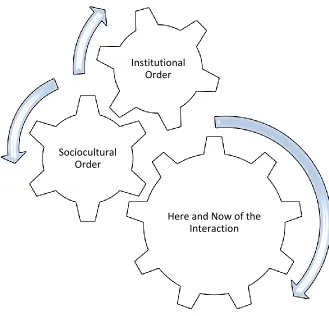
organisations and organising. Figure 1 provides an analytical framework that draws on a
representation of three orders of context (see Goffman 1959; Giddens, 1984; Jenkins, 2000 but also
Latour, 2005): the individual order, the interactional order, and the institutional order. The
interactants operate at the interface of these three orders which “overlap completely; each is
implicated in each of the others; none makes sense without the others” (Jenkins, 2000, p.10). The
three orders also correspond to the commonly used distinction between macro/meso/micro levels of
analysis. The micro typically referrers to the ‘here and now’ of the moment and the macro to the
wider sociopolitical environment and social processes within which we all operate. While
micro/meso/macro are often represented as separate, with the macro being ‘out there’, they are
intertwined. Instead of conceptualising them as yet another binary opposition, the three orders form
a web of relationships and structures, within which the agency of the individual user is located.
Simply put, the first order has to do with individuals and their own reality, the second is negotiated
between people, while the third refers to norms and structures already in place.
---
Insert Figure 1 about here
---Figure 1 suggests that a better understanding of language use in the modern workplace should
encompass all three orders, thus providing a more dynamic and holistic analysis. This analytical
model connects the here and now of interaction and links the choices individuals make with the
language resources available in the institutional order. Instead of either looking into macro discourse
and personal accounts on language, or only take a micro interactional approach, this comprehensive
model looks into the micro choices individuals make interactionally and the ways in which this is
situated in the broader context of the team, department, organisation, or industry, for example. This
approach, which explicitly spans multiple levels of analysis, may help avoid the problem of ‘forcing’
data into a particular analytical category or extrapolating a ‘local’ phenomenon or practice to the
whole organisation, thus assuming it exists as an analytical category (e.g. particular language use is
only characteristic of a specific team, department or unit rather than the entire firm; the metaphor of
a ‘language pocket’; Piekkari et al., 2014). Taken together, Figure 1 proposes an iterative and
multilayered approach to better understand multilingualism in the workplace and the process of
negotiating membership into different communities and linguistic repertoires (see Angouri et al.,
2016 on transitions into a profession and within a workplace).
In terms of specific methods and data sources, self-reported data, surveys and observations as
well as critical ethnographic studies, interaction analysis and experimental work can shed light on
multilingual practices at work. There is a body of ethnographically informed studies which have
shown the multiple choices individuals make locally depending on whom they interact with, what
their interactional agenda is, and the linguistic resources available to them (Angouri, 2014). While
ethnographic research uncovers language practices in real time, there is also a need for longitudinal
research which connects the choices made in a local setting with wider structures existent in the
have been prioritised in our fields such as personal interviews, surveys and analysis of interactional
data, a mixed methods approach is also suitable for answering the kind of questions we address here.
They allow us to study language use from different angles and traditions.
5 Conclusion
We have argued that there is a need to problematise and reposition a number of established
orthodoxies in order to capture the dynamics of the multilingual reality of the modern workplace. Our
concluding section scrutinizes the analytical value of categories and makes a call for seriously
engaging with multidisciplinarity.
5.1 Repositioning the analytical value of categories in a situated way
The dominance of the multilingual organization as a main analytical category has largely
excluded informal, partial and temporal organisations and organising from the analysis in both IB
research and workplace discourse studies. Furthermore, language use by non-organisational members
and other key actors is rarely captured when the organisation remains the core category. As such,
categories have no inherent analytical power; they are constructions that the researcher has used to
explain phenomena. However, these categories correspond to structures that are visible to lay people
and take on different meanings in different contexts. Organisations operate in a broader linguistic
ecosystem that interacts with and straddles a nexus of national, cultural, professional, and
geographical boundaries, to name but a few. If we accept that organising multiligually is what is
happening, the challenge is to also understand how individuals use these or other categories in doing
We argue that a focus on language practices provides an alternative way to conceptualise and
unpack management practices; organising multilingually suggests a nuanced understanding of the
complex linguistic landscape of any workplace. We all operate within a set of power structures and
legal frames which are visible when at work or any other societal context. At the same time, the social
world and professional context are negotiated, resisted or perpetuated through discourses and
individual agency is paramount. Accordingly, zooming in the practices of employees around specific
processes and zooming out on the wider context within which this takes places, can afford the
theoretical and methodological tools for bringing together theory and practice. Stability and change
co-exist and are related to the linguistic choices people make; this includes any language variety
available and the style of interaction that is considered appropriate.
5.2 Engaging seriously with multidisciplinary
This leads us to the final point of our essay, namely the need for multidisciplinarity. Crossing
disciplinary boundaries has been on the agenda for many years and a number of projects and
collaborations form examples of good practice (e.g. Janssens and Steyaert, 2014; Slíwa and
Johansson, 2014). Notions in linguistics such as linguistic human rights, issues of ownership of a
language variety, and the ethics of language teaching (e.g. Pennycook, 1998) can enrich current
debates in IB research. In reverse, the extensive understanding of the multinational organisation in
IB scholarship can fruitfully advance current research on the multilingual workplace in the
socio/linguistic field.
However, we often fall into the trap of paying merely lip service to multidisciplinary research
rather than engaging with it seriously. Needless to say, going outside one’s own comfort zone is never
difficulties to fully appreciate research findings from another discipline and to understand the
vocabulary and methods of ‘the other’. Despite this, if we are to challenge established orthodoloxies
and not reinvent the wheel again and again, we need to connect better research agendas, theoretical
and methodological tools that we have been using. Also, by being less dogmatic about our own
disciplinary conventions and more tolerant and accepting of other ways of studying language use in
multilingual workplaces ‘right’, we start hearing and listening what colleagues have to say, linguistics
and IB being our main foci here. Patience is currency here because building awareness and sharing
research findings across disciplines takes time4. Only through an open exchange and dialogue can we
make a start of a more nuanced enquiry which can provide richer insights into the fast changing
workplace.
We hope that our initiative to engage in a conversation across disciplinary boundaries contributes to
a fruitful dialogue and paves the way for many more studies to follow.
4 We would like to thank the convenors Jeffrey Loewenstein, William Ocasio and Eero Vaara of sub-theme 34
“Something to talk about: Building bridges to understand the power of words and vocabularies in organizing” at the 32nd EGOS Colloquium, Naples, Italy, July 7-9, 2016, for facilitating and contributing to an insightful discussion on
References
Abrams, D. and Hogg, M.A. (1988) ‘Comments on the motivational status of self-esteem in social
identity and intergroup discrimination’, European Journal of Social Psychology, Vol. 18,
pp.317–334.
Alvesson, M. and Kärreman, D. (2000) ‘Taking the linguistic turn in organizational research:
challenges, responses and consequences’, The Journal of Applied Behavioral Science, Vol. 36,
pp.136–158.
Angouri, J. (2014) ‘Multilingualism in the workplace: language practices in multilingual contexts’,
Multilingua, Vol. 33, pp.1–9.
Angouri, J. (2016) ‘Online communities of practice’, in Georgakopoulou, A. and Spilioti, T. (Eds):
The Routledge Handbook of Language and Digital Communication, Routledge Handbooks in
Applied Linguistics, Routledge, Oxon, UK, pp.323–338.
Angouri, J. (2017) Intercultural Talk at Work,Routledge, Oxon, UK, forthcoming
Angouri, J. and Marra, M. (2011) Constructing Identities at Work, Palgrave Macmillan, Basingstoke.
Angouri, J., Marra, M. and Holmes, J. (2016) Negotiating Boundaries at Work. EUP, Edinburgh.
ARCTIC. 2013. ARCTIC: Assessing and reviewing cultural transaction in international companies,
www.surrey.ac.uk/arctic
Auer, P. and Wei, L. (2007) ‘Introduction: multilingualism as a problem? Monolingualism as a
problem’, in Auer, P. and Wei, L. (Eds): Handbook of Multilingualism and Multilingual
Communication, Mouton de Gruyter, Berlin, pp.1–14.
Barakos, E. (2014) The Promotion of Bilingualism in Businesses in Wales: A Critical Language
Bartlett, C.A. and Ghoshal, S. (1989) Managing across Borders: The Transnational Solution, Harvard
Business School Press, Boston, MA.
Berger, P. L. and Luckmann, T. (1991) The Social Construction of Reality: A Treatise in the Sociology
of Knowledge (No. 10). Penguin, London.
Bjerregaard, T., and Klitmoeller, A. (2016). ‘Conflictual practice sharing in the MNC: a theory of
practice approach’, Organization Studies, Vol. 37, pp.1271–1295.
Blommaert, J. and Rampton, B. (2011) ‘Language and superdiversity’, Diversities, Vol. 13,
UNESCO, France and Germany.
Boussebaa, M., Sinha, S. and Gabriel, Y. (2014) ‘Englishization in offshore call centres: a
postcolonial perspective’, Journal of International Business Studies, Vol. 45, pp.1152–1169.
Boussebaa, M. and Brown, A. (2016) ‘Enlishization, identity regulation and imperialism’,
Organization Studies, DOI: 10.1177/0170840616655494
Brannen, M.Y., Piekkari, R. and Tietze, S. (2014) ‘The multifaceted role of language in international
business: unpacking the forms, functions and features of a critical challenge in MNC theory and
performance’, Journal of International Business Studies, Vol. 45, pp.495–507.
Britain, D. (2016) Sedentarism, nomadism and the sociolinguistics of dialect. In Nikolas Coupland
(ed.), Sociolinguistics: Theoretical Debates. Cambridge: Cambridge University Press. 217-241.
Canagarajah, A.S. (2000). ‘Negotiating ideologies through English: strategies from the periphery, in
Ricento, T. (Ed.): Ideology, Politics, and Language Policies: Focus on English, John Benjamins,
Amsterdam, pp.121–132.
Canagarajah, S. (2009) ‘Multilingual strategies of negotiating English: from conversation to writing’,
Canagarajah, S. (2013) Translingual Practice: Global Englishes and Cosmopolitan Relations,
Routledge, New York.
Christensen, C.M. and Carlile, P.R. (2009) ‘Course research: using the case method to build and teach
management theory’, Academy of Management Learning & Education, Vol. 8, pp.240–251.
Cornelissen, J.P., Durand, R., Fiss, P.C., Lammers, J.C. and Vaara, E. (2015) ‘Putting communication
front and center in institutional theory and analysis’, Academy of Management Review, Vol. 40,
pp.10–27.
Creese, A. and Backledge, A. (eds) (2018). The Routledge Handbook of Language and Superdiversity,
Taylor & Francis, London.
Caldas-Coulthard, C. R. and Iedema, R. (eds) (2008) Identity Trouble. Critical Discourse and Contested
Identities. Basingstoke: Palgrave Macmillan.
Costa, A., Foucart, A., Arnon, I., Aparici, M., Apesteguia, J. (2014). ‘‘‘Piensa’’ twice: On the foreign
language effect in decision making’, Cognition, Vol. 130, pp.236–254.
Coupland, N. (ed) (2016) Sociolinguistics: Theoretical Debates, CUP, Cambridge.
Deetz, S. (2003) ‘Reclaiming the legacy of the linguistic turn’, Organization, Vol. 10, pp.421–429.
Feely, A. J. and Harzing, A.-W. (2003) ‘Language management in multinational companies’,
Cross-Cultural Management: An International Journal, Vol. 10, pp.37–52.
Fredriksson, R., Barner-Rasmussen, W. and Piekkari, R. (2006) ’The multinational corporation as a
multilingual organisation: the notion of a common corporate language’, Corporate
Communications: An International Journal, Vol. 11, pp.406–423.
Gaibrois, C. (2015) The Discursive Construction of Power Relations in Multilingual Organisations, PhD
Giddens, A. (1984) The Constitution of Society, Polity Press, Cambridge.
Goffman, E. (1959) The Presentation of Self in Everyday Life, Anchor Books, New York.
Gunnarsson, B.L. (2014) ‘Multilingualism in European workplaces’, Multilingua, Vol. 33, pp.11–33.
Harzing, A.-W. and Pudelko, M. (2014) ’Hablas vielleicht un peu la mia language? A comprehensive
overview of the role of language differences in headquarters–subsidiary communication’, The
International Journal of Human Resource Management, Vol. 25, pp. 696–717.
Heller, M. (2010) ‘The commodification of language’, Annual Review of Anthropology, Vol. 39,
pp.101–114.
Holmes, J. and Stubbe, M. (2003) Power and Politeness in the Workplace. A Sociolinguistic Study of
Talk at Work, Pearson, Harlow, UK.
Holmqvist, J. and Grönroos, C. (2012) ‘How does language matter for services? Challenges and
propositions for service research’, Journal of Service Research, Vol. 15, pp.430–442.
Jaffe A. (1999) Ideologies in Action: Language Politics on Corsica. De Gruyter, Berlin.
Janssens, M. and Steyaert, C. (2014) ‘Reconsidering language within a cosmopolitan understanding:
toward a multilingual franca approach in international business studies’, Journal of International
Business Studies, Vol. 45, pp.623–639.
Jenkins, R. (2000) ‘Categorization: identity, social process and epistemology’, Current Sociology,
Vol. 48, pp.7–25.
Johnstone, B. (2008) Discourse Analysis, Wiley-Blackwell, Oxford, UK.
Kalmane, M.R. (2010) Advertising: Using Words as Tools for Selling, Lulu.com., UK.
Kelly-Holmes H. (2005) Advertising as Multilingual Communication, Palgrave Macmillan, London.
Keysar, B., Hayakawa, S. L., An, S. G. (2012). ‘The foreign language effect: Thinking in a foreign
Kirilova, M. (2013) All Dressed Up and Nowhere to Go: Linguistic, Cultural and Ideological Aspects
of Job Interviews with Second Language Speakers of Danish, PhD Dissertation, University of
Copenhagen, Denmark.
Kirilova, M. and Angouri, J. (2017) ‘Workplace communication practices and policies’, in
Canagarajah, S. (Ed.): The Routledge Handbook of Migration and Language. Routledge, Oxon,
UK, forthcoming.
Klitmøller, A. (2013) (Re)contextualising Cultural and Linguistic Boundaries in Multinational
Corporations: A Global Ethnographic Approach, PhD Dissertation, Aarhus University,
Denmark.
Koskinen, K. (2008) Translating Institutions: An Ethnographic Study of EU Translation, St. Jerome
Publishing, Manchester, UK.
Latour, B. (2005) Reassembling the Social: An Introduction to Actor-Network Theory, OUP, Oxford.
Llamas, C. and D. Watt (eds) (2010) Language and Identities, Edinburgh: EUP.
Loewenstein, J., Ocasio, W. and Jones, C. (2012) ‘Vocabularies and vocabulary structure: a new
approach linking categories, practices and institutions.’ The Academy of Management Annals,
Vol. 6, pp.41–86.
Luo Y., Shenkar O. (2006) ‘The multinational corporation as a multilingual community: Language
and organization in a global context.’ Journal of International Business, Vol 37, pp. 321-339
Macdonald, S. and Hellgren, B. (2004) ‘The interview in international business research: problems
we would rather not talk about’, in Marschan-Piekkari, R. and Welch, C. (Eds): Handbook of
Qualitative Research Methods for International Business, Edward Elgar, Cheltenham, UK,
Mahili, I. (2014) ‘‘It’s pretty simple and in Greek…’: Global and local languages in the Greek
corporate setting’, Multilingua, Vol. 33, pp.117–146.
Mautner, G. (2015a) Discourse and Management: Critical Perspectives: Critical Management
Studies Perspectives. Palgrave Macmillan, London.
Mautner, G. (2015b) ‘Organizational behaviour and the linguistic turn: a critical textbook review’,
conference paper at the 9th International GEM&L Conference on Language and Management,
10-12 June, Helsinki, Finland.
Meyer, B. and Apfelbaum, B. eds., 2010. Multilingualism at work: From policies to practices in
public, medical and business settings (Vol. 9). John Benjamins Publishing.
Neeley, T. B., and Dumas, T. L. (2016) ‘Unearned status gains: evidence from a global language mandate’, Academy of Management Journal, Vol. 59, pp. 14–43.
Neeley, T. B. (2017) Global Work: How One Language Drives Globalization, Princeton University
Press, Princeton, NJ.
Otsuji, E. and Pennycook, A. (2011) ‘Social inclusion and metrolingual practices’, International
Journal of Bilingual Education and Bilingualism, Vol. 14, pp.413–426.
Peltokorpi, V. and Vaara, E. (2014) ‘Knowledge transfer in multinational corporations: productive
and counterproductive effects of language-sensitive recruitment’, Journal of International
Business Studies, Vol. 45, pp.600–622.
Pennycook, A. (1998) English and the Discourses of Colonialism, Routledge, London.
Phillips, N. and Oswick, C. (2012) ‘Organizational discourse: domains, debates and directions’, The
Academy of Management Annals, Vol. 6, pp.435–481.
Piekkari, R., Welch, D. and Welch, L. (2014) Language in International Business: The Multilingual
Piekkari, R. and Westney, D.E. (2017) ‘Language as meeting ground for research on the MNC and
organisation theory’, in Dörrenbächer, C. and Geppert, M. (Eds): Multinational Corporations
and Organisation Theory: Post Millennium Perspectives (Series: Research in the Sociology of
Organisations, Vol. 49), Emerald, Bingley, UK, pp. 193–232.
Piller, I. (2016). Linguistic Diversity and Social Justice: An Introduction to Applied Sociolinguistics,
Oxford University Press, Oxford, UK.
Pohjanen-Bernardi, K. and Talja, K. (2011) Language Strategies in Finnish Small and Medium
Enterprises, Master’s Thesis, Aalto University, School of Economics, Finland.
Reiche B. S., Harzing, A.-W and Pudelko, M. (2015) ‘Why and how does shared language affect
subsidiary knowledge inflows? A social identity perspective’, Journal of International Business
Studies, Vol. 46, pp.528–551.
Roberts, C. (2007) ‘Multilingualism in the workplace’, in Auer, P. and Wei, L. (Eds): Handbook of
Multilingualism and Multilingual Communication, De Gruyter, Berlin, pp.405-422.
Romaine, S. (2000) Language in Society: An Introduction to Sociolinguistics, Oxford University
Press, Oxford, UK.
Sarangi, S. and Roberts, C. (eds.). 1999. Talk, Work and the Institutional Order: Discourse in
Medical, Mediation and Management Settings. Berlin, Mouton de Gruyter.
Sanden, G.R. (2015) Language Strategies in Multinational Corporations: A Cross-sector Study of
Financial Service Companies and Manufacturing Companies, PhD Dissertation, Copenhagen
Business School, Denmark.
Slíwa, M. and Johansson, M. (2014) ‘How non-native English-speaking staff are evaluated in a
linguistically diverse organisation: a sociolinguistics perspective, Journal of International
Strikwerda, J., and Stoelhorst, J. W. (2009) The emergence and evolution of the multidimensional
organization, California Management Review, Vol. 51, pp.11–31.
Strubell, M. and Marí, I. (2013) ‘Localisation and globalisation in Catalan companies’ language
policies’, Journal of Multilingual and Multicultural Development, Vol. 34, pp.549–563.
Swain, M. (1985) ‘Communicative competence: some roles of comprehensible input and
comprehensible output in its development’, Input in Second Language Acquisition, Vol. 15,
pp.165–179.
Tietze, S. (2008) ‘The work of management academics: an English language perspective’, English
for Specific Purposes, Vol. 27, pp.371–386.
Tietze, S., and Dick, P. (2013) ‘The victorious English language: hegemonic practices in the
management academy’, Journal of Management Inquiry, Vol. 22, pp.122–134.
Unger, J.W., Krzyzanowski, M. and Wodak, R. eds., 2014. Multilingual encounters in Europe's
institutional spaces. A&C Black.
Vaara, E. (2010) ‘Taking the linguistic turn seriously: strategy as a multifaceted and interdiscursive
phenomenon’, The Globalization of Strategy Research Advances in Strategic Management, Vol.
27, pp.29–50.
Vertovec, S. (2007) ‘Super-diversity and its implications’, Ethnic and Racial Studies, Vol. 30,
pp.1024–1054.
Wei, L. (2011) ‘Multilinguality, multimodality, and multicompetence: code‐and modeswitching by
minority ethnic children in complementary schools, The Modern Language Journal, Vol. 95,
pp.370–384.
Weick, K.E. (1979) ‘Cognitive processes in organisations’, Research in Organizational Behavior,
Westney, D.E. and Van Maanen, J. (2011) ‘The casual ethnography of the executive suite’, Journal
[image:35.595.155.484.264.580.2]of International Business Studies, Vol. 42, pp.602–607.
Figure 1 Unpacking multilingualism in the modern workplace
Here and Now of the Interaction Sociocultural
Order
Table 1. Summary of current and future research trajectories
Current research trajectories Future research trajectories
National language as the main category
Focus on separate/distinct languages
A complex linguistic landscape/Languaging
Focus on language practice
Multilingual organization as the main category and its binary sub-categories
Focus on organizational boundaries
Organizing multilingually
Focus on transcending boundaries The multilingual
MNC
The ‘monolingual’ domestic firm
Language as a design practice
The large MNC The ‘local’ SME Language[s] as a factor to be designed (e.g., common corporate language)
The manufacturing firm
The service firm Ecosystem as a metaphor and a meso-level construct that connects macro and micro levels of analysis The executive suite The white-collar
and blue-collar workplace
Multilingualism as a mundane practice, monolingual spaces an exception
The private for-profit organization
The public non-profit organization
‘Doing’ organizing