This is a post-print version of an ar0cle accepted for publica0on to appear in Corpora 13:2 in 2018: h<p://www.euppublishing.com/loi/cor.
First catch your corpus: methodological challenges in constructing a thematic corpus 1
Alison Sealey
Chris Pak
Abstract
This paper describes the process by which we have constructed a corpus of heterogeneous texts about non-human animals. It aims to contribute both methodologically – in respect of the challenges of compiling a thematic corpus – and substantively – in relation to the identi=ication of some features of discourse about animals. Having introduced the research project and its guiding questions, the article describes the principles of data selection and the procedures used in analysis. We highlight the methods we devised both to avoid the potential circularity associated with pre-determined search terms, and to overcome the limitations of a relatively small corpus containing a wide range of relevant vocabulary. We go on to report some initial =indings on the most frequent animal naming terms and adjectives describing them, including a small case study of the adjectives ‘live’ and ‘dead’. The article concludes by indicating the ways in which the iterative methods we have employed are open to further extension, and points to some methodological and substantive implications of this enterprise.
* * * * *
This paper reports on methodological issues raised by constructing a corpus of heterogeneous texts that are all, in some way, about non-human animals. Although some of the issues are speci=ic to our particular theme, we hope to contribute to the generic enterprise of corpus construction by exploring the
Acknowledgements. This research is funded by the Leverhulme Trust (RPG 2013-063). We are grateful to the other members of the
1
challenges associated with building a corpus whose focus is thematic, in contrast with the better-established methods of building corpora to facilitate description of a speci=ic linguistic variety or the discourse associated with speci=ied genres, for example. The =irst section situates the construction of the corpus within the aims of the research project, and the second explains the parameters we set around potential data. In section three we summarise the iterative procedures we followed for identifying and selecting data for inclusion, before presenting some initial =indings in section four. Here we provide an overview of the most frequent animal naming terms, going on to explore the adjectives in the corpus used to describe animals, followed by a small case study focusing on two of these. We conclude by drawing out the contribution of this approach to corpus
construction for the analysis of discourse using corpus-assisted methods and for the enterprise of extending it to language about the non-human.
1. Background to the project: ‘People’, ‘products’, ‘pests’ and ‘pets’: the discursive representation of animals
The motivations for our project include a growing recognition (within and beyond academia) of the importance of exploring the boundaries and
relationships between humans and animals. Developments of various kinds – biological, technological, political – as well as ‘a new sense of our precariousness as a species in the face of ecological threats and climate change’ (Rose, 2013: 4) are obliging social researchers to shift from largely exclusive concerns with the relations and interactions between people to include considerations of the other living organisms with which we share the planet. Research in this =ield is
developing fast (e.g. journals such as Society & Animals; Anthrozoös), and includes debates among natural scientists and philosophers about the language used to talk and write about animals (for an overview see Sealey and Oakley, 2013), while applied linguists are beginning to acknowledge the posthuman (e.g. Pennycook, 2016) and discourse analysts are turning their attention to environmental issues in general (e.g. Alexander, 2009; Fill and Mühlhäusler, 2001; Harré et al., 1998), and the linguistic representation of animals in
observes, ‘the language used to describe animals in a Disney documentary is quite different from that of a slaughterhouse instruction manual,’ (2012: 7) and his book is divided accordingly into chapters organised around such thematic distinctions.
In deciding how to compile our own corpus, we wanted to ensure that we would be able not only to explore empirically claims found in existing commentaries, but also to identify any unanticipated trends or patterns – the ‘non-obvious meanings’ (Partington, 2008) which corpus-assisted discourse analysis can help to identify. For this reason, rather than using our intuition to predetermine sets of either animals or sub-topics (such as meat production, for example) about which to look for texts to include, we have instead taken an eclectic and inductive approach, as explained below. The overarching question guiding this strand of the project is ‘How are animals in the corpus represented by the language used?’ A more speci=ic sub-question, which we consider towards the end of this paper, is: ‘What kinds of description are associated with different kinds of animal?’
2. The parameters of the corpus
2.1 A thematically organised corpus
Corpus type (e.g. general, learner, diachronic) is linked with analytic or applied objectives (linguistic description, pedagogy etc.), and our own project is
discourse analytic (Partington et al., 2004; Conrad, 2002). Even within this kind of approach, compiling a corpus according to a shared topic or theme is not yet a well-established practice and could be considered controversial, or even ill advised (Sinclair, 2005), although there are exceptions. For example, Baker (2006: 26) cites the topic-based corpus compiled by Johnson et al. (2003) as one example of a ‘specialized corpus’, which he suggests is ‘perhaps the most
2.2 The boundaries of our theme: what is an animal?
Engagement with the idea of ‘animal’ as a category can challenge common sense, rather as the =indings from corpus analysis may challenge assumptions about language. Despite our intuitions that we know what animals are, the
classi=ication of living beings as ‘animals’ is not unproblematic (e.g. Dupré, 2001, 2002, 2012; Ingold, 1988; Margulis, 2007). Part of our quest is to discover what people include in their own concepts of ‘animals’, and to explore both how far the casual, practical taxonomies of the non-specialist and those of ‘experts’ overlap, as well as to identify any evidence there may be for linguistic categorisations in=luencing people’s perceptions of, and behaviour towards, various kinds of creatures in different registers. We maintain that this focus on terms denoting the non-human has implications for corpus-assisted discourse analysis more broadly, in that the selection of search terms for any such project necessarily makes assumptions about relations between: individuals, the categories by which they are classi=ied, and the linguistic labels for both.
Numerically, the smallest animals constitute the largest proportion of the world’s creatures: arthropods, a group that includes insects, arachnids and crustaceans, outnumber mammals by a ratio of about 312 to 1 (Basset et al., 2012), while micro-organisms are even more numerous, their diversity exceeding that of all other life-forms (Dupré, 2012: 165). Yet research into ‘folk’ categories (Atran and Medin, 2010; Berlin, 1973; Berlin et al., 1973) and the ‘semantic primes’ of natural kinds suggests that it is the more visible, larger categories of creature that people typically name when prompted to report on their awareness and experience of ‘animals’. So while we have included in our corpus texts featuring spiders, snails and insects, we took the decision to exclude from our working de=inition of names for ‘animals’ words that denote any type of creature that is not normally visible to the naked eye.
2.3 Which linguistic variety?
We are investigating discourse about animals in ‘contemporary British
domain are different, and the language varies too. However, the identi=ication of any text as being in ‘British English’ is somewhat problematic (c.f. critiques of the rei=ication of languages and of ‘native speakerism’), and some of the texts in which we are interested may be co-authored by several writers with varied linguistic backgrounds. So we include discourse originating wholly or mainly in the UK, insofar as its provenance can be established.
2.4 What kind of discourse?
As with many other studies of a similar kind, our potential ‘universe’ of discourse is huge and unquanti=iable. We cannot hope to establish either the nature or the extent of all the texts that could potentially be included in our corpus, nor even to claim that it constitutes a representative sample of all the discourse about
animals that exists in contemporary British English; (c.f. Leech, 1991: 27, on representativeness as ‘largely as an act of faith’). To some extent, our decisions about what to include must be made on pragmatic, practical or opportunistic grounds. On the other hand, in line with the emphasis in corpus analysis on procedures that are replicable (e.g. Stubbs, 1996; 1997), we present the principles guiding our decisions. Although there continues to be debate in the literature about representativeness and sampling in corpus construction, there is general agreement that there is a potential circularity in pre-selecting the terms associated with a given theme. To avoid this, ‘the design criteria … should be external to the texts, relating to the use of language in a recognized context that exists outside the realm of language analysis’ (Adolphs, 2006: 21; Sinclair, 2005). In line with this approach, key parameters in data selection for our corpus are the orientations, interests and purposes expressed in discourse about animals from a range of genres. Again, we argue that the potential of this approach is not restricted to our topic. For example, the dominance of news as a source of corpus data about a wide range of issues in (critical) discourse analysis is
understandable: not only are news texts increasingly readily available in digital form, but, as critical discourse analysts recognise, they are a powerful conveyor of dominant ideologies (e.g. van Dijk, 2013). However, if stances towards a theme are likely to vary across genres – as is the case here – then we believe it is
advisable to be wary of restricting a corpus to news texts alone.
clothes), competitors (with each other and with humans, in sport, as quarry in hunting, racing, =ighting) and ‘out of place’ (‘pests’ / ‘vermin’). These are not mutually exclusive categories: creatures hunted for sport, such as ‘game’ birds or =ish, may then be eaten; ‘pests’ or ‘vermin’ may be executed clinically (e.g. by fumigation) or hunted down in sporting rituals (e.g. foxes). Likewise, there are often no neat divisions between kinds of animal and orientations towards them: a dog may be treated as a pet and also used for guarding the home or acting as a blind person’s ‘sight’; a sign outside a farm, observed by a colleague, read
‘Rabbits for sale: pet or meat’; Herzog (2010) recounts the attentive care afforded laboratory rats and mice, in contrast to the casual way in which those that escape and become ‘pests’ are dispatched.
Part of our strategy, then, is to include a range of ‘interests’ in our data, in the sense of the beliefs, attitudes and values of those producing the discourse, given that people with differing views about our topic are obviously likely to represent the creatures they talk and write about in different ways – one person’s
‘laboratory experiment on a specimen’ is another person’s ‘torture of a sentient being’. We include a wide range of potential stances towards our topic, since part of our goal is to discover more subtle contrasts in the ways animals are
represented than the obvious, semantically loaded ones such as these, given that even apparently ‘neutral’ discourse is saturated with evaluative stance (Hunston, 2007, 2010; Martin and White, 2005; Stubbs, 2001).
are inherently persuasive, though they may be instructive also, as well as being legally obliged to contain factual information, while the purpose of texts
produced in support of campaigns is persuasive by de=inition. We have included examples of all of these in our corpus, recognising that these kinds of purposes are realised by different text types in different modalities. We acknowledge that this spreads coverage of each type relatively thinly, but believe that, for a topic which is under-researched, this potential disadvantage is outweighed by the opportunities offered for discovering patterns in different kinds of discourse that would not be found in a corpus of one genre alone, such as news, for example.
2.5 Where is discourse about our topic to be found?
In this section we explain how we dealt with the ‘corpus-theoretical
paradox’ (Aarts and Bauer, 2008) which faces anyone compiling a corpus that involves selecting search terms in order to identify relevant texts. In our case the challenge is particularly daunting, because of the huge number of terms that can denote an ‘animal’. Yet it is also worth noting that few topics investigated by discourse analysts present themselves with objective, concise lists of relevant terms. Mautner (2015: 157) claims that ‘phenomena with varying and
unpredictable lexical realizations’ are much less suitable for corpus analysis than studies that ‘crystallize … around discrete lexical items’, and she illustrates the latter with =indings about the patterning of the single words unemployed and
hardworking in a corpus of news texts. However, the selection of even items such as these rests on prior knowledge about which words are likely to shed light on the topic of interest. Our approach to search term selection accords with that advocated by Biber (1993: 243), where ‘[t]he actual construction of a corpus … proceed[s] in cycles: the original design based on theoretical and pilot-study analyses, followed by collection of texts, followed by further empirical investigations of linguistic variation and revision of the design.’
about animals is similarly identi=iable in a fairly direct way, and was selected using Lexis Nexis. These kinds of texts constitute one section of our data.
A second source of data is elicited from people who are asked to re=lect on their responses to our topic. We have been given access to two data-sets collected by a sociologist who studies the role of animals in people’s lives. One is 103 written responses to a ‘directive’ in 2009 on ‘Animals and humans’ by the Mass
Observation Project. (For more detailed information, see Sealey and Charles, 2013.) The other comprises transcripts of interviews by Charles with guardians/ keepers of companion animals. In other, qualitative strands of our project, we have conducted 17 metadiscursive interviews with producers of texts such as those included in the =irst type of data outlined above, as well as 9 pairs of re=lective focus-group sessions with readers and viewers from a range of
backgrounds and with varying kinds of interests in our topic. The aim here is to complement the corpus analysis (what is said/written) with evidence from producers and audiences for such texts, thus attending to the ‘triangle of
communication’ (Cook, 2004). Transcripts of this elicited data are included in our corpus.
The third types of texts for our corpus are less readily identi=ied. Facing similar challenges to ours, Gilquin and Jacobs (2006) used the BNC as data, and various Internet sources as a basis for their list of search terms comprising 914 words 2 for animals, including: ‘(a) general and common nouns (e.g. bird, cat, dog, horse); (b) nouns for males, females, and offspring (e.g. calf, mare, stag); (c) some
specialized nouns (e.g. drosophila, ostracod, whydah); and (d) the main breeds of cats, dogs, and horses (e.g. angora, collie, shire).’ These authors have been kind enough to share the resulting list with us, and we have incorporated it into the process by which we have =iltered the search terms used to identify candidate texts for inclusion in the corpus, as explained below.
[Insert Table 1 about here]
3. Piloting and selecting
h<p://dir.yahoo.com/Science/Biology/Zoology/Animals__Insects__and_Pets/Complete_List_of_Animals_by_Name/Complete_Lis0ng/, 2
h<p://www.mcwdn.org/Animals/AnimalsIndex.html, h<p://www.greenapple.com/~jorp/amzanim/aninfct.htm, h<p://
www.geoci0es.com/RainForest/4076/indexlist.html, h<p://www.enchantedlearning.com/subjects/animals/Animalbabies.shtml, h<p:// dir.yahoo.com/Science/Biology/Zoology/Animals__Insects__and_Pets/Mammals/Cats/Breeds/, h<p://dir.yahoo.com/Science/Biology/ Zoology/Animals__Insects__and_Pets/Mammals/Dogs/Breeds/All_Breeds/, h<p://dir.yahoo.com/Science/Biology/Zoology/
To summarise, we have explained the challenges we faced in identifying appropriate data for our corpus of ‘discourse about animals’, along with the principles we have adopted to meet them. We have set parameters around: linguistic variety, time period, genres, stance and interests of text authors, and categories of animals, including the ways in which people are likely to interact with them, and we have been able to take advantage of previous studies (Cook et al., 2003; Cook, 2007), some student projects about this theme, the support of co-operative colleagues and organisations, and pilot analyses of sub-sets of the data already collected (Sealey and Charles, 2013; Sealey and Oakley, 2013, 2014).
For incorporation into the corpus, each text was processed so that all the data is consistent in layout and searchable in identical ways using corpus tools. Pdfs were converted into plain text =iles using AntFileConverter (Anthony, 2015a). Tags for headings, paragraph breaks etc. are used consistently with simple XML
markup, and each text has been given a unique identi=ier. Core attributes are recorded both in a metadata spreadsheet and in-text headers, for maximum =lexibility with different corpus tools.
3.1 The composition of the initial corpus and ‘Master List’ of potential search terms
The second cycle of this approach to corpus construction uses the existing mini-corpus (in this case around a quarter of a million words) to generate a list of search terms to use with more general discourse types. That is, from this corpus of texts that are self-evidently and/or elicited to be about our topic, we used
AntConc (Anthony, 2014) to derive a complete word list, manually identifying words within it that denote animals, which generated a list of 419 items. This was a labour-intensive process, necessitating not only the identi=ication of words denoting animals but also the checking of unfamiliar terms (using the
Encyclopedia of Life3 in the =irst instance, or a Google search if no hits were returned, often due to mis- or alternative spellings). In addition to variant
spellings, other anomalies and inconsistencies had to be resolved (e.g. automated searches for ‘pig’ will by default not distinguish hits on ‘guinea pig’; ‘humpback whales’ are referred to variously as ‘humpback’ and ‘humpbacks’ in the plural).
The eventual composite list of candidate ‘words for animals’ we refer to as our ‘Master List’, which was subject to continuing modi=ication in light of the iterative processes outlined here. We went on to compare the words identi=ied by the
processes described above with the 914 terms used by Gilquin and Jacobs in their 2006 study (see Section 2.5); we included many of these terms in our Master List, but excluded those that denote organisms not visible to the naked eye.
3.2 Using and reIining the Master List
Re=inement and consolidation of this Master List was a rather paradoxical process: the list was extended ‘vertically’ as new terms occurred in texts that we added to our collection, and at the same time the list of items to explore in depth was shortened, as we paid attention to the ‘horizontal’ dimension – that is, whether items occur across all or most genres and text types. Therefore, we calculated which terms to focus on in detail by identifying within each sub-corpus:
• where in a ranked list each naming term for an animal occurs, when all the types in any given text are ranked by frequency
• the normalised frequency of each term: each naming term for an animal that occurs in one of these sub-corpora is ranked for its frequency per 1000 words, to take account of the varying sizes of the sub-corpora
• the percentile rank in the frequency list in each case (i.e. the ranking of a term within a wordlist converted into a percentage). 4
As we added to the range of material from texts that are self-evidently about our topic, it became more apparent which animals are named most consistently across different genres of discourse (see Section 4.1)
3.3 Using the Master List to identify new texts
Once complete, the Master List comprised a set of terms that could be used for identifying texts whose topic is animals, but which originate from general sources that are potentially about a wide range of subjects. For example, we
To explain this further: to iden0fy which terms occur more or less frequently across the different genres we have collected, simple 4
received access to a corpus of 10,000 articles sampled from 50 academic journals (mainly scienti=ic) published by Elsevier in the period 2001–2010. Some, but by no means all, feature animals, so we used the words denoting animals from the initial Master List to generate a single string (…pigeon OR sheep OR puppy OR squirrel OR bear OR hamster OR pony OR collie OR insect OR cow OR budgie OR frog OR hen …), identifying 2000+ articles as potentially relevant. The titles and abstracts suggested by this process were then manually checked, and false hits eliminated.
The most heterogeneous data source on which we drew was newspapers. Readers may wish to consider how far the challenges we encountered in
identifying the relevance of texts returned by our search terms are speci=ic to our topic. One of these challenges is the return of texts including only metaphorical uses of a search term. There is a rich seam of animal-related idioms and
metaphors running throughout the language, and dozens of variations of the
HUMANISANIMAL metaphor (see Goatly 2006), so we needed to process returns of
references to ‘moles’ denoting ‘insiders who spy’, for example, of ‘lamb’ that turned out to be in the phrase ‘mutton dressed as lamb’, and multiple instances of the idiom ‘dog eat dog’. While metaphor is a signi=icant issue for computational management of linguistic data generally (e.g. Association for Computational Linguistics, 2013), the extent of the porosity in the boundaries between discourse about humans and other animals is likely to be a more substantive =inding from our research (e.g. Sealey, 2016). This is evident not only in
metaphorical uses of animal naming terms, but also in the range of proper nouns that are identical to words for animals (e.g. individuals and organisations such as ‘Peter Bird’, ‘Fox News’, ‘Badgers Healthcare Providers’), while we also
encountered organisations named the ‘Foxhounds’ or ‘Hounds’, where the term was used to denote both hunters and dogs.
In light of this, we could have restricted our search within newspapers to events in which animals are central to a story (such as the horse-meat ‘scandal’ or the badger cull), selecting perhaps only texts with multiple mentions of speci=ic animal naming terms. However, this approach would overlook the more
incidental ways in which animals are referred to in news texts, which is contrary to the principle of corpus construction that we have established, of not
Ten newspapers were selected with reference to a list of those with high circulation, compiled from the ABC and re=lecting the most up-to-date reports 5 on circulation =igures; they are: The Sun, Daily Mail, Daily Mirror, Daily Telegraph, Daily Express, Daily Star, The Times, The Guardian, The Independent, Evening
Standard. For each year in our time-span, six evenly spaced months were chosen,
and four numbers were randomly generated for each month of these years. All articles for the =irst of the randomly generated dates for each newspaper were identi=ied. If this date fell on a day with no articles published, the second of the four randomly generated numbers was selected, and, if that was not suitable, the third was used, and so on. The returned articles were searched using the string of terms in the Master List, and all the articles that were returned were
downloaded. A second random number was generated to select a single article from each of the days. If the article was irrelevant – either because its reference to animals was metaphorical, or because there was only a single, passing
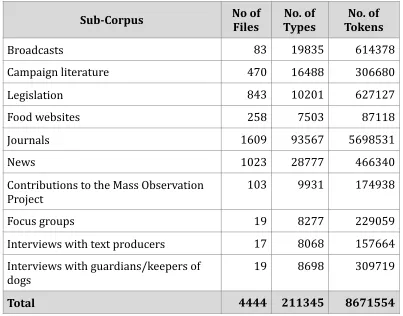
reference to an animal – another randomly generated number was used until a relevant hit was obtained and these articles were saved - a time-consuming process. This procedure resulted in a news sub-corpus comprising 1023 texts (466340 words).
4. Initial Hindings
The initial =indings presented in this section are of substantive interest for our research into contemporary British English discourse about animals. But they are also of methodological interest, in that they illustrate the results of corpus
construction guided by the iterative, largely inductive (and partially
opportunistic) approach described above, as opposed to one based on the a priori selection of a unitary data source or search terms based only on intuition.
4.1 Most frequent naming terms
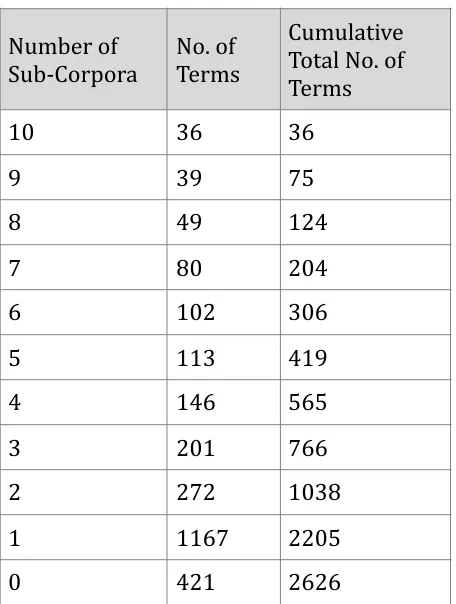
Our Master List has, as indicated above, foregrounded the most frequent words for animals found across a wide range of genres. The total number of animal terms stands at approximately 2600, distributed across sub-corpora as indicated in Table 2. Table 3 lists the 20 items that occur across at least nine of the sub-corpora, with the percentile rankings for each.
[Insert Table 2 and Table 3 about here]
The animals that are referred to consistently frequently in this heterogeneous corpus, as identi=ied in this list, may be grouped by various properties. Two of the naming terms are superordinates (Hish, bird(s)). While all the others are naming terms for mammals, it is noticeable that mammal(s) is much less frequent, consistent with the notion that it acts as the default, implicit superordinate; moreover, the naming terms for mammals denote those that feature prominently in human experience. That is, the terms are for ‘domestic’ animals, although this is itself a fairly imprecise term, and one that derives from human priorities and practices: a ‘domestic’ animal is de=ined by the Cambridge Dictionary as one ‘that is not wild and is kept as a pet’ (which includes dog(s) and cats), ‘or to produce food’ (pig(s), cow(s), cattle, sheep). Apart from fox, the other three species named could potentially be food, but there are cultural connotations (stigma, taboo or snobbery) to the consumption of the =lesh of these animals that do not apply to the others. Moreover, rabbits are an archetypal mixed category (‘pest’, ‘pet’, ‘food’), while horses are used for labour and sport. In this sense, fox is
anomalous, in that it names a species about which our corpus suggests there is social concern, but of a different sort from the other most commonly named kinds of animals.
4.2 Animals described: illustrative examples
Readers will no doubt have realised that with so many search terms relevant to our theme, and such a relatively small corpus, the available data for identifying patterns around any particular animal naming term is limited. We conclude this section with a description of how we facilitated analysis by tagging all the animal naming terms, to two levels of delicacy. Each occurrence of an animal naming term from the Master List was tagged with a symbol (‘¬’). In addition, a further code was devised according to common, ‘folk’ categories for classes of animals: ‘amphibian’, ‘bird’, ‘=ish’, ‘insect’ (in which we include arachnids, for pragmatic reasons), ‘mammal’, ‘mollusc’ (gastropods and cephalopods) and ‘reptile’.
Because the word ‘worm(s)’ appears frequently in the corpus, denoting creatures of various types, it was assigned a separate code. Three other categories were also used: ‘ambiguous’ was assigned to terms that are used for two or more animals of different types (often scienti=ic terms such as ‘Japonicus’ and
List with each =ile in the corpus, inserting the class code before the animal term, and the symbol ‘¬’ following each animal naming term.
These operations allow us to identify the frequency of co-occurrences of speci=ic words with all animal terms, with speci=ic classes of animal, or with speci=ic animals. For example, we analysed the frequency of adjectives to the immediate left of the tagged animal naming terms by searching a POS tagged corpus for the animal symbol and any preceding adjectives. In order to ensure that the
frequency of occurrences of a particular adjective and the animal symbol was comparable across the variably sized sub-corpora, log-dice values were
calculated, following Rychlý (2008). First, an aggregate of the frequency of the speci=ic adjective and the frequency of the animal symbol within one sub-corpus was divided by the frequency of co-occurrences of the two terms (within the same sub-corpus), multiplied by 2. A log-dice value was then generated by adding 14 to the binary logarithm (log2) of the result. An average log-value for each adjective was then calculated to derive a single log-value for the particular adjective within one sub-corpus, and across all sub-corpora. Using this method, we were able to identify the most frequently occurring adjectives preceding an animal naming term for each sub-corpus, and for the corpus as a whole.
As an illustration of our approach to the analysis of our corpus, we outline in this section the inductive approach with which we are addressing the sub-question, ‘what kinds of description are associated with different kinds of animal?’. Using the process described above, we generated a list of the adjectives (as classi=ied by
TagAnt, Anthony 2015b) that collocate with an animal naming term; we report
here on those occurring most frequently in attributive position immediately before the noun (i.e. in L1 position with the animal-name-tag as node) . There 6 are some false hits when the animal term is itself a modi=ier of a subsequent noun (e.g. one of the occurrences of the frequent phrase ‘good dog’ is in the string ‘good dog shampoo’); nevertheless, the process does allow us to identify some general trends.
Among the most frequent adjectives used to modify animal naming terms in our corpus are several that also feature highly in a general corpus such as the BNC . 7 In the list in Leech et al. (2001) of the top 50 adjectives in the BNC, other is ranked highest, and in our list it is second; new is in third position in both lists,
Because the journal sub-corpus is much larger and more specialised than the other sub-corpora, we have excluded it from this analysis.
6
The comparison is not exact of course as we are focusing on a<ribu0ve adjec0ves for animal nouns only.
and old is fourth in both; young is 6th in our list and 14th in the BNC list; black is 7th / 40th; small 10th / 7th; little 18th / 21st; different 19th / 8th; white 21st / 48th;
large 24th / 9th; British 28th / 16th; big 30th / 20th; local 31st / 10th; only 43rd / 37th;
certain is ranked 45th in both lists; whole is 49th / 47th. Adjectives that rank high in our list but not in the BNC list include: wild, in top position, and pet in 5th. There are also colour terms for describing animals that are not high in the BNC’s more general list: red (17th) grey (25th) blue (44th).
Other researchers from various disciplines (see citations above) have identi=ied anthropocentric attitudes as a prevalent feature of contemporary treatment of animals. We could gloss this as the assumption of the centrality of human beings’ concerns, perceptions and values. For the discourse analyst, the notion of ‘stance’ is useful in this context. Analysts using a range of approaches have demonstrated how both affective and epistemic stance are integral to the expression of
propositions, while cognitive linguists (e.g. Langacker, 1991) draw attention to the in=luence of our biological, cognitive endowment on the ways in which we construe our experience through language. Langacker also notes ‘linguistic evidence [for] the greater intrinsic prominence of entities that are … human vs. non-human’ (1993: 449).
Analysis of stance in discourse typically focuses on items such as stance adverbs and modal expressions, while the adjectives receiving attention tend to be semantically evaluative (e.g. possible, amazing, easy, Hunston, 2007 citing
Charles, 2004). However, even common English adjectives such as big, small, little
and large, as well as colour terms, denote a property of some entity as it is perceived in relation either to an observer or to some other entity. The fact that the observer, and/or the evaluator of relative size, is almost invariably human almost – but not quite – goes without saying. Our species’ biological endowment leads us to prioritise in language the characteristics that we perceive most readily, whereas the perceptive capacities of many other species are very
different, and some would probably be impossible to encode in human language. In identifying the adjectives in our own corpus that most frequently modify animal naming terms, we are reminded of this observation by Leech et al. (2001: 287) about the relative frequencies in the BNC of adjectives for regions and nations:
Analogously, we might suggest that our list of adjectives frequently used to describe animals – like the list of the most frequent naming terms – re=lects the assumption that what is important about them is de=ined by human concerns. In addition to descriptive adjectives that point to the properties of animals
perceived visually by humans, two other relatively frequent modi=iers of animal naming terms in our corpus are live and dead, at 9th and 12th positions
respectively. These are both much higher than in the BNC list, where dead is ranked 99th and live 454th, suggesting that these qualities are particularly salient in discourse about animals. The choice of ‘live’ as an attributive adjective to describe an organic entity is a marked one. Non-organic entities such as
‘broadcast’ or ‘performance’, for example, may be classi=ied as ‘live’ as opposed to ‘pre-recorded’, but human beings are implicitly presumed to be ‘live’, a quality which is thus not usually worthy of mention. Not so with non-human animals. We therefore conclude this indicative analysis of one aspect of our corpus with a closer exploration of these adjectives in context.
4.3 A small case study: ‘live’ and ‘dead’ animals
The absolute frequency of {dead + [animal naming term]} is greater than that of {live + [animal naming term]}, but the former ranks higher when the different sizes of sub-corpora are accounted for. The two strings are not evenly distributed among our sub-corpora, with these descriptions of animals predominating in campaigning literature and newspapers.
[Figure 1 about here]
Live premodi=ies 28 different animal naming terms (24 if plurals are not counted separately ), and 8 dead 59 (48). There is some overlap: terms (singular or plural) which are premodi=ied by both adjectives include: animal, badger, bird, cow, Hish, fox, rabbit, shark, sheep, and whale. Among animals described in our corpus as ‘live’ but not ‘dead’ are: chicks, cockerels, lambs, and pigeon(s), while among those premodi=ied by ‘dead’ but not by ‘live’ are: beetles, buzzards, crows, mice, salmon
and turkeys. The fact that speakers and writers draw attention to the live/dead status of animals points to ways they are experienced, perceived and valued in human society. This is illustrated by examples of concordance lines, which are grouped thematically below.
Though note that plurals of animal naming terms are not always marked (e.g. sheep, fish) and some func0on as mass nouns – e.g. lamb 8
We classify one such theme as broadly ‘ecological’, including accounts in
broadcast documentaries of how a dead animal represents food for others, while the fact that an animal may fall prey to another before dying naturally is also commented on:
In all these examples, despite the fact that the topic is behaviour among non-human animals, a non-human-like stance is inevitable. There is an anthropomorphic =lavour to ‘drawn a crowd’, ‘great bonanza’, ‘quite prepared’, ‘purpose built’, and ‘hoovering up’. Although ‘scavenger’ may be intended as a neutral description (one that feeds on decaying matter), the connotations with behaviour that humans =ind disgusting are unavoidable.
A sub-set of this ‘ecological’ theme is where dead animals are potentially an indication of a problem – especially for humans. Most of these examples represent human health concerns, e.g.:
vultures are quick to spot any opportunity. A dead yak has drawn a
crowd Broadcast (Wild China)
A dead tuna has attracted a deep sea conga eel and a six gill shark Broadcast (Earth Story)
So this is a great bonanza for them [great white sharks]- the body of a dead whale. The carcass will draw in every great white for miles around
Broadcast (Africa)
the sturgeon is purpose built for hoovering up salmon eggs, small =ish, cray=ish and even the carcasses of dead salmon from the gravel river bed
Newspaper (The Daily Express)
These scavengers [turkey vultures] are quite prepared to attack live
chicks Broadcast (Spy in the HuddlePenguins: )
One cat brought in live =ish from someone's pond and a dead
guinea-pig Mass Observation
Health authorities ordered every villager to be vaccinated as soon as the
dead birds sparked the alert Newspaper (SunThe )
fears that bird =lu is heading to Britain increased yesterday as dozens of
dead turkeys were found on a farm Newspaper (Daily MirrorThe )
Oxygen levels in the Thames were reduced to virtually nil along a stretch from Kew, Brentford and Isleworth, with dead bream and roach piled up on the banks and =loating belly up in the water
Newspaper (The Guardian)
Urgent analysis of the dead birds is being carried out by scientists from
In addition, some dead animals are commented on in ways that reveal social norms, e.g.:
These examples illustrate how proscriptions against certain kinds of human behaviour towards animals sit alongside the acceptance of others, such as the assumption that grouse should be preserved from birds of prey so as to be available for humans to shoot and kill.
Another major theme concerns humans as consumers of animals, and the ‘pivotal transitional stage’ when ‘livestock become deadstock’ (Wilkie, 2010: 16). Wilkie explores in detail how farmed animals are differentially valued when traded before and after being killed, while the discursive representation of animals as ‘stock’ has been noted by Stibbe (2006: 66), who examines the way salmon are routinely represented ‘in economic terms … as a commodity … equated with grain
and timber’. Examples of this theme in our corpus include:
Since the alert began at the weekend - when 63 dead swans and wild fowl were found on marshes near the village -, 100 domestic birds have been culled
Newspaper (The Sun)
Dead cat dumped on doorstep A HORRIFIED couple found a kitten's
severed HEAD on their doorstep Newspaper (SunThe )
It is suspected some of the terriers and bulldogs were being used in illegal =ighting and badger-baiting. Cats and dead rats were found in some of the outbuildings, suggesting owners were attempting to blood young terrier pups
Newspaper (The Daily Mail)
Providing alternative food, such as dead mice, rats or chicks, stopped
harriers taking any grouse Newspaper (Daily ExpressThe )
It’s like the word, the way we use ‘beef’ to describe dead cow and it’s the
way we use ‘pork’ to describe pig meat and stuff like that Focus Group (18-23 year olds)
paying for leather and sheepskin adds substantially to the
slaughterhouse value of the dead animal and =inancially supports the meat industry
Campaign (Animal Equality)
Some prices for live lambs being sold at markets are the best for nearly
And =inally in this section, we note how ‘live’ serves to emphasise the objections of some speakers and writers to ways of treating animals that are accepted by others.
We cited above the point made by Mautner about the =it between corpus-assisted discourse analysis and ‘discrete lexical items’ (2015: 157). In the case of our topic – and perhaps similarly under-researched topics – it is the iterative approach to corpus construction and analysis described above that has helped us to recognise how, in context, the apparently factual descriptors, live and dead, play a role in the discursive representation of human orientations – practical, epistemic, attitudinal – towards animals.
5. Conclusion
Our specialised corpus, compiled around the theme of animals, has some limitations. Its relatively small size and heterogeneity preclude certain kinds of analysis. We have mitigated this to some extent by tagging the extensive set of naming terms to facilitate searching for patterns that would not otherwise have been apparent. We are also able to compare =indings from this corpus with reference corpora, a process that reveals, among other things, bidirectional in=luences of the metaphorical uses of animal terms. That is, as with the term ‘scavenger’ discussed above, socio-cultural norms are implicit in descriptions both of animals in human terms and vice versa. The iterative process of data selection, processing and analysis continues. In light of the =indings about the most frequently mentioned animals across the genres in the corpus, we can select search terms to collect additional, animal-speci=ic corpora, with the bene=it of indicators derived from our corpus of genuine ‘hits’ as opposed to ‘noise’. The
It's a live dog, it's just sitting there waiting for the thing to come down on its head and I don't know where the image was taken but just in a part of the world where the animal is just no value at all
Interview (CEO of the Badger Trust)
If you wouldn’t visit an animal circus, then you shouldn’t visit a live
reindeer parade (Compassion in World Campaign literature
Farming)
A live bird is placed in one compartment of the trap, to act as a
decoy for other birds Campaign literature (Animal Aid)
Support Kent Action Against Live Exports (KAALE) by attending
their demos at Dover Port when live animal exports take place (Compassion in World Campaign literature Farming)
Shooting of free-running badgers has never been carried out before and is likely to be extremely dif=icult for the marksmen involved, especially at night, resulting in injured live badgers
elicited, metadiscursive interviews and focus groups indicate intuitions and expectations which can be further investigated from within our corpus, and, in light of patterns revealed there we can again consult larger reference corpora for con=irmatory or con=licting evidence.
The aim of this article has been to set out the considerations underlying the procedures we have used to compile a thematic corpus, including speci=ically the steps we have taken to avoid the potential circularity in such an enterprise. We hope these will be relevant to other researchers working with corpus-assisted discourse analysis. While some very particular challenges about categories, classi=ication and taxonomies are raised by our theme, we suggest that these aspects should always be questioned by researchers using corpus-assisted methods to explore the discourse associated with social issues.
Meanwhile, increasing attention is being paid to the speci=ic theme of our corpus, and to ‘the in=luence of language on the life-sustaining relationships of humans with each other, with other organisms and with the natural
References
Aarts, B., Bauer, M., 2008. Corpus construction: A principle for qualitative data collection, in: Atkinson, P., Bauer, M.W., Gaskell, G. (Eds.), Qualitative Researching with Text, Image and Sound: a practical handbook for social research. Sage, London, pp. 19 - 37.
Adolphs, S., 2006. Introducing electronic text analysis : a practical guide for language and literary studies. Routledge, London; New York.
Alexander, R.J., 2009. Framing Discourse on the Environment: a critical discourse
approach. Routledge, New York and London.
Anthony, L., 2014. AntConc, 3.4.3 ed, Tokyo, Japan.
Anthony, L., 2015a. AntFileConverter, 1.2.0 ed. Waseda University, Tokyo, Japan. Anthony, L., 2015b. TagAnt, 1.2.0 ed. Waseda University, Tokyo, Japan.
Association for Computational Linguistics, 2013. The First Workshop on Metaphor in NLP, in: Association for Computational Linguistics (Ed.), The First
Workshop on Metaphor in NLP, Atlanta, GA, USA.
Atran, S., Medin, D., 2010. The Native Mind and the Cultural Construction of Nature. MIT Press.
Baker, P., 2006. Using Corpora in Discourse Analysis. Continuum, London.
Baker, P., Gabrielatos, C., KhosraviNik, M., Krzyzanowski, M., McEnery, T., Wodak, R., 2008. A useful methodological synergy? Combining critical discourse analysis and corpus linguistics to examine discourses of refugees and asylum seekers in the UK press. Discourse and Society 19, 273 - 306. Basset, Y., Cizek, L., Cuénoud, P., Didham, R.K., Guilhaumon, F., Missa, O., Novotny,
V., Ødegaard, F., Roslin, T., Schmidl, J., Tishechkin, A.K., Winchester, N.W., Roubik, D.W., Aberlenc, H.P., Bail, J., Barrios, H., Bridle, J.R., Castaño-Meneses, G., Corbara, B., Curletti, G., Duarte da Rocha, W., De Bakker, D., Delabie, J.H.C., Dejean, A., Fagan, L.L., Floren, A., Kitching, R.L., Medianero, E., Miller, S.E., Gama de Oliveira, E., Orivel, J., Pollet, M., Rapp, M., Ribeiro, S.P., Roisin, Y., Schmidt, J.B., Sørensen, L., Leponce, M., 2012. Arthropod diversity in a rainforest. Science 338, 1481-1484.
Berlin, B., 1973. Folk systematics in relation to biological classi=ication and nomenclature. Annual Review of Ecology and Systematics 4, 259 - 271. Berlin, B., Breedlove, D.E., Raven, P.H., 1973. General principles of classi=ication
and nomenclature in folk biology. American Anthropologist 75, 214-242. Biber, D., 1993. Representativeness in corpus design. Literary and Linguistic
Computing 8, 243-257.
Conrad, S., 2002. 4. Corpus linguistic approaches for discourse analysis. Annual Review of Applied Linguistics 22, 75-95.
Cook, G., 2004. Genetically ModiHied Language. Routledge, London.
Cook, G., 2007. The discourse of organic food promotion: language, intentions, and
effects. ESRC End of Award Report, RES-000-22-1626. ESRC, Swindon.
Cook, G., Reed, M., Twiner, A., 2003. “But it's all true!”: commercialism and commitment in the discourse of organic food promotion. Text & Talk - An Interdisciplinary Journal of Language, Discourse Communication Studies 29, 151–173.
DeMello, M., 2012. Animals and Society: an introduction to human-animal studies. Columbia University Press, New York.
Dupré, J., 2001. In defence of classi=ication. Studies in History and Philosophy of Biological and Biomedical Sciences 32, 203–219.
Dupré, J., 2002. Humans and Other Animals. Clarendon Press, Oxford. Dupré, J., 2012. Processes of Life. Oxford University Press, Oxford.
Ecolinguistics Association, n.d. The Ecolinguistics Association: About. h<p:// www.ecoling.net. Last accessed 1st May 2016.
Fill, A., Mühlhäusler, P., 2001. The Ecolinguistics Reader: language, ecology and
environment. Continuum, London.
Gabrielatos, C., Baker, P., 2008. Fleeing, sneaking, =looding: a corpus analysis of discursive constructions of refugees and asylum seekers in the UK press, 1996-2005. Journal of English Linguistics 36, 5 - 38.
Gilquin, G., Jacobs, G.M., 2006. Elephants who marry mice are very unusual: the use of the relative pronoun who with nonhuman animals. Society & Animals 14, 79 - 105.
Glenn, C.B., 2004. Constructing consumables and consent: a critical analysis of factory farm industry discourse. Journal of Communication Inquiry 28, 63-81.
Goatly, A., 2002. The representation of nature on the BBC World Service. Text 22, 1-27.
Goatly, A., 2006. Humans, animals, and metaphors. Society and Animals 14, 15 - 37.
Gupta, A.F., 2006. Foxes, hounds, and horses: who or which? Society & Animals 14, 107 - 128.
Harré, R., Brockmeier, J., Mühlhäusler, P., 1998. Greenspeak: a study of environmental discourse. Sage, London.
Herzog, H., 2010. Some We Love, Some We hate, Some We Eat: why it's so hard to think straight about animals. Harper Perennial, New York.
Hunston, S., 2007. Using a corpus to investigate stance quantitatively and qualitatively, in: Englebretson, R. (Ed.), Stancetaking in Discourse:
subjectivity, evaluation, interaction. John Benjamins, Amsterdam, pp. 27 - 48.
Hunston, S., 2010. Corpus Approaches to Evaluation: phraseology and evaluative language. Taylor & Francis.
Ingold, T., 1988. What is an Animal? Unwin Hyman, London.
Kantner, C., Kutter, A., Hildebrandt, A., Püttcher, M., 2011. How to get rid of the noise in the corpus: cleaning large samples of digital newspaper texts.
International Relations Online Working Paper Series.
Kemmerer, L.A., 2006. Verbal activism: 'Anymal'. Society & Animals 14, 9 - 14. Keulartz, J., van der Weele, C., 2008. Framing and reframing in invasion biology.
ConHigurations 16, 93 - 115.
Kheel, M., 1995. License to kill: an ecofeminist critique of hunters' discourse, in: Adams, C.J., Donovan, J. (Eds.), Animals and Women: feminist theoretical explorations. Duke University Press, Durham, NC, pp. 85-125.
Langacker, R.W., 1991. Foundations of Cognitive Grammar. Stanford University Press, Stanford, CA.
Langacker, R.W., 1993. Universals of construal, Annual Meeting of the Berkeley Linguistics Society, pp. 447-463.
Leech, G., Rayson, P., Wilson, A., 2001. Word Frequencies in Written and Spoken English, based on the British National Corpus. Longman, London.
Margulis, L., 2007. Power to the protoctists, in: Sagan, D. (Ed.), Dazzle Gradually: reHlections on the nature of nature. Chelsea Green Publishing.
Martin, J.R., White, P., 2005. The Language of Evaluation: appraisal in English. Palgrave Macmillan, London.
Mautner, G., 2015. Checks and balances: how corpus linguistics can contribute to CDA, in: Wodak, R., Meyer, M. (Eds.), Methods of Critical Discourse Studies. Sage, London, pp. 154 - 179.
Pace, P., Severance, K., 2016. Migration terminology matters. Forced Migration Review 51, 69 - 70.
Partington, A., 2008. The armchair and the machine: corpus-assisted discourse research, in: Taylor Torsello, C., Ackerley, K., Castello, E. (Eds.), Corpora for University Language Teachers. Peter Lang, Bern, pp. 95-118.
Partington, A., 2010. Modern Diachronic Corpus-Assisted Discourse Studies (MD-CADS) on UK newspapers: an overview of the project. Corpora 5, 83–108. Partington, A., Morley, J., Haarman, L., 2004. Corpora and Discourse. Peter Lang,
Berlin.
Pennycook, A., 2016. Posthumanist applied linguistics. Applied Linguistics amw 016, online.
Rose, N., 2013. The human sciences in a biological age. Theory, Culture & Society
30, 3–34.
Rychlý, P., 2008. A lexicographer-friendly association score, in: Sojka, P., Horák, A. (Eds.), Proceedings of Recent Advances in Slavonic Natural Language Processing (RASLAN). Brno: Masaryk University, pp. 6 - 9.
Sealey, A., 2014. Cats and categories—reply to Teubert. Language and Dialogue 4, 299-321.
Sealey, A., 2016. What do we talk about when we talk about animals? , The Animal Challenge to the Social Sciences, University of Leicester.
Sealey, A., Charles, N., 2013. “What do animals mean to you?”: naming and relating to nonhuman animals. Anthrozoös 26, 485-503.
Sealey, A., Oakley, L., 2013. Anthropomorphic grammar? Some linguistic patterns in the wildlife documentary series Life. Text & Talk 33, 399–420.
Sealey, A., Oakley, L., 2014. Why did the Canada goose cross the sea? Accounting for the behaviour of wildlife in the documentary series Life. International Journal of Applied Linguistics 24, 19 - 37.
Sinclair, J.M., 2005. Corpus and text - basic principles, in: Wynne, M. (Ed.),
Developing Linguistic Corpora - a guide to good practice. Oxbrow Books, Oxford, pp. 1 - 16.
Stibbe, A., 2001. Language, power and the social construction of animals. Society and Animals 9, 145-161.
Stibbe, A., 2003. As charming as a pig: the discursive construction of the
relationship between pigs and humans. Society and Animals 11, 375-392. Stibbe, A., 2006. Deep ecology and language: the curtailed journey of the Atlantic
salmon. Society & Animals 14, 61 - 77.
Stibbe, A., 2014. Ecolinguistics and erasure: restoring the natural world to consciousness, in: Hart, C., Cap, P. (Eds.), Contemporary Critical Discourse
Studies. Bloomsbury Academic, London.
Stubbs, M., 1996. Text and Corpus Analysis. Blackwell, Oxford.
Stubbs, M., 1997. Whorf's children: critical comments on critical discourse analysis (CDA), in: Ryan, A., Wray, A. (Eds.), Evolving models of language. British Association of Applied Linguistics / Multilingual Matters,
Clevedon, pp. 100 - 116.
Stubbs, M., 2001. Words and Phrases: corpus studies of lexical semantics. Blackwell, Oxford.
van Dijk, T.A., 2013. News as Discourse. Routledge, Abingdon.
Tables and Figures
Table 1. The composition of the corpus
Sub-Corpus No of Files TypesNo. of TokensNo. of
Broadcasts 83 19835 614378
Campaign literature 470 16488 306680
Legislation 843 10201 627127
Food websites 258 7503 87118
Journals 1609 93567 5698531
News 1023 28777 466340
Contributions to the Mass Observation
Project 103 9931 174938
Focus groups 19 8277 229059
Interviews with text producers 17 8068 157664
Interviews with guardians/keepers of
dogs 19 8698 309719
The =igures in the column ‘No. of Terms’ show the number of items added as the threshold number of sub-corpora in which items appear is reduced. The other =igure in this column is the cumulative total. I.e., when the threshold is reduced from 10 to 9, for example, 39 new items are included, in addition to the 36 already listed.
[image:26.595.90.318.95.397.2]The 421 animal terms in the ‘0’ row are those that appeared in Gilquin and Jacobs’ list of 914 animal terms, but which did not appear in any of our sub-corpora.
Table 2. The distribution of terms for animals occurring across the 10 sub-corpora
Number of
Sub-Corpora No. of Terms
Cumulative Total No. of Terms
10 36 36
9 39 75
8 49 124
7 80 204
6 102 306
5 113 419
4 146 565
3 201 766
2 272 1038
1 1167 2205
Term Broadcas ts Campai gn Legislati on Food Websit es Journa ls Mass Observati on News Focus Grou ps Intervie ws Dog Keeper Intervie ws Average of Percentile Rankings
=ish 99.35 98.65 98.92 98.07 99.9
1 97.82 99.71 97.73 94.58 95.29 98.00
birds 98.89 99.51 89.71 95.47 99.5
3 98.68 99.53 95.32 93.64 82.06 95.23
dogs 94.75 99.61 96.80 63.71 99.8
5 99.32 99.64 98.27 97.32 99.18 94.85
pigs
94.72 96.53 83.14 98.75 99.81 95.78 98.82 98.30 97.78 83.96 94.76
sheep 97.28 97.56 89.99 94.86 99.8
0 94.85 98.87 96.99 88.58 84.92 94.37
bird 97.46 99.31 91.68 93.58 98.7
0 97.43 99.41 92.71 90.77 79.25 94.03
pig 97.24 92.44 62.96 96.76 99.5
2 92.53 98.56 97.60 97.69 79.95 91.53
dog
90.81 99.70 97.55 30.16 99.63 99.62 99.68 98.71 95.72 99.71 91.13
cows 94.22 97.65 69.34 97.21 99.8
0 92.96 97.15 96.69 92.53 69.45 90.70
horse
s 87.15 99.52 91.72 50.11 99.54 98.00 99.33 94.37 90.31 92.25 90.23
cattle 87.30 96.49 89.83 94.35 99.8
1 89.99 98.94 95.18 91.10 36.70 87.97
horse
88.09 99.30 94.67 23.46 99.21 98.10 99.59 95.26 80.52 93.35 87.16
cats 94.35 99.08 83.96 0.00 99.5
9 99.38 98.87 96.18 95.65 97.56 86.46
chicke
n 80.94 95.86 22.83 98.88 98.24 95.58 97.93 94.30 89.08 86.28 85.99
fox 90.80 99.07 67.55 26.46 97.6
6 97.01 98.67 97.05 97.88 85.35 85.75
rabbit
75.88 97.05 72.57 45.80 98.94 97.95 96.99 91.33 87.88 92.41 85.68
cat 91.96 99.23 82.98 0.00 99.1
2 99.53 98.99 96.40 85.31 97.77 85.13
deer 96.27 98.27 94.59 85.81 98.3
Table 3. The 20 most frequent animal naming terms by percentile rank (i.e. the ranking of a term within a wordlist converted into a percentage) in each sub-corpus and in the corpus as a whole
cow 96.87 92.13 21.18 85.87 99.3
9 79.16 97.67 96.74 92.09 69.46 83.06
rabbit
Figure 1. Sources of the adjectives live and dead immediately preceding animal naming terms by percentage from each of the sub-corpora (excluding the journal sub-corpus)
0 10 20 30 40
campaign news broadcast MO focus gpinterview