Emergent Software Systems
Roberto Rodrigues Filho
BSc. Computer Science, Federal University of Goi´as, Brazil (2010) MSc. Computer Science, Federal University of Goi´as, Brazil (2013)
A Thesis presented for the degree of
Doctor of Philosophy
School of Computing and Communications
Lancaster University, UK
Emergent Software Systems
Roberto Rodrigues Filho
Submitted for the degree of Doctor of Philosophy
January, 2018
Abstract
Contemporary software systems often have millions of lines of code that interact over complex infrastructures. The development of such systems is very challenging due to the increasing complexity of services and the high level of dynamism of current operating environments. In order to support the development and management of such systems, autonomic computing concepts have gained significant importance.
Declaration
I declare that the work undertaken in this thesis is my own and has not been submitted in any other form for the award of a research degree.
This work has been conducted within the context of the “Deep Online Cognition in Modular Software” project. The entire emergent framework modules (both the local and distributed framework) were entirely written by me. Also, the datacentre software (load balancer and web cache) were also entirely developed by me. The web server, in particular, was extended by me from the open source web server example made available with the Dana programming language. Finally, the clients, used in the evaluation of this thesis, were extended by me from a simple HTTP client application. The HTTP client application, the web server example and the Dana language were developed by Dr. Barry Porter, who directly supervised this work.
Acknowledgements
First and foremost I would like to thank my supervisor Dr. Barry Porter for his invaluable advice, and great support in the realisation of this work. Barry is a great mentor and has become a dear friend. I would also like to thank my supervisor Prof. Gordon Blair for giving me the opportunity to join his research group, and for his support and crucial feedback on all important milestones in the PhD process.
I would like to thank all my colleagues in the School of Computing and Commu-nications who made this journey less lonely and more enjoyable. In special I would like to thank Dr. Vatsala Nundloll, Dr. Faiza Samreen, Dr. Sirak Kaewjamnong, Dr. Yehia Elkhatib, Dr. Izhar Ullah, Dr. Leandro Marcolino, Dr. Rodrigo Siqueira, Dr. Vicent Sanz, Willy Wolff, James Hadley, Ben Taylor, Alex Wild, Wyatt Lindquist, the Metalab and DSG group for the fruitful discussions and the enriching feedback. I am also deeply grateful to all my friends and family in Brazil who supported me throughout this journey. In special I would like to thank my dear wife D´ebora Caetano for supporting and motivating me in my decision to pursuit a PhD degree. I would like to thank my parents and brother for their unconditional love and support, Taciano Moraes for the fun online chats we had in the difficult moments, and Cheryl Towey who helped me throughout a good portion of my PhD studies with our weekly philosophical chats and exercise training sessions.
Finally, I would like to thank Coordena¸c˜ao de Aperfei¸coamento de Pessoal de N´ıvel Superior (CAPES) Brazil for the grant Proc. BEX 13292/13-7. This thesis would not have been possible without their financial support.
Thank you all,
Roberto Rodrigues Filho
Publications
• Defining emergent software using continuous self-assembly, perception and
learning. Rodrigues Filho, R. & Porter, B. ACM Transactions on Au-tonomous and Adaptive Systems. 12, 3, 25 p. 16 (TAAS) (2017)
• Experiments with a machine-centric approach to realise distributed emergent software systems. Rodrigues Filho, R. & Porter, B. Proceedings of ACM 15th Int. Workshop on Adaptive and Reflective Middleware (ARM) (2016)
• Losing control: the case for emergent software systems using autonomous as-sembly, perception and learning. Porter, B. & Rodrigues Filho, R. IEEE 10th Int. Conf. on Self-Adaptive and Self-Organizing Systems (SASO) (2016).
• REX: a development platform and online learning approach for Runtime
emer-gent software systems. Porter, B., Grieves, M., Rodrigues Filho, R. & Leslie, D. S. Proceedings of the 12th Symposium on Operating Systems Design and Implementation. USENIX Association, p. 333-348 (OSDI) (2016)
• A runtime framework for machine-augmented software design using
unsuper-vised self-learning. Rodrigues Filho, R. & Porter, B. (Poster)IEEE Inter-national Conference on Autonomic Computing p.231-232 (ICAC) (2016)
• Demonstrating a runtime machine-centric emergent software architecture
frame-work. Rodrigues Filho, R. & Porter, B. (Demo) IEEE International Con-ference on Autonomic Computing p.239-240 2 (ICAC) (2016)
• Environmental IoT: programming cyber-physical clouds with high-level system specifications. Rodrigues Filho, R., Porter, B. & Blair, G. (Workshop)
IEEE/ACM 7th Int. Conf. Utility and Cloud Computing (UCC) (2014)
“Intelligence is the ability to adapt to change.”
Contents
Abstract iii
Declaration iv
Acknowledgements v
Publications vi
1 Introduction 14
1.1 Overview . . . 14
1.2 Critique of Existing Approaches . . . 16
1.3 Research Goals . . . 18
1.4 Methodology . . . 19
1.5 Contributions . . . 21
1.6 Thesis Structure . . . 22
2 Background and Related Work 23 2.1 Autonomic Computing . . . 23
2.1.1 IBM Vision . . . 24
2.1.2 Organic Computing . . . 25
2.1.3 Self-adaptive Systems . . . 26
2.2 Self-adaptive Approaches and Mechanisms . . . 28
2.2.1 Policy-driven Approaches . . . 28
2.2.2 Model-based Approaches . . . 30
2.2.3 Reinforcement Learning in Self-adaptive Systems . . . 38
2.2.4 Multi-agent Approaches . . . 39
Contents ix
2.2.5 Assurance and Controlling Mechanisms . . . 41
2.2.6 Biologically Inspired Approaches . . . 43
2.3 Overall Analysis . . . 44
2.4 Summary . . . 49
3 Emergent Software Systems: Concept and Challenges 52 3.1 Emergent Software Systems Concept . . . 53
3.2 Emergent Software Systems Challenges . . . 55
3.2.1 Online Learning Challenges . . . 55
3.2.2 Local Emergent Systems Challenges . . . 59
3.2.3 Distributed Emergent Systems Challenges . . . 64
3.3 Thesis Scope . . . 67
3.4 Summary . . . 69
4 Implementation 71 4.1 Local Emergent Systems . . . 72
4.2 Assembly Module . . . 73
4.2.1 Component-based Model . . . 73
4.2.2 Assembly Module API . . . 76
4.3 Perception Module . . . 79
4.3.1 Perception Data (Events and Metrics) . . . 79
4.3.2 Proxy Components . . . 82
4.4 Learning Module . . . 87
4.4.1 Learning Algorithms . . . 87
4.4.2 Environment Classification . . . 93
4.5 Distributed Emergent Systems . . . 96
4.5.1 External References Concept . . . 97
4.5.2 Hierarchical Coordination Strategy . . . 100
4.6 Summary . . . 104
Contents x
5.1.1 Case Study: Emergent Web Server . . . 107
5.1.2 Evaluating Compositions Under Different Workloads . . . 110
5.1.3 Experimental Learning Analysis . . . 113
5.2 Distributed Emergent Web Platform . . . 118
5.2.1 Case study: Emergent Web Platform . . . 118
5.2.2 Locus and Personality Control Analysis . . . 121
5.2.3 Hierarchical Coordination Analysis . . . 127
5.3 Additional Learning Aspects . . . 132
5.3.1 Environment Classification . . . 132
5.3.2 Window Size Effects in Online Learning . . . 136
5.4 Summary . . . 138
6 Conclusion 140 6.1 Thesis Summary . . . 141
6.2 Revisiting the Hypothesis . . . 141
6.3 Revisiting the Research Questions . . . 143
6.4 Contributions . . . 146
6.5 Future Work . . . 148
6.6 Final Remarks . . . 150
References 151
Appendices 161
A Architectural Descriptions 161
B Proxy Expression Language 163
List of Figures
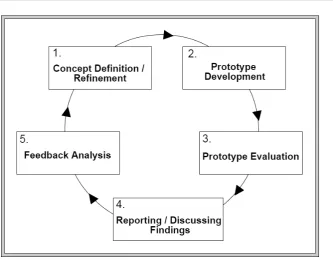
1.1 Phases of the iterative process. . . 20
3.1 The emergent software online learning problem. The way the envi-ronment changes over time is illustrated on the left. On the right, the data collected at the end of each observation window is illustrated. . . 56
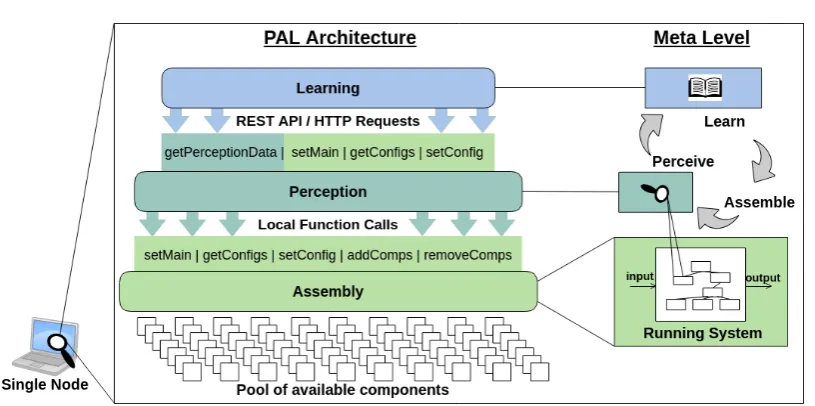
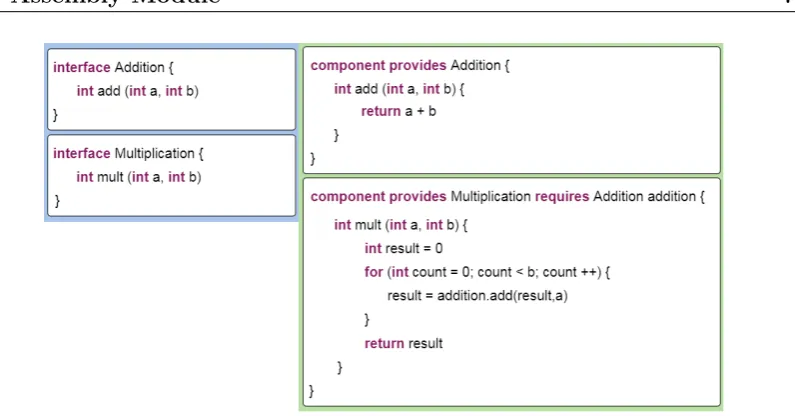
4.1 PAL framework architecture. . . 72 4.2 Example of interfaces and components. Note that Multiplication
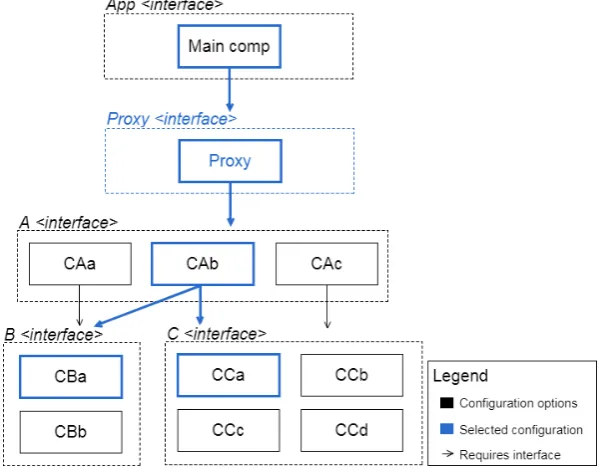
re-quires an external interface (Addition) to complete its implementa-tion. The code is written using the Dana programming language syntax. . . 75 4.3 This is an illustration of a generic architecture represented by the
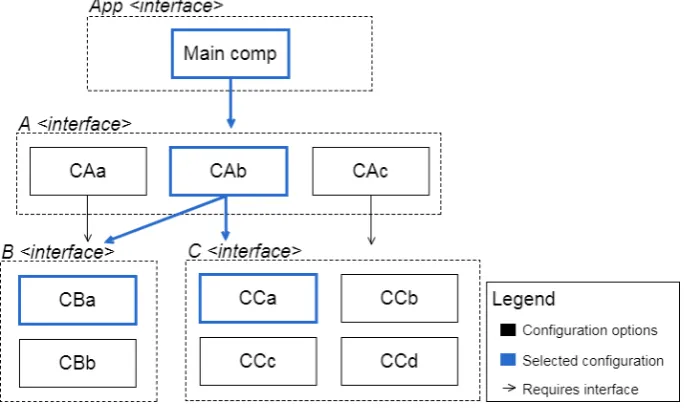
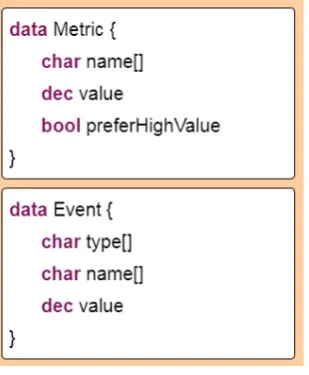
As-sembly module. This is the result of executing the AsAs-sembly module function setMain. . . 78 4.4 Metric and Event data types in the Dana programming language. . . 80 4.5 Proxy component inserted in the system’s architecture. . . 82 4.6 Feature-based strategy in action, considering the generic architectural
compositions in in Fig. 4.3. . . 93 4.7 Example of classified environments using ranges of collected Event
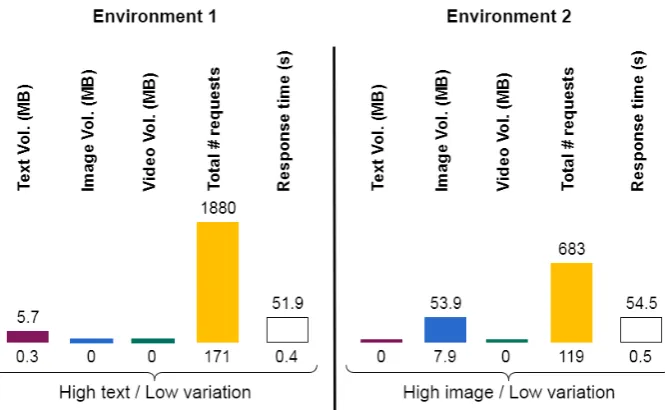
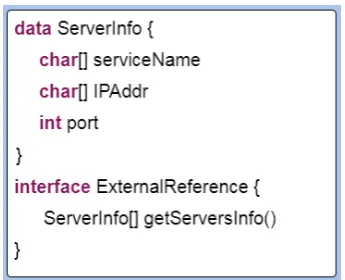
and Metric values. First environment consists of requests of large size text files with low variation. Second environment consists of large size image files with low variation. . . 94 4.8 The External Reference interface code. . . 97 4.9 The image shows the Registry information table with data about
potential services provided by nodes A, B and C. . . 98
List of Figures xii
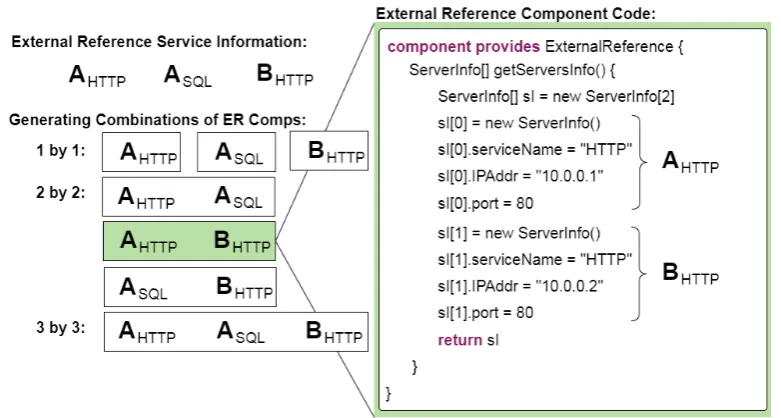
4.10 Example of resulting External Reference components. All possible components generated from services information are illustrated on the left part of the image. An External Reference component code is represented on the right. . . 100 4.11 Hierarchical topology used in the Hierarchical Coordination approach. 101 4.12 Example of exploration groups created by the Validator module. The
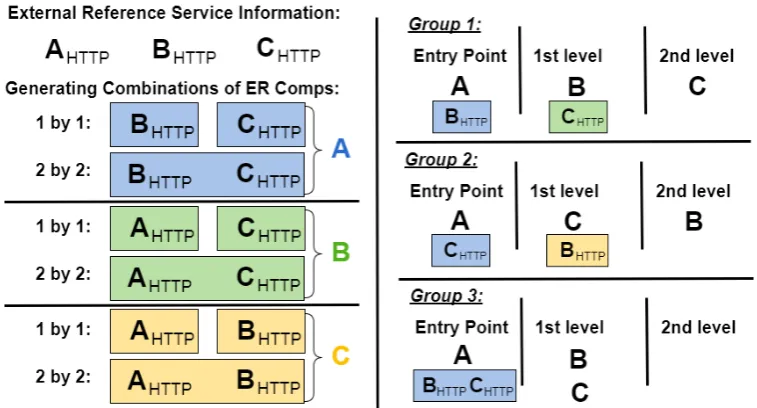
available External Reference components are represented on the left. The exploration groups resulted from the components is illustrated on the right. . . 102
5.1 Architectural representation of the web server compositions. . . 109 5.2 Ground truth: (a) small texts (∼3KB) with low variation workload
pattern; (b) small images (∼64KB) with low variation workload pattern.112 5.3 Ground truth: (a) small texts with high variation workload pattern;
(b) NASA workload trace from [1]. . . 112 5.4 Performance comparison between fixed web server architectures and
our emergent platform, using two different request patterns over time. 114 5.5 Performance comparison between two fixed web server architectures
and the emergent system framework when exposed to the NASA trace [1]. . . 115 5.6 Performance comparison between the brute-force algorithm and the
feature-based algorithm when exposed to the small text with low variation workload. . . 116 5.7 Performance comparison between the brute-force algorithm and the
feature-based algorithm when exposed to the small text with high variation workload. . . 117 5.8 Architectural representation of the load balancer and web cache
com-positions. . . 119 5.9 Unified architectural of the emergent web platform. . . 121 5.10 Average response time of every available distributed composition for
List of Figures xiii
5.11 Average response time of every available distributed composition when
using Workload 2. . . 124
5.12 Performance of our coordinated learning approach for two different workloads, compared with static baseline compositions. The spikes at the beginning of the coordinated learning curve for both workloads represent the exploration phase. . . 126
5.13 Performance of our decentralised learning approach for two different workloads, compared with static baseline compositions. The spikes at the beginning of the selfish learning curve for Workload 1 represent the exploration phase. . . 127
5.14 Performance of a web server and load balancer composition exposed to the Dynamic Workload A (a) and Dynamic Workload B (b). . . . 129
5.15 Performance convergence (60s) of the hierarchical coordination when exposed to the Dynamic Workload B. The number of valid global compositions is 5,186,160. The brute-force learning would theoreti-cally converge in 1.6 years. . . 130
5.16 Classification results: environment ranges detected for each workload. 133 5.17 Classification experiment using request patterns that are difficult to distinguish. . . 134
5.18 Classification experiment using mid-exploration workload changes. . . 135
5.19 Observation window experiments of 1 and 2 seconds. . . 137
5.20 Observation window experiments of 5, 10 and 20 seconds. . . 137
A.1 Example of architectural description. . . 161
B.1 Example of PEL expressions. . . 164
CHAPTER
1
Introduction
1.1
Overview
Contemporary software systems have reached a level of complexity that is beyond human capacity to fully understand [53]. Besides the innate complexity of software development [13], which continues to be a problem, systems are becoming larger, with millions of lines of code, and are deployed on highly dynamic and complex infrastructures, running on distributed heterogeneous platforms across the globe. In addition, these systems require high levels of scalability, reliability and security to deliver services to millions of users worldwide. Building and managing systems to maintain such properties using classical engineering approaches is becoming ineffi-cient [19,50,53]. For instance, fluctuations on incoming workload yield unpredictable resource utilisation demands and complex interactions among software modules.
In classical software engineering approaches, which do not aim at creating self-management software solutions, the design decisions are made in the design phase and often become invalid at runtime due to unpredictable fluctuations in the operat-ing environment. Furthermore, management decisions are made entirely by experts, who demand time to profile the system and analyse historical workloads to create models to predict workload changes before manually optimising the system. This scenario makes classical engineering methods unsuitable as the level of uncertainty increases in operating environments of contemporary software systems [19,32,50,53]. In this context, a desired property of contemporary systems is the ability to
1.1. Overview 15
autonomously change their behaviour to accommodate changes in the environment. This property is known as self-adaptation [76]. The most relevant idealisation of autonomous software management and its related challenges were defined by IBM in 2001 [43, 53]. The authors defined the term Autonomic Computing and moti-vated subsequent research to tackle the challenges in building systems capable of self-management. However, equipping software systems with self-adaptive proper-ties has consequences. The development of autonomic systems is very complex and they often present undesired emergent properties and behaviours [53, 74]. The com-plexity of creating self-adaptive solutions involves the development of self-adaptive mechanisms and strategies to guide software adaptation and evolution at runtime.
Current approaches handle these complexity aspects by applying adaptation mechanisms to only specific parts of the system and using predefined models and policies to guide online software adaptation. Although, this strategy to handle com-plexity in designing self-adaptive systems is a first step, it is not sufficient to cope with the increasing levels of complexity in contemporary systems. The use of policies and models to guide software adaptation rely on predictions that might not happen, leading systems to error and malfunctioning states. Furthermore, the dependence of policies might result in undesired emergent properties due to unforeseen events in the operating environment and unpredicted effects of software interactions. Finally, these predefined models and policies require upfront human effort in creating such systems, which adds to the complexity and cost in creating autonomous solutions.
1.2. Critique of Existing Approaches 16
Therefore, this thesis defines a new engineering approach where software systems are composed out of small units of behaviours, which enable the system to actively experiment with a variety of component variations in order to assemble optimal software compositions to handle different operating environments. This approach embraces the emergent properties and behaviour in systems as a way to manage software complexity, and handles undesired behaviour through a continuous runtime learning process, where the software itself learns according to high level goals, and observations of the system health status whether its composition is acceptable.
As a consequence, this approach handles the problem of system complexity by handling uncertainties in the operating environment and interactions among the software modules, as well as addressing the complexity aspects of creating self-adaptive systems by reducing the influence of humans in the design and management of software systems. This approach is named Emergent Software Systems.
The ‘emergent systems’ term is not precisely defined in the literature and is usu-ally used as a characteristic of systems with emergence properties. In this thesis, emergence means: i) to autonomously compose software from small units of be-haviour, where the resulting combination of software units is greater than the sum of its parts, ii) to autonomously compose software as a result of operating conditions, and iii) the possibility of the approach to autonomously find unexpected optimal compositions. Furthermore, our approach is intended as a method for creating Auto-nomic Computing systems and to increase their capability of self-management. This thesis discusses the proposed approach in the context of datacentre-based software.
1.2
Critique of Existing Approaches
1.2. Critique of Existing Approaches 17
The majority of self-adaptive solutions show significant levels of expert depen-dency in designing adaptive solution. These approaches usually rely on models and policies to support and guide software adaptation at runtime [48, 55]. These design decisions are made at design time which results in two main problems.
• These systems suffer from high levels of uncertainty in contemporary operating
environments [32];
• These approaches require significant upfront effort to develop [32].
The dynamism in contemporary operating environments leads systems to an error and malfunctioning state when they are subjected to events not predicted in the predefined adaptation policies. Also, as systems become larger, the task to define models to guide software adaptation becomes increasingly complex to a point where is unwieldy to manually specify all adaptation rules, making such approaches not scalable, due to increasing upfront effort required to develop such approaches [32].
Assurance mechanisms in self-adaptive systems sound very appealing at first, be-cause they promise to maintain the system within a safe operating state. However, there are two main concerns with those mechanisms. The first is that the provision of assurance to self-adapting systems is very complex. In many systems a combi-nation of valid behaviours might result in undesired behaviour, and it is difficult to anticipate such combinations before they happen [18, 32]. The second problem is the presence of controlling mechanisms to support assurance in self-adaptive sys-tems. This is because they constrain the systems’ ability to freely explore and find more suitable compositions to better handle their operating environment, limiting the benefits of incorporating self-adaptive mechanisms to the system.
1.3. Research Goals 18
1.3
Research Goals
Classical software engineering methods, which do not consider autonomous software management, are becoming inadequate as the levels of system complexity increases [53]. In this context, this thesis explores the application of self-composition concepts in the software development process, where software systems are the result of their operating environments, constantly building and optimising their own structure. More specifically this thesis aims to validate the hypothesis stated below:
The use of fine-grained software components in tandem with
reinforcement learning as a method to develop self-adaptive
software systems is key to address operating environment
dy-namism whilst minimising design complexity.
Component-based technologies [21, 70] have been demonstrated as a suitable solution to minimize software complexity by maximising software re-usability and maintainability [52]. These technologies are also the bedrock that seamlessly support runtime architectural software adaptation and evolution [21]. Complementarily, the application of reinforcement learning approach [79] allows systems to learn at run-time how their constituent parts act in diverse environments. In tandem, these two technologies have the potential to empower systems with the ability to understand their architecture and choose compositions depending on the operating conditions.
This work presents an engineering approach to software development and man-agement that transcends the boundaries of current self-adaptive and autonomic computing approaches. Furthermore, this thesis demonstrates the feasibility of cre-ating software capable of actively building its own understanding of its architecture whilst self-optimising according to its goals and operating environment. As these systems are autonomously composed as a product of their operating environment, this concept is named Emergent Software Systems.
1.4. Methodology 19
composition for the different operating environment with no predefined models or domain-specific information. This thesis shows the validity of Emergent Software Systems in both local and distributed instances. The validation steps unfold into the following research questions:
[RQ 1] Do different software compositions have different performance when subjected
to different operating environments?
[RQ 2] Is it possible to autonomously locate optimal software composition (within a
set of available options) with no predefined nor domain-specific information?
[RQ 3] How can an autonomous system coordinate multiple instances of emergent
software to converge to optimal available global compositions in distributed settings?
1.4
Methodology
The methodology used to conduct this research is a prototyping, experimental-driven and iterative approach. This approach was chosen for two main reasons: i) developing prototypes and designing experiments often forces one to consider important technical limitations, which otherwise would not be considered, that may directly affect the validity of the proposed concepts, and ii) an iterative methodology suits the explorative nature of defining the novel concepts presented in this thesis.
The methodology consists of executing the steps illustrated in Fig.1.1. The first step is the definition of a concept or idea for investigation (1. Concept Definition / Refinement), the proposed concept is then implemented (2. Prototype
cre-ation) and evaluated (3. Prototype Evalucre-ation). The results of the evaluation
are discussed with supervisors and research group and, if considered relevant, are written in the form of scientific paper and submitted to a high quality conference of the area (4. Reporting/Discussing Findings). The feedback from the discussion phase is then analysed (5. Feedback Analysis) and the original idea or concept is refined, triggering subsequent iteration for further investigation.
fundamen-1.4. Methodology 20
Figure 1.1: Phases of the iterative process.
tal concepts that form the basis of Emergent Software Systems focusing only on the autonomous composition of a single software instance. The second scenario explores Emergent Systems consisting of multiple interacting software instances, exploring learning coordination and emergent behaviour in distributed emergent systems.
The first step of this research was to define datacentre-based software as the case study. Specifically, web servers were chosen as the primary target to apply Emergent Software System concepts, due to their timely importance in contemporary systems, which are in their majority web-based systems and because of the notable difficulty in manually optimise and configure them [87].
1.5. Contributions 21
1.5
Contributions
The main contributions are i) the proposal of the Emergent Software System con-cept overcoming significant human dependency in creating self-adaptive systems, and ii) the validation of the concept, showing that different software compositions have different performances under different operating conditions, and that emergent systems are able to autonomously converge towards optimal performance. The pro-posal of the Emergent Software System concept is the result of extensive practical experiments using real-world datacentre-based software, making it a concept deeply grounded in reality. In addition, this thesis demonstrates the potential of emergent systems approach by minimising human efforts in creating autonomous systems, through a complete automated creation and evolution of systems’ adaptation logic. More specifically this thesis:
• Presents a list of key challenges in realising Emergent Systems, whilst also
presenting solutions to the most important identified challenges. This the-sis presents solutions to: i) handling large search spaces resulted from the combinatorial nature of the autonomous software composition process, ii) on-line classification of dynamic operating environments, and iii) coordination of software composition and learning in distributed systems environment.
• Introduces a domain-independent framework to orchestrate Emergent Software
Systems. The framework captures the essence of Emergent Software System in its main modules that are used to autonomously assemble software systems, monitor the operating environment and the systems health status, and learn about the systems operating environment and the systems constituent parts, with no predefined models or adaptation rules. The framework implementation is also made available for replication of the main results reported in this thesis, and can be downloaded at [33], [34], [35] and [36].
• Argues for a paradigm shift in the autonomous software creation process, by
1.6. Thesis Structure 22
rather than the main focus for creating autonomous solutions. This paradigm shift is at the core of Emergent Systems, and reduces the up-front effort and complexity involved in designing autonomous solutions, by pushing design de-cisions to be made at runtime by the system itself.
• Applies the concept of Emergent Systems to create a complete emergent web platform. The emergent web platform does not require the classical process of optimising web platforms, which consists of: expert analysis of historical work-load, profiling the web platform, the creation of models to predict workload changes, and a manual tuning of parameters of web servers, load balancers and web caches. Instead, the emergent web platform composes and self-optimises based on real-time observed workload.
1.6
Thesis Structure
The rest of this thesis is structured in the following manner:
• Chapter 2 discusses the background for this thesis and presents a
compre-hensive analysis of recent and most relevant work in the literature.
• Chapter 3 defines the concept of Emergent Software Systems, describing the
problem space and challenges of implementing the concept.
• Chapter 4introduces the Emergent Software System framework, detailing the
implementation of each of its modules and presenting the solution for the most important challenges described in the problem space (listed in Chapter 3).
• Chapter 5 evaluates the framework presented in Chapter 4 applied to a web
platform case study, demonstrating the practicality of Emergent Software Sys-tems in both local and distributed software instances.
• Chapter 6 concludes the thesis, highlighting the main contributions, and
CHAPTER
2
Background and Related Work
This chapter introduces the main concepts discussed in this thesis, whilst also de-scribing the most relevant work as application examples of such concepts. Further-more, this chapter presents the shortcomings of current approaches contrasting with the concept of emergent software systems, as well as how these approaches comple-ment and assist emergent software system to be consolidated as a complete method to develop autonomous solutions.
2.1
Autonomic Computing
This section describes the Autonomic Computing concept and vision, and its impor-tance for understanding the novelty and contribution of Emergent Software Systems. This section starts by presenting the IBM vision for Autonomic Computing to tackle the increasing complexity in managing software systems. The concept of Organic Computing is also introduced in this section as a complementary research area that focuses on autonomous system solutions. Organic Computing solutions also aims at controlling the interaction of multiple autonomic systems to guide emerging solu-tions whilst restraining the occurrence of undesired behaviours. Finally, the concept of self-adaptive systems is also introduced as an umbrella term for autonomous sys-tems, and as a fundamental property to enable different aspects of autonomous systems (e.g. self-optimising, self-healing, self-protecting, self-configuring).
2.1. Autonomic Computing 24
2.1.1
IBM Vision
Motivated by the increasingly complexity in contemporary systems, IBM introduced the concept of Autonomic Computing [53] in a manifesto in 2001. Contemporary systems are characterised by their large size and their interconnectivity with other large systems. This scenario requires skilled software experts to install, configure, tune and maintain such systems. In [53], Kephart and Chess argue that these systems were reaching the limit of human capacity to adequately address managing tasks and to timely react to unexpected events from the systems. Thus, inspired by the autonomic nervous system in human beings, the Autonomic Computing vision aims to enable systems to self-manage based on goals defined by administrators.
2.1. Autonomic Computing 25
in ‘The Vision of Autonomic Computing’ paper (see [53]). The main challenges in-volve the life-cycle of autonomous systems which comprehends systems design, test, management, monitoring and upgrading systems. The management of interactions among autonomous systems which includes defining services provided and required by autonomous systems, services discovery and negotiation of providing services to multiple autonomous entities. Another challenge is the definition and represen-tation of global system’s goals which represent the interface between humans and autonomous systems. Also, learning and optimisation techniques exploring and ad-vancing the state-of-the-art in machine learning techniques and statistical and prob-abilistic models to support system adaptation. These challenges are still in debate in the related scientific communities with promising solutions and future directions.
2.1.2
Organic Computing
The Organic Computing research initiative started in Germany with the focus to address and explore the self-organisation in technical software systems, inspired by neuroscience and molecular biology concepts and software engineering [77, 82]. Originated around the same time as the Autonomic Computing vision, the Organic Computing initiative also focused on the problem of having multiple instances of in-teracting autonomous systems, which may result in conflicts and undesired emergent behaviour affecting the resulting system [77].
2.1. Autonomic Computing 26
behaviours resulted from unpredicted interactions among systems devices.
Given this scenario of interacting autonomous systems, several studies were con-ducted to validate multiple controlling mechanisms that could be used to prevent undesired emergent behaviour in a variety of scenarios [62, 74] as well as to address further aspects (self-* properties) of autonomous systems [16, 40]. These studies are described in Sec 2.2.5, and later contrasting with the concept of Emergent Systems.
2.1.3
Self-adaptive Systems
The term ‘self-adaptive systems’ are usually used as an umbrella term, by different research communities, to refer to the systems ability to change its structure to ac-commodate changes. Whereas in distributed environments the term ‘self-organising systems’ is frequently used to refer to systems capable of reorganising its distributed architecture to cope with changes and achieve global system goals. In order to build systems that are capable of self-organising and self-adapting, the system requires the definition of an adaptation logic to guide software adaptation, the imple-mentation of adaptation mechanisms to propagate changes to the actual system structure, and coordinationamong the system nodes to ensure a coherent change and convergence towards global system goals.
The adaptation logic is responsible to capture the knowledge that allows the
system to detect events of interest and decide its next course of actions, which include the decision to maintain the system in its current state or to adapt to another config-uration. The adaptation logic can be represented in different forms: the policy-based approaches, which represent adaptation logic using expertly-crafted rules defined in the design phase; mode-driven approaches, which apply models representing system properties, QoS traits, system architectures, system goals and equations that sup-ports runtime reasoning and adaptation; and bio-inspired algorithms are used to encode adaptation logic imitating behaviours found in nature, e.g. ant-colony.
The adaptation mechanisms are responsible to propagate changes in the
com-2.1. Autonomic Computing 27
pared to architectural, because it can only change the system within a predefined range of parametric values. The architectural adaptation approach allows the sys-tem to change its structure by replacing components or changing its architecture pattern to maintain system properties (e.g. to use a load balancer architecture to maintain performance or to replicate services to cope with system failures). The architectural adaptation allows profound changes in the system, making it more flexible to cope with changes in the operating environment.
In a distributed scenario where multiple autonomous entities, with individual goals and capable of making their own adaptation decisions, are interacting with each other, it is important to create mechanisms to ensure that the system achieves its global goals whilst maintaining non-functional requirements. Thecoordination
of software adaptation is key to ensure a coherent adaptation of distributed
systems and convergence towards a common global system goal. Many approaches for coordinating adaptation were investigated in the multi-agent research community where the autonomous entities (agents) sought cooperation and consensus in order to make decisions to converge the system towards the global desired behaviour. Some approaches use voting schemes, action predictions, and other consensus schemes.
2.2. Self-adaptive Approaches and Mechanisms 28
2.2
Self-adaptive Approaches and Mechanisms
This section surveys relevant work that illustrates different aspects of developing self-adaptive solutions. The works described in this section represent a compre-hensive survey of techniques to support reasoning and planning for self-adaptation and change propagation throughout the actual software structure and configura-tion. Moreover, these works are evidence of the shortcomings and limitation of current approaches, as well as illustrations of the design process of current auto-nomic computing solutions. Some approaches are complementary and may assist further development and consolidation of the emergent software paradigm.
The first two subsections are divided to showcase approaches that use i) static policies and ii) model approaches as different techniques to represent systems adap-tation logic, which is responsible to support reasoning and decision making in the adaptation process of the system’s behaviour and structure. These two aspects of software adaptation is described in Sec. 2.2.1 and Sec. 2.2.2 respectively, along with a description of the adaptation mechanisms that the presented works apply to ensure changes in the actual software structure. Furthermore, Sec. 2.2.3 introduces the concept of reinforcement learning and discusses how this learning paradigm has been used in self-adaptive systems. Sec. 2.2.4 describes relevant examples of multi-agent systems, illustrating how multi-agents are used to autonomously organise systems, and to autonomously coordinate distributed adaptation to achieve global systems goals. Sec. 2.2.5 presents relevant work implementing assurance and controlling mechanisms to avoid undesired emergent behaviour. Finally, Sec 2.2.6 describes bi-ologically inspired approaches that are used to solve a variety of optimising problems, including problems in the context of self-adaptive systems.
2.2.1
Policy-driven Approaches
2.2. Self-adaptive Approaches and Mechanisms 29
or operating conditions and make the system aware of what software configuration it should change to in case those conditions are detected. Some approaches implement very straightforward and static rules not leaving room for autonomous reasoning and decision making in the process, as described in [48], and other approaches, such as in [55], the software engineers describe adaptation rules in terms of logic expressions, which allow a small level of reasoning in the adaptation process.
The most relevant example of manually crafted rules to guide software adaptation is described in [48]. The work applies component-based technologies to introduce the concept of open overlays into middleware architectures. The open overlays con-cept supports the configuration and reconfiguration of network overlays allowing a flexible composition of virtual network resources and services at runtime. The pa-per describe a series of fine-grained software components that are used to compose overlay-related behaviour in wireless sensor network nodes at runtime, guided by predefined declarative XML-based expressions. These expressions are used to de-fine rules that are processed at runtime to determine the most appropriate overlay behaviour for the system. For instance, a rule can be created for the case where ‘mul-ticast’ is requested by the application (which represents the system goal), stating that in those cases when the underlying network infrastructure provides no support to IP multicast (which represents the software state or environment condition), then the Tree Building Control Protocol (TBCP) overlay components should be selected (which represents the desired software configuration). This work is a very relevant example of a rule-based approach as a way to express the adaptation logic and guide software adaptation at runtime, and it applies component-based technology to compose and adapt software as the system executes.
2.2. Self-adaptive Approaches and Mechanisms 30
different manners, for instance by using GPS, or by using WiFi as a location-aware device, or using a combination of both GPS+WiFi. The different compositions have different effects in the non-functional properties of the system, e.g. energy consumption and accuracy. The approach requires the definition of the systems configuration and reconfiguration in the design phase. These static policies define the events and temporal requirements responsible to trigger software adaptation, as well as the configuration to which the system will adapt. The mechanism used to propagate changes to the actual software is also realised through a component-based runtime. The authors apply the Fractal [14] component-based model, a well-known framework that supports fine-grained and runtime component adaptation.
These policy-driven approaches are very effective when all system state are well known a prior and the deployment environment are fairly static. For that reason these approaches were used in early examples of self-adaptive solutions. Due to the high levels of dynamisms in the operating environment of contemporary applications, the static policy-driven approach is not adequate to support the required levels of flexibility in the software adaptation process. In case where the system suffers from fluctuations in the workload or unexpected failures in the underlying structure, these systems are not be able to react accordingly and accommodate the changes in a timely manner, leading the system to malfunctioning or degraded performance.
2.2.2
Model-based Approaches
Model-driven approaches are engineering techniques widely used to tackle software complexity, specifically in the development and adaptation of large software sys-tems. These approaches use representations of systems in an abstract and simplified form, supporting autonomous reasoning of the system state and facilitating runtime optimisation of large systems. In particular, there are three main situations in which models are used to tackle software complexity and are briefly introduced.
2.2. Self-adaptive Approaches and Mechanisms 31
abstract/simplified representation allows runtime reasoning of the system state, sup-porting decision making that enables system adaptation. Finally, models are used to guide software adaptation at runtime, through code generation techniques or command interpretation to change the running system architecture.
The model-driven approaches represent the majority of work that support self-adaptation. In the literature, there are a variety of models capturing different aspects of software and domain information used to support autonomous software adapta-tion. These models, as opposed to expertly-crafted policies, support more elaborate autonomous reasoning of the software state and its configurations, enabling a wider range of more complex adaptation possibilities.
This section categorise different model-based approaches considering the con-tent that is represented by the models. This categorisation method yielded three categories that capture well the variety of model-based approaches to support self-adaptive solutions. The first category is‘domain-specific and system-representative models’, which considers models that either capture domain-specific information or the representation of the system itself and are used to support online reasoning of the system state and adaptation. The second category is ‘predefined analytical models’ and refers to models that capture in formal manner the adaptation process, for example by using mathematical equations. Finally, the third category is the
‘autonomously generated analytical models’, representing the leading approaches to support software adaptation, consists of models that capture the adaptation process in a formal manner, but require less up-front engineering effort in specifying models. These categories were designed not only to show the variety of ways to use models to support adaptation, but also to showcase the progression of how model-based approaches tackles the challenges of supporting system adaptation.
Domain-specific and System-representative Models
The domain-specific and system-representative models require the definition of mod-els in the design phase that capture the system state, domain-specific information, the system goals or QoS traits and models that correlate all these informations.
self-2.2. Self-adaptive Approaches and Mechanisms 32
adaptive systems. This is built on the core idea that there is no one-to-one mapping between requirements and solutions, and that alternative solutions to satisfy the system requirements impact systems properties in different ways. The approach requires two manually crafted models. One representing the system goals, and the other representing the architecture design decisions captured in the form of a decision tree. The goal model captures all systems requirements, both functional (goals) and non-functional (softgoals) and their correlation. The goals in the model are connected to tasks which are in turn connected to architecture design choices capable of carrying out the tasks. One requirement is often connected to multiple alternative goals, meaning that at least one of the goals must be satisfied in order to satisfy the requirements. This alternative relation between goals gives the system the choice of how to satisfy its requirements by selecting the goals it will satisfy. Considering that each goal is attached to a different task, by selecting a set of new goals the system is selecting a different architecture configuration responsible to achieve the new set of goals. The system considers its monitored information to decide what goals to satisfy and consequently what architectural configuration to choose in order to maintain system properties and the quality of service provided. The result is the generation of a incrementally transformed models of the current running architecture, which can be used to adapt the actual system. This work is a relevant example of using models to reason about the systems operational profile and make software adaptation decisions. This paper focuses solely on its goal-oriented requirement model and architecture design decision model to support adaptation, not advocating in favour of any mechanism to conduct adaptation in the actual system. The paper mentions that once the adapted architecture model for the system is generated, architecture-based management middleware can be used to propagate changes to the actual system. Component-based models and service-oriented adaptation techniques are suggested as adaptation mechanisms.
2.2. Self-adaptive Approaches and Mechanisms 33
and software adaptation patterns to compose and evolve service-oriented architec-tures. The ‘QoS architectural patterns’ model, for instance, correlates QoS metrics to architectural decision. For example to increase fault-tolerance the system should replicate services, or the system should opt for a load balancer architecture to in-crease throughput. The adaptation pattern, on the other hand, is an analytical model that specifies how an architectural pattern influences QoS metrics of interest, serving as a bedrock to system online adaptation. This work is an important and rel-evant example of the upfront effort required to create models to abstract systems to support online adaptation. This work is classified in model-driven approach, where static analytical models are defined in the design phase to support and guide adap-tation at runtime. The approach uses architectural patterns for service composition, and selection of service providers to compose and adapt system at runtime.
2.2. Self-adaptive Approaches and Mechanisms 34
level commands, it is still very human-centric. The technical concepts that make up IMs, for instance, are predefined and manually crafted, in other words, humans define the range of possible execution paths that the system can choose from at runtime, there is no online learning and consequently knowledge are not created and new/unpredictable paths of executions are not encountered. Furthermore, this approach does not have any embedded autonomous decision making process, relying solely on domain-specific models to guide software adaptation at runtime.
Predefined Analytical Models
A different type of model used to support software adaptation is the analytical models. An analytical model can represent the system, the system’s goals or the system’s domain concepts, however, this section details two examples of models that mathematically captures the knowledge used to conduct software adaptation.
2.2. Self-adaptive Approaches and Mechanisms 35
the design phase and are composed of a set of difference equations that capture the systems adaptation logic, supporting decisions based on monitored information frequently collected from the system, and acting accordingly to fluctuations of the workload and predefined desired delays. The adaptation mechanism for the system is responsible to change the allocation policy of incoming requests, not having to change structural details of the server (e.g. architectural adaptation) but rather performing parametric changes to the connection scheduler (component responsible to allocate incoming connections to executing threads). This work is classified as an example of applying control-theory in creating a static predefined adaptation logic, and to use parametric mechanisms for system adaptation.
2.2. Self-adaptive Approaches and Mechanisms 36
mechanism for the system implementation (e.g. replacing architectural components or changing systems parameters). This approach enables structural system changes by replicating and placing stored content across different memcached servers.
These predefined analytical models require a deep and complex analysis of the systems conditions and external environment to define the models. This condition makes this approach unwieldy to implement, demanding a considerable effort in deducing models to realise the system.
Autonomously Generated Analytical Models
As a response to the complexity and upfront analytical effort demanded from the predefined analytical models, which make these approaches highly complex to alise, recent approaches explore the autonomous development of these models, re-ducing the complexity of realising such approach and facilitating the development of complex self-adaptive systems.
2.2. Self-adaptive Approaches and Mechanisms 37
have two phases, the first phase profiles the system and generate a linear model of the system, it then uses that model to synthesise the system controller, creating a set of differential equations to control the self-adaptive software. Online model updates are also considered in this approach, which allows the system to re-synthesis controllers adjusted to new operating conditions. This approach is classified (for the purpose of this thesis) as ‘dynamic’, regarding the dynamic synthesis of the adaptation logic, and as ‘parametric’, considering the adaptation mechanisms.
2.2. Self-adaptive Approaches and Mechanisms 38
parts of the system, and to establish correlations between features and goals. The ‘analytical model’ approach captures the complexity and nuances required to guide software adaptation at runtime in dynamic and uncertain environments. However, creating analytical models requires substantial effort. The presented ‘Au-tonomously Generated Analytical Models’ is a way to mitigate this problem. This approach enables automated learning or deduction of analytical models with min-imum human involvement. This autonomous model generation facilitates the real-isation of complex self-adaptive software, whilst supporting the evolution of such models as new operating conditions emerge.
2.2.3
Reinforcement Learning in Self-adaptive Systems
Reinforcement Learning is a learning paradigm in which an agent learns to correlate a set of actions to reward values [75, 79]. An agent, in this context, can be defined as a software that is capable of executing actions and collecting rewards as a conse-quence of the performed actions. This learning paradigm allows software systems to learn, at runtime, whilst the system interacts with the environment, which actions and in which order will yield maximum reward values. This characteristic of this learning paradigm applied to self-adaptive systems enables the system to learn the adaptation logic as it executes, driving software adaptation at runtime, and evolving its adaptation logic as the system encounters new, unforeseen situations [4, 54].
Several papers on self-adaptive systems that apply reinforcement learning algo-rithms in the adaptation process, such as [4], or any machine learning algorithm for that matter [30, 57, 88], focuses on parametric adaptation. Parametric adaptation consists of changes in software parameters as if the system were a black box with dials. In this context, the system is only capable of adapting within a predefined set of values/actions, limiting the capacity of reinforcement learning algorithms to learn beyond the actions that was established by experts in the design phase.
2.2. Self-adaptive Approaches and Mechanisms 39
the system and the learning algorithm to be re-evaluated and re-defined.
In [54], Kim and Park demonstrate the application of Q-learning, a well-known and widely used reinforcement learning algorithm, to architectural change in a robot simulation case study. This is one of the earlier and most representative examples of the direct application of reinforcement learning to build and evolve adaptation logic in self-adaptive systems. The paper describes how to create learning tables with actions and systems states, detailing a method that can be followed to apply Q-learning to self-adaptive systems. The paper ends with an evaluation of the application of reinforcement learning to robot simulations, showing that a robot that applies such approach can successfully learn and evolve its adaptation logic.
The main limitation of applying reinforcement learning to self-adaptive systems in the literature is the lack of abstraction of actions and state for the machine learn-ing algorithm. As papers such as [4,54] illustrate, reinforcement learnlearn-ing algorithms are applied to self-adaptive systems to optimise software in specific domains, with a predefined set of actions observable in specific case studies. This shows high levels of human dependency to define, for each application domain, the set of actions and states on which the learning algorithm will be developed upon, limiting the potential and generalisation of reinforcement learning approaches in self-adaptive systems.
This thesis argues that in order to fully enable learning and evolution of the adaptation logic of software systems, it is required to i) apply reinforcement learning to the composition process of systems, and ii) ‘abstract’/remodel the system to be easily handled by machine learning algorithms. The proposed Emergent Systems concept demonstrates how these two points can be realised by unifying component-based model and reinforcement learning algorithms.
2.2.4
Multi-agent Approaches
2.2. Self-adaptive Approaches and Mechanisms 40
to combine themselves to autonomously compose algorithms.
In order to support a coherent adaptation process to achieve a global desired behaviour in distributed self-organising systems, a key problem is the creation of coordinating mechanisms of the adaptation process. An easy solution for this prob-lem is the creation of a centralised decision making entity that has a global view of the system and thus can provide a better support for a global system adaptation. However, the centralised coordination approach provides a single-point of failure and hinders scalability, not being able to support a system with large numbers of agents. On the other extreme side of the spectrum lies the complete decentralised decision making process, where each agent adopts an adaptation plan according to its local conditions and demands. Although this approach is extremely scalable, it often makes the system converge towards local optimal configuration which might not satisfy the global system requirements. Moreover, in a competitive scenario, i.e. where agents might compete for resources or service provision, this type of solution may lead to agent’s resource starvation and disruption of services. A reli-able self-organising processes require an intermediate solution that supports agent coordination in the adaptation process.
2.2. Self-adaptive Approaches and Mechanisms 41
actions of an agent’s neighbourhood (a network of agents defined by proximity) by understanding how they react to certain events, and then use that knowledge to approximate and converge their interactions.
A key property of multi-agent systems is their ability to implement emergent behaviour. An important examples of this is in the paper [44], where the authors present an emergent programming platform supported by multi-agents to enable emergent software design. The paper proposes a multi-purpose programming lan-guage where the instruction set is composed of autonomous agents. The instruction-agent compose fully functioning computer programmes by partnering instruction-agents. The agents link to other agents from which data are received, and to which data are sent, forming an execution flow as data is received from one instruction-agent and passed down to another instruction-agent. This approach enables an autonomous agent-based software design and composition by having the agents try different in-structions combinations to create the desired behaviour.
2.2.5
Assurance and Controlling Mechanisms
2.2. Self-adaptive Approaches and Mechanisms 42
system goals and uses the system status collected from the observer module to influence the underlying system, in order to maintain it within the system goals. As an adaptation system, the observer/controller architecture expects that the system is implemented as a multi-agent system, and changes are done by changing networks of agents that can influence its ‘neighbourhood’ and have global system impact. This approach illustrates the goals of the organic computing research community, and presents a theoretical architecture to support the concept. The architecture implements a feedback loop to avoid undesired emergent behaviours whilst guiding systems changes, based on user-provided goals and system representative models.
In the paper [62], the authors present a variety of evolutionary computing (i.e. genetic algorithms and genetic programming) techniques to mitigate uncertainty in designing self-adaptive solutions and increase assurance in the adaptation process. The paper suggests the application of evolutionary computing in different stages of the software life-cycle to tackle uncertainty. For example, in the development time, evolutionary computing techniques can be used to assist program development by evolving algorithms to be more robust when facing diverse operating conditions. This process is done by having potential algorithms as individuals, and the desired high level behaviour as the selective filter used to guide the evolutionary process. This process can be used to generate software variations capable of addressing dif-ferent operating conditions. The advantage of this method is in its ability to find solution autonomously for complex problems and optimise them for specific operat-ing conditions. A disadvantage of this approach is that it requires software engineers to know details of the operating environment in the design phase.
McKinley el al. [62] also present the exploration of potential operating conditions that system might encounter after deployment. The described approach generates operating conditions used to simulate system variations. The results of the simula-tions are then recorded, showing how the system performed in different condisimula-tions. The recorded data is then captured as an utility function for requirement monitor-ing after the system deployment. This solution is only effective in cases where the generated conditions match a high number of real operating conditions.
2.2. Self-adaptive Approaches and Mechanisms 43
runtime monitoring problems. A system with a high frequency monitoring process provides a more precise picture of the system state, which in turn require more resources to support the monitoring process. The paper mentions an genetic algo-rithm approach that balances resource consumption and online monitoring accuracy to support better decision making in the adaptation process. Finally, the authors describe the use of evolutionary computing to address the selection of adaptation paths when the system presents multiple intermediary configurations with different requirements impact, enabling optimisation considering conflicting requirements.
These approaches demand the involvement of domain experts to define the sys-tem’s acceptable conditions, limiting the potential of autonomous system to freely explore and find unexpected optimal configurations for the operating conditions. Also, in certain scenarios, such as in self-driving vehicles, it is extremely hard to predict and create the proper assurance mechanisms to avoid undesired behaviour.
2.2.6
Biologically Inspired Approaches
Biologically inspired approaches are often used in optimisation problems. These approaches encode behaviours found in nature in algorithms to solve optimisation problems. A very popular example of this approach is the ant-colony where agents imitate ant behaviour in finding food by leaving a trail of pheromone that other ants can sense [27]. A great variety of papers explored the application of such methods in a variety of problems such as the travelling sales [28], vehicle routing [42], graph colouring [20] and project scheduling [63]. Another popular example of this approach is evolutionary computing [31]. This concept applies the basic idea of biological evolution to solve problems. This approach defines a population of individuals, then randomly insert genetic variations into the population and submit them through a selective process eliminating some individuals and leaving the fittest according to a selection function. The remaining individuals are used to build the next generation of individuals that go through the process again.
2.3. Overall Analysis 44
and adaptation of web services. Another examples is described in [73] the used of evolutionary computing to predict in the design phase the operating environment that the system will be facing and how the diverse available software configurations would best suit different environment maintaining desired QoS levels.
2.3
Overall Analysis
The proposed Emergent Systems concept unifies component-based models and re-inforcement learning approach to push design decisions to the software architecture at runtime. This concept also aims to eliminate human involvement in creating rules and models to guide software adaptation at runtime. In this sense, this con-cept provides a framework to support systems to create its own understanding of its environment and constituent parts. This concept is described in Chapter 3 with a detailed description of the problem space. This section revisits the presented approaches and contrast them to the concept of Emergent Systems. Finally, this section is concluded with a table, summarising the presented approaches, illustrating the gap in the literature which the concept of Emergent System aims to address.
Policy-driven Approaches
The Emergent Software System paradigm differs from the expertly-crafted policy-driven approaches by having the system learn its own adaptation rules. As part of the learning process, the system learns how the available different software compo-sitions are used in the detected operating conditions as the system executes. The Emergent Software System approach, as alternative, reduces the engineering effort and discards expert knowledge to create adaptive systems. The resulting system is also able to cope with high levels of dynamism in the operating environment.
Autonomously Generated Analytical Models
2.3. Overall Analysis 45
runtime, rather than offline training the system. The online learning approach in tandem with a component-based model is fundamental to enable software to build its own understanding of its environment and structure, being able to evolve and cope with high levels of uncertainty and dynamism in the operating environment, representing a step beyond current approaches.
Reinforcement Learning in Self-adaptive Systems
Reinforcement learning is at the core of the proposed concept of Emergent Soft-ware Systems. Its role in the proposed concept is to support runtime learning and evolution of the adaptation logic in autonomous systems, with minimum human intervention. However, the state-of-the-art application of reinforcement learning al-gorithms in self-adaptive systems suffers from the lack of an autonomous method to abstract state and actions necessary to implement these algorithms. This is mainly because software systems have an infinite set of states and actions, and the ex-traction of the ones that have the most impact on system’s goals requires domain specific knowledge. The key difference of the work in the literature and the proposed approach is to change the paradigm from having human-selected actions to provide self-adaptation, to defining only one action: deciding if a set of components should be in or out of the software architectural composition. By changing the paradigm from self-adaptation to self-composition, this thesis aims to generalise and abstract autonomous software composition using the reinforcement learning paradigm.
Multi-agent Systems
sys-2.3. Overall Analysis 46
tem, components is not seen as agent because they do not hold a particular goal. The components only perform very specific tasks. The Emergent Software System concept implements a meta-structure through which software is composed and op-timised as it runs, maintaining the target software functioning despite its ability to freely explore among composition variants.
Assurance and Controlling Mechanisms
Assurance and controlling mechanisms are often considered a desired property in autonomous systems. These techniques require the provision of information pre-dicted by engineer expert in the design phase, or controlling mechanisms to guide system to maintain a correct behaviour. This technique often makes the system vulnerable when unpredicted events emerge, leaving the system in unknown states. In the Emergent Software System paradigm, however, the system is a product of its operating environment, being composed as a consequence of the perceived operating conditions. This characteristic gives emergent systems the ability to learn how to respond to changes, and how to deal with unexpected situations.
Bio-inspired approaches
2.3. Overall Analysis 47
Other Related Work
The Autonomic Computing area is vast and multidisciplinary, spreading through diverse disciplines such as Artificial Intelligence, Software Engineering, Distributed Systems, and so on. Because of this multidisciplinary characteristic, many research communities use their own concepts and techniques to propose systems with self-* properties. Many of these works use different taxonomy to express and describe their contributions and methods. Although, previous sections already present the main articles carefully selected to clearly show the gap that this thesis addresses, for completeness, this section describes other articles that complement this narrative.
On the mechanisms of self-adaptation and propagation of changes in the soft-ware structure, some work such as [8, 9, 49] use (micro)services to support softsoft-ware composition and self-adaptation. Works such as [15, 29, 58, 66], as opposed to use inflexible orchestration, create choreographies that are enacted at runtime to com-pose and integrate distributed systems. Furthermore, articles such as [10, 11, 23, 81] describes models, languages used by experts to express goal-oriented self-integration systems in an autonomous setting. Although, these articles illustrate a different per-spective (goal-oriented self-integration and composition), they still fall within the previously defined sections, where autonomous systems rely on rules, and models mainly defined at design phase to implement their self-* properties.
Another relevant class of work that tackles engineering and management of com-plex system is described in [12, 24, 41]. These articles apply the concept of holons to create a goal-oriented model for engineering autonomous systems. These works are highly complimentary to the work presented in this thesis, since they provide ways to express high-level goals to guide system integration and composition that can be used in the context of Emergent Software System concept proposed.
2.3. Overall Analysis 48
address energy efficiency [84]. These are very relevant and important work that take advantage of machine learning techniques to be able to keep up with the speed of changes in CPU architectures, GPU architectures and datacentre infrastructures. However, the application of machine learning, or languages that define adaptation options in the design phase have different challenges than applying reinforcement learning techniques at runtime, specially to learn and evolve adaptation logic of self-adaptive systems. The problem space of online learning applied to self-adaptive systems, which is the main focus of this thesis, is fully presented in Chapter 3.
State of the Art and Research Gap
The realisation of self-adaptive solutions require the development of an adaptation logic, adaptation mechanisms and often a coordination strategy (in distributed con-texts). Analysing the presented work in this domain with regards to adaptation logic creation and evolution, a research gap is identified in the literature, which is illustrated and summarised in Table 2.1. The table shows the lack of work address-ing the entirely autonomous creation and evolution of adaptation logic, which would enable the development of solutions capable of addressing the high levels of uncer-tainty commonly presented in developing adaptive solutions (as described in [19]). Furthermore, the creation of systems able to autonomously develop their adaptation logic would reduce the engineering efforts of developing autonomous solutions.
2.4. Summary 49
None Manual Hybrid Automated
(offline)
Automated
(online) None Manual
Partially Automated
Completely Automated
Grace, et al
[48]
SASSY [61]
Netkv [86]
FUSION [32]
Preisler, et al.
[72]
Georgé, et al.
[44]
Ramirez, et
al. [73]
Emergent
Systems
Work
Aspects Adaptation Logic Definition Adaptation Logic Evolution
Table 2.1: The table shows a gap in the literature, with a lack of approaches that enable both autonomous creation and evolution of adaptation logic with no human involvement.
approach is not able to ‘remember’ optimal solutions for previously seen situations, having to search for solutions even when previously seen conditions occur.
The Emergent Software System paradigm differentiates itself from all these ap-proaches by incorporating an online reinforcement learning approach to compose software systems. This strategy is a step beyond current approaches and reduces the effort of creating the system, enabling the system to build its own understanding of its components and operating conditions (i.e. its adaptation logic). Furthermore, the main focus of Emergent Software solutions is in self-composition instead of self-adaptation. As a consequence of this change of focus, the Emergent Systems paradigm is expected to create software solutions capable of handling the increas-ingly complexity of software systems by postponing decisions that are commonly made in the systems design phase, pushing software composition and design deci-sions to be made at runtime whilst the system is exposed to operating conditions.